
Bama’s shot at revenge, high stakes in the ACC and the 29 biggest games of Week 6


-
Bill Connelly
It feels like we know less about the college football landscape now than we did a month ago. Virginia is ranked, and Clemson very much isn’t. Ole Miss, Oklahoma and Texas A&M are unbeaten and ranked in the AP top six, and Texas, Alabama, Georgia and LSU are not. If you knew nothing about college football history and dove into this crazy world only this season, you would believe that Indiana, Texas Tech and Vanderbilt are three of the most elite programs in the country.
It’s into this murky world that we wade for Week 6. Last week boasted serious headliners that clarified the Big Ten’s hierarchy (Oregon over Penn State) and very much blurred the SEC’s (Bama over Georgia, Ole Miss over LSU). Week 6 doesn’t feature the same marquee matchups, but we still get Miami-Florida State, plus many games that are far bigger and better than we expected — Bama against unbeaten Vandy, Virginia against unbeaten Louisville, Texas Tech against unbeaten Houston, and Iowa State against a scorching Cincinnati.
Welcome to October. It’s hard to see where this season is taking us, but that makes the journey awfully fun. Here’s everything you need to follow in a surprising, mysterious Week 6.
All times Eastern.

Revenge time in Tuscaloosa?

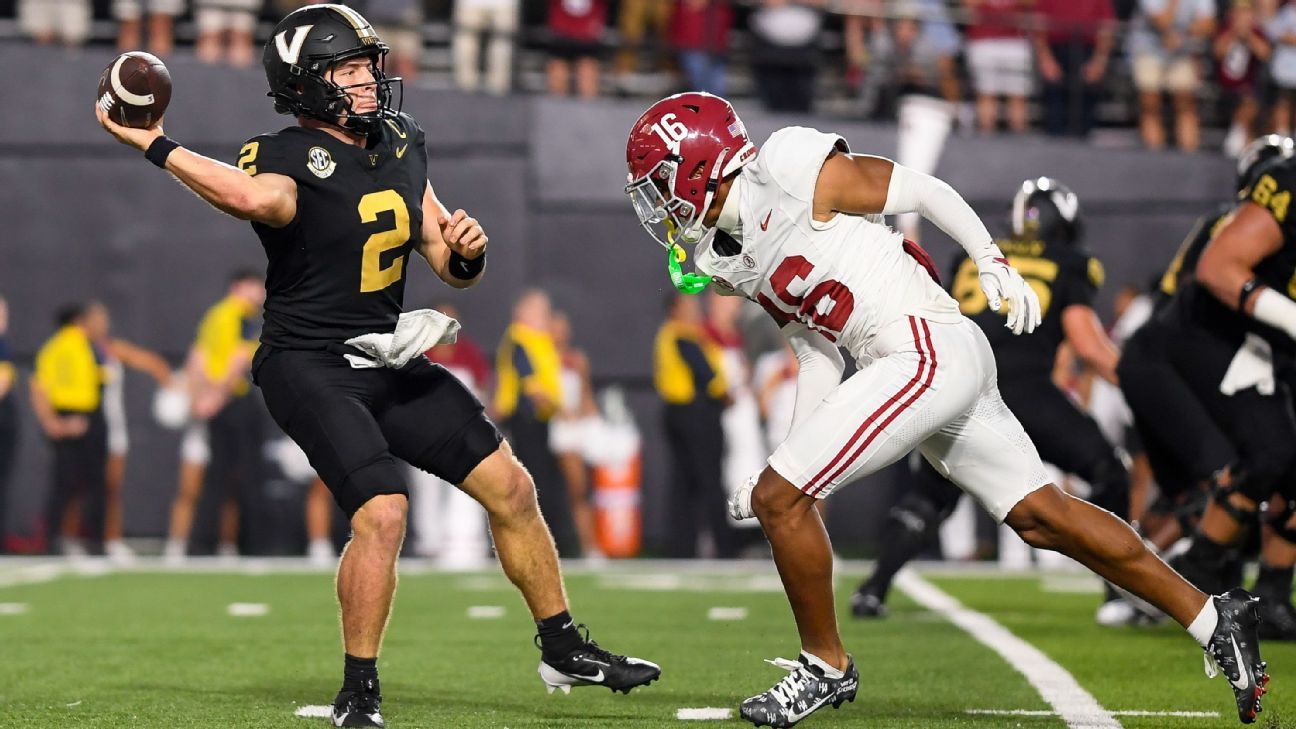
 No. 16 Vanderbilt at No. 10 Alabama (3:30 p.m., ABC)
Part of succeeding a legend is that we notice anytime you don’t live up to the legend’s standards. Granted, Kalen DeBoer has proven adept at continuing Nick Saban’s relative success against Kirby Smart’s Georgia, but DeBoer’s track record otherwise has some holes. He has already lost four games to unranked teams, as many as Saban lost in 17 years. Not great.
Saban was particularly good at putting upstarts in their place — think of Michigan State and Washington in the College Football Playoff. Or Missouri in the SEC championship game. Or Mississippi State every time the Bulldogs thought they were good. He was also good at revenge. His Crimson Tide bopped Tim Tebow’s Florida in 2009 and beat LSU by three TDs when they got a second shot at the Tigers in the 2011 BCS Championship Game. They lost to Auburn four times but won the following year by an average of 25 points.
You might remember what happened the last time Alabama played Vanderbilt.
0:52
Vanderbilt fans storm field after historic win over Alabama
Vanderbilt hangs on for its first-ever win over a No. 1 ranked team in a thrilling 40-35 victory over Alabama.
Vandy has to go to Tuscaloosa this time, which sets up a revenge opportunity. But the Commodores are much better this time. They’re 11th in SP+, and they’re scoring 49 points per game. Diego Pavia is third nationally in Total QBR (and maybe the second-best power conference quarterback to date), completing 75% of his passes and averaging nearly 7 yards per non-sack carry. Backs Sedrick Alexander and Makhilyn Young are averaging 6.9 yards per carry, tight end Eli Stowers is catching everything and receiver Junior Sherrill has scored on five of his 17 receptions.
The Commodores are combining ruthless efficiency with above-average explosiveness.
Because Vandy has so thoroughly taken care of business through five games, Pavia hasn’t had to do as much — he had taken contact 108 times through five games last year (and battled wear-and-tear issues later in the season), but he’s at only 65 hits this year. If he needs to run more in the bigger games, he can probably handle it.
The Commodores’ defense isn’t amazing, but it’s also better than it was last season. Vandy plays decent run defense with great big-play prevention against the pass; safety CJ Heard is excellent, and linebackers Bryan Longwell and Khordae Sydnor swarm well.
Alabama remains an unfinished picture. The Crimson Tide’s defense looked downright unprepared in Week 1 against Florida State, but it has allowed only 11.7 points per game since. The Crimson Tide don’t create nearly enough negative plays, but they don’t give up big plays either, and safety Bray Hubbard keys a frustrating zone defense.
The offense has been the star of the show. Ty Simpson looked disheveled against Florida State, but he has been brilliant since, and the Tide are up to sixth in points per drive despite a below-average run game. They couldn’t quite close out Georgia after a brilliant first half, but Simpson is incredibly sharp, and the offensive line has shored up a lot of its Week 1 breakdowns.
After what happened in 2024, this game is symbolically huge. But it’s also just part of a huge stretch for both teams. Alabama just took down Georgia, but five of the Tide’s next six opponents rank 17th or better in SP+. At absolute worst, they’ll need to win four of six to keep their CFP hopes alive. Meanwhile, five of Vandy’s past seven opponents are also 17th or better. Without an obvious quality win yet, they’ll probably need to win five of seven. Now would be an apt time for Bama to throw its weight around and remind everyone who’s supposed to be the boss. But based solely on 2025 to date, the Commodores might yet be the Tide’s equal.
Current line: Bama -10.5 | SP+ projection: Bama by 2.5 | FPI projection: Bama by 6.9
A high-stakes doubleheader in the ACC
Virginia’s upset of Florida State last week damaged the hype value of one ACC matchup but heightened another. FSU hosts unbeaten Miami on Saturday evening in desperate need of a turnaround win, but the winner of the afternoon’s Virginia-Louisville game — a matchup of the teams with the second- (Louisville) and fourth-best (Virginia) ACC title odds, per SP+ — will be positioned wonderfully, too.

 No. 3 Miami at No. 18 Florida State (7:30 p.m., ABC)
In some ways, you could say that Florida State was flying a little too high. The Seminoles had been nearly perfect in 2024, manhandling Alabama and humiliating two buy-game opponents (East Texas A&M and Kent State), and they were due a bad break or two. The defense hadn’t faced a tough and efficient run game like Virginia’s (including Alabama’s), and the offense had faced barely a down of adversity. Regression ran its course in Charlottesville last Friday night, when FSU lost an early fumble, gave up an acrobatic red zone interception and saw a juggling overtime touchdown catch go incomplete by millimeters. Stuff happens.
Even in the playoff era, though, a “stuff happens” loss can wipe out your margin for error. Thanks to early-season collapses from Clemson and Florida, Miami is the last SP+ top-40 opponent on FSU’s schedule, meaning this is likely the Seminoles’ last chance at another high-visibility win.
On paper, this one’s awfully even. Miami has its own solid, physical run game like Virginia’s, one with a bit better blocking but fewer yards after contact. The Hurricanes also have Carson Beck and a passing attack that rules third downs. It’s lacking explosiveness — Beck is averaging just 11.9 yards per completion — and therefore doesn’t generate loads of easy points. But it’s an efficient attack, and FSU’s defense has allowed a few more third-and-long conversions than is preferable.
With how well Notre Dame’s offense has played since, Miami’s Week 1 defensive performance against the Fighting Irish (24 points and 5.4 yards per play allowed) looks awfully impressive. But FSU’s offense has quite a bit to offer, even with the misfires against Virginia. The Seminoles rank first in points per drive and second in yards per play. Virginia hemmed in quarterback Tommy Castellanos and forced him to throw instead of making plays on the perimeter — it’s the key to keeping a lid on a Castellanos attack — but FSU still scored 35 points in regulation and averaged 6.4 yards per play. The ceiling is high even if teams defend the Noles correctly. Gavin Sawchuk and Ousmane Kromah average a combined 5.8 yards per carry with a 59% success rate, and Duce Robinson and Micahi Danzy have combined for 24 catches and 514 yards. And this is still one of the best Net YAC teams in the country.
Considering Miami took down Florida in part due to physical running, whoever generates more success in this regard could have a huge advantage.
With tackle Rueben Bain Jr. at full force and getting help from disruptors such as linebacker Mohamed Toure and nickel back Keionte Scott, Miami’s defense might be even better than Bama’s. It will land some shots, but if FSU can hold Beck and the Canes to 24 or fewer points, you have to like the Seminoles’ chances.
Current line: Miami -4.5 | SP+ projection: Miami by 2.1 | FPI projection: Miami by 3.9

 No. 24 Virginia at Louisville (3:30 p.m., ESPN2)
What’s Virginia’s reward for winning a big game against an explosive Florida State offense? A big game against an explosive Louisville offense! Granted, Cardinals quarterback Miller Moss is more of an efficiency player, but wideout Chris Bell has big-play potential, and if or when the Louisville running back corps is healthy, look out. Isaac Brown and Duke Watson have battled injury, and they’ve combined for only 56 carries this year, but Brown is averaging 8.1 yards per carry (6.1 after contact!), and Watson averaged 8.9 in 2024.
Brown and Watson should be as close to full speed Saturday as they’ve been all year, and that’s good because Louisville has played against two SP+ top-50 defenses and averaged just 4.8 yards per play against them. The defense has improved a bit after slippage in recent years, thanks mostly to a pass rush led by star transfers Clev Lubin and Wesley Bailey, but for the Cardinals to live up to growing expectations, the run game will need to shift into gear.
Virginia, meanwhile, has already exceeded expectations. Obliterated them. Blown them to smithereens.
The transfer portal provides miracles for some teams each year and disaster for others, and it smiled on the Cavaliers with the potent additions of quarterback Chandler Morris, running back J’Mari Taylor, receivers Cam Ross and Jahmal Edrine and about 10 new rotation defenders, including star edge rushers Mitchell Melton and Daniel Rickert and nickel back Ja’son Prevard. The defense allows too many big plays and has allowed touchdowns on 80% of opponents’ red zone trips (125th nationally), and that was costly in a Week 2 loss to NC State. But the Hoos rule third downs on offense and defense, and that will take you pretty far. UVA has won more than eight games in a season just once in 17 years, but SP+ says there’s a 57% chance of at least a 9-3 finish. What a world.
Current line: Louisville -6.5 | SP+ projection: Louisville by 9.2 | FPI projection: Louisville by 1.4
This week in the Big 12
Five weeks into the 2024 season, we thought we had a decent read on the Big 12. BYU and Iowa State were still unbeaten, and Kansas State and Utah were 4-1 and looking good. Per SP+, those four teams had about a two-in-three chance of winning the conference. Arizona was 3-1 and hoping to make a run. 3-2 Oklahoma State and 3-1 Arizona State had equal long shot odds.
But the conference had all sorts of surprises in store. Utah lost seven games in a row, and Kansas State lost three of four down the stretch. Arizona and OSU went a combined 1-14 the rest of the way, while Arizona State transformed into a top-10 caliber team in November and won the conference title.
We probably don’t know anything about this conference race yet, in other words, no matter how much it feels like we do. Texas Tech has looked spectacular in its first four games, and Iowa State, BYU, Utah and Arizona State are all positioned pretty well. But Week 6 sends the top two favorites on the road against upstarts and offers a few teams with early losses a chance to get right and stay in the race. We have some plot-twist opportunities for a conference that loves nothing more than delivering them.

 No. 11 Texas Tech at Houston (7 p.m., ESPN)
Texas Tech has been genuinely awesome this season, walloping three bad teams as an elite team should and then physically manhandling Utah in Salt Lake City two weeks ago. They’ve been awesome at pretty much everything — they’re fifth in yards per play on offense and defense — and aside from a predilection for penalties and some injury-prone tendencies for quarterback Behren Morton, we don’t really know their weaknesses yet.
Houston’s a little bit easier to figure out. Defense: good. Offense: not so much. The Cougars are ninth in yards per play allowed and are very much in the best quadrant of this chart.
Willie Fritz lost defensive coordinator Shiel Wood to Tech, but the UH defense has been even better with replacement Austin Armstrong. But the Conner Weigman-led offense remains a work in progress. The Coogs go three-and-out nearly 39% of the time (124th), and that will probably be their downfall in this one. But if the defense sets up some easy scoring opportunities, this one quickly moves into “upset watch” territory.
Current line: Tech -10.5 (down from -12.5 on Sunday) | SP+ projection: Tech by 13.9 | FPI projection: Tech by 7.0

 No. 14 Iowa State at Cincinnati (noon, ESPN2)
If you combined Cincinnati’s offense with Houston’s defense, you’d have a potential top-10 team. Last Saturday’s 37-34 win at Kansas inserted the Bearcats into the Big 12 title conversation. We’ll see if the Bearcats have the defensive chops to remain a factor — their run defense is strong thanks in part to star tackle Dontay Corleone (who’s as questionable this week), but they’re 136th, last nationally, in completion rate allowed. But quarterback Brendan Sorsby is on a roll, and Cincy ranks first nationally in rushing success rate. Track meets could work out well for the Bearcats.
Iowa State is not a track meet team. The Cyclones have allowed more than 16 points just once in five games, but they’ve also topped 24 only twice. ISU runs a lot on first down but doesn’t get very far, so quarterback Rocco Becht has to convert a lot of third downs. He usually pulls it off, though, either with deep shots to Brett Eskildsen and Chase Sowell or passes to any of four tight ends.
The ISU defense is strong once again. The Cyclones rarely invade the backfield, but Domonique Orange occupies space up front (he’s listed as probable this week), and they tackle well, prevent big plays and pounce on mistakes. Sorsby hasn’t made many mistakes lately, though.
Current line: Cincy -1.5 | SP+ projection: ISU by 3.2 | FPI projection: ISU by 0.3

 Kansas State at Baylor (noon, ESPN+)
Kansas State suffered a three-week funk after losing to Iowa State in Dublin, Ireland, but quarterback Avery Johnson just enjoyed, by far, his best game of the season, and RB Dylan Edwards is finally healthy. The Wildcats still have only one conference loss, but their next four games — at Baylor, TCU, at Kansas, Texas Tech — will require a sustained A-game. Sawyer Robertson and the prolific Bears also have one conference loss and could easily stay in the conversation with a strong performance.
Current line: Baylor -6.5 | SP+ projection: Baylor by 3.4 | FPI projection: Baylor by 2.6

 Kansas at UCF (7:30 p.m., ESPN2)
UCF makes a lot of big plays but can’t keep a quarterback healthy and missed a solid upset opportunity with a poor performance at Kansas State last week. With last week’s defeat to Cincinnati, meanwhile, Kansas has dropped eight of its past nine one-score finishes since late 2023. Iowa State weathered a similar streak recently before flipping that script, and if KU does the same, it’s not too late to get into the race. It’s now or never, though.
Current line: Kansas -4.5 | SP+ projection: Kansas by 1.2 | FPI projection: Kansas by 1.5
A CFP eliminator of sorts

 Boise State at No. 21 Notre Dame (3:30 p.m., NBC)
Last week was great and terrible for Notre Dame. On one hand, the Fighting Irish looked spectacular in making Arkansas quit in a 56-13 road blowout. The offense is improving rapidly, and CJ Carr is quickly becoming one of the nation’s best quarterbacks. Meanwhile, despite injuries to star corner Leonard Moore and tackle Donovan Hinish, among others, the defense finally showed some life after a poor start to 2025. Notre Dame is the projected favorite in every remaining game.
On the other hand, the Irish’s potential CFP résumé, should they win out and get to 10-2, took a hit. USC’s loss to Illinois hurt their potential for a top-10 win, and four other upcoming opponents all lost. It will be difficult for the Irish to stand out in a pile of two-loss teams, even if they deliver blowouts.
The blowouts must continue regardless. And we’ll see how that goes against a Boise State team that has shifted nicely into gear. The running back trio of Sire Gaines, Dylan Riley and Malik Sherrod combined for 190 yards from scrimmage last week against Appalachian State, while Maddux Madsen threw for 321 yards and four touchdowns. The pass rush, led by Jayden Virgin-Morgan and Braxton Fely, delivered five sacks. The Mountain West has a growing number of potential contenders this season — UNLV, Fresno State, perhaps New Mexico or San Diego State — but the Broncos still lead the pack.
Under Marcus Freeman, Notre Dame has been either ridiculously rude or ridiculously accommodating to aspirational Group of 5 opponents. The Irish fell 26-21 to Marshall in 2022 and, famously, 16-14 to Northern Illinois last year, but they also pummeled excellent Army and Navy teams last fall. Boise State has looked like Boise State since the demoralizing Week 1 dud against South Florida, and an upset here would push the Broncos back to the top of the pile in the Group of 5. Both of these teams have big-play capabilities, plus defenses that have been a little too willing to give up a chunk play or two. Let’s see if BSU can keep up with an increasingly ruthless Notre Dame attack.
Current line: Irish -20.5 (up from -17.5) | SP+ projection: Irish by 13.5 | FPI projection: Irish by 18.8
Week 6 chaos superfecta
We’re once again using this space to will chaos into existence, looking at four carefully curated games with pretty big point spreads and mashing them together into a much more upset-friendly number. Houston’s overtime win over Oregon State cost us a fourth win in five tries — how could you do that to us, Coogs? — but 3-for-5 is still pretty good.
Going 4-for-6 is even better, though. SP+ tells us there’s only a 55% chance that Nebraska (81% win probability against Michigan State), Illinois (85% over Purdue), Michigan (88% over Wisconsin) and Ohio State (90% over Minnesota) all win. It’s time to take down a Big Ten favorite.
Week 6 playlist
Here are some more games you should pay attention to if you want to get the absolute most out of the weekend, from both information and entertainment perspectives.
Friday evening
West Virginia at No. 23 BYU (10:30 p.m., ESPN). I’m sticking this one in the Playlist instead of the Big 12 section above because of the larger point spread. BYU overcame a poor performance to remain unbeaten against Colorado, and the Cougars could probably withstand another iffy game this weekend. But it feels like a race to get quarterback Bear Bachmeier — 48th in Total QBR, 51st in yards per dropback — ready for an epic run of high-stakes Big 12 games on the horizon.
Current line: BYU -18.5 | SP+ projection: BYU by 22.4 | FPI projection: BYU by 23.5
New Mexico at San José State (10 p.m., FS1). I’m not sure anyone in college football is having more fun than New Mexico.
You Know The Vibes™️#GoLobos pic.twitter.com/Ix1Nx8lPxZ
— New Mexico Football (@UNMLoboFB) September 27, 2025
The Lobos frustrated Michigan, stomped UCLA and beat rival New Mexico State for the Chile Roaster trophy. Now, with trips to San José and Boise in the next two weeks, we find out if this is a fun bowl push or a fun Mountain West title push.
Current line: SJSU -2.5 | SP+ projection: UNM by 1.0 | FPI projection: UNM by 0.9
Early Saturday
Clemson at North Carolina (noon, ESPN). One of the most noteworthy ACC games in the preseason — Dabo Swinney’s top-five Clemson versus Bill Belichick’s North Carolina! — still packs intrigue, but it’s mostly negative. Clemson has lost to all three of its power-conference opponents, and UNC has lost to two by a combined 82-23. Clemson likely has too much talent for the Heels, but, well, that hasn’t stopped the Tigers from playing like they have thus far.
Current line: Clemson -14.5 | SP+ projection: Clemson by 7.7 | FPI projection: Clemson by 8.3
No. 22 Illinois at Purdue (noon, BTN). Illinois responded well to its humiliation at Indiana two weeks ago, beating USC in a nailbiter in Champaign. Now comes a different kind of test. Purdue has a spry passing game and an aggressive (if spectacularly dysfunctional) defense, and if the Illini are caught looking ahead to next week’s Ohio State game, the Boilermakers could land some punches.
Current line: Illinois -9.5 | SP+ projection: Illinois by 16.7 | FPI projection: Illinois by 7.0
Kentucky at No. 12 Georgia (noon, ABC). Kentucky nearly beat Georgia last season before the wheels totally fell off in Lexington, but four games into 2025, the Wildcats still haven’t put the wheels back on. This is a get-right opportunity for Kirby Smart’s surprisingly mediocre (by their standards) Dawgs before Ole Miss visits in two weeks.
Current line: UGA -20.5 | SP+ projection: UGA by 17.4 | FPI projection: UGA by 17.0
Wisconsin at No. 20 Michigan (noon, Fox). Michigan is a week away from a huge trip to USC, but the Wolverines must first handle a Wisconsin team that has just continued to fall into further depths. Badgers quarterback Billy Edwards Jr. should finally be near full strength, which can’t hurt, but they have just been lifeless this year.
Current line: Michigan -17.5 | SP+ projection: Michigan by 18.8 | FPI projection: Michigan by 15.8
Air Force at Navy (noon, CBS). Air Force might have found its next awesome option quarterback in sophomore Liam Szarka. Unfortunately, the Falcons’ defense has allowed at least 44 points against all three of its FBS opponents. Will that matter or will this become the typical battle of attrition that service-academy rivalry games frequently become?
Current line: Navy -12.5 | SP+ projection: Navy by 18.7 | FPI projection: Navy by 13.2
Saturday afternoon
No. 9 Texas at Florida (3:30 p.m., ESPN). I wouldn’t have guessed this one would be relegated to the Playlist, but here we are. Florida’s defense is excellent and could absolutely frustrate Arch Manning & Co., but the Gators have scored 33 points in three games against FBS opponents, and Texas has the best defense in the country, per SP+. It’s hard to think of anything else mattering beyond that.
Current line: Texas -6.5 | SP+ projection: Texas by 9.9 | FPI projection: Texas by 7.8
Washington at Maryland (3:30 p.m., BTN). On Christmas Day in 1982, Washington’s Tim Cowan outdueled Maryland’s Boomer Esiason, throwing for 369 yards and three touchdowns — including the game winner with six seconds left — as the Huskies won a 21-20 Aloha Bowl thriller. I just listed the entire football history between these two new conference mates.
Current line: UW -6.5 | SP+ projection: Maryland by 1.6 | FPI projection: UW by 0.5
Michigan State at Nebraska (4 p.m., FS1). Michigan State’s Aidan Chiles and Nebraska’s Dylan Raiola have made nice strides this season, but only Raiola is getting help from his defense. Can Chiles, receiver Omari Kelly and the Spartans’ offense suck the Huskers into a track meet or is the NU pass defense — first nationally in yards per dropback — too much?
Current line: Nebraska -11.5 | SP+ projection: Nebraska by 13.7 | FPI projection: Nebraska by 13.1
No. 7 Penn State at UCLA (3:30 p.m., CBS). Penn State should get back on track after last week’s frustrating loss to Oregon, but I’m highlighting this game primarily to point out that, per SP+, UCLA is a projected underdog of at least 16 points in every remaining game and has a 61% chance of finishing 0-12. It was easy to see this season perhaps not going well, but wow.
Current line: PSU -25.5 | SP+ projection: PSU by 32.5 | FPI projection: PSU by 20.2
Kent State at No. 5 Oklahoma (4 p.m., SECN). OK, yes, OU will win by a lot. But with John Mateer out because of injury, we’ll get a look at how backup Michael Hawkins Jr. runs the Ben Arbuckle offense and what kind of chance the Sooners might have against Texas next week.
Current line: OU -45.5 | SP+ projection: OU by 48.0 | FPI projection: OU by 46.3
Saturday evening
Mississippi State at No. 6 Texas A&M (7:30 p.m., SECN). Texas A&M nearly suffered a “stuff happens” loss last week, dominating Auburn statistically but winning by only 6, but the Aggies remain unbeaten and are projected favorites in the next three games. This one’s interesting, though. A&M makes and allows big plays, while Mississippi State, having already played in two down-to-the-wire finishes with more to come, makes and allows few.
Current line: A&M -14.5 | SP+ projection: A&M by 4.9 | FPI projection: A&M by 9.0
Minnesota at No. 1 Ohio State (7:30 p.m., NBC). Ohio State faced one of the best offensive teams in the country (to date) last week at Washington and brushed the Huskies aside with relative ease. Now, the Buckeyes face one of the most reliably solid defenses in the country. Minnesota tackles well and generates loads of negative plays, which will provide Julian Sayin & Co. with a different type of test. I’m guessing they’ll ace this one too.
Current line: OSU -23.5 | SP+ projection: OSU by 20.7 | FPI projection: OSU by 23.1
Colorado at TCU (7:30 p.m., Fox). As with BYU, TCU is a Big 12 contender facing a theoretically easier challenge this year. Granted, all three of Colorado’s losses were by one score, and the Buffaloes could score an upset or two down the stretch (especially with more stable QB play). But TCU should control the line of scrimmage in this one and move to 4-1.
Current line: TCU -13.5 (down from -15.5) | SP+ projection: TCU by 12.4 | FPI projection: TCU by 9.0
UNLV at Wyoming (7 p.m., CBSSN). UNLV is unbeaten and has scored at least 30 points in every game; the Rebels’ defense, however, is dreadful, especially against the run. Wyoming backs Samuel Harris and Sam Scott are both strong yards-after-contact players, and the Cowboys might have a shot at making this one awkward for an ambitious conference rival.
Current line: UNLV -3.5 (down from -5.5) | SP+ projection: UNLV by 4.9 | FPI projection: UNLV by 6.6
Late Saturday
Duke at California (10:30 p.m., ESPN). Washington-Maryland feels like the most geographically ridiculous conference game of the week, but this one isn’t much better. It’s a pretty big one, though, with the teams a combined 3-0 in ACC play. Duke’s offense (31st in points per drive) facing Cal’s defense (29th) could be appointment viewing. Cal’s offense (86th) against Duke’s defense (99th), not so much.
Current line: Duke -2.5 | SP+ projection: Duke by 6.1 | FPI projection: Duke by 2.9
Nevada at Fresno State (10:30 p.m., CBSSN). Since a poor Week 0 performance against Kansas, Fresno State is unbeaten. Plus, the Bulldogs are projected underdogs in only one remaining game, meaning they’re Mountain West contenders until proven otherwise. Nevada doesn’t have much to offer, but the Wolf Pack have a randomly explosive run game with backs Herschel Turner and Caleb Ramseur.
Current line: Fresno -13.5 | SP+ projection: Fresno by 18.9 | FPI projection: Fresno by 14.7
Smaller-school showcase
Let’s once again save a shout-out for the glorious lower levels of the sport. Here are three games you should track.
FCS: Yale at No. 8 Lehigh (noon, ESPN+). We’re looking at a ferocious Ivy League race among Harvard (fourth in FCS SP+), Yale (10th) and Dartmouth (18th) — one that has FCS playoff implications because the Ivy is sending a team now. But first, Yale gets a huge nonconference showdown with a Lehigh team that has won 11 of its past 12 games thanks, in part, to backs Luke Yoder and Jaden Green (combined: 207.2 rushing yards per game) and a ferocious and diverse pass rush.
SP+ projection: Lehigh by 1.8.
Division III: No. 5 Wisconsin-La Crosse at No. 10 Wisconsin-Whitewater (2 p.m., local streaming). It’s the first weekend of one of college football’s most exciting conference races: the WIAC, which has four of the top 11 teams in Division III, based on SP+. Two of them meet Saturday. Whitewater has dominated this series through most of the 2000s, but La Crosse, led by prolific quarterback Kyle Haas, has won the past two games.
SP+ projection: UWW by 6.4.
Division II: No. 9 UT Permian Basin at No. 5 Angelo State (7 p.m., FloCollege). Angelo State is unbeaten and averaging 39 points per game this season behind backs Cameron Dischler and Jayden Jones and a relentless, deep run game. UTPB? Also unbeaten and averaging 38.8 points per game thanks to quarterback Kanon Gibson and a prolific passing game. Track meet: likely.
SP+ projection: Angelo State by 7.6.


-
Andrea Adelson
THE JOKES ARE easy enough to make between “old man” Haynes King and his position coach, the oldest man to ever win the Heisman Trophy.
Twenty-five years ago, when Chris Weinke took home the award as a 28-year-old senior, his age became a nonstop topic of conversation. Today, older quarterbacks dot the college football landscape, their advanced ages met with a collective shrug.
“Sometimes I try and mess with him and say, ‘I couldn’t quite catch you on the age, but I tried. I gave it my all,” the 24-year-old King said of Weinke, his quarterbacks coach at Georgia Tech.
Older players have been normalized, thanks to the transfer portal and the pandemic, which granted freshmen an extra year of eligibility if they wanted it. Nearly 40 quarterbacks from the 2020 class came back this year for one more season at the FBS level. Plus, with NIL and revenue sharing, some quarterbacks are opting to stay in college as opposed to leaving school for the NFL draft. And sixth-year quarterbacks like King and Vanderbilt’s Diego Pavia entered the Heisman conversation this year. (Pavia was named a finalist.) Still, if more quarterbacks are 24 years old these days, nobody is quite as aged as Weinke was when he played.
“The landscape of college football has obviously changed,” Weinke says. “But that was a point of contention when I won it. When I walked into the room that evening when they were making the Heisman announcement, I didn’t think I was going to win it, because there was so much chatter that I didn’t deserve to win it because I was older.
“But I’ve got it now, and they can’t take it away.”
Perhaps the conversation around what Weinke did in 2000 at Florida State should be reframed. What made that season so remarkable had nothing to do with age, and everything to do with how he turned himself into a star after his college football career nearly ended. Twice.
FLORIDA STATE OFFENSIVE coordinator Mark Richt was sitting in his office in 1996, when then-coach Bobby Bowden came in with some news. At the time, Richt was closing in on getting a commitment from the top quarterback prospect in the country, Drew Henson. That is, until Bowden told him about a promise he had made to Weinke six years earlier.
Weinke had initially signed with the Seminoles in 1990, joining a quarterback room that included Brad Johnson, Casey Weldon and fellow freshman Charlie Ward. But he also had a lucrative offer to play baseball with the Toronto Blue Jays organization, after being selected in the second round of the MLB draft. Weinke had until classes started in late August to decide which sport he was going to play, so he opted to begin fall practice with Florida State while weighing his options.
He went through fall two-a-days, and with decision day closing in, Richt remembers one quarterback meeting in particular. To make sure his quarterbacks understood what he was teaching them, he would ask them questions.
Richt turned to Weinke as they watched tape and asked, “What coverage is this on this play?”
“Cover 3?” Weinke guessed.
“No.”
“Cover 1?
“No. It’s quarters coverage,” Richt said.
Weinke responded: “Whatever.”
“That was the day before school started,” Richt said. “I said, ‘I got a feeling this kid is going to leave and play pro baseball.'”
Sure enough, Weinke left. But Bowden told him if he ever decided to return to football, he would have a spot waiting for him at Florida State.
After six years of bouncing around the minor leagues and getting as high as Triple-A, Weinke decided to give up on baseball, but not playing sports entirely. He wanted to go back to football. Richt reminded Bowden that if they took Weinke, they would lose Henson.
“Well, I promised him if ever wanted to play football again, I’d let him come back,” Bowden told Richt.
Richt asked to speak with Weinke first.
“I was telling him all the rules and regs, I was telling him about [quarterback] Dan Kendra already on campus and when I’m done giving him my spiel to try to get him not to come, he says, ‘Hey coach, let me ask you one question. If I’m the best guy, will I play?’ I said, ‘Of course.’ He goes, ‘I’m coming.’ We lost the other quarterback to Michigan. I guess we came out OK with Weinke.”
Nobody quite knew what to expect when he arrived on campus as a 25-year-old freshman in 1997, but he quickly became one of the guys, in part because he had a large house off campus and threw his fair share of parties where all were invited.
The larger issue was that he arrived as a baseball player. Weinke had not picked up a football in six years.
Getting his form back would take time and reps. Lots and lots of reps. Former teammates and coaches described Weinke’s competitiveness, work ethic and relentless demeanor as driving forces. He would never settle for anything less than his best effort; and he expected the same from his teammates.
That is why he woke up before class started and went to watch tape with Richt. Why he organized every voluntary 7-on-7 workout and essentially made them mandatory. Because if someone failed to show up, he would go and find them and bring them out to the practice field. He developed such a great rapport with his receivers that he would be able to anticipate where they would be at any given time on the field.
“Our chemistry was like none other,” said Marvin “Snoop” Minnis, his leading receiver in 2000. “He knew what I was going to do before I did. He would have the ball to me before I even got out of my break, and as a receiver, you love that so you can react and make the move you need to make on the defender.”
Weinke played sparingly in 1997 but won the starting job in 1998. Things started well enough in the opener. Then in his second career start, at NC State, Weinke threw a school-record six interceptions, and the criticism began.
“I remember getting back to the house, we had an answering machine back then. The most brutal messages you could imagine, cursing and threats, and ‘You don’t need to play quarterback,'” said Jeff Purinton, who was working in the Florida State media relations department at the time and was one of Weinke’s roommates. “Even going to the store, people would talk trash. Chris just weathered it and used that as an opportunity to learn.”
Weinke rebounded from there, helping Florida State reel off eight straight wins. That last win, against Virginia, was nearly the last time he saw the field.
TOWARD THE END of the first half, Weinke got sacked and felt pain in his right arm. He initially thought he had a shoulder injury. Weinke went into the locker room at halftime, and as trainers began to lift off his shoulder pads, he had a sharp pain in his neck. He was fitted with a brace and underwent further testing.
When the doctor walked in to deliver the results, Weinke remembers asking, “Before you share any news, I just want to know one thing. Am I ever going to play college football again?”
“Well,” the doctor said. “Do you want the good news or the bad news?”
The doctor said Weinke needed surgery to insert a titanium plate into his neck after X-rays showed a chipped bone lodged against a nerve in a vertebra, ligament damage and a ruptured disc.
“Maybe the better news,” the doctor said. “You were a centimeter away from being paralyzed from the neck down.”
“Mom hears that, and dad hears that. They’re not real excited about me getting back out on the field,” Weinke says. “But they knew that burning desire inside of me that wanted to get back out there and be a part of the team. The doctors told me that I’d be stronger with a titanium plate in my neck, so I was going to do whatever it took. But those were probably the hardest seven months of my life.”
Weinke initially had complications post-surgery and had to be in bed for five weeks. He lost 30 pounds, and his throwing arm atrophied so severely that it became impossible for him to even lift a football. He had to teach himself again how to throw, starting first with a tennis ball. Throwing it 5 yards was a huge accomplishment. Seven hours a day, day after day, he rehabbed, steadily progressing, all the while unsure whether he would make it all the way back.
Then, there he was in the season opener against Louisiana Tech, completing 63% of his passes, throwing for 242 yards and two touchdowns. That was the start of an undefeated national championship-winning season in 1999, as Florida State went wire to wire as the No. 1 team in the nation.
Weinke opted to return for one more season, because he wanted to get Bowden another national championship. After throwing for 3,432 yards, 29 touchdowns and 15 interceptions as a junior and winning the title, Weinke became one of the Heisman front-runners headed into 2000.
TWENTY-FIVE YEARS LATER, there is one play from that season that remains a part of Seminoles lore: Weinke to Minnis, 98 yards, in a 54-7 blowout win over Clemson in mid-November.
On the second series of the game, backed up near the goal line, Florida State ran what Bowden referred to as a “gym play” — one that was never practiced on the field, but rather behind closed doors inside the gym away from prying eyes. “Or spies,” Richt said.
Weinke dropped back deep into the end zone and faked a handoff to Jeff Chaney, turning his back to the defense and tucking the ball as if he no longer had it. Minnis had gone in motion and made the safety think he was blocking for a handoff, then took off down the middle. By the time Weinke delivered the ball, Minnis was wide open. Easy touchdown. Easy 54-7 win.
“He was so ice cold in that moment,” Minnis said. “The confidence that he had in the O-line to just stand there, then turn around and hit me for the touchdown. For him to make that fake as beautiful as he did and then put that ball on a dime just tells you how great Chris Weinke was and how deserving he was of that Heisman Trophy.”
There was another game that added to his legend: The regular-season final against the rival Gators. Weinke had missed the 1998 game in Gainesville because of his neck injury. Nothing would keep him from playing them in The Swamp in 2000. Not even the flu.
Weinke was so sick the night before the game, he stayed at the home of team doctor Kris Stowers so he would not be around the rest of the team in the team hotel. He rode with Stowers to the game on Saturday, and walked through all the tailgate lots on the way to the locker room. Trainers gave him an IV before the game started, and Weinke proceeded to throw for 353 yards and three touchdowns in the 30-7 win.
Florida State was well positioned to make it back to the national title game, and Weinke was also well positioned in the Heisman Trophy race. But as the weeks drew closer to the announcement of the Heisman finalists, critics waged a campaign against Weinke — saying his age should disqualify him from consideration. That angered his teammates.
“He dominated that year, and it had nothing to do with age,” Minnis said. Added running back Travis Minor: “When he got there, he wasn’t looking like a Heisman Trophy candidate or winner. He really put the work in. You saw the difference from when he first got there to when he had that Heisman Trophy season. He earned everything that he won.”
Florida State knew it had to start working on messaging with Heisman voters as the debate over his age raged on. Ultimately, school officials came back to one main point: It was hard to argue with the stats. Weinke had led the nation with 4,167 yards passing and 33 touchdowns and had the Seminoles playing in a third straight national championship game.
“He was playing baseball for six years. It wasn’t like he was throwing the football every day and training to be a starting college quarterback,” Purinton said. “The other part is he could have died when he broke his neck. There were two points in time where he had to go back and start football over again.”
Weinke said the narrative taking shape around his age “pissed me off.”
“I was playing college football, so if I’m playing college football, then I should be eligible to win any award that they’re giving out in college football,” Weinke said. “That was just a little motivating factor for me.”
Weinke ultimately made it to New York with fellow finalists Josh Heupel, LaDainian Tomlinson and Drew Brees. His teammates watched on television screens from the team banquet Florida State had scheduled for that night.
“Sitting in the Downtown Athletic Club coming out of a commercial break and them announcing your name will ring in my head till the day I die,” Weinke said.
Weinke beat out Heupel in one of the closest votes in Heisman history, taking a 76-point margin of victory. His teammates whooped and hollered for him back home. Weinke took the stage and said, “With apologies to Lou Gehrig, I feel like I’m the luckiest man in the world.”
WEINKE BEGAN COACHING 10 years after he won the Heisman. He first came to know King while working as an assistant at Tennessee in 2020. When King hit the portal in 2022, Weinke had moved on to Georgia Tech. His first call was to King.
“Playing quarterback is kind of tricky,” King says. “The stars have to align, whether it’s people around you and or how you’re playing. Even in my class, there were guys like Bryce Young and Anthony Richardson and C.J. Stroud, already in the league, and I’m still in college like Chandler Morris, Diego Pavia, Carson Beck. Everybody’s timeline is different.”
While the debate over his age has been left to the dustbin of history, what Weinke did that year may never be replicated. In an era of sport and position specialization, quarterbacks rarely play multiple sports at elite levels — let alone leave football behind for six years before coming back to it. In the 25 years since Weinke won the Heisman, Brandon Weeden at Oklahoma State is perhaps the only notable quarterback to play baseball and then stick around in college football into his late 20s.
“To go through the things that I went through was clearly the road less traveled,” Weinke said. “Being an older guy and not playing football for seven years, then fulfilling a dream of playing for Coach Bowden, then breaking my neck, and coming back and giving Coach Bowden his first undefeated season, and ultimately having my name called for the Heisman Trophy, I just felt blessed.”

The MLB winter meetings have come and gone, and though there’s always a hope that there will be plenty of action, that’s not always the case. The 2025 meetings didn’t have a $700-plus million deal like last year, but there were still a number of impactful free agent signings, although no groundbreaking trades.
Veteran slugger Kyle Schwarber chose to return to the Philadelphia Phillies on a five-year deal in the first major splash of the meetings. The Los Angeles Dodgers added to an already star-studded roster by signing closer Edwin Diaz to a three-year, $69 million contract that sets a record in AAV for a reliever. The Baltimore Orioles then joined the fun by adding a veteran slugger on a five-year deal of their own in Pete Alonso.
We asked our MLB experts who were on the scene in Orlando, Florida, to break down everything that happened this week. Which moves most impressed them — and which most confused them? Who were the biggest winners and losers? What should we make of the trade market? And what can we expect next?
What is the most interesting thing you heard this week in Orlando?
Jorge Castillo: That a Tarik Skubal trade is likely. Here’s what we know: Detroit Tigers president of baseball operations Scott Harris can shut down speculation by simply saying he is not trading Skubal and he has not done that. Instead, he noted this week that there aren’t any “untouchables” on his roster. Trading the best pitcher in baseball when you’re trying to compete would upset the fan base, but the Tigers, knowing re-signing Skubal next winter is unlikely, appear open to it.
Bradford Doolittle: Managers’ responses to questions about how they plan to handle the new ABS system were interesting. No one seems fixed on a protocol just yet, but what had not occurred to me is that catchers are likely to be the triggers for challenges for the defense. So instead of the possible reality in which catcher value was undermined by a full-blown automated system, this structure actually will enhance it — and we’ll have a new set of statistics to track.
Alden Gonzalez: Tyler Glasnow‘s name has come up in conversations, and the Dodgers would not be opposed to moving him. He’s poised to make a combined $60 million over the next two years, with either a $30 million club option or a $21.6 million player option in 2028. But the quality of his stuff continues to tantalize executives throughout the industry, and there are certainly a fair share of teams that will bank on him staying healthy enough to make it worthwhile. Maybe he’s part of the package that brings Tarik Skubal to L.A. A longshot, perhaps, but wilder things have happened.
Jeff Passan: The Texas Rangers are in listening mode on star shortstop Corey Seager, which doesn’t mean the two-time World Series MVP is by any means going to be moved but reflects the Rangers’ willingness to overhaul the team beyond their trade of Marcus Semien. To be abundantly clear: Texas isn’t looking to shed the remaining $186 million on his contract. The return would need to overwhelm the Rangers. But they are facing a payroll crunch, and with Pete Alonso landing a $155 million deal and Kyle Schwarber reaping $150 million, Seager’s deal is quite appealing. He’s only 31, he plays an excellent shortstop and of all the position players ostensibly available via trade or free agency, he is the best.
Jesse Rogers: Simply put, that deals for many of the major free agent pitchers aren’t close to being finalized. It almost feels like the beginning of the offseason for starting pitchers, who are meeting with teams to try to ignite their market. There has been a steady pace of signings for relievers — especially at the high end — but other than Dylan Cease, starting pitchers have been slow to agree to deals. That will change — at least in part — because Japanese starter Tatsuya Imai has a deadline of Jan. 2 to sign, but even that is still several weeks away.
What was your favorite move of the offseason so far?
Doolittle: I’m not too excited about any of them so far — not that I think they’re all bad, just nothing tickles my fancy. So the bar is pretty low. I’ll go with the Toronto Blue Jays going big on Cease. Keep that crest wave Toronto is on rolling.
Gonzalez: As a general rule, any free agent deal this time of year tends to be an overpay. And that’s what makes the Dodgers’ deal for star closer Diaz so appealing. Diaz received the highest annual value ever for a reliever, but they were able to get him for only three years (and, as they so often do, defer some of the payments). The Dodgers capitalized on the New York Mets‘ signing of Devin Williams — which opened the door for Diaz’s departure — and addressed their own biggest need with the type of short-term, high-AAV contract that is always their preference.
Rogers: I love Baltimore going for it, agreeing to a deal with Alonso. The Orioles had a bad season in 2025 and are doing everything they can to change their fortunes for next season — even if there are some inherent doubts about acquiring an aging first baseman for big money. The bottom line is Alonso is going to mash in Baltimore and perhaps bring some leadership to a team that needs a veteran presence. I love the big swing here — pun intended.
Which team’s actions (or lack thereof) had you scratching your head?
Doolittle: It’s probably too early to judge any particular team for its offseason in total, but the most perplexing move for me was Baltimore dealing Grayson Rodriguez to the Los Angeles Angels for one year of Taylor Ward. That definitely makes my head itch.
Castillo: The Orioles prioritizing a slugger after acquiring Ward from the Angels was unexpected. Baltimore does not have a shortage of young position player talent. Starting pitching, not offense, was their pressing need — especially after trading Rodriguez for Ward. But the Orioles offered Schwarber a five-year, $150 million and quickly pivoted to Alonso when Schwarber chose the Phillies, landing the former Mets first baseman with a five-year, $155 million deal that surpassed industry projections. The pressure remains on Orioles president of baseball operations Mike Elias to acquire a frontline starter, which he has plainly stated is an offseason priority.
Passan: What the New York Mets did over a 24-hour period to end the meetings — miss out on slugger Schwarber, lose closer Díaz to the two-time defending World Series champion Dodgers and lose Alonso, their franchise home run leader, to the Orioles — felt like a bloodletting.
Collapses like the Mets’ have consequences, and president of baseball operations David Stearns is reshaping them to his liking. Defensive liabilities are a no-no. Record-setting deals for relief pitchers are verboten. How the Mets proceed is anyone’s best guess, but let’s not forget: Steve Cohen is still the richest owner in baseball, and that opens a world of possibilities. But if this period of inaction isn’t remedied through decisive moves — an influx of talent either through free agency or trades — the Mets’ playoff hopes will end before they’ve begun.
After a lot of buzz ahead of the meetings, it was pretty quiet on the trade front. What is one big deal you think could go down from here?
Gonzalez: The Miami Marlins have been engaged in trade conversations around Edward Cabrera, a 27-year-old starting pitcher with three controllable years remaining. And the Orioles have emerged as a front-runner, as first reported by The Athletic. There are a number of starting pitchers available at the moment. Sonny Gray has already gone from St. Louis to Boston, and Cabrera could be next to move.
Passan: A second baseman is going to move. Maybe multiple. There is too much interest in Ketel Marte, Brendan Donovan and Brandon Lowe for a deal not to be consummated. It’s not just them, either. Jake Cronenworth is available. The Yankees have listened on Jazz Chisholm Jr. The Mets’ overhaul could include moving Jeff McNeil.
Marte and Donovan are the clear prizes, with Arizona’s and St. Louis’ respective asking prices exceptionally high. Which is where, at this point on the calendar, they should be. Especially with all of the teams that could use a second baseman (Boston, Pittsburgh, San Francisco, Seattle, New York Mets) or that would be willing to replace theirs.
Rogers: Where there is smoke, there is fire, meaning Washington Nationals starting pitcher MacKenzie Gore will be moved. His name came up a lot in Orlando and there are enough motivated teams in part because he’s good and affordable. An American League East team, such as the New York Yankees or Orioles, fits for Gore — especially the latter, which might have an extra hitter or two to spare after signing Alonso. Gore fits in Baltimore on several levels.
Who was the biggest winner — and loser — of the week?
Castillo: The Mets were the biggest loser. Losing Diaz and Alonso on consecutive days two weeks after trading Brandon Nimmo is a staggering sequence not just because they are all All-Star-caliber players, but because they were so integral to the franchise and beloved by the fan base. This doesn’t mean the Mets can’t emerge as winners this season. President of baseball operations David Stearns & Co. have time to rebound. They certainly have moves to make. But this was an ugly week for Mets fans, one they’ll never forget.
Passan: The Dodgers were the biggest winner, filling their clearest need with one of the best closers in baseball, Díaz. Cincinnati, in the meantime, is the biggest loser.
Free agents of Schwarber’s ilk rarely entertain the idea of going to small-market teams, but the Reds had a built-in advantage: He was from there. Considering the scarcity of such possibilities, the Reds– one big bat away from being a real threat to win the NL Central — needed to treat Schwarber’s potential arrival with urgency and embrace their inner spendthrift. They had the money to place the largest bid. They chose not to. And they missed, a true shame considering the strength of their rotation and the likelihood that similar opportunities won’t find them again anytime soon.
Rogers: The Phillies were the biggest winner. Where would they be without Schwarber? Perhaps it was fait accompli he would be returning, but until he signed on the dotted line, some doubt had to exist. His power simply can’t be replaced, meaning the Phillies’ whole trajectory this offseason would have changed had he left. Now, they can keep moving forward on other important decisions, such as what to do at catcher and if Nick Castellanos still fits their roster. Checking the Schwarber box removes a major potential headache for the franchise. Conversely, even if it was a long shot, the Cincinnati Reds losing out on Schwarber has to hurt. As important as he is to the Phillies, his impact in Cincinnati could have been even more meaningful. He instantly would have elevated the Reds on and off the field.
Which team is under the most pressure to do something big after the meetings?
Castillo: The Mets for the reasons I stated above. Stearns obviously believed he needed to make changes to the roster after such a disappointing season. But this is a major, major overhaul that goes beyond on-field performance. Diaz, Alonso, and Nimmo were beloved core Mets and key to the franchise’s fabric. The pressure is on Stearns to ensure the jarring changes will produce success.
Doolittle: Cincinnati. The Reds muffed the Schwarber situation in a major way. I’m not sure what their actual chances were of signing him, but they should have at least matched what the Phillies offered. The fit between the player and what he’d add to the city and the clubhouse culture while addressing the roster’s biggest need in an emphatic fashion was a set of alignments hard to replicate. There is no suitable pivot from here. But the Reds need to do something — and they need to stop making excuses for why they don’t.
Gonzalez: The Mets. Their decision to not pay a premium for cornerstone players prompted Diaz to leave for L.A., Alonso to depart for Baltimore and their fans, understandably, to be up in arms. Now, they must react. They still have needs to address in their rotation, but they have to get aggressive with their lineup before all of the premium bats come off the board. Going after Cody Bellinger, and potentially stealing him from their crosstown rivals, feels like the natural pivot.
Passan: The Blue Jays have a chance to seize control of the AL East even more than they did in winning the division this year. Whether that means signing Tucker, Bo Bichette or both, they’re spending in the sort of fashion the Yankees and Red Sox used to — and taking advantage of the window of opportunity that presents is imperative.
Toronto, long mocked for its failures in free agency, is now a destination for players enthralled by the brand of baseball the Blue Jays play as well as the deep pockets of ownership. If you’re going to spend $210 million on Cease, that’s a sign: It’s all-in time, and opportunistic maneuvering would pay huge dividends for Toronto.
Rogers: The Yankees. For once, they are the team that needs to respond after the Blue Jays beat them on the field and now so far in the offseason. Toronto keeps adding while New York should try to at least maintain what it has — meaning Bellinger, or perhaps Tucker, should be in Yankees pinstripes as soon as possible. If the Yankees can add Imai, they’ll match Toronto’s addition of Cease. That would be a good thing. The two teams aren’t that far apart in talent, but Yankees general manager Brian Cashman can’t take his foot off the gas. The pressure is on in New York again.
-
 Sports2 years ago
Story injured on diving stop, exits Red Sox game
-
 Sports3 years ago
‘Storybook stuff’: Inside the night Bryce Harper sent the Phillies to the World Series
-
 Sports2 years ago
Game 1 of WS least-watched in recorded history
-
 Sports3 years ago
Button battles heat exhaustion in NASCAR debut
-
 Sports3 years ago
MLB Rank 2023: Ranking baseball’s top 100 players
-
Sports4 years ago
Team Europe easily wins 4th straight Laver Cup
-
 Environment3 years ago
Japan and South Korea have a lot at stake in a free and open South China Sea
-
 Environment1 year ago
Here are the best electric bikes you can buy at every price level in October 2024