
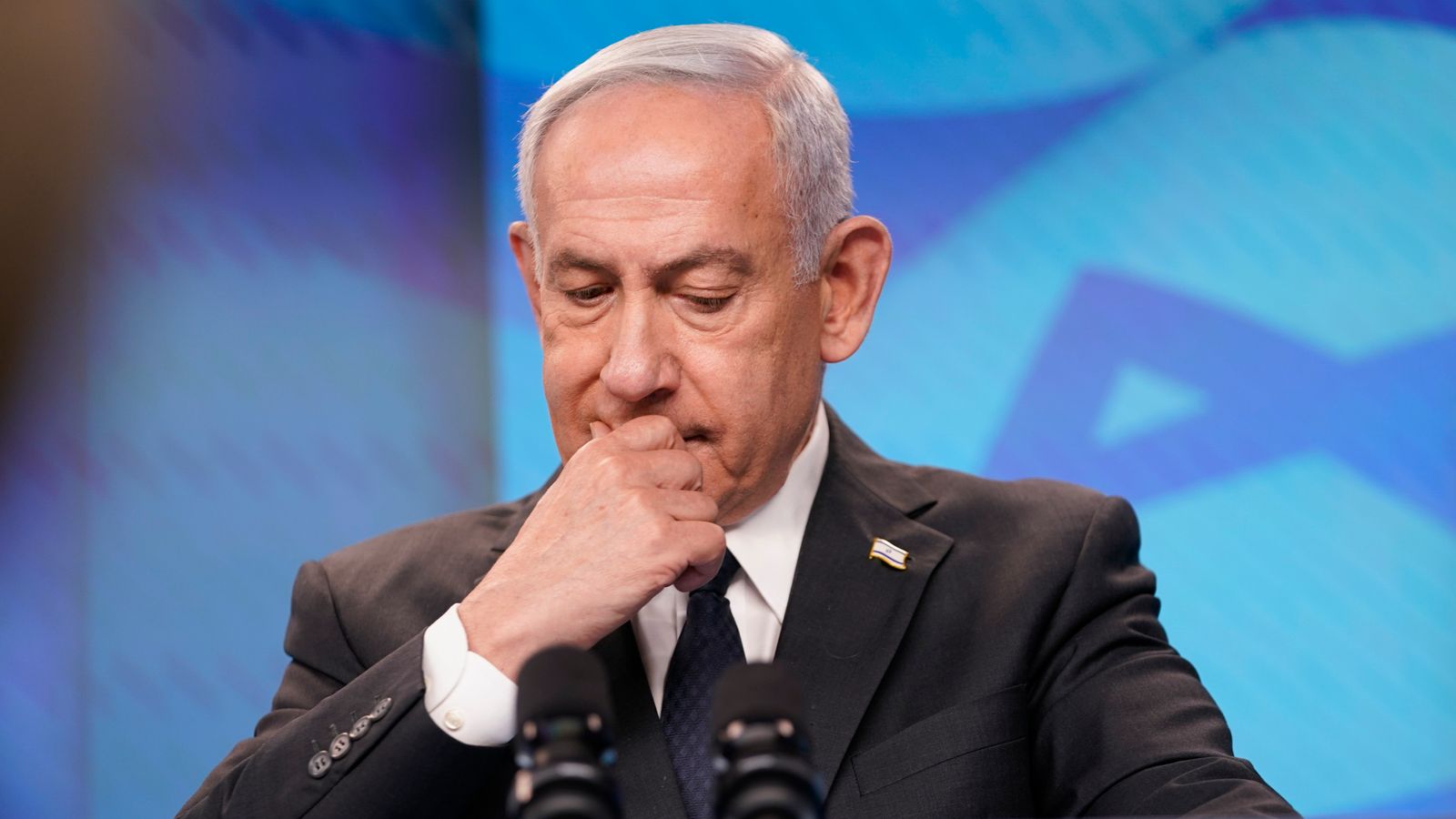
Netanyahu is learning limits of what can be achieved by military power alone


It is hard to remember the Middle East before October 7 2023, so much has changed in the wake of its horrendous events.
Before the attack, the region’s geopolitical tectonic plates were grinding, but an uneasy status quo held sway and observed certain rules.
Follow updates on Israel-Hamas war
But that day unleashed an earthquake, changing everything.
In two years of turmoil since, the region’s rulebook has been torn to pieces.
The first rule: Israel would manage the threat from Hamas but not try to eradicate it. Israel’s policy of dividing and ruling the Palestinians’ rival factions had come back to bite them.
Instead, Israelis insisted in one voice after October 7 no more “mowing the grass”, their euphemism for cutting Hamas down to size, from time to time. This time, the job must be finished.
That would change the way Israelis waged their war in Gaza. Not least in the way they would tolerate many more civilians dying, in the name of defeating their enemy. If the target’s rank was high enough, the deaths of scores of civilians – women and children – would be acceptable.
Watch The World: War in Gaza Special
Two years on from 7 October attacks
The outcome has been an unprecedentedly high civilian death toll.
Israel’s war on Hamas has now killed more than 67,000 people in Gaza, most of them civilians, according to the Hamas-run health ministry, which does not differentiate between civilians or combatants.
Its impact will be felt for generations to come, not least no doubt on the potential radicalisation of those who have survived.
And it has seen Israel, a nation conceived in the wake of one genocide, accused of perpetrating another. That stain, justified or not, has implications for Israel’s psyche and own sense of identity.
Israel denies all accusations of genocide. But it has potentially grave repercussions for its future.
Abroad, popular support for Israel has fallen most of all among the young and most of all where it needs it most: America. The rule that supporting Israel will always be a vote-winner in the US is also now in question.
But the rules have changed Israel’s borders and in the way it has chosen to wield its increasingly hegemonic military power even more dramatically.
Read more from Sky News:
Peace plan – what you need to know
Trump urges peace talks ‘move fast’
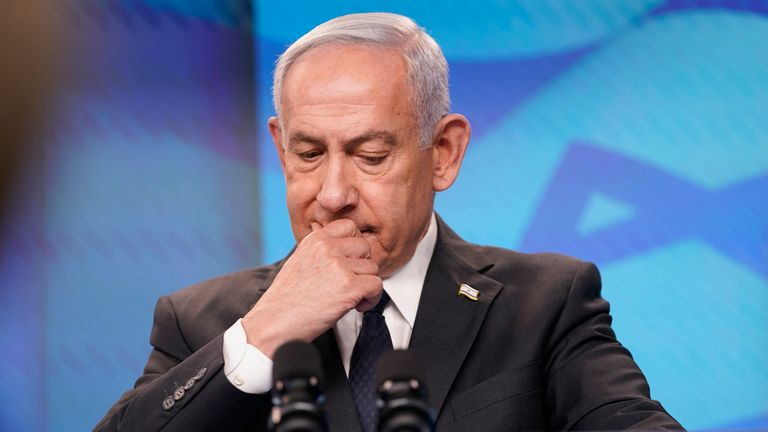
Benjamin Netanyahu’s Israel is now finding itself increasingly isolated. Pic: AP
Israel’s leaders found a new boldness in the wake of October 7, at the same time as technological and tactical advances gave them the tools to pursue it.
The pager operation against Hezbollah that crippled the Shiite Lebanese militia was planned long before October 7. But it reached operational utility just as Israel found the risk appetite to implement it.
It was decisive in the events that led to the assassination of Hezbollah leader Hassan Nasrallah.
Since 2006 and Israel’s last war with Hezbollah, the rule held that neither would risk provoking another. It would be too devastating for both.

Listen to The World with Richard Engel and Yalda Hakim every Wednesday
The pager attack disabled Hezbollah’s ability to launch tens of thousands of missiles, after months of attritive attacks on them by Israel.
For as long as Hezbollah held that arsenal of missiles, it was assumed Israel would not risk attacking Iran. With that neutralised, Israel could now take on its ultimate enemies there.
The rules were rewritten in the skies over Iran and Israel in their first direct attacks on each other in April and October last year. Then, in June this year, Israel unleashed a devastating 12-day war on Iran, joined in its closing stages by US warplanes too.
But after reaching that zenith in military supremacy, Israel has since overreached. A failed airstrike on Hamas leaders in Doha, Qatar, provoked the anger of allies, most crucially Donald Trump.
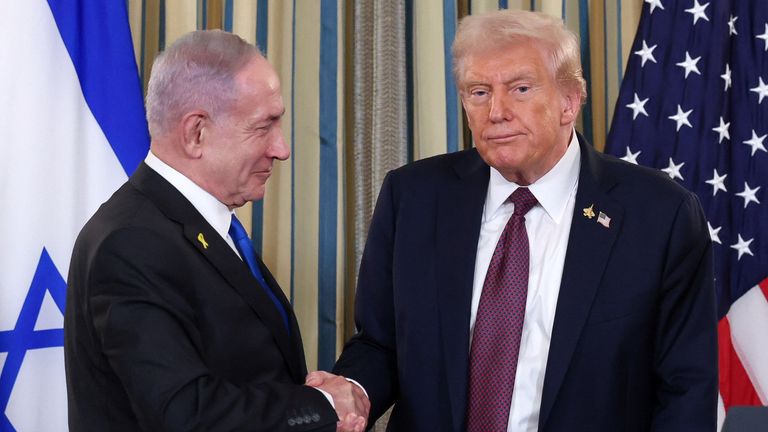
Netanyahu has provoked Trump in the past with Israel’s military offensives. Pic: Reuters
In the prelude to this anniversary, Benjamin Netanyahu is learning the limits of what can be achieved by military power alone. Having invested more in military action than constructive diplomacy, Netanyahu’s Israel is now increasingly isolated.
Israel’s leader finds himself hemmed in by a US president being leant on by Arab allies. Trump will not tolerate Israel annexing the West Bank and wants a deal that offers a “credible pathway” to a future Palestinian state.
Netanyahu needs to show he can still bring the remaining hostages home, that fighting the war this long was justified, and he has a plan for what happens the day after.
And if the war is being drawn to a close, with American mediation and the support of Arab partners and allies, they all have responsibilities too.
To find a better new status quo with far better rules, to make sure the carnage and regionwide turmoil of the last two years can be brought to a close and never repeated.
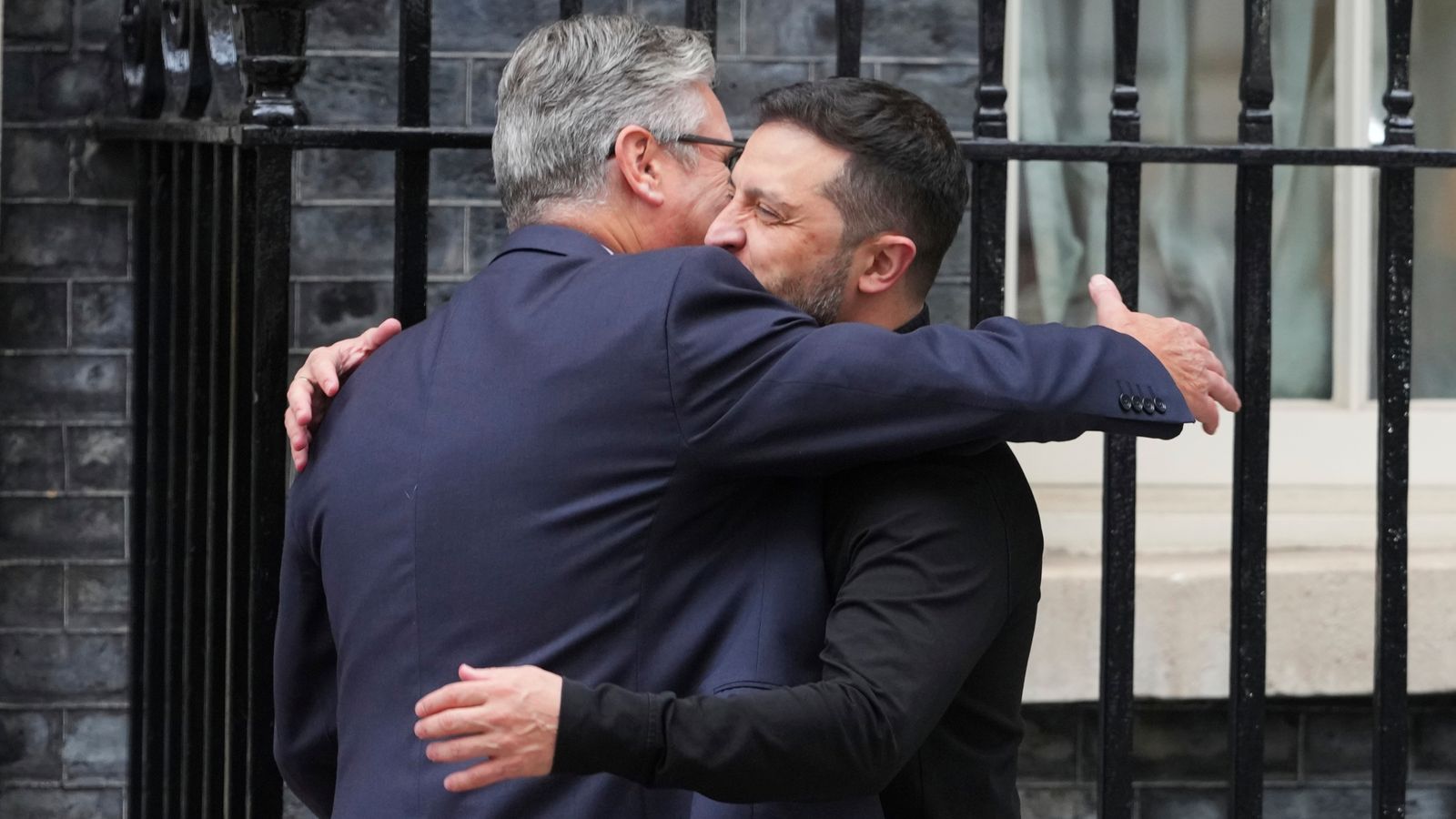
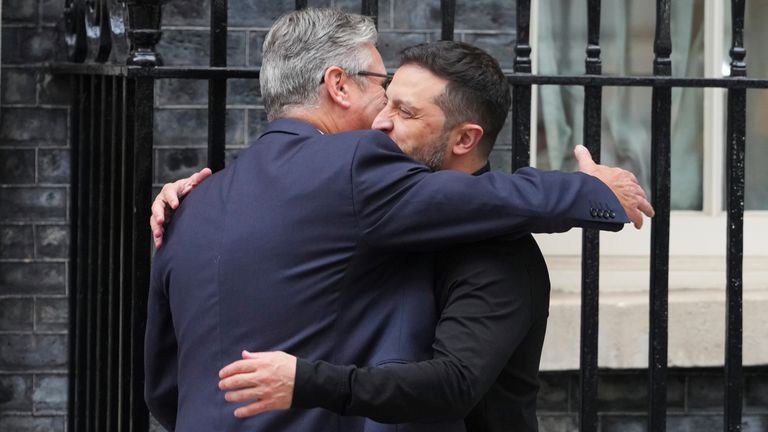
Volodymyr Zelenskyy is heading to Downing Street once again, but Prime Minister Sir Keir Starmer will be keen to make this meeting more than just a photo op.
On Monday the prime minister will welcome not only the Ukrainian president, but also E3 allies France and Germany to discuss the state of the war in Ukraine.
French President Emmanuel Macron and German Chancellor Friedrich Merz will join Sir Keir in showing solidarity and support for Ukraine and its leader, but it’s the update on the peace negotiations that will be the main focus of the meet up.
The four leaders are said to be set to not only discuss those talks between Ukraine, the US and Russia, but also to talk about next steps if a deal were to be reached and what that might look like.
Ahead of the discussions, Sir Keir spoke with the Dutch leader Dick Schoof where both leaders agreed Ukraine’s defence still needs international support, and that Ukraine’s security is vital to European security.
But while Russia’s war machine shows no signs of abating, a warm welcome and kind words won’t be enough to satisfy the embattled Ukrainian president at a time when Russian drone and missile attacks continue to bombard Kyiv.
Keir Starmer welcoming Volodymyr Zelenskyy to Downing Street during a previous visit. Pic: AP
What is the latest in negotiations?
Over the weekend, Mr Zelenskyy said he had discussed “next steps” with US President Donald Trump’s advisers and was “determined to keep working in good faith”.
“The American representatives know the basic Ukrainian positions,” Mr Zelenskyy said in his nightly video address. “The conversation was constructive, although not easy.”
But on Sunday evening, ahead of an event at the Kennedy Center, President Trump said he was “disappointed” with Mr Zelenskyy, as was asked about the next steps in Russia-Ukraine talks following negotiations.
He said: “We’ve been speaking to President Putin and we’ve been speaking to Ukrainian leaders, including Zelenskyy, President Zelenskyy.
“And I have to say that I’m a little bit disappointed that President Zelenskyy hasn’t yet read the proposal. That was as of a few hours ago.
“His people love it. But he hasn’t – Russia’s fine with it. Russia’s you know, Russia, I guess, would rather have the whole country when you think of it. But Russia is, I believe, fine with it, but I’m not sure that Zelenskyy’s fine with it. His people love it but he hasn’t read it.”
Read more:
Ukraine has become Europe’s war – so why doesn’t it act like it?
Inside a secret underground military base in eastern Ukraine
On Saturday, Keith Kellogg, Trump’s outgoing Ukraine envoy, had told the Reagan National Defence Forum that efforts to resolve the conflict were in “the last 10 metres”.
Kremlin spokesman Dmitry Peskov praised new US security strategy over the weekend, adding that Russia hopes this would lead to “further constructive cooperation with Washington on the Ukrainian settlement”.
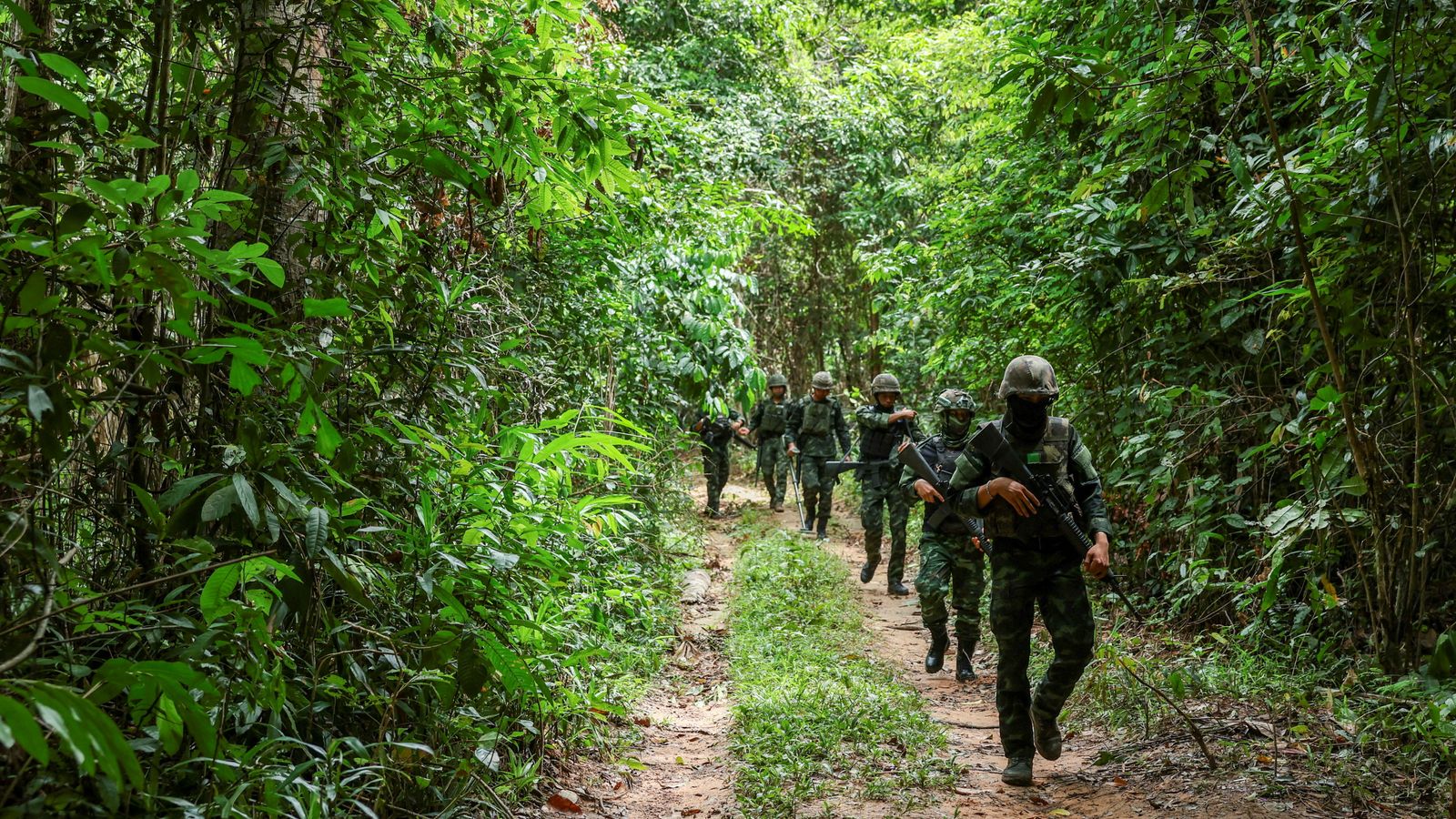
Thailand has launched airstrikes and said it has struck military targets along the border with Cambodia, as both sides accused the other of attacking first.
One Thai soldier was killed and eight others wounded, according to Thai army spokesperson Major General Winthai Suvaree, who also said Cambodian troops fired first into Thai territory.
Thailand used aircraft “to strike military targets in several areas to suppress Cambodian supporting fire attacks,” he added.
In Cambodia, Met Measpheakdey, deputy governor of Oddar Meanchey province, wrote in a Facebook post that three civilians had been seriously injured.
Cambodian officials said the Thai military attacked their troops first in Preah Vihear province.
“Cambodia urges that Thailand immediately stop all hostile activities that threaten peace and stability in the region,” said Cambodian defence ministry spokesperson Maly Socheata.
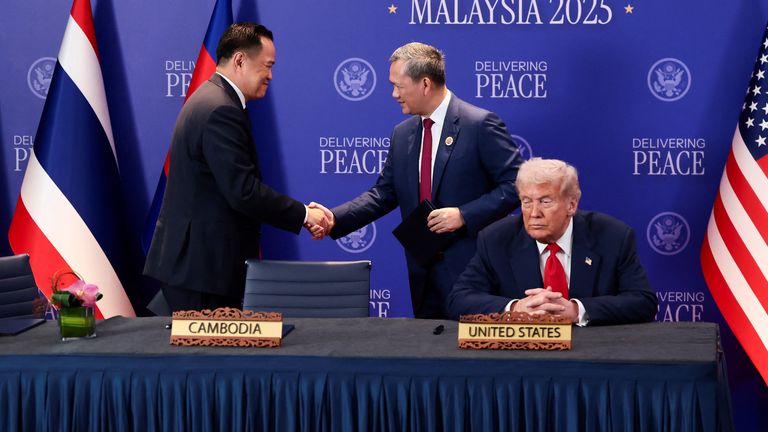
Tensions have simmered since the neighbouring countries signed a US-brokered ceasefire agreement in October, put forward by US President Donald Trump.
Thailand’s Prime Minister Anutin Charnvirakul and Cambodia’s Prime Minister Hun Manet shake hands next to US President Donald Trump in October. Pic: Reuters
Their territorial disputes led to five days of combat in July that killed dozens of soldiers and civilians.
Thai Prime Minister Anutin Charnvirakul said that military operations would be carried out as necessary to defend the country and protect public safety.
“Thailand has never wished for violence. I’d like to reiterate that Thailand has never initiated a fight or an invasion, but will never tolerate a violation of its sovereignty,” he said.
In Thailand, more than 385,000 civilians across several border districts are being evacuated, with over 35,000 already housed in temporary shelters, military officials said.
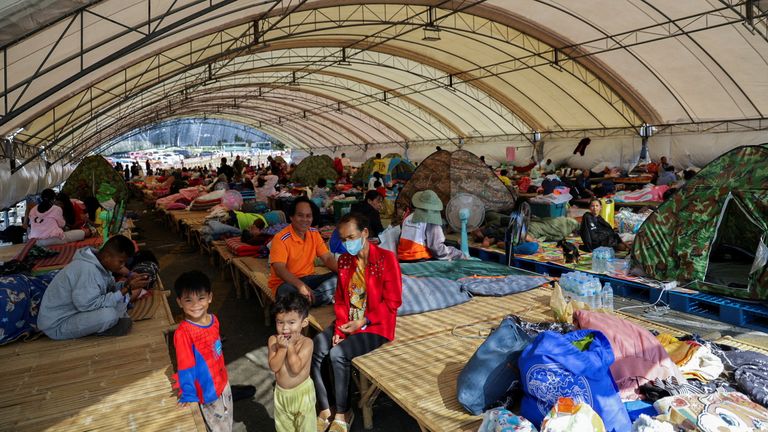
People rest at a shelter in Buriram province, Thailand, after fresh military clashes. Pic: Reuters
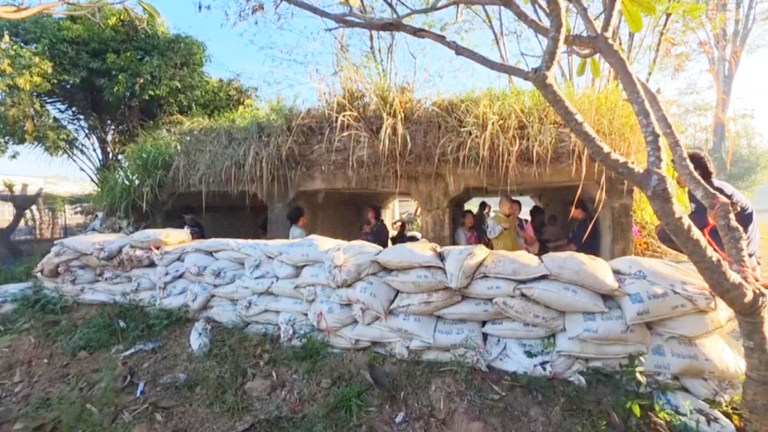
A concrete shelter in Thailand’s Ubon Ratchathani province. Pic: AP
Meanwhile, the Cambodian Education Ministry said several schools along the border had been shut.
Footage posted online showed what appeared to be students hurriedly leaving classes to meet their parents.
Malaysia’s Prime Minister Anwar Ibrahim urged Thailand and Cambodia to “exercise maximum restraint”.
In a post on social media, he added: “Our region cannot afford to see long-standing disputes slip into cycles of confrontation.”
Si Sa Ket, Surin and Ubon Ratchathani provinces in Thailand, and Cambodia’s Preah Vihear and Oddar Meanchey provinces were among the areas said to be caught up in the latest clashes.
On Sunday, both nations accused each other of opening fire along the border in what the Thai army said was an incident that lasted around 20 minutes and resulted in the injury of two of its soldiers.
But Cambodia said that the Thai side fired first and that Cambodian troops did not retaliate.
For more than a century, Thailand and Cambodia have contested sovereignty at points along their 508-mile (817km) land border.
Donald Trump’s eldest son has said his father may walk away from the Ukraine peace process, claiming the issue is not a priority for Americans, and signalling Europe needs a better plan.
In a wide-ranging discussion with Sky’s lead world news presenter Yalda Hakim at Doha Forum 2025, Donald Trump Jr addressed issues including the US administration’s recent diplomatic efforts around the world.
He was speaking in his capacity as a business leader, setting out his agenda for “America first” investments in defence technology and artificial intelligence (AI), drawing a direct line between global stability and economic prosperity.
Ukraine war latest – follow live updates
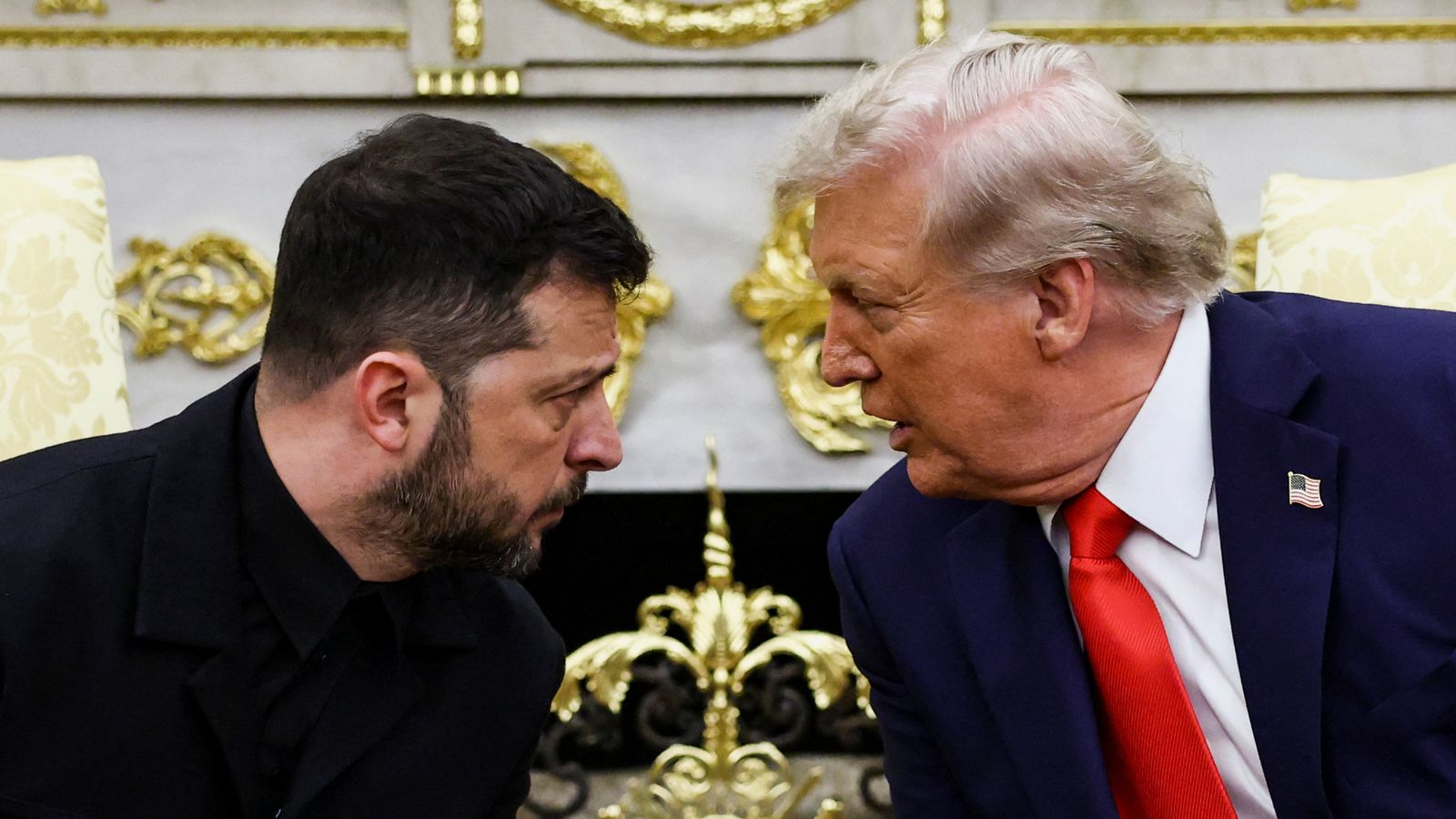
Donald Trump meeting Volodymyr Zelenskyy in Washington earlier this year. Pic: Reuters
When asked directly if he believed the US president would walk away from Ukraine, he answered: “I think he may, what’s good about my father and what’s unique about my father is you don’t know what he’s going to do. He’s unpredictable.”
President Trump has led renewed efforts for a ceasefire deal with Russia in recent months.
Drawing a parallel with his father’s current “war” on drug cartels, Donald Trump Jr described gangs bringing illegal drugs into America as a “far greater clear and present danger to the US than anything [going on] in the Ukraine or Russia”.
While he said he did not believe Ukraine would be “abandoned”, he said: “The American public doesn’t have the appetite [for endless wars and further funding of Ukraine’s military efforts].”
Describing Ukraine as “a far more corrupt country than Russia”, he characterised Ukrainian President Zelenskyy as “one of the great marketeers of all time”, who he said had become “a borderline deity, especially to the left”.
He went on to describe President Trump’s approach as “common sense”.
China rivalry was the focus, but Musk got a mention

In a country and at a conference which is friendly, even admiring of the Trump administration, Don Jr was in his element.
He’s here in his capacity as a business leader, promoting his venture, 1789 Capital which claims to be focused on “America First” investments.
But he wasn’t shy about discussing his father’s foreign policy achievements, boasting that Donald Trump had resolved seven or eight wars – conflicts that most ordinary Americans were unaware of.
His pitch is bullish and direct – the current US administration is projecting strength globally, stopping wars and creating investment opportunities which serves the American economy. It’s the MAGA mentality for the global audience.
It’s clear that the rivalry with China is their biggest focus, especially finding ways to combat their dominance over critical minerals.
“America can no longer just sit there and hope that China is going to be a good actor… I think the rest of the world understands that they want America to be at the forefront of all of that.”
When I asked him about recent efforts by President Trump to bring the war in Ukraine to an end, he responded forcefully. “We want peace, we want to stop the death.”
But he went on to say that Europe needed to shoulder the burden and currently they have no plan.
As he sat on the stage in Qatar, the country which has been at the centre of the ceasefire efforts for Gaza, he expressed hope that peace would prevail, but balanced expectations America would fund its re-construction. This would have to be a global effort.
“If there’s one thing my father is, it’s a builder… I think he can be the greatest construction manager in the history of the world, but no one in America wants to bear the entire responsibility of that.”
And, away from international diplomatic efforts, he was happy to announce a breakthrough closer to home.
The “bromance” with Elon Musk and President Trump is back on – calling the entrepreneur a “generational talent, a generational level of genius”.
‘Bromance’ back on
He also confirmed that Tesla billionaire Elon Musk was “100% back in the fold”, after previously appearing to fall out with the president.
Earlier this year, Donald Trump Jr’s investment company, 1789 Capital, heavily invested in some of Musk’s companies, including SpaceX.

Elon Musk and Donald Trump in the Oval Office at the White House in May. Pic: AP
Directly comparing President Trump with Musk, he said: “Imagine dealing with one Donald Trump – now I have to deal with two.
“They’re very similar that way, so it created some headaches… but the reality is they’re both very much aligned, they’re on message with what we want to do with our country. What we want to do with freedom of speech.”
He went on: “Elon did incredible things for Twitter, really allowed the democratisation of truth and freedom and free speech to occur. That’s something that is a true threat in America right now.”
He also praised Musk as “changing the face of free speech, science and technology”, adding, “we have to protect our geniuses”.
When asked whether Mr Trump would stand for a third term, he joked that he could be “just trolling” those on the left.
He went on, “He’s the most unpredictable person, probably in the history of politics. Which is why he’s able to get something done. We’ll see.”
-
 Sports2 years ago
Story injured on diving stop, exits Red Sox game
-
 Sports3 years ago
‘Storybook stuff’: Inside the night Bryce Harper sent the Phillies to the World Series
-
 Sports2 years ago
Game 1 of WS least-watched in recorded history
-
 Sports3 years ago
Button battles heat exhaustion in NASCAR debut
-
 Sports3 years ago
MLB Rank 2023: Ranking baseball’s top 100 players
-
Sports4 years ago
Team Europe easily wins 4th straight Laver Cup
-
 Environment3 years ago
Japan and South Korea have a lot at stake in a free and open South China Sea
-
 Environment1 year ago
Here are the best electric bikes you can buy at every price level in October 2024