
Starmer refuses to rule out tax rises as he flies business leaders to India

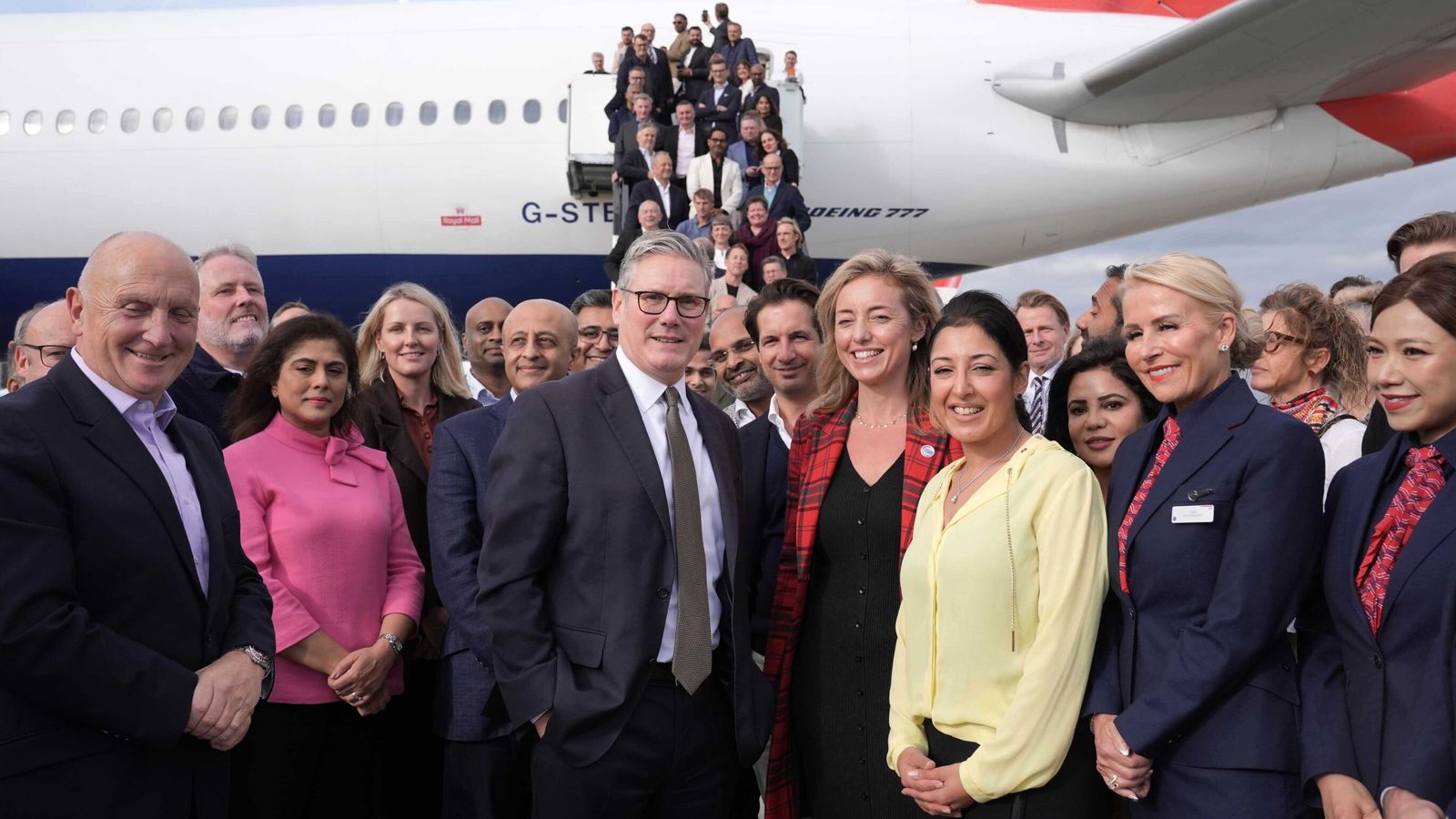
Sir Keir Starmer has begun the first full-blown trade mission to India since Theresa May was prime minister, bringing 125 UK CEOs, entrepreneurs and university leaders to Mumbai.
The prime minister flew on a plane with dozens of Britain’s most prominent business people, including bosses from BA, Barclays, Standard Chartered, BT and Rolls-Royce, for the two-day trip designed to boost ties between the two countries.
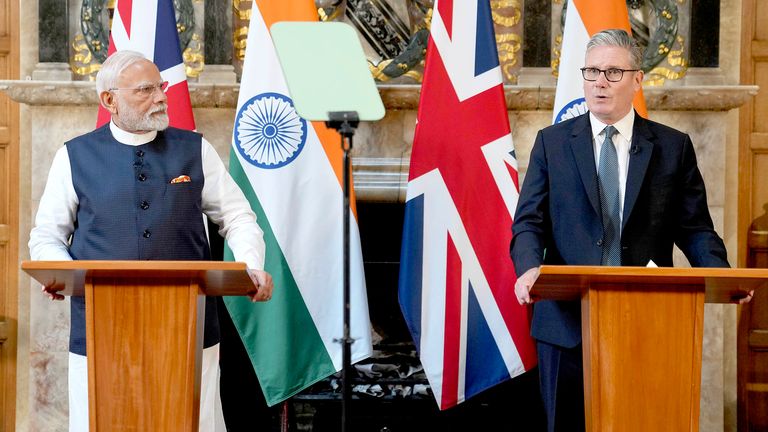
Starmer will meet Prime Minister Narendra Modi on Thursday, five months after the UK signed the first trade deal with India since Brexit.
The agreement has yet to be implemented, with controversial plans to waive national insurance for workers employed by big Indian businesses sent to the UK still the subject of a forthcoming consultation.
Speaking to journalists on the plane on the way out, the prime minister said he was determined to boost ties between the two countries.
The trip has been arranged to coincide with the Conservative Party conference, with the first day of meetings coinciding with Kemi Badenoch’s speech to activists in Manchester.
Politics latest – Badenoch: ‘Robert Jenrick is not the leader of the Conservative Party’
However, the business delegation is likely to use the trip to lobby the prime minister not to put more taxes on them in the November budget.
Sir Keir has already turned down the wish of some of the CEOs on the trip to increase the number of visas.
“The visa situation hasn’t changed with the free trade agreement, and therefore we didn’t open up more visas,” he said.
He told business that it wasn’t right to focus on visas, telling them: “The issue is not about visas. It’s about business-to-business engagement and investment and jobs and prosperity coming into the United Kingdom.”
Narendra Modi and Keir Starmer during a press conference in July. Pic: PA
The prime minister sidestepped questions about Mr Modi’s support of Russian leader Vladimir Putin, whom he wished happy birthday on social media. US President Donald Trump has increased tariffs against India, alleging that Indian purchases of Russian oil are supporting the war in Ukraine.
Asked about Mr Modi wishing Mr Putin happy birthday, and whether he had leverage to talk to Mr Modi about his relationship with Russia, Sir Keir sidestepped the question.
“Just for the record, I haven’t… sent birthday congratulations to Putin, nor am I going to do so,” he said. “I don’t suppose that comes as a surprise. In relation to energy, and clamping down on Russian energy, our focus as the UK, and we’ve been leading on this, is on the shadow fleet, because we think that’s the most effective way. We’ve been one of the lead countries in relation to the shadow fleet, working with other countries.”
Sir Keir refused to give business leaders any comfort about the budget and tax hikes, despite saying in his conference speech he recognised the last budget had an impact.
“What I acknowledged in my conference and I’ve acknowledged a number of times now, is we asked a lot of business in the last budget. It’s important that I acknowledge that, and I also said that that had helped us with growth and stabilising the economy,” he added. “I’m not going to make any comment about the forthcoming budget, as you would expect; no prime minister or chancellor ever does.”
Asked if too many wealthy people were leaving London, he said: “No. We keep a careful eye on the figures, as you would expect.
“The measures that we took at the last budget are bringing a considerable amount of revenue into the government which is being used to fix things like the NHS. We keep a careful eye on the figures.”

Shares in The Magnum Ice Cream Company (TMICC) have fallen slightly on debut after the completion of its spin-off from Unilever amid a continuing civil war with one of its best-known brands.
Shares in the Netherlands-based company are trading for the first time following the demerger.
It creates the world’s biggest ice cream company, controlling around one fifth of the global market.
Primary Magnum shares, in Amsterdam, opened at €12.20 – down on the €12.80 reference price set by the EuroNext exchange, though they later settled just above that level, implying a market value of €7.9bn – just below £7bn.
The company is also listed in London and New York.
Money latest: The cheapest days to travel by plane
Unilever stock was down 3.1% on the FTSE 100 in the wake of the spin off.
The demerger allows London-headquartered Unilever to concentrate on its wider stable of consumer brands, including Marmite, Dove soap and Domestos.
The decision to hive off the ice cream division, made in early 2024, gives a greater focus on a market that is tipped to grow by up to 4% each year until 2029.
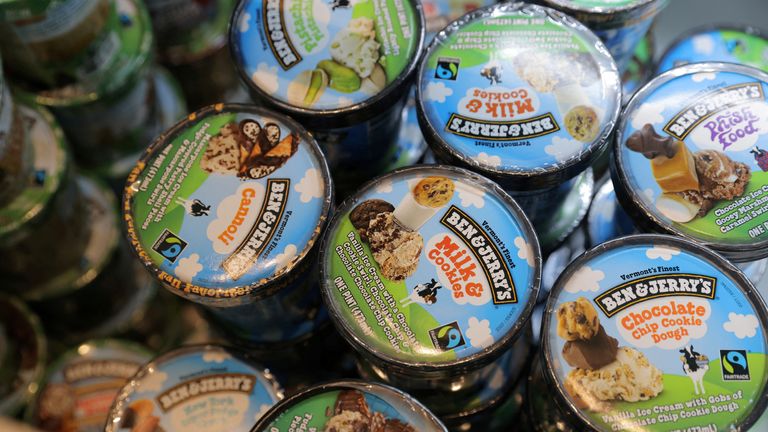
Ben & Jerry’s accounts for a greater volume of group revenue now under TMICC. Pic: Reuters
But it has been dogged by a long-running spat with the co-founders of Ben & Jerry’s, which now falls under the TMICC umbrella and accounts for 14% of group revenue.
Unilever bought the US brand in 2000, but the relationship has been sour since, despite the creation of an independent board at that time aimed at protecting the brand’s social mission.
The most high-profile spat came in 2021 when Ben & Jerry’s took the decision not to sell ice cream in Israeli-occupied Palestinian territories on the grounds that sales would be “inconsistent” with its values.
Unilever responded by selling the business to its licensee in Israel.
A series of rows have followed akin to a tug of war, with Magnum refusing repeated demands by the co-founders of Ben & Jerry’s to sell the brand back.
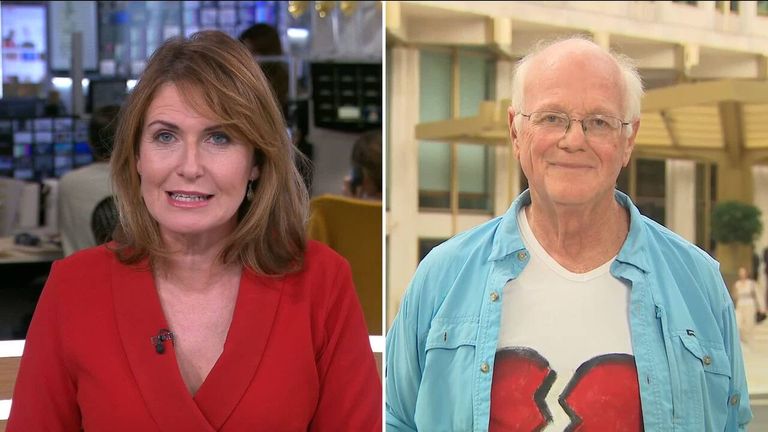
Sept: ‘Free Ben & Jerry’s’
Magnum and Unilever argue its mission has strayed beyond what was acceptable back in 2000, with the brand evolving into one-sided advocacy on polarising topics that risk reputational and business damage.
TMICC is currently trying to remove the chair of Ben & Jerry’s independent board.
It said last month that Anuradha Mittal “no longer meets the criteria” to serve after internal investigations.
An audit of the separate Ben & Jerry’s Foundation, where she is also a trustee, found deficiencies in financial controls and governance. Magnum said the charitable arm risked having funding removed unless the alleged problems were addressed.
The Reuters news agency has since reported that Ms Mittal has no plans to quit her roles, and accused Magnum of attempts to “discredit” her and undermine the authority of the independent board.
Magnum boss Peter ter Kulve said on Monday: “Today is a proud milestone for everyone associated with TMICC. We became the global leader in ice cream as part of the Unilever family. Now, as an independent listed company, we will be more agile, more focused, and more ambitious than ever.”
Commenting on the demerger, Hargreaves Lansdown equity analyst Aarin Chiekrie said: “TMICC is already free cash flow positive, and profitable in its own right. The balance sheet is in decent shape, but dividends are off the cards until 2027 as the group finds its footing as a standalone business.
“That could cause some downward pressure on the share price in the near term, as dividend-focussed investment funds that hold Unilever will be handed TMICC shares, the latter of which they may be forced to sell to abide by their investment mandate.”
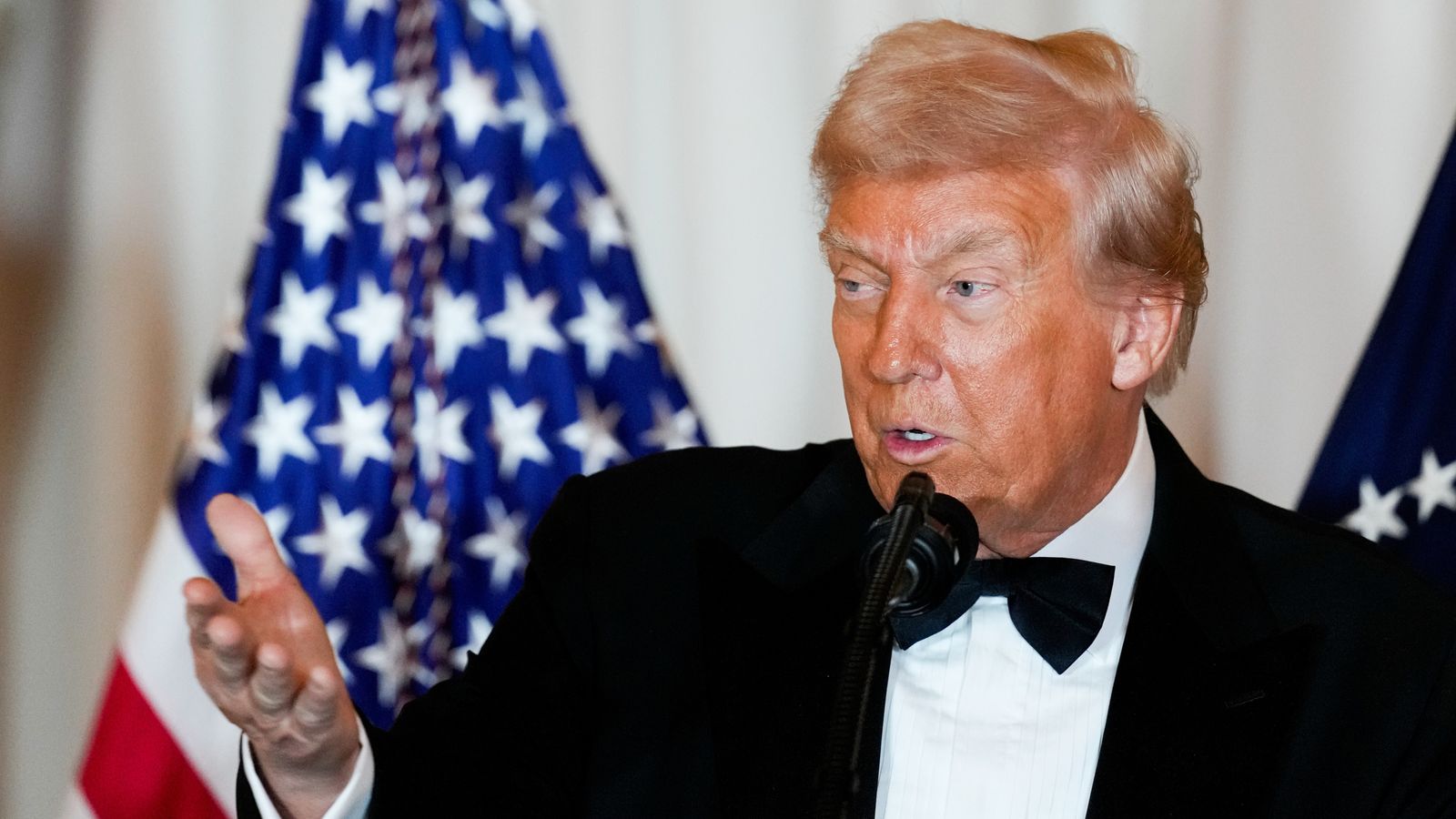

Donald Trump has said he will be “involved” in the decision on whether Netflix should be allowed to buy Warner Bros, as the $72bn (£54bn) deal attracts a media industry backlash.
The US president acknowledged in remarks to reporters there “could be a problem”, acknowledging concerns over the streaming giant’s market dominance.
Crucially, he did not say where he stood on the issue.
Money latest: The cheapest days to travel by plane
It was revealed on Friday that Netflix, already the world’s biggest streaming service by market share, had agreed to buy Warner Bros Discovery’s TV, film studios and HBO Max streaming division.
The deal aims to complete late next year after the Discovery element of the business, mainly legacy TV channels showing cartoons, news and sport, has been spun off.
But the deal has attracted cross-party criticism on competition grounds, and there is also opposition in Hollywood.
Netflix agrees $72bn takeover of Warner Bros
The Writers Guild of America said: “The world’s largest streaming company swallowing one of its biggest competitors is what antitrust laws were designed to prevent.
“The outcome would eliminate jobs, push down wages, worsen conditions for all entertainment workers, raise prices for consumers, and reduce the volume and diversity of content for all viewers.”
File pic: Reuters
Republican Senator, Roger Marshall, said in a statement: “Netflix’s attempt to buy Warner Bros would be the largest media takeover in history – and it raises serious red flags for consumers, creators, movie theaters, and local businesses alike.
“One company should not have full vertical control of the content and the distribution pipeline that delivers it. And combining two of the largest streaming platforms is a textbook horizontal Antitrust problem.
“Prices, choice, and creative freedom are at stake. Regulators need to take a hard look at this deal, and realize how harmful it would be for consumers and Western society.”
Paramount Skydance and Comcast, the parent company of Sky News, were two other bidders in the auction process that preceded the announcement.
The Reuters news agency, citing information from sources, said their bids were rejected in favour of Netflix for different reasons.
Paramount’s was seen as having funding concerns, they said, while Comcast’s was deemed not to offer so many earlier benefits.
Paramount is run by David Ellison, the son of the Oracle tech billionaire Larry Ellison, who is a close ally of Mr Trump.
The president said of the Netflix deal’s path to regulatory clearance: “I’ll be involved in that decision”.
On the likely opposition to the deal. he added: “That’s going to be for some economists to tell. But it is a big market share. There’s no question it could be a problem.”
-
 Sports2 years ago
Story injured on diving stop, exits Red Sox game
-
 Sports3 years ago
‘Storybook stuff’: Inside the night Bryce Harper sent the Phillies to the World Series
-
 Sports2 years ago
Game 1 of WS least-watched in recorded history
-
 Sports3 years ago
Button battles heat exhaustion in NASCAR debut
-
 Sports3 years ago
MLB Rank 2023: Ranking baseball’s top 100 players
-
Sports4 years ago
Team Europe easily wins 4th straight Laver Cup
-
 Environment3 years ago
Japan and South Korea have a lot at stake in a free and open South China Sea
-
 Environment1 year ago
Here are the best electric bikes you can buy at every price level in October 2024