
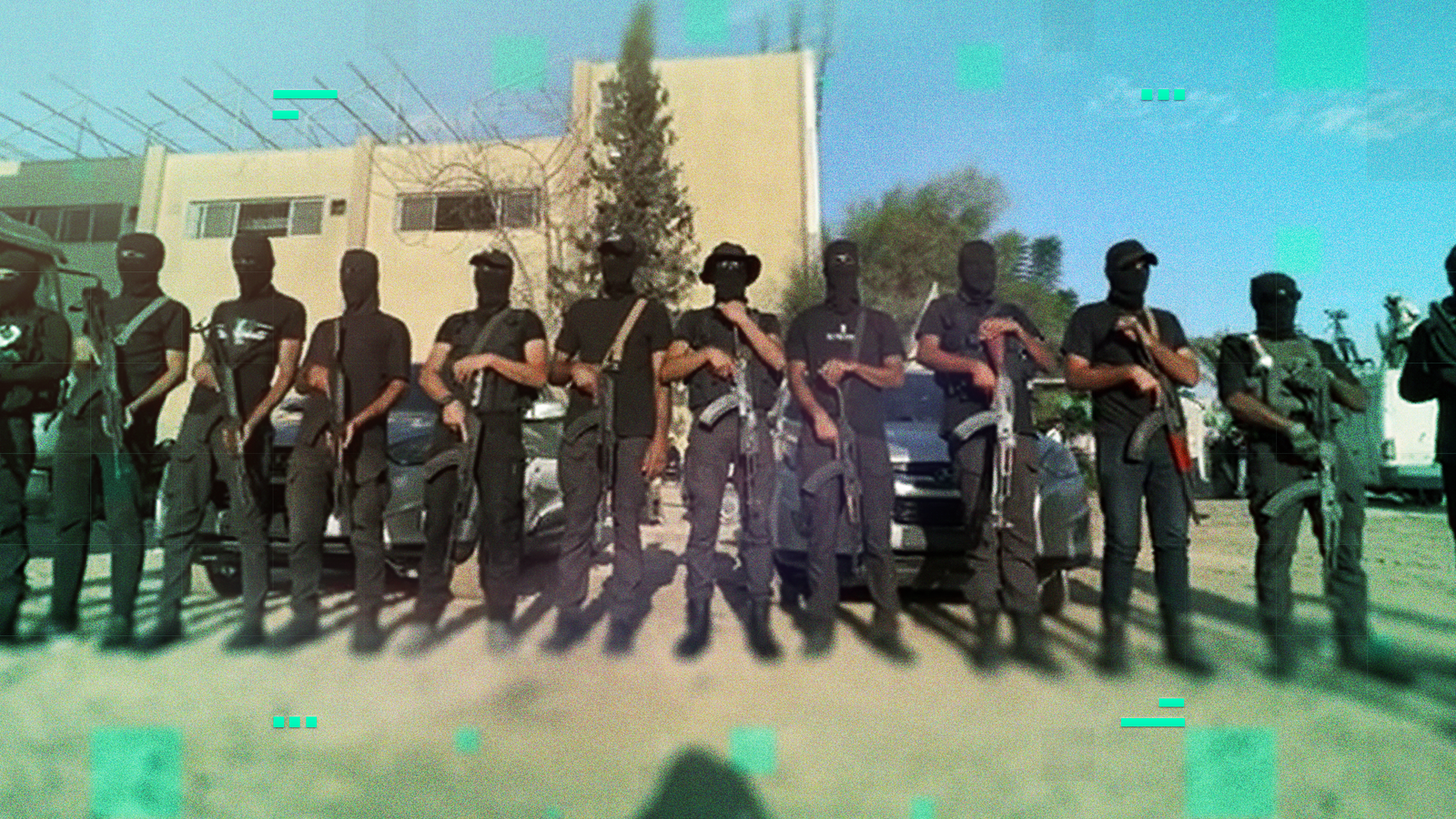
Hamas battles rival militias for control of Gaza following Israel’s withdrawal

One week into the ceasefire, a new kind of violence is plaguing the Gaza Strip.
Public executions, arson attacks and gun battles have raised the spectre of a slide into civil chaos as Hamas battles armed groups it accuses of collaborating with Israel.
Experts say Hamas is attempting to reassert its authority following Israel’s withdrawal from parts of the Gaza Strip.
But members of three anti-Hamas militias, operating from areas still controlled by Israel, have told Sky News they have no intention of laying down their arms and plan to fight Hamas to the end.
The fighting has drawn the ire of US President Donald Trump, who posted on his Truth Social platform on Thursday: “If Hamas continues to kill people in Gaza, which was not the deal, we will have no choice but to go in and kill them.”
Who are the Doghmosh clan?
On the night the ceasefire was agreed, Majed Doghmosh – not his real name – was sheltering in Gaza City’s abandoned Jordanian Hospital alongside his parents and six-year-old sister.
Like many residents of the surrounding Al Sabra neighbourhood, Majed belongs to the Doghmosh clan – an influential extended family which has long had a tense relationship with Hamas.
Many members of the clan had fled to the hospital two weeks earlier, after the Israeli forces entered Al Sabra.
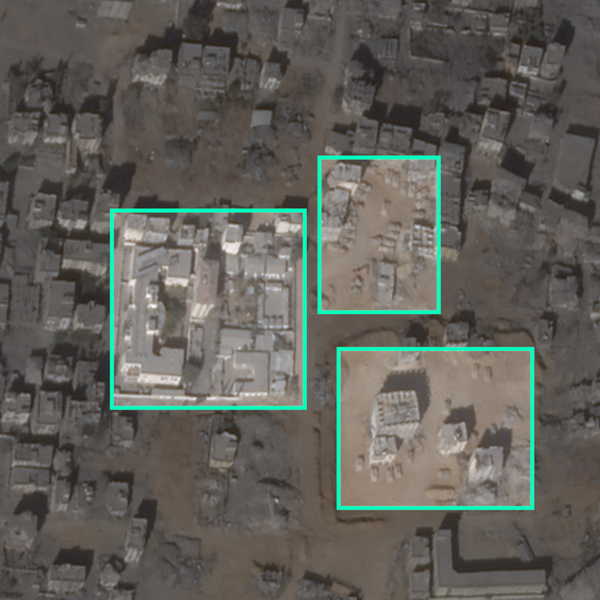
Israeli tanks visible outside the Jordanian Hospital (left) in Gaza City, 7 October 2025. Pic: Planet Labs PBC
When the ceasefire was announced, Majed says, “people began to rejoice that the war was over and life would return to normal.”
But as people were returning to their homes, a contingent from Gaza’s Hamas-led security forces arrived at the hospital. They said they were searching for collaborators.
‘They came with hundreds of people’
“We, as a family in general, have completely refused any cooperation with the occupation,” says Nizar Doghmosh, the family’s leader in Gaza.
“But the occupation managed to infiltrate one… weak, shallow-minded, foolish person.”
While in the Jordanian Hospital, Nizar says, this person recruited seven or eight others into an anti-Hamas militia.
Instead of handing themselves in, these men opened fire on the security forces, killing Mohammed Aqel – the son of senior Hamas commander Imad Aqel.
“Suddenly, we started hearing that Hamas wants to kill everyone who calls himself a Doghmosh,” Majed says.
“They came with hundreds of people, killing women, children and young people and burning down our homes.”
Majed fled, but left behind his parents and sister – who he says are still trapped and hiding in Al Sabra neighbourhood.
Palestinian journalist and social media influencer Saleh Al Ja’afari was killed on Sunday while reportedly covering the fighting in Al Sabra. It remains unclear who shot him.
Footage posted on Sunday shows a gun battle at a junction near the neighbourhood.
On Monday evening, footage emerged of a mass public execution at the same intersection.
“All they wanted were 6 or 7 people, and these people were killed,” says Basel Doghmosh – not his real name – who also managed to escape the fighting. “Now they are killing everyone.”
Speaking to Sky News in Gaza, Hamas spokesman Hazem Qassem described these incidents as “efforts to maintain order in Gaza, not acts of revenge”.
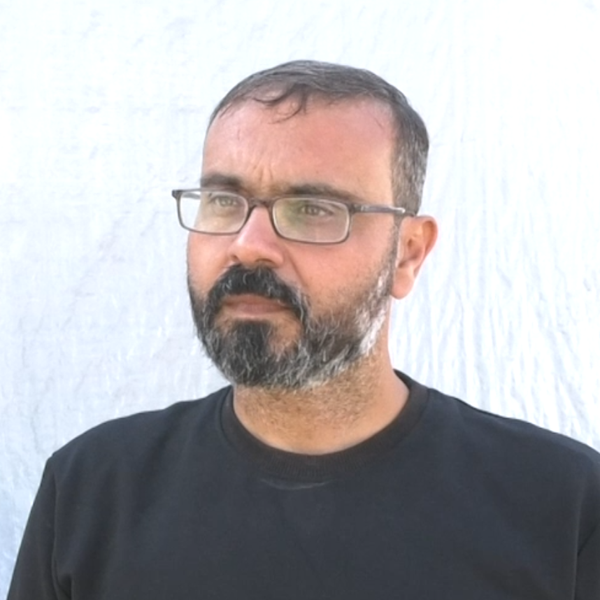
Hamas spokesman Hazem Qassem told Sky News that Gaza’s government is attempting to maintain order.
“Hamas has not targeted any family,” he said.
“The occupation has formed armed militias loyal to it, and these militias are accused of high treason – the most severe charge in Palestinian revolutionary law.”
At least four anti-Hamas militias
Hamas has made a show of force in recent days, with its fighters appearing on street patrols and at hostage handover ceremonies across the Gaza Strip.
Amjad Iraqi, a senior analyst at the International Crisis Group, says that Hamas’s “vicious” response to the Doghmosh clan is partly intended to deter other armed groups from challenging its authority.
Sky News has confirmed that at least four anti-Hamas militias are currently active within the Gaza Strip, all of them based in areas still under Israeli control – where Hamas is unable to operate freely.
Who is Yasser Abu Shabab?
The most influential is a former looting gang led by Yasser Abu Shabab, which controls territory along Gaza’s main route for transporting aid. The group claims that 1,500 people are living in their territory, including 500-700 fighters.
Abu Shabab’s militia maintains loose ties to the other groups, whose control of territory is much less clear.
Fighting shows need for multinational security force

It is quite clear from the evidence Sky has gathered that Israel has pursued a policy of divide and rule in Gaza and is continuing to do so. It has armed and financed militia who are rivals to Hamas and is now allowing them to operate in areas under its control.
The security situation in Gaza would be bad enough without that kind of meddling. From the start of the ceasefire Hamas has clearly set out to reassert control as would be expected.
Its spokesman has told Sky News it is only reestablishing law and order and averting chaos. But it has never tolerated any groups threatening its grip on power in Gaza and is unlikely to start doing so now. From the video footage emerging from Gaza and eyewitnesses we have spoken to it is working hard on dominating the strip as it did before.
As the UN agency UNRWA told Sky, the last thing Gazans need right now is fighting between Palestinians. It threatens their lives and hampers the vital effort to get aid into Gaza.
Hamas is likely to prevail in a struggle with smaller more disparate groups. That will then raise questions for both Israel and the Trump peace plan.
The Netanyahu government promised Israelis total victory over Hamas. Hamas is far from dismantled even if it is unlikely to renew hostilities anytime soon.
Donald Trump has repeated his demand Hamas disarm. That will not happen, not least because it would leave them at the mercy of their enemies.
The best hope for the peace plan and for Gaza is the insertion of the multinational security force envisaged in the Trump plan. But that would appear to be months away and by then Hamas may be confident enough not to cooperate.
Members from three of the militias told Sky News they have no intention of laying down their arms, and intend to fight Hamas to the end.
Ashraf Al Mansi’s militia
The leader of the fourth group, Ashraf Al Mansi, posted a statement to social media on Tuesday warning Hamas against approaching areas under their control.
Al Mansi’s militia has established itself north of Gaza City.
Its headquarters are at an abandoned school more than 500 metres inside the Israeli zone of control.
Although the militia claims to control significant territory in northern Gaza, Sky News has not seen any evidence of their presence more than 200 metres from the school.
Where do the Halas militia operate?
Further south, to the east of Gaza City, gunfire could be heard on Tuesday as Hamas battled another militia, led by Rami Halas.
On Sunday, 12 October, Gaza’s Hamas-run interior ministry offered amnesty to any militia members not involved in killings, so long as they turned themselves in by 19 October. “Consider this a final warning,” the statement said.
Speaking to Sky News from his base in the Israeli-controlled zone, a member of the Halas militia says that his group has no plans to surrender.
“Hamas destroyed the Gaza Strip – it has become nothing but a pile of ashes and stones,” says Basel.
“We are not afraid of death as long as it is for the sake of liberating the Gaza Strip from their ignorance, backwardness, and destruction.”
Fighting could imperil planned aid surge
The growing violence comes as Palestinians continue to wait for a surge in aid promised under the ceasefire agreement.
Gaza City is currently experiencing famine, with the rest of the territory suffering from severe food shortages after months of Israeli restrictions on aid deliveries.
Read more from Sky News:
Call for inter-Arab force to stop Hamas retaking Gaza
Will Trump stay the course over Gaza?
Analysis: There is a catch to Trump’s Gaza peace deal
Sam Rose, Gaza director of the UN refugee agency UNRWA, says that mounting an effective aid operation will require Israel to allow aid in at scale and to give aid groups the freedom to move across the Gaza Strip.
“But we also need to know that our trucks and staff are not at risk from fighting or looting by armed elements,” he adds.
Among those leading the looting of aid trucks in the past was Yasser Abu Shabab, whose group has transformed itself into the most influential of the four anti-Hamas militias identified by Sky News.
Last week, Sky News revealed that Israel is providing extensive support to the group, allowing them to smuggle cash, guns and cars into Gaza.
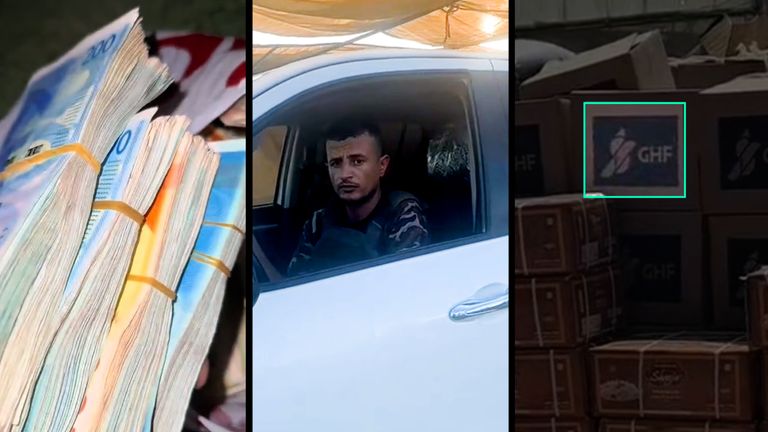
A Sky News investigation has uncovered new details about Israel’s support for a Palestinian rebel group
We also found that Abu Shabab’s militia has been receiving food aid from the Gaza Humanitarian Foundation (GHF), a US- and Israeli-backed aid group.
Footage from the camp, verified by Sky News, shows large stocks of fresh produce.
In other videos, militia members can be seen showing off stacks of cash and smuggled valuables.
Israel accused of ‘divide and conquer’ strategy
The GHF told Sky News that “every Gazan deserves to be fed with dignity – including those in areas controlled by [Abu Shabab]”. The IDF declined to comment on Sky’s findings.
Crisis Group’s Amjad Iraqi says that, by supporting groups such as Abu Shabab’s, Israel has been engaging in a strategy of “divide and conquer”.

Amjad Iraqi, a senior analyst at the International Crisis Group, says Israel is engaging in a strategy of “divide and conquer”.
“What’s happening right now is really a direct consequence of an Israeli policy throughout much of the war, but especially since it broke the ceasefire in March, to essentially render Gaza ungovernable.”
“A power vacuum… is to Israel’s advantage because it weakens Hamas and it weakens Gazan society writ large,” he says.
Additional reporting by Sophia Massam and Freya Gibson.
The Data and Forensics team is a multi-skilled unit dedicated to providing transparent journalism from Sky News. We gather, analyse and visualise data to tell data-driven stories. We combine traditional reporting skills with advanced analysis of satellite images, social media and other open source information. Through multimedia storytelling we aim to better explain the world while also showing how our journalism is done.
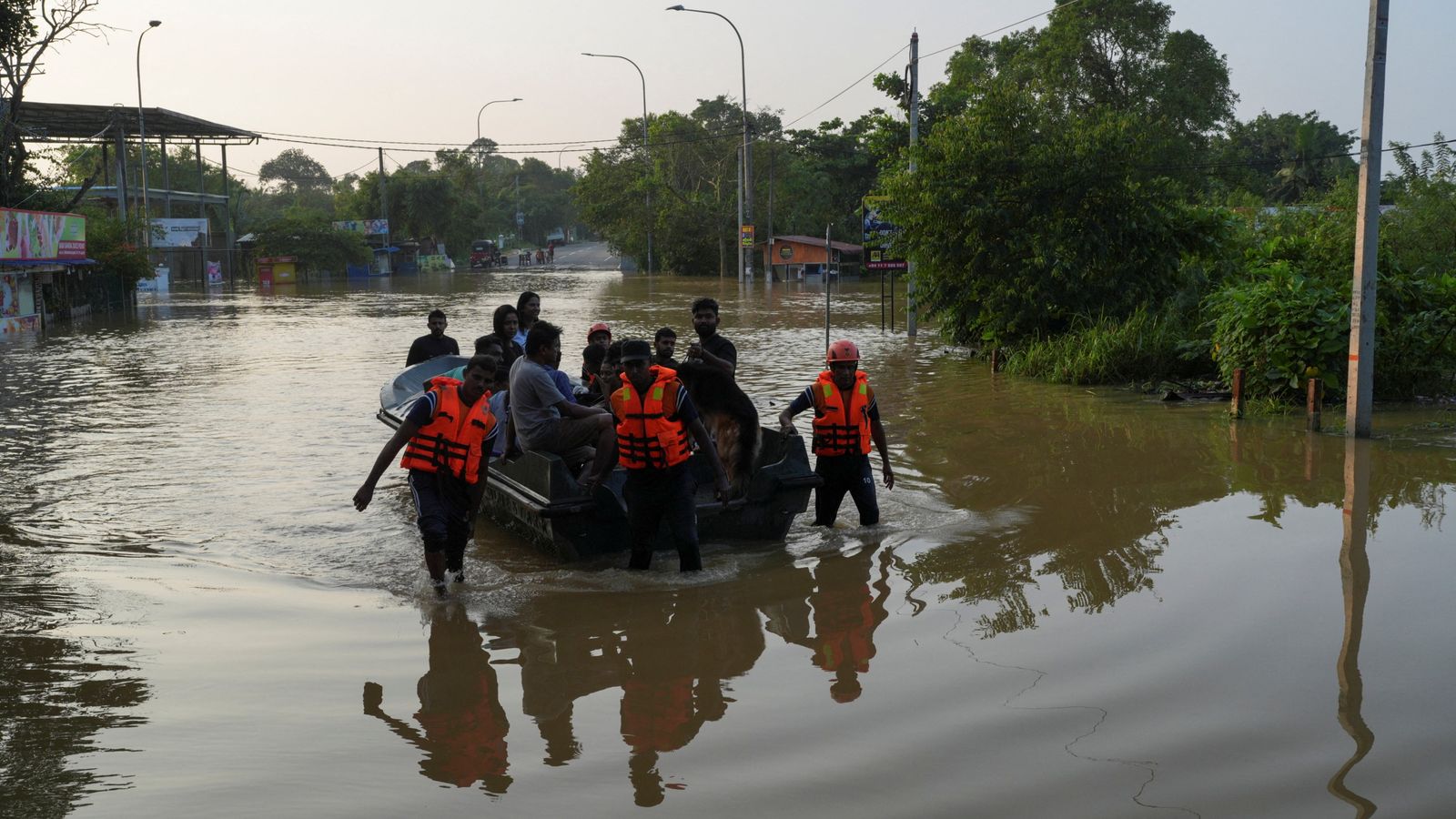
Rescue and recovery and efforts are underway in parts of South and Southeast Asia where the number of those killed in devastating flooding continues to rise.
The extreme weather last week has killed at least 334 people in Sri Lanka, 502 in Indonesia, and 170 in Thailand, according to authorities.
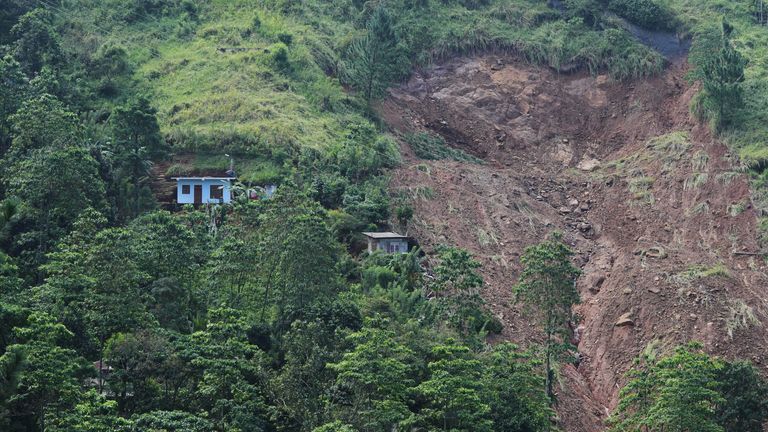
Rescuers in Sri Lanka are still searching for 370 people after a cyclone hit the island nation, with downpours flooding homes, fields and roads and triggering landslides in the hilly central region.
Landslides in Sarasavigama village near Kandy, Sri Lanka. Pic: AP
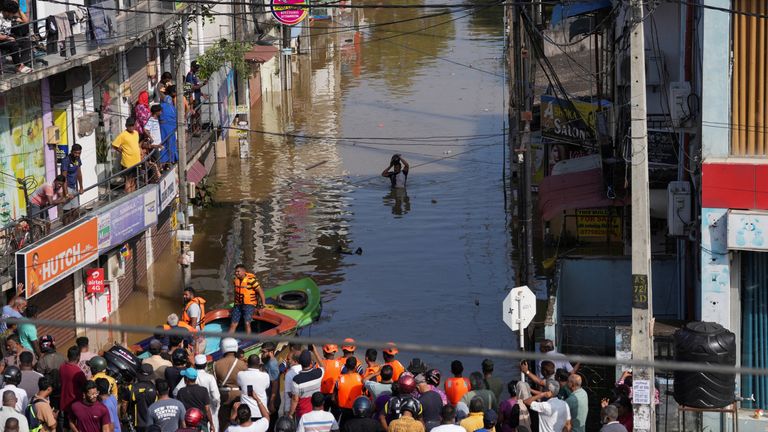
A man wades through the flooded street, following heavy rainfall in Wellampitiya, Sri Lanka. Pic: Reuters
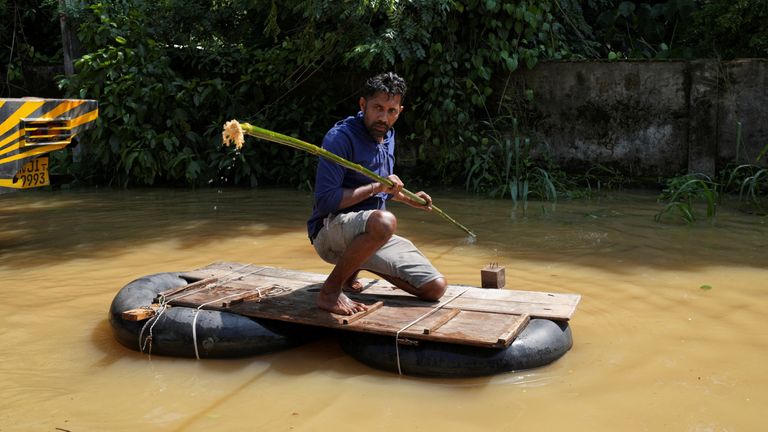
A man uses a makeshift raft at a flooded area, following Cyclone Ditwah in Kelaniya, Sri Lanka. Pic: Reuters
Nearly a million people have been impacted by the heavy rains and floods, which forced nearly 200,000 into shelters, the country’s disaster management centre said.
People were seen salvaging belongings from flooded homes along the banks of the Kelani river near capital Colombo on Monday.
Meanwhile, train and flight services have resumed after being disrupted last week, but schools stayed closed, officials said.
Cyclone Ditwah was the “largest and most challenging” natural disaster in Sri Lanka’s history, President Anura Kumara Dissanayake said.
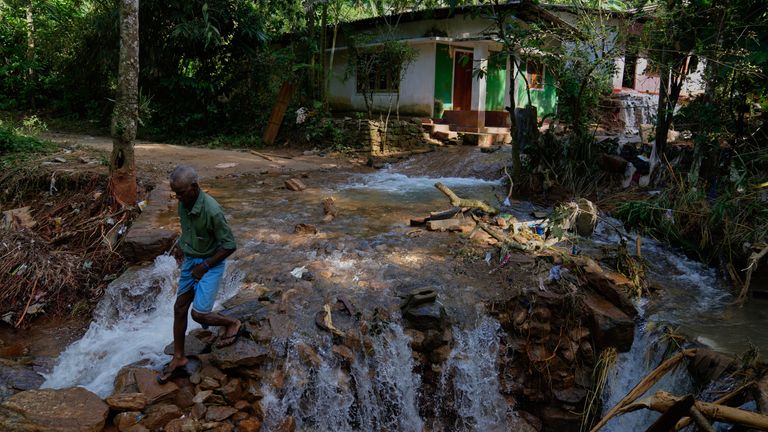
A landslide survivor crosses a section of a damaged road in Sarasavigama village near Kandy, Sri Lanka. Pic: AP
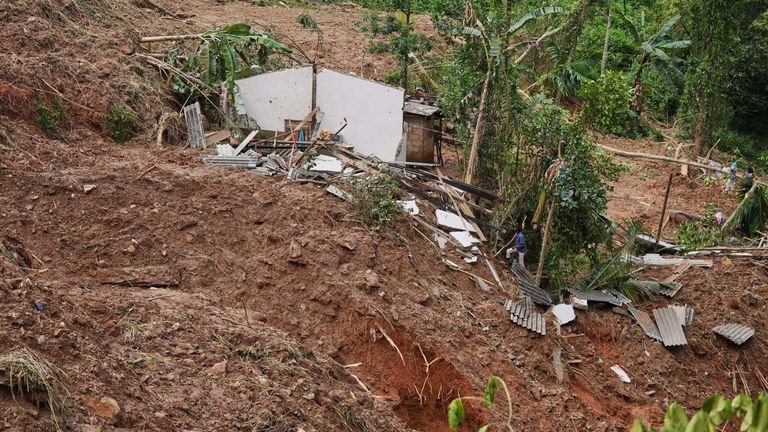
Landslide survivors salvage belongings at the site of a landslide in Sarasavigama village near Kandy, Sri Lanka. Pic: AP
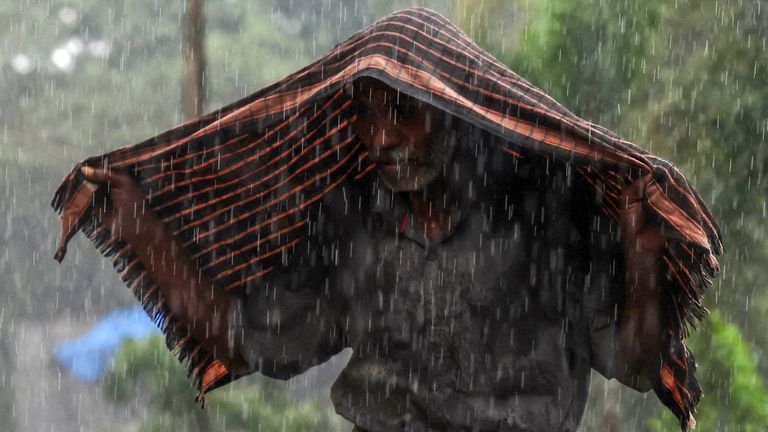
A man uses his scarf to protect himself from the rain in the aftermath of Cyclone Ditwah, in Chennai, India. Pic: Reuters
The cyclone also brought heavy rain to India’s southern state of Tamil Nadu over the weekend, with authorities saying three people were killed in rain-related incidents.
The storm, which is currently 50km (30 miles) off the coast of the state capital Chennai, has already weakened into a “deep depression” and is expected to weaken further in the next 12 hours, weather officials said on Monday.
Hundreds still missing in Indonesia
In Southeast Asia, close to 700 people were killed as two different cyclones hit the region. Rescuers in Indonesia are still searching for at least 508 people missing, according to official figures.
People have started clearing mud, trees and wreckage from roads on the weekend as recovery operations continued.
More than 28,000 homes have been damaged, with 1.4 million people affected by the rare tropical storm.
The country’s president, Prabowo Subianto, called it a catastrophe and pledged to rebuild infrastructure as he visited the three affected provinces on Monday, where nearly 300,000 people have been displaced by the flooding.
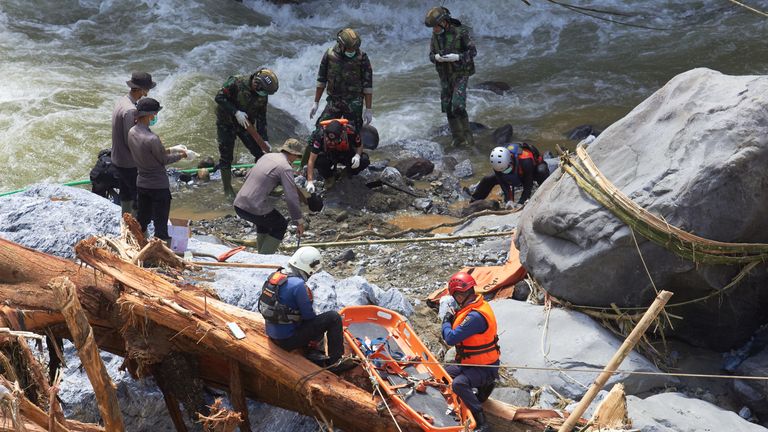
Rescuers search for flood victims in Tanah Datar, West Sumatra, Indonesia. Pic: AP
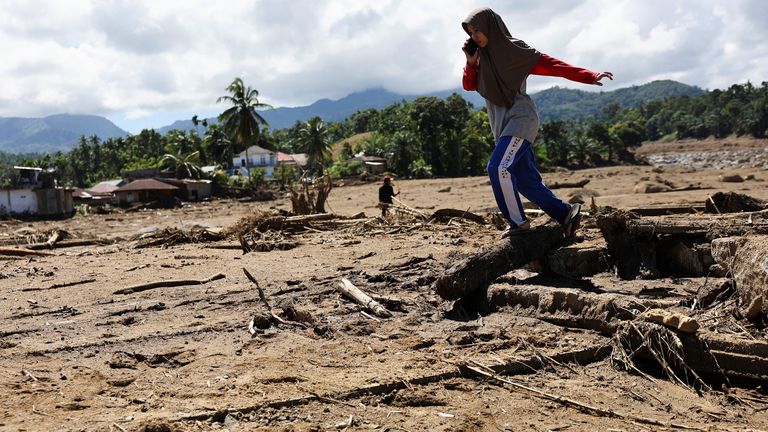
A flooded field in Indonesia’s West Sumatra province. Pic: Reuters
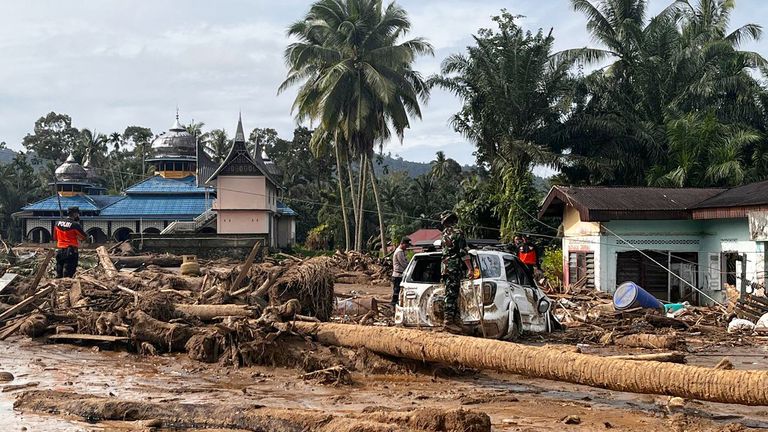
Rescuers search for victims at a village affected by flash flooding, in Agam, West Sumatra, Indonesia. Pic: AP
In Thailand, flooding in eight southern provinces affected about three million people and led to a major mobilisation of its military to evacuate critical patients from hospitals and reach people stuck in floodwaters for days.
In the worst-affected city of Hat Yai, a southern trading hub, 335 mm (13 inches) of rain fell on 21 November, its highest single-day tally in 300 years, followed by days of unrelenting downpours.
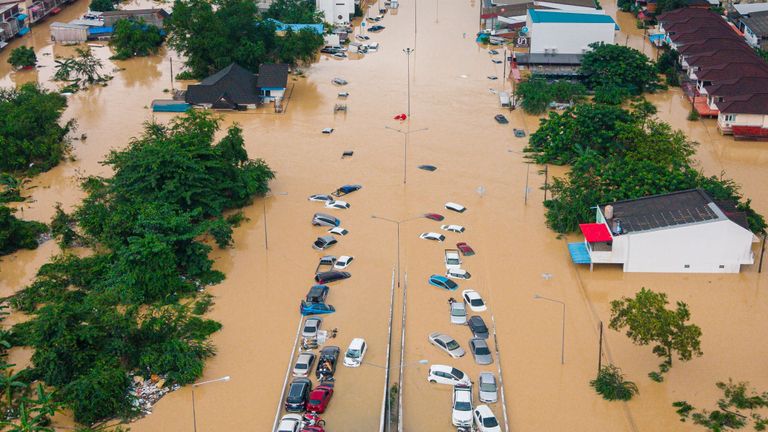
At least 82 people have died and more than 3 million people have been impacted by floods in 12 southern Thai provinces.
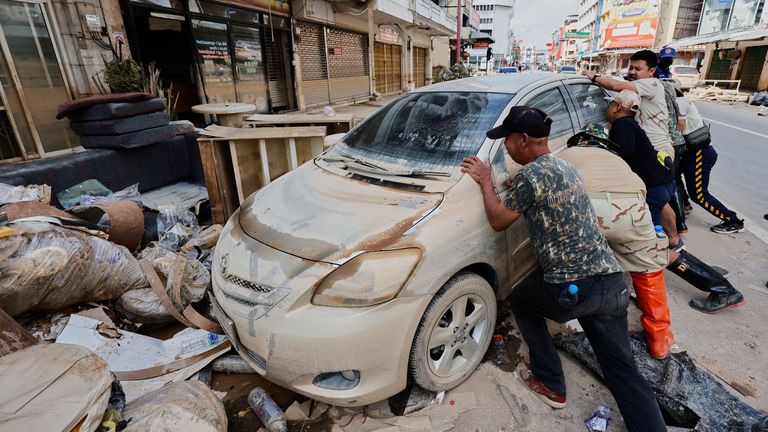
People move a car damaged by floods in Songkhla province, southern Thailand. Pic: AP
Prime Minister Anutin Charnivirakul expects residents to be able to return home within seven days, a government spokesperson said on Monday.
Read more from Sky News:
Zelenskyy to make first official visit to Ireland
Dignitas founder dies by assisted suicide aged 92
The first batch of compensation payments is set to be distributed on Monday, starting with 239m baht (£5.6m) for 26,000 people, the spokesperson added.
In Malaysia there have been at least three deaths and authorities are still on alert for a second and third wave of flooding as 11,600 remain in evacuation centres.
World
Zelenskyy to make first official visit to Ireland – as ‘productive’ Ukraine-US talks under way in Florida


Volodymyr Zelenskyy is set to make his first official visit to Ireland tomorrow, Taoiseach Micheal Martin has revealed.
The Ukrainian president will be accompanied by First Lady Olena Zelenska and meet Mr Martin, president Catherine Connolly and foreign minister Helen McEntee.
Mr Martin said he and Mr Zelenskyy would be holding a bilateral meeting, as well as attending the inauguration of the Ireland-Ukraine Economic Forum, which he said “offers an opportunity to explore the potential for strengthened business-to-business, trade and investment links between Ireland and Ukraine”.
Micheal Martin greets Volodymyr Zelenskyy as he briefly stops in Ireland on way to the US in February. Pic: Reuters
Speaking ahead of the visit, the Taoiseach said: “It is an honour to welcome President Zelenskyy and the First Lady to Ireland.
“Around the world, he is rightly recognised as someone who embodies the courage and resilience of the Ukrainian people, who have inspired the world in their brave defence of their country and its sovereignty since it was brutally and illegally invaded by Russia.
“I have met with President Zelenskyy many times, including in Kyiv, but I particularly look forward to greeting him on this first official visit of a Ukrainian president to Ireland.”
Ireland has been a staunch ally of Ukraine’s since Russia began its invasion in 2022, offering some 120,000 Ukrainians a safe haven.
US-Ukraine talks begin in Florida
The Ireland announcement comes after Mr Zelenskyy’s top team engaged in peace talks with the US for several hours in Florida on Sunday.
The US-Ukraine talks were quickly organised after Donald Trump released a 28-point proposal that was largely seen to be favouring Russia, having been developed in earlier negotiations between Washington and Moscow.
The plan would have imposed limits on the size of Ukraine’s military, blocked Ukraine from joining NATO and required it to hold elections in 100 days. It also initially envisioned Ukraine ceding the entire eastern region of the Donbas to Russia.
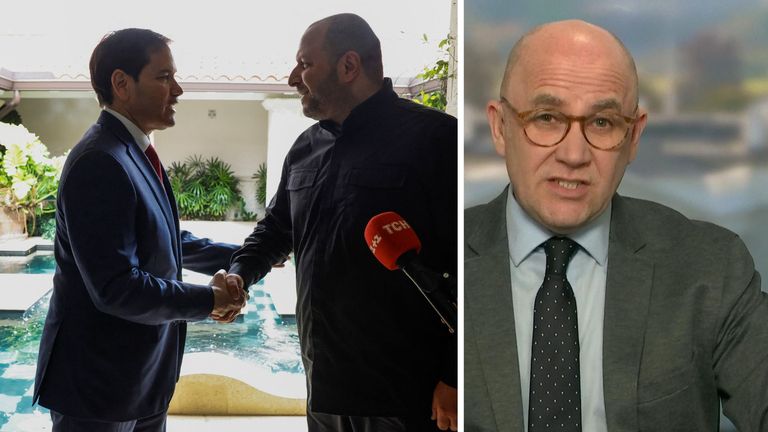
Sky’s US correspondent David Blevins analyses what’s at state this week
Read more:
Who is Steve Witkoff, the property mogul seeking a peace deal?
Go behind the scenes on the frontline with new-look Sky News show
It isn’t clear what changes have been made so far, but US secretary of state Marco Rubio has reassured Ukraine over the plans.
“This is not just about ending a war. This is about ending a war in a way that creates a mechanism and a way forward that will allow them to be independent and sovereign, never have another war again, and create tremendous prosperity for its people,” he said.
“Not just rebuild the country, but to enter an era of extraordinary economic progress.”
He added: “This is not just about peace deals. It’s about creating a pathway forward that leaves Ukraine sovereign, independent and prosperous. We expect to make even more progress today.”
Rustem Umerov, head of Ukraine’s security council, responded by saying the US was “hearing”, “supporting” and “working beside” Ukraine.
Mr Zelenskyy’s team in the US was without his former chief of staff and lead negotiator, Andrii Yermak, as he quit on Friday after officials raided his home amid a corruption scandal.
After the meeting, Mr Rubio said the talks had been “productive”, but more work remained to be done.
On X, Mr Zelenskyy said: “I am grateful to the United States, to President Trump’s team, and to the President personally for the time that is being invested so intensively in defining the steps to end the war. We will continue working. I look forward to receiving a full report from our team during a personal meeting.”
Later this week, Mr Trump’s special envoy Steve Witkoff is set to travel to Moscow to continue talks with the Kremlin.

‘Ukrainians have a delicate job’
Sustained Russian aerial assaults over the weekend
While peace talks ensued, Russian forces launched overnight attacks in and around Kyiv over the weekend, killing at least seven people and injuring dozens more.
Impacts were also reported in the regions of Dnipro, Kharkiv, Odesa, Sumy and Kherson.
Mr Zelenskyy said: “Such attacks occur daily. This week alone, Russians have used nearly 1,400 strike drones, 1,100 guided aerial bombs and 66 missiles against our people. That is why we must strengthen Ukraine’s resilience every day.”
The attacks also hit Ukrainian energy facilities and left hundreds of thousands without power in the capital. Supplies have since been restored.
Targeting such infrastructure has become a familiar tactic from Russia over the winter, in what Ukraine officials say is the “weaponising” of the cold.

Moment Ukraine strikes Russian ‘shadow fleet’ ships
Ukraine launched its own drones at two of Russia’s so-called “shadow fleet” oil tankers in the Black Sea on Friday, and claimed responsibility for damaging a major oil terminal on Saturday near the Russian port of Novorossiysk.
The terminal is owned by the Caspian Pipeline Consortium, which includes Russian, Kazakh and US shareholders.
Subsequently, on Sunday, Kazakhstan’s foreign ministry said it viewed Ukraine’s attack as “an action harming the bilateral relations of the Republic of Kazakhstan and Ukraine”, adding it expected Ukraine to “take effective measures to prevent similar incidents in the future”.
Ukraine’s foreign ministry said the country’s actions were not directed against Kazakhstan or third parties and were only aimed at repelling what it called “full-scale Russian aggression”.
World
‘This is journalism at its most raw’: Go behind the scenes on the frontline with new-look Sky News show

-
 Sports2 years ago
Story injured on diving stop, exits Red Sox game
-
 Sports3 years ago
‘Storybook stuff’: Inside the night Bryce Harper sent the Phillies to the World Series
-
 Sports2 years ago
Game 1 of WS least-watched in recorded history
-
 Sports3 years ago
Button battles heat exhaustion in NASCAR debut
-
 Sports3 years ago
MLB Rank 2023: Ranking baseball’s top 100 players
-
Sports4 years ago
Team Europe easily wins 4th straight Laver Cup
-
 Environment3 years ago
Japan and South Korea have a lot at stake in a free and open South China Sea
-
 Environment1 year ago
Here are the best electric bikes you can buy at every price level in October 2024