
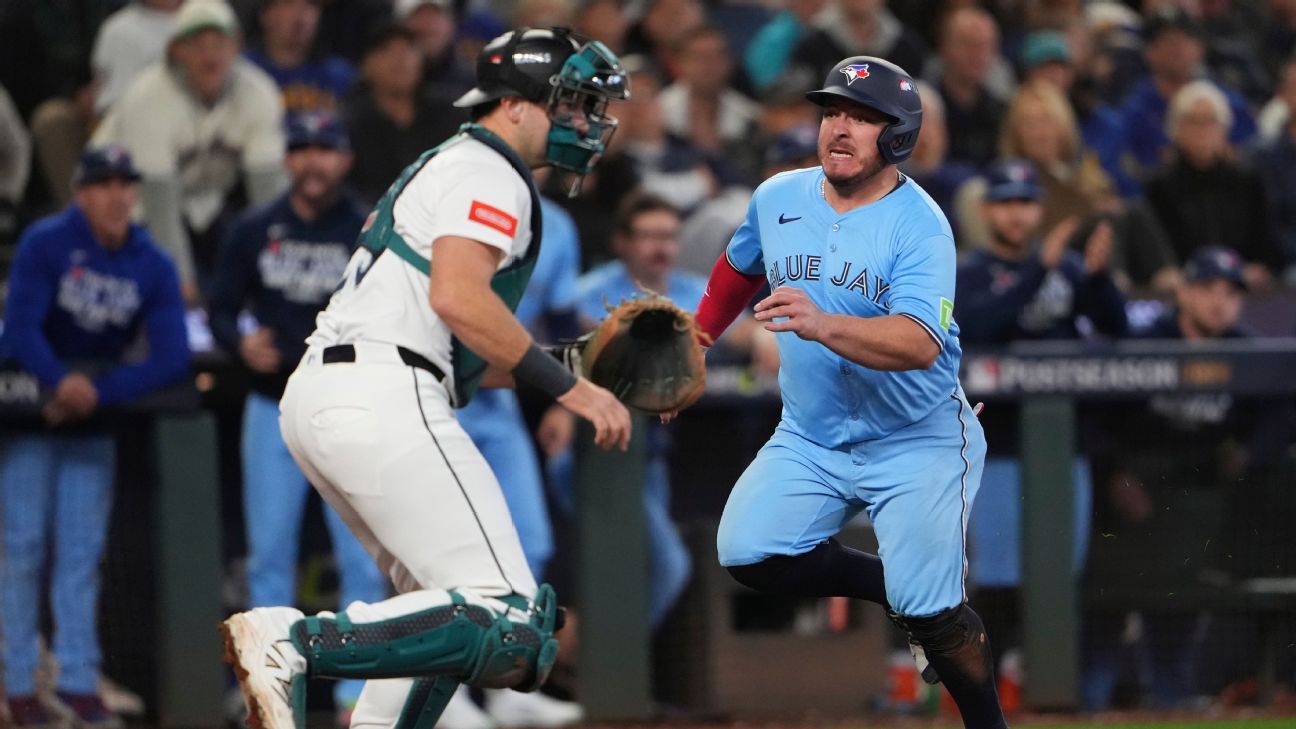
Keys to ALCS Game 6 (and maybe 7): Superstar dilemmas, secret heroes and numbers to watch


-
David Schoenfield
Are we having fun yet? Friday was one of the most unforgettable days ever seen in the playoffs, with Eugenio Suarez’s go-ahead grand slam rocking T-Mobile Park and putting the Seattle Mariners one win away from the World Series, and then Shohei Ohtani’s historic three-homer, 10-strikeout performance that goes down as perhaps the single greatest individual performance in postseason history.
Let’s call it a top-five day of all time and add this to our list of future projects to research. Meanwhile, with Ohtani’s Los Angeles Dodgers in the World Series, we’re left with one game Sunday: The Seattle Mariners vs. the Toronto Blue Jays, Game 6 of the ALCS.
Let’s dig into it with some of the keys to watch with the remaining World Series spot at stake.
Guerrero is having a monster postseason, hitting .457/.524/.971 with five home runs. After a hitless first two games of the ALCS, he did his best Roy Hobbs impersonation in Seattle, going 7-for-11 with five extra-base hits. He has just two strikeouts in 42 postseason plate appearances, and he has had 15 balls in play register over 100 mph, including six of his seven hits at T-Mobile.
“He’s a special player, a special talent, an awesome guy to be around,” teammate Ernie Clement said. “He’s earned every bit of success that he’s having, and I couldn’t be happier for him. Just really proud of the work he’s put in. To do it on the biggest stages, it’s a testament to his work.”
In Game 5, the Mariners intentionally walked Guerrero twice, once in the fourth inning with nobody out and a runner on second base — his second intentional walk of the postseason with nobody out, the first time that has happened since 2016 — and then in the seventh with two outs and a runner on second.
The Mariners escaped both jams, but they’re playing with fire — and that’s whether they pitch to him or whether they put him on. It’s certainly not an easy decision for manager Dan Wilson with Guerrero so locked in, but eventually one of those intentional walks is going to backfire and potentially lead to a big inning.
Toronto’s challenge: Getting Cal Raleigh out
Raleigh is following up his historic 60-homer season with an outstanding postseason of his own, hitting .333/.435/.692 with four home runs, the one Mariner who has provided consistent offense. Suarez’s slam was the moment for the history books in Game 5, but that moment might never happen if Raleigh doesn’t first tie the game leading off the eighth inning with his towering home run to left that looked high enough to soar over the Space Needle.
“Oh my god, that ball took forever to get down,” said teammate Bryan Woo. “I can’t say that I’m surprised anymore, but he just continues to impress and show up in big moments.”
The Blue Jays have mostly gone right after Raleigh, who has drawn three walks in five games, one of those intentional. That included the game-tying home run when Brendon Little fell behind 2-0 but came in with a fastball — a little too much down the middle.
“A lot of times I get out there and just start swinging and try to hit something hard,” Raleigh said, “but I was patient waiting for my pitch there and understanding to let the game come to me, try and make solid contact, don’t need a home run, don’t need to try to hit a ball 500 feet, just do something good and adrenaline will usually take over in those moments.”
Toronto’s potential secret hero: Ernie Clement
Following the Blue Jays’ win in Game 3, Clement called himself “probably the worst hitter in baseball” a couple years ago. He was referring to 2022, when he hit .184/.243/.209 in 179 plate appearances with the Guardians and Athletics — which led to the Guardians letting him go, and then the A’s, with the Blue Jays claiming him on waivers during spring training in 2023.
The one-time worst hitter in baseball played 157 games this season, had his best season at the plate with a .277/.313/.398 line and 46 extra-base hits, and is a Gold Glove finalist at two positions — third base (where he started 66 games) and the utility slot (he also started games at second base, shortstop and first base).
He has followed that up with an exceptional postseason, hitting .429 with 15 hits, the most for a player in his first nine career postseason games since Daniel Murphy in 2015. He attributes his success to learning from his failures — “I’ve had quite a few of those,” he said — and understanding that he’s at his best when he’s swinging often, even if that goes against the modern convention of waiting for your pitch.
“I just started to lean into my strength a little bit, which is putting the bat on the ball. I kind of tried to work the count a little bit and maybe try to draw some walks and hit for more power, and that’s just not really my game. Over the last couple years, I’ve learned to just make it hard on the opposing pitchers with my ability to get hits on pitchers’ pitches, and I’ve just really been more aggressive.”
Seattle’s potential secret hero: Bryan Woo
The Mariners’ top starter in the regular season had been sidelined since Sept. 19 due to a right pectoral strain. He wasn’t on the ALDS roster but finally made his postseason debut in Game 5, pitching two innings in relief in Game 5. Alejandro Kirk greeted him with a ringing double and then Clement drove him with an RBI single, although bounced back with a scoreless seventh, getting out of that jam when Kirk tapped back to the mound.
It wasn’t necessarily a stellar effort — he didn’t record a strikeout and had just two swings and misses out of 28 pitches — but it was good enough. He did enjoy running through the “flames” as he left the bullpen for the mound. “Yeah, I told Logan [Gilbert] when he did it the other day, he looked like the coolest he’s ever looked, so I tried to replicate that.”
Woo said he’ll have to wait and see how he feels over the next couple of days, and he isn’t stretched back out to start yet but said “I’d love to contribute the next couple of games.” Given Wilson’s quick hook with Luis Castillo in Game 4 and relatively quick hook with Miller in Game 5, Woo’s potential to throw multiple innings to help bridge the gap to closer Andres Munoz looms large, whether it’s in Game 6 or Game 7.
Key stat to watch: 28 vs. 49
The Blue Jays have struck out just 28 times in the first five games compared to 49 for the Mariners. The Blue Jays had the lowest strikeout rate in the majors in the regular season and have been striking out even less often during the playoffs (just 14.4% of the time in the ALCS). That hasn’t actually produced much more hard contact in this series, however, as the Jays have 53 balls in play classified as hard-hit balls (95-plus mph) while the Mariners have hit 51. The Jays have 14 at 105-plus mph, and the Mariners have 15.
Still, on Friday everything went the Mariners’ way.
“To be honest, we dodged a lot of bullets today,” Raleigh said. There was a the double play on a line drive to first baseman Josh Naylor, Leo Rivas made a nice leaping grab of a line drive up the middle, Raleigh turned Clement’s ball in front of the plate into another double play and Randy Arozarena made a leaping grab at the wall in the eighth to rob Clement of a potential home run.
Over the long haul, swing-and-miss is still a good thing for pitching staffs, and Seattle’s hasn’t generated nearly as much as Toronto’s: The Jays have swung and missed 70 times compared to 102 for the Mariners.
Logan Gilbert, Seattle’s Game 6 starter, was a big swing-and-miss pitcher during the regular season with the third highest strikeout rate among pitchers with at least 100 innings, behind only Zack Wheeler and Chris Sale. He lasted just three innings in his Game 2 start, however, generating just five swinging strikes in 58 pitches. The Mariners will hope that poor effort was a result of starting on two days of rest after pitching two innings in relief in the 15-inning win over Detroit in the ALDS.
Likewise, Trey Yesavage, Toronto’s rookie starter who has pitched just 23.1 innings in the big leagues, will try to find his form from his ALDS start against the Yankees when he struck out 11 in 5.1 hitless innings. The Mariners got to him for five runs in four innings in Game 2 as he walked three, and Julio Rodriguez hit a three-run homer in the first inning.
The key decision: When to go to the bullpens
Both managers have deployed quick hooks with the starters — and both saw those moves backfire in the three games in Seattle. In Game 4, Wilson pulled Luis Castillo in the third inning after just 48 pitches, the shortest start of Castillo’s career, and went early to his high-leverage relievers, but Gabe Speier walked in one of Castillo’s runs, and Matt Brash threw a wild pitch to let in one of the two runs Speier allowed. Wilson doubled in Game 5, pulling Bryce Miller after a leadoff single in the fifth even though he had yet to allow a run. Brash let that inherited runner score, and then Bryan Woo later allowed another run.
Blue Jays manager John Schneider’s decision in Game 5 might have been even more questionable, leaving closer Jeff Hoffman in the pen in the eighth while going first to Brendon Little and then to Seranthony Dominguez, and they combined to allow five runs in blowing the 2-1 lead. Hoffman never got in the game.
Little came on and gave up the home run to Raleigh and then walked the next two batters.
“We talked about it all series,” Schneider said after the game. “Little’s been one of our best pitchers in big spots. Tough guy to elevate. Cal’s a really good hitter. I get it, man. After that, you got to settle down and throw strikes too. So that’s been part of Little’s game. So has strikeouts. Again, I trust every single guy on this roster. It’s hard. No one feels worse than Little, no one feels worse than Ser right now, or me. But I trust every single guy on this roster. Today it didn’t work out, but we’ve won two games in a row a whole lot this year.”
That’s where we’re at: The Blue Jays need to win two to reach their first World Series since 1993. The Mariners need one to reach their first. Ohtani and the Dodgers await. Let’s play some ball.


-
Dave Wilson
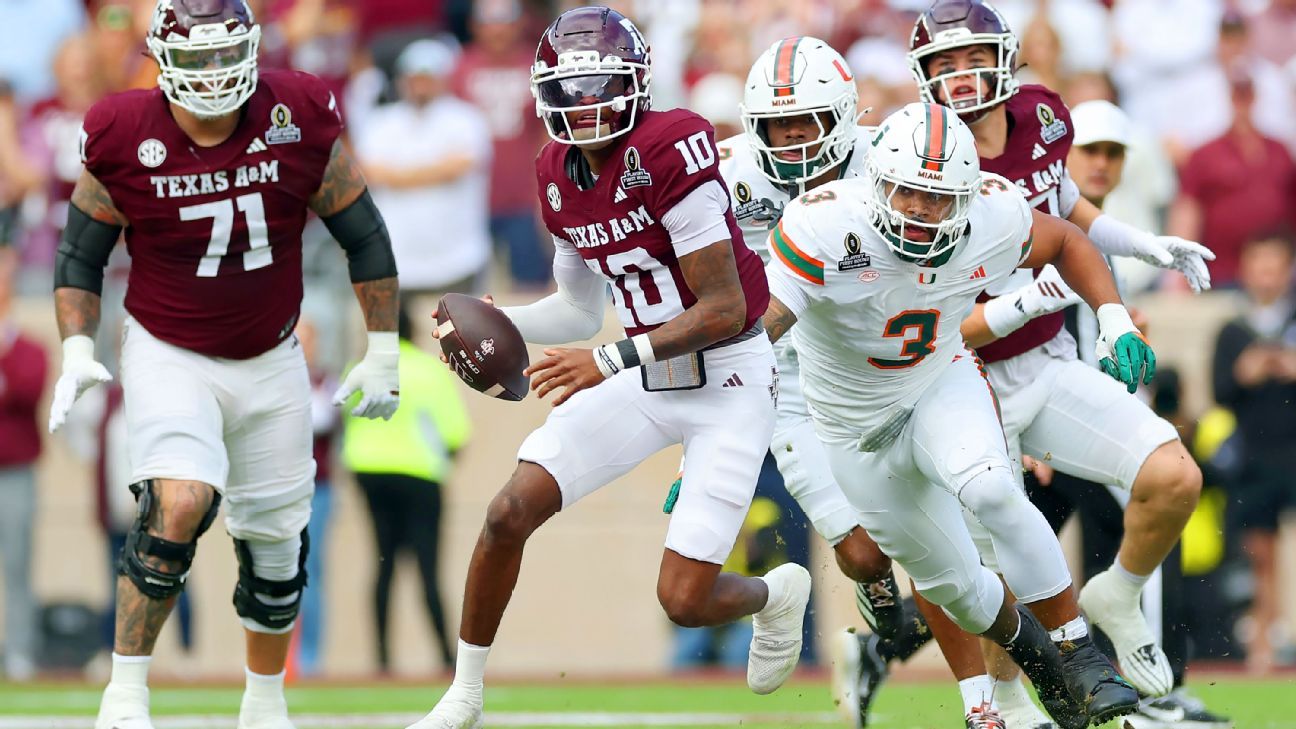
COLLEGE STATION, Texas — Texas A&M‘s historic season ended with a gut punch, as quarterback Marcel Reed, who had driven the Aggies to the Miami 5-yard line with 27 seconds left, threw an interception in the back of the end zone in a 10-3 loss at Kyle Field.
The loss Saturday in front of 104,122, the second-biggest crowd in CFP history, ended the Aggies’ season at 11-2, tying A&M’s 1939, 1998 and 2012 teams for the second-most wins in program history, behind the 1992 squad that finished 12-1.
Mike Elko, the Aggies’ second-year head coach, said that the loss will sting but that it shouldn’t discount what the team accomplished. When he took over before last season, he said that this was not an elite program ready to compete for a national championship. In his first season, the Aggies finished 8-5 after a 7-1 start and went into the offseason vowing to put an emphasis on finishing games. They did that all year and started 11-0 but lost their final two games: to Texas in Austin and then to the Hurricanes, their first defeat at home this season.
“We weren’t able to tilt the margins in our favor the last two games,” Elko said. “That’s going to be a killer. One to not go to Atlanta [to the SEC championship], one to not go to the quarterfinals. So that’s a killer, but you’ve got to swallow it and you’ve got to move forward just like we did last year.”
Elko said he and his staff believed this team had “fairly small margins” to be successful in each game, and that’s exactly how the season played out. He said that as a grown man he can handle the disappointment but that he is hurting for his players. Still, he emphasized that he didn’t want to discount what his players had done to help turn the tide for the Aggies.
“I said to the seniors who just played their last game, they left a mark on elevating this program that will never go away. From where this program was two years ago to where it is now, I don’t think that can be lost on people,” Elko said. “I said to the guys coming back, there’s still another major step we have to take as a program to finish. I think the last two games showed that.”
Elko said his offense had become one-dimensional, and he credited Miami’s defense for preventing the Aggies from being able to run the ball, enabling the Canes to tee off on Reed.
“Marcel Reed can’t be our leading rusher,” Elko said of his sophomore quarterback who had 15 carries for 27 yards, 6 more than running back Rueben Owens II. “He can’t have the most carries. It just can’t happen that way.”
Reed sat devastated on the bench as the game ended following the interception, a towel draped over his head. Reed’s offensive coordinator, Collin Klein, is headed to Kansas State, his alma mater, as the Wildcats’ new coach. The two spoke about how close their relationship is after the game, with Reed saying Klein is like a father figure for him.
“It didn’t really feel real,” Reed said. “I don’t want the season to end. A lot of changes are going to be made after the season, so I really didn’t want it to end. It sucked.”
Taurean York, the Aggies’ all-SEC linebacker, said he’s proud of the steps the team took and called the season a “foundation-setter,” saying A&M finally got to the big stage and has plans to keep building.
“We’re really just scratching the surface of who we’re going to become in the future,” he said.
The Aggies traded defensive blows with Miami all day, but Carson Beck‘s shovel pass to Malachi Toney with 1:44 left broke the game open. The Aggies’ offense responded, driving with a chance to tie the game before Bryce Fitzgerald‘s second interception of Reed on the day ended A&M’s season and crushed the Kyle Field faithful.
“We came up 5 yards short and that’s something we’ll have to live with throughout the off season,” Elko said. “But [I’m] still proud of this team, proud of what they accomplished, proud of what they did.”

-
David Hale
COLLEGE STATION, Texas — Rueben Bain rolled his eyes, smiled, then held up his cell phone, the lock screen glowing with a photo of Texas A&M offensive lineman Trey Zuhn III. Bain had anticipated the question. He was looking forward to it.
In the run-up to Saturday’s College Football Playoff game between Miami and Texas A&M, Zuhn had delivered the bulletin-board material, when he told reporters he didn’t think Bain “would be a threat that we need to worry about too much.”
Big mistake.
“We don’t take kindly to disrespect,” Bain said. “Some people said some things they shouldn’t have said.”
Bain and the Miami defense were dominant in a 10-3 win over the Aggies, ending a once-promising Texas A&M season and sending the Hurricanes on to the Goodyear Cotton Bowl, where they’ll face off against Ohio State.
Bain finished with five tackles — four for a loss — and three sacks, while also blocking a field goal in the first half.
The rest of the defense followed his lead, racking up nine tackles for loss and creating three takeaways, including a game-sealing interception in the back of the end zone with 24 seconds to play by freshman Bryce Fitzgerald.
In the aftermath, defensive end Akheem Mesidor was running through his rolodex of players who’d stepped up against the Aggies — defensive line, defensive backs, linebackers — then mentioned Fitzgerald.
“Bryce!” Bain and cornerback Keionte Scott both shouted in unison, laughing.
Fitzgerald arrived on campus in June, but quickly made his presence felt, and his role on Miami’s defense has grown as the season progressed. On Saturday, he was a star, intercepting Aggies quarterback Marcel Reed twice. The latter came on a third-and-goal at the 5 after the Aggies had marched down the field in an effort to tie it, but Fitzgerald stepped in front of a pass intended for Melin Ohrstrom and the celebration began.
“He’s a quick study,” Miami coach Mario Cristobal said. “He’s never flinched. He spends every waking minute studying, but when the lights come on, some guys just kind of have ‘it.’ He’s that guy. He just knows what to do and how to do it.”
A year ago, this Miami defense was the fly in the ointment that kept the Hurricanes from the playoff. With future No. 1 NFL draft pick Cam Ward working magic on offense, Miami’s battered secondary created a chain reaction that led to a complete defensive meltdown in the season’s stretch run. Miami lost two of its final three games to fall from No. 4 in the rankings to out of the playoff.
Cristobal responded by making a change at coordinator, bringing in Corey Hetherman — now a Broyles Award finalist — and putting a focus on rebuilding the back end of the defense. Fitzgerald and Scott, along with transfer Xavier Lucas, were keys to the turnaround. With the secondary secure, the defensive front was free to wreak havoc, and Mesidor and Bain did exactly that against the Aggies.
“We sat in the locker room for like 15 minutes [after the game],” Bain said, “just saying how crazy it was for us to win this game in this kind of way.”
Hetherman said the focus for Miami’s defense was actually more about patience and keeping Reed inside the pocket. The A&M quarterback did have a handful of scrambles that extended plays to find open receivers or picked up yards on the ground. But Hetherman said he prioritized showing Reed a host of different coverage schemes to keep him off balance, and eventually that allowed the Miami defensive front to get home.
Miami’s seven sacks against Texas A&M tied for the most by a ‘Canes defense in the last six seasons. And while there’d been concern about how Miami’s offensive line would handle the crowd noise at Kyle Field, where more than 104,000 fans provided a stifling soundtrack, it was actually the Aggies O-line that was flagged for multiple penalties.
“We lost the game of the line of scrimmage, and I think it got worse in the second half,” Aggies coach Mike Elko said. “We just couldn’t keep them off of us. We couldn’t get the run game established. We became one-dimensional. Once we became one-dimensional, they were able to tee off.”
Overall, Miami held the Aggies to just 326 yards of offense and just 89 on the ground — just 50 from A&M’s trio of tailbacks, Le’Veon Moss, Rueben Owens and EJ Smith.
And when Miami’s back was against the wall, the defense was at its best. A&M’s three red-zone trips amounted to just three total points, and when Miami receiver Malachi Toney fumbled near midfield late in the game, the Hurricanes defense followed with a quick three-and-out.
“A year ago, we had a tough time stopping people on defense,” Cristobal said. “This was one of those games where we felt like we were holding good and knocking them back. The confidence that [the defense] brings is off the charts, and they were the difference today.”
-
 Sports2 years ago
Story injured on diving stop, exits Red Sox game
-
 Sports3 years ago
‘Storybook stuff’: Inside the night Bryce Harper sent the Phillies to the World Series
-
 Sports2 years ago
Game 1 of WS least-watched in recorded history
-
 Sports3 years ago
Button battles heat exhaustion in NASCAR debut
-
 Sports3 years ago
MLB Rank 2023: Ranking baseball’s top 100 players
-
Sports4 years ago
Team Europe easily wins 4th straight Laver Cup
-
 Environment3 years ago
Japan and South Korea have a lot at stake in a free and open South China Sea
-
 Environment1 year ago
Here are the best electric bikes you can buy at every price level in October 2024