
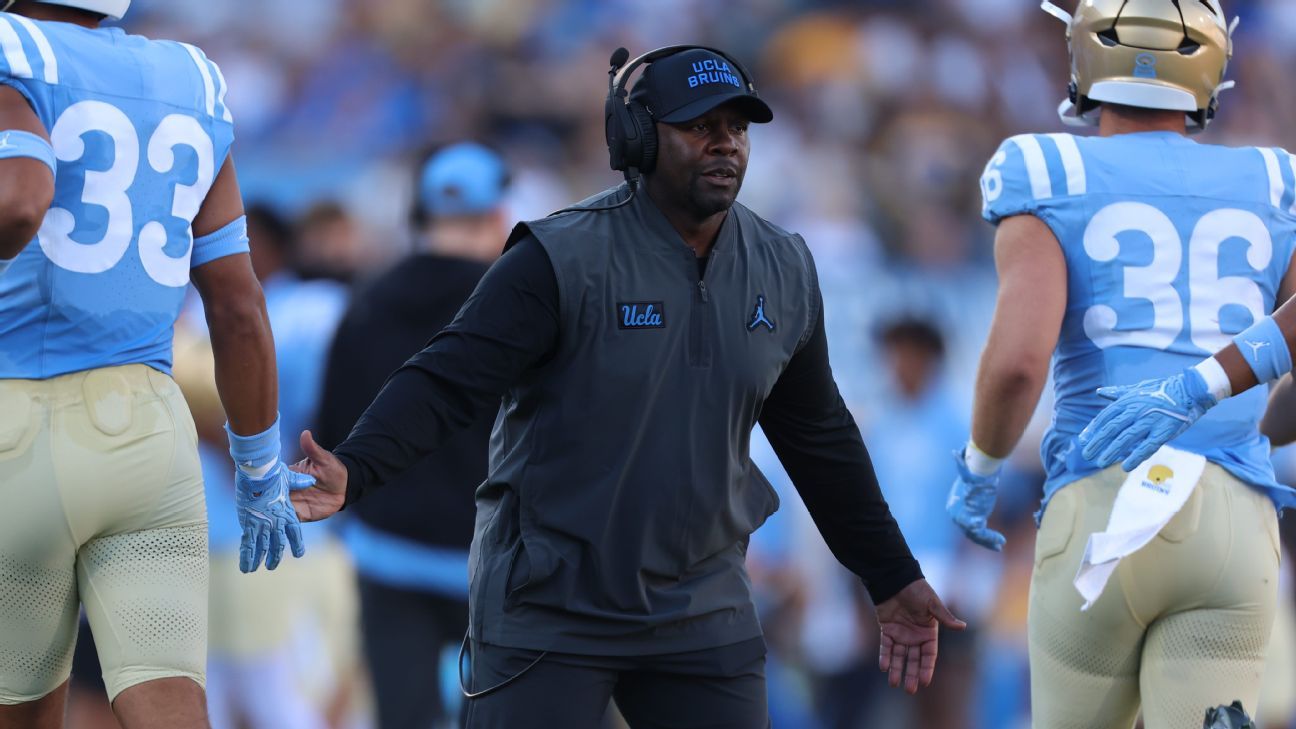
From 0-4 to three straight wins, UCLA has found an identity under Tim Skipper


PASADENA, Calif. — The Rose Bowl stands are filled with blue. No one is sitting down. UCLA players are jumping to the beat of the music on the sideline. The student section is packed, coursing with energy, ready to erupt. The game against Maryland is hanging in the balance, tied at 17 with 40 seconds left. A winning streak is on the line.
The scene is in itself a victory — a rare sight that would have felt impossible just a few weeks ago, when the bleachers at the historic venue had emptied with ease, when the chants that echoed belonged to the opposing team, the scoreboard spelled ridicule and the future at UCLA appeared dire.
The Bruins had tried with all their might to conjure excitement about this football season. They added quarterback Nico Iamaleava from the transfer portal and raved about the kind of team they would be fielding. But after a listless 0-3 start, rock bottom came quickly. Head coach DeShaun Foster was fired. Defensive coordinator Ikaika Malloe left. New offensive coordinator Tino Sunseri quickly followed him out the door.
Tim Skipper had been named special assistant to Foster before the season, but after the firing he was suddenly tasked with picking up the pieces.
“Anytime there’s an interim head coach, it’s not a good time,” Skipper told ESPN. “We’re all in uncertainty. Everybody, not just the players. The coaches are in uncertainty. There’s families involved. Their parents are calling like crazy. My parents are calling me. You don’t know what’s going to happen next.”
No matter the topic, Skipper’s accompanying smile flashes with nearly every other word he speaks like a built-in punctuation. It’s not just a mannerism, but also emblematic of his positive approach, one that made him well-suited for the daunting task of reenergizing a winless team without a clear purpose.
“I’m an energy guy. I like juice. I like people that are having fun,” said Skipper, who was Fresno State‘s interim coach last season. “I’m not a doom-and-gloom, it’s-raining-every-day guy. I just am not — I am a person that thinks you dictate how your day was.”
Skipper’s pragmatic stewardship of UCLA has resulted in a dramatic turnaround that feels straight out of a movie script. After a loss against Northwestern in Skipper’s first game, the Bruins have won three straight: a shocking upset over No. 7 Penn State, a dominant win over Michigan State on the road and a hard-fought victory against Maryland on Saturday that featured a game-winning field goal in the final seconds.
The Bruins win the game with a FG 🙌 🙌 @UCLAFootball pic.twitter.com/KQsbUu86L8
— Big Ten Football (@B1Gfootball) October 19, 2025
It was Skipper and UCLA’s coup de grâce — a game won in the margins, with every unit contributing and the style of play mirroring the grind-it-out rhetoric Skipper has preached as he has helped turn this Bruins season from a disaster into a dream.
“Those same guys that were dealing with all this adversity are now over the hump and enjoying coming to work,” Skipper said. “They enjoy football again.”
When Foster was fired, Skipper was given the complex task of being the team’s Band-Aid. Four games in, he has given the program back its heartbeat.
THE DAILY DRIVE Skipper makes down the southbound 405 freeway feels different these days. As he heads from the San Fernando Valley down to Westwood, there is little traffic at this time of the morning. It’s never too early for a head coach — interim or otherwise — to clock in at work.
Through the changes and the increased responsibility, Skipper has tried to maintain a certain level of status quo for himself. Yes, he’s spending a lot more time inside the Wasserman Football Center, but he has remained in his small office near the rest of the staff instead of moving into the much-larger head coach office.
As the noise around the Bruins has grown, Skipper has doubled down on his approach to not go near any coverage or social media reactions regarding him or the team — aside from an inevitable glimpse or two. After the Penn State win, he returned home and was surprised by how much time the nightly college football recap show on TV spent talking about the Bruins’ win.
“It was just shocking. I watch it all the time, and I’ve never been a part of it,” Skipper said. “That stuff starts messing with your head and everything. That’s why I try to avoid it at all costs.”
Consistency has been key to Skipper’s life in coaching since his first job as a defensive backs coach at Western New Mexico in 2001. But once he was placed in charge of this UCLA team, he knew that a kind of transformation was necessary. Before he even attempted to fix anything football-specific, however, Skipper saw two immediate priorities off the field.
“We cleaned the locker room,” Skipper said. “Every time I went to visit another place — whether it’s a college team, NFL team, even high schools and recruiting — the winning teams always had a nice, clean locker room.”
The task was simple and put the onus on the players, while the ultimate purpose of the exercise was to give the Bruins something tangible to both achieve and celebrate.
“The first thing Coach Skip said when he got the interim job is, ‘We got to celebrate the small successes.’ So let’s start with the locker room, let’s clean the locker room,” said tight end Hudson Habermehl. “That’s one win. Let’s celebrate that win. And it just piles on. It’s like a snowball effect.”
For the first two weeks after instituting the new clean locker rule, Skipper would have someone take a picture of the locker room at day’s end to ensure players had followed through and also to remind them of their accomplishment. Now, it has become a habit he no longer has to worry about.
At 0-3 and with their head coach gone, there hadn’t been much the players could say they had accomplished together on the football field. It’s why Skipper’s other first move was to get them all as far away from it as possible. Three days after he had been given the interim tag, Skipper took the entire team bowling.
“I just wanted to get away and do something competitive,” Skipper said. “We started to enjoy being together and seeing that, hey, we have enough here that we can be competitive, and it’s carried over for us.”
Inevitably, the combination of organization and camaraderie started seeping onto the field, where the primary fix was evident: UCLA needed an identity.
“We didn’t even talk about winning games and points and all that. It was talking about getting our style of play,” Skipper said. “We wanted to outhit people. We wanted to strain for every single play. We want to watch the film and say, these dudes play hard. These dudes play physical, they play fast, they play smart. We needed to get the style of play and then let the style of play dictate the scoreboard.”
Skipper not only demanded this style of play change, but crafted the team’s schedule to maximize it and implement it as soon as possible. Sunday was no longer their off day. Instead, Skipper gave the team Monday off before he increased the intensity of Tuesday and Wednesday practices, which are now full pads with live tackling and a physicality that is starting to show itself on Saturdays. “Strain” has become the team slogan, a mantra they both chant postgame and wear on their T-shirts.
“Coach Skip has done an incredible job flipping the culture,” Habermehl said. “[He’s] making sure we’re disciplined with what we do every day, but also when we get on the field, just cut it loose, play freely, have fun.”
Take the Penn State game, for example. Skipper said that leading up to it, they practiced a surprise onside kick, which he used as an incentive. If the team could execute it in practice, he told them, they’d implement it in the game plan. But they would only use it if the Bruins were able to score first and get out to an early lead. Once they scored the first touchdown of the game, they all knew what was coming; the Nittany Lions didn’t. UCLA recovered the kick, keeping the momentum on their side.
“We kind of have nothing to lose,” said defensive lineman Keanu Williams. “It’s like, let’s go out there, let’s have fun, let’s get some film on there, let’s just be together, let’s do this together.”
Skipper will be the first to say that he is still getting used to the job and still learning every day how to manage this team. So far though, he has hit all the right buttons.
After the upset of Penn State, Skipper motivated players by printing out papers that said, “Are you a one-hit wonder?” and putting one on each player’s plane seat on their way to Michigan State. Ahead of Maryland, Skipper pivoted, challenging players by saying that they had now established a standard of play they needed to uphold. He challenged coaches to uphold their professionalism, too, as they dealt with both uncertainty and their own overhaul.
Longtime defensive coach Kevin Coyle, whom Skipper called the “godfather” of defense, was brought in from Syracuse to help lead that unit, which has allowed one touchdown in the past two games. The playcalling joystick on offense was given to 33-year-old Jerry Neuheisel, the former UCLA quarterback, tight ends coach and son of UCLA legend Rick Neuheisel, a former quarterback and head coach for the Bruins himself.
Shell Shocked 🐢💥#4sup pic.twitter.com/vuiHXwyznN
— UCLA Football (@UCLAFootball) October 19, 2025
The lanky, blond wunderkind has stood out because of his appearance as much as the track record he is putting together. In the three games since taking over playcalling, Neuheisel has unlocked the Bruins’ offense, freed up Iamaleava at quarterback and elicited chants of “Jerry! Jerry! Jerry!” from the Rose Bowl crowds in the process.
On Saturday after a pair of fourth-quarter, go-ahead drives, those crowds serenaded Neuheisel again while Skipper quietly relished the victory. As the entire team celebrated the win, which put the Bruins in a tie for third place in the Big Ten, Skipper and Neuheisel found each other and embraced. The unlikely partnership of UCLA’s newfound cult heroes walked toward the tunnel together, their team surrounding them, where even more fans awaited to heap on the praise.
JUST OUTSIDE THE Rose Bowl late Saturday night, awash in the glow of the floodlights that remained on following the game, the Iamaleava family celebrated.
Parents, cousins, siblings, uncles, aunts and grandparents alike — most of them wearing different variations of Iamaleava’s No. 9 jersey — basked in the moment. They took pictures with the stadium’s signature sign, lit in UCLA’s baby blue hue, in the background and hugged each other.
When Iamaleava emerged — ice wrapped around his right knee and with a slight limp after he went down with an injury before returning to lead the game-winning drive — they all surrounded him. One by one, Iamaleava greeted every one of the family members who had come to watch him play.
When UCLA was 0-3, the decision to transfer to Westwood and closer to home had looked to be a faux pas for the Iamaleavas. Now, in the most improbable way, Nico — who has accounted for nine touchdowns during the winning streak — finds himself right at the center of one of the best stories in the sport.
“We were getting a little uptight the first four games. We went out there and let our hair flow,” Iamaleava said after Michigan State. “We’re getting back to having fun.”
Before Skipper took over, UCLA didn’t have official team captains or any kind of leadership council. Skipper wanted to change that, so he had players vote for which four players would join that group and be the captains who would be part of the coin toss on Saturdays. The top vote-getter was Iamaleava.
“I don’t have to say much to Nico. Nico is a natural leader. He takes the messages and he circulates it throughout the team,” Skipper said. “He’ll say what he needs to say, he’ll talk when it’s good, but what I love about him, he’ll talk when it’s bad too.”
When UCLA lost to Northwestern for its fourth straight loss, it was Iamaleava who spoke up, telling players ahead of the Penn State game that if they didn’t want to be part of the team, they should leave. Since then, UCLA has not only won every game, but it also did not lose a single player to the portal, which opened for 30 days after Foster’s firing, nor any healthy players to a redshirt request, which Skipper said is something he is more proud of.
“I didn’t really have a pitch — there was no line, no fluff, no trying to paint this picture that it isn’t,” Skipper said. “I told ’em Tuesday and Wednesday we’re going to grind. Thursdays are going to be mental, Friday is going to be mental and we’re going to have fun on Saturdays. I didn’t talk about money or NIL or any of that. That never came up.”
This fairytale turnaround does not yet change the reality that looms in the distance. The future beyond this season remains, as Skipper said, uncertain.
Before the game, a plane had, for the second home game in a row, flown overhead calling for the firing of athletic director Martin Jarmond, who hired Foster. Jarmond is leading a group of notable UCLA alumni and donors in a coaching search. Whether that quest leads them back to Skipper or someone else remains to be seen.
Even though he is not wanting for the spotlight, Skipper does allow himself to admit his dreams. Long term, he says, he wants to be a head coach, have his own program that he can start “from the bottom and go up to the top.”
“If I’m doing something, I want to do it at the highest level. In this profession, that’s being a head coach, so I want to be able to do that,” Skipper said. “But my immediate goals right now, to be totally honest with you, it’s just to win each day, literally win each day. What’s important now is winning.”
A tougher schedule awaits, beginning with a game at undefeated Indiana on Saturday. But for now, with Skipper at the helm, the Bruins have turned winning into their new normal.

-
Bill Connelly
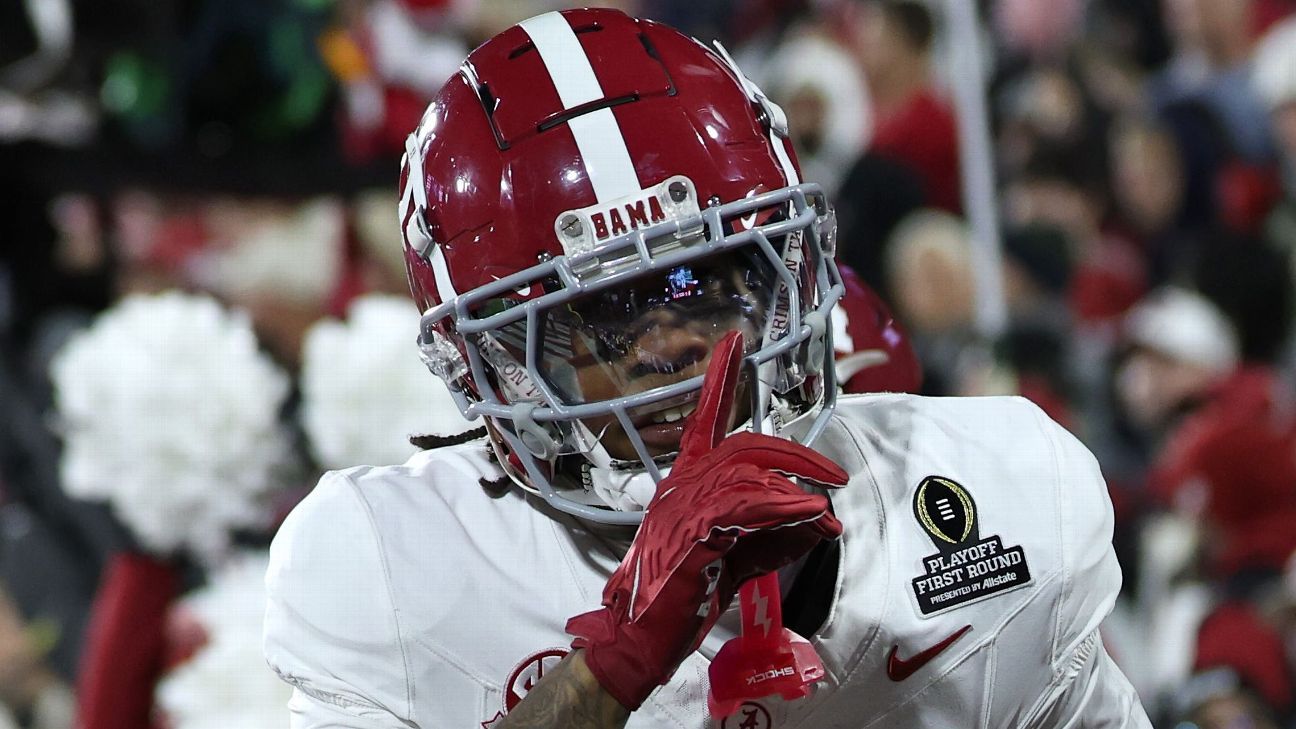
The 2025 College Football Playoff got underway in Norman, Oklahoma, on Friday night, and we’ve already seen a first. After all four home teams won by demonstrative margins in last year’s first round, Alabama became the first road team to prevail in a playoff game with a stirring comeback against Oklahoma and a 34-24 win.
Here are the main takeaways. We will update this with each completed game.



What just happened?
Oklahoma’s offense only had 20 minutes in it. The Sooners were perfect out of the gate, bursting to a 17-0 lead against an Alabama team that looked completely unprepared for the moment. But the Crimson Tide adjusted and rallied, and OU had only a brief answer. From 17 down, Bama outscored its hosts by a 34-7 margin from there.
We use the word “momentum” far too much in football, but this was an extremely momentum-based game.
1. Over the first 19 minutes, Oklahoma went up 17-0 while outgaining Bama by a stunning 181-12 margin. It could have been worse, too, as the Sooners’ Owen Heinecke came within millimeters of a blocked punt that might have produced a safety or a touchdown.
2. Over the next 21 minutes, Bama outscored the Sooners 27-0, outgaining them, 194-59. Freshman Lotzeir Brooks caught two touchdown passes — the first on a fourth-and-2 to finally get Bama on the board (after he caught a huge third-down pass earlier in the drive), and the second TD came on a 30-yard lob that put the Tide up for good. The Tide defense got pressure on John Mateer, and his footwork and composure vanished. An egregious pick-six thrown directly to Zabien Brown tied the game, and Bama scored the first 10 points of the second half as well.
0:58
Zabien Brown stuns OU with game-tying pick-six before halftime
Zabien Brown takes a big-time interception 50 yards to the house to tie the score before halftime.
OU responded briefly, cutting the margin to three points early in the fourth quarter thanks to a 37-yard Deion Burks touchdown. But the Sooners’ offense couldn’t do enough, and kicker Tate Sandell, the Groza Award winner, missed two late field goals to assure a Bama win.
1:25
Tate Sandell’s back-to-back FG misses help Alabama secure 1st-round win
Tate Sandell misses a pair of late field goals as Alabama holds on to beat Oklahoma 34-24 in the CFP first round.
Impact plays
Oklahoma beat Alabama in Tuscaloosa in November — in the game that eventually certified the Sooners’ CFP bid — thanks to a pick-six and special teams dominance. But the tables turned completely in Norman. Brown’s pick six was huge, and special teams completely abandoned the Sooners, both with Sandell’s misses and with a botched punt in the second quarter.
The botched punt was actually the second of a two-part sequence that turned the game against the Sooners. First, Mateer passed up an easy third-and-3 conversion to throw downfield to a wide open Xavier Robinson, but he short-armed the pass and dropped it. On the very next snap, punter Grayson Miller dropped the ball moving into his punting motion. Bama’s Tim Keenan III recovered the ball at the OU 30, and while OU’s defense held the Tide to a field goal, what could have been a 24-3 OU lead turned instead into a 17-10 advantage. That set the table for Brown’s pick-six and everything that followed.
The blown early lead leaves Oklahoma with quite the ignominious feat: In the history of the College Football Playoff, teams are 28-2 with a 17-point lead: OU is 0-2, and everyone else is 28-0. Ouch.
See you next fall, Sooners
We knew that whenever Oklahoma’s season ended, offense would be the primary reason. The Sooners survived playing with almost no margin for error for most of the year. Their No. 49 ranking in offensive SP+ was the worst of any CFP team, but they got enough defense (third in defensive SP+), special teams (21st in special teams SP+) and quality red zone play to overcome it.
The Sooners’ defense still played well on Friday night — Bama gained only 260 total yards (4.8 per play) — but the special teams miscues put more pressure on the offense to come through, and after a brilliant start, it ran out of steam. Mateer began the game 10-for-15 for 132 yards with a touchdown, 26 rushing yards and a rushing TD, but his last 31 pass attempts gained just 149 yards with five sacks and the pick, and his last nine non-sack rushes gained just 15 yards.
Brent Venables therefore heads into the offseason with some decisions to make. OU’s offense technically improved after the big-money additions of coordinator Ben Arbuckle and Mateer, but Mateer was scattershot before his midseason hand injury and poor after it. Do the Sooners run it back with the same roster core, hoping that better health and a theoretically improved run game can give the defense what it needs to take OU to the next level? Does Venables hit the reset button again? Can he ever get all the arrows pointed in the right direction at the same time?
What’s next
Alabama’s reward for the comeback win is a trip out West: The Tide will meet unbeaten and top-seeded Indiana in the Rose Bowl on January 1. Bama’s defense will obviously face a stiffer test from Heisman winner Fernando Mendoza and the Hoosiers attack, but Bama’s defense has been mostly up for the test this season. Their ability to pull an upset will be determined by Ty Simpson and the Alabama passing game.
Simpson began Friday night’s win just 2-for-6 with a sack, and while he improved from there and didn’t throw any interceptions — his final passing line: 18-for-29 for 232 yards, two touchdowns and four sacks (6.0 yards per attempt) — his footwork still betrayed him quite a bit over the course of the evening, and he misfired on quite a few passes. Oklahoma’s pass rush is fearsome, but Indiana’s defense ranks seventh in sack rate itself, and with almost no blitzing whatsoever. The Hoosiers generate pressure and clog passing lanes, and they held Oregon‘s Dante Moore and Ohio State‘s Julian Sayin to 5.1 yards per dropback with 11 sacks and two touchdowns to three picks. Bama will be an underdog for a reason.
That said, kudos to the Tide for getting off the mat. They were lifeless at the start, missing tackles and blocks and looking as unprepared as they did in their season-opening loss to Florida State. But Brooks’ play-making lit the fuse, and Bama charged back.
-
 Sports2 years ago
Story injured on diving stop, exits Red Sox game
-
 Sports3 years ago
‘Storybook stuff’: Inside the night Bryce Harper sent the Phillies to the World Series
-
 Sports2 years ago
Game 1 of WS least-watched in recorded history
-
 Sports3 years ago
Button battles heat exhaustion in NASCAR debut
-
 Sports3 years ago
MLB Rank 2023: Ranking baseball’s top 100 players
-
Sports4 years ago
Team Europe easily wins 4th straight Laver Cup
-
 Environment3 years ago
Japan and South Korea have a lot at stake in a free and open South China Sea
-
 Environment1 year ago
Here are the best electric bikes you can buy at every price level in October 2024