

Labour dealt historic loss in Caerphilly by-election – as Plaid Cymru win seat


Plaid Cymru have won the by-election in the Senedd seat of Caerphilly for the first time.
The Welsh nationalist party secured 15,960 votes – and candidate Lindsay Whittle cried as the result was announced.
Mr Whittle is 72 years old and had stood as a Plaid candidate 13 times since 1983. He will now hold the seat until the Senedd elections next year.
This by-election was widely regarded as a two-horse race between Plaid Cymru and Reform UK, and the result marks a considerable blow for Nigel Farage.
Analysis: Reform candidate looked neglected and dejected
In a by-election in the birthplace of the comedian Tommy Cooper, it was Plaid Cymru that had the last laugh.
During the campaign, Nigel Farage and Reform UK’s candidate Llyr Powell had posed for photos in front of the statue of the legendary comic in Caerphilly.
But when the result was declared at 2.10am at the count in the town’s leisure centre, Mr Farage – who’d been campaigning for Mr Powell on polling day – was nowhere to be seen.
In fact, the joke among Plaid supporters at the count was that long before the declaration Mr Farage was halfway down the M4 on his way back to London.
His candidate Llyr Powell received 12,113 votes – denying a victory that would have strengthened claims that Reform can convert a large lead in opinion polls into election wins.
Nonetheless, the party’s performance is a marked improvement on 2021, when it received just 495 votes.
More than anything, the result is a humiliating and historic defeat for Labour, who had held Caerphilly at every Senedd election since it was created in 1999 – as well as the Westminster seat for over a century.
Its candidate Richard Tunnicliffe secured 3,713 votes and finished in third place, with Welsh Labour describing it as a “by-election in the toughest of circumstances, and in the midst of difficult headwinds nationally”.
Turnout overall stood at 50.43% – considerably higher than during the last ballot back in 2021.
Giving his acceptance speech after the result was confirmed, Mr Whittle described how he had been “absolutely heartened” by how many young people were involved in the by-election – and said the result sends a clear message.
He said: “Listen now Cardiff and listen Westminster – this is Caerphilly and Wales telling you we want a better deal for every corner of Wales. The big parties need to sit up and take notice.
“Wales, we are at the dawn of new leadership, we are at the dawn of a new beginning – and I look forward to playing my part for a new Wales, and in particular, for the people of the Caerphilly constituency. I thank you with all my heart.”
Mr Whittle quipped Plaid’s victory “was better than scoring the winning try for Wales in the Rugby World Cup”.
And looking ahead to the next year’s elections, he added: “[This] result shows what’s possible when people come together to back practical solutions and protect what matters most.
“We’ve beaten billionaire-backed Reform and, with the same determination, we can do it again in May 2026. Caerphilly has shown the way – now Wales must follow.”
Read more from Sky News:
Mafia members and NBA stars arrested
Putin criticises Trump’s new sanctions
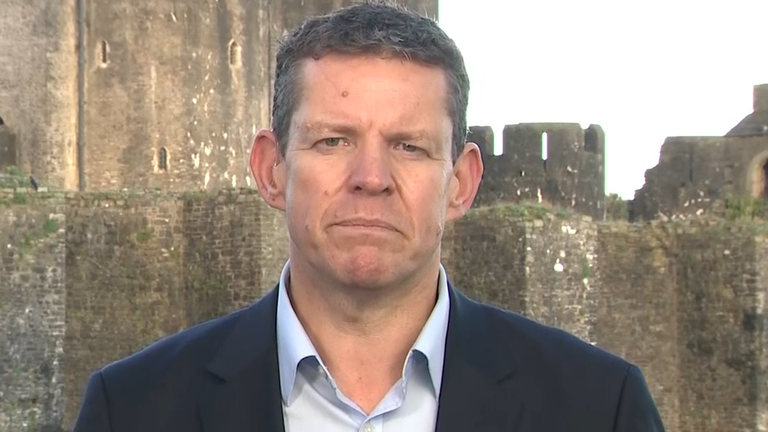
Plaid Cymru leader Rhun ap Iorwerth has everything to celebrate after winning the Caerphilly by-election.
Plaid Cymru leader Rhun ap Iorwerth told Sky News his party’s victory is the “start of a reset of politics in Wales”.
He said Plaid’s goal is to take over the Senedd for the first time in May next year.
“I want to see that through now. I’ve made it clear, said it in my conference speech a couple of weeks ago, we have to replace Labour,” he said.
“And it’s not just for its own sake, it’s so we get better outcomes for Wales. That’s what Plaid Cymru’s always about.”
Labour minister labels result ‘disappointing’
Cabinet Office minister Nick Thomas-Symonds told Sky News that “frustrations” with the “pace of change” led to Labour’s loss.
“I’m not shying away from, how disappointing the result is,” he said.
“What I found on the doorsteps was a real desire for more change, a frustration about the pace of change. That was coming through to me very strongly when I was speaking to people, I think that’s been reflected in the result.”

Labour ‘not shying away’ from loss
Labour’s deputy first minister in the Senedd, Huw Irranca-Davies, said the prime minister must “get back to bread and butter things” such as the cost of living, instead of focussing on immigration.
“We’ve got to get better,” he said.
“If it turns out as we think, as the polls have shown tonight, after a really good campaign with a really good Labour candidate in Richard, then we’ve got to talk about how do we get back to bread and butter things: cost of living, the state of the local community, the high street, the green spaces, the money in people’s pockets.
“And that’s a task for both Welsh Labour and UK Labour as well.”
First Minister Eluned Morgan congratulated Mr Whittle on his return to the Senedd and said: “We take our share of the responsibility for this result. We are listening, we are learning the lessons, and we will be come back stronger.”
Reform’s chair David Bull suggested the party’s strong performance in the polls cost them the by-election to Plaid Cymru.
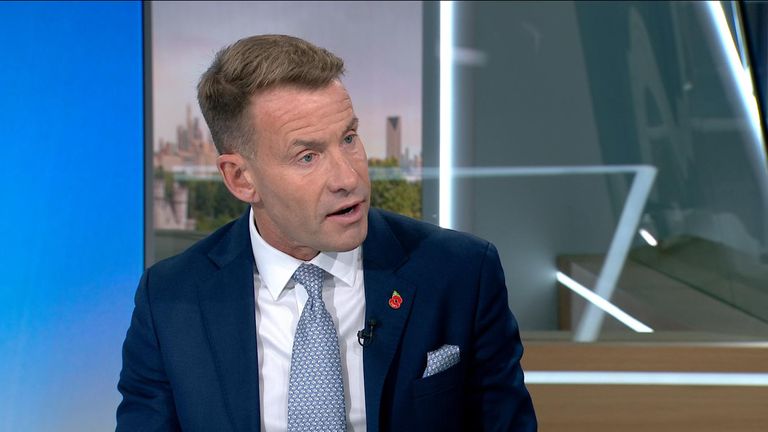
‘Extraordinary’ result for Reform
“I actually think the problem for us was the MRP poll, which was released two or three days ago,” he told Sky News.
“It showed us on 42%, Plaid on 38%, and it changed some people’s minds. I’ve heard tales from Lib Dem supporters, even Tories, actually voting tactically for Plaid to keep us out.”
Nigel Farage added that Reform’s candidate lost to “a party that people know well and to a popular local politician”.
“The Senedd elections next year are a two-horse race between Reform UK and Plaid Cymru,” he said.
The Conservatives and the Liberal Democrats were among the parties that lost their deposits.

Cryptocurrency markets saw another week of consolidation following last week’s long-awaited market recovery.
While Bitcoin (BTC) remained above the key $90,000 psychological level, investor sentiment continued to be dominated by “fear,” with a marginal improvement from 20 to 25 within the week, according to CoinMarketCap’s Fear & Greed index.
In the wider crypto space, the Ether (ETH) treasury trade appears to be unwinding, as the monthly acquisitions by Ethereum digital asset treasuries (DATs) fell 81% in the past three months from August’s peak.
Still, the biggest corporate Ether holder, BitMine Immersion Technologies, continued to amass ETH, while other treasury firms carried on with their fundraising efforts for future acquisitions.

Investors are also awaiting the key interest rate decision during the US Federal Reserve’s upcoming meeting on Wednesday to provide more cues about monetary policy leading into 2026.
Markets are pricing in an 87% chance of a 25 basis point interest rate cut, up from 62% a month ago, according to the CME Group’s FedWatch tool.

Ethereum treasury trade unwinds 80% as handful of whales dominate buys
The Ethereum treasury trade appears to be unwinding as monthly acquisitions continue to decline since the August high, though the largest players continue to scoop up billions of the Ether supply.
Investments from Ethereum DATs fell 81% in the past three months, from 1.97 million Ether in August to 370,000 ETH in November, according to Bitwise, an asset management firm.
“ETH DAT bear continues,” wrote Max Shennon, senior research associate at Bitwise, in a Tuesday X post.
Despite the slowdown, some companies with stronger financial backgrounds continued to accumulate the world’s second-largest cryptocurrency or raise funds for future purchases.

BitMine Immersion Technologies, the largest corporate Ether holder, accumulated about 679,000 Ether worth $2.13 billion over the past month, completing 62% of its target to accumulate 5% of the ETH supply, according to data from the Strategicethreserve.
BitMine holds an additional $882 million worth of cash according to the data aggregator, which may signal more incoming Ether accumulation.

Citadel causes uproar by urging SEC to regulate DeFi tokenized stocks
Market maker Citadel Securities has recommended that the US Securities and Exchange Commission tighten regulations on decentralized finance regarding tokenized stocks, causing backlash from crypto users.
Citadel Securities told the SEC in a letter on Tuesday that DeFi developers, smart-contract coders, and self-custody wallet providers should not be given “broad exemptive relief” for offering trading of tokenized US equities.
It argued that DeFi trading platforms likely fall under the definitions of an “exchange” or “broker-dealer” and should be regulated under securities laws if offering tokenized stocks.
“Granting broad exemptive relief to facilitate the trading of a tokenized share via DeFi protocols would create two separate regulatory regimes for the trading of the same security,” it argued. “This outcome would be the exact opposite of the “technology-neutral” approach taken by the Exchange Act.”
Citadel’s letter, made in response to the SEC looking for feedback on how it should approach regulating tokenized stocks, has drawn considerable backlash from the crypto community and organizations advocating for innovation in the blockchain space.
Arthur Hayes warns Monad could crash 99%, calls it high-risk “VC coin”
Crypto veteran Arthur Hayes has issued a warning over Monad, saying the recently launched layer-1 blockchain could plunge as much as 99% and end up as another failed experiment driven by venture capital hype rather than real adoption.
Speaking on Altcoin Daily, the former BitMEX chief described the project as “another high FDV, low-float VC coin,” arguing that its token structure alone puts retail traders at risk. FDV stands for Fully Diluted Value, which is the market value of a crypto project if all its tokens were already in circulation.
According to Hayes, projects with a large gap between FDV and circulating supply often experience early price spikes, followed by deep selloffs once insider tokens unlock. “It’s going to be another bear chain,” Hayes said, adding that while every new coin gets an initial pump, that does not mean it will develop a lasting use case.
Hayes said most new layer-1 networks ultimately fail, with only a handful likely to retain long-term relevance. He identified Bitcoin, Ether, Solana (SOL) and Zcash (ZEC) as the small group of protocols he expects to survive the next cycle.
Last year, Monad raised $225 million in funding from venture capital firm Paradigm. The layer-1 blockchain went live on Monday, accompanied by an airdrop of its MON token.

$25 billion crypto lending market now led by “transparent” players: Galaxy
The crypto lending market has become more transparent than ever, led by the likes of Tether, Nexo and Galaxy, and has just hit an aggregate loan book of nearly $25 billion outstanding in the third quarter.
The size of the crypto lending market has increased by more than 200% since the beginning of 2024, according to Galaxy Research. Its latest quarter puts it at its highest since its peak in Q1 2022.
However, it has yet to return to its peak of $37 billion at that time.
The main difference is the number of new centralized finance lending platforms and much more transparency, said Galaxy’s head of research, Alex Thorn.
Thorn said on Sunday that he was proud of the chart and the transparency of its contributors, adding that it was a “big change from prior market cycles.”

Portal to Bitcoin raises $25 million and launches atomic OTC desk
Bitcoin-native interoperability protocol Portal to Bitcoin has raised $25 million in funding amid the launch of what it describes as an atomic over-the-counter (OTC) trading desk.
According to a Thursday announcement shared with Cointelegraph, the company raised $25 million in a round led by digital asset lender JTSA Global. The fundraise follows previous investments by Coinbase Ventures, OKX Ventures, Arrington Capital and others.
Alongside the fresh funding, the company rolled out its Atomic OTC desk, promising “instant, trustless cross-chain settlement of large block trades.” The newly deployed service is reminiscent of crosschain atomic swaps offered by THORChain, Chainflip, and more Bitcoin-focused systems such as Liquality and Boltz.
What sets Portal to Bitcoin apart is its focus on the Bitcoin-anchored crosschain OTC market for institutions and whales, along with its tech stack. “Portal provides the infrastructure to make Bitcoin the settlement layer for global asset markets, without bridges, custodians, or wrapped assets,” said Chandra Duggirala, founder and CEO of Portal.

DeFi market overview
According to data from Cointelegraph Markets Pro and TradingView, most of the 100 largest cryptocurrencies by market capitalization ended the week in the red.
The Canton (CC) token fell 18%, marking the week’s biggest decline in the top 100, followed by the Starknet (STRK) token, down 16% on the weekly chart.

Thanks for reading our summary of this week’s most impactful DeFi developments. Join us next Friday for more stories, insights and education regarding this dynamically advancing space.

The lower house of Poland’s parliament failed to secure the required three-fifths majority to override President Karol Nawrocki’s veto of the Crypto-Asset Market Act, pushing the country further away from regulating its digital-asset sector at a moment when lawmakers argue that oversight is increasingly urgent.
As Bloomberg reported Friday, the legislation — advanced by Prime Minister Donald Tusk’s government — was intended to align Poland with the European Union’s MiCA framework for crypto markets. The bill was introduced in June but did not survive the president’s veto.
Nawrocki blocked the measure last week, arguing it would “threaten the freedoms of Poles, their property, and the stability of the state,” as Cointelegraph previously reported.
With the president’s veto upheld, the bill will not move forward, forcing the government to restart its crypto lawmaking process.

The proposal has sharply divided lawmakers and the crypto industry. Supporters framed the bill as a national security priority, saying that comprehensive rules are necessary to curb fraud and prevent potential misuse of crypto assets by foreign actors, including Russia, according to Bloomberg.
However, several crypto-industry groups opposed the legislation, warning that its requirements were overly burdensome and could drive startups out of the country.
Critics pointed to stringent licensing rules, high compliance costs and criminal-liability provisions for service-provider executives, arguing that the bill risked stifling innovation and creating an uncompetitive business environment.
Related: EU plan would boost ESMA powers over crypto and capital markets
Crypto adoption in Poland ramps up amid regulatory pause
Cryptocurrency use in Poland continues to accelerate even as the country stalls on comprehensive regulation. Chainalysis recently identified Poland as one of Europe’s “large crypto economies,” noting that the country’s onchain activity has expanded significantly over the past year.
According to the company’s 2025 Europe Crypto Adoption report, Poland recorded more than 50% year-over-year growth in overall transaction volume.

Polish investors are also increasing their exposure to Bitcoin (BTC), reflected in a surge in Bitcoin ATM installations in recent years. In January, Cointelegraph reported that Poland had become the world’s fifth-largest Bitcoin ATM hub, surpassing even El Salvador — a country that has made Bitcoin a central element of its monetary and financial system.
Magazine: When privacy and AML laws conflict: Crypto projects’ impossible choice

US attorneys representing the federal government have requested that a judge send Terraform Labs co-founder Do Kwon to prison for 12 years at his sentencing hearing next week.
In a Thursday filing in the US District Court for the Southern District of New York, prosecutors asked that a judge sentence Kwon “to a term of twelve years’ imprisonment and finalize the forfeiture of his criminal proceeds.”
The filing came about four months after the Terraform co-founder pleaded guilty to two counts of wire fraud and conspiracy to defraud.
“In just a few years, Kwon caused losses that eclipsed those caused by Samuel Bankman-Fried […] Alexander Mashinsky […] and Karl Sebastian Greenwood [….] combined [emphasis included in filing],” said the Thursday filing. “The Terraform market crash triggered a cascade of crises that swept through cryptocurrency markets and contributed to what has since become known as ‘Crypto Winter.’”

Kwon, who is scheduled to be sentenced on Thursday, was indicted by US authorities in March 2023 for charges including securities fraud, market manipulation, money laundering and wire fraud related to his role at Terraform.
Though his whereabouts were initially unknown after the collapse of Terra in 2022, authorities in Montenegro arrested him on charges unrelated to his role at the company, and he was later extradited to the US.
Related: South Korea targets sub-$680 crypto transfers in sweeping AML crackdown
The price of Terra’s native token, LUNA, surged by more than 40% in the previous 24 hours amid the release of the sentencing recommendation, from about $0.07 to $0.10 at the time of publication. However, the token reached an all-time high price of more than $19.00 before the ecosystem collapsed in May 2022.
Kwon says he could still face prison time in South Korea
In a November court filing, lawyers representing Kwon asked that the Terraform co-founder be given a sentence of no more than five years. His attorneys presented several arguments in favor of a shorter sentence, including that the co-founder could face 40 years in prison in his native South Korea, where prosecutors are also working on a case against him.
“He would not be able to walk out of jail in the United States as a free man for any amount of time: He will be taken from whatever facility in which he serves his sentence directly to an immigration detention center to await a deportation flight to Seoul, where he will immediately reenter pretrial detention pending his criminal charges in South Korea,” said Kwon’s lawyers.
Although Kwon’s and prosecutors’ respective recommendations will remain under consideration, the judge overseeing the sentencing hearing has the authority to sentence the Terraform co-founder to decades in prison, or a significantly shorter time. In contrast, former FTX CEO Sam Bankman-Fried is serving a 25-year sentence after his conviction on seven felony charges, former Celsius CEO Alex Mashinsky was sentenced to 12 years in prison, and a judge sent Karl Sebastian Greenwood to prison for 20 years for his role in the OneCoin scheme.
Magazine: When privacy and AML laws conflict: Crypto projects’ impossible choice
-
 Sports2 years ago
Story injured on diving stop, exits Red Sox game
-
 Sports3 years ago
‘Storybook stuff’: Inside the night Bryce Harper sent the Phillies to the World Series
-
 Sports2 years ago
Game 1 of WS least-watched in recorded history
-
 Sports3 years ago
Button battles heat exhaustion in NASCAR debut
-
 Sports3 years ago
MLB Rank 2023: Ranking baseball’s top 100 players
-
Sports4 years ago
Team Europe easily wins 4th straight Laver Cup
-
 Environment3 years ago
Japan and South Korea have a lot at stake in a free and open South China Sea
-
 Environment1 year ago
Here are the best electric bikes you can buy at every price level in October 2024