Connect with us

Published

on

On Oct. 20 of last year, college football’s first two firings unfolded with little fanfare — East Carolina let go of Mike Houston and Southern Miss dismissed Will Hall.

By that date in 2025, there already were 11 programs — including seven major conference teams — that dismissed their coach.

Those seven openings far outpace the final statistics from 2024, when just three coaches were fired for performance — Purdue’s Ryan Walters, UNC’s Mack Brown and West Virginia’s Neal Brown.

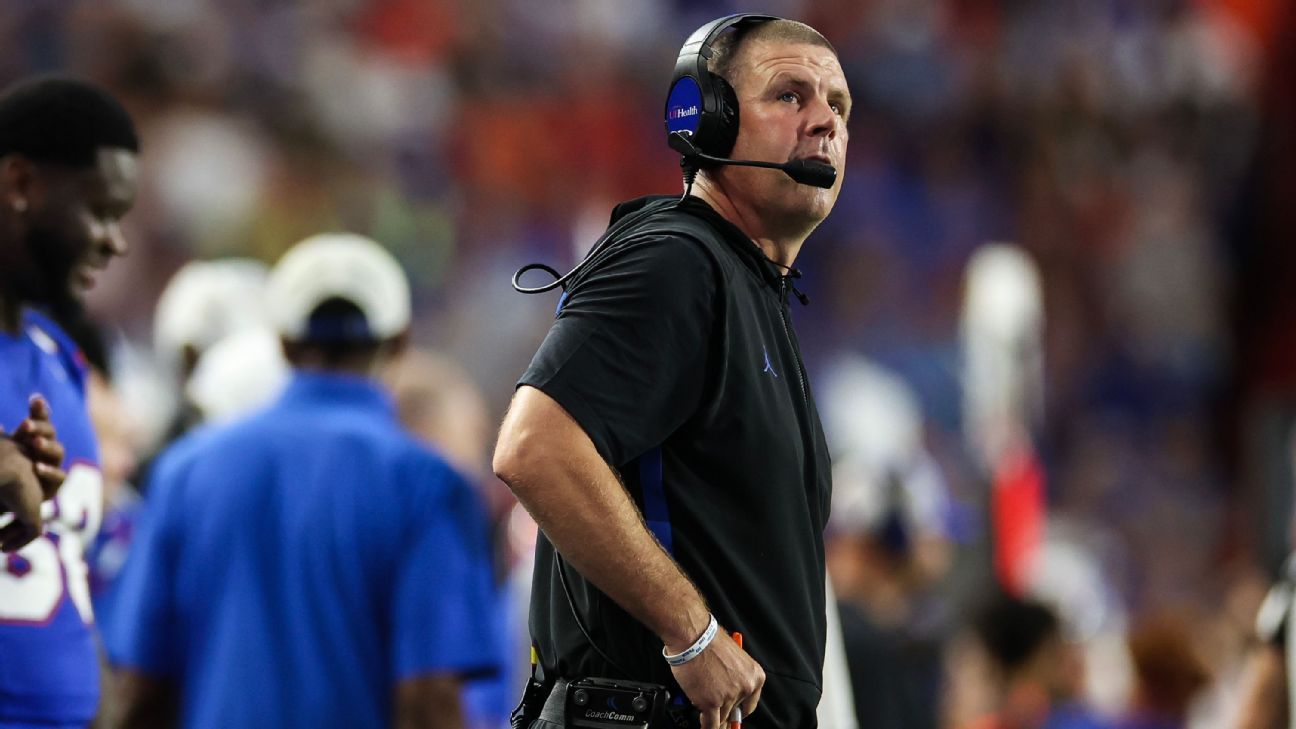
Since this season started, there have been six firings at major conference schools — UCLA, Virginia Tech, Oklahoma State, Arkansas, Penn State and Florida. (Stanford’s firing of Troy Taylor came after off-field tumult this offseason.)

So, how did we get to the point where there are 11 open jobs on the 2025 calendar — including UAB, Oregon State, Kent State and Colorado State — before the first open job in 2024?

There’s a confluence of factors that range from the slow power conference cycle in 2024 to the professionalization of college programs demanding instant results. (One industry source said jokingly that Curt Cignetti’s instant success at Indiana ruined the expectation curve for all coaches.)

How crazy will this cycle get? One industry source summed it up this way: “There’s not enough good coaches to fill all of these spots. It’s never a good year to be in the market, but especially not this year.”

We dove into the numbers and asked industry sources how they see it playing out, as the busiest and most expensive coaching carousel in the sport’s history looms.

Could this be the busiest coaching carousel ever?

In short, yes. Especially with the early flurry of Power 5 jobs.

Comparisons are tricky because of conference realignment and variables like season-long interim coaches. But the most major conference jobs open in a recent season happened in the 2021-22 cycle, when there were 14, per ESPN Research. That cycle included USC (Lincoln Riley), LSU (Brian Kelly), Notre Dame (Marcus Freeman), Florida (Billy Napier), Miami (Mario Cristobal), Oklahoma (Brent Venables) and Oregon (Dan Lanning).

This year is shaping up to rival that, as in the modern era, this is the earliest we’ve seen seven power conference jobs open.

Also on the radar are Auburn, Florida State and Wisconsin, with the latter two schools issuing statements about the futures of their coaches this week.

There are also eyes on Deion Sanders’ health at Colorado, Kyle Whittingham’s potential retirement at Utah and Bill Belichick’s struggles at UNC. Kentucky is 0-4 in the SEC under Mark Stoops, but the Wildcats would owe him nearly $38 million within 60 days of firing him.

And there are still six weeks left in the season. The legacy of Franklin’s firing at Penn State is that nearly every coach is a three-game losing streak from his job being in trouble. So, don’t be surprised if another school or two finds its situation untenable as the losses pile up. And never rule out a surprise retirement or two, as we’ve seen veteran coaches monitor the landscape and head off to their beach houses in recent years in college football and basketball.

Combine current openings with potential ones and the inevitable dominoes of hiring away sitting coaches from other power conference jobs, and it’s clear that the recent benchmark of 14 power jobs from the 2021-22 cycle and 2015-16 cycle will be threatened. (That number is 15 in 2021-22 if you count SMU, which has since moved to the ACC, and 16 in 2015-16 if you count UCF and BYU. College sports never makes these things easy.)

From a pure numbers standpoint, we’re likely amid a historic three-year run. The NCAA keeps annual tabs on new coaches in the FBS, and the past two cycles have been the first time in college football history, per the NCAA, that at least 30 new coaches have arrived in back-to-back years.

There were 32 to start the 2024 season, and there were 30 to start this season. The only other time in the FBS era there have been more than 30 is 2013, when there were 31 new coaches, good for a record 25.2% turnover.

That 30-coach benchmark appears likely to be eclipsed again. Even with a handful of duplicate jobs those years, it means somewhere over 60% of the sport is destined to turn over in three years.

How large will buyouts loom?

For decades, coaches were the largest talent expense for a program. And because of the competition to hire and retain them, it became standard practice for schools to offer lengthy guaranteed salaries.

And that has led to piles of dead money being paid to coaches. An ESPN study found $533.6 million in dead money in athletic departments for coaches over an 11-year period from Jan. 1, 2010, to Jan. 31, 2021. There’s already more than $100 million in buyout money owed this year, although many contracts are subject to offset and mitigation. (If Franklin gets a job for $25 million over five years, for example, that would be subtracted from the $49 million he’s owed through the 2031 season.)

But there are also a few more big figures potentially looming — Mike Norvell’s $58 million with Florida State, Freeze’s $15 million with Auburn and Luke Fickell’s more than $25 million with Wisconsin. Those will factor into decision-making at those schools.

As another industry source adds: “Look at the candidate pool. If it’s close and you think you might have the right guy, you don’t go in.”

What became apparent through calls this week is that the fervor over coaches is unlikely to translate to changed behavior in contracts. Restraint and discipline don’t often coincide with desperation.

Could a coach who makes the playoff jump to a new job?

Technically, sure. But in reality, that would be a hire that redefines awkward. ESPN spoke to a half a dozen sources about this, and the answers vary. With the transfer portal not opening until Jan. 2, there’s certainly a chance that a school could wait out a playoff coach.

But two looming factors would be difficult to overcome, even if there’s a proverbial “deal in the drawer” that a coach has agreed to in advance.

The first is that the coach would put his current team’s title hopes at risk, as his team would be suspicious if a major job remained open and he dodged answers about it. (Not to mention, didn’t sign a new deal with his current school.)

The second is simple — what happens if a coach wins a few games? A coach could play in the first round Dec. 19 or Dec. 20, lose the game and leave a day or two after to set up his roster in time for next year. But a win or two could extend his season into mid-January, and any athletic director who waits a month and doesn’t have a coach in place for the start of the portal would get squeamish.

“The tough part will be, if you have that search open, how do you keep it quiet?” an industry source said. “You’re going to have to keep a process going. The only way I see it happening is that school would have to keep a search going all that time.”

The portal might officially open Jan. 2, but most deals will be done long before. Even with a strong general manager at a program, the ambiguity would undercut the first year’s roster tremendously.

Essentially, the coach and school would have to announce that he’s leaving. The coach would then coach out the playoff, with the idea that the players are all free agents at the end of every season. It would be awkward and heavily criticized, but that might be the only option.

So, if a program wants a coach projected to reach the playoff — think Ole Miss’ Lane Kiffin, USF’s Alex Golesh or Georgia Tech’s Brent Key — there would be some hard conversations.

Who are the big names who could move?

Kiffin and Nebraska coach Matt Rhule will be the biggest names looming over the carousel, as they are the speculative favorites for the jobs at Florida (Kiffin) and Penn State (Rhule).

There are three former power conference coaches who could factor into the major jobs this year — former Northwestern coach Pat Fitzgerald, former Wake Forest coach Dave Clawson and former Florida State/Texas A&M coach Jimbo Fisher. The opportunity to go early and avoid the dangerous game of musical chairs may make those coaches attractive.

There are plenty of sitting power conference coaches who’ll generate interest and could move.

In the ACC, SMU’s Rhett Lashlee, Georgia Tech’s Key ($4 million buyout), Louisville’s Jeff Brohm ($1 million) and Cal’s Justin Wilcox ($1 million to leave after regular season) all have been bandied about.

In the Big Ten, Rhule, Minnesota’s P.J. Fleck and Washington’s Jedd Fisch are being discussed. (Rhule’s buyout is $5 million, Fleck’s is $5.5 million and Fisch’s is $10 million.)

In the SEC, Missouri’s Eliah Drinkwitz’s buyout drops from $5 million to $4 million after Dec. 1. Clark Lea has Vanderbilt 6-1, and the Commodores are the toast of the country this year. South Carolina’s Shane Beamer ($5 million buyout) will remain a name at Virginia Tech until that job is filled.

In the Big 12, the buzziest names are Iowa State’s Matt Campbell ($2 million buyout), ASU’s Kenny Dillingham ($4 million) and BYU’s Kalani Sitake (unknown).

Any of those would create further ripples.

How did we get here?

Well, everything changed. So, it makes sense that the coaching cycle would, too. There will be PhD projects and books written about the past handful of years in college athletics.

If you consider the entire player procurement and payment model being overhauled, it makes sense that there’s constant turnover on the landscape.

And with bigger investments by schools come more urgency for results. And acquisition mistakes are magnified because they come with an actual price tag.

“I think in the last three or four years, because of NIL, I just think it’s changed so much,” an industry veteran said. “If you’re going to lead a bunch of 18-to-23-year-olds, the relationship part is so different now that money is involved. Coaching and getting the most out of kids is so different because of the financial implications.”

Combine that with bosses stressed over money and boosters having more sway because they are footing the NIL bills, and the coaching market is haywire. Another industry source joked that “every school’s Cody Campbell” now has bigger sway in hires, referencing the ubiquitous Texas Tech booster.

With investment and uncertainty on parallel tracks, it only makes sense that volatility follows.

Marisa Dowling contributed to this report.

Continue Reading

Sports

Army vs. Navy (Dec 13, 2025) Live Score – ESPN

Published

on

By

Army vs. Navy (Dec 13, 2025) Live Score - ESPN

Source: Michigan begins query into athletic department

The University of Michigan has commissioned an investigation into its athletic department, centering on how numerous scandals have both occurred and been handled in recent years, a source told ESPN.

Continue Reading

Sports

Source: U-M launches athletic department query

Published

on

By

Source: U-M launches athletic department query

The University of Michigan has commissioned a full investigation into the practices and culture of its athletic department, centering on how numerous scandals have both occurred and been handled in recent years, a source told ESPN.

The firing of football coach Sherrone Moore this week will be a particular focus.

The investigation will be handled by Jenner & Block, a Chicago-based law firm that has done business with the school in recent years, including conducting the investigation into whether Moore had an inappropriate relationship with a staff member.

The Detroit News first reported the authorization of the investigation.

The firm opened an inquiry earlier this fall about the conduct of Moore and a staff member after the university received an anonymous tip, multiple sources told ESPN. Both Moore and the staff member denied the relationship and not enough evidence emerged to confirm it.

That changed Wednesday when, according to prosecutors in Washtenaw County, Michigan, the staff member told investigators it did occur and presented corroborating evidence. The staff member had, on Monday, broken off the multiyear relationship, according to prosecutors, but became concerned when Moore sent a flurry of texts and calls that were unreturned.

The university promptly fired Moore on Wednesday for the relationship. Soon after, Moore went to the staff member’s apartment just outside Ann Arbor and, according to prosecutors, barged in, grabbed kitchen scissors and some butter knives. He then threatened to kill himself.

“I’m going to kill myself,” Moore said, according to first assistant prosecutor Kati Rezmierski. “I’m going to make you watch. My blood is on your hands. You ruined my life.”

Moore, a married father of three, was charged Friday on three counts, including felony home invasion and misdemeanor charges of stalking in a domestic relationship and breaking and entering. Moore pleaded not guilty, and a probable cause hearing was set for Jan. 22, 2026.

Friday evening, after spending two nights in jail, Moore was released on a $25,000 bond with a GPS monitoring system and an order to receive counseling.

This is the latest in a series of scandals that have hit both the athletic department and the university as a whole. It includes a federal indictment in March of former offensive coordinator Matt Weiss, who is facing 24 charges of unauthorized access to computers and aggravated identity theft.

Prosecutors from the Eastern District of Michigan allege that Weiss ran a vast, multiyear effort to access the personal accounts of thousands of NCAA student-athletes across the country. He is charged with targeting specific female athletes to access personal and intimate photographs and videos.

Some of the alleged crimes, the feds say, occurred while Weiss was working inside the school’s football facility, Schembechler Hall from 2021 to 2022, and during a previous stint with the NFL’s Baltimore Ravens.

There have been additional run-ins with the NCAA rules, including the high-profile 2023 advanced scouting operation centered around former football staffer Connor Stalions. The NCAA hit the program with four years of probation and a fine that could reach over $30 million.

Former football coach Jim Harbaugh was sanctioned with numerous suspensions in his final years at the school for both the advanced scouting situation and recruiting violation. Harbaugh left to become the head coach of the Los Angeles Chargers in January 2024. Moore, who was promoted from offensive coordinator to succeed Harbaugh, has also twice been suspended by the NCAA. He still owes a one-game penalty, which was to be served in 2026, for deleting a thread of text messages sent to Stalions.

The series of scandals have put a spotlight on athletic department as a whole, including on director Warde Manuel, an alum and former player for the Bo Schembechler-led Wolverines of the late 1980s. Manuel has been on the job since 2016.

A high-level meeting of university officials was held Thursday evening, sources told ESPN, leading to intense speculation about Manuel’s future, but he remains on the job. The university would owe Manuel, 57, who signed a new five-year contract in December 2024, about $6.75 million if it dismissed him without cause.

On Thursday, interim university president Domenico Grasso, in a letter to the campus community, asked anyone with knowledge of the Moore situation to provide it via a confidential reporting system.

“Together, we will move forward with integrity and excellence, and reaffirm our dedication to serving the public good,” Grasso wrote.

Despite all of the tumult, the Wolverines’ athletic department is mostly thriving in competition, including the football program winning the 2023 national title. Currently both the men’s and women’s basketball teams are ranked in the top six nationally. Hockey is No. 1.

Meanwhile, the university has consistently set institutional records for the undergraduate application numbers in recent years, hitting 98,310 for the incoming freshman class this year, per federal filings from the university. That is up from 79,743 for 2022, an 18.9% jump in just three years.

Jenner & Block has a long-standing relationship with the university, including, in 2022, investigating an inappropriate relationship between then school president Mark Schlissel and a university employee that led to Schlissel’s removal from office.

Continue Reading

Sports

Blackhawks recall Lardis following Bedard injury

Published

on

By

Blackhawks recall Lardis following Bedard injury

CHICAGO — The Chicago Blackhawks have recalled high-scoring forward Nick Lardis from the minors a day after Connor Bedard got hurt in the final seconds of a loss at St. Louis.

Lardis, 20, could make his NHL debut as soon as Saturday night against Detroit. He had 13 goals and 13 assists in 24 games with Rockford of the American Hockey League.

“He’s a guy who’s scored a lot of goals throughout his young career, going back to junior,” coach Jeff Blashill said, “and he’s had a pretty good start to his American league. I know for sure Connor’s not playing tonight, so we just felt like it gives us another potential offensive guy that can come in and provide some scoring punch.”

Blashill had no update on Bedard, who leads the team with 19 goals and 25 assists in 31 games.

With 0.8 seconds left in Friday night’s 3-2 loss at St. Louis, Bedard attempted to win a draw to give Chicago one last chance, but he was knocked down by Blues center Brayden Schenn. He grasped at his right shoulder and immediately headed to the locker room, accompanied by a trainer.

Any significant injury for Bedard would be a major blow for Chicago. It also could take the 20-year-old center out of the running for Canada’s roster for the 2026 Winter Olympics.

“We’ll know more in the next couple days,” Blashill said. “I just don’t want to say stuff that’s not super accurate, so I don’t see any reason to guess.”

Lardis was selected by Chicago in the third round of the 2023 draft. He had 71 goals and 46 assists in 65 games last season with Brantford in the Ontario Hockey League.

Continue Reading

Trending