
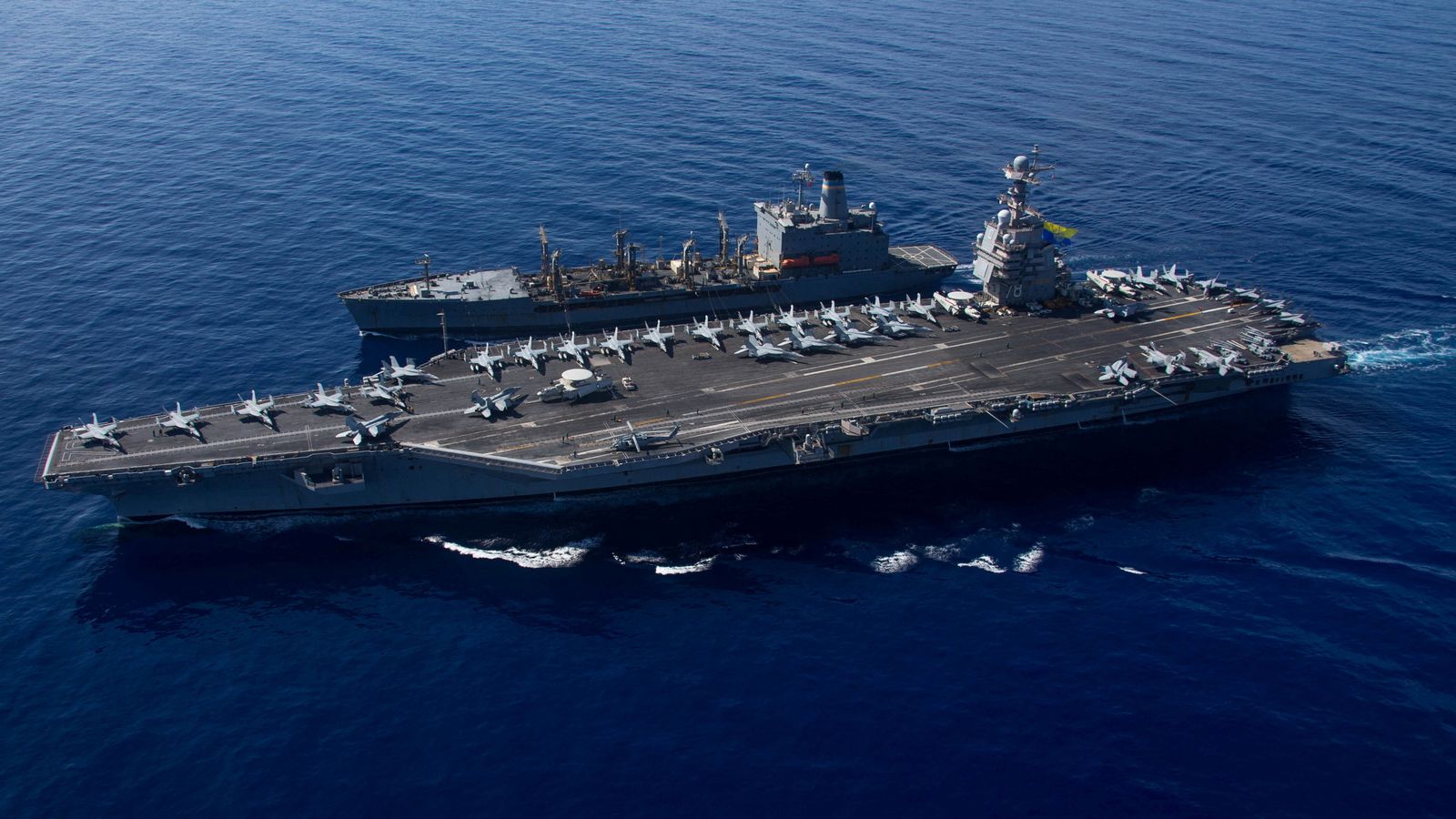
US accused of ‘inventing a war’ as it moves largest aircraft carrier to South America

The US has announced it is sending an aircraft carrier to the waters off South America as it ramps up an operation to target alleged drug smuggling boats.
The Pentagon said in a statement that the USS Gerald R Ford would be deployed to the region, including the Caribbean Sea, to “bolster US capacity to detect, monitor, and disrupt illicit actors and activities that compromise the safety and prosperity of the United States homeland and our security in the Western Hemisphere”.
Venezuela’s President Nicolas Maduro told state media that the US was “inventing a new eternal war”.
The vessel is the US Navy’s largest aircraft carrier. It is currently deployed in the Mediterranean alongside three destroyers, and the group are expected to take around one week to make the journey.
There are already eight US Navy ships in the central and South American region, along with a nuclear-powered submarine, adding up to about 6,000 sailors and marines, according to officials.
It came as the US secretary of war claimed that six “narco-terrorists” had been killed in a strike on an alleged drug smuggling boat in the Caribbean Sea overnight.
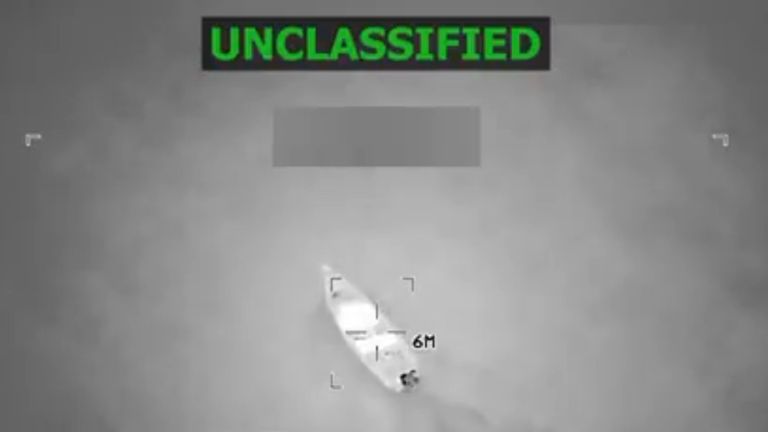
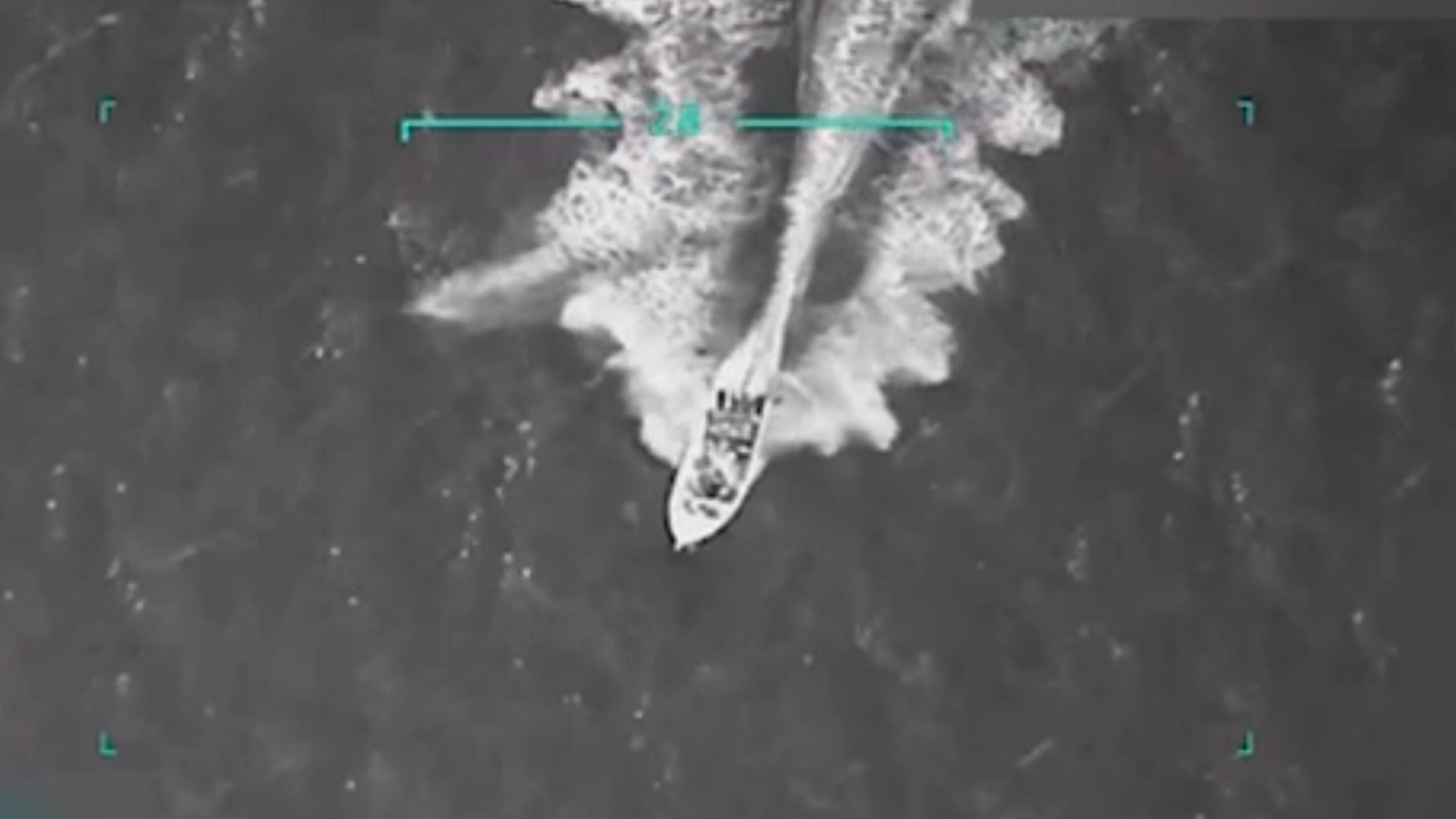
A still from footage purporting to show the boat seconds before the airstrike, posted by US Secretary of War Pete Hegseth on X
Pete Hegseth said his military had bombed a vessel which he claimed was operated by Tren de Aragua – a Venezuelan gang that was designated a terror group by Washington in February.
Writing on X, he claimed that the boat was involved in “illicit narcotics smuggling” and was transiting along a “known narco-trafficking route” when it was struck during the night.
All six men on board the boat, which was in international waters, were killed and no US forces were harmed, he said.
Ten vessels have now been bombed in recent weeks, killing more than 40 people.
Mr Hegseth added: “If you are a narco-terrorist smuggling drugs in our hemisphere, we will treat you like we treat al Qaeda. Day or NIGHT, we will map your networks, track your people, hunt you down, and kill you.”
While he did not provide any evidence that the vessel was carrying drugs, he did share a 20-second video that appeared to show a boat being hit by a projectile before exploding.
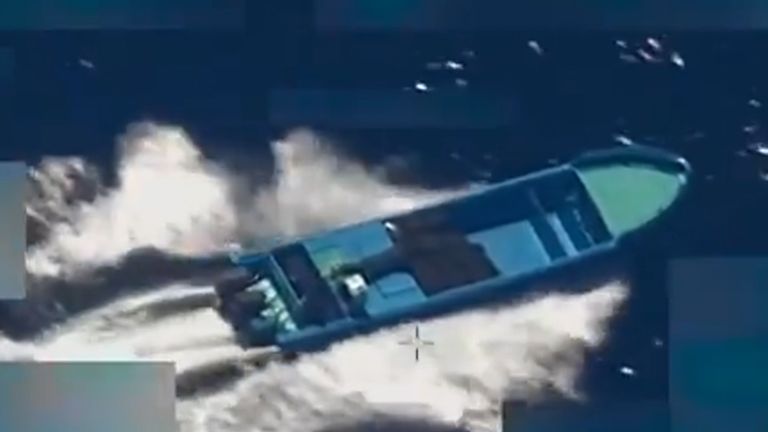
Footage of a previous US strike on a suspected drugs boat earlier this week
Speaking during a White House news conference last week, Donald Trump argued that the campaign would help tackle the US’s opioid crisis.
“Every boat that we knock out, we save 25,000 American lives. So every time you see a boat, and you feel badly you say, ‘Wow, that’s rough’. It is rough, but if you lose three people and save 25,000 people,” he said.
Read more:
Survivors reported after boat strike
US destroys ‘drug smuggling submarine’
On Thursday, appearing at a press conference with Mr Hegseth, Mr Trump said that it was necessary to kill the alleged smugglers, because if they were arrested they would only return to transport drugs “again and again and again”.
“They don’t fear that, they have no fear,” he told reporters.
The attacks at sea would soon be followed by operations on land against drug smuggling cartels, Mr Trump claimed.
“We’re going to kill them,” he added. “They’re going to be, like, dead.”
Some Democratic politicians have expressed concerns that the strikes risk dragging the US into a war with Venezuela because of their proximity to the South American country’s coast.
Others have condemned the attacks as extrajudicial killings that would not stand up in a court of law.
Jim Himes, a member of the House of Representatives, told CBS News earlier this month: “They are illegal killings because the notion that the United States – and this is what the administration says is their justification – is involved in an armed conflict with any drug dealers, any Venezuelan drug dealers, is ludicrous.”
He claimed that Congress had been told “nothing” about who was on the boats and how they were identified as a threat.
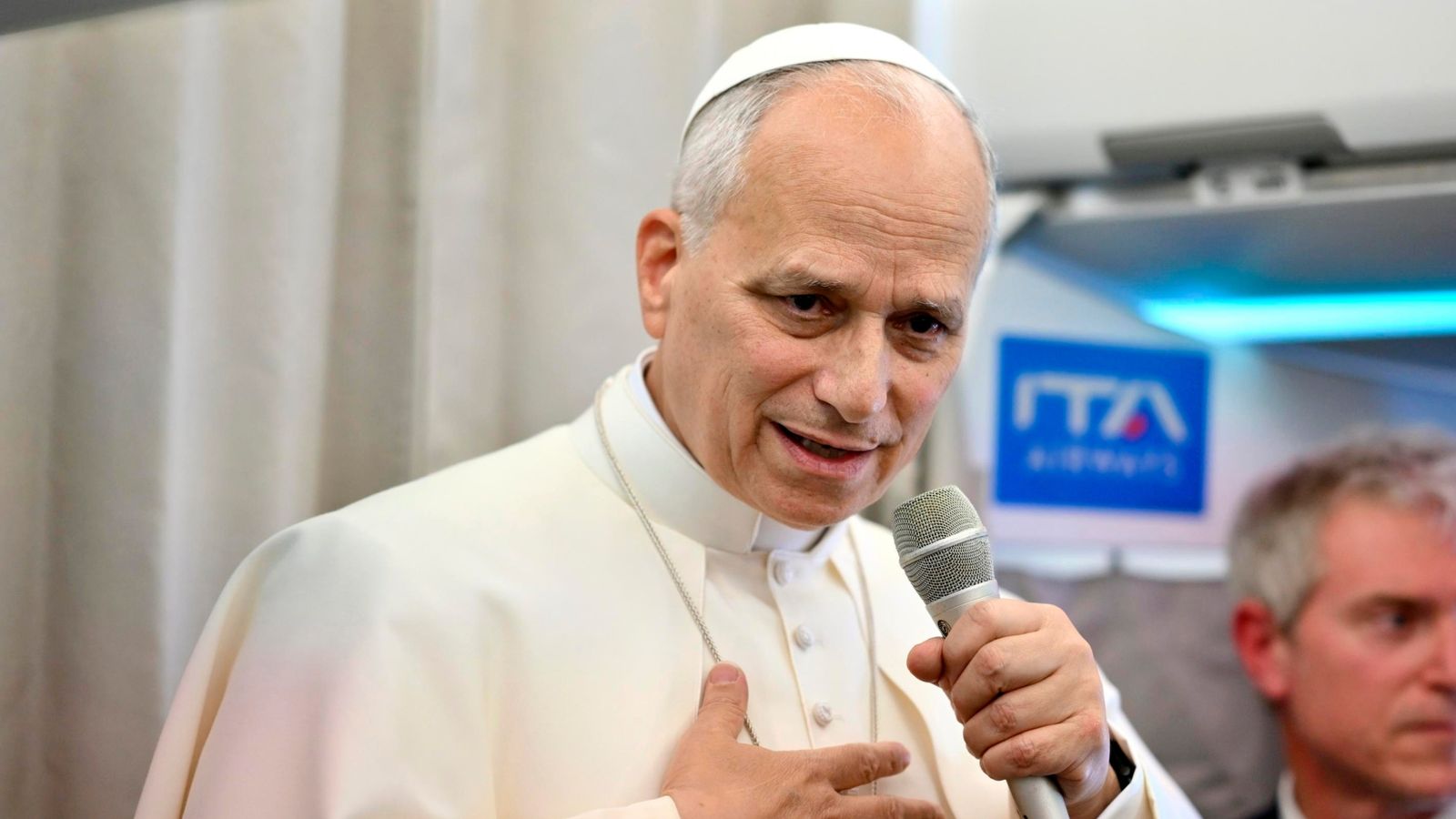
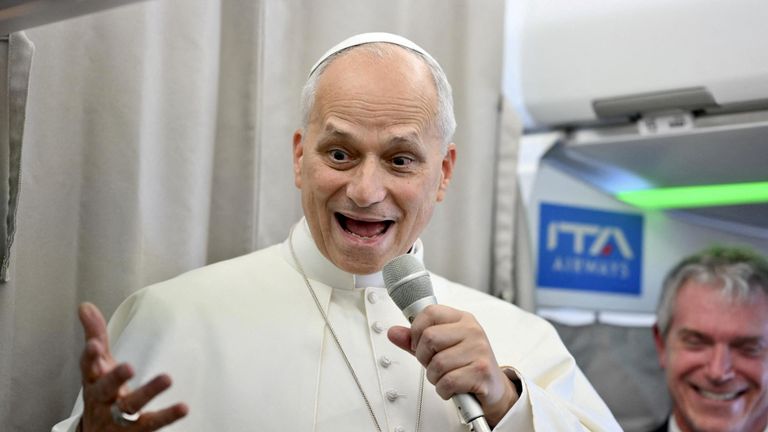
The Pope has urged Donald Trump not to try to oust Venezuelan President Nicolas Maduro using military force.
Leo, the first American pontiff, said it would be better to attempt dialogue or impose economic pressure on Venezuela if Washington wants to pursue change there.
The Trump administration has been weighing options to combat what it has portrayed as Mr Maduro’s role in supplying illegal drugs that have killed Americans.
The socialist Venezuelan president has denied having any links to the illegal drug trade.
Pope Leo XIV aboard a flight to Rome. Pic: Reuters
Asked during a news conference about President Trump’s threats to remove Mr Maduro by force, the Pope said: “It is better to search for ways of dialogue, or perhaps pressure, including economic pressure.”
He added that Washington should search for other ways to achieve change “if that is what they want to do in the United States”.
The Pope was speaking as he flew home from a visit to Turkey and Lebanon – his first overseas trip in the role.
Mr Maduro has said Venezuelans are ready to defend their country as the US considers a land attack.
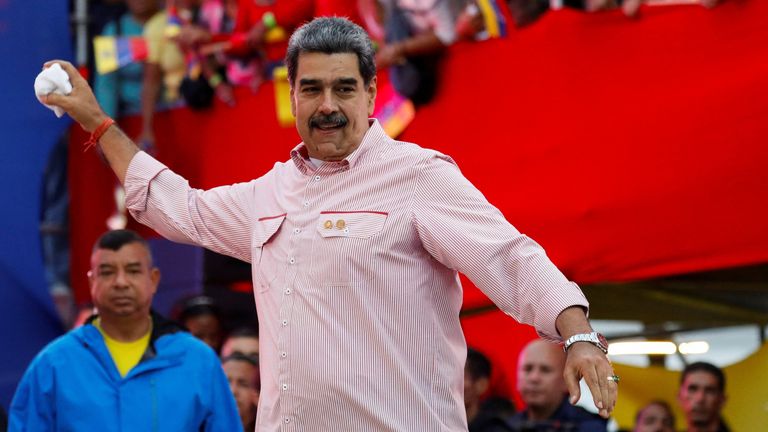
Venezuela’s President Nicolas Maduro in Caracas. Pic: Reuters
The president held a rally in Caracas amid heightened tensions with Mr Trump’s administration, which has been targeting what it says are boats carrying drug smugglers.
Mr Trump met his national security team on Monday evening, having warned last week that land strikes would start “very soon”.
It’s not been confirmed what was discussed at the meeting, but White House press secretary Karoline Leavitt told reporters: “There’s many options at the president’s disposal that are on the table – and I’ll let him speak on those.”
US forces have carried out at least 21 strikes on boats it claims were carrying narcotics to its shores over the last few months.
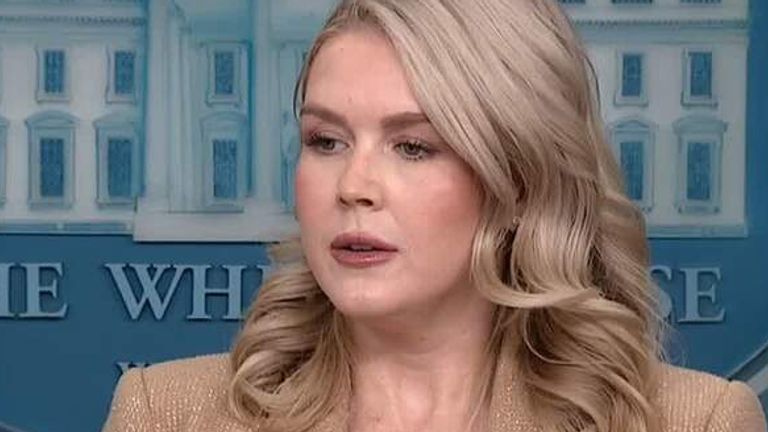
‘The president has a right to take them out’
Mr Maduro – widely considered a dictator by the West – said on Monday that Venezuelans are ready “to defend [the country] and lead it to the path of peace”.
“We have lived through 22 weeks of aggression that can only be described as psychological terrorism,” he said.
Venezuela has said the boat attacks, which have killed more than 80 people, amount to murder – and that Mr Trump’s true motivation is to oust Mr Maduro and access its oil.
This breaking news story is being updated and more details will be published shortly.
Please refresh the page for the latest version.
You can receive breaking news alerts on a smartphone or tablet via the Sky News app. You can also follow us on WhatsApp and subscribe to our YouTube channel to keep up with the latest news.

“Many options” are on the table to deal with Venezuelan drug gangs, the White House has said, as the US considers attacking on land.
President Trump is meeting his national security team on Monday and could discuss what would be a major escalation in strikes that have so far only targeted boats.
Karoline Leavitt, the president’s press secretary, did not detail what the meeting would focus on. However, Mr Trump said last week that land strikes would start “very soon”.
“There’s many options at the president’s disposal that are on the table – and I’ll let him speak on those,” Ms Leavitt told reporters.
Three killed as US strikes another alleged drug boat
American forces have carried out at least 21 strikes on boats it claims were carrying narcotics to its shores over the last few months.
The US has accused Venezuelan President Nicolas Maduro of being involved in the drugs trade – a claim he denies.
Venezuela has said the attacks, which have killed more than 80 people, amount to murder and that President Trump’s true motivation is to oust Mr Maduro and access its oil.
President Maduro – widely considered a dictator by the West – said on Monday that Venezuelans are ready “to defend [the country] and lead it to the path of peace”.
“We have lived through 22 weeks of aggression that can only be described as psychological terrorism,” he said.
Concerns have been raised over the legality of the US attacks, which the Pentagon has sought to justify by designating the gangs as foreign terror organisations.
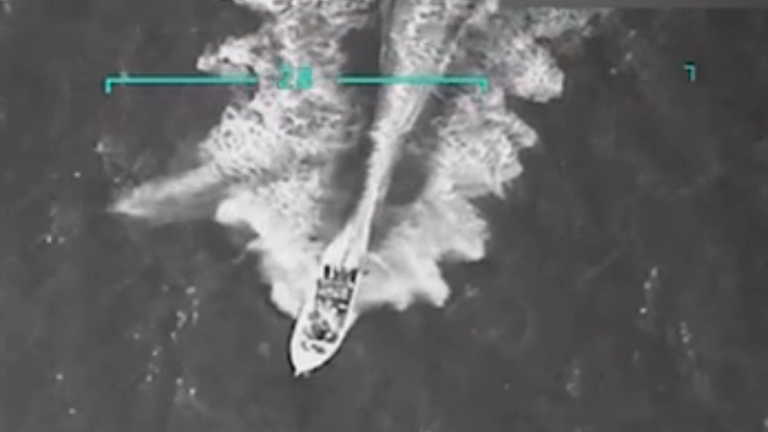
Image of an alleged drug boat being targeted by the US military. Pic: Truth Social
Tensions remain high over America’s large deployment in the Caribbean Sea and eastern Pacific, which includes its flagship aircraft carrier and thousands of troops.
The US has released videos of boats being blown up but has not provided evidence – such as photos of drugs – to support the smuggling claims.
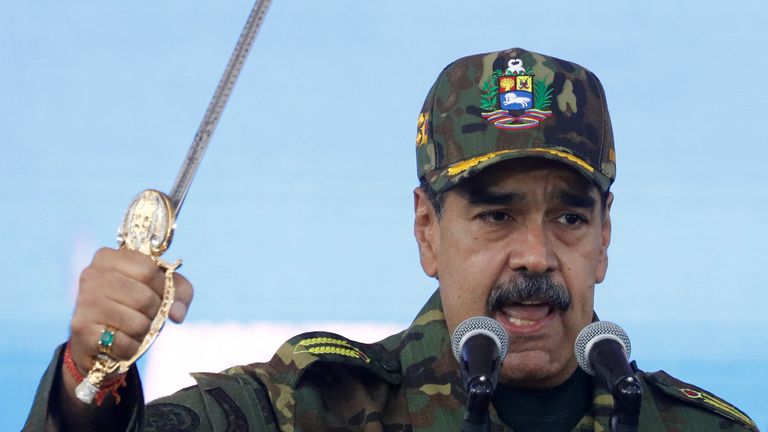
President Maduro is widely considered a dictator by the West. Pic: Reuters
Controversy also surrounds the first incident, on 2 September, in which 11 people were killed – with a follow-up strike targeting the boat after the first attack left two survivors in the water.
US media reported defence secretary Pete Hegseth gave an order beforehand that everyone on board should be killed.
However, there are concerns about the legality of the second strike if the survivors posed no threat.
Mr Hegseth dismissed the reporting as “fake news” and insisted all actions in the region are compliant with US and international law.
“Every trafficker we kill is affiliated with a Designated Terrorist Organization,” he said on X.
President Trump said on Sunday he would not have wanted a second strike and that Mr Hegseth had denied giving such an order.
Read more from Sky News:
Hong Kong fire: 13 arrested as death toll hits 151
More than 1,100 confirmed dead in Asia floods
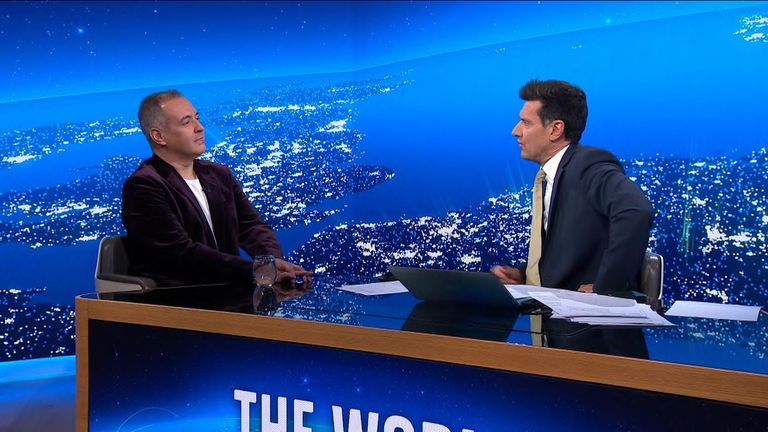
Is US about to go to war with Venezuela?
Ms Leavitt confirmed on Monday that the boat had been hit by a second strike – but denied Mr Hegseth gave the order for the follow-up.
Instead, she said he had authorised US navy vice admiral Frank Bradley to attack and the admiral acted “well within his authority and the law, directing the engagement to ensure the boat was destroyed and the threat to the US was eliminated”.
As the US weighs its next steps, Mr Trump said on Sunday he had spoken to President Maduro by phone and that the conversation went neither “well or badly”.
In recent days, he also stated that Venezuela’s airspace should be considered closed – with the South American nation calling it a “colonial threat” and “illegal, and unjustified aggression”.
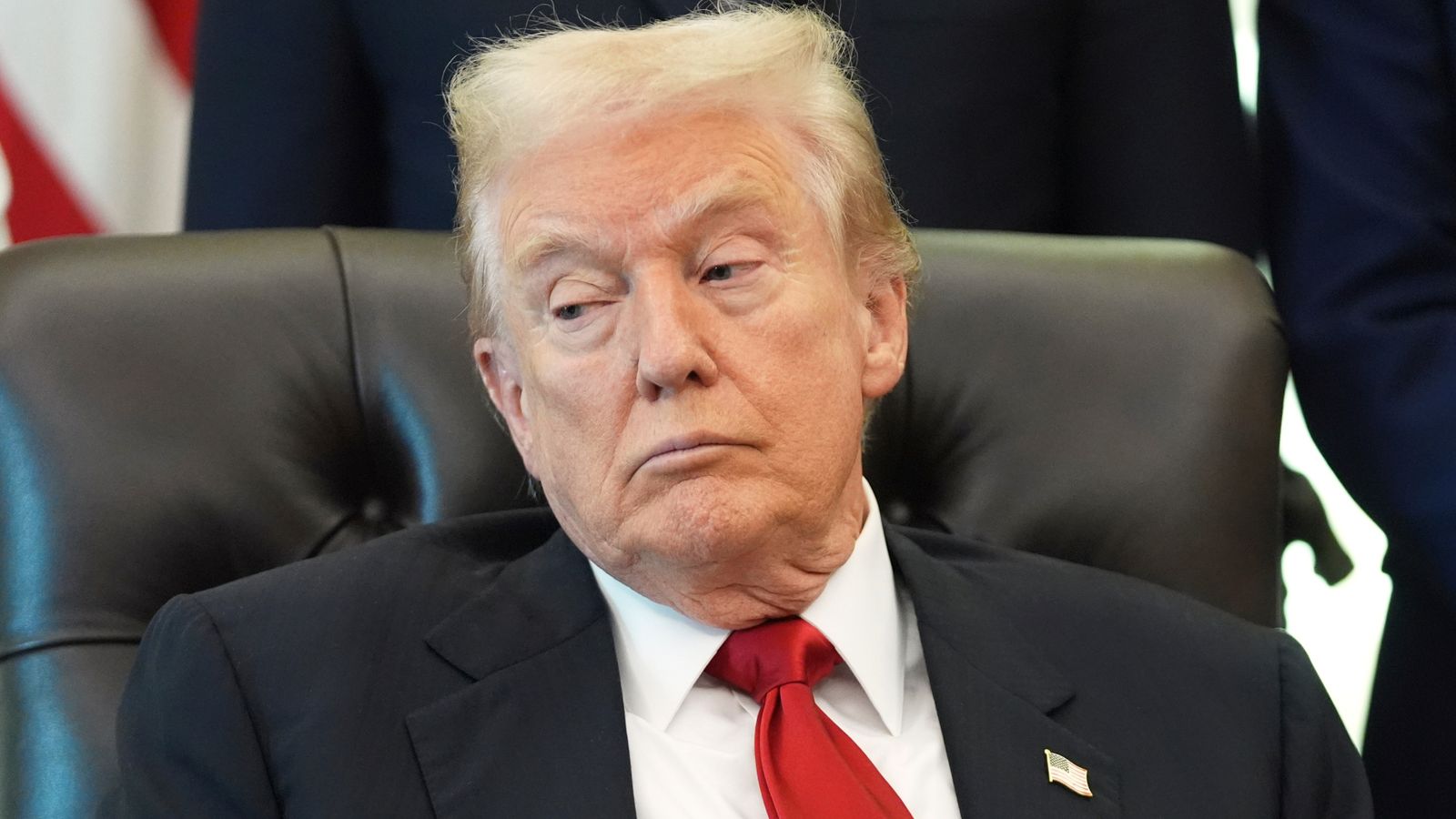

The White House has revealed details of Donald Trump’s recent medical evaluation involving a scan of his cardiovascular system and abdomen.
The US president, 79, underwent a magnetic resonance imaging (MRI) scan in October, which was confirmed in a memo from his doctor, Sean P Barbabella.
The White House physician wrote that the cardiovascular and abdominal imaging was “perfectly normal”.
“The purpose of this imaging is preventive: to identify issues early, confirm overall health, and ensure he maintains long-term vitality and function,” said Dr Barbabella.
He added that there was “no evidence of arterial narrowing impairing blood flow or abnormalities in the heart or major vessels”.
“The heart chambers are normal in size, the vessel walls appear smooth and health, and there are no signs of inflammation, or clotting.”
As for the abdominal imaging, he wrote that “all major organs appear very healthy and well-perfused”.
“Everything evaluated is functioning within normal limits with no acute or chronic concerns.”
He said the imaging was done “because men in his age group benefit from a thorough evaluation of cardiovascular and abdominal health”.
While speaking to reporters on Sunday, the US president said he didn’t know what part of his body was examined but added: “It wasn’t the brain because I took a cognitive test and I aced it.”
He described the results of the MRI as “perfect”.
Read more from Sky News:
Trump targets ‘third world’ immigrants
Venezuela accuses Trump of ‘colonial threat
Trump to cancel all Biden executive orders
Donald Trump in July with a swollen ankle. File pic: AP
In 2022, Donald Trump described himself as “the healthiest president that’s ever lived” but in July was diagnosed with chronic venous insufficiency (CVI) after noticing “mild swelling” in his lower legs.
Dr Barbabella said CVI, which causes blood to pool in the veins, was a “benign and common condition, particularly in individuals over the age of 70”.
Concerns were also raised in July about photos which showed bruising on the back of Mr Trump’s hand that had been covered with make-up.
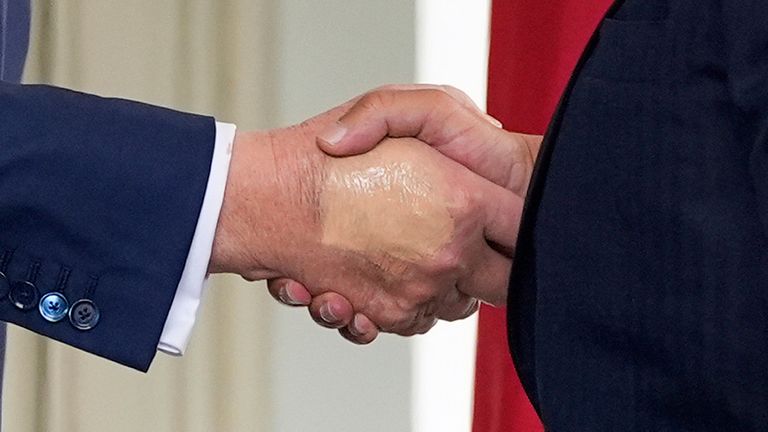
Make-up covering bruising on Mr Trump’s hand. File pic: AP
White House press secretary Karoline Leavitt clarified this was “minor soft tissue irritation from frequent handshaking and the use of aspirin” to reduce the risk of heart attack and stroke.
-
 Sports2 years ago
Story injured on diving stop, exits Red Sox game
-
 Sports3 years ago
‘Storybook stuff’: Inside the night Bryce Harper sent the Phillies to the World Series
-
 Sports2 years ago
Game 1 of WS least-watched in recorded history
-
 Sports3 years ago
Button battles heat exhaustion in NASCAR debut
-
 Sports3 years ago
MLB Rank 2023: Ranking baseball’s top 100 players
-
Sports4 years ago
Team Europe easily wins 4th straight Laver Cup
-
 Environment3 years ago
Japan and South Korea have a lot at stake in a free and open South China Sea
-
 Environment1 year ago
Here are the best electric bikes you can buy at every price level in October 2024