
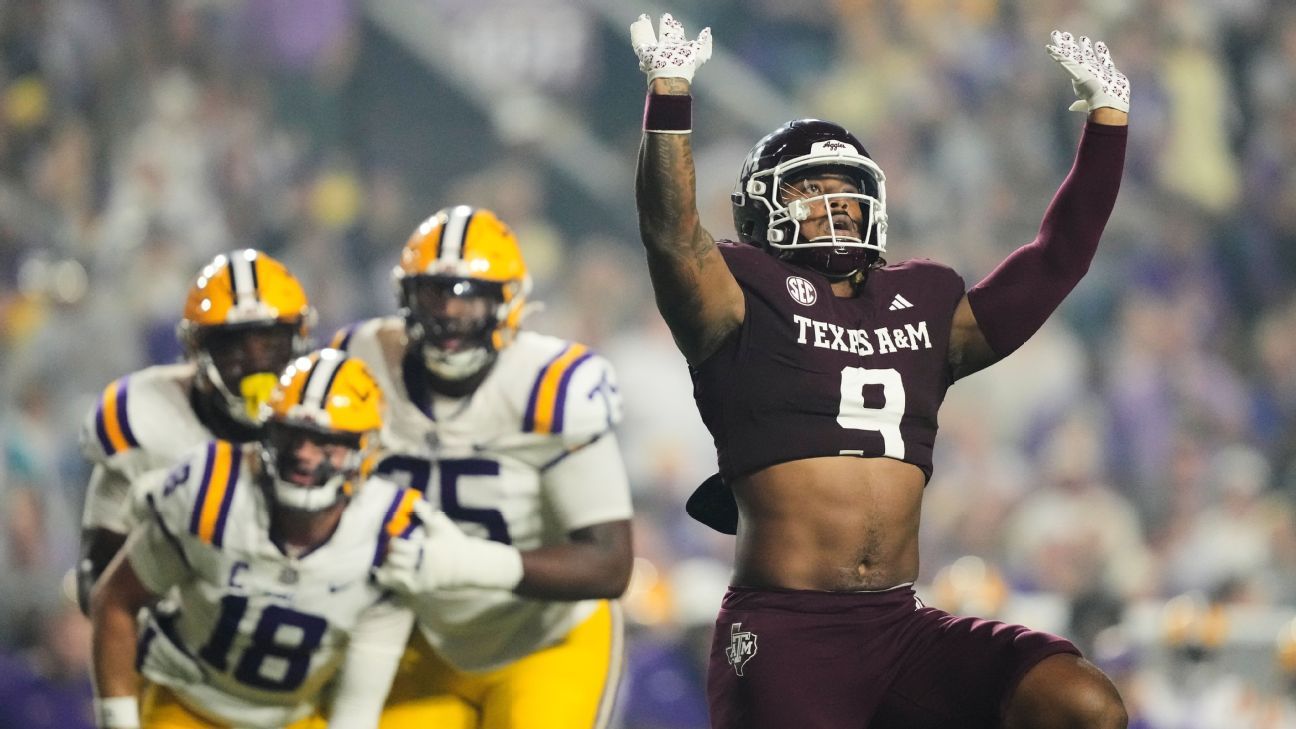
The 4 teams currently playing like national champions — and why


-
Bill Connelly
Almost every football coach in the known universe professes a desire for perfect balance, the desire to be able to run and pass in equal proportion and with equal quality.
Week 9 of the college football season created balance of a different sort: It gave us a particularly interesting mix of lovely, close games and huge statement performances. (It also gave us a few potentially season-altering quarterback injuries, but I guess that comes with the territory.)
The SEC alone gave us four one-score finishes, five fourth-quarter comebacks and a Hail Mary completed at about the 1-inch line. It also gave us Texas A&M’s resounding second-half surge against LSU that both erased the aura of Tiger Stadium at night and put LSU’s Brian Kelly on the hottest of hot seats. (Editor’s note: Kelly has been fired, LSU announced Sunday night.)
The Big Ten gave us tense, down-to-the-wire affairs with Rutgers-Purdue and Nebraska-Northwestern and blowouts with Indiana over UCLA and Iowa over Minnesota. The ACC gave us a pair of overtime thrillers, a last-second field goal stunner and two top-10 teams winning by a combined 60. The Group of 5 gave us a playoff plot twist (Memphis 34, USF 31), four overtime epics and a 600-yard passing game, and a 37-0 run from North Texas. The smaller-school ranks gave us a (nearly) walk-off pick-six, a great Anchor-Bone Classic and an FCS No. 1-versus-No. 2 game decided by 31 points and 344 yards.
I mentioned in last week’s preview that Week 9 tends to declutter things for us, shutting down some upstart stories and laying out some pretty clear stakes as we head into November. A lot of upstart stories continue, but even in a sea of parity talk and close games, one thing Week 9 did do is clarify which teams are playing the most like national champs at the moment. Let’s start there.

The four teams playing like potential national champions
Even after nine weeks, the polls can sometimes be misleading. At this point in 2022, 8-0 Tennessee was No. 1 in the country, and 8-0 Clemson was No. 4; the Volunteers and Tigers went a combined 6-5 the rest of the way. Hell, at this point in 2021, Michigan State was 8-0 and No. 3 — the Spartans are 20-28 since. November usually brings us plenty of unexpected twists, but I can say that, unlike Tennessee, Clemson or Michigan State, the top four teams in the current AP poll — Ohio State, Indiana, Texas A&M and Alabama — are the ones looking most like national title teams at the moment.
A week ago in this space, I wrote that I was pretty sure Ohio State was “comfortably the best team in the country at the moment.” I certainly don’t think any less of the Buckeyes after their Week 9 bye, but Saturday made me rethink the premise a bit. After all, only twice has a team beaten a conference opponent by 50-plus points this season, and it was Indiana both times.
The top of my SP+ rankings tend to be reserved for teams that repeatedly show boundless upside. Over the past 20 seasons, the only programs to finish No. 1 in SP+ are Alabama (10 times), Ohio State (three times), Georgia (twice), Florida, Florida State, LSU, Michigan and Texas. Blue bloods, all. But following IU’s 56-6 humiliation of UCLA, the Hoosiers jumped Ohio State into the top spot. Until otherwise noted, the center of the college football universe is Bloomington, Indiana.
I doubt UCLA would disagree. The Bruins came to Bloomington having won three games in a row with a disruptive defense and an improved run game. They created only one tackle for loss against the Hoosiers, and it came when IU was already up 42-3. (It also didn’t stop the Hoosiers from making it 49-3 two plays later.) UCLA running backs, meanwhile, averaged just 3.3 yards per carry, and quarterback Nico Iamaleava took three sacks and threw two picks. Indiana quarterback (and Heisman betting favorite) Fernando Mendoza completed only 15 passes for 168 yards, and it didn’t matter in the slightest.
The 2024 Hoosiers were, per SP+, the second-best team in the history of the program. This team is quite a bit better than that one. I cannot wait to see how this story unfolds in the coming weeks (and months).
Remaining regular-season schedule: at Maryland (SP+ projection: IU by 16.1), at Penn State (IU by 8.5), Wisconsin (IU by 34.8), at Purdue (IU by 28.1).
We’re just waiting on the big plays. Ohio State currently ranks ninth nationally in points scored per drive and first in offensive success rate; the defense ranks first in points allowed per drive and has forced more turnovers (nine) than it has given up gains of 25-plus yards (six). The Buckeyes given up only 4.0 yards per dropback (first) and have given up touchdowns on only two of 12 opponent red zone trips (16.7%, also first).
Because of Texas’ generally mediocre showing in 2025, the Buckeyes’ season-opening win over the Longhorns doesn’t carry as much weight as expected, but they played two other SP+ top-30 opponents on the road (Washington and Illinois) and beat them by a combined 58-22.
They’ve done that while barely even trying to get aggressive on offense. Julian Sayin‘s 80% completion rate leads the nation (no one else is even above 75%), but despite having two otherworldly deep threats in Jeremiah Smith and Carnell Tate, the Buckeyes’ average pass is just 7.6 yards downfield (105th), and only 12.9% of completions have gained 20-plus yards (109th). It feels as if they aren’t even showing us half the playbook, and they’ve reached November having barely broken a sweat. Indiana shows us it’s one of the best teams in the nation every week; Ohio State just drops us reminders of what it will probably do when the games really matter.
Remaining regular-season schedule: Penn State (SP+ projection: OSU by 13.2), at Purdue (OSU by 27.7), UCLA (OSU by 32.9), Rutgers (OSU by 27.7), at Michigan (OSU by 8.5).
In Friday’s preview, I wrote, “If the Aggies overcome this team and this environment, they are legit SEC, and potentially national title, contenders.” I don’t know about you, but I think going on a 35-0 run over about 24 minutes in the second half and turning a nip-and-tuck game into a 24-point laugher counts as “overcoming” LSU and Tiger Stadium.
In what was both a referendum on Texas A&M’s title chops and Brian Kelly’s status as LSU’s head coach, A&M suffered a couple of early turnovers and wobbled in the second quarter, falling behind 18-14 at halftime. But for the second straight season Mike Elko’s Aggies made an example out of LSU and Kelly, Elko’s former Notre Dame boss. Last season, they went on a 31-6 second-half run in a 38-23 win that served as a statement of what A&M might be capable of under Elko. The run also solidified quarterback Marcel Reed‘s place in the starting lineup (original 2024 starter Conner Weigman transferred to Houston, where he has helped to lead the Cougars to a 7-1 start).
This year’s second-half surge was an even more resounding statement. Aggies defenders sacked poor Garrett Nussmeier five times (three after halftime), then sacked backup Michael Van Buren Jr. twice in six pass attempts. Reed was a little too aggressive at times but needed only 12 completions to gain 202 passing yards — four receivers had at least one 20-yard catch — while rushing 13 times for 108 yards. Mario Craver and KC Concepcion are fast and terrifying in space (Concepcion’s punt return score hastened LSU’s second-half collapse), and even backups such as redshirt freshman Ashton Bethel-Roman are capable of absolute nonsense like this:
ABSOLUTELY SNAGGED IT pic.twitter.com/isdPEh2pjw
— Texas A&M Football (@AggieFootball) October 26, 2025
If you’re still slow to adopt the Aggies as potential title contenders, you could certainly point to their inconsistency. The defense has given up more than 40 points twice and almost got them into trouble at Arkansas a week ago, and the offense misfired in a near-loss to Auburn. You could also simply note that after last year’s “statement win” against LSU, A&M lost four of its next five games. Proving yourself in a big game only offers you bigger games down the line, and we don’t know how the Aggies will handle that. They do, after all, still have to play at Missouri and Texas. But once you’ve handled Tiger Stadium at night the way A&M did Saturday, I give you all the benefit of the doubt.
Remaining regular-season schedule: at Missouri (SP+ projection: A&M by 0.8), South Carolina (A&M by 18.2), Samford (A&M by 69.6), at Texas (A&M by 0.7).
The 2023 Washington vibes continue. After winning four straight games against ranked opponents — including three that had the ball with a chance to take the lead in the fourth quarter (and two that, per SP+, generated the game’s superior stats), Bama seemingly got a break against a 3-4 South Carolina team. But even with an incredible — and incredibly lucky — first-half pick-six, the Tide found themselves trailing 22-14 in Columbia with less than three minutes left. Then they magicked their way right out of a jam. Ty Simpson found Germie Bernard for a touchdown and Josh Cuevas for a 2-point conversion, then Deontae Lawson ripped the ball out of Gamecocks quarterback LaNorris Sellers‘ hands two plays later, and Tim Keenan III recovered it. Bernard raced down the sideline for a touchdown with 34 seconds left, and that was that. Crisis averted.
Barely beating a two-touchdown underdog is a weird way of getting onto a “playing like a national champion” list, but I’m struggling to avoid feelings of inevitability here, both because of how many times in a row the Crimson Tide have made the exact plays they needed to make in the fourth quarter and because Kalen DeBoer’s Washington Huskies basically did the exact same thing two years ago on the way to the national title game. They won eight one-score games during a 14-game winning streak, getting just the right combination of quarterback play, turnovers and special teams contributions to survive and advance. It’s hard to sustain that from year to year, but we’ve seen teams ride runs like this to rings throughout college football history.
Granted, DeBoer’s Huskies lost in 2023’s title game, but they lost to a Michigan team that ranked 12 spots higher than them on 247 Sports’ Talent Composite. The only team that ranks higher than Alabama in this year’s Talent Composite is Georgia, a team the Tide have already beaten. This team knows how to see games out and won’t face many matchup disadvantages in any hypothetical CFP matchup. That’s a pretty scary combination, isn’t it?
Remaining regular-season schedule: LSU (SP+ projection: Bama by 9.0), Oklahoma (Bama by 2.0), Eastern Illinois (Bama by 58.1), at Auburn (Bama by 5.6).
The hottest teams in the country (besides the contenders)

On Saturday, Kansas State reminded us that teams aren’t the same entity all season and that Lou Holtz’s old “You coach a different team every week” adage forever rings true. After a brutally disappointing 2-4 start, with the defeats by only 13 combined points, the Wildcats played well in a win over TCU, then overachieved against SP+ by 30 points in a 42-17 demolition of Kansas. The Wildcats haven’t lost to the Jayhawks since 2008, and more importantly, they’re back to .500. At 3-2 in conference play, they’re technically not out of the Big 12 title race just yet (though their odds obviously aren’t great).
Looking at two factors — recent wins and recent overachievement against projections — Kansas State is one of the hotter, more fast-rising teams in the country. Here are a few other teams whose recent improvement could seriously affect how the rest of the season plays out (or at least redefine how their fans look back on 2025).

I warned you about the Aztecs in Friday’s preview, but I still didn’t expect them to cruise to such an easy 23-0 win at Fresno State on Saturday. They’ve won their last three games by a combined 112-34, and per SP+ they’re projected favorites in every remaining game, including a Week 12 visit from Boise State. If the contenders in the American Conference all bloody each other up, and SDSU ends up a 12-1 Mountain West champion, the Aztecs might end up with a playoff case.

In Weeks 3 and 4, Wazzu lost to North Texas and Washington by a combined 118-34. The defense was a disaster, and the offense wasn’t progressing. But since then, the Cougars have beaten two Group of 5 opponents (Colorado State and Toledo) by a combined 48-10 and lost to two 7-1 power-conference opponents, on the road, by only five combined points. They actually came closer to beating Ole Miss than Oklahoma did. The offense is coming along, and the defense is dynamite. They should finish at least 7-5.

Kennesaw State face-planted in its FBS debut season in 2024, famously upsetting Liberty but otherwise going 1-10 and firing Brian Bohannon, the only coach in program history. I loved their replacement hire — Jerry Mack did excellent things at NC Central a few years ago — but I didn’t expect big things so quickly from him here. Whoops. The Owls nearly beat Wake Forest to start the season, and since a blowout loss to Indiana they’ve won five straight, including the past two by a combined 80-33. They’re right in the middle of the Conference USA race.

Usually, when a team decides to push a true freshman quarterback into the starting lineup, it’s an announcement that they’re punting on the season. But Pitt has been reborn since handing the reins to Mason Heintschel. Heintschel has thrown for at least 321 yards in three of four starts, the Panthers have scored at least 30 points in all four, and they’ve jumped from a disappointing 2-2 to a massively intriguing 6-2. The home stretch is pretty brutal — after this coming week’s trip to Stanford, they finish with Notre Dame, at Georgia Tech and Miami. But with this level of play, they’ll either force their way into the ACC title conversation or potentially take down an ACC favorite late in the season.

After becoming the only team to lose to Indiana by one score, Iowa enjoyed one hell of an October, outlasting interim-coached Penn State and walloping rivals Wisconsin and Minnesota by a combined 78-3. They head into November ranked 17th in SP+, and Kinnick Stadium will be an absolute cauldron when Oregon visits Nov. 8.

43-0! The Utes led Colorado 43-0 at halftime Saturday night! And it could have been even worse. Total first-half yardage: Utah 398, Colorado minus-18. The Buffaloes were lucky Kyle Whittingham decided to take it easy in the second half and settled for a 53-7 win.

We have to talk about what NDSU is doing to the rest of FCS this season. The Bison were projected first in SP+, but they’ve still managed to overachieve against projections by an average of 8.6 points. And they basically pulled a Utah against their biggest rival Saturday night, beating South Dakota State by a generous 38-7 score. SDSU had to start its backup quarterback, but he wasn’t going to do anything to stop NDSU from gaining 354 yards in the first half.
NDSU is now at least 10 points ahead of every other team in FCS, per SP+. There are a host of delightful upstart stories in FCS this season – recent Division II convert (and Army beater) Tarleton State is second in SP+, while Harvard is third, Tennessee Tech is fourth and Lehigh is 10th – but it will take a mammoth upset to prevent the playoff from being yet another long Bison coronation.
Others: Notre Dame, Marshall, Hawai’i, Southern Miss, Central Michigan, Cincinnati.
This week in SP+
The SP+ rankings have been updated for the week. Let’s take a look at the teams that saw the biggest change in their overall ratings. (Note: We’re looking at ratings, not rankings.)
Moving up
Here are the 10 teams that saw their ratings rise the most this week:
Kennesaw State: up 3.7 adjusted points per game (ranking rose from 95th to 82nd)
Wyoming: up 2.9 points (from 99th to 92nd)
Washington State: up 2.9 points (from 84th to 72nd)
Utah: up 2.8 points (from 14th to seventh)
Kansas State: up 2.8 points (from 53rd to 36th)
Central Michigan: up 2.7 points (from 114th to 103rd)
San Diego State: up 2.6 points (from 59th to 46th)
Indiana: up 2.5 points (from third to first)
Northern Illinois: up 2.4 points (from 127th to 123rd)
Iowa: up 2.3 points (from 22nd to 17th)
We covered most of these teams above.
Moving down
Here are the 10 teams whose ratings fell the most:
Toledo: down 4.5 points (from 54th to 64th)
Minnesota: down 4.0 points (from 49th to 58th)
Colorado: down 3.5 points (from 63rd to 68th)
Kansas: down 3.4 points (from 41st to 53rd)
LSU: down 3.3 points (from 19th to 26th)
Stanford: down 3.0 points (from 101st to 110th)
Kentucky: down 3.0 points (from 60th to 66th)
UCLA: down 2.9 points (from 68th to 78th)
Fresno State: down 2.7 points (from 80th to 93rd)
UConn: down 2.5 points (from 56th to 59th)
Minnesota has completely confounded SP+ this season. The Gophers have overachieved against SP+ projections by at least 18 points twice (including a Week 8 thumping of Nebraska) and have underachieved by at least 16 points three times. That, of course, includes Week 9’s rivalry game no-show against Iowa. The Gophers have either risen or fallen by at least nine spots in the rankings six times in eight games. They are quite the moving target, and that isn’t a compliment.
Who won the Heisman this week?
I am again awarding the Heisman every single week of the season and doling out weekly points, F1-style (in this case, 10 points for first place, 9 for second and so on). How will this Heisman race play out, and how different will the result be from the actual Heisman voting?
Here is this week’s Heisman top 10:
1. Trinidad Chambliss, Ole Miss (24-for-44 passing for 315 yards and a touchdown, plus 58 non-sack rushing yards against Oklahoma).
2. Haynes King, Georgia Tech (25-for-31 passing for 304 yards and 3 touchdowns, plus 96 non-sack rushing yards and 2 TDs against Syracuse).
3. Drew Mestemaker, North Texas (37-for-49 passing for 608 yards, 4 TDs and 1 INT, plus 18 non-sack rushing yards against Charlotte).
4. Isaac Brown, Louisville (14 carries for 205 yards and a touchdown against Boston College).
5. Bear Bachmeier, BYU (22-for-35 passing for 307 yards and 2 touchdowns, plus 60 non-sack rushing yards and a TD against Iowa State).
6. Jacob Rodriguez, Texas Tech (10 tackles, 1 TFL, 1 forced fumble and a 69-yard fumble return TD against Oklahoma State).
7. Joey Aguilar, Tennessee (20-for-26 passing for 396 yards and 3 touchdowns against Kentucky).
8. Anthony Hill Jr., Texas (10 tackles, 3.5 TFLs, 2.5 sacks, 1 forced fumble and 4 QB hurries against Mississippi State).
9. Demond Williams Jr., Washington (26-for-33 passing for 280 yards and 4 touchdowns, plus 66 non-sack rushing yards against Illinois).
10. KJ Duff, Rutgers (6 catches for 241 yards and a touchdown against Purdue).
Welcome back, Trinidad Chambliss! A week after a late-game collapse at Georgia knocked Chambliss and Ole Miss from the ranks of the unbeaten, the Rebels had to face an even better defense (Oklahoma) in an even more hostile environment. Trailing into the fourth quarter, Chambliss led a 75-yard touchdown drive and a clock-eating field goal drive to seal a 34-26 win. The Sooners were giving up a paltry 213 yards per game this season; the Rebels gained 431.
Haynes King, meanwhile, generated even more yards than Chambliss — albeit against a far weaker opponent — and holy moly Drew Mestemaker. Charlotte’s defense is awful, but no other team has gained 750 total yards on the 49ers this season.
Honorable mention:
• KC Concepcion, Texas A&M (three catches for 45 yards and a touchdown, plus a 79-yard punt return TD against LSU).
• Justice Haynes, Michigan (26 carries for 152 yards and 2 touchdowns, plus 19 receiving yards against Michigan State).
• Mason Heintschel, Pitt (28-for-48 passing for 423 yards and 3 touchdowns against NC State).
• Quinton Jackson, Rice (21 carries for 168 yards and 3 touchdowns, plus 80 receiving yards and a TD against UConn).
• Javen Nicholas, Charlotte (7 catches for 187 yards and 2 touchdowns, plus 20 receiving yards against North Texas).
• Eddie Walls III, Houston (5 tackles, 3 sacks, a pass breakup and a hurry against Arizona State).
• Terry Webb, SMU (8 tackles, 2.5 TFLs, 2 sacks, a forced fumble, a pass breakup and a hurry against Wake Forest).
• Conner Weigman, Houston (17-for-22 passing for 201 yards and a touchdown, plus 119 non-sack rushing yards and 2 TDs against Arizona State).
Through nine weeks, here are your points leaders:
1. Ty Simpson, Alabama (29 points)
2. Taylen Green, Arkansas (27)
3. Trinidad Chambliss, Ole Miss (25)
4. Demond Williams Jr., Washington (21)
5T. Fernando Mendoza, Indiana (19)
5T. Gunner Stockton, Georgia (19)
7T. Luke Altmyer, Illinois (16)
7T. Julian Sayin, Ohio State (16)
9. Diego Pavia, Vanderbilt (14)
10. Jayden Maiava, USC (12)
I’m not going to lie: This remains a very strange Heisman race. At this point last season, the top two players in our points race had 41 (Ashton Jeanty) and 40 points (Cam Ward), respectively. Travis Hunter, priming for a surge, was at 26. This season no one has topped 30, and the second-highest point total has gone to Green, the quarterback of a 2-6 team. The betting favorite, Mendoza, threw for all of 168 yards Saturday but remained the betting favorite because No. 2 pick (and points leader) Simpson nearly lost to South Carolina. I still think we’re going to see a surge — in both performance and sentiment — from someone, but damned if I know who. My best guess at this point: Julian Sayin. We’ll see.
My 20 favorite games of the weekend
1. No. 10 Vanderbilt 17, No. 15 Missouri 10. Mizzou blew a chance to seize this game with a pair of third-quarter red zone failures — or, if you prefer, Vandy’s defense seized the initiative with a pair of great defensive stands — and quarterback Beau Pribula dislocated his ankle in the process. But freshman Matt Zollers led the Tigers to one tying score in the fourth quarter and came within centimeters of a second.
1:36
Missouri’s Hail Mary no good as Vanderbilt hangs on
Freshman quarterback Matt Zollers throws a Hail Mary to Kevin Coleman Jr. but the completion comes up short of the goal line.
2. Wake Forest 13, SMU 12. Wake Forest: your “try, try again” team of the week. The Demon Deacons lost two fumbles inside the SMU 10 in the fourth quarter, but Kamrean Johnson made an unreal, 25-yard catch from backup quarterback Deshawn Purdie with four seconds left, and Connor Calvert‘s 50-yard game-winner traveled about 50.1 yards.
3. FCS: Georgetown 31, Bucknell 24. Three weeks ago, Georgetown made this list with a winning Hail Mary. The Hoyas are back with something almost as dramatic: a walk-off (almost) pick-six. Having overcome a 10-point fourth-quarter deficit, Bucknell was driving for a potential winning field goal attempt in the closing seconds, but Naiteitei Mose stepped in front of a Christopher Dietrich pass and rumbled 65 yards for the win.
Mose returns an interception for a GU TOUCHDOWN!!#HoyaSaxa #HoyaBold #DefendTheDistrict #SISU #PartnerWithSquadrahttps://t.co/CLGmxgiUPv pic.twitter.com/wm7DTPaZVf
— Georgetown Football (@HoyasFB) October 25, 2025
4. Memphis 34, No. 18 USF 31. USF just couldn’t quite knock out Memphis. The Bulls led by 14 heading into the fourth quarter, but three length-of-the-field drives and 17 points gave the Tigers the lead, and after an iffy snap, Nico Gramatica‘s 52-yard field goal attempt at the buzzer sailed wide.
5. No. 4 Alabama 29, South Carolina 22. It’s definitely more fun when the underdog gets the turnover breaks, but that’s not the way either Alabama’s or South Carolina’s story is playing out in 2025.
6. Rutgers 27, Purdue 24. You get bonus points on this list when you lose a game in a way I’ve never seen. I’d say “catching your own pass off of a deflection, then losing a fumble to set up the winning field goal” is worth quite a few points.
Scarlet Knights recover the fumble ‼️ @RFootball
📺: @BigTenNetwork pic.twitter.com/dbfUX2rqjF
— Big Ten Football (@B1Gfootball) October 25, 2025
7. Virginia Tech 42, Cal 34 (2OT). There’s something so heartening about seeing a fan base rally around a team in a lost season. At 2-5, Virginia Tech didn’t have a ton to play for Friday night against Cal, and the Hokies looked like a 2-5 team in losing a late lead. But from “Enter Sandman” through the second OT, the Lane Stadium crowd remained engaged, and Takye Heath‘s 7-yard touchdown catch and an overtime stop gave the Hokies the win.
8. Division III: St. Olaf 44, St. Scholastica 41. This one was similar to Georgetown-Bucknell in that one team was driving for a late win and then suddenly lost. St. Scholastica took a 38-24 lead late in the third quarter in Northfield, Minnesota, but St. Olaf tied it at 41-41 on a Rob Htoo touchdown in the fourth. CSS embarked on a nearly seven-minute drive to take the lead, but Will Harris recovered a fumbled handoff, and Ethan Hess knocked in a 29-yard field goal at the buzzer to give the Oles (yes, Oles) a surprise win.
9. No. 16 Virginia 17, North Carolina 16 (OT). A scoreless, four-turnover second half gave this one quite a sloppy vibe, but Virginia again made the plays when it counted. After failing to score a touchdown over the final 36 minutes of regulation, both teams scored pretty easily in overtime, but Gio Lopez‘s 2-point pass to Benjamin Hall came up just short after a brilliant tackle from Ja’son Prevard.
10. No. 22 Texas 45, Mississippi State 38 (OT). I guess it makes sense that Mississippi State didn’t know how to close out a win. The Bulldogs have been quite competitive this season, but they still came into this one having lost 15 straight conference games, and after Davon Booth‘s 62-yard touchdown put the Bulldogs up 38-21 early in the fourth quarter, the MSU offense proceeded to lose six yards over its final 17 snaps. Texas scored twice, then tied the score on a 79-yard punt return Ryan Niblett, the scariest return man in the country who has made pivotal fourth-quarter returns in three straight games.
0:43
Ryan Niblett takes 79-yard punt return to the house
Ryan Niblett scores on a 79-yard punt return late in the 4th quarter to tie things up for Texas vs. Mississippi State.
In overtime, Arch Manning left the game because of an apparent concussion, but backup Matthew Caldwell pulled a Major Applewhite, throwing a beautiful 10-yard touchdown to Emmett Mosley V. MSU’s hopeless offense moved straight backward, giving the Longhorns a second straight overtime road win over a winless-in-the-league opponent.
11. FCS: NC A&T 28, Campbell 24. We’ll save an honorary place on this week’s Heisman list for North Carolina A&T’s Elijah Kennedy, who tied the score on a 96-yard punt return with 6:12 left and then, after Campbell took the lead on a field goal, returned the ensuing kickoff 85 yards for the win. He out-Niblett’d Niblett.
What a day for Elijah Kennedy!! A Punt and Kickoff Return for TD!! #AggiePride | #PoundTheStone| #CAAFB pic.twitter.com/MigT2frR6Z
— Aggie Pride (@NCATFootball) October 25, 2025
12. Kent State 24, Bowling Green 21. Kent State entered this season having won only one of its previous 24 games. The Golden Flashes are now 3-5 after turning around a 21-3 deficit with three touchdowns — including a trick-play pass from receiver Da’Realyst Clark to Wayne Harris — and two late stops.
13. No. 8 Ole Miss 34, No. 13 Oklahoma 26. Ole Miss threatened to run away with this one, easing out to a 22-10 halftime lead. A 16-3 run gave the Sooners the advantage heading into the fourth quarter, but the Rebels made all the late plays they didn’t make against Georgia, scoring twice, making three stops and leaving Norman with a playoff bid looking likely.
14. FCS: Charleston Southern 17, Eastern Illinois 16. With six minutes left, this was anything but a “favorite games” contender. EIU led 16-3, but CSU scored, forced a three-and-out and took the lead on a short Hakeem Watters touchdown. EIU quickly drove the length of the field to save itself, but David Portu blocked what would have been a winning 35-yard field goal attempt.
BLOCKED! THE KICK IS BLOCKED! 🤯@CSU_FB blocks EIU’s go-ahead field goal attempt with 14 seconds left, and the Buccaneers win a second straight!#OVCBigSouthFB | #BucStrong pic.twitter.com/TbOjlzopEm
— OVC-Big South Football Association (@OVCBigSouthFB) October 25, 2025
15. Temple 38, Tulsa 37 (OT). Temple is one win away from bowl eligibility, but it took overtime to get the job done in Tulsa. After four second-half lead changes, Tulsa’s Dominic Richardson scored to send the game to overtime, where, like North Carolina, the home underdog scored second, went for two and failed.
16. Nebraska 28, Northwestern 21. Nebraska had it, lost it, then took it away one more time. Northwestern’s Caleb Komolafe scored twice to turn a 21-6 deficit into a 21-21 tie, but Nebraska drove 60 yards in 6:27, made it 28-21 with Emmett Johnson‘s 4-yard touchdown and forced a turnover on downs at their 35 with a minute left. A fun, intense game in a forever-intense environment.
17. Division III: DePauw 35, Denison 28. DePauw’s defense lost the game, then won it. Down 28-0 late in the first half, Denison roared back and tied the score on a 99-yard Tyler Green-to-Grayson Kerscher touchdown pass with 7:02 left. DePauw recovered and took the lead back with a 5:34 drive and a 1-yard Caden Whitehead score, but Green completed four passes to move Denison back inside the Tigers’ 25. But Joey Fico broke up a pass in the end zone, and DePauw survived.
18. Rice 37, UConn 34 (2OT). Like Minnesota, UConn has been all over the map, overachieving hugely against projections twice and underachieving three times. Following a win at Boston College, the Huskies visited Rice, jumped out to a quick lead, then fell victim to two long Quinton Jackson touchdowns in regulation, then two more Jackson scores in OT.
19. NAIA: College of Idaho 7, Eastern Oregon 0. Again, you get bonus points for winning a game in a way I haven’t seen. In a game that featured 12 punts, three missed field goal attempts, three turnovers, three turnovers on downs and less than 400 combined yards, Eastern Oregon used an interception to set up a potential winning field goal with 1:10 left. But College of Idaho’s Dee’Shon Swaffo blocked the 49-yard attempt, then took it 60 yards for the game’s only points.
20. Division II: No. 1 Ferris State 38, No. 18 Grand Valley State 31. The Anchor-Bone Classic, the biggest helmet game in Division II, lived up to its billing. GVSU outgained the defending national champs (462-433) but couldn’t quite overcome Taariik Brett, who ran for two touchdowns and caught two touchdown passes from Wyatt Bower (aka the new Trinidad Chambliss). GVSU overcame an early 14-0 deficit to tie the score at 21-21, but Brett and Bower both scored to build the lead again. The Bulldogs finally put the game away with an onside kick recovery with 1:35 remaining.

-
David Hale
The first College Football Playoff rankings came out five weeks ago. They looked a lot like tonight’s rankings.
We’ve had precious little movement at the top, with a few teams jockeying up or down a slot, but effectively no seismic shifts in the landscape. BYU and Texas are the only two teams that were projected in the field in the committee’s first ranking that aren’t now — and they’re just barely on the outside with reasonable arguments for inclusion.
Teams ranked in the top 18 by the committee this year are a combined 55-9, with six of those losses coming to other teams ranked in the top 18. All three outliers are courtesy of — you guessed it — the ACC (Louisville to Cal, Virginia to Wake and Georgia Tech to Pitt).
That’s a massive anomaly. Last year, top-18 teams at this point had lost 19 games, including 14 to teams outside their own grouping. Top-10 teams are 33-4 this year. In the first 11 years of the playoff, top-10 teams had lost an average of nine games by this point in the season.
The two words that best describe this year’s playoff push are “status quo.”
That, of course, has been bad news for all the teams on the outside looking in — from those with valid cases such as Miami, BYU and Vanderbilt, to underdogs such as USC, Utah or Arizona that might’ve had a shot in a more chaotic year.
But the real loser in this copy and paste rankings season is all the fans who just want to see things get weird. It’s a sad state of affairs when we’re left to rely on MACtion and the ACC to do all the heavy lifting when it comes to college football drama. The power players need to step up — or, perhaps, ratchet down — their game to add a bit more drama.
The good news is, the committee’s ad hoc reasoning, mushmouthed explanations and mind-boggling about-faces still leave plenty to argue about, even if the big picture hasn’t changed all that much.
Here’s this week’s biggest slights, snubs and shenanigans.

It’s not entirely clear how this committee values wins. For the past month, the priority has certainly appeared to be about which team has the better losses (unless, of course, you’re Alabama).
That seems a foolish way to prioritize playoff teams, since the goal of the playoff isn’t to lose to good teams but to win games.
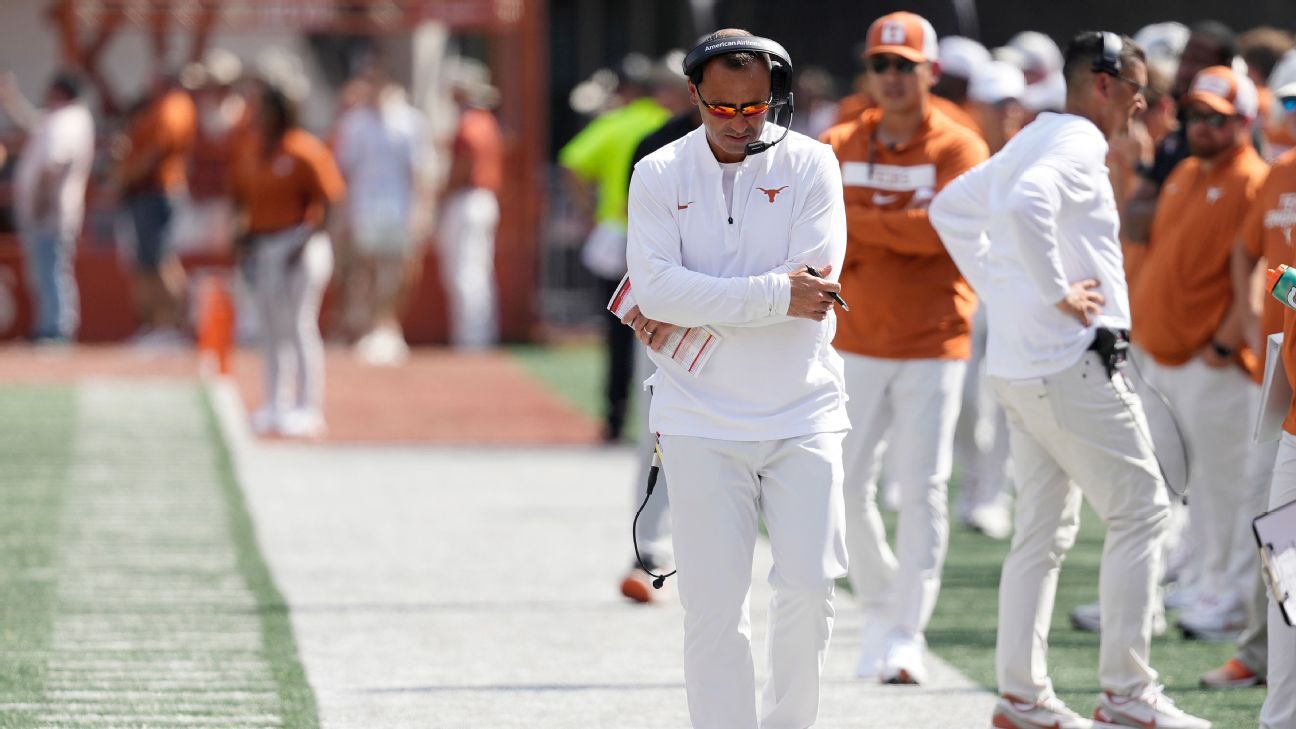
Does Texas have a bad loss? Yes. A 29-21 defeat to woeful Florida — even if the Gators also played Georgia and Ole Miss close and just walloped a team that beat Alabama head-to-head — is problematic.
But look who Texas has beaten: No. 7 Texas A&M by 10, No. 8 Oklahoma by 17 and No. 14 Vandy by three (in a game they led by 24 in the fourth quarter). That’s the résumé of a team capable of winning a national championship — even if the Horns were also capable of losing to a second-rate SEC team.
Are we trying to find teams with the most upside or give participation trophies to the ones which have not lost an ugly one? (Except, again, Alabama.)
And it’s not as if the committee believes an extra loss is disqualifying. Oklahoma, Alabama, Notre Dame and Miami all have two losses and are ranked ahead of one-loss BYU (more on that in a moment), so what’s the harm of moving a three-loss Texas ahead of a two-loss team that has accomplished less?
This all comes back to the most frequent and justified criticism of the committee: The same rules aren’t applied evenly. In some cases, record matters. In some cases, best wins matter. In some cases, better losses matter. The standard varies based on the team being considered. But if the committee is going to err in favor of any team, it should probably do so for one that’s proved — not once, not twice, but three times — that it can beat an elite opponent.
Oh, and moving Texas up ahead of, say, Notre Dame would also have the added bonus of allowing the committee to sidestep another tricky situation. Which leads us to…


We’re putting these two teams together because we’ve already lamented the committee’s utterly disingenuous evaluation of them repeatedly, so it feels redundant to keep going down the same rabbit hole. But, for the sake of two programs being astonishingly misevaluated, let’s do one more round.
For Miami, the logic is obvious: The Canes beat Notre Dame head-to-head.
But let’s keep going. Miami’s two losses — SMU and Louisville — would rank as the fourth- and fifth-toughest games on Notre Dame’s schedule, had the Irish played them. Instead, Notre Dame has cruised through an essentially listless slate. Six of Notre Dame’s 10 wins came against teams that beat zero or one other Power 4 opponent. Stanford — seriously, Stanford! — is Notre Dame’s fourth-best win (by record). Yes, Notre Dame played well enough in losses to two very good teams, but one of those teams has the same record and is somehow ranked lower! Even if this is strictly about the “eye test,” there’s little argument for ignoring the head-to-head outcome. Notre Dame’s strength of record is 13th. Miami’s is 14th. Notre Dame’s game control is fifth. Miami’s is sixth. If all else is the same, how is head-to-head not the deciding factor?
Yet, here’s a little more salt in the wound for the Canes: Had Florida State finished 6-2 instead of 2-6 in ACC play, Miami would’ve won the (fifth) tiebreaker for a spot in the ACC title game and could’ve locked up its place in the playoff by simply beating Virginia. Instead, the Canes will sit at home and watch and hope and, at this point, probably get left out. Chess, not checkers, by rival FSU.
As for BYU, the committee’s desire to overlook the Cougars makes no sense. Let’s take a look at a blind résumé, shall we? (Note: Best wins and composite top 40 based on an average of SP+, FPI and Sagarin ratings.)
Team A: No. 6 strength of record, No. 14 game control, best win vs. No. 11, next vs. No. 28, loss to No. 5, four wins vs. composite top 40, five wins vs. teams that finished 7-5 or better
Team B: No. 7 strength of record, No. 10 game control, best win vs. No. 13, next vs. No. 27, loss to No. 7, three wins vs. composite top-40, two wins vs. teams that finished 7-5 or better
Now, just based on that information, Team A would seem the obvious choice. Now what if I told you Team B just lost its head coach, too?
That’s right, Team A is BYU and Team B is Ole Miss. Every bit of data here suggests the Cougars are, at worst, on even footing with the Rebels or ahead, and yet the committee has Ole Miss ranked five spots higher.
This is, arguably, the second year in a row in which BYU was clearly the most overlooked team in the country.

A week ago, Notre Dame was ranked one spot ahead of Alabama.
Then on Saturday, the Irish beat 4-8 Stanford by 29 (in a game they at one point led 42-3), while Alabama beat 5-7 Auburn by seven (in a game the Tigers had a chance to tie before fumbling in Tide territory late).
The committee looked at those two results and said, “You know what, we like what we saw from the Tide! Move ’em up!”
What could possibly be the logic for shifting opinions on these two teams? The only other team that jumped another winning team was Texas, and the Longhorns beat the No. 3 team in the country emphatically, not a second-tier team that fired its head coach a month ago.
Oh, and hasn’t the committee made it pretty clear losses are supposed to matter? Well, Notre Dame has two losses to teams ranked in the top 12. Alabama got beat by a Florida State team that finished 5-7.
Even by the eye test, this makes little sense. Notre Dame has proved to be one of the most complete, dominant teams in the country, with a secondary that’s near impossible to throw on, a rookie quarterback who has been nearly flawless and a running back who might well be the best player in the country. Alabama, on the other hand, has a one-note offense that can’t run the football.
We’re not believers in using advanced metrics as a ranking of accomplishment, but if this is simply a “who’s better” debate…
-
SP+ ranks Notre Dame fifth and Alabama 12th.
-
FPI ranks Notre Dame third and Alabama sixth.
-
Sagarin ranks Notre Dame second and Alabama seventh.
-
FEI ranks Notre Dame fourth and Alabama ninth.
So, again, we ask: Why would the committee possibly make this change?
We’d wager you know the answer. That sticky Canes vs. Irish head-to-head debate is a real headache for the committee. But if Notre Dame’s currently the last team in and something unexpected happens this weekend (hello, BYU over Texas Tech), then the committee can do as it did in 2014 and wash its hands of a tough choice and keep both Notre Dame and Miami out.
(It’s also interesting that a seven-point win over a team with a losing record is enough to jump Notre Dame, but a 31-point win over a ranked Pitt did nothing for Miami’s relative placement with the Irish despite — and we’re not sure anyone has mentioned this yet — a head-to-head win!)
But, speaking of Alabama…


4. Championship game participants
Step into the time machine with us for a moment, all the way back to championship week 2024. Here’s the state of play: Alabama, at 9-3, is ranked No. 11, the first team out of the playoff and also out of the SEC title game. Still, the Tide and the SEC hope there’s a pathway to salvation because SMU — 11-1 and ranked eighth — still has a game to play against Clemson in the ACC championship. If the Mustangs were to lose, couldn’t the committee then justify slotting SMU behind Alabama based on another data point, even though the Tide were simply sitting at home watching the action?
This was the case being made throughout the run up to the ACC championship last season. SMU, which should’ve been celebrating a miraculously successful first season in the Power 4, spent hours upon hours defending itself against criticism that it didn’t belong in the same conversation with big, bad Bama. Rhett Lashlee hinted he thought the committee’s vote was rigged, SMU players lamented their status on the chopping block despite a ranking that should’ve put them safely in the playoff field, and SEC commissioner Greg Sankey made the rounds arguing that Alabama’s (and Ole Miss’ and South Carolina’s) strength of schedule ought to put them ahead of SMU (and others).
OK, back to the present day. Here we are with Alabama sitting perilously on the dividing line between in the field and out — a week ago, it would have been the last team in, but of course the committee had other ideas this time around — with a game to play against Georgia in the SEC championship. An ACC team (Miami) sits just a tick behind the Tide in the rankings, but it will be off this week.
So, what happens if Alabama loses?
The comparison to last year’s SMU isn’t even a particularly fair one. The Mustangs were at No. 8 before the ACC title game. Alabama is at No. 9 (and probably should be a spot or two lower). SMU’s game against Clemson was new territory. A loss to Georgia will actually undermine Alabama’s best argument for inclusion — the three-point win in Athens in September. And while SMU did make the playoff field last year, a last-second loss on a 56-yard field goal still dropped the Mustangs from No. 8 to No. 10 in the rankings.
Play this scenario out now: Alabama, ranked at No. 9, plays a team that currently counts as the Tide’s best win. Imagine if Georgia wins the rematch and does so convincingly. The committee docked SMU two spots for a last-second loss, so surely it will do at least that much to Alabama for a more convincing defeat, right? And here’s the other thing: Even with the ACC title game loss last year, SMU was 11-2 — one less loss than Alabama had. A Tide loss in the SEC title game will be defeat No. 3 — one more than Notre Dame or Miami or (presumably) BYU.
It’s hard not to see a conspiracy here given the committee’s inexplicable flip-flop between Alabama and Notre Dame. It’s hard not to see brand bias in how the Tide’s championship week narrative diverges from SMU’s a year ago. It’s not at all hard to envision a scenario where Alabama loses to Georgia, gets in as the last team anyway, and it’s all explained away as a completely reasonable decision.

Well, the committee finally weighed in on more than one team outside the Power 4 — mostly because it was just impossible to find enough Power 4 teams worth ranking — and the news isn’t good for JMU. With the committee deciding already that North Texas is the higher ranked team, the Dukes’ only hope for the playoff would seem to be a Duke win in the ACC title game.
But what exactly has the committee seen to warrant that decision? Check out the numbers.
Best win (by average FPI, SP+ and Sagarin ranking)
JMU: No. 54 Old Dominion
UNT: No. 62 Washington State
Next best
JMU: No. 62 Washington State
UNT: No. 68 Navy
Loss
JMU: No. 29 Louisville
UNT: No. 24 USF
Wins vs. bowl-eligible
JMU: six
UNT: five
Strength of record
JMU: 18th
UNT: 22nd
FPI
JMU: 28th
UNT: 37th
There are certainly some check marks in North Texas’ favor, including a more impressive win over common opponent Washington State and a slightly better SP+ ranking, but on the whole, James Madison has had the tougher path here. That can change should UNT beat Tulane, but the committee should’ve waited for that to happen. Instead, it has made it clear JMU isn’t sniffing the playoff unless it comes at the expense of the ACC.
Also angry this week: Vanderbilt Commodores (10-2, No. 14); The ACC leadership who voted on its tiebreaker policies; Manny Diaz, who has to try to make a coherent argument for his five-loss Duke Blue Devils getting in ahead of a one-loss JMU; Every 8-4 team with a markedly better résumé than 9-3 Houston, which isn’t ranked this week; and Lane Kiffin’s yoga instructor and Juice Kiffin’s dog walker.
Welcome to the party, James Madison.
With the inclusion of JMU at No. 25 in the selection committee’s penultimate ranking — its first appearance all season — the possibility of the ACC being excluded from the playoff entirely just got real. Five-loss Duke is nowhere to be found in the ranking.
If Duke beats Virginia in the ACC championship game, it’s not guaranteed a spot in the 12-team field. It could open the door for two Group of 5 conference champions to compete for a national title, and if the playoff were today, it would be Tulane out of the American and JMU from the Sun Belt. The ACC’s best team, Miami, is still on the outside.
At No. 12, the Hurricanes still need some help, but Alabama increased its chances of earning a spot as the SEC runner-up with a small promotion to No. 9. The conference championship games can still alter the picture, but hope on the bubble is dwindling.
Bubble Watch accounts for what we have learned from the committee so far — and historical knowledge of what it means for teams clinging to hope. Teams with Would be in status below are looking good after the committee’s fifth ranking. For each Power 4 conference, we’ve also listed Still in the mix. Teams that are Out will have to wait until next year.
The conferences below are listed in order of the number of bids they would receive, ranked from the most to least, based on the selection committee’s latest ranking.
Jump to a conference:
ACC | Big 12 | Big Ten
SEC | Independent | Group of 5
Bracket
SEC


Would be in: Alabama, Georgia, Oklahoma, Ole Miss, Texas A&M. Right now, the Crimson Tide are the last SEC at-large team in the field. Alabama will face Georgia in the SEC championship game, but the committee could have a difficult decision if Alabama loses and finishes as a three-loss runner-up. The Tide would have defeated Georgia during the regular season but lost to the Bulldogs in the championship game. Even in moving up a spot to No. 9 this week — ahead of Notre Dame — it still seems as if they have a little more margin for error, but how the SEC title game unfolds could matter. And how far Alabama drops could determine if the SEC gets four or five teams in the field. Alabama could finish as the committee’s highest-ranked three-loss team and still be excluded from the playoff to make room for a conference champion — as they were last year.
A Georgia win should lock up a first-round bye and a top-four finish for the Bulldogs, while a loss should still put them in position to host a first-round game. Georgia beat Ole Miss, so it would be surprising to see the Bulldogs drop below the Rebels with a loss, even though the Bulldogs would have one more defeat. With a 35-10 drubbing of Texas also on its résumé, Georgia would still have a strong enough case to finish as the committee’s top two-loss team.
At No. 6, the selection committee moved the Rebels up one spot, so clearly the departure of coach Lane Kiffin to LSU didn’t hurt Ole Miss or its chances of hosting a first-round home game. The bigger reasoning was a promotion after winning the Egg Bowl combined with Texas A&M losing to Texas.
Still in the mix: Texas. The Longhorns moved up to No. 13, but the win against Texas A&M wasn’t enough to put them into the field after the fifth ranking. Texas is stuck behind Miami in part because of its loss to Florida, which Miami beat. Even if BYU and Alabama were knocked out with title game losses, that still probably won’t be enough for Texas to get into the field because the bracket has to make room for conference champions.
Out: Arkansas, Auburn, Florida, Kentucky, LSU, Mississippi State, Missouri, South Carolina, Tennessee, Vanderbilt
Big Ten


Would be in: Indiana, Ohio State, Oregon. Both Indiana and Ohio State are CFP locks — even if they lose in the conference title game — and the runner-up will still have a strong case for a top-four finish and a first-round bye. The loser’s only loss will be to a top-two team, but it could fall behind Georgia in the top four if the Bulldogs win the SEC, and/or Texas Tech if it wins the Big 12.
The Ducks punctuated their résumé with a respectable win at Washington and should be secure in their playoff position, probably hosting a first-round game. Oregon received a small boost to No. 5 after Texas A&M lost to Texas.
Still in the mix: None.
Out: Illinois, Iowa, Maryland, Michigan, Michigan State, Minnesota, Nebraska, Northwestern, Penn State, Purdue, Rutgers, UCLA, USC, Washington, Wisconsin
Big 12

Would be in: Texas Tech. The Red Raiders will play BYU in the Big 12 title game and have a great case to be in the playoff regardless of the outcome. It’s highly unlikely the selection committee would drop the Red Raiders out of the field as a two-loss Big 12 runner-up — especially considering they would have a regular-season win against the eventual conference champion. It’s also possible Texas Tech earns a first-round bye as a top-four seed if the Red Raiders win the Big 12. The committee moved them into the top four Tuesday night following Texas A&M’s loss during Rivalry Week.
Still in the mix: BYU. If BYU doesn’t win the Big 12, it’s unlikely to earn an at-large bid as the conference runner-up because the Cougars are already on the bubble and would be eliminated during the seeding process if the playoff were today. It’s not impossible, though. If Alabama finishes as a three-loss SEC runner-up, it could at least open the door for debate. BYU would have lost to Texas Tech twice, and Alabama would have defeated Georgia, the eventual SEC champ once — and it was on the road. If BYU wins the Big 12, it’s the ideal scenario for the conference because it would have two teams in the playoff.
Out: Arizona, Arizona State, Baylor, Cincinnati, Colorado, Houston, Iowa State, Kansas, Kansas State, Oklahoma State, TCU, UCF, Utah, West Virginia
ACC


Would be in: TBD. The ACC championship game will feature Virginia and Duke, and if five-loss Duke wins, it’s possible the ACC is excluded from the playoff since Duke is not part of the CFP rankings. If Virginia wins, it will represent the league in the playoff, as the two-loss Cavaliers are ranked in the top 20. And no, Miami did not play Duke or Virginia during the regular season. Duke lost to Tulane, which is the top Group of 5 playoff contender and will reach the playoff if it wins the American. Duke also lost to UConn. And it has already lost to Virginia 34-17 on Nov. 15.
Still in the mix: Miami. The Canes are still the committee’s highest-ranked ACC team, but they would be excluded if the playoff were today to make room for a conference champion. That means the ACC winner could knock the league’s best team out of the playoff. The committee isn’t ignoring Miami’s head-to-head win against Notre Dame, but it also isn’t comparing the Canes only to the Irish. Miami also needs to earn an edge against BYU — which the committee has deemed better than Miami to this point. Miami inched closer to Notre Dame because Bama moved up Tuesday, but with neither team playing in a conference championship game, would the committee flip them on Selection Day with a BYU loss?
Out: Boston College, Cal, Clemson, Florida State, Georgia Tech, Louisville, North Carolina, NC State, Pitt, SMU, Stanford, Syracuse, Virginia Tech, Wake Forest
Independent
Would be in: Notre Dame. The Irish have done everything right since their 0-2 start, running the table and doing it with consistent dominance regardless of opponent. At No.10, Notre Dame is in a precarious position. If BYU wins the Big 12 and enters the field, that could bump out the Irish. If BYU wins the Big 12, both BYU and Texas Tech are highly likely to make the playoff, which means someone currently in the top 10 would have to be excluded.
Group of 5

Would be in: Tulane. If the Green Wave win the American, they will represent the Group of 5 in the playoff. Tulane is currently the highest ranked Group of 5 team, but if North Texas beats Tulane on Friday, the Mean Green would be the most likely team to reach the CFP, given the overall strength of the American Conference this season.

Still in the mix: James Madison, North Texas. JMU (11-1) has clinched the East Division and a spot in the Sun Belt Conference championship game, where it will face Troy (8-4) on Friday. North Texas will face Tulane in the American, and if it wins, it’s more likely to represent the Group of 5 in the playoff than JMU because of its schedule strength. JMU could still be considered, though, if Duke wins the ACC, giving the Group of 5 two playoff teams in the 12-team field. With JMU earning a spot in the top 25 this week, the situation became more probable.
Bracket
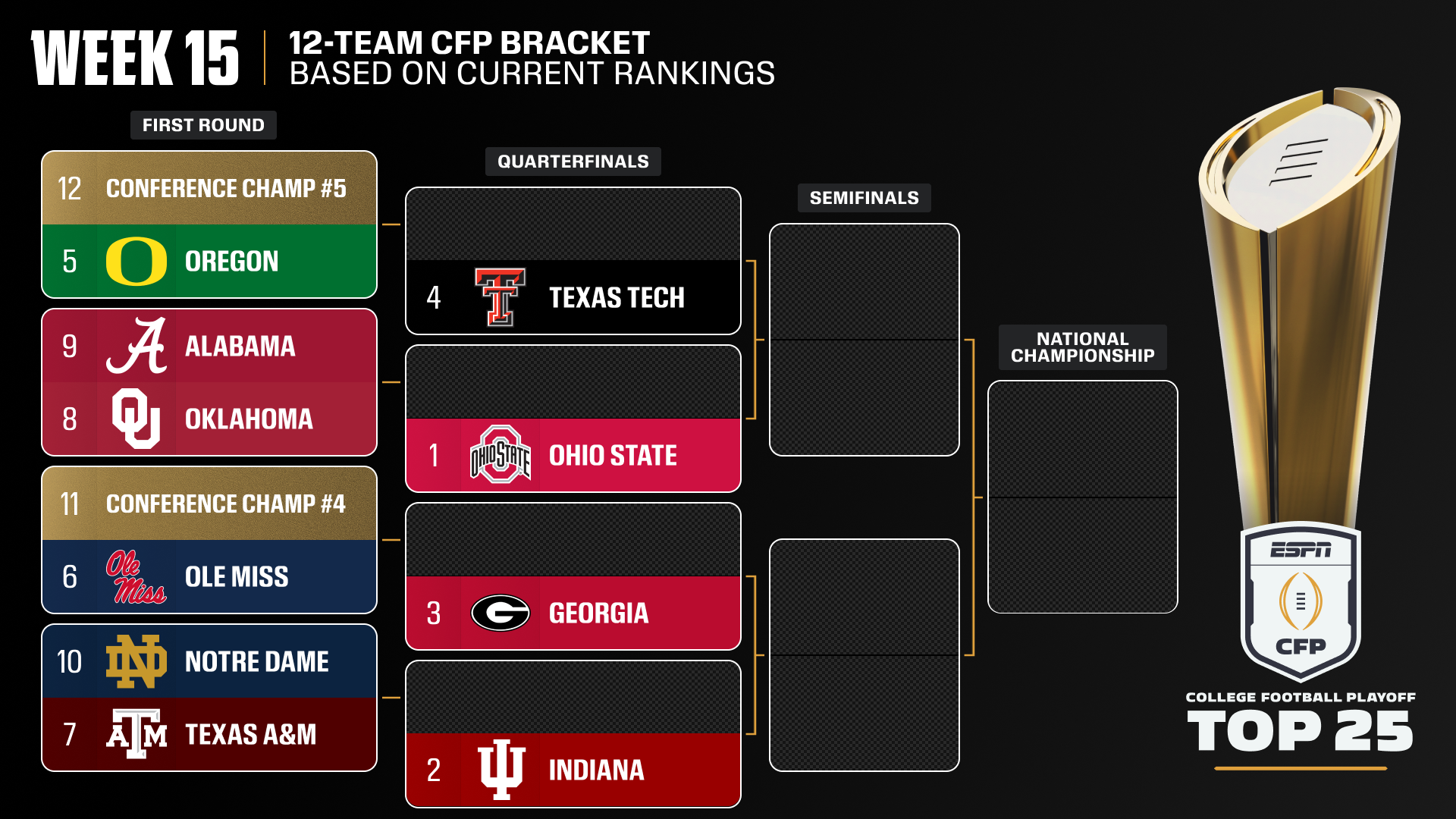
Based on the committee’s fifth ranking, the seeding would be:
First-round byes
No. 1 Ohio State (Big Ten champ)
No. 2 Indiana
No. 3 Georgia (SEC champ)
No. 4 Texas Tech (Big 12 champ)
First-round games
On campus, Dec. 19 and 20
No. 12 Tulane (American champ) at No. 5 Oregon
No. 11 Virginia (ACC champ) at No. 6 Ole Miss
No. 10 Notre Dame at No. 7 Texas A&M
No. 9 Alabama at No. 8 Oklahoma
Quarterfinal games
At the Goodyear Cotton Bowl, Capital One Orange Bowl, Rose Bowl Presented by Prudential and Allstate Sugar Bowl on Dec. 31 and Jan. 1.
No. 12 Tulane/No. 5 Oregon winner vs. No. 4 Texas Tech
No. 11 Virginia/No. 6 Ole Miss winner vs. No. 3 Georgia
No. 10 Notre Dame/No. 7 Texas A&M winner vs. No. 2 Indiana
No. 9 Alabama/No. 8 Oklahoma winner vs. No. 1 Ohio State
-
 Sports2 years ago
Story injured on diving stop, exits Red Sox game
-
 Sports3 years ago
‘Storybook stuff’: Inside the night Bryce Harper sent the Phillies to the World Series
-
 Sports2 years ago
Game 1 of WS least-watched in recorded history
-
 Sports3 years ago
Button battles heat exhaustion in NASCAR debut
-
 Sports3 years ago
MLB Rank 2023: Ranking baseball’s top 100 players
-
Sports4 years ago
Team Europe easily wins 4th straight Laver Cup
-
 Environment3 years ago
Japan and South Korea have a lot at stake in a free and open South China Sea
-
 Environment1 year ago
Here are the best electric bikes you can buy at every price level in October 2024