

Oil giant Shell launches another $3.5 billion share buyback as profit beats expectations

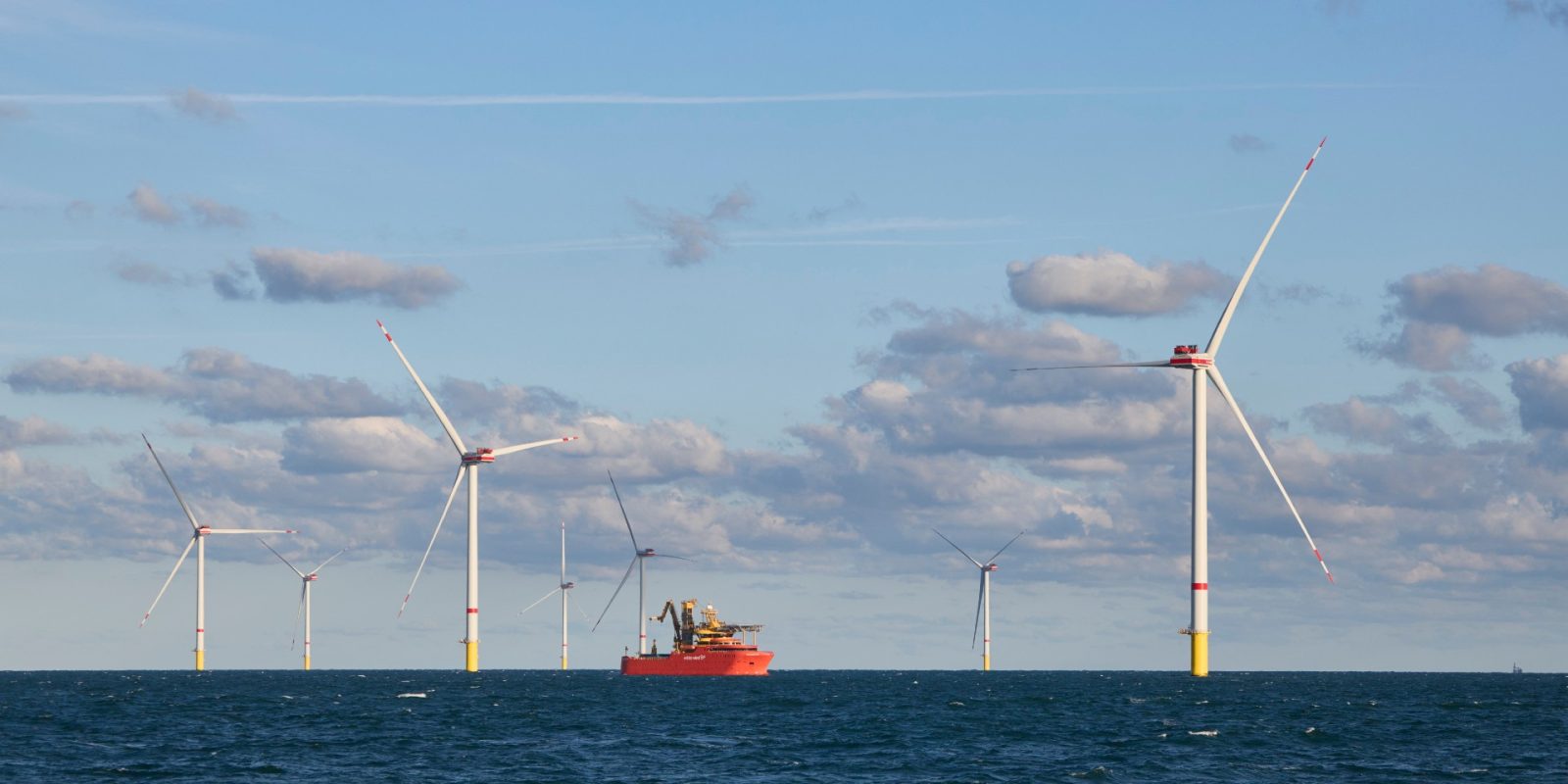
Germany’s largest offshore wind farm hit a big milestone: The first turbine at EnBW’s He Dreiht project has produced its first kilowatt-hour of electricity and sent it into the grid.
More turbines are expected to come online over the coming weeks. European energy provider EnBW has already installed 27 of the wind farm’s 64 turbines, all of which are scheduled to be commissioned by summer 2026.
Peter Heydecker, EnBW board member for Sustainable Generation Infrastructure, described the November 25 milestone as a “significant moment for EnBW.” With 960 megawatts (MW) of total capacity, He Dreiht is now Germany’s largest offshore wind farm.
Vestas supplied the 15 MW turbines, marking their world debut. Nils de Baar, president of Vestas Northern and Central Europe, said the giant turbine’s technology sets a new standard for offshore wind. “Its efficiency and performance enable a significant increase in energy yield per turbine.”
Just one rotation of the 15 MW turbine’s rotor can power the equivalent of four households for a day. The hub stands 142 meters (466 feet) tall, and the rotor’s 236-meter (774-foot) diameter sweeps a 43,742-square-meter (10.8-acre) area — roughly the size of six football fields. To put the scale into perspective, EnBW’s first offshore project, Baltic 1 in 2010, used 2.3 MW turbines.
EnBW wrapped up the wind farm’s internal cabling in August. Those lines connect all the turbines and feed into a converter platform operated by transmission system operator TenneT. That’s where the power is collected, converted from AC to DC, and sent to shore through two high-voltage DC cables.
Once complete, He Dreiht will generate enough electricity to power about 1.1 million households. The project is being built without state funding and sits roughly 85 kilometers (53 miles) northwest of Borkum and 110 kilometers (68 miles) west of Heligoland. EnBW’s offshore office in Hamburg is coordinating the build.
A partner group made up of Allianz Capital Partners, AIP, and Norges Bank Investment Management owns 49.9% of the project. Total investment comes in at around €2.4 billion.
Read more: China’s surge pushes global wind toward fastest growth ever

If you’re looking to replace your old HVAC equipment, it’s always a good idea to get quotes from a few installers. To make sure you’re finding a trusted, reliable HVAC installer near you that offers competitive pricing on heat pumps, check out EnergySage. EnergySage is a free service that makes it easy for you to get a heat pump. They have pre-vetted heat pump installers competing for your business, ensuring you get high quality solutions. Plus, it’s free to use!
Your personalized heat pump quotes are easy to compare online and you’ll get access to unbiased Energy Advisors to help you every step of the way. Get started here. – *ad


FTC: We use income earning auto affiliate links. More.
Environment
BYD tried crushing its $180K luxury SUV with a 2-ton tree and it barely left a mark [Video]

![BYD tried crushing its $180K luxury SUV with a 2-ton tree and it barely left a mark [Video]](https://i0.wp.com/electrek.co/wp-content/uploads/sites/3/2025/07/BYD-ultra-luxury-EV-Europe.jpeg?resize=1200,628&quality=82&strip=all&ssl=1)

The Yangwang U8L is among the most expensive Chinese vehicles, starting at about $180,000. To prove it’s built for just about anything, BYD dropped a 2-ton tree on it, three times, and the ultra-luxury pretty much brushed it off.
BYD drops a tree on its ultra-luxury SUV during testing
BYD launched the Yangwang U8L in September, a long-wheelbase version of the U8 off-road SUV. The U8 was first introduced in September 2023 as the first vehicle from BYD’s ultra-luxury sub-brand, Yangwang.
Yangwang is a new energy vehicle (NEV) brand that sells high-end plug-in hybrids (PHEVs) and 100% battery electric (BEV) vehicles as BYD expands into new segments.
The U8L is Yangwang’s fourth vehicle, following the U8, U9, and U7. It’s available in China with a quad-motor extended-range electric vehicle (EREV) system, delivering a CLTC range of 200 km (124 miles) on battery power alone.
A 2.0-liter turbocharged gasoline engine serves as a generator, delivering a combined CLTC range of 1,160 km (720 miles).
Measuring 5,400 mm in length, 2,049 mm in width, and 1,921 mm in height, the Yangwang U8L is even bigger than the Rolls-Royce Cullinan and Range Rover Long Wheelbase.
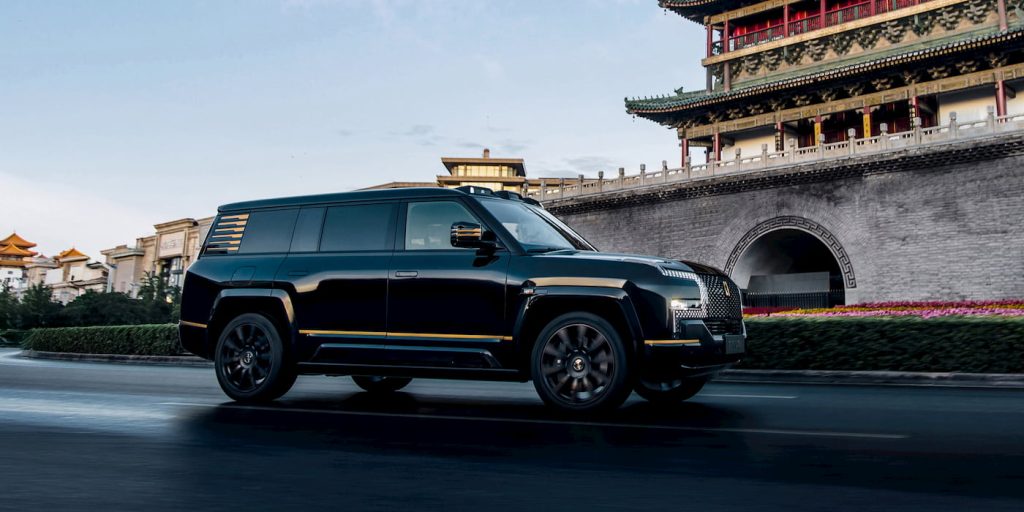
BYD’s ultra-luxury SUV is priced from 1.28 million yuan ($180,000), making it one of the most expensive models from a Chinese brand.
It may look pretty, but the Yangwang U8L is built for far more than just good looks. Like the U8, the long-wheelbase version is equipped with advanced features such as emergency float mode, which allows it to float on water for up to 30 minutes, tank turns, crab walking, and more.
To prove its durability, BYD engineers put the luxury SUV through the paces, dropping a massive 2-ton tree on it, not once, but three times.
During the final drop, the company said the maximum impact energy reached 50.4 kJ, or about 37,200 lb-ft. After three consecutive drops, the Yangwang U8L barely even got a scratch. The body structure remained intact, the door still opened, the columns didn’t bend, and the vehicle could even drive like normal.
FTC: We use income earning auto affiliate links. More.


.jpg)
The White House will formally announce its planned hike in US fuel costs by $23 billion tomorrow, according to Reuters.
Since the beginning of this year, the occupants of the White House have been on a mission to raise costs for Americans.
This mission has encompassed many different moves, most notably through unwise tariffs.
But another effort has focused on changing policy in a way that will raise fuel costs for Americans, adding to already-high energy prices.
The specific rollback tomorrow focuses on a rule passed under President Biden which would save Americans $23 billion in fuel costs by requiring higher fuel economy from auto manufacturers. By making cars use less fuel on average, Americans would not only save money on fuel, but reduce fuel demand which means that prices would go down overall.
The effort to roll back this rule was initially announced on the first day that Sean Duffy started squatting in the head office of the Department of Transportation. Duffy notably earned his transportation expertise by being a contestant on Road Rules: All Stars, a reality TV travel game show.
Then in June, Duffy formally reinterpreted the Corporate Average Fuel Economy (CAFE) standard, claiming falsely that his department does not have authority to regulate fuel economy.
Republicans in Congress even got into effort to raise your fuel costs, as part of their ~$4 trillion giveaway to wealthy elites included a measure to make CAFE rules irrelevant by setting penalties for violating them to $0. In addition, it eliminated a number of other energy efficiency and domestic advanced manufacturing incentives.
Duffy’s department then told automakers that they would not face any fines retroactively to 2022, which saved the automakers (mostly Stellantis) a few hundred million dollars and cost American consumers billions in fuel costs.
Tomorrow, Duffy is expected to make an announcement formally changing CAFE rules, lowering the required fuel economy for 2022-2031 model year vehicles, even despite all of the other changes in trying to make the rules unenforceable. The theory behind this would be to make it harder to later enforce the rules, and to allow automakers to get off with more pollution, and to increase fuel demand and fuel prices for longer until a real government returns to power and starts doing its job to regulate pollution.
We don’t know the specifics yet of what exactly the announcement will entail, but given the general trend of recent announcements, it will likely be a full rollback of the improvements to the rule made by President Biden.
Tomorrow’s announcement is expected to be attended by executives from the Big Three American automakers – GM, Ford, and Stellantis (formerly Chrysler).
Their presence on stage suggests that their prior commitments to energy efficiency and electrification were not serious, as they are now joining in an effort to increase your fuel costs, just to save themselves a few engineering dollars on having to provide something other than the disgusting, deadly land yachts that are a blight on the nation’s roads and are murdering pedestrians at a 50-year high.
Tomorrow’s announcement is just one many efforts currently being undertaken by executive departments to try to raise your fuel costs.
One of the largest is the EPA’s attempt to delete the “Endangerment Finding,” the government’s recognition of the scientific fact that climate change is dangerous to humans. The EPA is undertaking this effort so that it can then eliminate other rules intended to reduce pollution, with the goal of making you more beholden to fossil fuels.
Even the Energy Department’s own numbers, signed off on by oil shill Chris Wright, say that changes sought by the White House will increase gas prices by $.76/gal.
Like most other governmental changes, today’s change will likely go up for public comment, as required by the Administrative Procedures Act. We’ll let you know when they do.
The 30% federal solar tax credit is ending this year. If you’ve ever considered going solar, now’s the time to act. To make sure you find a trusted, reliable solar installer near you that offers competitive pricing, check out EnergySage, a free service that makes it easy for you to go solar. It has hundreds of pre-vetted solar installers competing for your business, ensuring you get high-quality solutions and save 20-30% compared to going it alone. Plus, it’s free to use, and you won’t get sales calls until you select an installer and share your phone number with them.
Your personalized solar quotes are easy to compare online and you’ll get access to unbiased Energy Advisors to help you every step of the way. Get started here.
FTC: We use income earning auto affiliate links. More.
-
 Sports2 years ago
Story injured on diving stop, exits Red Sox game
-
 Sports3 years ago
‘Storybook stuff’: Inside the night Bryce Harper sent the Phillies to the World Series
-
 Sports2 years ago
Game 1 of WS least-watched in recorded history
-
 Sports3 years ago
Button battles heat exhaustion in NASCAR debut
-
 Sports3 years ago
MLB Rank 2023: Ranking baseball’s top 100 players
-
Sports4 years ago
Team Europe easily wins 4th straight Laver Cup
-
 Environment3 years ago
Japan and South Korea have a lot at stake in a free and open South China Sea
-
 Environment1 year ago
Here are the best electric bikes you can buy at every price level in October 2024