
Resetting the coaching carousel: What we’re hearing about Franklin, Kiffin, LSU and more


-
Adam Rittenberg
The defining trait of this coaching cycle in college football isn’t scope but speed.
Yes, the number of open jobs in the FBS seems to grow by the weekend, with LSU being the latest — and biggest — to drop. We’ve seen early-season and midseason firings before, most recently in 2021, when jobs including USC and LSU were already open at this point in the calendar. The number of power-conference vacancies before Nov. 1 this season, though, is notable.
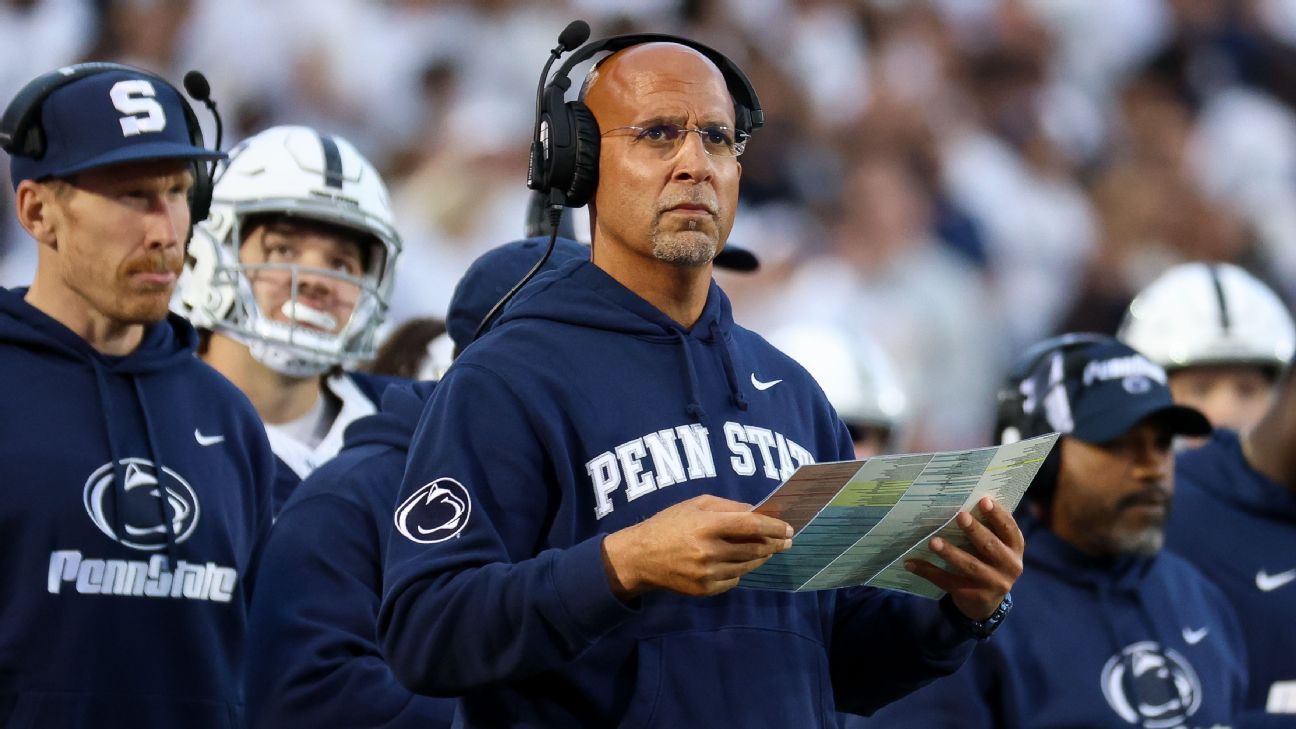
More than anything, the pace at which the carousel is moving stands out. Consider the Penn State coaching search, only 18 days old. We barely had time to digest the magnitude of James Franklin’s firing after 11-plus seasons at PSU — and a College Football Playoff semifinal appearance in January — before potential replacement Curt Cignetti agreed to a new eight-year, $93 million contract with Indiana. A day later, Nebraska‘s Matt Rhule — considered by many to be the favored target for Penn State athletic director Pat Kraft — saw the Cornhuskers lose 24-6 at Minnesota, their sixth consecutive defeat to the Golden Gophers. Then Rhule agreed to his own extension on Oct. 30.
Where will Penn State turn now? And how will Texas A&M‘s surge under Mike Elko, a New Jersey native who played college football at Penn, impact the search? Who else is working their way into the mix?
The Lane Kiffin-Florida exclusive courtship lasted only a week before LSU entered the chat. Kiffin could end up deciding between two of the better jobs in the SEC or he could stay at Ole Miss, which he has built into a national contender and where he receives strong support. Ole Miss’ position as a CFP hopeful could take the process well into December.
“Hard for me to see Lane staying with this much movement,” a coaching agent said.
If Kiffin stays put, Florida will need to turn elsewhere. Missouri‘s Eliah Drinkwitz, Louisville‘s Jeff Brohm and SMU‘s Rhett Lashlee are intriguing options, but would they get Gators fans anywhere near as excited?
LSU’s non-Kiffin options could include Drinkwitz, Brohm and others with varying profiles as the job is undoubtedly among the nation’s best. Can LSU swing big? Absolutely. Should it? That’s another question entirely.
Every weekend of results shapes the carousel, as so many sitting coaches are expected to be targeted for new jobs. Some are leading CFP hopefuls, which ultimately could limit their ability to move in December.
It’s time to reset the carousel as November nears, spotlighting jobs, candidates and an upcoming stretch that will reshape the leadership in several key spots around the country.

Targeted searches at PSU and Florida
Coaching circles often have a trickle-down effect, starting with the most appealing jobs, which are Penn State and Florida. What ultimately happens in State College and Gainesville might affect other open searches, as well as those that could come open, such as Florida State and Auburn. Kiffin, for example, will be high on FSU’s wish list, as well.
The belief among industry sources is that both the PSU and Florida candidate pools will be limited. If either school is talking to six or seven candidates, something probably isn’t right.
“Even though we have a ton of potential searches, there’s some niche searches,” a source said. “Penn State could not really be a search, and Florida might not really be a search. It might just be the obvious candidates.”
Those would have meant Rhule at Penn State and Kiffin at Florida, but that has changed. Elko, who has Texas A&M off to an 8-0 start, certainly would fit the PSU program, given his roots and how he spent the first 15 years of his coaching career in the Northeast, mid-Atlantic or Midwest.
Elko might be deciding between two well-resourced programs. The difference is that Penn State has accomplished way more on the field than Texas A&M has and is now clearly striving for national titles. Elko is certainly motivated to, as he has put it this season, break down doors. “We have high goals and expectations for this team and for this program,” he told ESPN last week. “We know in order to meet them, we have to do things that haven’t been done.”
Being the coach to elevate a historic underachiever is enticing. Elko also has followed college football for decades. He knows that outside Ohio State and Michigan, Penn State has had fewer barriers to success over the years, including no rival like Texas in the same state.
“Elko should take that [Penn State] job,” an industry source said.
Then again, if Texas A&M makes the CFP as a top-four seed, Penn State might have to make its hire sooner.
Vanderbilt‘s Clark Lea is emerging as a name to watch at Penn State and elsewhere. Would Penn State hire a coach from Vanderbilt twice in a row? Until last season, Lea was 9-27 at his alma mater. But he’s now doing things that Franklin never did at Vanderbilt (7-1), and Lea showed his flexibility as a coach by bringing in quarterback Diego Pavia and others from New Mexico State to spark the program. Lea is an Elko protégé and could appeal to PSU for many of the same reasons.
“The guy can win big games when the lights are bright,” an industry source said. “Last year against Bama, this year against LSU and Missouri, like, he shows up.”
Florida clearly has interest in Kiffin, but what if he’s not the guy? Drinkwitz and Lashlee both seem ready for a jump and could be good fits in Gainesville. They’re both in good situations, though, especially Lashlee after making the CFP last season. Missouri has capitalized on its SEC schedule across the past two campaigns but hasn’t beaten a ranked opponent in the league. Next season, the Tigers will visit Georgia and Ole Miss, and they will host Texas, Texas A&M, Oklahoma and Florida.
“They’re not going to have this path,” an industry source said. “Drinkwitz is smart enough to know he’s got to get out.”
Brohm is another option, especially because of his big-game record. He is 4-4 against AP top-five opponents following an Oct. 17 win at Miami. Although Brohm also has struggled in losing games he shouldn’t, his big-game success and creative offense are appealing. He also is extremely rooted in Louisville — both at the university and in his hometown — so it would take a lot to pull him away.
Unique dynamics in the LSU search
When Brian Kelly was fired Sunday, LSU immediately shot to the top of open job lists. There are two truths about LSU, though: It is a great job; it also is a complicated job.
Tiger Stadium is about 3 miles south of the Louisiana State Capitol, and the football program and state politics are historically intertwined. LSU also doesn’t have a permanent university president, and while an answer is expected soon, the school’s Board of Supervisors has a significant role in major university matters. Louisiana Gov. Jeff Landry appoints the board, and was part of the discussions Sunday that led to Kelly’s firing.
Landry, on Wednesday, shook up the search when he lit into LSU athletic director Scott Woodward, making it clear Woodward would not be hiring Kelly’s successor. The governor pointed to Woodward’s hires of Kelly and Jimbo Fisher at Texas A&M, and the significant costs both schools incurred when the coaches were fired.
“Scott Woodward is not selecting the next coach,” Landry said “Hell, I’d let [President] Donald Trump select him before I’d let him do it. The Board of Supervisors is going to come up with a committee and find us a coach.”
In announcing Kelly’s firing Sunday night, Woodward presented himself as LSU’s lead decision-maker, referring to being “a proud alum” and “the current caretaker of our athletics programs.” Woodward said he made the decision to fire Kelly.
1:30
Kiffin to McAfee: My players have movement rumors like I do
Ole Miss coach Lane Kiffin joins Pat McAfee and explains why he thinks the coaching rumors about him aren’t a big deal to his players.
But after Landry’s comments, it’s more than fair to wonder: Who will really make this hire?
Landry also criticized the hefty contracts coaches receive and the insular agent-administrator world that often yields those coach-friendly deals.
“This is a pattern,” Landry said.
Will this mean LSU avoids the big-splash hires Woodward has historically made, and the price tags that come with them? What’s the immediate future of Woodward, who has led LSU’s athletic department since 2019?
LSU’s search is clearly more complex than some of the others, and could take longer to wrap up. The school needs a clearly outlined process and might need to look at a wider candidate pool.
Remember, Kelly came to LSU with more accomplishments than his three predecessors — Orgeron, Les Miles and Saban — who all won national titles there. Coaches with different profiles can succeed there.
Kiffin has never worked at LSU but knows more than enough about the job from his time in the SEC. He might ultimately view Florida as a more sensible option, or even staying at Ole Miss.
LSU could prioritize SEC experience (Drinkwitz, Lea, Georgia Tech‘s Brent Key, Arizona State‘s Kenny Dillingham) or those connected to the state (Tulane‘s Jon Sumrall, Houston coach Willie Fritz, Detroit Lions defensive coordinator and former LSU linebacker Kelvin Sheppard).
But the candidates might be secondary right now, as LSU has to get its very stormy house in order.
The James Franklin factor
One emerging theme of this coaching cycle is potentially not having enough quality candidates to fill all of the major openings. But there’s also a sizable contingent of notable coaches not currently working and seemingly wanting to get back in the game.
The group includes two national-championship-winning coaches in Fisher and Orgeron. Former Northwestern coach Pat Fitzgerald wants to coach again now that his wrongful termination lawsuit against the school has been settled. Dave Clawson, who resigned from Wake Forest after the 2024 season, also might see a path to the sideline.
Then there are the recently fired coaches, headlined by Franklin and now Kelly. Rarely has a coach with Franklin’s credentials — 128-60 FBS record, nine AP Top 25 finishes, a CFP semifinal appearance — been jettisoned so quickly, and Franklin made it clear on “College GameDay” that he wants to coach in 2026.
“The X factor right now in a bunch of these searches is James Franklin,” an industry source said.
Franklin told the “College GameDay” crew that he will resume his national championship quest at his next job. Does he see a program such as Virginia Tech having that potential? Virginia Tech has committed to fund its program better than it has previously, and the school has an easier CFP path in the ACC. Franklin would be a strong hire there, but the Hokies haven’t had an AP top-10 finish since 2009.
How Franklin views Big Ten jobs is another layer. Other than Penn State, UCLA is the only current vacancy. UCLA has some pluses, especially from a lifestyle standpoint, but would have to take a massive jump to become a national contender. Franklin could have more interest in Big Ten jobs that haven’t opened yet, such as Wisconsin and perhaps Michigan State.
Other potential vacancies such as Florida State and Auburn could enter Franklin’s radar too, especially FSU. He would bring a level of credibility to both jobs.
Kelly’s next move is a bit harder to plot out. His final game at LSU took place on his 64th birthday, so he likely won’t be coaching that much longer. Could he go from fired at LSU to another national contender such as Penn State? Probably not. The more sensible jobs for Kelly might not be open yet.
Before the LSU job, he spent 35 years of his coaching career in three states: Michigan, Ohio and Indiana. If Wisconsin or Michigan State make changes, Kelly would make sense. The same goes for other jobs in the Midwest or Northeast.
Resetting searches outside of the big three
Penn State, Florida and now LSU have taken up a lot of oxygen in the coaching world, and so have the will-they-or-won’t-they situations at Florida State, Wisconsin and Auburn. But several searches have been underway for more than a month and will be winding toward resolutions.
Before Oklahoma State fired Mike Gundy, there was a lot of chatter in industry circles that Cowboys athletic director Chad Weiberg, who was working without a contract, might be out first. Not only did Weiberg survive the transition but last week had a new four-year deal approved. His job stability is a good sign for the next Cowboys coach.
Who will that be? Oklahoma State could look at several sitting Group of 5 coaches, including North Texas‘ Eric Morris, whose wizardry with quarterbacks has propelled his profile, and South Florida‘s Alex Golesh, a former Oklahoma State graduate assistant. The school might want a clean break from the Gundy era, but former quarterback Zac Robinson, the current Atlanta Falcons offensive coordinator, has some support around the program.
The candidate who has generated the most attention for Arkansas is former Razorbacks coach Bobby Petrino, who is leading the team on an interim basis. Despite how his first go-round ended, Petrino still has support in the state because of his on-field success. The problem is he hasn’t won a game as interim coach.
Lashlee might be the dream candidate, but as of now, it seems unlikely he’ll be headed home. Golesh, Sumrall and Memphis‘ Ryan Silverfield could be in the mix. Silverfield works in the same region. He beat Arkansas on Sept. 20 and won the head-to-head battle with Golesh on Saturday. Silverfield is 49-22 at Memphis.
Stanford and UCLA are the two Power 4 jobs that have been open the longest — Stanford since the spring — and both have performed fairly well under respective interim coaches Frank Reich and Tim Skipper. Former Stanford quarterback Tavita Pritchard, who spent 2010 to 2022 as a Stanford assistant before becoming quarterbacks coach of the Washington Commanders, is the name generating the most attention for the Cardinal.
UCLA certainly could take a run at Franklin or perhaps one of the top Group of 5 candidates. If Michigan State fires Jonathan Smith, would UCLA pursue the Pasadena, California, native, who had a lot of success on the West Coast? The UCLA search has been fairly quiet so far, and there are questions swirling around athletic director Martin Jarmond. The Los Angeles Times reported Wednesday that a group of 64 former UCLA players sent a letter to chancellor Julio Frenk asking for Jarmond to be replaced.
Baylor‘s Dave Aranda could be a name to remember, especially if Wisconsin comes open. Aranda served as defensive coordinator for the Badgers from 2013 to 2015 and loves the area. Aranda, a California native, also would make sense at both UCLA and Stanford. He entered 2024 on the hot seat and went 8-5, but Baylor is just 4-4 this fall, setting up a potential split.
Jon Sumrall and the other non-Power 4 coaches to watch
Whenever a Power 4 job comes open, there’s an expectation, externally and even internally, that other Power 4 coaches will jump to take the job. But those moves happen less than people might think.
Given the number of Power 4 vacancies, which certainly will grow in the coming weeks, it’s a good time to be an emerging Group of 5 coach, and there are several names to know.
Tulane’s Sumrall is the most talked about Group of 5 coach entering the hiring cycle. He won two Sun Belt Conference championships at Troy, and he brings a 15-6 record at Tulane into Thursday’s game at UTSA. Sumrall is an Alabama native who played at Kentucky and also coached at his alma mater as well as Ole Miss. He would be a natural choice for just about any vacancy — current or future — in the SEC. After serious talks with North Carolina about its vacancy last year, he also might fit in the ACC at a job such as Virginia Tech. The 43-year-old Sumrall certainly will have options.
“Sumrall is probably the best G5 right now,” an industry source said.
Silverfield and Golesh are two other coaches to watch in the American Conference. Golesh has a diverse background, having coached in the Big Ten, Big 12 and SEC as an assistant before landing his first head coaching gig at South Florida, where he is 20-14. Memphis’ Silverfield has done great work within the American, going 3-0 against Golesh and handing Sumrall his first conference loss last season. Silverfield operates a very productive offense, has NFL experience with the Minnesota Vikings and the Detroit Lions, and seems like a fit for jobs both in the South and the Midwest.
James Madison‘s Bob Chesney is another intriguing Group of 5 candidate. He has spent his career in New England and the mid-Atlantic region, guiding Holy Cross to consistent FCS playoff appearances and a 44-21 record. Chesney is 15-5 at James Madison and could be a name to watch at Virginia Tech and maybe even Penn State.
Western Kentucky‘s Tyson Helton has been a consistent winner, finishing with at least eight wins in five of his first six seasons with the Hilltoppers, who are 6-2 this fall. Helton, who has received interest from Purdue and other higher-profile jobs, runs a dynamic offense that ranks fifth nationally in passing offense during his tenure.
Southern Miss‘ Charles Huff also merits consideration. He guided Marshall to a Sun Belt championship last season then made a unique intraleague move to Southern Miss, which went 1-11 in 2024 but is 6-2 — including 4-0 in league play — this fall under Huff. He is a Maryland native who played college football in Virginia (Hampton) and has made coaching stops in both the Big Ten (Penn State) and SEC (Alabama, Mississippi State). He could be an intriguing option for Virginia Tech or several other SEC, ACC or Big Ten jobs.
What about the coordinators?
A look at the AP top 10 reveals six teams — No. 1 Ohio State (Ryan Day), No. 5 Georgia (Kirby Smart), No. 6 Oregon (Dan Lanning), No. 8 Georgia Tech (Brent Key), No. 9 Vanderbilt (Clark Lea) and No. 10 BYU (Kalani Sitake) — overseen by first-time head coaches. The right hires in college football often have come from the assistant ranks, especially primary coordinators.
The coordinator pool isn’t overly deep, even after a light hiring cycle last season.
“It’s a little thinner there compared to years past,” an industry source said.
Still, there are several names to know, especially on the offensive side.
Texas A&M’s Collin Klein is thriving in his second season there, overseeing an offense that ranks 14th nationally in both scoring and plays of 20 yards or longer. Klein, 36, is a former Heisman Trophy finalist at quarterback for Kansas State who remains beloved at his alma mater after assisting there for many years but has enhanced his profile by leaving for a high-pressure gig at Texas A&M. He could be a name to watch for Big 12 or SEC openings.
Oregon’s Will Stein has continued the offense’s success from predecessor Kenny Dillingham and has done it with different quarterbacks in Dillon Gabriel and now Dante Moore. Stein could be a name to watch if Kentucky moves on from Mark Stoops or if Brohm were to leave Louisville, where Stein played quarterback. Stein also is an interesting name for possible jobs in Texas, where he spent time coaching from 2015 to 2022.
Ohio State’s Brian Hartline has been on the radar for Power 4 jobs and could be again, especially with more direct influence in the playcalling this season. Hartline, a former Buckeyes wide receiver who played in the NFL, is the best collector of wideout talent of his generation and has helped propel his alma mater. He won’t leave Ohio State for just any job but would make sense for Big Ten openings, in particular.
Georgia Tech’s Buster Faulkner is a veteran playcaller with a distinctive scheme that has helped put the Yellow Jackets into the CFP mix. The Georgia native has spent much of his career in his home state or in neighboring states and would be a good option for vacancies in the region.
On the defensive side, Georgia’s Glenn Schumann and Oregon’s Tosh Lupoi are both names to track.
Schumann has worked with Smart and/or Saban throughout his career and has been around Lanning and other top coaches. The 35-year-old from Georgia seems fairly tied to the Southeast, but that’s where many of the jobs (current and expected) are located.
Lupoi built his reputation as a West Coast recruiter then made coaching stops at Alabama and with three NFL teams before returning as Oregon’s defensive coordinator under Lanning. The 44-year-old former defensive lineman at Cal should be a name to watch for West Coast vacancies, in particular.
Indiana held onto both of its coordinators — Mike Shanahan (offense) and Bryant Haines (defense) — after its first CFP run. That might be tougher after an even more impressive 2025 season so far. Haines was a finalist for the 2024 Broyles Award, which goes to the nation’s top assistant, and has Midwest roots. Shanahan, a former Pitt wide receiver, has spent most of his career alongside Hoosiers coach Cignetti.

Baseball’s winter meetings are just around the corner, and we’re ready for some blockbuster deals.
We’ve already seen some intriguing trades this offseason with the New York Mets acquiring Marcus Semien from the Texas Rangers for Brandon Nimmo and the Boston Red Sox adding Sonny Gray to their pitching staff — but there are even bigger stars who could move in the weeks ahead.
With that in mind, we asked our MLB insiders to give us their preferred destination for some of the biggest names in our ranking of the top 25 MLB offseason trade candidates.
Where did we send All-Stars Ketel Marte and Byron Buxton? Which Red Sox outfielder is on the move in our deals? And which contenders get starting pitching help? Let’s find out.
The Arizona Diamondbacks should trade Ketel Marte to the …

The Mariners plucked from the D-backs to jolt their offense just five months ago, acquiring corner infielders Eugenio Suarez and Josh Naylor. They should do so again, this time for Marte, the star second baseman who can be had for the right return. The Mariners have a need for another bat, and Marte would represent a massive upgrade over merely re-signing Suarez or Jorge Polanco.
Marte would slide in perfectly ahead of fellow All-Stars Julio Rodriguez and Cal Raleigh, allowing Randy Arozarena to join Naylor in the middle of the lineup and giving Seattle arguably the best offense in the American League — to pair with what is likely the best pitching staff.
Coming off a gut-wrenching loss in Game 7 of the American League Championship Series, it’s the perfect move to push the M’s toward the first World Series berth in franchise history. And whether it’s Cole Young, Michael Arroyo or Felnin Celesten, the Mariners might have enough young, promising middle infielders to satisfy the D-backs’ likely desire for a Marte replacement without parting with Colt Emerson. — Alden Gonzalez

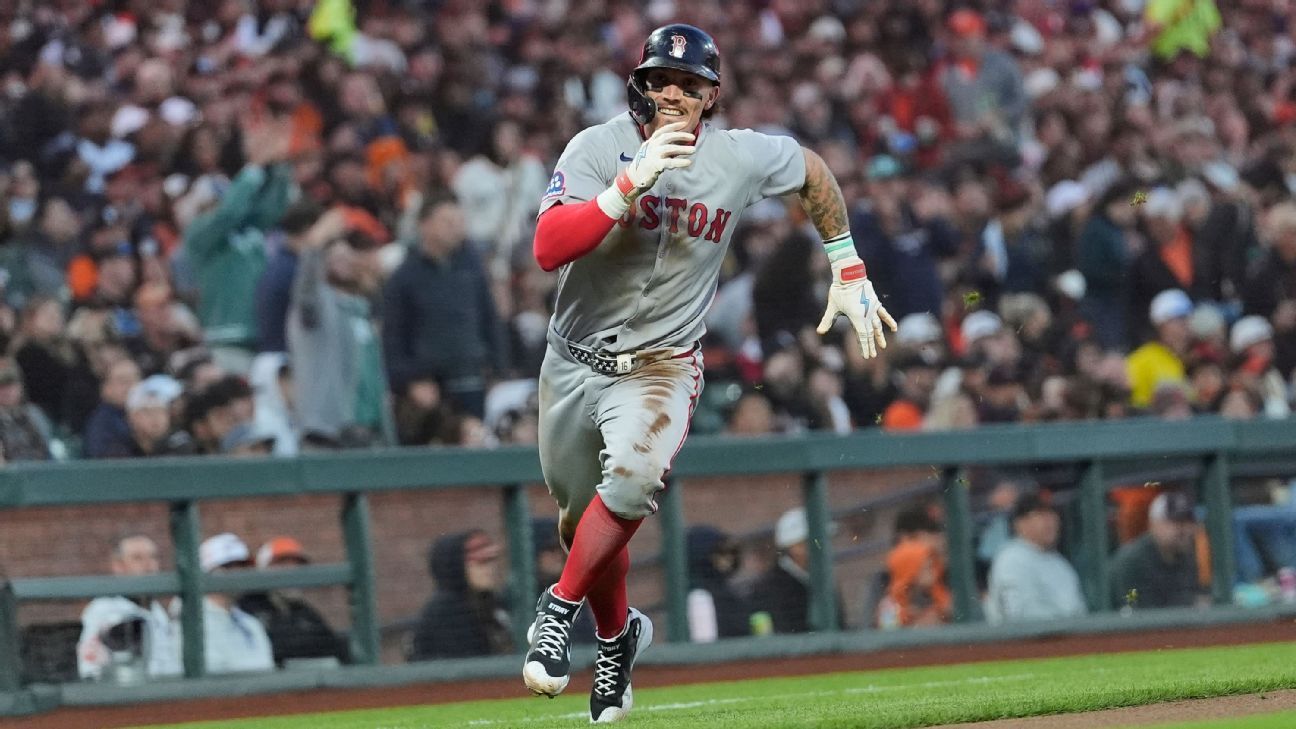
Boston Red Sox for Jarren Duran and Kyson Witherspoon
Roman Anthony‘s 2025 breakout rendered Duran expendable in an outfield already staffed by Ceddanne Rafaela and Wilyer Abreu, both of whom offer more remaining team control. And with presumed second-baseman-of-the-future Kristian Campbell struggling as a rookie (86 OPS+, -1.0 WAR), the door swung open for a move of this magnitude.
Duran’s proclivity for doubles and triples will play beautifully in Arizona (just ask Corbin Carroll), and Witherspoon, the No. 15 pick in the 2025 MLB draft, instantly becomes the club’s best pitching prospect. — Paul Hembekides

The Red Sox should trade Duran to the Philadelphia Phillies for a package including Alec Bohm
These lightning-rod players certainly are not coming off their best seasons and perhaps each needs the proverbial change of scenery. The Red Sox may need someone to play third base, and Bohm, while no match for Alex Bregman, is a capable hitter and defender. The Phillies could then get a more consistent third baseman who enjoys playing in Philadelphia. Duran would fill Philadelphia’s center-field need, and it would create some opportunity in a crowded Boston outfield. See, trades can work out for both teams! — Eric Karabell

The Cleveland Guardians should trade Steven Kwan to the Mariners
I love this idea so much. Kwan would return to the West Coast, about a four-hour drive from Corvallis, where he starred for Oregon State. He would give the Mariners a needed upgrade at a corner outfield spot, teaming with Julio Rodriguez to improve Seattle’s outfield defense. Most importantly, he could slide into the leadoff spot, offering contact and OBP as a poor man’s Ichiro, hitting in front of Cal Raleigh, Rodriguez and his old Cleveland teammate, Josh Naylor. Let’s get this done. — Bradford Doolittle

The Chicago White Sox should trade Luis Robert to the …

Rumor mill whispering has connected the Royals with Boston’s Jarren Duran for the hefty price of Cole Ragans, a swap I can’t abide. The Royals have starting pitching depth, but they don’t have ace depth and Ragans must stay. Duran isn’t an ideal defensive fit for Kauffman Stadium if you view him as a center fielder, and the Royals need to upgrade at that spot badly.
Enter Robert, whose work on strike zone judgment seemed to be paying off in the latter stages of last season. He’s younger than Duran and has more power upside without sacrificing speed and defense. The Royals’ new hitting staff is hyper-focused on improving pitch recognition, and I’d love for them to be new voices in Robert’s ear. The Royals could keep Ragans and modulate their rotation/prospect return based on Chicago’s willingness to pay down some of Robert’s $20 million for next season. Alas, this would be more palatable from a payroll perspective if the Royals had not already committed $8 million to run it back with Jonathan India. — Doolittle
Philadelphia Phillies
It’s time. Time for Robert to find a new home and time for the Phillies to mix up the vibe a little. It’s possible that last season proved to be Robert’s current floor — good defense and 33 stolen bases will help teams win games. But it’s also just as possible the ceiling is still within reach after years of underachieving. First off, getting away from the Sox did wonders for Gavin Sheets and Andrew Vaughn. The same could be true of Robert if he moves on, especially since he’s finally cutting his chase rate down.
Now put him in a good lineup with even better pitches to see — and perhaps a little more pressure to perform — and the Philles could just get the best version of him. He has hit 28 homers in a season. He hit .338 in another (partial year). Put it all together and he might turn into a steal. — Jesse Rogers

The Minnesota Twins should trade …

Byron Buxton to the Los Angeles Dodgers
This falls into the “Why? Because they can, that’s why” category. Enough is never enough for the Dodgers, so this offseason’s installment of making sure they have too much is the acquisition of the best available player at the position they may actually believe they need to upgrade. Move Andy Pages to left, slot Buxton into the top half of the lineup and go for three in a row. — Tim Keown

Joe Ryan and Ryan Jeffers to the New York Yankees
Ryan was a popular name at the trade deadline, and he’s popular again coming off an All-Star season with a rebuilding team and two years of team control remaining. The Yankees don’t need another front-line starter, but Ryan would give them some rotation stability early in the season with Gerrit Cole and Carlos Rodon (and Clarke Schmidt) on the injured list, and he would supply insurance should Cole or Rodón return later than usual or struggle upon return. And as these front offices like to say: You can never have enough starting pitching.
Jeffers would quench the Yankees’ need for a right-handed-hitting catcher after carrying three left-handed-hitting catchers for most of the 2025 season. He would platoon with Austin Wells and allow the Yankees to move Ben Rice, also a left-handed hitter, to first base full time. — Jorge Castillo

The Miami Marlins should trade Edward Cabrera to the New York Yankees for Jasson Dominguez If the Yankees are truly focused on keeping their payroll in check, they’ll need to be creative in how they address their roster shortcomings. Presuming that the team re-signs Cody Bellinger, the Yankees will already have spent a majority of their available free agent budget, and have rendered Dominguez excess with top prospect Spencer Jones also an in-season debut candidate. Dominguez is the kind of high-ceiling youngster the Marlins should be targeting.
Cabrera is a talented, albeit injury-prone, starter who can provide critical rotation depth while the team waits for the healthy returns of Gerrit Cole, Carlos Rodon and Clarke Schmidt. Dominguez’s two additional years of team control might make this a slight overpay for the Yankees, but Cabrera’s projected $3.7 million salary via arbitration could make him an ideal, budget-conscious acquisition. — Tristan Cockcroft

The Miami Marlins should trade Sandy Alcantara to the Athletics
Alcantara’s return from Tommy John surgery was a disaster in the first half of the season, as he entered the All-Star break with an ERA over 7.00. That made him untradeable; it made no sense for the Marlins to deal him at the trade deadline with his value at a low point. Alcantara found his groove over his final 12 starts, however, posting a 3.13 ERA with 69 strikeouts versus 18 walks over 77 innings. That is a pitcher you can trade.
The A’s finished 26th in rotation ERA in 2025. The rotation did struggle at home with a 5.52 ERA in Sacramento, so that led to inflated ERAs, but their only two returning starters with more than 100 innings are Jeffrey Springs (4.11 ERA) and Luis Severino (4.54 ERA). It will be difficult for the A’s to lure a decent free agent starter to Sacramento — they had to overpay to sign Severino — so a trade makes sense. Alcantara is signed to a reasonable $17.3 million for 2026 with a $21 million club option for 2027, which even the A’s can afford.
With the Nick Kurtz-led offense, the A’s will score runs. If they can build out the rotation and bullpen, they have the look of 2026’s sleeper playoff team. Their farm system is improved and they have low-salaried pitching depth with guys like Mason Barnett and Jack Perkins to throw back Miami’s way. — David Schoenfield


The Washington Nationals should trade MacKenzie Gore to the Baltimore Orioles
Gore hasn’t quite made the jump to front-line starter. But he has some qualities in common with higher slot lefties who are front-line types, like Blake Snell and Max Fried, so there could be another gear to be teased out. He also comes with two years of control and his arbitration number this year should land around $5 million.
In return, the Orioles can send a prospect package featuring OFs Slater de Brun and Austin Overn and RHPs Esteban Mejia and J.T. Quinn to the Nationals. Baltimore doesn’t have to include C Samuel Basallo and can probably hang onto OF Dylan Beavers, as well. I have the Nats opting for a larger package of players that includes what I think will be the sorts of prospects we’ll see new president of baseball operations Paul Toboni target. It helps new execs coming from the draft side of evaluation to target recent draftees, with de Brun and Quinn from the 2025 draft and Overn from the 2024 draft. — Kiley McDaniel


The Pittsburgh Pirates should trade Mitch Keller to the San Francisco Giants
The Giants churned through 15 starting pitchers in 2025 and return only three who made more than 10 starts (Logan Webb, Robbie Ray and Landen Roupp), leaving two slots to fill aside from the depth that is required in this era. Hayden Birdsong and Carson Whisenhunt are the top internal candidates, but adding a veteran starter for stability looks like an offseason necessity.
Keller is signed for three more years at an AAV of about $18.5 million. His biggest strength has been durability and consistency, making at least 29 starts four seasons in a row and averaging 183 innings and 2.1 WAR the past three seasons. His strikeout rate has declined from 25.5% to 20.0% since 2023, so that’s a minor cause for concern, but moving to the Giants, with better defense behind him and a stellar catcher in Patrick Bailey should help lower his batting average allowed.
Do the Pirates have enough rotation depth to trade Keller? Probably not, but they do have Paul Skenes, Mike Burrows, Braxton Ashcraft, Johan Oviedo and Bubba Chandler, plus Jared Jones returning from injury, so there at least is the makings of an exciting young rotation even without Keller. They need power, however, so the ask from the Giants would be their top prospect, first baseman Bryce Eldridge.
Too steep for the Giants? Perhaps. Eldridge has 35-homer potential and has produced while being very young for his levels, reaching Triple-A in 2025 at just 20 years old. He does have some holes in his game, with a 3-to-1 strikeout-to-walk ratio, he struggled against breaking balls from left-handers, he has below-average speed and his defense at first base is fringy, so he might be a DH with Rafael Devers playing first. The power is real — enough for the Pirates to gamble on and also real enough that he’ll be difficult to pry away from the Giants. — Schoenfield
Inspirational thought of the week:
Hang on to your hopes, my friend
That’s an easy thing to say
But if your hopes should pass away
Simply pretend that you can build them again
Look around
The grass is high
The fields are ripe
It’s the springtime of my life
Seasons change with the scenery
Weavin’ time in a tapestry
Won’t you stop and remember me?
Look around
Leaves are brown
And the sky is a hazy shade of winter
— “Hazy Shade of Winter” by Simon & Garfunkel (or The Bangles, depending on how old you are)
Here at Bottom 10 Headquarters, located behind the bank of telephones used to raise money for the “Free Marty Smith From Oxford” fund, we once again look at the calendar and realize that it is conference championship weekend, which means it’s time for the Bottom 10 to make like Lane Kiffin and run for the exit amid a shower of boos and middle fingers.
The #Bottom10 Selection Committee is currently in session to determine the final 2025 rankings, to be revealed Wednesday morning. pic.twitter.com/WdIvj25gNW
— Ryan McGee (@ESPNMcGee) December 2, 2025
Due to an unprecedented coaching carousel that was so bonkers we’ve renamed it the Coaching Tilt-A-Whirl, the candidates list for this year’s Bottom 10 Selection Committee grew faster than Brian Kelly’s lawyers’ billable hours invoice. The final roster: me, my dad, Captain Morgan (aka my stepdad), Mike Gundy, current Northwest Oklahoma defensive coordinator Jerry Glanville and former Texas State Armadillos head coach Ed “Straight Arrow” Gennero. As our vote began, we were joined by Sam Pittman, who pulled up to our meeting spot, a truck stop behind the Gaylord Texan where the fancy-schmancy CFP committee was gathered, behind the wheel of a shoebox Winnebago blasting Skynyrd and towing a pontoon boat upon which the name “S.S. YESSIR” was airbrushed.
Once again, we leaned on our Bottom 10 FPI formula. No, not the ESPN Football Power Index, but rather the Faux Pas Index. Because everyone loves math.
Teams receive one point for each win, minus one point for each loss, minus one point for each loss of their longest losing streak of the year, plus a minus-10 bonus if that longest losing streak is currently active. We also subtract the number of points they have surrendered on the season from the number of points they scored, subtract or add points based on their season turnover margin and subtract their weakness of schedule (WoS) ranking. If a team fired its head coach, that earns a 50-point subtraction, aka the Randy Edsall Fired Coach Bonus.
Divide all of that by the number of games played, and there’s your Bottom 10 FPI score. Because it’s hard numbers, the results are indisputable. And by hard numbers we mean that we made the formula so badly complicated that it’s too hard to dispute because it’s not worth wasting the effort to do so.
With apologies to Tennessee wide receiver Deon Hardin, Mizzou running back Ahmad Hardy, Rice running back D’Andre Hardeman Jr. and Steve Harvey, here’s the final 2025 Bottom 10 rankings.

Wins: +0
Losses: -12
Longest losing streak: -12 (current -10)
Point differential: -330 (133 for, 463 against)
Turnover margin: -7
WoS: -91
Randy Edsall Fired Coach Bonus: N/A
Total: -450
Games played: 12
Final Bottom 10 Faux Pas Index: -37.5
The Minuetmen had their wet hay in the barn a full week early, having played their final game of the season on the Tuesday afternoon prior to Thanksgiving. Once they got that hay into the barn, they remembered that the Salem witch trials took place in Massachusetts and they immediately burned that barn down in an effort to exorcise their Bottom 10 demons.

Wins: +2
Losses: -10
Longest losing streak: -8
Point differential: -241 (213 for, 454 against)
Turnover margin: +2
WoS: -104
Randy Edsall Fired Coach Bonus: N/A
Total: -359
Games played: 12
Final Bottom 10 Faux Pas Index: -29.9
The Bearkats kompiled a two-win kampaign, but still katapulted kompletely over kontenders who had only one win. How did they akkomplish that? Bekause of a krappy strength of skedule and a defense too frekwently skored upon.

Wins: +1
Losses: -11
Longest losing streak: -11 (current -10)
Point differential: -230 (170 for, 400 against)
Turnover margin: -5
WoS: -30
Randy Edsall Fired Coach Bonus: -50
Total: -346
Games played: 12
Final Bottom 10 Faux Pas Index: -28.8
Many people in the greater Stillwater area had told me that I didn’t have the Kowboys, er, sorry, Cowboys ranked low enough. When we did the FPI math, it backed up those complainers with the same amount of force that it backed down their team.

Wins: +1
Losses: -11
Longest losing streak: -9 (current -10)
Point differential: -217 (237 for, 454 against)
Turnover margin: -11
WoS: -66
Randy Edsall Fired Coach Bonus: N/A
Total: -323
Games played: 12
Final Bottom 10 Faux Pas Index: -26.9
Just as the arithmetic hurt OSU, it helped GSU, which jumped/fell from No. 2 to No. 4. That might not seem like much, but for a team that last won a game more than 80 days ago, you’ll take whatever good news you can get.
5. The Lane Train
Marty said if I didn’t have Kiffin in the Coveted Fifth Spot again this week he would beat me over the head with the turkey leg he wasn’t able to eat with his family on Thanksgiving because he had to go to Oxford and hold a microphone instead.

Wins: +2
Losses: -10
Longest losing streak: -6 (current -10)
Point differential: -148 (222 for, 370 against)
Turnover margin: -4
WoS: -90
Randy Edsall Fired Coach Bonus: -50
Total: -316
Games played: 12
Final Bottom 10 Faux Pas Index: -26.3
Easily, the most vocal “How can we not be ranked?!” #Bottom10Lobbying crowd of 2025 was Rams Nation. And when we did the math, they were proved right as Colorado State leapt like a ram from a rock formation off the Waiting List into the canyon of nearly the top/bottom five. Now they have hired professional Bottom 10 rehabilitation specialist Jim Mora, who totally ruined what used to be the Bottom 10’s version of Chiefs vs. Eagles, UMess vs. U-Can’t, by inexplicably turning the Huskies into winners.

Wins: +1
Losses: -11
Longest losing streak: -9 (current -10)
Point differential: -264 (172 for, 436 against)
Turnover margin: -8
WoS: -70
Randy Edsall Fired Coach Bonus: N/A
Total: -271
Games played: 12
Final Bottom 10 Faux Pas Index: -22.5833333
Niners officials reached out to the Bottom 10 committee to see if perhaps they might receive bonus cool points for the fact that their record was 1-9 when Georgia paid them $1.9 million to play “between the hedges.” We told them no, but only after reaching out to UNCC math professors, who assured us that the laws of natural numerical law would not allow us to add something called “cool points” to something called a “Faux Pas Index.” Speaking of math, Charlotte also is now part of a Bottom 10 FPI first, a numerical tie! With whom … ?

Wins: +2
Losses: -10
Longest losing streak: -7
Point differential: -135 (218 for, 353 against)
Turnover margin: -11
WoS: -60
Randy Edsall Fired Coach Bonus: -50
Total: -271
Games played: 12
Final Bottom 10 Faux Pas Index: -22.5833333
It should be no surprise that the Beavers would be in some weird spot here after spending their entire season stuck in a bizarro Bottom 10 vortex. They won the tiebreaker with Charlotte via one common opponent, Appalachian State. The Niners lost at home to the Mountaineers 34-11, while the Beavs lost in Boone by only four points. One of only a pair of members of the 2Pac conference, Oregon State had already beaten its only league colleague, Warshington State, in Week 10, but then immediately lost to Sam Houston. Then all the Beavers had to do was beat Wazzu again to depart these rankings for good, but they lost 32-8. Now they will do like all beavers and spend the winter not hibernating, but packed into a mud lodge with other beavers, shivering and seeing who has to swim out under the ice to get food. In related news, that’s also how we on the Bottom 10 Selection Committee spent this week. We sent Mike Gundy out to get the food because his haircut totally looks like a beaver.

Wins: +2
Losses: -10
Longest losing streak: -5 (current -10)
Point differential: -85 (280 for, 365 against)
Turnover margin: -12
WoS: -109
Randy Edsall Fired Coach Bonus: N/A
Total: -229
Games played: 12
Final Bottom 10 Faux Pas Index: -19.1
Representatives of the Minors crashed our committee meeting to remind us that while they understood they would likely have to be ranked, no matter what the math said, they had to be ranked above/below Sam Houston because they beat the Bearkats head-to-head. But we didn’t hear any of that because when we say they crashed our meeting, they literally crashed our meeting. Paydirt Pete had to use his pickax to pry the UTEP conversion van free from where it ran into the trailer carrying Pittman’s pontoon boat.

Wins: +2
Losses: -10
Longest losing streak: -10
Point differential: -88 (305 for, 393 against)
Turnover margin: -9
WoS: -54
Randy Edsall Fired Coach Bonus: N/A
Total: -169
Games played: 12
Final Bottom 10 Faux Pas Index: -14.08
The Golden Beagles were in a Bottom 10 peloton to the finish line, which was more like that scene at Oklahoma a few weeks ago when the Sooners got lost in the smoke of their stadium entrance and fell over each other, piling up like firewood for winter. In the end, Arkansaw and Pur-don’t received too big of a Power 4 WoS boost, while Muddled Tennessee and No-vada both had the audacity to win two out of their final three games, hitting the Raise Hell Praise Dale 3-victory mark and moving out of the running. We started to do the FPI math on a few other teams, but when the batteries ran out in our Texas Instruments calculator, Coach Pittman, relieved his former Hogs missed the final cut, announced, “I’ll go to the store, but it won’t be to buy batteries. It’ll be to buy beer.” Meeting adjourned.
Waiting List: Arkansaw Fightin’ Former Petrinos, No-vada, San No-sé State, Pur-don’t, Muddled Tennessee State, Northern Ill-ugh-noise, ULM (pronounced “Uhlm”), conference tiebreakers that require slide rules.
-
 Sports2 years ago
Story injured on diving stop, exits Red Sox game
-
 Sports3 years ago
‘Storybook stuff’: Inside the night Bryce Harper sent the Phillies to the World Series
-
 Sports2 years ago
Game 1 of WS least-watched in recorded history
-
 Sports3 years ago
Button battles heat exhaustion in NASCAR debut
-
 Sports3 years ago
MLB Rank 2023: Ranking baseball’s top 100 players
-
Sports4 years ago
Team Europe easily wins 4th straight Laver Cup
-
 Environment3 years ago
Japan and South Korea have a lot at stake in a free and open South China Sea
-
 Environment1 year ago
Here are the best electric bikes you can buy at every price level in October 2024