
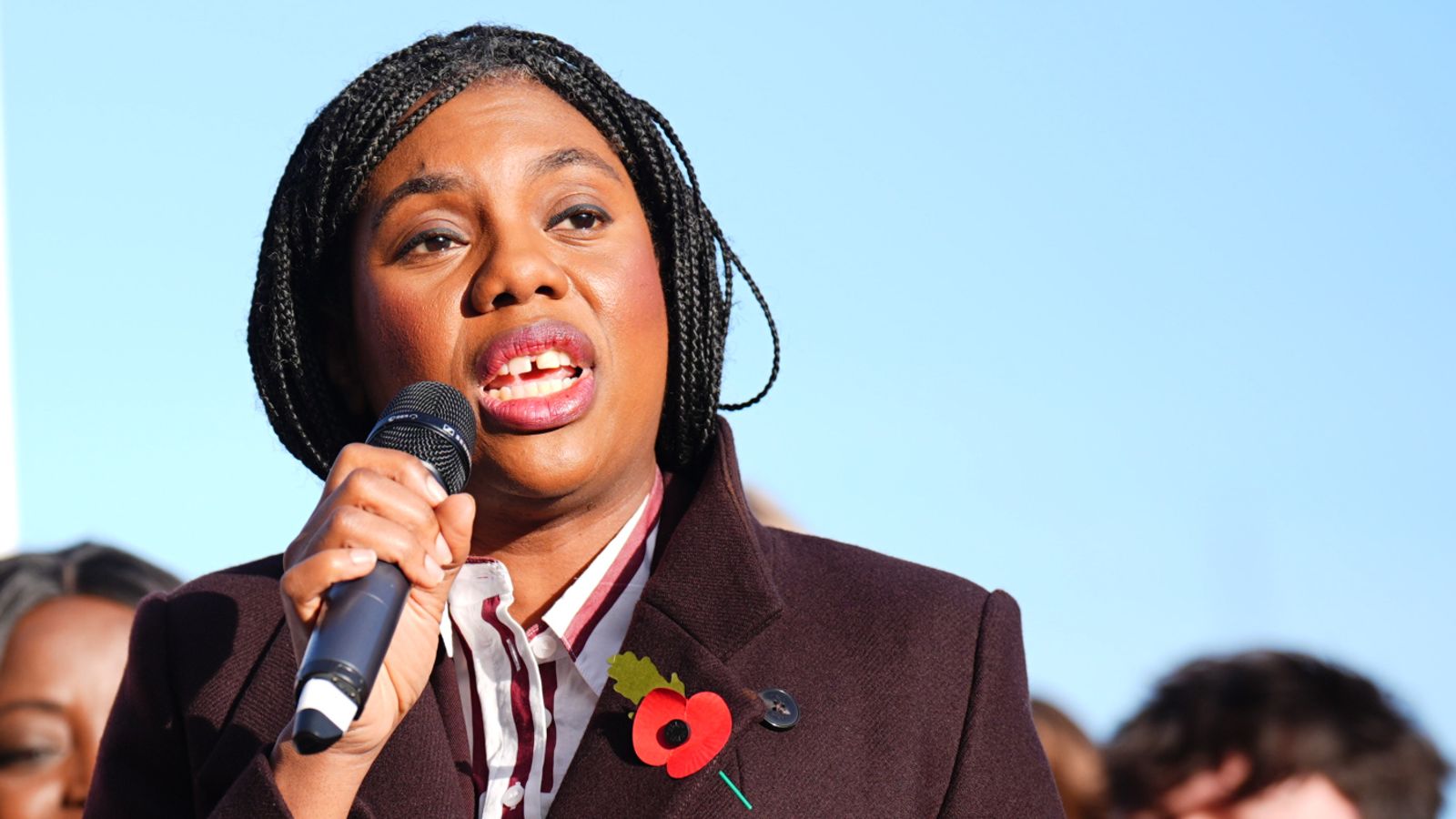
Kemi Badenoch ‘rebuilding’ Tory party as she marks first year as leader


Conservative leader Kemi Badenoch has said she is “rebuilding” the party as she marks her first year in the job.
Ms Badenoch also said she had spent the last 12 months “giving the country a serious alternative to Labour’s weakness: a plan for a stronger economy and stronger borders”.
The leader, who was elected on 2 November last year when she defeated Robert Jenrick, said on Sunday she was “rebuilding our party, our principles and our plan for Britain”.
She came to the helm after a leadership contest, triggered by Rishi Sunak’s resignation in the wake of the 2024 general election drubbing.
Pic: PA
But despite starting to craft a new Tory policy platform, she has been criticised by anonymous MPs who are disappointed the Conservatives do not appear to be cutting through with voters.
And she has seen some senior party figures defect to Reform UK, including ex-Conservative chairman Jake Berry, former Welsh secretary David Jones, and Tory MP Danny Kruger.
Ms Badenoch also continues to face the challenge of ambitious frontbenchers who appear to be plotting potential future leadership bids, including shadow justice secretary Mr Jenrick.
Despite her insistence that the party is providing a credible alternative to the Labour government, the latest polling from YouGov suggested voters are yet to be convinced by Ms Badenoch, with just 12% believing she is a prime minister in waiting, while 62% do not.
But Ms Badenoch appeared adamant in her approach as she faced down the critics.
She said: “This first year of my leadership has been about rebuilding. Rebuilding our party, our principles and our plan for Britain.
“After defeat in 2024, we faced a choice: retreat into slogans, or rebuild around values. We chose to rebuild.
“The Conservative Party now stands once again for what made Britain strong in the first place – responsibility, fairness, competence and pride in our nation.”
Read more:
Johnson third ex-Tory PM to criticise Badenoch’s policies
Analysis – Tories and Reform: From feud to love-in?

‘They have scandal after scandal’
A majority of Conservative members, 54%, do believe she is doing a good job as party leader, while 24% say she has done a bad job, the YouGov survey found.
Pollsters have also suggested the Tories are less popular than the Liberal Democrats, as Nigel Farage’s Reform UK continues to lead with the public.
In May, the Conservatives suffered heavy defeats in the local elections, as Ms Badenoch apologised to her party over the result.
In October at her first Conservative party conference as leader, she made the surprise announcement the Tories would scrap stamp duty, a tax paid by house buyers, on the purchase of their main homes.
It gave the Conservatives and their leader a much-needed lift after what many have dubbed the lost year.
But backbench Tories could soon hold Ms Badenoch’s future in their hands, as a grace period stopping them from submitting letters expressing no confidence in her expires once her first year in office is complete.
Bob Blackman, who as chairman of the 1922 Committee acts as a conduit for Conservative backbenchers, said he believed Ms Badenoch’s slow and steady approach had been the correct one.
However, Labour said that “one year in, Kemi Badenoch’s Conservatives have shown themselves incapable of change or learning lessons from the past”.
Party chairwoman Anna Turley said: “They crashed the economy, sent mortgages rocketing and left NHS waiting lists at record highs.”


A new long-awaited child poverty strategy is promising to lift half a million children out of poverty by the end of this parliament – but critics have branded it unambitious.
The headline announcement in the government’s plan is the pledge to lift the two-child benefit cap, announced in Rachel Reeves’s budget last week.
It also includes:
• Providing upfront childcare support for parents on universal credit returning to work
• An £8m fund to end the placement of families in bed and breakfasts beyond a six-week limit
• Reforms to cut the cost of baby formula
• A new legal duty on councils to notify schools, health visitors, and GPs when a child is placed in temporary accommodation
Many of the measures have previously been announced.
Two-child cap ‘a real victory for the left’
The government also pointed to its plan in the budget to cut energy bills by £150 a year, and its previously promised £950m boost to a local authority housing fund, which it says will deliver 5,000 high-quality homes for better temporary accommodation.
Downing Street said the strategy would lift 550,000 children out of poverty by 2030, saying that would be the biggest reduction in a single parliament since records began.
But charities had been hoping for a 10-year strategy and argue the plan lacks ambition.
A record 4.5 million children (about 31%) are living in poverty in the UK – 900,000 more since 2010/11, according to government figures.
Phillip Anderson, the Strategic Director for External Affairs at the National Children’s Bureau (NCB), told Sky News: “Abolishing the two-child limit is a hell of a centre piece, but beyond that it’s mainly a summary of previously announced policies and commitments.
“The really big thing for me is it misses the opportunity to talk about the longer term. It was supposed to be a 10-year strategy, we wanted to see real ambition and ideally legally binding targets for reducing poverty.
“The government itself says there will still be around four million children living in poverty after these measures and the strategy has very little to say to them.”

‘A budget for benefits street’
‘Budget for benefits street’ row
The biggest measure in the strategy is the plan to lift the two-child benefit cap from April. This is estimated to lift 450,000 children out of poverty by 2030, at a cost of £3bn.
The government has long been under pressure from backbench Labour MPs to scrap the cap, with most experts arguing that it is the quickest, most cost-effective way to drive-down poverty this parliament.
The cap, introduced by Conservative chancellor George Osborne in 2017, means parents can only claim universal credit or tax credits for their first two children. It meant the average affected household losing £4,300 per year, the Institute for Fiscal Studies calculated in 2024.
The government argues that a failure to tackle child poverty holds back the economy, and young people at school, cutting their employment and earning prospects in later life.
However, the Conservatives argue parents on benefits should have to make the same financial choices about children as everyone else.
Shadow chancellor Mel Stride said: “Work is the best way out poverty but since this government took office, unemployment has risen every single month and this budget for Benefits Street will only make the situation worse. “
OBR leak: This has happened before
‘Bring back Sure Start’
Lord Bird, a crossbench peer who founded the Big Issue and grew up in poverty, said while he supported the lifting of the cap there needed to be “more joined up thinking” across government for a longer-term strategy.
He has been pushing for the creation of a government ministry of “poverty prevention and cure”, and for legally binding targets on child poverty.
“You have to be able to measure yourself, you can’t have the government marking its own homework,” he told Sky News.
Lord Bird also said he was a “great believer” in resurrecting Sure Start centres and expanding them beyond early years.
The New Labour programme offered support services for pre-school children and their parents and is widely seen to have improved health and educational outcomes. By its peak in 2009-2010 there were 3,600 centres – the majority of which closed following cuts by the subsequent Conservative government.

Lord Bird on the ‘great distraction’ from child poverty
PM to meet families
Sir Keir Starmer’s government have since announced 1,000 Best Start Family Hubs – but many Labour MPs feel this announcement went under the radar and ministers missed a trick in not calling them “Sure Starts” as it is a name people are familiar with.
The prime minister is expected to meet families and children in Wales on Friday, alongside the Welsh First Minister, to make the case for his strategy and meet those he hopes will benefit from it.
Several other charities have urged ministers to go further. Both Crisis and Shelter called for the government to unfreeze housing benefit and build more social rent homes, while the Children’s Commissioner for England, Dame Rachel de Souza, said that “if we are to end child poverty – not just reduce it” measures like free bus travel for school-age children would be needed.
The strategy comes after the government set up a child poverty taskforce in July 2024, which was initially due to report back in May. The taskforce’s findings have not yet been published – only the government’s response.
Sir Keir said: “Too many children are growing up in poverty, held back from getting on in life, and too many families are struggling without the basics: a secure home, warm meals and the support they need to make ends meet.
“I will not stand by and watch that happen, because the cost of doing nothing is too high for children, for families and for Britain.”


A group of former executives from the collapsed crypto-friendly Signature Bank has launched a new blockchain-based, state-chartered bank called N3XT, with the goal of enabling instant 24-hour payments.
N3XT said on Thursday that it aims to settle payments instantly at any time using a private blockchain and offers programmable payments through smart contracts. The company added that its systems have been designed for interoperability with stablecoins, utility tokens, and other digital assets.
Signature Bank founder Scott Shay founded N3XT, which will operate under a Wyoming Special Purpose Depository Institution (SPDI) charter and will not offer lending services.
Signature Bank was one of three crypto-friendly banks, along with Silicon Valley Bank and Silvergate Bank, that collapsed in the 2023 US banking crisis due to a bank run and ties to the then-rapidly falling crypto market.
The Federal Deposit Insurance Corporation took control of Signature Bank in March 2023, just days after the collapse of Silicon Valley Bank, saying it had an overreliance on uninsured deposits, weak risk controls and was facing a worsening run on deposits.
N3XT avoiding lending services
Jeffrey Wallis, Signature Bank’s former director of digital asset and Web3 strategy, will be N3XT’s CEO and president and said that crypto innovations are at the heart of the new venture.

“Money should move as seamlessly as information,” he said. “We’re applying crypto innovations to banking to deliver instant, programmable payments for institutional clients.”
N3XT won’t be offering lending, and the bank claims its reserves are also backed one-to-one by cash or short-term US Treasurys, with promises to share reserve holdings daily.
At launch, N3XT lists its client base as unnamed businesses across crypto, foreign exchange, shipping and logistics, and a variety of other sectors.
Crypto venture capital firms backing N3XT
The bank raised three rounds of financing from a range of investors that included Winklevoss Capital, the venture capital firm of Tyler and Cameron Winklevoss, Paradigm and HACK VC.
Related: Group of EU banks pushes for euro-pegged stablecoin by 2027
Hack co-founder Alexander Pack said in an X post on Thursday his firm is ready to support N3XT and its founders as they emerge from “stealth mode.”
“N3XT’s founders, Scott and Jeff, are forces of nature: they previously built Signature Bank, the biggest and best bank to support the US crypto industry in a regulated way, before the last administration forced them to shut down,” he said.

“Most founders would quit after something like that, but instead they immediately went back to work building N3XT,” Pack added.
Magazine: 6 reasons Jack Dorsey is definitely Satoshi… and 5 reasons he’s not
-
 Sports2 years ago
Story injured on diving stop, exits Red Sox game
-
 Sports3 years ago
‘Storybook stuff’: Inside the night Bryce Harper sent the Phillies to the World Series
-
 Sports2 years ago
Game 1 of WS least-watched in recorded history
-
 Sports3 years ago
Button battles heat exhaustion in NASCAR debut
-
 Sports3 years ago
MLB Rank 2023: Ranking baseball’s top 100 players
-
Sports4 years ago
Team Europe easily wins 4th straight Laver Cup
-
 Environment3 years ago
Japan and South Korea have a lot at stake in a free and open South China Sea
-
 Environment1 year ago
Here are the best electric bikes you can buy at every price level in October 2024