
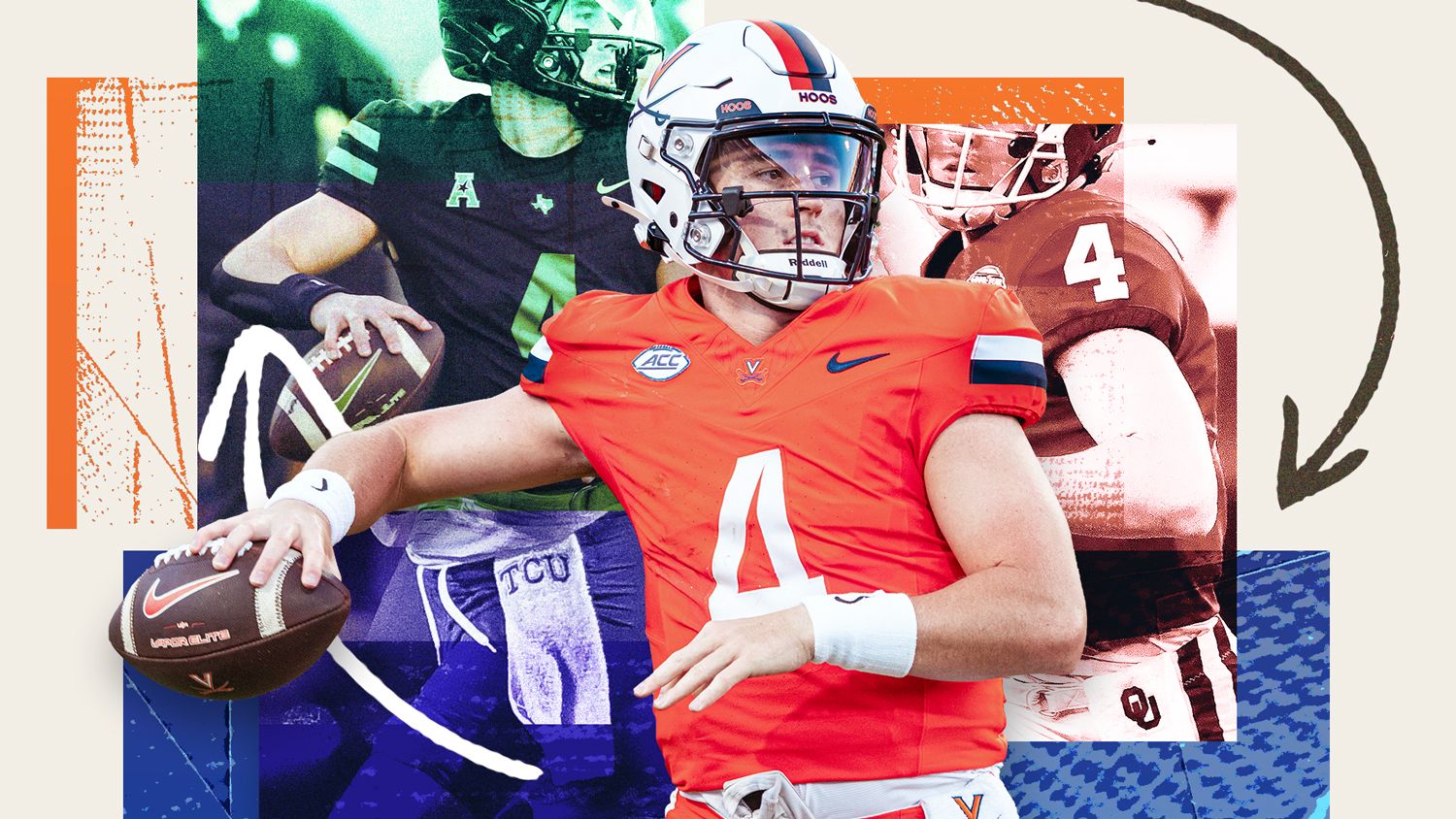
‘Wouldn’t necessarily say I’m trash’: A tale of four journeyman QBs and their 15 schools


-
Max Olson
When you’re a veteran college quarterback transferring to your fourth school in six years, you know what to expect if you check the internet comments.
He’s still around? Geez.
Isn’t he like 30 years old?
He needs to move on with his life. He isn’t going to the league.
It’s time to hit LinkedIn and get a job.
And yet, despite the haters, we’ve reached a peak moment for journeyman quarterbacks across college football. Freshmen who began college in 2020 during the COVID pandemic were granted an extra year of eligibility by the NCAA. Now they’re still hanging around as sixth-year seniors. Nearly 40 quarterbacks from the 2020 class came back this year for one more season at the FBS level.
They’re 23- and 24-year-old grizzled veterans who feel even older inside their locker rooms. They have college degrees. Their partying days are done. They’re training and preparing like pros, trying to squeeze every last drop out of their college days.
College football today is in many ways unrecognizable compared to when they were high schoolers. The explosion of NIL and the transfer portal, big-name coach firings, conference realignment, the expanded College Football Playoff, the pandemic, collectives, agents, revenue sharing — you name it, these quarterbacks went through it.
“Not a lot of people have experienced this type of roller-coaster ride in college football,” SMU quarterback Tyler Van Dyke said.
The days of QBs bouncing from school to school for starting jobs aren’t going away. In this new era of unlimited transfers, 85% of top-50 quarterback recruits from 2018 to 2021 have transferred and more than 40% have switched schools multiple times. But we are nearing the end of the road for a historic fraternity of super seniors granted additional eligibility because of the pandemic.
This is the story of four journeyman quarterbacks — Chandler Morris, Robby Ashford, Drew Pyne and Van Dyke — still chasing glory in Year 6.
Jump to:
Chandler Morris | Robby Ashford
Drew Pyne | Tyler Van Dyke

Chandler Morris: Oklahoma | TCU | North Texas | Virginia
Chandler Morris was ready to retire from football. After four years of setbacks, he’d had enough.
“Football just wasn’t loving me back,” Morris said. “It’s kind of hard to love something if it’s not loving you back.”
He started fighting those thoughts two years ago at TCU. Midway through his first full season as a starter, Morris hurt his left knee and was sidelined for four games. Young backup Josh Hoover stepped in to replace him. Morris got healthy but never got his starting job back, and he couldn’t understand why.
By then, though, little had gone according to plan. Morris had initially committed to play for his father, Chad Morris, at Arkansas. Five months later, Arkansas fired his dad. The younger Morris responded to that gut punch by signing with Oklahoma. He arrived in Norman in the summer of 2020, amid the COVID outbreak, knowing nothing would seem normal.
There wasn’t much bonding time with his freshman class. Gathering outside the football facility was discouraged. Players were taking online courses in their dorms, masking up, testing for COVID daily and trying to get through a college football season played in empty stadiums.
“I don’t know if I was very happy there,” Morris said. “But I don’t know if there was a happy freshman anywhere in the country that year.”
After a season behind Spencer Rattler and with Caleb Williams on the way, Morris had a sense Oklahoma wasn’t the right fit. He transferred home to TCU to play for Gary Patterson. Eight games into the 2021 season, Patterson’s successful 21-year tenure ended abruptly when he was fired on Halloween. The next day, Morris learned he’d make his first career start.
The Horned Frogs had nothing to lose against No. 12-ranked rival Baylor, and that’s exactly how Morris played. He lit up one of the Big 12’s best defenses with 461 passing yards, 70 rushing yards and 3 touchdowns in a shocking 30-28 upset.
“I was probably too young for that success,” Morris said. “I probably thought I had arrived. I went out there and just dominated them. I was kind of like an overnight success.”
Morris was no less dominant the following August in his preseason competition with senior Max Duggan. TCU coaches still swear to this day it wasn’t a close call. Morris earned the right to be QB1 as the Frogs kicked off the Sonny Dykes era. But he didn’t make it through the season opener, exiting with an MCL sprain in his left knee after a Colorado defender landed on his leg.
“Max took it over,” Morris said, “and the rest was history.”
A few weeks later, when Duggan led a 55-24 blowout win over Oklahoma, Morris went home and cried. He knew he’d missed his chance. TCU went on a surprising 13-1 run to the CFP national championship game, with Duggan finishing runner-up for the Heisman Trophy. Morris enjoyed going on that wild ride, but it wasn’t easy to set personal feelings aside. He badly wanted to be out there playing.
Everything finally seemed aligned for Morris entering 2023. The Horned Frogs got off to a nightmare start with a home loss to Colorado they never saw coming, but Morris settled in from there and was playing well until another MCL sprain shut him down. Dykes and his coaches went with Hoover to finish a rough 5-7 season. Morris felt he was being pushed out the door.
Chad Morris knew how frustrated and hurt his son was — and how seriously he was contemplating retirement — but urged him to give it one more shot. North Texas offered a fresh start. Chandler finished his degree at TCU in the spring of 2024, taking four classes as a regular student and staying away from football. He needed the time off to reset.
“I learned not to put my identity into football,” Morris said. “I think it’s easier said than done when that’s all you do. I had my identity wrapped up in that, and once it got stripped away from me, I was in a low place.”
North Texas coach Eric Morris (no relation) watched his QB get his swagger back last season. Chandler credits his coaches for fully tailoring the Mean Green offense to his strengths and preferences. “They poured so much confidence into me,” he said. Morris went in thinking 2024 would be his final college season. Then he put up 4,016 total yards, seventh most in FBS, and had $1 million offers coming in from Power 4 programs.
If Morris was going to move back up for his sixth year, he wanted to be around good people. He trusted Virginia coach Tony Elliott, who had worked with his dad at Clemson. He knew Virginia was loading up on transfers and going all-in for 2025. Once he got on campus and saw the personnel, he knew the team could compete.
“You can’t ask for much more than an opportunity to come to a place like this and try to get ’em back on the map,” he said.
Nothing about the Cavaliers’ 8-1 start and rise to No. 12 in the AP poll, their highest ranking since 2004, has surprised their QB. Their double-overtime triumph over then-No. 8 Florida State got everyone’s attention, and they’ve survived two more overtime thrillers since. When asked if this team is giving him 2022 TCU vibes, Morris didn’t hesitate.
“I really do compare it to that year, just based off our locker room and how close and how hungry we are,” Morris said. “They’ve lost quite a bit of games over the years. They’re ready to be done with that.”
Even on a seven-game win streak, nothing comes easy. Morris has battled a shoulder injury for most of the season. Elliott says he’s been a “warrior” throughout. After everything Morris has gone through, good luck convincing him to miss a single snap of this ACC title chase.
“I wouldn’t pick to be in college football for six years,” Morris said, “but here I am.”
Robby Ashford: Oregon | Auburn | South Carolina | Wake Forest
For Wake Forest quarterback Robby Ashford, the trials of the past six years have felt beyond his control.
“I wouldn’t necessarily say I’m trash, because I’ve been to four Power 4 schools,” Ashford joked. “I can’t be that bad. It’s just been situations I couldn’t handle. I went through a lot of things I couldn’t really do anything about.”
He was committed to Ole Miss back in 2019, the same year Elijah Moore pretended to urinate in the end zone during the Egg Bowl. Rebels coach Matt Luke was in Hoover, Alabama, visiting Ashford when he got the call and realized he was getting fired.
Ashford had little time to pick his next school and moved across the country to play both football and baseball at Oregon. If the 2020 MLB draft hadn’t been cut from 40 rounds down to five due to COVID, the former top-200 draft prospect might have picked pro baseball out of high school.
After two seasons as a backup QB in Eugene, Ashford was eager to play. But then Mario Cristobal left for Miami, Dan Lanning took over and his new offensive coordinator Kenny Dillingham brought in Bo Nix. Ashford hit the portal and went home to Auburn. He found a coach who believed in him in Bryan Harsin, and he became a starter three games into the 2022 season.
During his first start against Missouri, Ashford seriously injured his throwing shoulder: second-degree AC joint sprain, bruised rotator cuff, sprained trap muscle. He played hurt for nine games, not saying a word about it publicly until the season ended.
“I was getting four shots a game in my shoulder and neck to be able to play,” he said. “I wasn’t going to tell anybody so teams wouldn’t hammer my shoulder. The only people who really know are with you every day. They can’t go out there and tell everybody, ‘Bro, y’all don’t understand, Robby is hurt. He’s playing with a messed-up shoulder.’ But that gave everybody a perception about me.”
After a four-game slide, Auburn fired Harsin. The backlash Ashford experienced during that 5-7 season was unlike anything he anticipated. He knew all about the passion in the SEC, but nothing prepares a 20-year-old for an inbox full of racial slurs and death threats after losses. Ashford said it wasn’t just direct messages on social media; he’d get texts from unknown numbers too.
“You try not to look at it, but sometimes it pops up while you’re scrolling,” he said. “It’s like you can’t get away from it, even when you’re not trying to search for it. That’s part of it that comes with being a Black quarterback.”
Ashford didn’t want to show his face on campus. He knows he played too timid, too nervous about making matters worse.
“It gets to the point where you almost have to start worrying about your personal safety,” he admitted. His father, Robert, encouraged him to keep his head up and keep trusting it would work out.
Ashford gave up baseball in the spring of 2023, a sacrifice he was willing to make to prove to new Auburn coach Hugh Freeze he was focused on leading the Tigers. He felt great about his performance in spring practice and was the spring game offensive MVP. Weeks later, Freeze landed transfer QB Payton Thorne from Michigan State.
“I got backdoored,” Ashford said. “I got my job taken without losing it. If I would’ve known I was going to lose my job without playing bad, I would’ve played baseball. You live and learn.”
Ashford hadn’t graduated and couldn’t leave. He backed up Thorne for a season before moving on and was glad to get out.
“It felt like a toxic environment,” Ashford said.
He moved on to South Carolina, believing it was important to stay in the SEC, but lost an offseason competition to LaNorris Sellers. Ashford remembers his first time meeting the redshirt freshman who wore glasses even with his helmet on.
“I was like, ‘You’re the kid that’s, like, really good?'” Ashford recalls with a laugh. “It just don’t seem like it when you meet him. Then he gets on that field and, yeah, you’re the kid that’s really good.”
Ashford mentored and pushed Sellers as he became a breakout star for the Gamecocks. He wasn’t thrilled about his backup role but had nothing but love for Sellers, whom he considers a little brother. With one season left, Ashford reentered the portal seeking an opportunity.
Wake Forest had a new coaching staff and needed a veteran starter. Ashford suspects he might be the lowest-paid QB1 in the Power 4, but he doesn’t care. He just wanted to play.
Ashford is right where he wanted to be, but it’s been a tough year. His father passed away suddenly at the age of 53 in April. He’s still working through the grief, and it hit him hard 15 minutes before his first Wake Forest start.
“He’d been there for me through the ups and downs,” Robby said. “I was hoping he got to see this year.”
Robby continues to tough it out without him. He’s trying to lead this 5-3 team despite an injured thumb on his throwing hand. Ashford and backup Deshawn Purdie pulled off a 13-12 upset of SMU in Week 9, but they had few answers for Florida State’s defense in a 42-7 loss Saturday.
Ashford hasn’t stopped believing, even in Year 6, that his best football is still ahead of him.
“There’s been a lot of days where it’s like, man, why is this going on?” he said. “But it’s kind of brought me a great sense of hope, just to know I can keep going. I’ve gotta keep going.”
Drew Pyne: Notre Dame | Arizona State | Missouri | Bowling Green
Drew Pyne’s legendary Connecticut high school football coach, Lou Marinelli, had a saying that stuck with the quarterback: Football is just like life, but sped up.
For Pyne, the college football journey began incredibly early. He received scholarship offers as an eighth grader back in 2016, thanks to a highlight tape of his mom’s Pop Warner footage cut together on iMovie. Pyne threw at an Alabama camp and suddenly had an offer from Nick Saban.
“I kinda stopped being a kid in eighth grade after that,” Pyne said.
The kid who grew up quickly in a Catholic family committed to his dream school, Notre Dame, as a high school sophomore. Ian Book took Pyne under his wing during Pyne’s freshman year in 2020 as the Fighting Irish rolled through a bizarre season in the ACC to the College Football Playoff and a Rose Bowl semifinal played in Texas.
Pyne went in for two snaps against No. 1 Alabama and saw eight future NFL draft picks on the other side of the ball. He couldn’t wait to lead the Irish back to that big stage.
After another year of waiting behind Jack Coan, Pyne felt ready. Tyler Buchner won the starting job entering 2022 but suffered a shoulder injury. In the first quarter of his first start in South Bend, Pyne accidentally went viral. The NBC broadcast captured offensive coordinator Tommy Rees cursing out his QB from the coaches’ box after three poor drives. Welcome to the big leagues.
Pyne’s run as the starting quarterback of the Fighting Irish, the goal he’d chased his whole life, lasted just 10 games. A four-loss season in Year 1 under Marcus Freeman wasn’t the goal for a team with preseason top-five expectations. But Pyne did go 8-2 as a starter with victories over Clemson, North Carolina, Syracuse and BYU.
“I’m real proud of my time there,” Pyne said. “I still root for Notre Dame and Coach Freeman, who was great to me. I’m still best friends with a lot of those guys. It’s a great place. I loved it there.”
So why leave? By the end of the season, it was clear Freeman and Rees wanted a transfer QB to push or replace Pyne and Buchner. Pyne was one semester away from graduating and hoped to become a captain in 2023, but he was informed there’d be a competition. He sensed the odds were stacked against him and exited before the bowl game to hunt for his next home.
Pyne transferred to Arizona State. And then Missouri. And now Bowling Green. He didn’t expect this many twists and turns.
“Going in, I never wanted to transfer or do any of that,” Pyne said. “But that’s just the way the tide flows in today’s game. I love football and I want to play football. That’s why I’ve done what I’ve done.”
At Arizona State, he teamed up with Dillingham to try to lead a revival. A pulled hamstring during a preseason scrimmage was the first setback. Pyne came back several weeks early — refusing to miss a rematch with Caleb Williams after losing to USC in his Notre Dame finale — with the help of daily sessions in a hyperbaric oxygen chamber.
“All I wanted to do was to play Caleb again and try to beat him,” Pyne said. “So I said screw it, I don’t care if my leg falls off, I’m going to play in that USC game.”
And how’d that go?
“I popped my left groin, separated my AC joint, got a pinched nerve in my neck and got sacked eight times — but we took ’em to the fourth quarter,” he said. “Let me tell you, the next morning was pretty tough.”
Pyne’s season was over. He’d wake up at 4:30 a.m. each day to go in for physical therapy. He’d get down on himself as doubt crept in. And he didn’t know what to do next.
He returned to Notre Dame, reenrolling for the spring to take the final classes needed for his degree. Pyne worked out with a local trainer and hoped someone would take a chance on him.
Missouri brought in Pyne to back up senior Brady Cook. He had to relieve an injured Cook against Alabama and threw three interceptions in a 34-0 loss. What stuck with him, though, was the way Luther Burden III and fellow teammates kept encouraging him. “They know I try as hard as I can,” Pyne said. “Those guys had my back.”
He rewarded their faith the following week against Oklahoma, guiding a 75-yard touchdown drive late in the fourth quarter to tie it up. Less than a minute later, Missouri defensive end Zion Young scooped up a fumble and scored to stun the Sooners.
“I was on the bench saying a prayer,” Pyne said. “I go, ‘God, I feel like things don’t go my way all the time. Can you please let something go my way?’ And then, boom, I look up and Zion’s running in for the touchdown.”
After one of the proudest nights of his life, Pyne wanted to chase that feeling in 2025. He joined Bowling Green because he was sold on new coach Eddie George and the culture he’s building. Pyne knows a thing or two about winning over a new team by now, but this group embraced its 24-year-old captain.
When Pyne made his fifth trip to the Manning Passing Academy this summer, Archie Manning named him captain of the college QBs. After all, he’d roomed with Brock Purdy in his first year.
“Now I’m the old head,” he said.
Pyne is going through more trying times this season. He just returned to action Saturday in a loss to Buffalo after missing three games with a leg injury. The Falcons are 3-6 and trying to get back on track to chasing bowl eligibility in November.
Believe it or not, thanks to the Arizona State injury, Pyne has one more season of eligibility in 2026 if he wants it. He hasn’t decided, saying his life could go in a million directions after this year. At the moment, he’s just grateful for what he found at Bowling Green.
“It’s really all you could ask for, especially for a guy like me at the tail end of my career, being a starter, a leader and a captain,” Pyne said. “It’s like playing Road to Glory, but in real life.”
Tyler Van Dyke: Miami | Wisconsin | SMU
Entering the 2022 season, some were calling Tyler Van Dyke, the reigning ACC Rookie of the Year, a first-round NFL draft talent alongside Bryce Young and C.J. Stroud.
“It was a lot of praise, but I believed it,” Van Dyke said, “I thought I was that good. And I know I’m that good when I’m healthy and playing my best.”
Young and Stroud are now third-year NFL starters. Van Dyke is still fighting to get back on their level. He’s off the national radar for now, a backup at SMU recovering from a significant leg injury and preparing for one more chance.
Van Dyke reunited with Rhett Lashlee, the coach who gave him so much confidence as a redshirt freshman subbing for injured starter D’Eriq King at Miami. Now King is his position coach. They went on a good run together in 2021, but it wasn’t enough to save Manny Diaz’s job. New coach Mario Cristobal offered effusive praise for the quarterback he inherited, comparing Van Dyke to Justin Herbert and declaring there wasn’t a better QB in the country.
But at the end of 2022, Van Dyke wasn’t ready for the NFL. He got a wake-up call four games in when Cristobal benched him during an ugly loss to Middle Tennessee. “Everything’s not rainbows and butterflies like 2021,” Van Dyke said. In the moment, he felt like the fan base was flipping on him from love to hate.
Van Dyke started meeting with a sports psychologist to talk it out and clear his head. He threw for 496 yards in his next start, a close loss to Drake Maye and North Carolina, and felt back on track after a road win at Virginia Tech. Then he suffered a third-degree AC joint sprain in his throwing shoulder, forcing him to sit out most of the final five games. After a disappointing 5-7 season, Van Dyke considered leaving Miami.
In the spring of 2023, Alabama tried to persuade Van Dyke to transfer. And he was listening.
“To be honest, I was pretty much all-in on going there,” Van Dyke said.
The Crimson Tide had lost Young to the NFL and were unsure of what they had in Jalen Milroe. Van Dyke said Rees, then the OC at Alabama, tried to recruit him to Notre Dame to replace Pyne. Now he was circling back. For Van Dyke, it wasn’t a financial decision. The NIL money back then was nothing like it is today. This was about his future. A great year at Alabama could get him back to first-round status.
But he didn’t transfer. Cristobal found out about the Alabama talks and convinced him to stay. Van Dyke doesn’t know how that leaked out, but he was in a tough spot and ultimately preferred to stick with his team.
“I felt good about it at the end of the day,” Van Dyke said. “I didn’t want to move. I had a lot of friends on that team. I was the leader of the team. Everybody loved me and I loved the team. I wanted to stay at Miami.”
The Hurricanes started 4-0 in 2023 before a baffling loss to Georgia Tech, eschewing victory formation to close out a win and fumbling away the game. Van Dyke got hurt the following week against North Carolina, a bruise on his knee that spread to his quad. He tried to play through the rare leg ailment, called a Morel-Lavallée lesion, but wasn’t close to his best and finished with 14 turnovers. It was clearly time to move on.
The weekly unpredictability of those last two Miami seasons wore him out. The Canes would win and feel like contenders. They’d lose and, to Van Dyke, it felt like the end of the world. He says he has a lot of respect for Cristobal, but the situation deteriorated over time.
“It ended up not working out for both of us,” Van Dyke said.
Miami replaced him with a future No. 1 pick in Cam Ward. For Van Dyke, it stung to see all the effusive praise for Ward’s leadership last year come with unsubtle digs at the previous QB.
“Leadership is easy when everything’s going well,” he said. “It’s easy to blame someone, it’s easy to put that scapegoat on someone, when things go wrong. It was a tough year. I felt like that was a narrative on me that was so unnecessary and ridiculous. Even some coaches who recruited me in the portal were questioning my leadership.
“I remember Cristobal, when the Alabama situation came up, saying to me: ‘You mean more than you know to this team. You’re the guy. Everybody looks up to you.’ He said that to my face. After that, for all them to question my leadership? That one hurt a little bit.”
Van Dyke was relieved to have a dozen offers in the portal, and he called Lashlee for advice. Wisconsin felt like the right fit for 2024, a Big Ten program where he could win and revive his draft stock. Three games in, Van Dyke got to face Alabama.
He tried scrambling on a third down to extend the Badgers’ opening drive. His right foot got stuck in turf as a defender slammed him down along the sideline. Had he known officials threw a flag for defensive holding, Van Dyke would’ve walked out of bounds. Instead, he fought for extra yards and it cost him the season.
Van Dyke didn’t just tear the ACL in his right knee and his meniscus. He also damaged cartilage at the bottom of his femur, which required three allograft plugs. The injuries meant a more than 12-month recovery timeline. He spent two long months on crutches watching the Badgers stumble to 5-7, wondering if he’d ever play another snap.
Van Dyke went back in the portal. Lashlee and King offered what he needed most: a place to rehabilitate with the people he trusts most. Lashlee didn’t bring him to Dallas to be SMU’s starter or backup for 2025. He was giving his former QB an opportunity to recover with full support and no pressure.
“Some guys on the team when they first met me, they were like, ‘Oh my god, you were at Miami. You were good at Miami,'” Van Dyke says with a chuckle. “I’d say, ‘Yeah…'”
It’s an odd experience, taking a backseat when you’ve been a starter for four years. Van Dyke is suiting up for games and is close to being cleared, but he’s there to support starter Kevin Jennings. He’s offering tips in film sessions and charting plays during games as he ponders getting into coaching after he’s done playing.
Van Dyke is working toward his big comeback and returning for a seventh year in 2026. He’s determined to start again, whether that’s at SMU or elsewhere, but he’s happy where he is these days. He’ll turn 25 in March. He’s getting married next summer. That’s all he knows for now.
“In the past, I would always look at my future like if I don’t do this, this and this, it’s not going to work out for me,” Van Dyke said. “Now I’m taking it one day at a time.”
The book on his career isn’t closed yet. The veteran passer grins when he considers what people will say about his journey extending into Year 7.
“It’s going to surprise a lot of people that I’m still in college,” Van Dyke. “But everyone has a different story to tell.”
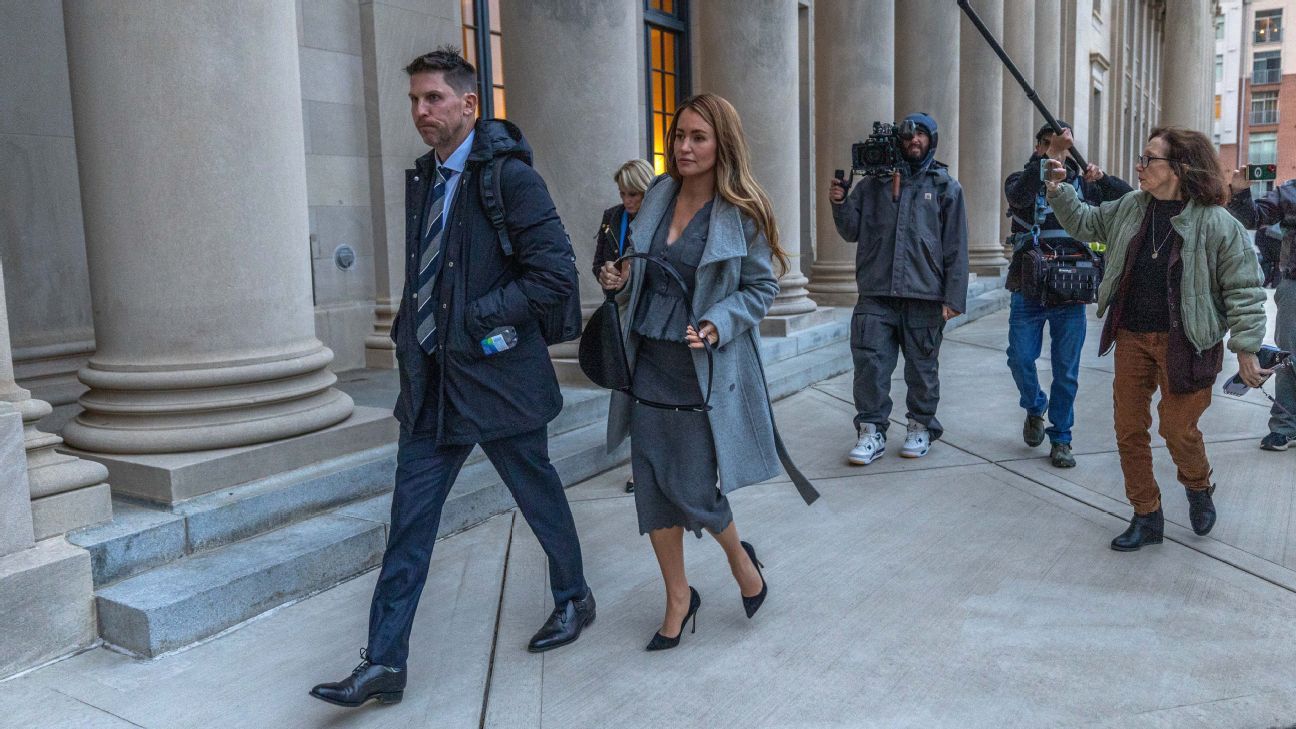
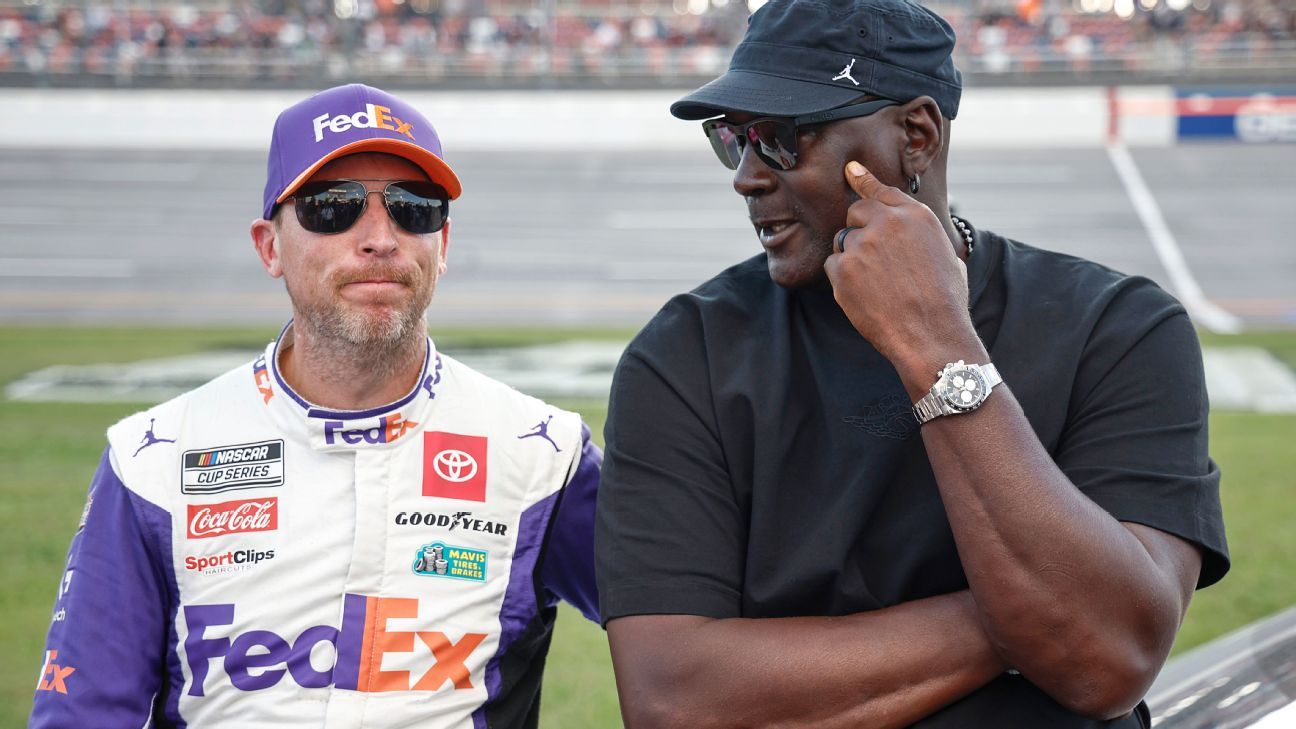
CHARLOTTE, N.C. — The landmark federal antitrust trial against NASCAR opened Monday with three-time Daytona 500 winner Denny Hamlin breaking down in tears minutes into his testimony as the first witness in a case that could upend the venerable stock car series.
Hamlin’s 23XI Racing, which he co-owns with Michael Jordan, and Front Row Motorsports claim the series is a monopolistic bully that leaves its teams no option but to comply with rules and financing they don’t agree with.
As Jordan watched from the gallery, Hamlin began to cry and had to stop and compose himself when asked how he got into racing. He disclosed to The Associated Press last month that his father is dying, and he said on the stand he was emotional because his dad “is not in great health.”
“We got to when I was about 20 and a decision had to be made, I could keep racing or go out and work for my dad’s trailer business,” Hamlin testified, adding that he later was thinking about what retirement looked like and found a team going out of business. He needed a partner and turned to Jordan, who he had developed a friendship with when the Basketball Hall of Famer owned the Charlotte Hornets and Hamlin was a season-ticket holder.
“If I can’t be successful with Michael as a partner, I knew this was never going to work,” he said.
The references to his early days in auto racing and the sacrifices his family made were intended to show how difficult it is for both team owners and drivers to make it at the top level of the sport. He said he never would have been able to start 23XI in 2021 had he not partnered with Jordan.
Because of Jordan’s presence with the team, Hamlin testified, 23XI has turned a profit in all but one of its five seasons of operation. His attorney, Jeffrey Kessler, said in his opening statement that fast-food restaurant entrepreneur Bob Jenkins has never turned a profit since starting his Front Row team in 2004, a team that won the Daytona 500 in 2021.
Kessler said a NASCAR-commissioned study found that 75% of teams lost money in 2024 and added that over a three-year period almost $400 million was paid to the France Family Trust. He said a 2023 evaluation by Goldman Sachs found NASCAR to be worth $5 billion. NASCAR is currently run by Jim France, son of founder Bill France Sr.
“What the evidence is going to show is Mr. France ran this for the benefit of his family at the expense of the teams and sport,” Kessler said.
At the heart of the lawsuit is NASCAR’s revenue sharing model, which 23XI and Front Row argue is unfair to race teams that often operate at a loss. Hamlin testified it cost $20 million to simply bring a single car to the track over a 38-race season, not including overhead expenses such as driver salary and business operations.
“So, why would these people do this if you are just going to lose money because NASCAR isn’t giving you a fair deal?” asked Kessler, “Because you love stock car racing, and there’s nowhere else to do it.”
The charter agreements signed for this year that triggered the lawsuit guarantee the teams $12.5 million in annual revenue per chartered car. NASCAR argues the guaranteed payouts are an increase from $9 million from the previous agreement, but Hamlin noted that 11 of the first 19 chartered teams are no longer in business.
All three charters 23XI purchased came from teams that ceased operations, and Hamlin said 23XI paid $4.7 million for its first charter, $13.5 million for its second and $28 million for its third, acquired late last year. He acknowledged purchasing the third charter was a risk because of the pending litigation – and the price concerned him – but it was required if 23XI intends to build itself into a top team.
The charter system guarantees a car a spot in the field each race week as well as a percentage of the purse and gives team owners an asset to sell should they want to get out of the business.
NASCAR attorneys argued that the charter system has created $1.5 billion in equity for the 36 chartered teams. Prior to the charter system, teams raced “open,” with no guarantee they’d make the field or earn a payout.
“The France family built NASCAR from nothing. They are an American success story,” Johnny Stephenson said in the opening statement for NASCAR. Stephenson is a colleague of Christopher Yates, who had previously handled most of the courtroom arguments for the defendants.
“They’ve done it through hard work over 75 years. That’s the kind of effort that doesn’t deserve a lawsuit. That’s the kind of effort that deserves admiration.”
The case has churned through hearings and arguments for more than a year despite calls from other NASCAR teams to settle. U.S. District Judge Kenneth Bell even helped mediate a failed two-day summit in October.
A NASCAR victory could put 23XI, Front Row and their six combined cars out of business. Their charters – now being held by NASCAR – would likely be sold. The last charter went for $45 million, and NASCAR has indicated there is interest from potential buyers including private equity firms.
A win for the teams could lead to monetary damages and the potential demolition of NASCAR as it is run today. The judge has the power to unravel a monopoly, and nothing is off the table, from ordering a sale of NASCAR to the dismantling of the charter system.
Jordan’s presence factors into the trial
Jordan’s presence in the courtroom gallery near Hamlin was a factor: Among those dismissed from serving on the jury was a man who said he can’t be impartial because “I like Mike” and another who said he had Michael Jordan posters on his walls growing up. A juror said they were a North Carolina fan but noted the football team at Jordan’s alma mater is not “doing too well right now” to which the star shook his head and laughed.
NASCAR executives in the courtroom included chairman Jim France and vice chair Lesa France Kennedy, two scions of the family that founded NASCAR in 1948 and still owns it.
Hamlin will resume testimony Tuesday morning. NASCAR Commissioner Steve Phelps, 23XI minority owner Curtis Polk, France Kennedy and other top executives had to leave the courtroom after opening arguments because they are all potential witnesses.
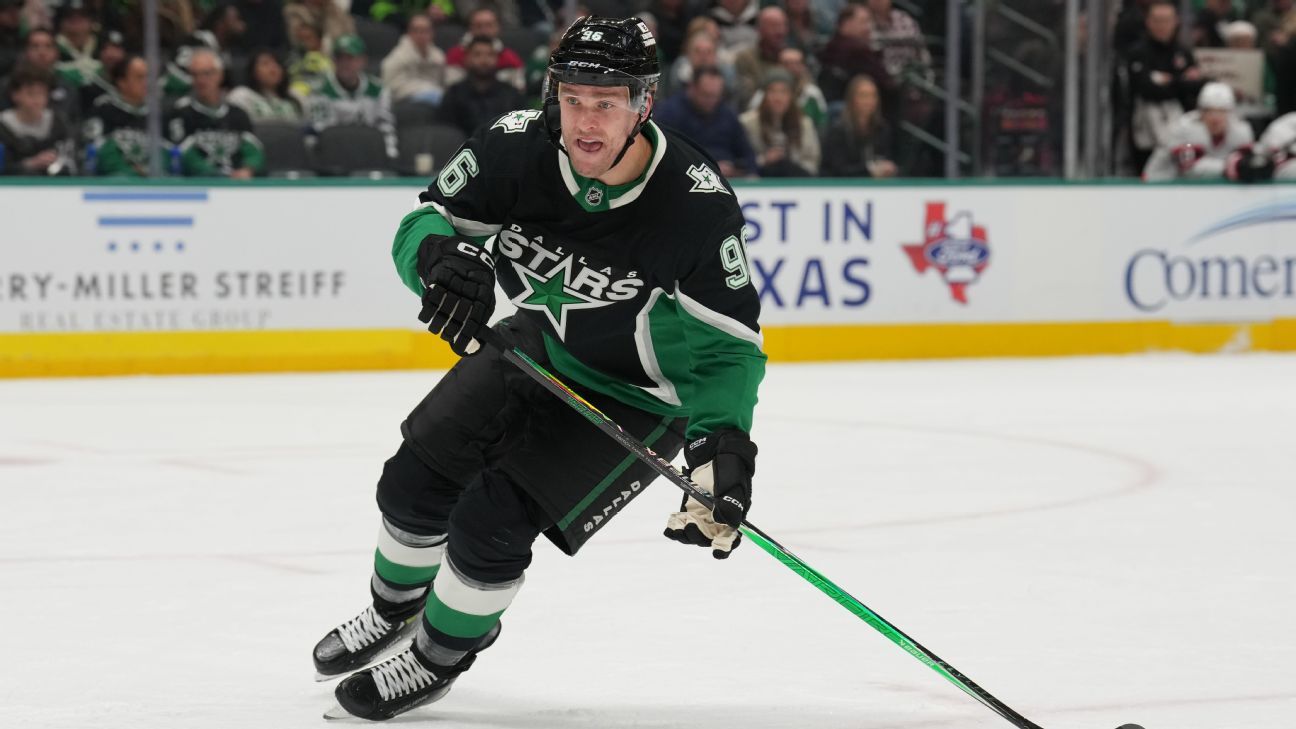

-
Greg Wyshynski
NEW YORK — After 11 seasons as one of the NHL’s leading scorers, Mikko Rantanen has become accustomed to fame.
But infamy? Not so much, although he has experienced plenty of that this season.
Rantanen recently served the first suspension of his NHL career, having earned an automatic one-game ban for two game misconducts for physical infractions.
NHL rules state that players must go 41 games between ejections to avoid suspension. Rantanen’s second ejection, for boarding Calgary Flames forward Matt Coronato, came four days after his first ejection on a play that earned Rantanen widespread derision from fans — and one very angry coach.
On Nov. 18, Rantanen skated through a check by New York Islanders defenseman Scott Mayfield and shoved defenseman Alexander Romanov in the back, sending him violently into the end boards. As a result of that play, Romanov had shoulder surgery that will put him on the shelf for five months at a minimum.
Rantanen didn’t have a hearing with the NHL Department of Player Safety for either of these misconducts, but he heard plenty from Islanders coach Patrick Roy after the Romanov hit. It was a scene that instantly went viral: Rantanen leaving the ice after his major penalty and a red-faced Roy screaming at him from the New York bench.
0:38
Mikko Rantanen ejected for nasty hit on Alex Romanov
Alex Romanov is left flat out on the ice after this shove in the back from Mikko Rantanen with under a minute left in regulation.
“Usually if something happens, if somebody gets pissed off, the media picks it up,” Rantanen told ESPN on Tuesday. “So I’m not really surprised it got so big.”
Roy, who called the hit “disrespectful,” yelled at Rantanen, appearing to say, “You’re not going to f—ing finish that game” in reference to the teams’ rematch scheduled for March 26 on Long Island.
Is Rantanen worried about what might happen in that game?
“No, no, no,” he said. “I’m just going to play there, play hard, play hockey and see what comes at me. But I’m a grown man. So I can stand up for myself.”
But the notoriety wasn’t only on the ice for Rantanen in 2025. Earlier this year, thanks to two blockbuster trades, he became one of the NHL’s most debated players.
RANTANEN WAS PLAYING for the Colorado Avalanche in a contract year. His salary demands remained high — rumored at the time to be around $14 million annually for one of the league’s most dominant scoring wingers and a player who helped Colorado win the Stanley Cup in 2022.
Avalanche GM Chris MacFarland shocked the hockey world by trading him to the Carolina Hurricanes in a blockbuster deal on Jan. 24 that saw Canes leading scorer Martin Necas sent back to the Avalanche. MacFarland called it a “business decision” involving a player who “had the unrestricted free agent card” but lamented losing “a superstar human being.”
However, Rantanen’s time with the Hurricanes was incredibly short. Carolina hoped to convince him to sign an extension — meeting his salary demands — and to put roots down in Raleigh. But after 13 games, the player the Hurricanes hoped could lead them to the Stanley Cup was traded again, this time to Dallas, in a deal involving young forward Logan Stankoven.
“My sense of it was that this just didn’t feel like home for him, as far as I can tell. And that’s OK. He’s making an eight-year commitment,” Carolina GM Eric Tulsky said at the time.
It was a dizzying, at times humbling, experience for Rantanen. He wanted to remain in Colorado. He learned quickly how much was out of his control. It was no surprise that Rantanen’s contract with Dallas spanned eight seasons (for $96 million total) and carried a full no-movement clause.
“You learn always from those tough moments, whether it’s on the ice or wherever in life,” he said. “You always learn from those moments when you’re going through tough times.”
The double-trade season and the new monster contract sparked questions around the NHL about whether Rantanen was in fact worth coveting. Was he a superstar away from the Avalanche? Was he a franchise-level player?
“There’s been a lot written about him. There’s been a lot said about him,” then-Stars coach Peter DeBoer said last postseason. “There’s been a lot of doubters out there, based on the situations he’s been in and how it’s looked at different points.”
Rantanen began answering those questions in the Stanley Cup playoffs, leading the Stars back to the conference finals for the third straight season — including a seven-game, first-round elimination of his friends from Colorado. Rantanen had 22 points in 18 playoff games, including one torrid stretch in which he had nine goals and eight assists in the span of six games.
DALLAS IS HOME NOW. Rantanen and his girlfriend, Susanna Ranta, got engaged in the offseason. No contract talk leaks. No trade chaos. To his relief, just playing the game.
“We’re settled and know where we’re going to be,” he said. “You don’t have to think about off-ice stuff as much. You can just focus on hockey. It’s been more comfortable.”
Rantanen’s comfort has been to Dallas’ benefit. Through 25 games, he has 33 points, including 10 goals. That includes 18 points on the Stars’ torrid power play, which ranked second to Pittsburgh heading into Tuesday’s game against the New York Rangers.
Winger Jason Robertson said having Rantanen for a full training camp was a key to that unit’s success. “You really didn’t have time to develop that look, that chemistry after the trade deadline last year,” he said.
At 5-on-5, Rantanen has found a fit with center Wyatt Johnston, who was tied with Robertson at 16 goals to lead the Stars. Like Nathan MacKinnon, the Avalanche star with whom Rantanen had explosive chemistry, Johnston is a right-shot center.
“Obviously last year I had a lot of success with playing with [Roope] Hintz and [Mikael] Granlund. Those are two lefties, so it’s not end of the world,” Rantanen said. “But playing a lot with Nate in the past as a righty, it’s more common for me to make plays and stuff. [Johnston] is a really good player. He can score goals. We find each other pretty well. Obviously, it takes some time. We haven’t played that long together, so we can still get better, but it’s going in a good direction.”
0:45
Mikko Rantanen capitalizes on the power play
Mikko Rantanen scores on the power play for Dallas Stars
Rantanen has played with Johnston and Dallas captain Jamie Benn recently, which is to say the Finland native is not playing with his countryman Hintz. When he was traded to the Stars last season, Rantanen joined what was colloquially known as Dallas’ “Finnish Mafia,” along with Hintz, defensemen Miro Heiskanen and Esa Lindell, and Granlund, who left for Anaheim as a free agent last summer. He played on a line with Hintz and Granlund for much of the playoffs.
There are moments when the Finns flock together. Such as at the end of a recent morning skate, when they were speaking their native tongue during a Suomi-only shooting drill. But Dallas players say Rantanen also has subverted some expectations.
“Normally, most of our Finnish guys are relatively quiet and whatever. Mikko comes in here and he’s this big, loud and happy guy. Just a different dynamic,” Robertson said. “He fit in obviously very well, and everyone welcomed him in.”
Forward Tyler Seguin knew Rantanen only as an opponent before the trade. A rather large opponent, at 6-foot-4 and around 230 pounds. Seguin said having Rantanen as a teammate offered an up-close glimpse at “how thick he is and why his nickname is what it is” referring to “Moose,” Rantanen’s moniker in Colorado.
“He’s a big boy,” Seguin said.
But Seguin also appreciates what a charismatic teammate he is, too.
“I used to know him as a skilled big forward that put up a lot of offense and points with Colorado. Getting him here as a teammate, I’ve learned what a good person he is. How much he can affect our locker room with his leadership,” Seguin explained. “Sometimes, guys come in and won’t feel comfortable talking. He does. So it’s nice.”
RANTANEN BRINGS SIZE, skill and personality to Dallas. He also brings a superstar quality to the franchise as “one of the elite power forwards in the game,” as GM Jim Nill described him last March.
Dallas coach Glen Gulutzan, hired to replace DeBoer in the offseason, coached two other elite forwards on the Edmonton Oilers‘ bench as an assistant coach: Connor McDavid and Leon Draisaitl. Gulutzan said that Rantanen is “certainly there” as far as comparable star quality.
“The most interesting thing that I’ve found coaching Mikko and then coaching Leon and Connor: The similarity is their fire. Their competitiveness. And that’s what you need, right?” Gulutzan said. “They’re very hard on themselves, just to be great every night. That’s what I really noticed. I didn’t know that as much with Mikko, but now that I’ve gotten to coach him, you just see that drive and that intensity.”
Rantanen is trying to drive the Stars into the Stanley Cup Final after three straight conference finals losses, and push Dallas to its first Cup win since 1999. He has found the right fit with a team committed to him for the long term. But he learned a lesson the hard way during last season’s chaos: Take nothing for granted.
“Last year was nothing like I’ve experienced before. Hopefully it never happens again,” he said. “But if it does, I’m ready.”
-
 Sports2 years ago
Story injured on diving stop, exits Red Sox game
-
 Sports3 years ago
‘Storybook stuff’: Inside the night Bryce Harper sent the Phillies to the World Series
-
 Sports2 years ago
Game 1 of WS least-watched in recorded history
-
 Sports3 years ago
Button battles heat exhaustion in NASCAR debut
-
 Sports3 years ago
MLB Rank 2023: Ranking baseball’s top 100 players
-
Sports4 years ago
Team Europe easily wins 4th straight Laver Cup
-
 Environment3 years ago
Japan and South Korea have a lot at stake in a free and open South China Sea
-
 Environment1 year ago
Here are the best electric bikes you can buy at every price level in October 2024