

Instacart rolls out AI tools for grocers, Sprouts will be first to use its Cart Assistant


Rivian debuted new tech at its first “Autonomy and AI Day” on Thursday in Palo Alto, California.
Credit: Rivian
Electric vehicle maker Rivian Automotive has developed a custom chip, car computer and new artificial intelligence models that will enable it to bring self-driving features to its forthcoming vehicles, the company revealed at its first “Autonomy and AI Day” on Thursday in Palo Alto, California.
Rivian also said it plans to roll out an Autonomy+ subscription with “continuously expanding capabilities” to customers in early 2026, to be powered by its Rivian Autonomy Processors and autonomy computers.
The Autonomy+ offering will be priced at $2,500 as a one-time upfront purchase or is available for $49.99 per month to start. By comparison, competitor Tesla offers its premium FSD (Supervised) option for $8,000 upfront or a $99 per month fee.
The company said in a statement that a near-future software update will include a “Universal Hands-Free,” capability, allowing Rivian customers “hands-free driving” on “over 3.5 million miles of roads in North America, covering the vast majority of marked roads in the US.”
Unlike its primary competitor, Tesla, Rivian said it intends to use lidar, or light detection and ranging, systems and radar sensors in its forthcoming cars to enable “level 4,” or fully automated driving, as defined by SAE Levels of Driving Automation.
A passenger can sleep in the back seat in a level 4 self-driving car while it carries them to their destination in normal traffic and weather conditions. Waymo, the Alphabet-owned robotaxi leader in the U.S., considers its vehicles level 4.
Rivian CEO RJ Scaringe said Thursday the company’s forthcoming self-driving vehicles enable the company to pursue robotaxis, which Tesla has promised for years but has yet to launch.
“Now, while our initial focus will be on personally, owned vehicles, which today represent a vast majority of the miles to the United States, this also enables us to pursue opportunities in the rideshare space,” Scaringe said during the event.
Rivian and Tesla stock’s since Rivian went public.
Rivian is not alone in aiming to deliver autonomous systems that meet level 4 expectations, while rolling out partially automated features along the way to drivers who generally want these to reduce fatigue on long drives or make them safer behind the wheel overall.
Tesla and General Motors are working on their own proprietary driverless systems, while Honda, Lucid and Nissan have partnered with venture-backed autonomous vehicle tech startups (Helm.AI, Nuro and Wayve respectively) to develop similar systems with a range of different technical approaches.
Powering Rivian’s self-driving aspirations will be a new in-house chip developed by the company, which is set to launch in 2026. Vidya Rajagopalan, Rivian vice president of electrical hardware, said the chip uses “multi-chip module” packaging and has “high memory bandwidth,” which is “key for AI applications.” Rivian’s chip boasts bandwidth of 205 gigabytes per second.
Rivian is under pressure to prove its future growth potential to investors and to grow its customer base amid slowing sales of battery electric vehicles in the U.S. and competition from Chinese EV makers internationally.
The fully electric vehicle segment has experienced a sales slump domestically after the Trump administration put an early end in September to a $7,500 federal tax credit previously available for EV buyers in the U.S.
Shares of Rivian are up about 25% this year, but remain off more than 80% since the company’s 2021 initial public offering amid internal and external challenges.


A Broadcom sign is pictured as the company prepares to launch new optical chip tech to fend off Nvidia in San Jose, California, U.S., September 5, 2025.
Brittany Hosea-small | Reuters
Broadcom is scheduled to report its fourth-quarter earnings after market close on Thursday.
Here’s what analysts are expecting, according to LSEG:
- Earnings per share: $1.86, adjusted
- Revenue: $17.49 billion
Wall Street is expecting Broadcom’s overall revenue to increase 25% in the quarter ended in October, from $14.05 billion a year earlier.
Analysts are expecting the chipmaker to guide for $1.95 in adjusted earnings per share on $18.27 billion in sales in the current quarter.
The report comes as investors increasingly see Broadcom as well-placed to capitalize on the AI infrastructure boom both with its custom chips, which it calls XPUs, and the networking technology needed to build massive data centers where thousands of AI chips work as one.
Broadcom stock is at all-time highs and has climbed 75% so far in 2025 as its custom chips, such as Google’s tensor processing units, are increasingly seen as a rival to Nvidia’s AI chips. The company has a market cap of $1.91 trillion.
Google released its latest AI model, Gemini 3, during the quarter, which it said was trained entirely on its TPU chips.
Another Broadcom AI customer is OpenAI. The AI startup said in October that it will start deploying custom chips for AI developed with Broadcom starting next year.
Broadcom CEO Hock Tan is expected to discuss the company’s pipeline of AI chips and partners with investors on Thursday.
“We expect investors to focus on FY26 AI revenue guidance, Google and OpenAI revenue contributions, and gross margin trajectory given the steep ramp of custom XPUs,” Goldman Sachs analyst James Schneider wrote in a note last month. He has the equivalent of a buy rating on the stock.
WATCH: Broadcom-OpenAI deal expected to be cheaper than current GPU options
Technology
Disney’s OpenAI stake is ‘a way in’ to AI and Sora will help reach younger audience, Iger tells CNBC

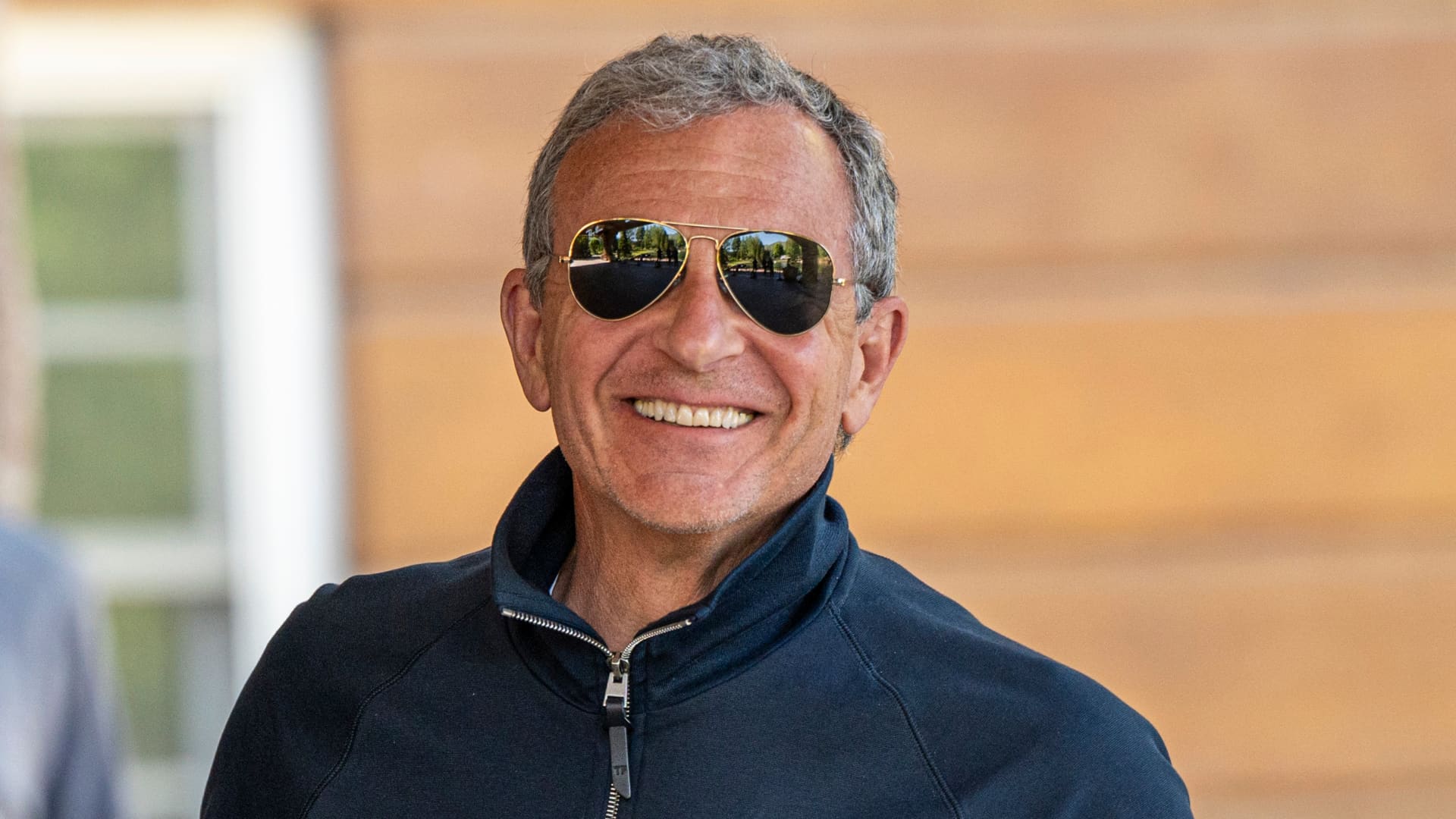

The Walt Disney Company’s $1 billion equity investment in OpenAI will serve as “a way in” to artificial intelligence, which will have a significant long-term impact on Disney’s business, Disney CEO Bob Iger told CNBC’s “Squawk on the Street” on Thursday.
“We want to participate in what Sam is creating, what his team is creating,” Iger said. “We think this is a good investment for the company.”
Disney announced its investment in OpenAI as part of an agreement on Thursday that will allow users to make AI videos with its copyrighted characters on the startup’s app called Sora.
More than 200 characters, including Mickey Mouse, Darth Vader and Cinderella, will be available on the platform through a three-year licensing agreement, which Iger said would be exclusive to OpenAI at the beginning of the term.
As new AI products have exploded into the mainstream, several media companies, including Disney, have taken legal action in an effort to safeguard their intellectual property.
Iger said Disney has been “aggressive” at protecting its IP, but he has been “extremely impressed” with OpenAI’s growth as well as their willingness to license content.
“No human generation has ever stood in the way of technological advance, and we don’t intend to try,” Iger said. “We’ve always felt that if it’s going to happen, including disruption of our current business models, then we should get on board.”
Shares of Disney are up more than 1% on Thursday.
Barton Crockett, a senior internet media research analyst, told CNBC that Disney’s investment is “a great endorsement for OpenAI.”
He said it’s important for companies like Disney to understand the importance of user-generated and AI-generated content.
“I think it’s crucial for a content-creation company, like Disney, to get ahead of that,” he said.
OpenAI launched Sora in September, and the short-form video app allows people to generate content by simply typing in a prompt.
The app quickly rose to the top of Apple’s App Store, but as users flooded the platform with videos of popular brands and characters, large media players began to raise concerns around safety and copyright infringement.
Iger said Disney’s deal with OpenAI “does not in any way represent a threat to creators at all,” in part because characters’ voices as well as talent names and likenesses are not included.
“In fact, the opposite,” Iger said. “I think it honors them and respects them, in part because there’s a license fee associated with it.”
OpenAI CEO Sam Altman said there will be guardrails in place around how Disney’s characters will be used on Sora.
“It’s very important that we enable Disney to set and evolve those guardrails over time, but they will of course be in there,” Altman told CNBC on Thursday.
WATCH: Watch CNBC’s full interview with Disney CEO Bob Iger and OpenAI CEO Sam Altman
-
 Sports2 years ago
Story injured on diving stop, exits Red Sox game
-
 Sports3 years ago
‘Storybook stuff’: Inside the night Bryce Harper sent the Phillies to the World Series
-
 Sports2 years ago
Game 1 of WS least-watched in recorded history
-
 Sports3 years ago
Button battles heat exhaustion in NASCAR debut
-
 Sports3 years ago
MLB Rank 2023: Ranking baseball’s top 100 players
-
Sports4 years ago
Team Europe easily wins 4th straight Laver Cup
-
 Environment3 years ago
Japan and South Korea have a lot at stake in a free and open South China Sea
-
 Environment1 year ago
Here are the best electric bikes you can buy at every price level in October 2024