
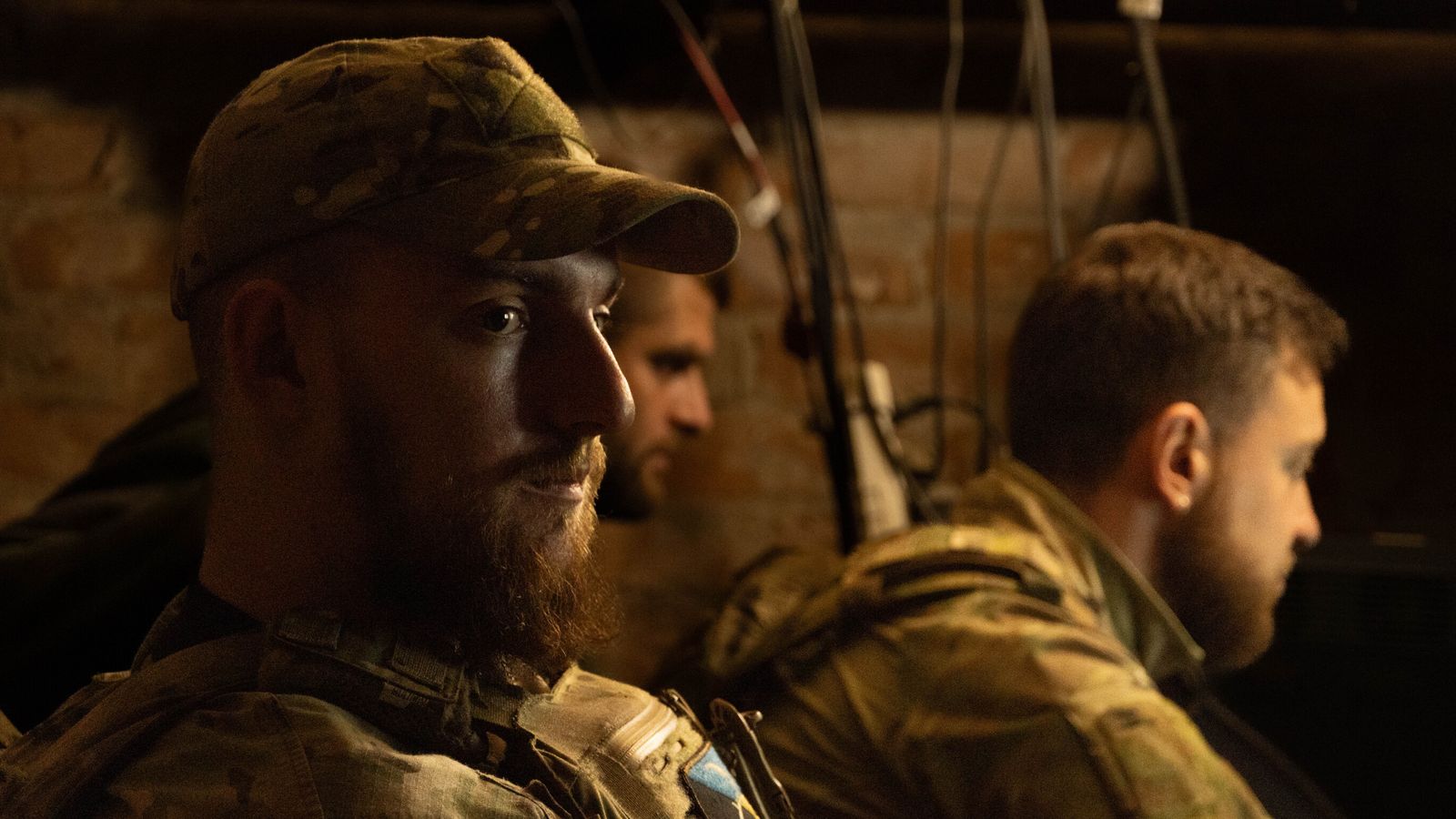
Meet the underground squad with the lives of countless civilians in their hands

“Follow me and be careful,” says the commander, as he leads us down a narrow path in the dead of night.
The overgrown tract had once been occupied by the Russians, and there are landmines scattered on the side of the path.
But the men with us are more concerned about the threat from above.
Members of a unit in Ukraine’s 3rd Assault Brigade, they run a covert operation from an underground cellar, tucked behind a ruined farmhouse.
And what they are doing in this old vegetable store is pushing the boundaries of war.
“This is the interceptor called Sting,” says the commander, named Betsik, holding up a cylindrical device with four propellers.
“It’s an FPV [first-person view] quad, it’s very fast, it can go up to 280km. There’s 600 grams of explosive packed in the cap.”
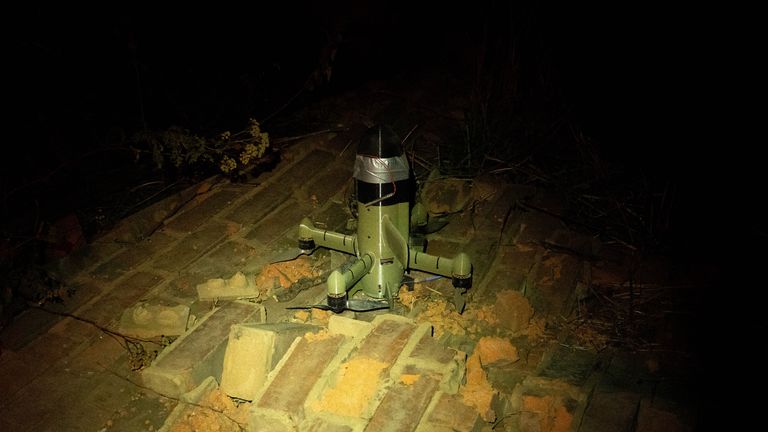
The Sting interceptor drone used by the Ukrainians
However, he had not told us the most important thing about this bulbous drone.
“It can easily destroy a Shahed,” he says with determination.
Devastating and indiscriminate drone attacks
Once viewed as a low-cost curiosity, the Iranian-designed Shahed drone has turned into a collective menace.
As Russia’s principal long-range attack weapon, enemy forces have fired 44,228 Shaheds into Ukraine this year, with production expected to rise to 6,000 per month by early next year.
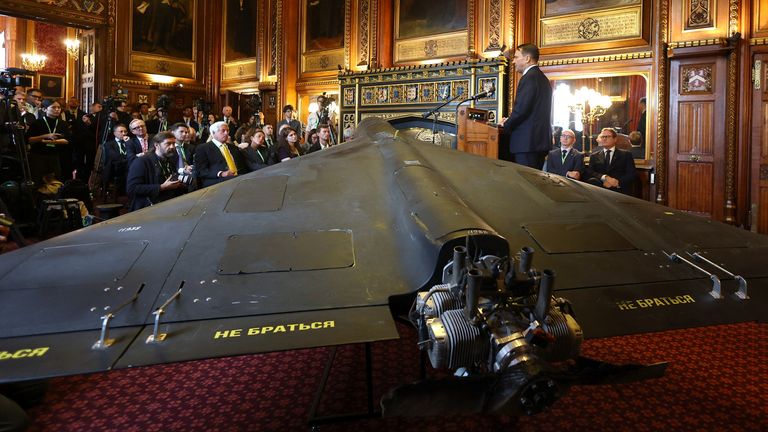
A Shahed-136 drone used by Russia amid its attack on Ukraine, on display in London. Pic: Reuters
The Russians are also changing the way they use them, launching vast, coordinated waves at individual cities.
The damage can be devastating and indiscriminate. This year, more 460 civilians have been killed by these so-called kamikaze weapons.
Russia’s strategy is straightforward. By firing hundreds of Shaheds on a single night, they aim to overload Ukraine’s air defences.
It is something Betsik reluctantly accepts.
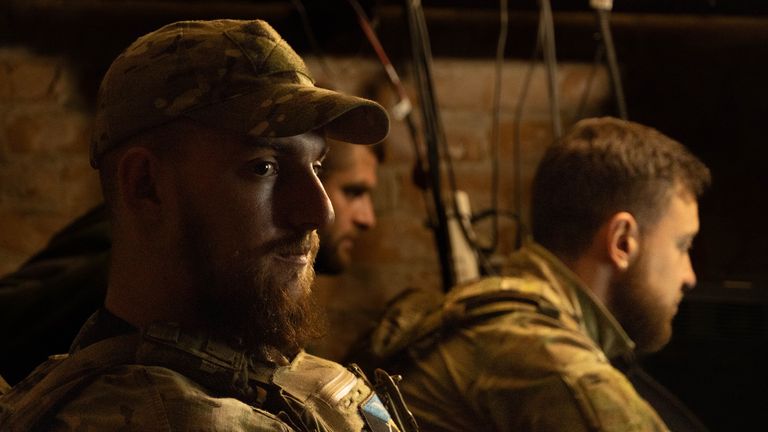
Betsik observes the work of the team on in the cellar
Still, his unit has come up with a groundbreaking way to tackle it.
Perched in the centre of the vegetable store, we watch a youthful drone pilot and a couple of navigators staring at a bank of screens.
“Guys, there’s a Shahed 10km away from us. Can we fly there?” asks one of the navigators, called Kombucha.
He had just spotted a Shahed on the radar, but the enemy projectile was just out of reach.
“Well, actually 18 km – it’s too far,” Kombucha says.
“Do you know where it is going?” I ask.
“Yes, Izyum, the city. Flying over Izyum, I hope it won’t hit the city itself.”
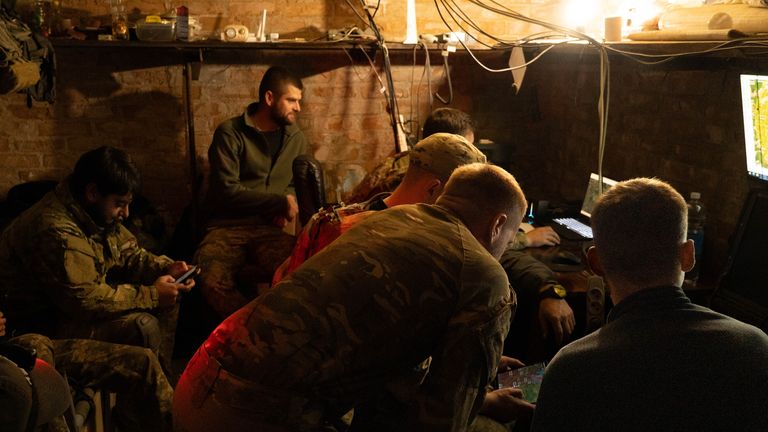
Kombucha takes a deep breath.
“It is driving me nuts when you can see it moving, but you can’t do anything about it.”
The chase
The atmosphere soon changes.
“Let’s go. Help me lift the antenna.”
An engineer runs an interceptor drone up to the unit’s ad-hoc launch pad, located on a pile of flattened brick.
“The bomb is armed.”
The drone pilot, called Ptaha, tightens his grip on the controller and launches the Sting into the night sky.
Now, they hunt the Shahed down.
Their radar screen gives them an idea of where to look – but not a precise location.
“Target dropped altitude.”
“How much?”
“360 metres. You’re at 700.”
Instead, they analyse images produced by the interceptor’s thermal camera. The heat from the Shahed’s engine should generate a white spec, or dot, on the horizon. Still, it is never easy to find.
“Zoom out. Zoom out,” mutters Ptaha.
Then, a navigator code-named Magic thrusts his arm at the right-hand corner of the screen.
“There, there, there, b****!”
“I see it,” replies Ptaha.
The pilot manoeuvres the interceptor behind the Russian drone and works to decrease the distance between the two.
The chase is on. We watch as he steers the interceptor into the back of Shahed.
“We hit it,” he shouts.
“Did you detonate?”
“That was a Shahed, that was a Shahed, not a Gerbera.”
Going in for the kill
The Russians have developed a family of drones based on the Shahed, including a decoy called the Gerbera, which is designed to overwhelm Ukrainian defences.
However, the 3rd Brigade tells us these Gerberas are now routinely packed with explosives.
“I can see you’ve developed a particular technique to take them all down,” I suggest to Ptaha. “You circle around and try to catch them from behind?”
“Yes, because if you fly towards it head-on, due to the fact that the speed of the Shahed…”
The pilot breaks off.
“Guys, target 204 here.”
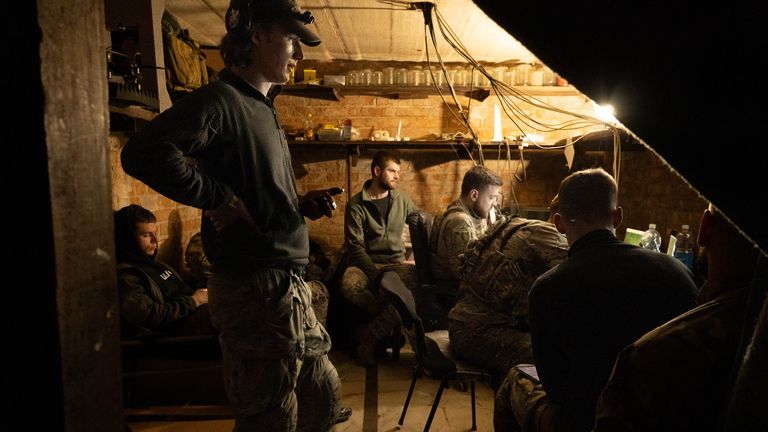
It’s clear that a major Russian bombardment is under way.
“About five to six km,” shouts Magic.
With another target to chase, the unit fires an interceptor into the sky.
Ptaha stares at the interceptor’s thermal camera screen.
The lives of countless Ukrainians depend on this 21-year-old.
“There, I see it. I see it. I see it.”
The team pursues their target before Ptaha goes in for the kill.
“There’s going to be a boom!” says Magic excitedly.
“Closing in.”
On the monitor, the live feed from the drone is replaced by a sea of fuzzy grey.
“Hit confirmed.”
“Motherf*****!”
‘In a few months it will be possible to destroy most of them’
The Russians would launch more than 500 drones that night.
Betsik and his men destroyed five with their Sting interceptors and the commander seemed thrilled with the result.
“I’d rate it five out of five. Nice. Five launches, five targets destroyed. One hundred percent efficiency. I like that.”
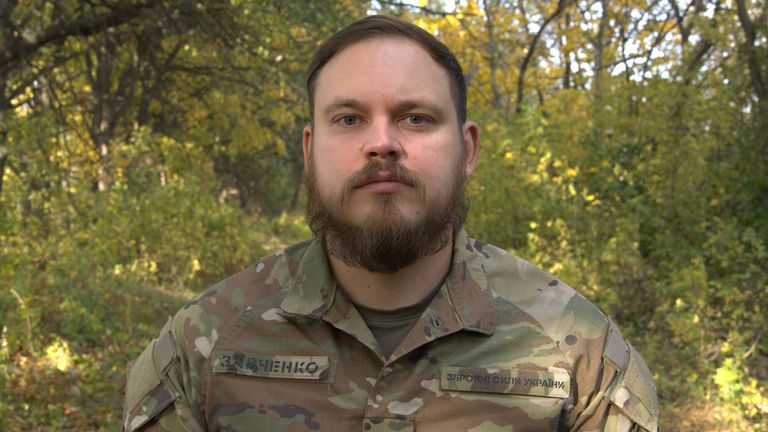
Maxim Zaychenko
Nevertheless, 71 long-range projectiles managed to slip through Ukraine’s air defences, despite efforts made to stop them.
The head of the air defence section in 3rd Brigade, Maxim Zaychenko, told us lessons were being learnt in this underground cellar that would have to be shared with the entire Ukrainian army.
“As the number of Shaheds has increased we’ve set ourselves the task of forming combat crews and acquiring the capabilities to intercept them… it’s a question of scaling combat crews with the right personnel and equipment along the whole contact line.”
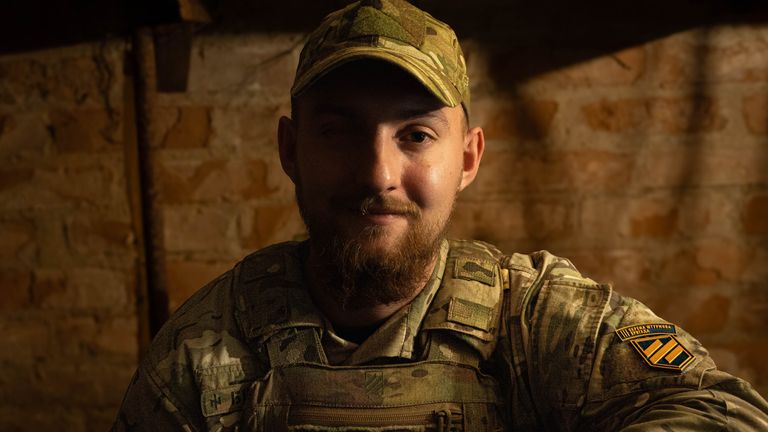
Betsik speaks to Sky News
Buoyed by the night’s successes, Betsik was optimistic.
“In a few months, like three to five, it will be possible to destroy most of them,” he said.
“You really think that?” I replied.
“This is the future, I am not dreaming about it, I know it will be.”
Photography by Katy Scholes.
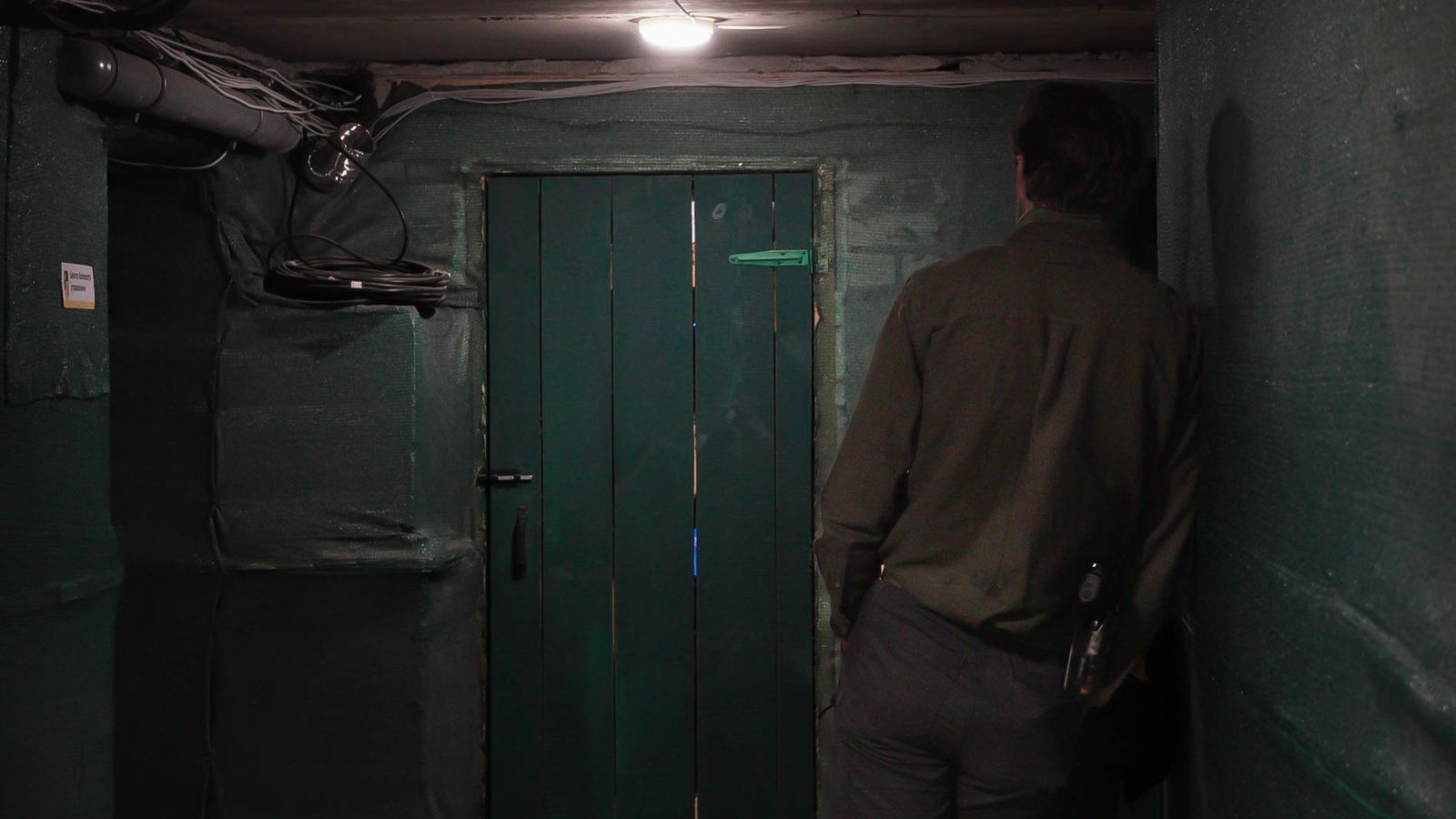

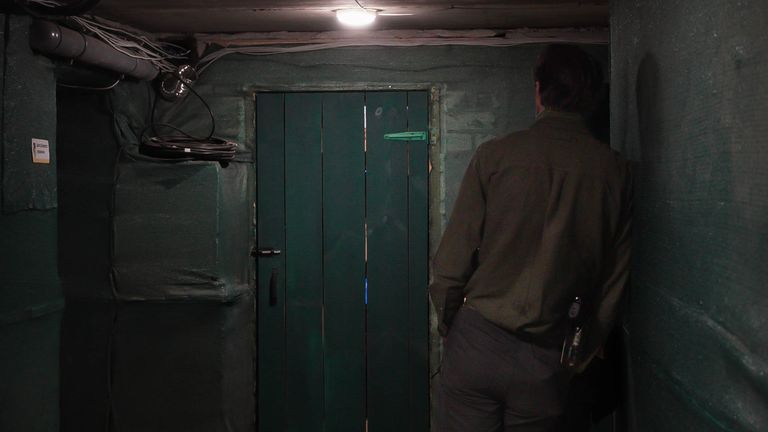
A hidden, underground military base in eastern Ukraine is so secret, soldiers change into civilian clothes whenever they step outside to avoid drawing attention.
Journalists are not usually allowed access.
But the unit that has been using this vast, subterranean warren of war rooms, a dormitory, kitchen, canteen and makeshift gym as its headquarters since the summer is imminently relocating, so Sky News was invited inside.
Lieutenant Colonel Arsen Dimitric – call sign Lemko – is the chief of staff of 1st Corps Azov of the National Guard of Ukraine, one of the country’s most effective combat forces.
Lemko
He sat with us in the base, next to a large square table, covered by a map of the Donbas region.
His soldiers have been fighting in this area since the summer, countering a surge in Russian attacks in and around the frontline city of Pokrovsk.
“We aim to destroy as much of the enemy as possible,” he said.
“Will we take losses? Yes. Will it hurt? Absolutely.”
But he said if Russia is allowed to advance, even more Ukrainians will suffer.
“Their [the Russians’] only advantage is numbers,” he said.
“They don’t care how many people they lose.”
Lemko said almost 17,000 Russian soldiers had been killed or wounded fighting in this section of the warzone alone between August to November.
Read more:
Russia hits Ukraine with massive missile and drone attack

Ukrainian video footage of the battlefield showed Russian armoured vehicles being taken out by drones and artillery fire.
At one point, Russian soldiers mounted on motorbikes try to advance, only to be stopped by Ukrainian fire.
“Our task is to hit them as hard as possible in various areas,” Lemko said. “We focus on our operations, others on theirs, and leadership will negotiate the best possible terms.”
The Azov Corps soldiers are fighting over land that should be handed over to Russia, according to an initial draft of a peace deal proposal between Kyiv and Moscow put forward by the United States. This is despite swathes of the Donbas remaining under Ukrainian control.
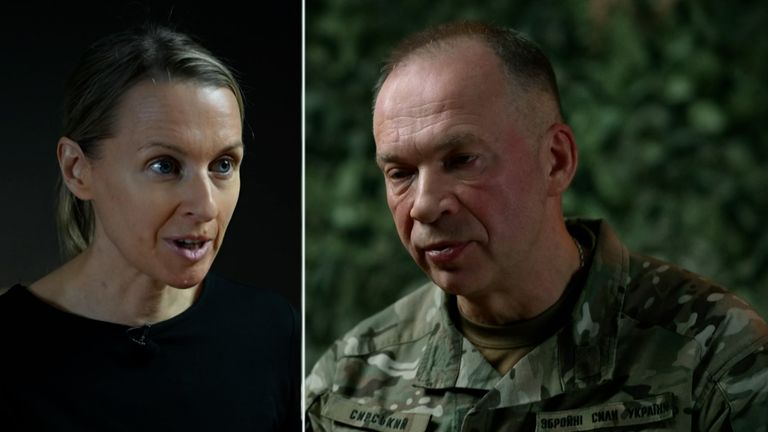
But General Oleksandr Syrskyi, the head of the Ukrainian armed forces, has since told Sky News that simply surrendering territory would be “unacceptable”.
Giving up territory ‘unacceptable’, Ukraine’s military chief says
For Lemko, he says the job of his troops is to inflict as much damage as possible on the Russian side to help strengthen Ukraine’s hand in negotiations.
“Simply giving it [land] away isn’t the way,” he said.
“Diplomats do their work, we do ours. Our job as soldiers is to give as many advantages as possible to our negotiating team. And we’re doing exactly that.”
Lemko, who has been battling against Russia since the Crimean annexation in 2014, also had a warning for the rest of Europe about a rise in hybrid attacks, such as mysterious drone sightings, acts of sabotage and cyber hacks suspected of being linked to Moscow.
He said Ukraine’s experience showed that if attacks by Russia that fall under the threshold of conventional war are not successfully countered, full-scale conflict could follow.
“Ukraine once lost a hybrid war that had been waged since the very start of our independence,” he said.
“Because of that defeat, there was a physical operation against us in Crimea and then a physical operation in 2022.
“Now the hybrid war has reached its climax, and it is moving into the Baltic States and Europe.
“That is why, in my opinion – and in the opinion of most of our officers – now is the moment for all countries to unite and counter this hybrid war. Because the consequence may be a physical one.”
Production: Katy Scholes, security and defence producer, and Azad Safarov, Ukraine producer.
Camera operator: Mostyn Pryce
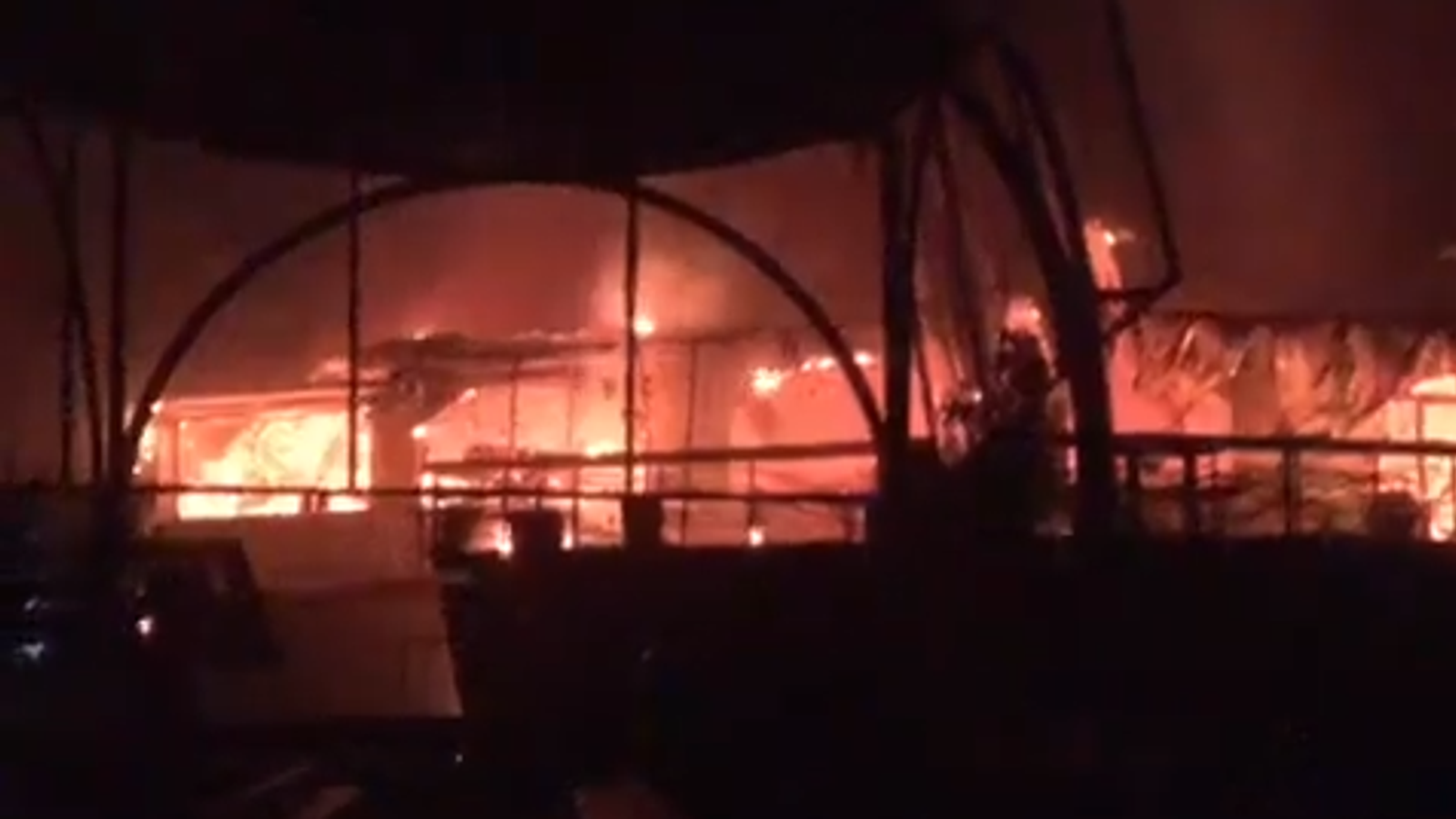

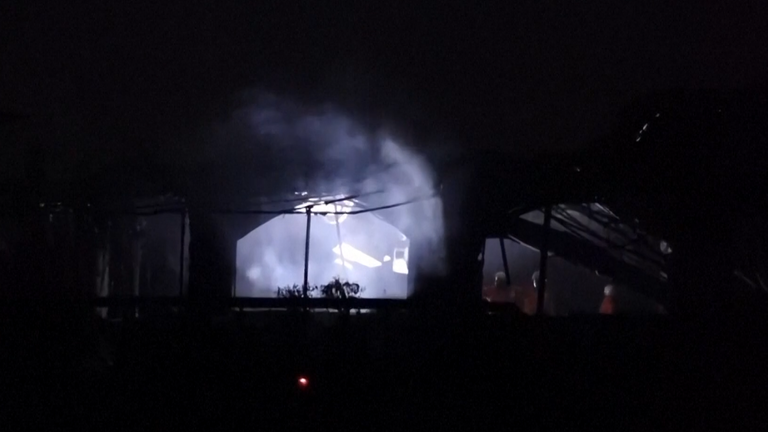
At least 25 people have been killed after a fire at a nightclub in Goa, the state’s police service has said.
The fire reportedly started around midnight on Saturday local time.
The majority of victims were kitchen staff at the club – although around three to four tourists are thought to be among those killed.
Videos on social media showed emergency services lining up to help the injured – some of whom were taken to nearby hospitals.
Dr Pramod Sawant, Goa’s chief minister, said: “I am deeply grieved and offer my heartfelt condolences to all the bereaved families in this hour of unimaginable loss.”
He later said he was “closely reviewing the situation arising from the tragic fire” – adding six additional people had been injured.
“All six injured persons are in a stable condition and are receiving the best medical care,” he said.
Pic: NDTV
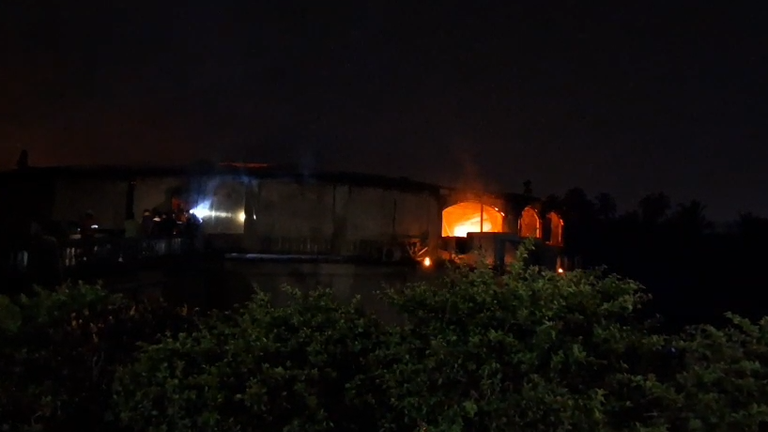
Fire at nightclub in Goa. Pic: NDTV
Authorities worked through the night to bring the situation under control and all bodies have been recovered, the state’s police chief told reporters, according to Reuters news agency.
India’s Prime Minister Narendra Modi said the deadly fire was “deeply saddening”.
He said he had spoken with Goa’s chief minister and that “the state government is providing all possible assistance to those affected”.
Dr Sawant said he has “ordered an inquiry” to discover what happened after visiting the site.
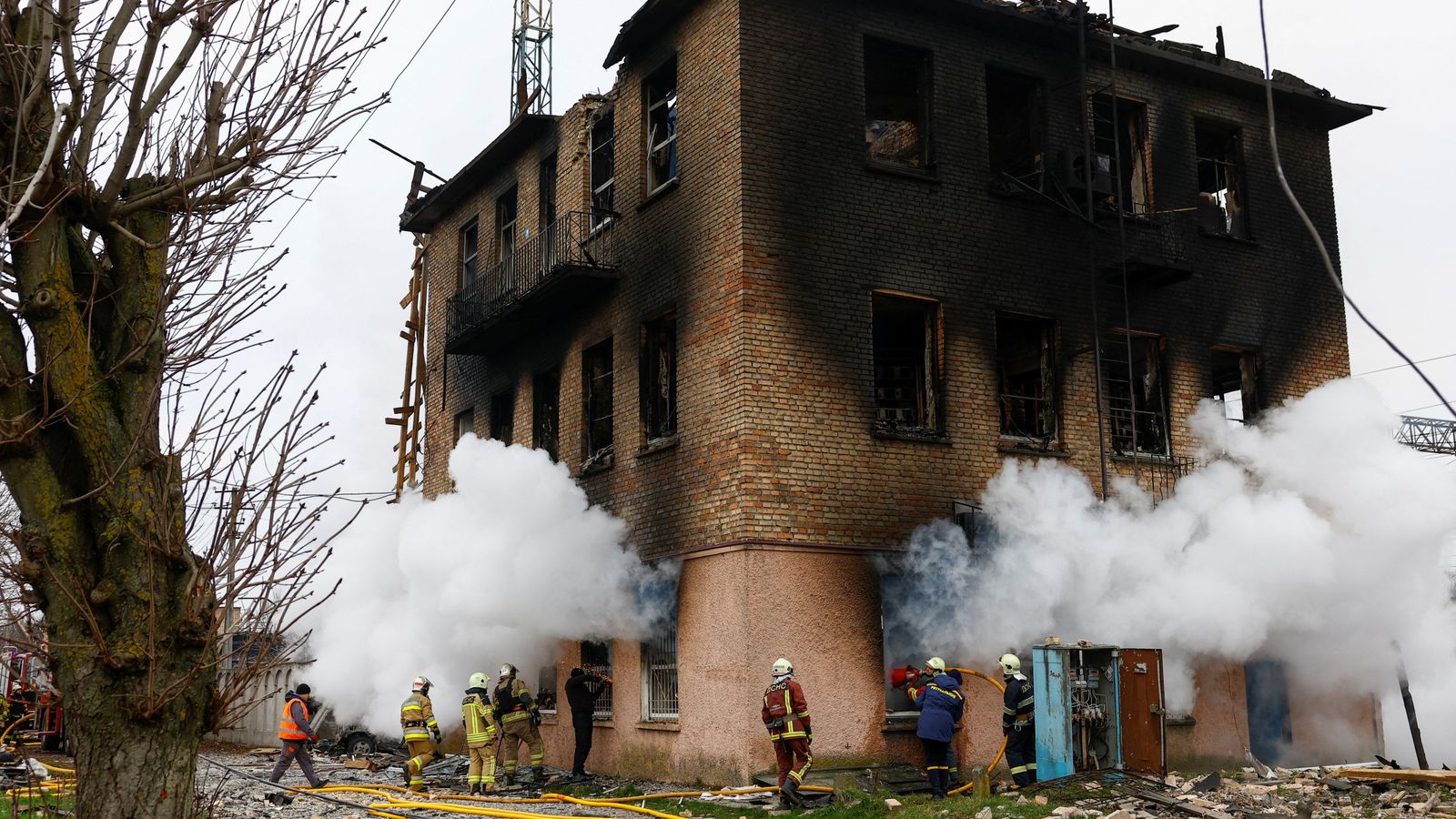
Pic: AP
“The inquiry will examine the exact cause of the fire and whether fire safety norms and building rules were followed,” he said.
“Those found responsible will face most stringent action under the law – any negligence will be dealt with firmly.”
Goa, a small state on India’s western coast, is a popular tourist destination, attracting millions of tourists every year.
Russia launched a massive missile and drone attack on Ukraine overnight, after US and Ukrainian officials said they would meet for a third day of talks aimed at bringing the war to an end.
The two sides said they had made progress on a security framework for post-war Ukraine, but that any “real progress toward any agreement” will depend “on Russia’s readiness to show serious commitment to long-term peace.”
Russia launched 653 drones and 51 missiles in its attack on Ukraine, triggering air raid alerts across the country, Ukraine’s air force said.
Giving up territory ‘unacceptable’ – Ukraine’s military chief
Ukrainian forces shot down and neutralised 585 drones and 30 missiles, the air force said, adding that 29 locations were struck.
At least eight people were wounded in the attacks, Ukraine’s minister of internal affairs Ihor Klymenko said.
Russia conducted a “massive missile-drone attack” on power stations and other energy infrastructure in several regions, Ukraine’s national energy operator Ukrenergo said on Instagram.
Ukraine’s Zaporizhzhia nuclear power plant temporarily lost all off-site power overnight, the International Atomic Energy Agency said.
The plant is in an area that has been under Russian control since early in Moscow’s invasion of Ukraine. It is not in service, but needs reliable power to cool its six shutdown reactors and spent fuel in order to avoid any catastrophic nuclear incidents.
Read more from Sky News:
Young Germans fear return to conscription
Giving up territory would be ‘unjust’, says Kyiv armed forces chief

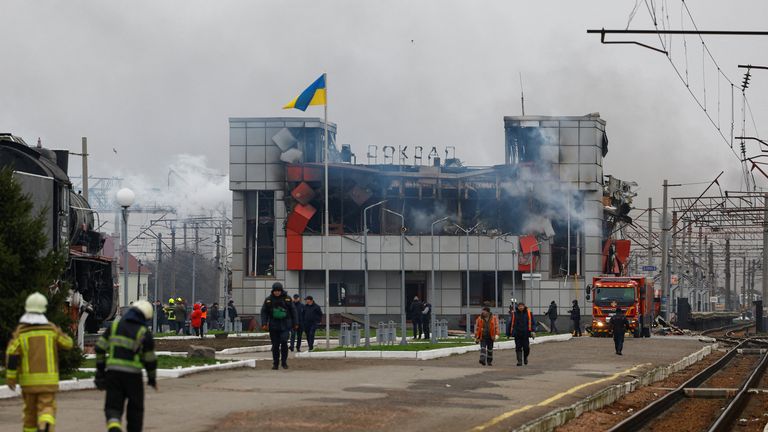
Russia struke a train station in the city of Fastiv. Pics: Reuters
Zelenskyy condemns ‘meaningless’ strikes
Ukrainian President Volodymyr Zelenskyy condemned the strikes as “meaningless” from a military point of view.
He said energy facilities were the main targets, but a drone strike had “burned down” a train station in the city of Fastiv, in the Kyiv region.
“The Russians’ goal is to hurt millions of Ukrainians, and they have sunk so low that they are launching missiles at peaceful cities on St. Nicholas Day,” he said.
“That is why additional pressure is needed. Sanctions must work, and so must our air defence, which means we must continue to support those who defend our lives.”
Ukraine strikes oil refinery
Meanwhile, Russia’s defence ministry said its air defences had shot down 116 Ukrainian drones over Russian territory overnight.
The General Staff of the Ukrainian Armed Forces said Ukrainian forces had struck Russia’s Ryazan Oil Refinery, while Russian Telegram news channel Astra shared footage appearing to show a fire breaking out and plumes of smoke rising above the refinery.
Over the last few months, Ukraine has used long-range drones to target Russian refineries in an attempt to deprive Moscow of the oil export revenue it needs to continue the war.
Meanwhile, Kyiv and its Western allies say Russia is trying to cripple Ukraine’s power grid and deny civilians access to heat, light and running water in winter, which Ukrainian officials call “weaponising” the cold.
On Monday, Mr Zelenskyy will meet Sir Keir Starmer in London to discuss the ongoing negotiations mediated by the US, along with French President Emmanuel Macron and German Chancellor Friedrich Merz.
-
 Sports2 years ago
Story injured on diving stop, exits Red Sox game
-
 Sports3 years ago
‘Storybook stuff’: Inside the night Bryce Harper sent the Phillies to the World Series
-
 Sports2 years ago
Game 1 of WS least-watched in recorded history
-
 Sports3 years ago
Button battles heat exhaustion in NASCAR debut
-
 Sports3 years ago
MLB Rank 2023: Ranking baseball’s top 100 players
-
Sports4 years ago
Team Europe easily wins 4th straight Laver Cup
-
 Environment3 years ago
Japan and South Korea have a lot at stake in a free and open South China Sea
-
 Environment1 year ago
Here are the best electric bikes you can buy at every price level in October 2024