
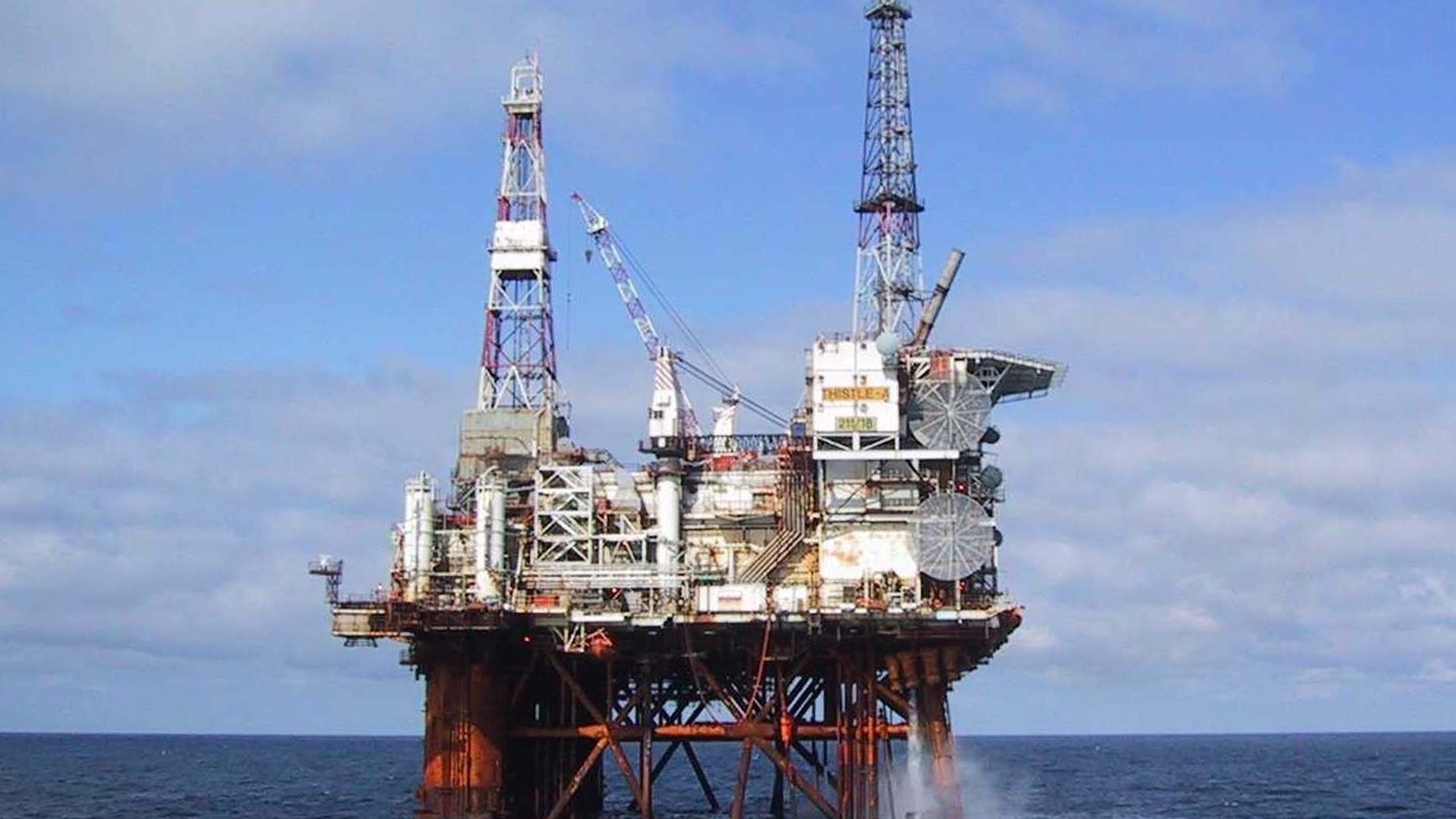
UK must increase North Sea drilling to boost economy, says US ambassador

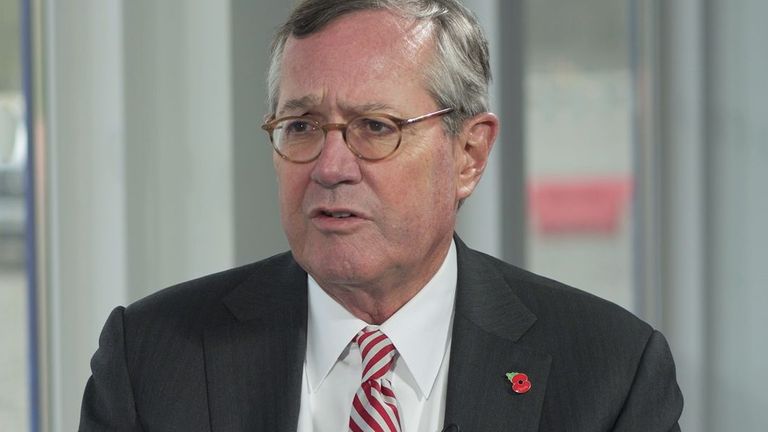
The US ambassador to the UK has said Britain should carry out “more drilling and more production” in the North Sea.
In his first broadcast interview in the job, Warren Stephens urged the UK to make the most of its own oil and gas reserves to cut energy costs and boost the economy.
“Electricity costs are four times ours in the UK, versus the US,” he told Mornings with Ridge and Frost.
“I want the UK economy to be as strong as it possibly can be, so the UK can be the best ally to the US that it possibly can be.
“Having a growing economy is essential to that – and the electricity costs make it very difficult.”
Mr Stephens told Wilfred Frost he hoped Britain would “examine the policies in the North Sea and frankly, make some changes to it that allows for more drilling and more production”.
“You’re using oil and gas, but you’re importing it. Why not use your own?” he asked.
Mr Stephens said Britain should make more of its own oil and gas
The ambassador said he had held meetings with Sir Keir Starmer on the energy issue while US President Donald Trump was in the room, and that the prime minister was “absolutely” listening to the US view.
“I think there are members of the government that are listening,” Mr Stephens told Sky News. “There is a little bit of movement to make changes on the policy and I’ll hope that will continue.”
Energy Secretary Ed Miliband has said the UK should be prioritising net zero by 2030 to limit climate change, rather than issuing new oil and gas drilling licences.
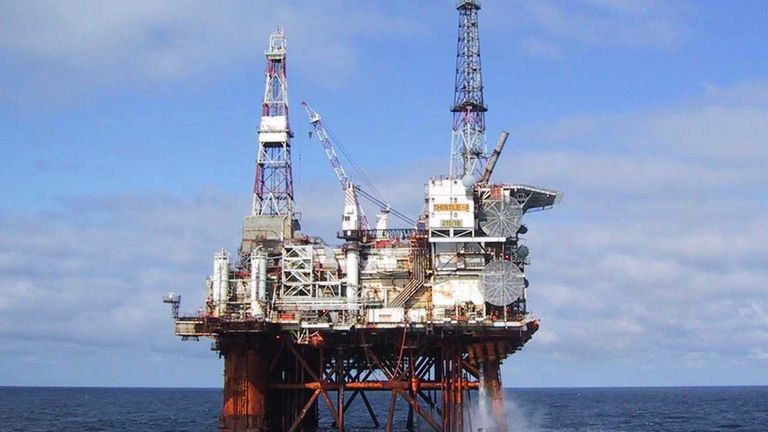
The Thistle Alpha platform, north of Shetland, stopped production in 2020 . Pic: Reuters/Petrofac
However, the ambassador said it would take “all energy for all countries to compete” in the future, given the huge power demands of data centres and AI.
“I don’t think Ed Miliband is necessarily wrong,” said Mr Stephens. “But I think it’s an incorrect policy to ignore your fossil fuel reserves, both in the North Sea and onshore.”
The ambassador hosted Mr Trump on the first night of his second UK state visit in September – a trip that was seen as a success by both sides.
Mr Stephens said Mr Trump and Sir Keir had a “great relationship” and pointed to the historic ties between Britain and the US as a major factor in June’s trade deal and the favourable tariff rate on the UK.
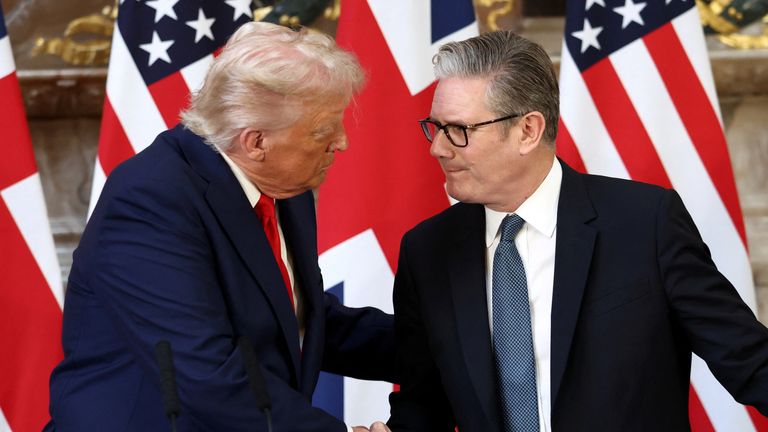
The ambassador said Sir Keir and President Trump have a ‘great relationship’
“The president really loves this country,” the ambassador told Sky News.
“I don’t think it’s coincidental that the tariff rates on the UK are generally a third, or at worst half, of what a lot of other countries are facing.
“I think the prime minister and his team did a great job of positioning the United Kingdom to be the first trade deal, but also the best one that’s been struck.”
Mr Stephens – who began his job in London in May – also touched on the Ukraine war and said Mr Trump’s patience with Russia was “wearing thin”.
The Alaska summit between Mr Trump and Vladimir Putin failed to produce a breakthrough, and the US leader has admitted the Russian president may be “playing” him so he can continue the fighting.
Read more from Sky News:
Trump accused of ‘new low point’ with refugee order
Trump’s opinion of Xi meeting brushes over thornier issues
The ambassador told Sky News he had always favoured a tough stance on Russia and was “delighted” when Mr Trump sanctioned Russia’s two biggest oil firms a few weeks ago.
However, he emphasised the president’s call that other countries must stop buying Russian energy to really tighten the screw.
“The president, has been, I would say, careful in ramping up pressure on Russia. But I think his patience is wearing out,” said Mr Stephens.
“One of the problems is a lot of European countries still depend on Russian gas,” he added.
“We’re mindful of that. We understand that, but until we can really cut off their ability to sell oil and gas around the world, they’re going to have money and Putin seems intent on continuing the war.”
The ambassador also struck a cautious but hopeful tone on future US and UK relations with China.
It comes after Mr Trump said his meeting this week with President Xi Jinping was a “12/10”, raising hopes the trade war between the superpowers could be simmering down.
China’s huge economy is too big to ignore – but it remains a major spy threat; the head of MI5 warned last month of an increase in “state threat activity” from Beijing (as well as Russia and Iran).
Mr Stephens praised the country’s economy and said it would be “terrific” if China could one day be considered a partner.

Trump-Xi meeting: Three key takeaways
But he warned “impatient” China is ruthlessly focused on itself only, and would like to see the US and the West weakened.
“There’s certainly things we want to be able to do with China,” added the ambassador.
“And I know the UK wants to do things with China. The United States does, too – and we should. But I think we always need to keep in the back of our mind that China does not have our interests at heart.”
:: Watch Mornings with Ridge and Frost on weekdays Monday to Thursday, from 7am to 10am on Sky News
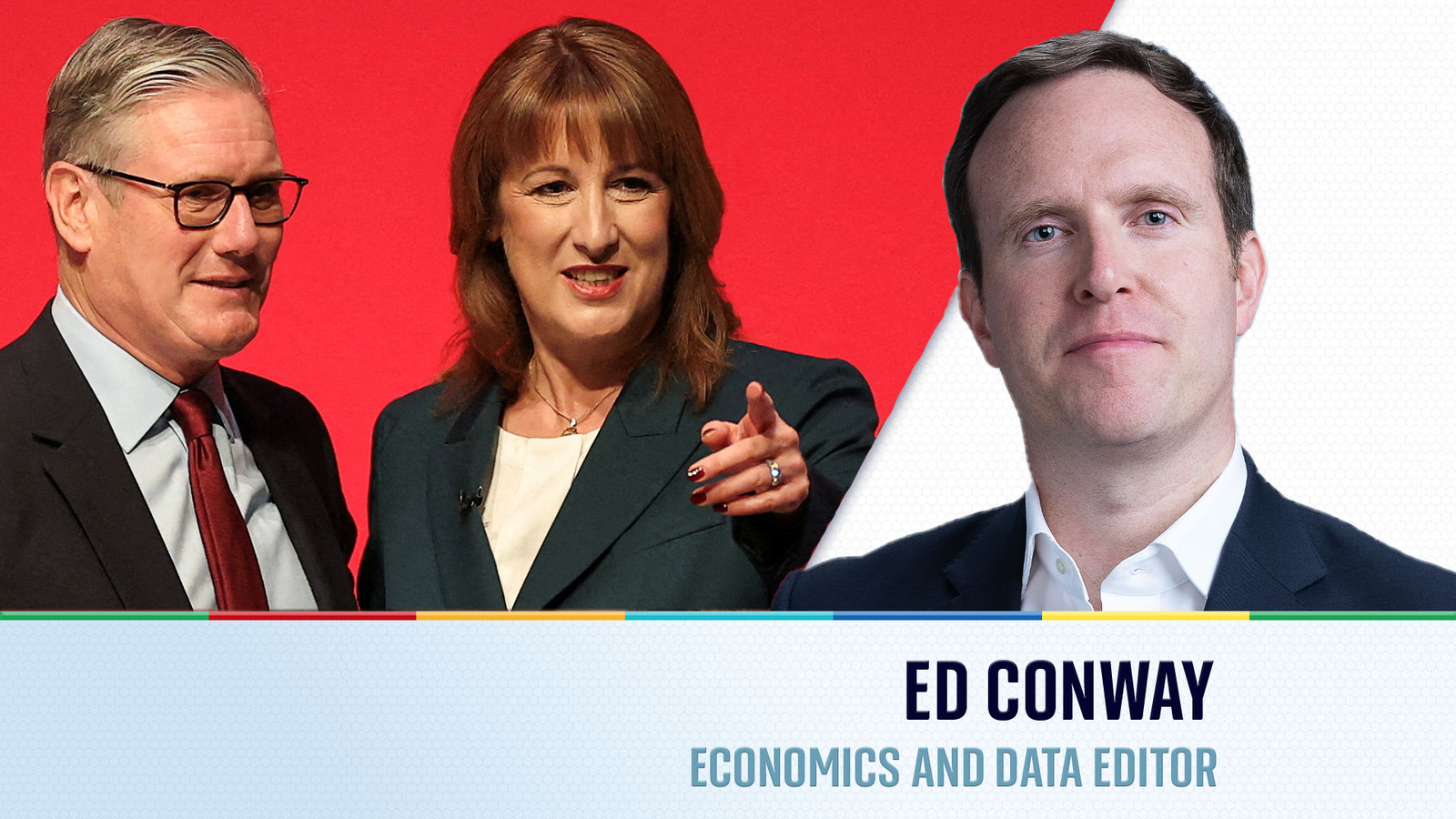

Did the chancellor mislead the public, and her own cabinet, before the budget?
It’s a good question, and we’ll come to it in a second, but let’s begin with an even bigger one: is the prime minister continuing to mislead the public over the budget?
The details are a bit complex but ultimately this all comes back to a rather simple question: why did the government raise taxes in last week’s budget? To judge from the prime minister’s responses at a news conference just this morning, you might have judged that the answer is: “because we had to”.
“There was an OBR productivity review,” he explained to one journalist. “The result of that was there was £16bn less than we might otherwise have had. That’s a difficult starting point for any budget.”
Politics latest: OBR boss resigns over budget leak
Beth Rigby asks Keir Starmer if he misled the public
Time and time again throughout the news conference, he repeated the same point: the Office for Budget Responsibility had revised its forecasts for the UK economy and the upshot of that was that the government had a £16bn hole in its accounts. Keep that figure in your head for a bit, because it’s not without significance.
But for the time being, let’s take a step back and recall that budgets are mostly about the difference between two numbers: revenues and expenditure; tax and spending. This government has set itself a fiscal rule – that it needs, within a few years, to ensure that, after netting out investment, the tax bar needs to be higher than the spending bar.
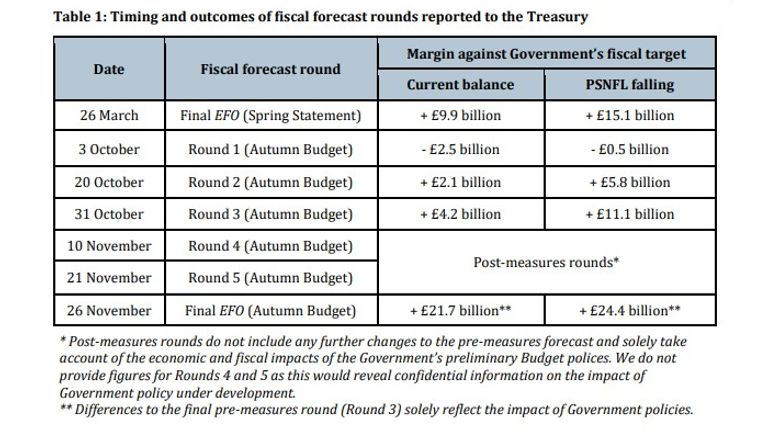
At the time of the last budget, taxes were indeed higher than current spending, once the economic cycle is taken account of or, to put it in economists’ language, there was a surplus in the cyclically adjusted current budget. The chancellor had met her fiscal rule, by £9.9bn.
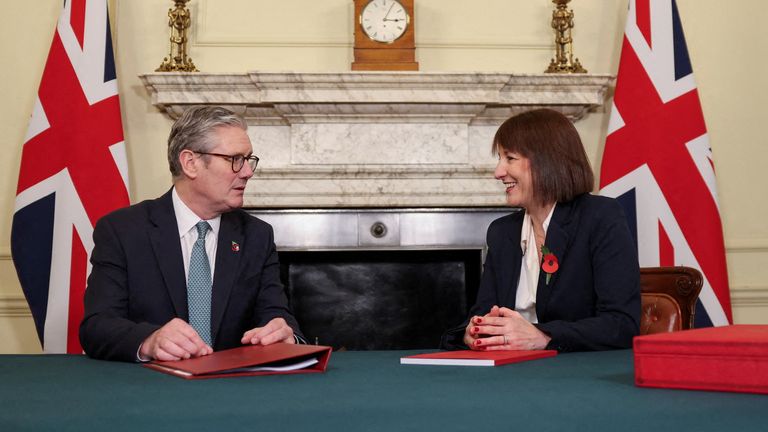
Pic: Reuters
This, it’s worth saying, is not a very large margin by which to meet your fiscal rule. A typical budget can see revisions and changes that would swamp that in one fell swoop. And part of the explanation for why there has been so much speculation about tax rises over the summer is that the chancellor left herself so little “headroom” against the rule. And since everyone could see debt interest costs were going up, it seemed quite plausible that the government would have to raise taxes.
Then, over the summer, the OBR, whose job it is to make the official government forecasts, and to mark its fiscal homework, told the government it was also doing something else: reviewing the state of Britain’s productivity. This set alarm bells ringing in Downing Street – and understandably. The weaker productivity growth is, the less income we’re all earning, and the less income we’re earning, the less tax revenues there are going into the exchequer.
The early signs were that the productivity review would knock tens of billions of pounds off the chancellor’s “headroom” – that it could, in one fell swoop, wipe off that £9.9bn and send it into the red.
Read more:
Main budget announcements – at a glance
Enter your salary to see how the budget affects you
That is why stories began to brew through the summer that the chancellor was considering raising taxes. The Treasury was preparing itself for some grisly news. But here’s the interesting thing: when the bad news (that productivity review) did eventually arrive, it was far less grisly than expected.
True: the one-off productivity “hit” to the public finances was £16bn. But – and this is crucial – that was offset by a lot of other, much better news (at least from the exchequer’s perspective). Higher wage inflation meant higher expected tax revenues, not to mention a host of other impacts. All told, when everything was totted up, the hit to the public finances wasn’t £16bn but somewhere between £5bn and £6bn.
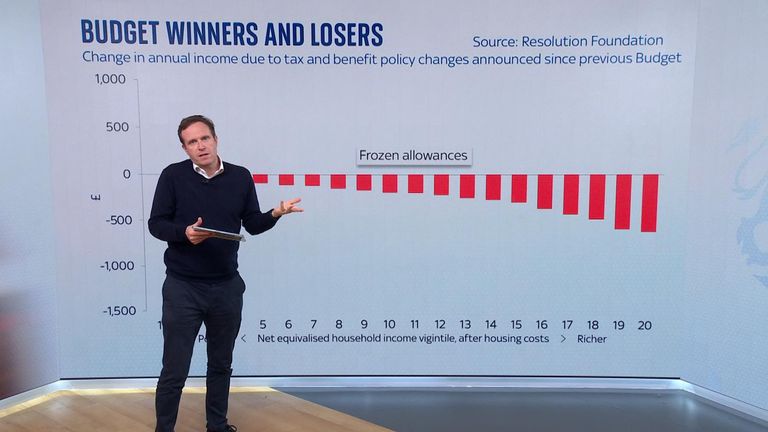
Budget winners and losers
Why is that number significant? Because it’s short of the chancellor’s existing £9.9bn headroom. Or, to put it another way, the OBR’s forecasting exercise was not enough to force her to raise taxes.
The decision to raise taxes, in other words, came down to something else. It came down to the fact that the government U-turned on a number of its welfare reforms over the summer. It came down to the fact that they wanted to axe the two-child benefits cap. And, on top of this, it came down to the fact that they wanted to raise their “headroom” against the fiscal rules from £9.9bn to over £20bn.
These are all perfectly logical reasons to raise tax – though some will disagree on their wisdom. But here’s the key thing: they are the chancellor and prime minister’s decisions. They are not knee-jerk responses to someone else’s bad news.
Yet when the prime minister explained his budget decisions, he focused mostly on that OBR report. In fact, worse, he selectively quoted the £16bn number from the productivity review without acknowledging that it was only one part of the story. That seems pretty misleading to me.

Sir Keir Starmer has denied he and the chancellor misled the public and the cabinet over the state of the UK’s public finances ahead of the budget.
The prime minister told Sky News’ political editor Beth Rigby “there was no misleading”, following claims he and Rachel Reeves deliberately said public finances were in a dire state, when they were not.
Politics latest: Reeves says Cabinet briefed on morning of budget
He said a productivity review by the Office for Budget Responsibility (OBR), which provides fiscal forecasts to the government, meant there would be £16bn less available so the government had to take that into account.
“To suggest that a government that is saying that’s not a good starting point is misleading is wrong, in my view,” Sir Keir said.
Cabinet ministers have said they felt misled by the chancellor and prime minister, who warned public finances were in a worse state than they thought, so they would have to raise taxes, including income tax, which they had promised not to in the manifesto.
At last Wednesday’s budget, Ms Reeves unveiled a record-breaking £26bn in tax rises.
The OBR published the forecasts it provided to the chancellor in the two months before the budget, which showed there was a £4.2bn headroom on 31 October – ahead of that warning about possible income tax rises on 4 November.
The OBR’s timings and outcomes of the fiscal forecasts reported to the Treasury
Sir Keir added: “There was a point at which we did think we would have to breach the manifesto in order to achieve what we wanted to achieve.
“Late on, it became possible to do it without the manifesto breach. And that’s why we came to the decisions that we did.”
Sir Keir said a productivity review had not taken place in 15 years and questioned why it was not done at the end of the last government, as he blamed the Conservatives for the OBR downgrading medium-term productivity growth by 0.3 percentage points to 1% at the end of the five-year forecast.
Read more:
Senior cabinet minister defends Reeves
‘Of course I didn’t lie about budget forecasts, says chancellor
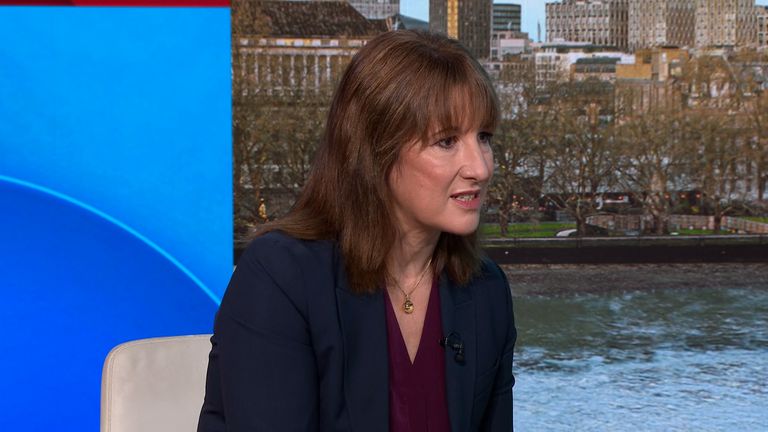
Reeves: I didn’t lie about ‘tax hikes’
The prime minister added: “I wanted to more than double the headroom, and to bear down on the cost of living, because I know that for families and communities across the country, that is the single most important issue, I wanted to achieve all those things.
“Starting that exercise with £16 billion less than we might otherwise have had. Of course, there are other figures in this, but there’s no pretending that that’s a good starting point for a government.”
On Sunday, when asked by Sky’s Trevor Phillips if she lied, Ms Reeves said: “Of course I didn’t.”
She also said the OBR’s downgrade of productivity meant the forecast for tax receipts was £16bn lower than expected, so she needed to increase taxes to create fiscal headroom.

-
 Sports2 years ago
Story injured on diving stop, exits Red Sox game
-
 Sports3 years ago
‘Storybook stuff’: Inside the night Bryce Harper sent the Phillies to the World Series
-
 Sports2 years ago
Game 1 of WS least-watched in recorded history
-
 Sports3 years ago
Button battles heat exhaustion in NASCAR debut
-
 Sports3 years ago
MLB Rank 2023: Ranking baseball’s top 100 players
-
Sports4 years ago
Team Europe easily wins 4th straight Laver Cup
-
 Environment3 years ago
Japan and South Korea have a lot at stake in a free and open South China Sea
-
 Environment1 year ago
Here are the best electric bikes you can buy at every price level in October 2024