
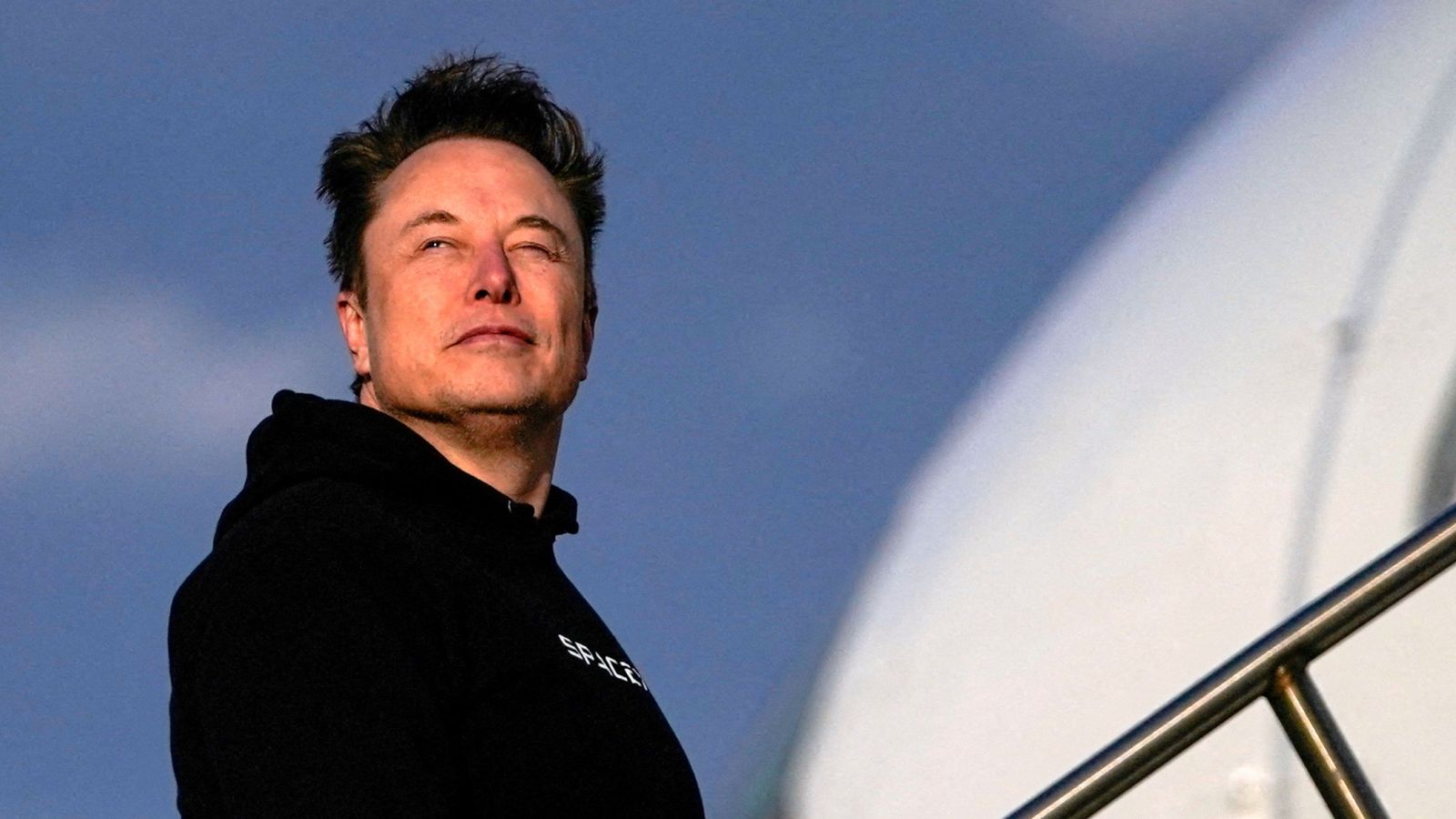
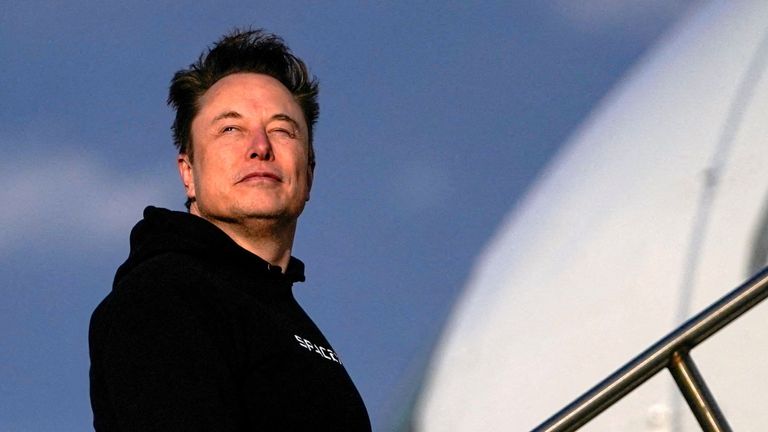
Elon Musk: Why some are starting to question if the world’s richest man is still value for money

Elon Musk is already the world’s richest man, but today he could take a giant step towards becoming the world’s first trillionaire.
Shareholders at Tesla are voting on a pay deal for their chief executive that is unlike anything corporate America has ever seen.
The package would grant Musk, who already has a net worth of more than $400bn, around 425 million shares in the company.
That would net him about $1trn (£760bn) and, perhaps more importantly to Musk, it would tighten his grip on the company by raising his stake from 15% to almost 30%.
The board, which has been making its case to retail investors with a series of videos and digital ads, has a simple message: Tesla is at a turning point.
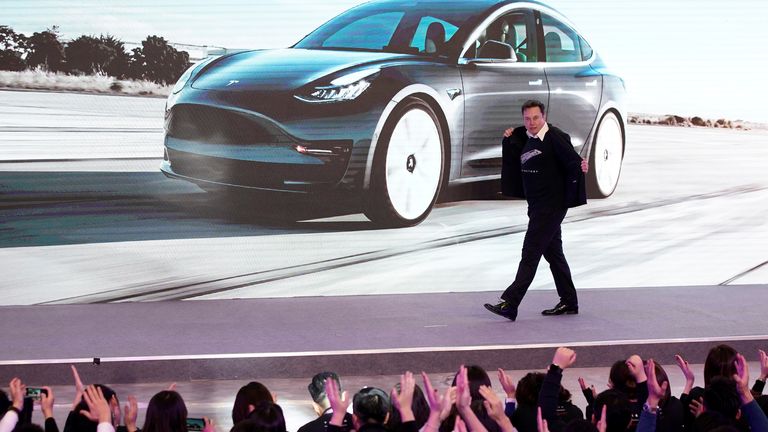
Musk onstage during an event for Tesla in Shanghai, China. Pic: Reuters
Yes, it wants to sell millions of cars, but it also wants to be a pioneer in robotaxis, AI-driven humanoid robots, and autonomous driving software. At this moment, it needs its visionary leader motivated and fully on board.
Musk has served his warning shot. Late last month, he wrote on X: “Tesla is worth more than all other automotive companies combined. Which of those CEOs would you like to run Tesla? It won’t be me.”
Not everyone is buying it, however.
With so much of his personal wealth tied up in Tesla, would Musk really walk away?
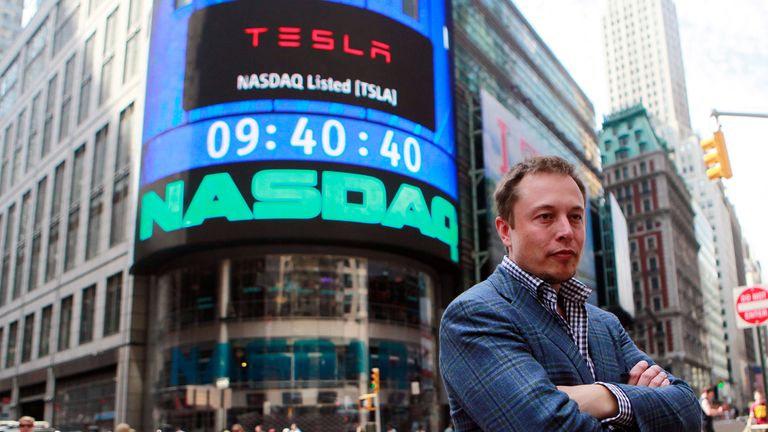
Musk poses after his company’s initial public offering at the NASDAQ market in New York on 29 June 2010. Pic: Reuters
Bad for the brand?
Others see his continued presence and rising influence as a risk. Norway’s sovereign wealth fund, the world’s largest, which owns 1.1% of the company (making it a top 10 shareholder), has already declared it will vote against the deal. It cited concerns about “the award’s size, dilution, and lack of mitigation of key person risk”.
Several major US pension funds have followed suit. In an open letter published last month, they warned: “The board’s relentless pursuit of keeping its chief executive has damaged Tesla’s reputation.”
They also criticised the board for allowing Musk to pursue other ventures. They said he was overcommitted and distracted as a result. Signatories of that letter included the state treasurers of Nevada, New Mexico, Connecticut, Massachusetts, Colorado, and the comptrollers of Maryland and New York City.
All of them Democrats. Republicans have been more favourable. There is a political slant to this.
The signatories’ concerns with his “other ventures” no doubt include the time Musk spent dabbling in right-wing politics with the Republican inner circle. That made him a polarising figure and, to an extent, Tesla too.
Elon Musk, who’s been close to Donald Trump, boards Air Force One in New Jersey. Pic: Reuters
Pay packet dwarfs rivals
Combine this with a mixed sales performance and a volatile share price, and some are wondering whether the carmaker has lost its way under his leadership.
Irrespective of performance, for some, the existence of billionaires – let alone trillionaires – can never be justified. Some may also ask why Musk is worth so much more than the leaders of Apple, Facebook, and Microsoft, or Nvidia, the world’s most valuable company by market capitalisation.
Nvidia‘s chief executive, Jensen Huang, received $49.9m (£37.9m) this fiscal year. So, how has Tesla come up with these numbers? Why is Musk’s pay so out of kilter with the benchmark? Does the company have a corporate governance problem?
The courts have suggested it might. Last year, a Delaware court took the view that Tesla’s board members, which include Musk’s brother Kimbal, were not fully independent when agreeing to a $56bn (£42.6bn) pay packet back in 2017.

Jensen Huang has defended the AI sector. Pic: Reuters
Read more from Sky News:
Badenoch calls for government to ‘get Britain drilling again’
Sickness bill costs £85bn a year, says new report
The Delaware Supreme Court is now reviewing the case. It is a reminder that even if Musk meets his targets, a similar fate could befall the current package.
The Tesla board is holding firm, however. Robyn Denholm, the company’s chair, told The New York Times: “He doesn’t get any compensation if he doesn’t deliver,” adding that Musk “does things that further humankind”.
Tesla’s valuation is tied up in its promise to deliver revolutionary AI and robotics products that will change the world. Those ambitions, which include robots that can look after children, are lofty. Some would call them unrealistic, but the board is adamant that if they are to become a reality, only Musk can make it happen.
Under the deal, Musk would receive no salary or cash bonus. Instead, he would collect shares as Tesla’s value grows. To unlock the full package, he would have to increase the current market valuation six times to $8.5trn (£6.47trn). For context, that’s almost twice that of Nvidia.
There are other hurdles. The company would have to sell 20 million additional electric vehicles, achieve 10 million subscriptions to its self-driving software on average over three months, deploy one million robotaxis on average over the same period, sell one million AI-powered robots, and boost adjusted earnings 24-fold to $400bn (£304bn).
They are ambitious targets, but Musk has defied the sceptics before.

Did the chancellor mislead the public, and her own cabinet, before the budget?
It’s a good question, and we’ll come to it in a second, but let’s begin with an even bigger one: is the prime minister continuing to mislead the public over the budget?
The details are a bit complex but ultimately this all comes back to a rather simple question: why did the government raise taxes in last week’s budget? To judge from the prime minister’s responses at a news conference just this morning, you might have judged that the answer is: “because we had to”.
“There was an OBR productivity review,” he explained to one journalist. “The result of that was there was £16bn less than we might otherwise have had. That’s a difficult starting point for any budget.”
Politics latest: OBR boss resigns over budget leak
Beth Rigby asks Keir Starmer if he misled the public
Time and time again throughout the news conference, he repeated the same point: the Office for Budget Responsibility had revised its forecasts for the UK economy and the upshot of that was that the government had a £16bn hole in its accounts. Keep that figure in your head for a bit, because it’s not without significance.
But for the time being, let’s take a step back and recall that budgets are mostly about the difference between two numbers: revenues and expenditure; tax and spending. This government has set itself a fiscal rule – that it needs, within a few years, to ensure that, after netting out investment, the tax bar needs to be higher than the spending bar.
At the time of the last budget, taxes were indeed higher than current spending, once the economic cycle is taken account of or, to put it in economists’ language, there was a surplus in the cyclically adjusted current budget. The chancellor had met her fiscal rule, by £9.9bn.
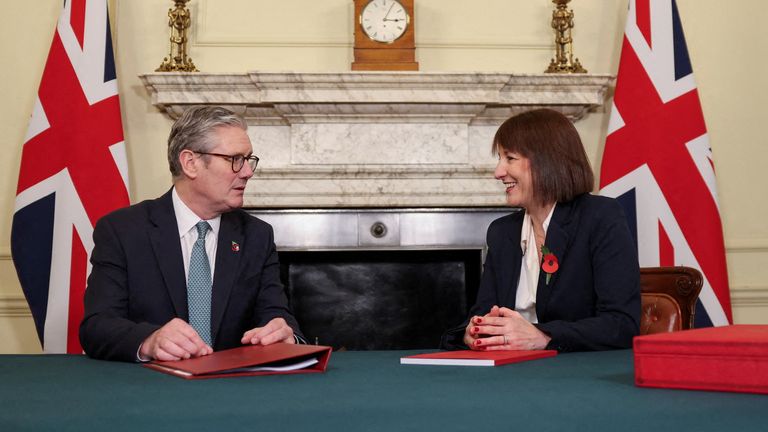
Pic: Reuters
This, it’s worth saying, is not a very large margin by which to meet your fiscal rule. A typical budget can see revisions and changes that would swamp that in one fell swoop. And part of the explanation for why there has been so much speculation about tax rises over the summer is that the chancellor left herself so little “headroom” against the rule. And since everyone could see debt interest costs were going up, it seemed quite plausible that the government would have to raise taxes.
Then, over the summer, the OBR, whose job it is to make the official government forecasts, and to mark its fiscal homework, told the government it was also doing something else: reviewing the state of Britain’s productivity. This set alarm bells ringing in Downing Street – and understandably. The weaker productivity growth is, the less income we’re all earning, and the less income we’re earning, the less tax revenues there are going into the exchequer.
The early signs were that the productivity review would knock tens of billions of pounds off the chancellor’s “headroom” – that it could, in one fell swoop, wipe off that £9.9bn and send it into the red.
Read more:
Main budget announcements – at a glance
Enter your salary to see how the budget affects you
That is why stories began to brew through the summer that the chancellor was considering raising taxes. The Treasury was preparing itself for some grisly news. But here’s the interesting thing: when the bad news (that productivity review) did eventually arrive, it was far less grisly than expected.
True: the one-off productivity “hit” to the public finances was £16bn. But – and this is crucial – that was offset by a lot of other, much better news (at least from the exchequer’s perspective). Higher wage inflation meant higher expected tax revenues, not to mention a host of other impacts. All told, when everything was totted up, the hit to the public finances wasn’t £16bn but somewhere between £5bn and £6bn.
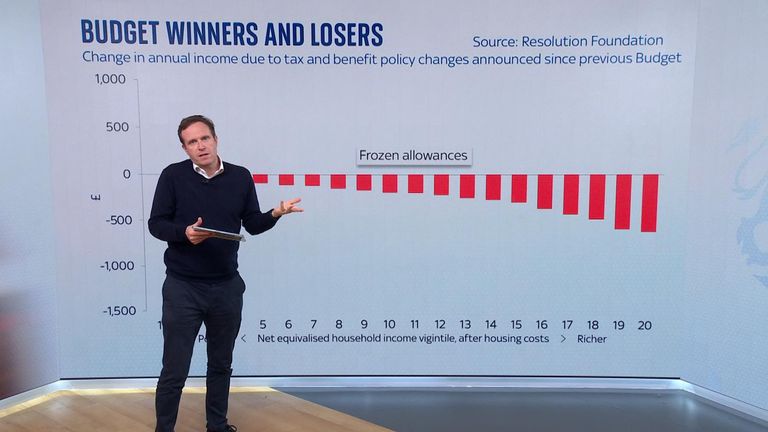
Budget winners and losers
Why is that number significant? Because it’s short of the chancellor’s existing £9.9bn headroom. Or, to put it another way, the OBR’s forecasting exercise was not enough to force her to raise taxes.
The decision to raise taxes, in other words, came down to something else. It came down to the fact that the government U-turned on a number of its welfare reforms over the summer. It came down to the fact that they wanted to axe the two-child benefits cap. And, on top of this, it came down to the fact that they wanted to raise their “headroom” against the fiscal rules from £9.9bn to over £20bn.
These are all perfectly logical reasons to raise tax – though some will disagree on their wisdom. But here’s the key thing: they are the chancellor and prime minister’s decisions. They are not knee-jerk responses to someone else’s bad news.
Yet when the prime minister explained his budget decisions, he focused mostly on that OBR report. In fact, worse, he selectively quoted the £16bn number from the productivity review without acknowledging that it was only one part of the story. That seems pretty misleading to me.

Sir Keir Starmer has denied he and the chancellor misled the public and the cabinet over the state of the UK’s public finances ahead of the budget.
The prime minister told Sky News’ political editor Beth Rigby “there was no misleading”, following claims he and Rachel Reeves deliberately said public finances were in a dire state, when they were not.
Politics latest: Reeves says Cabinet briefed on morning of budget
He said a productivity review by the Office for Budget Responsibility (OBR), which provides fiscal forecasts to the government, meant there would be £16bn less available so the government had to take that into account.
“To suggest that a government that is saying that’s not a good starting point is misleading is wrong, in my view,” Sir Keir said.
Cabinet ministers have said they felt misled by the chancellor and prime minister, who warned public finances were in a worse state than they thought, so they would have to raise taxes, including income tax, which they had promised not to in the manifesto.
At last Wednesday’s budget, Ms Reeves unveiled a record-breaking £26bn in tax rises.
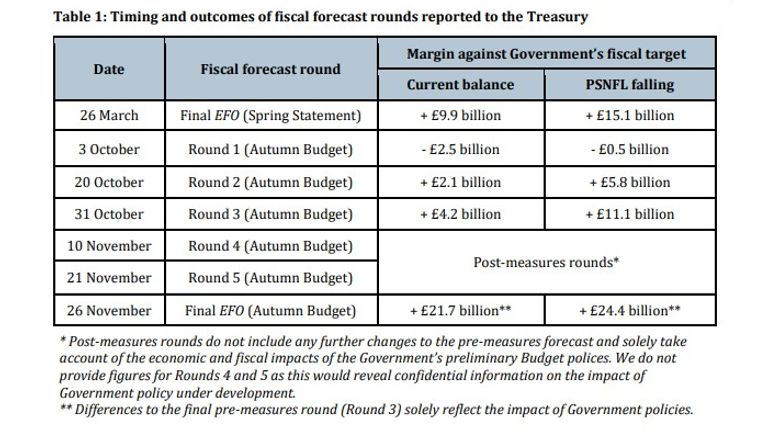
The OBR published the forecasts it provided to the chancellor in the two months before the budget, which showed there was a £4.2bn headroom on 31 October – ahead of that warning about possible income tax rises on 4 November.
The OBR’s timings and outcomes of the fiscal forecasts reported to the Treasury
Sir Keir added: “There was a point at which we did think we would have to breach the manifesto in order to achieve what we wanted to achieve.
“Late on, it became possible to do it without the manifesto breach. And that’s why we came to the decisions that we did.”
Sir Keir said a productivity review had not taken place in 15 years and questioned why it was not done at the end of the last government, as he blamed the Conservatives for the OBR downgrading medium-term productivity growth by 0.3 percentage points to 1% at the end of the five-year forecast.
Read more:
Senior cabinet minister defends Reeves
‘Of course I didn’t lie about budget forecasts, says chancellor
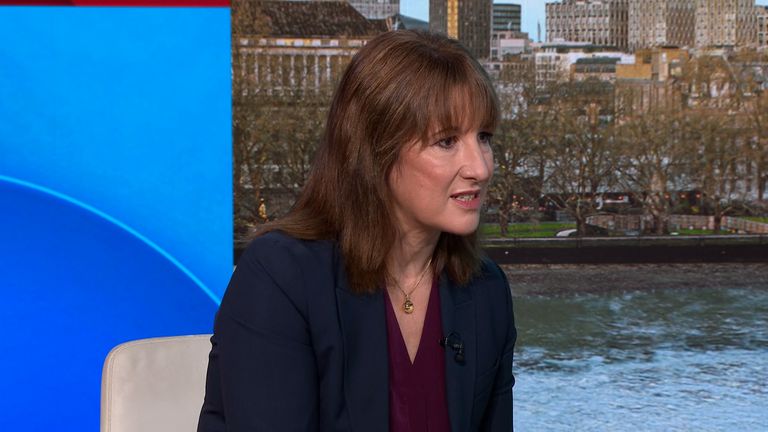
Reeves: I didn’t lie about ‘tax hikes’
The prime minister added: “I wanted to more than double the headroom, and to bear down on the cost of living, because I know that for families and communities across the country, that is the single most important issue, I wanted to achieve all those things.
“Starting that exercise with £16 billion less than we might otherwise have had. Of course, there are other figures in this, but there’s no pretending that that’s a good starting point for a government.”
On Sunday, when asked by Sky’s Trevor Phillips if she lied, Ms Reeves said: “Of course I didn’t.”
She also said the OBR’s downgrade of productivity meant the forecast for tax receipts was £16bn lower than expected, so she needed to increase taxes to create fiscal headroom.
-
 Sports2 years ago
Story injured on diving stop, exits Red Sox game
-
 Sports3 years ago
‘Storybook stuff’: Inside the night Bryce Harper sent the Phillies to the World Series
-
 Sports2 years ago
Game 1 of WS least-watched in recorded history
-
 Sports3 years ago
Button battles heat exhaustion in NASCAR debut
-
 Sports3 years ago
MLB Rank 2023: Ranking baseball’s top 100 players
-
Sports4 years ago
Team Europe easily wins 4th straight Laver Cup
-
 Environment3 years ago
Japan and South Korea have a lot at stake in a free and open South China Sea
-
 Environment1 year ago
Here are the best electric bikes you can buy at every price level in October 2024