
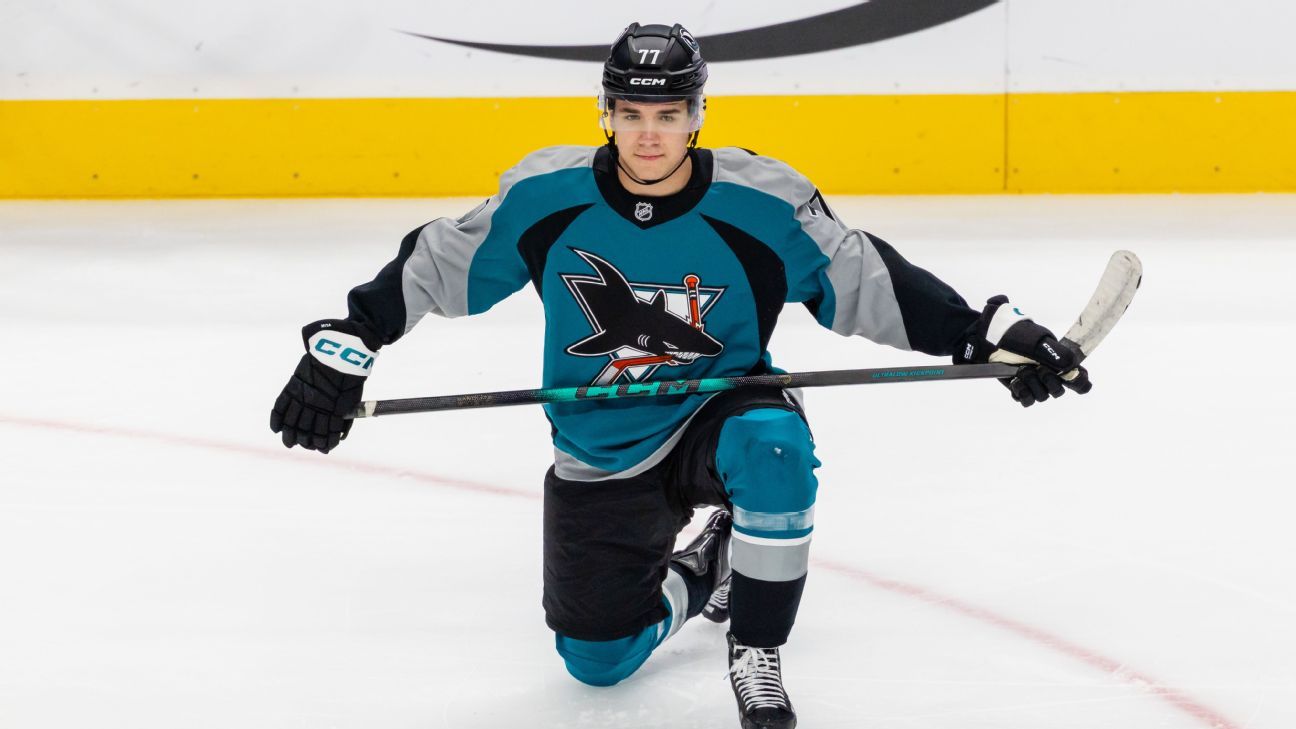
NHL prospect pipeline rankings: Sharks, Islanders, then …?


-
Rachel Kryshak
With the top 50 prospects ranking done, and hockey seasons well underway worldwide, it is time to rank each NHL team’s prospect pipeline.
The criteria for a player to be included in the prospect pool are the same as for the prospect ranking: Any player who is under 23, with under 50 NHL games played, is eligible for this list. The rankings are done by assigning a value to each of the prospects based on his NHL projection and taking the cumulative value of each team’s prospects. That means some teams with many prospects might rank higher than others with fewer, but more talented, prospects. A tie goes to the pipeline with the higher-quality prospects.
Counting down from No. 32 all the way to No. 1, here’s the lay of the land for NHL team prospect pipelines for the 2025-26 season:

Last season: 27
Following back-to-back Stanley Cups and three Cup Final appearances in as many years, the Panthers are exactly where they desire to be and will have no qualms about it.
Trading prospects and picks away to win Stanley Cups is the easiest decision — when it works. It has worked famously well for the Panthers of late, but it leaves them with a very depleted pipeline. Not a single player is expected to become an impactful NHLer, and most are long shots to play.
Gracyn Sawchyn is far and away their best prospect, and has skill and confidence to develop into a middle-six player. Jack Devine and Shamar Moses have NHL depth potential, but are likely to be a few years away. Marek Alscher is an intriguing defensive prospect, with the size and defensive ability to fill a bottom-pairing role for the Panthers in the future.

Last season: 31
Conor Geekie isn’t eligible for this ranking, or the Lightning might have moved up a few spots.
Sam O’Reilly, who was acquired in the Isaac Howard trade, is the Lightning’s best opportunity at a middle-six, impact player. He’s a well-rounded, two-way center capable of contributing offense and shutting down the opponent’s best. Learning from Anthony Cirelli is going to be huge for his NHL transition.
The two Ethans, Czata and Gauthier, have NHL potential, and are most likely to be third-line, offensive contributors. Dylan Duke is NHL-ready and should be a contributor in the middle six with a relentless, checking play style.

Last season: 22
The Stars have had plenty of success finding players late in the draft, but without many draft picks recently, accruing value is difficult.
Still, the Stars extracted tremendous value getting Cameron Schmidt in the 2025 draft. If he were 3 inches taller, he would’ve been a top-15 pick. Schmidt is unsettlingly fast and generates scoring chances through his skating. If his offensive toolbox of skating, shooting and playmaking translates, he’ll be a top-six forward.
Samu Tuomaala should carve out a bottom-six role as soon as next season for the Stars. Emil Hemming and Brandon Gorzynski have potential to become bottom-six NHL players, with Hemming representing the best chance of an impactful depth player.
Aram Minnetian is the lone defender projected to play NHL games after the Stars dealt Christian Kyrou to Philadelphia. Minnetian’s skating and skill with the puck should see him become a No. 4/5 defender who exits the zone cleanly and disrupts offense.

Last season: 30
The Oilers have three players who are going to play NHL games and, if slotted properly, should be impactful players. Outside of that … it is bleak.
Isaac Howard is playing in the NHL and has 30-goal potential. To unlock that, playing him consistently with Connor McDavid or Leon Draisaitl will be necessary. He’s a good skater who can keep pace, shoots the puck well and brings some physicality on the forecheck. Ideally, he turns into “Zach Hyman lite.”
Matt Savoie is a smaller forward with high-end offensive abilities. He’s another perfect complement to McDavid or Draisaitl and could provide secondary offense, something the Oilers desperately need.
Beau Akey is the lone NHL-projectable defenseman outside of the NHL for the Oilers. He moves very well, making him dangerous in transition, and he defends very well in transition. If he starts to consistently engage physically, he could be a shutdown defender on the Oilers’ second pair.

Last season: 24
After the Avs’ traded away their most valuable prospect in Cal Ritchie, their pipeline took a major hit. It leaves them with two forward prospects with NHL potential in the middle six.
Gavin Brindley started the season with Colorado before getting hurt, but he made things happen when he was on the ice and endeared himself to his coach. He would benefit from some more AHL time, but there is a middle-six, all-situations forward there if he develops properly. Sean Behrens is the other forward prospect with middle-six potential, but he is likely two to three years away.
Mikhail Gulyayev is a tantalizing defensive prospect with good transition defense and untapped offensive capability. He needs to play in North America to develop the offense further and realize his NHL potential as a middle-pairing defender.
Ilya Nabokov has legitimate potential to be an NHL starter and is certainly someone who can split time with a 1A goaltender. He moves in a controlled and powerful manner, cuts the angle well, and is difficult to beat in breakaway situations. There’s something there for the Avs, who might have him on their roster next year.

Last season: 20
Gone are the days of drafting prospects with special skill; in are the days of drafting big bodies, it seems. While both Easton Cowan and Ben Danford play physical, in-your-face hockey, they are also the Leafs’ most intelligent prospects in their on-ice decision-making.
Cowan is already playing NHL games, and likely carves out a long-term, second-line role as a scoring pest, although he was sent down to the AHL on Wednesday. Danford is a physical defender who should become a second-pair, shutdown guy in tough matchups.
Harry Nansi and Miroslav Holinka have increased their prospect value and projections with brilliant starts to the season. Nansi in particular has elevated his projection to a be middle-six forward with two-way ability and complementary offense. Holinka is most likely to be a bottom-six forward if his two-way play improves.
Luke Haymes and Tyler Hopkins have relatively confident projections as NHL depth players who might grow into third-line contributors. Defensively, Noah Chadwick and Victor Johansson represent organizational depth options in a year or two.

Last season: 28
Vegas has a few players that are projected to play NHL games — but it’s unlikely those games will be for the Golden Knights, given the organization’s propensity to trade away draft picks and top prospects.
Trevor Connelly is a brilliantly skilled forward who is a reasonable bet to become a top-six option who can score and make plays. Jakob Ihs-Wozniak has an NHL-ready shot and very good playmaking ability. Whether he makes the NHL as a middle-six forward will be determined by improvement in his skating and competitive engagement.
Matyas Sapovaliv and Mathieu Cataford have bottom-six potential as checking, penalty-killing forwards with secondary offense if they improve their skating.
Carl Lindbom has earned his keep as one of the best young goaltenders in the AHL and has performed admirably in NHL appearances. His path to more NHL playing time was blocked with the signing of Carter Hart, elongating the 22-year-old’s path to the NHL. He has the tools to be a starter in the NHL and would help a few teams if he were to be traded.

Last season: 29
Almost all of the Senators’ pipeline value is concentrated on defense. At this point, they should have the NHL’s best D corps in three years.
Carter Yakemchuk and Logan Hensler are both projected to become top-four defenders, with Yakemchuk’s offensive prowess expected to serve him well on the power play. Hensler’s defensive abilities could see him play a significant shutdown role in the NHL.
Tomas Hamara, Gabriel Eliasson and Jorian Donovan are longer shots to become NHL regulars but should provide value in depth roles.
Up front, Blake Montgomery and Javon Moore are big, reliable two-way players with offensive upside that could see them contribute in third-line roles, providing secondary scoring. Lucas Beckman is an intriguing prospect in goal because he has platoon starter potential as a 1B, but he needs to refine his techniques and movements to realize his potential.

Last season: 19
The Devils have prospects at every position, but their standout prospects are on defense and in goal.
Anton Silayev and Seamus Casey both have comfortable projections in the NHL as middle- to bottom-pairing defenders. Silayev is a mammoth (6-7, 207 pounds) with high-end skating ability who thrives in physical battles. He’ll be best suited in a shutdown role on the middle pair.
Casey is an offensive catalyst who defends the rush very well and squeezes much larger opponents off the puck. His path in Jersey seems blocked by other similar defensemen, but Casey could be an interesting trade chip to an organization that needs mobile defenders. There is immediate No. 4/5 potential there.
Mikhail Yegorov is a strong candidate to develop into an NHL goalie with his size, athleticism and strong mental approach. He makes timely saves and doesn’t get rattled by the moment. Up front, Lenni Hameenaho, Shane Lachance and Ben Kevan have the best chance to become impactful third-line players who can contribute offensively.

Last season: 23
The bulk of the Kings’ pipeline value can be attributed to three goaltenders with NHL potential. Carter George, Hampton Slukynsky and Petteri Rimpinen all have the skill and ability to become starting goaltenders, likely in platoon roles.
George and Slukynsky could form the tandem that becomes the Kings’ future in net, as soon as the 2027-28 season after Darcy Kuemper‘s contract expires. They are both that good.
Liam Greentree has a fair chance of developing into a dual-threat playmaker and finisher in the top six if he can improve his skating. Kristian Epperson, Koehn Zimmer and Kenny Conners have reasonable chances to become bottom-six forwards.
On defense, Henry Brzustewicz projects as a creative, play-driving, middle-pairing defender. He’s likely two years away, but he will add more mobility and creativity to the Kings’ blue line.

Last season: 16
Gathering excellent value outside of the first round has allowed the Jets to have quite a few NHL prospects in the pipeline. In particular, the Jets have two forward prospects who should be impactful in middle-six roles.
Brayden Yager has an NHL-ready shot and developed his playmaking skills in the AHL last season. If he continues to develop his off-puck play, he should become an offensive contributor in the middle of the lineup. Brad Lambert is a speedy winger with good puck skills that are tough to defend in transition. If his defensive play continues to improve, he’s going to be a solid middle-six player.
Other forwards with opportunities to play depth roles include Colby Barlow, Kevin He, Kieran Walton, Nikita Chibrikov and Owen Martin.
Elias Salomonsson and Sascha Boumedienne are two Swedish defenders with middle-pair potential for the Jets. Salomonsson is more likely to play a bottom-pair role, where he can win secondary matchups. Ideally, Boumedienne hones his offensive skills and become a secondary power-play quarterback who can drive play.

Last season: 21
The Canucks have been in the mushy middle for a while, but they have four prospects with potential to become impactful NHLers.
Braeden Cootes fills a significant organizational need for center, and while he made the team out of camp, the Canucks made the right choice in returning him to junior. He’s going to be a solid, middle-six center who produces secondary offense and drives play. Jonathan Lekkerimaki isn’t a complete boom-or-bust prospect, but his slight frame isn’t helpful to him if he’s anything but a top-line scorer. He’s certainly got the skill and shot to play in the NHL, but adding strength will increase his confidence to play in the middle.
Tom Willander already looks the part of a middle-pairing defender with shutdown ability, and he should be a key part of Vancouver’s blue line for years.
The Canucks were fantastic at developing goaltenders under Ian Clark, and while he has stepped back from day-to-day involvement, Alexei Medvedev is the type of goaltender who should thrive in his development system. He’s young, with excellent athleticism and skating ability, and has a strong chance to become an NHL goaltender.

Last season: 7
It has been quite some time since the Sabres were this far down the prospect pipeline ranking, and unlimited lottery picks will certainly buoy the value of a prospect pool. Many of their high-end prospects (Zach Benson, Jiri Kulich, Devon Levi) have graduated.
The No. 9 pick this summer, Radim Mrtka is their best defensive prospect, and he projects to become a middle-pairing defender who drives play. Adam Kleber has No. 4/5 defender written all over him with his combination of size (6-6, 229 pounds) and skating ability.
Up front, there are three players with legitimate middle-six upside. Konsta Helenius and Noah Ostlund have the highest upside as second-line players, while Brodie Ziemer projects as a middle-six, secondary scorer. Helenius needs to find more offense to become a second-line center and would likely instead be one of the NHL’s best third-line centers with his two-way ability. Ostlund is best suited for the wing at the NHL level, and will need his dynamic playmaking ability to translate for him to be successful.

Last season: 14
Gabe Perreault and Scott Morrow are the crown jewels of the Rangers’ prospect pool. Perreault has the offensive talent to be a top-six scorer in the NHL, as soon as next season. Morrow has the potential to become a middle-pairing, offensive play driver because of his brilliant skating and puck-handling ability.
Malcolm Spence and Brennan Othmann have third-line potential with bite, and they would complement Noah Laba perfectly. Laba has made a seamless transition to the NHL and is already playing in the role he’s best suited for in the middle six.
EJ Emery has a path to becoming a shutdown defender in a depth role. Sean Barnhill and Drew Fortescue are longer shots to become NHL defenders, but both have tools and are longer-term projects with projectable NHL traits.

Last season: 32
Having James Hagens fall into their laps at No. 7 this summer certainly boosted the value of the Bruins’ pipeline. Hagens is more than likely to become a first-line center around whom Boston can build.
Acquired at the deadline last season, Fraser Minten is already filling a middle-six role and is likely to be a long-term third-line player. Dean Letourneau has the size and skill to become a middle-six forward who provides complementary offense, but he’s at least two years away.
William Moore and Fabian Lysell project to play NHL games and are most likely to contribute in middle of the lineup. Dans Locmelis impressed through camp and is off to a good start in his first AHL season. A bottom-six role does not seem to be out of the question.
Scoring over a point per game in the USHL, Cooper Simpson is off to a fantastic start. He’s two or three years away, but there is middle-six potential as a complementary scorer.
You might have noticed: The Bruins lack defensive or goaltending prospects, something they will need to address in the near future.

Last season: 13
This is a well-rounded prospect pool with projectable players at every position, players with modest projections and players with high-risk, high-reward projections.
Brady Martin and Matthew Wood project to be second-line players, with Martin profiling as a playoff menace. Ryker Lee is a boom-or-bust type, where he’s a top-six offensive play driver if he hits and an AHL player if he doesn’t. Teddy Stiga and Yegor Surin have real potential as top-six forwards who complement skilled players because of their relentless play style, good speed and ability to make plays.
Ozzy Weisblatt, Cole O’Hara and Joey Willis are all reasonable bets to fill bottom-six roles, with Weisblatt starting to see NHL playing time.
On defense, Tanner Molendyk, Andrew Gibson and Jacob Rombach represent formidable options in middle- or bottom-pair roles. Jack Ivankovic has the tools to become the next Nashville goalie on the smaller side to steal games. If his skating improves and he develops on schedule, he can be a platoon starter in three years’ time.

Last season: 25
A lot of eyebrows were raised when the Penguins drafted Ben Kindel 11th overall this summer, but he is well on his way to proving every doubter wrong. He has looked excellent thus far, making the Penguins out of camp and providing impactful minutes along the way. He’s well ahead of development schedule to be a scoring, top-six forward.
Ville Koivunen has made the jump to the NHL after a short stint lighting up the AHL. Koivunen is very smart, and his skating has improved to where becoming a middle-six, secondary scorer seems to be his most likely outcome.
Rutger McGroarty, William Horcoff, Tanner Howe and Bill Zonnon all bring complementary offensive games with strong two-way details that should lead to them contributing in the bottom six.
Harrison Brunicke and Owen Pickering are playing with the NHL club, and while they’re not tilting the ice in favor of the Penguins yet, they don’t look out of place either. Both are developing, and if they can minimize the mistakes, they have paths to becoming top-four defenders.

Last season: 10
The Canes have graduated many of their top prospects, but a few remain, and they continue to draft well.
Bradly Nadeau leads the charge, and he is a relatively safe bet to become a top-six forward with an elite shot. Two other young forwards to be excited about in the middle six are Nikita Artamonov and Felix Under Sorum. Ivan Ryabkin is a major wild card. If he hits, he’s a second-line power forward; if he doesn’t, he probably won’t carve out a role in the NHL. Playing in the AHL will be good for his development.
Kurban Limatov and Dominik Badinka represent legitimate options in the middle pair who are big, physical and very mobile. Vladimir Grudinin and Charles-Alexis Legault have reasonable projections to become depth defenders, and Legault is already seeing NHL action. If either of those players can provide depth for the Canes on a consistent basis, it will be a major win.
Semyon Frolov has the tools to become a platoon starter in the NHL, with excellent athleticism and flexibility. If he can quiet his movements and play regularly while he develops, he could provide stability in goal.

Last season: 4
There is a long list of prospects slated to become NHL players in this system. Emmitt Finnie was not high on that list, but he made the Red Wings out of camp and looks every bit the part of an NHL player this season.
Axel Sandin-Pellikka is already playing top-four minutes in an offensive role and looks every bit the part of a future offensive blue-line star.
Carter Bear projects to become a Swiss Army knife forward with top-six scoring ability and the type of guy you need to win in the playoffs. Nate Danielson and Michael Brandsegg-Nygard are tracking to become middle-six forwards with two-way play as their main calling card.
In goal, the Red Wings have two quality prospects in Trey Augustine and Sebastian Cossa. Both are excellent, and in an ideal world, form the type of 1A/1B tandem that Jeremy Swayman and Linus Ullmark rode to success for Boston. The Red Wings are headed in the right direction, as long as they continue to add young players who contribute to their lineup.

Last season: 6
The Wild have done a fantastic job stocking the prospect cupboard through the last five years despite being consistent playoff participants. They draft for smarts, translatable skill sets and talent, and they are rewarded for it.
Zeev Buium is already an NHL defender and power-play quarterback, and there is plenty of room for growth. He’s on track to become a top-pairing, offensive dynamo. Jesper Wallstedt barely makes the age cutoff, but he’s one of the best goalie prospects and has potential to be a platoon starter right now.
Up front, the Wild are loaded with talent including NHL-ready talent in Danila Yurov and Liam Ohgren, who will contribute in the middle six as complementary pieces. Ryder Ritchie, Riley Heidt and Hunter Haight all have middle-six NHL projections with complementary scoring upside.
Caeden Bankier and Adam Benak are longer shots to become NHL players, but the toolbox is there for both of them with elongated development. Defensively, David Jiricek no longer qualifies for inclusion here due to games played, but he should be a middle-pairing defender and is worth mentioning. Carson Lambos and Aron Kiviharju are longer shots to become NHL defenders, but if they hit, they are top-four offensive catalysts and all you need is one of them to complement Zeev Buium and the blue line starts to look elite.

Last season: 11
There are a lot of young, highly skilled forwards in the Kraken pipeline, which is exactly what their NHL lineup needs.
Jake O’Brien and Berkly Catton are on pace to become top-six offensive dynamos for the Kraken. Both possess high-end hockey sense and puck skill to execute plays that drive offense. It wouldn’t be surprising if both are on the top power-play unit as soon as next season.
Outside of those two, the Kraken have other forwards capable of filling middle-six roles and contributing offensively. Eduard Sale, Carson Rehkopf, Jani Nyman, Oskar Fisker Molgaard and Jagger Firkus all have potential to contribute in complementary offensive roles. Not all of them will get there, but two or three of them should.
Defensively, they lack a high-end prospect. Blake Fiddler, Caden Price and Lukas Dragicevic all have NHL potential, with Fiddler’s trajectory as a middle-pairing defender representing the Kraken’s best opportunity at an impact player. Price defends well by keeping players to the outside and exiting the zone with ease, which profiles him as a depth defender.
The Kraken have three goaltending prospects with NHL potential. Niklas Kokko is likely an NHL backup, while Kim Saarinen and Semyon Vyazovoi have platoon starter potential a few years down the road.

Last season: 2
The Blue Jackets, buoyed by high-value prospects at the top of the pool, land just outside the top 10.
Cayden Lindstrom’s development has been marred by injury, but that has not altered his projection as a top-six forward who drives play with physical bite. Lindstrom is big, moves well, owns an excellent shot and should be an NHL contributor next season.
Jackson Smith is a well-rounded defender who should play top-four minutes and dictate play on both sides of the rink. If he continues to develop, there’s a chance he becomes a 60-point defender who shuts down the best players on other teams.
Stanislav Svozil and Charlie Elick have depth projections with an outside chance of middle-pairing minutes. Luca Del Bel Belluz, Owen Griffin and Luca Pinelli have third-line, complementary scoring potential.
In goal, Sergei Ivanov and Pyotr Andreyonov are a few years away, but both of them possess platoon-starter potential. The Blue Jackets have a well-rounded prospect pipeline with projectable players at every position.

Last season: 12
The Blues have a plethora of forwards who are likely to be impactful NHLers, and a few more who can win minutes in bottom-six roles.
Justin Carbonneau, Jimmy Snuggerud and Dalibor Dvorsky are going to score in the NHL. They have clear paths to top-six roles, with skill and hockey IQ to match. Otto Stenberg, Tomas Mrsic and Juraj Pekarcik all have relatively confident projections as NHL players in bottom-six roles, with potential to provide offense in third-line duty.
On the blue line, Adam Jiricek and Theo Lindstein could form a fun middle pairing that provides offense while locking it down defensively. Both are at least a year or two away, but the tools are there. Lukas Fischer and Colin Ralph have depth-pairing potential and bring different skill sets. Fischer is more offensively calibrated, while Ralph is a physical menace who violently defends all over the ice. If two of the four play games for the Blues, that would be considered a win because there is no shortage of forwards expected to play.

Last season: 17
The Caps have four players projected to play impactful minutes for them in their prospect pipeline.
Ryan Leonard is already an NHL player, and he looks like the right fit in the Capitals’ top six, a spot he will occupy for the foreseeable future. Lynden Lakovic and Ilya Protas are on track to become middle-six players, with ceilings as second-line scoring wingers. Andrew Cristall and Terik Parascak are longer shots, because they need top-six minutes to contribute offensively. Their path to that is a tough one but remains viable.
In the bottom six, Milton Gastrin and Eriks Mateiko have confident projections to become checking, two-way forwards.
Cole Hutson is tracking to become a top-four defender in the NHL and could step into the lineup at the end of his NCAA season. He’s brilliant with the puck, creating and facilitating offense in all situations. Ryan Chesley and Leon Muggli have a decent chance to become middle-of-the-lineup defenders if they can develop the puck skills, specifically Chesley’s retrievals and Muggli’s playmaking. They have projectable defensive qualities to become modern shutdown defenders.

Last season: 15
The Flames’ top two prospects are with the big club, and it appears they will remain there.
Zayne Parekh is a dynamic offensive defenseman who will be quarterbacking the Flames’ power play for years to come. He’s a brilliant skater with the puck skill to match and has the potential to become one of the best offensive defensemen in the NHL.
Samuel Honzek is currently playing middle-six minutes. He’s likely to be a long-term center in the middle six who can contribute offensively.
The Flames have a plethora of forwards with middle-six scoring potential, including Cullen Potter, Matvei Gridin, Cole Reschny, Aydar Suniev and Andrew Basha. In the bottom six, Luke Misa and Jacob Battaglia have potential to provide reliable play with modest offensive contributions.
The two Henrys — Brzustewicz and Mews — have the tools and potential to become bottom-pairing defenders, with Brzustewicz owning the higher ceiling for his two-way play. The Flames have a well-rounded prospect pool, but they lack a projectable top-six forward.

Last season: 18
The Flyers’ prospect pool has an identity, and that is tough to play against, physically imposing, low-risk players.
Porter Martone is the cream of the crop and is one of the smartest prospects outside the NHL. There is little doubt he will become a top-six dual-threat forward, especially if his skating improves.
Jett Luchanko and Alex Bump project to become complementary, middle-six NHL players with secondary scoring capability. Denver Barkey, Shane Vansaghi, Jack Murtagh and Jack Nesbitt all have ceilings in the middle six but are more likely to form an integral part of a bottom six that is physically punishing, relentless in puck pursuit and trusted to kill penalties.
On defense, Oliver Bonk is the Flyers’ best hope for a top-four defender who can play matchup minutes in a middle-pairing role. Carter Amico is a commanding presence who defends very well, kills plays in transition and is a nightmare to battle at the net front. If he continues to develop, he’s going to be a quality shutdown defender for the Flyers who plays big minutes.
If the prospect pipeline is any indicator, the Broad Street Bullies 2.0 Era is just around the corner.

Last season: 5
Quack, Quack, Quack, Mr. Ducksworth! The young Ducks have been the surprise of the NHL season thus far, and their young players are carrying them.
Beckett Sennecke leads the way, already providing value in the middle six and the potential to leap into a top-line role as he matures. Roger McQueen has the potential to be a unicorn in the NHL at the center ice position if he can stay healthy.
Stop me if you’ve heard this before: The Ducks are loaded with defensive prospects. Not only are they the best at developing defensemen, but they also have a lot of them. Ian Moore missed the cutoff for this list, but Stian Solberg, Tarin Smith, Tyson Hinds and Noah Warren all project to become middle- or depth-pair defenders. Damian Clara has shown potential to be an NHL backup in goal, something the Ducks could use behind Lukas Dostal.

Last season: 3
Ivan Demidov is special, and there is little doubt about his ability to become an NHL star: a top-line forward, offensive dynamo, get-you-out-of-your-seat kind of player.
Jacob Fowler is the other prospect in the Canadiens’ pipeline who projects to be a high-end NHL talent. Fowler is getting meaningful time in the AHL to develop into a starting goaltender and has the talent to do so.
Outside of those two, the Canadiens have plenty of players who project to become middle-of-the-lineup players at their respective positions. David Reinbacher’s development has been marred by injury, but he has a path to being a second-pair, shutdown defender. Michael Hage and Alxander Zharovsky are reasonable bets to become offensive contributors in the middle six, while LJ Mooney is a longer shot, but the potential is there.
Owen Beck, Oliver Kapanen and Hayden Paupanekis have paths to becoming bottom-six NHL players. Montreal has players in the pipeline to fill out the rest of the roster and is forging a path to a lengthy contention window.

Last season: 8
A few lottery picks go a long way to bolstering the prospect pipeline, and if all goes to plan, Chicago is set at center, on defense and in goal.
Artyom Levshunov and Sam Rinzel are playing NHL minutes, and there is plenty of room for both players to develop into their roles as top-four defensemen. Much of Chicago’s prospect value is derived from the forward group, which features five players projected to play more than 200 NHL games: Oliver Moore, Sacha Boisvert, Vaclav Nestrasil, Nick Lardis and Marek Vanacker. Add in the upside of Mason West, Nathan Behm and Roman Kantserov and there is plenty to be excited about.
The crown jewel at forward is Anton Frondell, who is on track to become a high-end center in the NHL. Frondell is likely to be an NHL player as soon as next season and should be immediately impactful.
Not every player is going to fit the way the Blackhawks want, but they’ve given themselves plenty of shots at the dart board to get it right with their forward group and defensive core.

Last season: 9
The mountain of draft picks accumulated by the Arizona Coyotes is starting to come to fruition in the NHL, just in time for the Mammoth to have an owner who is deeply invested in Utah’s success.
There are quality prospects at every position, starting with Dmitriy Simashev on defense. He is a bit of an actual mammoth at 6-6, and has the potential to become a premier shutdown defender in the NHL.
Tij Iginla, Caleb Desnoyers and Daniil But all have floors as middle-six forwards, with Iginla and Desnoyers projected to become high-end, second-line players. Maveric Lamoureux and Max Psenicka represent solid bottom-pair options with potential to play on the second pair.
Goaltender Michael Hrabel is off to a good start at UMass this season and has the potential to be a platoon starter for the Mammoth after developing in the AHL. Utah is well positioned to add young players to its lineup and be a perennial playoff team.

Last season: 26
Using three first-round picks in a single draft will naturally elevate your prospect pool value. Having one of those prospects break a Bobby Orr record and become a vital part of the NHL blue line from the get-go is extra helpful.
Matthew Schaefer isn’t going to become an NHL star; he is one already. The question becomes: Can he get to Cale Makar/Quinn Hughes territory? There is a distinct possibility that he does.
Victor Eklund and Cal Ritchie possess top-six scoring potential in the NHL and could be ready for full-time roles next season. Add Cole Eiserman, Danny Nelson and Daniil Prokhorov to the mix in the middle six and the Isles should be in business with a blend of size, scoring and two-way ability. That trio could be a future third line, truthfully.
On defense, Kashawn Aitcheson and Jesse Pulkkinen are clear front-runners to play middle-pairing roles with the Isles and have a blend of size, skill and physicality that could prove nightmarish to play against. Their ceilings are sky-high — albeit with high boom-or-bust potential — and if they both hit, the Isles are set on defense for the next decade.

Last season: 1
Given how many players were featured in the top 50 rankings, it should come as no surprise that the Baby Sharks make up the NHL’s top-ranked prospect pool.
Michael Misa and Sam Dickinson are already making an impact at the NHL level and are more likely than not to become NHL stars.
Outside of those two promising young talents, the Sharks have forwards Quentin Musty and Igor Cherynshov off to great starts at the AHL level. Both of them have potential middle-six ability.
Goaltender Joshua Ravensbergen has platoon-starter potential, which might fit perfectly with Yaroslav Askarov. Notably, Askarov missed the cutoff by a few months; otherwise, San Jose’s lead atop this ranking would have been a landslide.
Other valuable players in the Sharks’ prospect pool include Cam Lund, Kasper Halttunen, Luca Cagnoni and Haoxi Wang. Not every player is going to be an NHL star, but the Sharks have done a fantastic job of stockpiling players with high-end potential. They are going to be a very dangerous team for years to come.
College football’s championship weekend delivered a mix of compelling drama and blowouts.
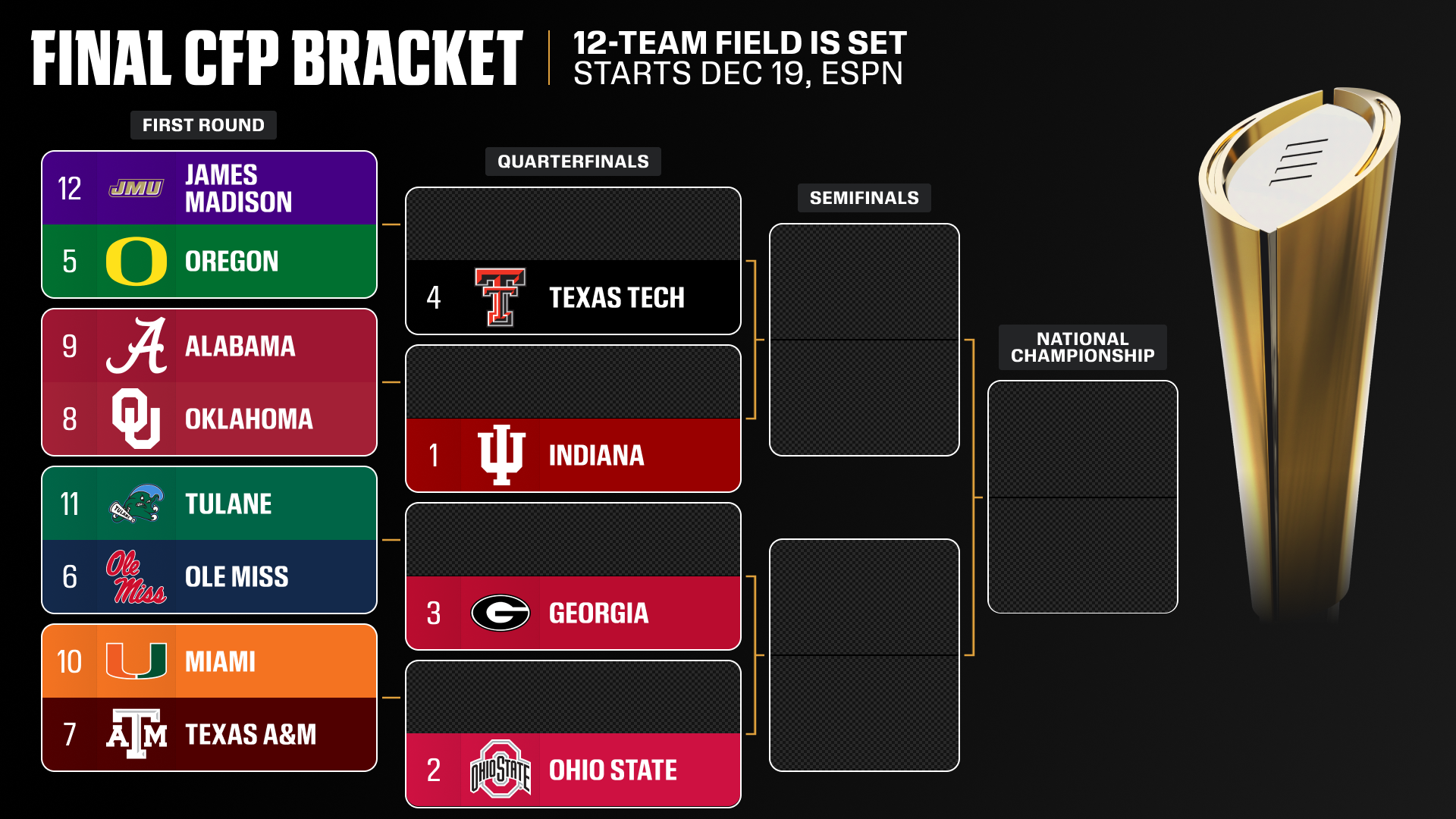
In Atlanta, Georgia dominated Alabama and won the SEC for a second year in a row. The Bulldogs held the Tide to 209 total yards and locked up a first-round bye. UGA, the No. 3 seed, will play the winner of the matchup of No. 6 Ole Miss vs. No. 11 Tulane in the Allstate Sugar Bowl.
It was a similar story in the Big 12 where Texas Tech broke open the game with BYU in the second half. The Red Raiders forced four turnovers in the 34-7 win. Texas Tech is the No. 4 seed and will face either No. 5 Oregon or No. 12 James Madison in the Capital One Orange Bowl.
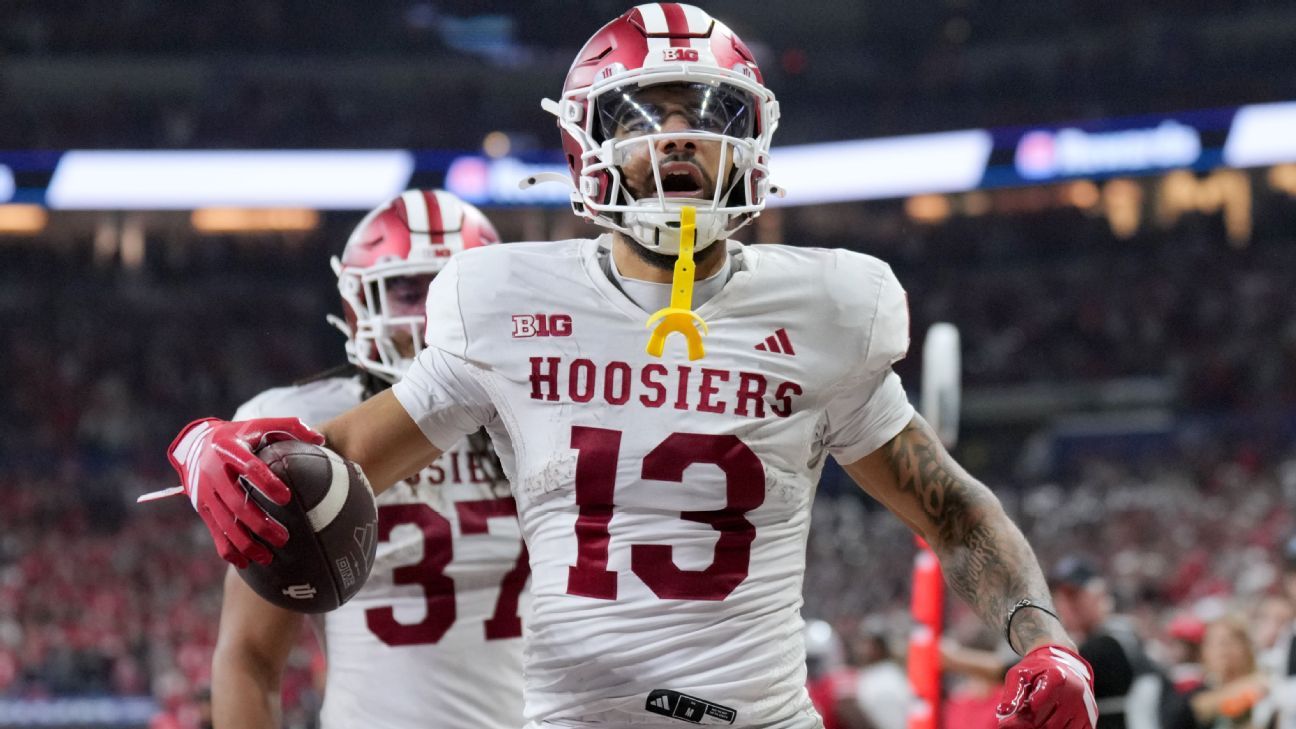
The real drama was reserved for the Big Ten and ACC championships. Indiana won its first conference title since 1967 and took down No. 1 Ohio State. The Hoosiers will be the No. 1 seed while the Buckeyes fell just one spot to No. 2 The undefeated Hoosiers will have their first playoff game at the Rose Bowl presented by Prudential against the winner of the No. 8 Oklahoma-No. 9 Alabama matchup. Ohio State faces the winner of No. 10 Miami vs. No. 7 Texas A&M in the Goodyear Cotton Bowl.
Duke‘s upset of Virginia in the ACC title game opened the door for two Group of 5 teams — Tulane (which won the American) and James Madison (Sun Belt winner).
After months of rankings, seedings and countless debates, we have a 12-team bracket that brings about plenty of enticing questions and intriguing possibilities.
Can Oregon, Indiana, Texas A&M or Texas Tech bring home its first national title? Can Ohio State repeat? Will a Group of 5 team get its first-ever CFP win?
Here are our full picks for the 12-team College Football Playoff.

Andrea Adelson
First round
Oregon 55, JMU 13
Bama 20, Oklahoma 17
Ole Miss 35, Tulane 14
Miami 27, Texas A&M 24
Quarterfinals
Oregon 35, Texas Tech 30
Indiana 30, Alabama 20
Georgia 40, Ole Miss 24
Ohio State 24, Miami 21
Semifinals
Ohio State 27, Georgia 24
Indiana 35, Oregon 31
National title game
Ohio State 21, Indiana 20
Kyle Bonagura
First round
Oregon 49, James Madison 24
Texas A&M 31, Miami 24
Ole Miss 38, Tulane 24
Alabama 31, Oklahoma 28
Quarterfinals
Texas Tech 28, Oregon 27
Georgia 35, Ole Miss 21
Ohio State 24, Texas A&M 14
Indiana 35, Alabama 27
Semifinals
Ohio State 24, Georgia 17
Indiana 28, Texas Tech 24
National title game
Indiana 17, Ohio State 10
Bill Connelly
First round
Oregon 41, James Madison 24
Oklahoma 27, Alabama 17
Ole Miss 35, Tulane 20
Texas A&M 31, Miami 28
Quarterfinals
Texas Tech 38, Oregon 34
Indiana 30, Oklahoma 7
Georgia 27, Ole Miss 23
Ohio State 24, Texas A&M 13
Semifinals
Texas Tech 27, Indiana 23
Georgia 17, Ohio State 16
National title game
Texas Tech 28, Georgia 20
David Hale
First round
Oregon 35, JMU 13
Ole Miss 48, Tulane 24
Alabama 17, Oklahoma 10
Miami 27, Texas A&M 21
Quarterfinals
Texas Tech 24, Oregon 21
Indiana 20, Alabama 10
Georgia 30, Ole Miss 21
Ohio State 34, Miami 24
Semifinals
Indiana 30, Texas Tech 28
Georgia 27, Ohio State 24
National title game
Georgia 24, Indiana 20
Eli Lederman
First round
Oregon 38, James Madison 10
Ole Miss 31, Tulane 20
Alabama 21, Oklahoma 10
Texas A&M 38, Miami 31
Quarterfinals
Oregon 24, Texas Tech 17
Indiana 23, Alabama 10
Georgia 41, Ole Miss 30
Ohio State 30, Texas A&M 17
Semifinals
Indiana 20, Oregon 17
Georgia 27, Ohio State 20
National title game
Georgia 31, Indiana 17
Max Olson
First round
Oregon 34, James Madison 17
Alabama 13, Oklahoma 10
Ole Miss 38, Tulane 14
Texas A&M 27, Miami 24
Quarterfinals
Texas Tech 27, Oregon 20
Indiana 24, Alabama 17
Georgia 41, Ole Miss 31
Ohio State 27, Texas A&M 17
Semifinals
Indiana 17, Texas Tech 16
Georgia 35, Ohio State 31
National title game
Georgia 31, Indiana 20
Adam Rittenberg
First round
Oregon 38, James Madison 13
Ole Miss 34, Tulane 16
Alabama 20, Oklahoma 17
Miami 31, Texas A&M 28
Quarterfinals
Texas Tech 23, Oregon 20
Indiana 24, Alabama 16
Georgia 31, Ole Miss 21
Ohio State 27, Miami 20
Semifinals
Indiana 20, Texas Tech 17
Ohio State 19, Georgia 16
National title game
Ohio State 24, Indiana 20
Mark Schlabach
First round
Oregon 51, JMU 17
Alabama 17, Oklahoma 14
Ole Miss 42, Tulane 20
Miami 28, Texas A&M 20
Quarterfinals
Texas Tech 35, Oregon 31
Indiana 31, Alabama 14
Georgia 35, Ole Miss 28
Ohio State 24, Miami 17
Semifinals
Ohio State 27, Georgia 24
Indiana 42, Texas Tech 38
National title game
Indiana 24, Ohio State 20
Jake Trotter
First round
Oregon 38, James Madison 10
Oklahoma 17, Alabama 16
Ole Miss 30, Tulane 14
Miami 27, Texas A&M 23
Quarterfinals
Texas Tech 25, Oregon 17
Indiana 24, Oklahoma 13
Georgia 35, Ole Miss 14
Ohio State 21, Miami 13
Semifinals
Indiana 19, Texas Tech 17
Ohio State 16, Georgia 14
National title game
Ohio State 21, Indiana 20
Paolo Uggetti
First round
Oklahoma 21, Alabama 17
Oregon 38, JMU 14
Miami 27, Texas A&M 24
Ole Miss 31, Tulane 21
Quarterfinals
Indiana 34, Oklahoma 20
Oregon 24, Texas Tech 21
Georgia 21, Ole Miss 17
Ohio State 27, Miami 20
Semifinals
Indiana 23, Oregon 20
Georgia 24, Ohio State 17
National title game
Indiana 21, Georgia 17
Dave Wilson
First round
Oregon 44, James Madison 13
Texas A&M 27, Miami 17
Ole Miss 31, Tulane 24
Oklahoma 23, Alabama 17
Quarterfinals
Texas Tech 24, Oregon 20
Georgia 44, Ole Miss 17
Ohio State 21, Texas A&M 20
Indiana 24, Oklahoma 10
Semifinals
Georgia 27, Ohio State 17
Indiana 24, Texas Tech 17
National title game
Georgia, 17, Indiana 14

-
Bill Connelly
Championship Week came and went with one last burst of uncertainty. The politicking is mercifully over. The bracket is set for the second 12-team College Football Playoff, and it is an incredible mix of stalwarts and new blood.
Five teams from last year’s field return. Four of the five teams with the most CFP appearances — Alabama (ninth appearance), Ohio State (seventh), Georgia (fifth), Oklahoma (fifth) — are here, too.
But the No. 1 seed is an Indiana team that just won its first Big Ten title in 58 years and had, until earlier this year, lost more games than any other program in the history of college football. No. 4 seed Texas Tech has never finished in the top 10 and just won its first outright conference title since 1955 (when it was in the Border Conference). No. 6 seed Ole Miss has its best record in 63 years, and No. 7 Texas A&M has its best record in 34 years.
Miami, potentially looking at its first top-10 season in 22 years, eked out a bid. Tulane is here! The Green Wave are on their best run since the 1930s! James Madison is here, too! The Dukes were in FCS four years ago!
New blood, bluebloods, great offenses, great defenses. The stakes are set. Let’s talk about why each playoff team will — or won’t — win the national title.
All times Eastern.

Title odds, per SP+: 23.5% (No. 2 favorite)
Quarterfinal opponent: vs. Oklahoma-Alabama winner (first-round bye)
Why they will win it all: No known weakness. Are you a “defense wins championships” person? Indiana ranks second in defensive SP+, third in points allowed per drive and sixth in success rate* allowed. The Hoosiers just held Ohio State to its lowest point total in 18 games. Do you like defensive disruption? They’re second in stuff rate (run stops at or behind the line) and seventh in sack rate.
(* Success rate: How frequently an offense is gaining 50% of necessary yardage on first down, 70% on second and 100% on third or fourth.)
Need to know that your title pick has a QB it can count on in big moments? Fernando Mendoza is third in Total QBR and is, if betting odds are to be believed (and they usually are), the Heisman favorite by a large margin. And in Elijah Sarratt and Omar Cooper Jr., he has maybe the most elite receiving duo in the country outside of Columbus. Does it help to know what a team can ground-and-pound when necessary, or stop its opponent from doing the same? IU’s offense ranks fourth in rushing success rate and 17th in yards per carry (not including sacks); its defense ranks fourth and 12th, respectively, in the same categories.
Third downs are important — what about those? Indiana is first nationally in third-down conversion rate (55.8%) and second on third-down conversion rate allowed (28.1%).
Have they come through away from home? Yeah, I’d say winning at Iowa City and Eugene probably qualifies.
There’s a reason why Indiana is the last unbeaten team standing. This team has aced every test it has been given in 2025.
Why they won’t: Random big-play issues. When you allow just 4.6 yards per play and 0.9 points per drive, you don’t have a serious issue with big plays. But a few teams did still have some success creating chunk plays.
Old Dominion scored on touchdown runs of 78 and 75 yards. Illinois hit on a 59-yard TD pass. Penn State had a 59-yard run and 43-yard pass. Kennesaw State had three completions of 30-plus yards. Hell, 98 of Ohio State’s 322 yards came on two completions (though one was a fruitless end-of-game Hail Mary), as did 93 of Maryland’s 293 yards. Even if it’s not a season-long issue, there are plenty of ultra-explosive offenses in this playoff field, and a couple of glitches could become extremely costly.

Title odds, per SP+: 28.6% (No. 1 favorite)
Quarterfinal opponent: vs. Texas A&M-Miami (first-round bye)
Why they will win it all: They’re Ohio State. The Buckeyes are the defending champions, they have at least two of the five or so best players in the sport (receiver Jeremiah Smith, safety Caleb Downs), their quarterback (Julian Sayin) has the highest Total QBR of any playoff QB, their offense ranks fourth in points per drive (despite having played four games against top-20 defenses, per SP+), and their defense ranks first in defensive SP+ and second in points per drive and yards per play.
They have all the components you could ask for, and despite Saturday night’s loss to Indiana, they enter this year’s CFP with better form and fewer question marks. And hell, after 11 straight comfortable wins, even the loss might be beneficial from the standpoints of focus and motivation. This is the shortest “why they will win it” section in this entire piece, but it’s also the most definitive. We know how good they are.
Why they won’t: Cautious programming. Against the best defense he has faced in his footballing life, Sayin completed 21 of 29 passes for 258 yards, a touchdown and an interception. Granted, those numbers were boosted by the late Hail Mary completion, but he mostly kept the ball out of harm’s way, and in nearly his first genuinely high-consequence drive all season, he drove the Buckeyes 70 yards inside the Indiana 5 in the third quarter and 81 yards inside the 10 in the fourth.
Sayin came up just short on a fourth-down QB sneak on the former drive, however, which evidently prompted Ryan Day to go shockingly conservative on the latter. On fourth-and-1 from the 9, Day elected to attempt a game-tying field goal, one that, even had Jayden Fielding made it, would have given the Hoosiers ample time to drive down for a field goal of their own. Fielding missed it. Ball don’t lie.
Day and offensive coordinator Brian Hartline have played it safe with Sayin for most of the season, easing him in, dialing up mostly quick passes and programming him to throw the ball away if he doesn’t see what he wants. When you have a star-studded receiving corps and an incredible defense backing you up, that makes sense. But you might need to dial the risk factor up in big moments, and it sure felt like Ohio State failed in that regard Saturday night. Will they put their faith in Sayin when it matters the most? Will he back up the faith if they do?

Title odds, per SP+: 9.8% (No. 4 favorite)
Quarterfinal opponent: vs. Ole Miss-Tulane winner (first-round bye)
Why they will win it all: They’re mean again. Georgia was maddening to watch early this season. Kirby Smart’s Bulldogs almost seemed to come out without a game plan, playing things as vanilla as possible, taking some shots from the opponent — and frequently falling behind into the second half — before rallying. It worked, aside from a loss to Alabama, but it made for some underwhelming performances (and undue stress for fans).
Over the past four games, however, the defense has locked in, allowing a paltry 7.3 points per game, 4.3 yards per play and 2.6 yards per carry, not including sacks. The Dawgs have forced three-and-outs 41% of the time in this span (10th nationally), and they’ve allowed touchdowns on just 17% of red zone trips (second).
In Saturday’s SEC championship game, a 28-7 win over Alabama, the Dawgs painted their masterpiece. They allowed just 209 total yards (3.8 per play), including just 20 non-sack rushing yards. On Bama’s first eight possessions, the Tide punted seven times, turned the ball over once and finished just one drive in Georgia territory. They finally moved the ball late but never got closer than 14 points.
After some listless play early on, Georgia is defending as well as it has since the 2022 season, its last national title year.
Why they won’t: A lack of big plays. Despite having faced a schedule featuring five top-20 defenses (per SP+), Georgia’s overall offensive numbers have been solid. It is 14th in offensive SP+, 23rd in points per drive and 22nd in success rate. The run game probably hasn’t helped as much as Smart would prefer, but short, quick passing has bridged the efficiency gap, and the Dawgs have scored at least 28 points nine times. That’s more than enough with the way the defense is playing.
While efficiency levels have been solid, Georgia struggles to create chunk plays. The Dawgs rank 130th in yards per successful play; quarterback Gunner Stockton averages just 10.7 yards per completion, and that sinks to 9.5 per completion against top-20 defenses. He almost never puts the ball in harm’s way, but safety comes with a price, and UGA is not built to move the ball quickly and aggressively if (or when) the need arises.

Title odds, per SP+: 20.9% (No. 3 favorite)
Quarterfinal opponent: vs. Oregon-James Madison winner (first-round bye)
Why they will win it all: They have the best front six in the country. Jacob Rodriguez is the best linebacker in the nation. Fellow linebacker Ben Roberts (two interceptions and a pass breakup) was the Big 12 championship game’s MVP. David Bailey is second in the nation in sacks and third in TFLs. Romello Height is 16th in sacks. And despite losing Skyler Gill-Howard to a midseason injury, tackles Lee Hunter and Anthony Holmes Jr. have prevented any semblance of a drop-off in the middle.
The secondary is good, too, but the front six has been transcendent in Lubbock. The Red Raiders rank third nationally in success rate allowed (31.3%), third in yards allowed per play (4.0) and first in yards allowed per carry, not including sacks (3.3). They’ve allowed more than two offensive touchdowns just once all year (to Kansas State in a game they still won by 23), and they’ve allowed less than 4.0 yards per play eight times in 13 games. Over the previous 15 seasons, Tech’s average defensive SP+ ranking was 83.0; thanks to first-year coordinator Shiel Wood and a transformational transfer class, the Red Raiders enter their first CFP ranked fourth. And since a 26-22 loss to Arizona State — suffered without starting quarterback Behren Morton — the offense has averaged 40.8 points per game. This band of pirates is playing utterly merciless ball at the moment.
Why they won’t: Red zone offense. Tech’s offensive numbers have been good, especially considering Morton was in and out of the lineup in the first two months. The Red Raiders are 15th in points per drive, and they can lean heavily into whatever opponents can’t stop. Cameron Dickey and J’Koby Williams grind out 145 rushing yards per game (5.5 per carry), and four receivers — all 6-foot-2 or taller — have caught between 46 and 55 passes.
They’ve scored TDs on just 56% of red zone trips, however, which is 101st in the nation. Against three top-20 defenses (Utah, plus BYU twice), the Red Raiders turned 14 trips into just five TDs (36%). By settling for field goal attempts, they let BYU hang around into the second half of both their meetings despite total defensive domination, and the level of competition will only rise from here.

Title odds, per SP+: 6.8% (No. 5 favorite)
First-round opponent: vs. No. 12 James Madison (Dec. 20, 7:30 p.m., TNT)
Why they will win it all: Big plays and three-and-outs. Oregon has gained at least 20 yards on 10.4% of its snaps this season, the most in the country. The Ducks have also allowed gains of at least 20 yards on 3.3% of their snaps, the least in the country. They have gone three-and-out just 15.3% of the time (fourth) while forcing three-and-outs 42% of the time (fifth). It is, to say the least, difficult to beat a team that is pummeling you in both the efficiency and explosiveness departments.
Flexibility is the name of the game for Dan Lanning’s Ducks in 2025. For the third straight season, with a third different starting quarterback, they have played beautifully efficient offense: They rank fifth nationally in offensive success rate (they were seventh in 2024 and first in 2023). They’re also in the overall SP+ top four for the third straight year. This year, however, the defense has caught up to the offense. They’re fifth in defensive SP+, their highest ranking since 1958, and while they’ve topped 34 points seven times, they’ve also won Big Ten rock fights with scores of 18-16 and 21-7. You need to have a lot of arrows in the proverbial quiver to work through the CFP, and while Oregon has been really good for a while, it feels like the Ducks have more arrows than ever.
Why they won’t: More disruption needed. As effective as the defense has been, the Ducks haven’t been great at forcing the issue. They rank 98th in stuff rate and 47th in sack rate. They force a lot of passing downs — which I define as second-and-8 or more and third- or fourth-and-5 or more — but they rank 47th in passing-down success rate allowed, and if you can work the ball into the red zone, you’re probably scoring seven points: Oregon’s 75.0% red zone TD rate allowed ranks 129th.
Against defenses without disruption, good offenses are consistent enough to thrive. Against the two top-15 offenses they’ve faced (Indiana and USC), the Ducks allowed 28.5 points per game and 5.1 yards per play — not terrible averages, but not dominant either.

Title odds, per SP+: 4.6% (No. 6 favorite)
First-round opponent: vs. No. 11 Tulane (Dec. 20, 3:30 p.m., TNT)
Why they will win it all: Vengeance (and great passing). Now that the weeks of innuendo and will-he-or-won’t-he questions are over, Ole Miss will head into its first CFP without Lane Kiffin but with most of the rest of the coaching staff. And while the Rebels aren’t the title favorites by any means, they’re capable of beating any team they play, especially if Kiffin’s departure produces a useful chip-on-the-shoulder effect.
The Rebels’ defense regressed from last year’s level, but it defends the pass well and has allowed more than 26 points only twice. When you almost never score fewer than 26 points (also twice all year), that puts you in a pretty good place. Ole Miss hogs the ball and wears opponents down with a solid but unspectacular run game (74th in yards per carry, not including sacks), and when it’s time for Trinidad Chambliss to pass, he often does something great. Chambliss is fifth in Total QBR, the Rebs are sixth in passing success rate and eighth in yards per dropback, and 23.1% of their completions have gained at least 20 yards (fourth). He rarely faces pressure — often because of good downs and distances — and is able to keep his eyes downfield quite a bit. Kewan Lacy and the run game are persistent, but the pass is why the Rebels are here.
Why they won’t: Run defense. The pass defense may be sound, but Ole Miss has been gashed on the ground at times. Not including sacks, the Rebels allow 5.0 yards per carry (83rd). Five opponents produced at least a 47% rushing success rate against them, including the only team to beat them (Georgia) and three that nearly pulled upsets (Kentucky, Washington State and Arkansas). Tackles Will Echoles and Zxavian Harris can both create negative plays, and not every CFP team has a great run game, but enough do for this to become a serious problem.
(One other thing to track, whether it’s a fatal flaw or not: How does new coach Pete Golding handle fourth-down decision-making? Kiffin has been famously aggressive on fourth downs through the years, and Ole Miss has scored 79 points after fourth-down conversions this season while allowing only three points after turnovers on downs. That’s some serious profit, and it could cost the Rebels if Golding chooses to be more conservative.)

Title odds, per SP+: 2.2% (No. 7 favorite)
First-round opponent: vs. No. 10 Miami (Dec. 20, noon, ABC)
Why they will win it all: Leverage. On offense, A&M brilliantly applies both horizontal and vertical leverage in the passing game, using speedsters KC Concepcion and Mario Craver to stretch defenses wide and deep threat Ashton Bethel-Roman and tight ends Theo Melin Öhrström and Nate Boerkircher to stretch them vertically. Once defenses are properly stressed, run lanes begin to open up for running back Rueben Owens II. At his best, quarterback Marcel Reed fires the ball quickly to all these different weapons and provides a solid run threat as well. The Aggies have topped 40 points seven times.
On defense, A&M leverages opponents into passing downs and tees off. Led by Cashius Howell (11.5 sacks), the Aggies rank first nationally in sack rate, and they are nearly impossible to beat on third downs: 73% of opponents’ third downs have required at least 7 yards (first), and A&M has allowed conversions on only 22% (also first). They also force three-and-outs 41% of the time (seventh). Attack, attack, attack.
Why they won’t: They may have peaked early. Following their 38-17 win at Missouri in Week 11, the Aggies proceeded to underachieve against SP+ projections by 20.9 points per game in their final three. Part of that average comes from showing mercy to an outmanned Samford, but they needed a huge second-half comeback to beat 4-8 South Carolina, and they got knocked out in the second half at Texas.
The Aggies’ run game isn’t contributing as much, and Reed is facing more pressure (35.6% pressure rate over the past three games), taking more sacks and throwing more interceptions — two each against South Carolina and Texas. And while their third-down conversion rate was 43.1% over their first nine games, it was 24.0% against the Gamecocks and Longhorns.
Defensively, glitches that have been problematic all season have become downright worrisome:
South Carolina had gains of 80 and 50 yards, and Texas had gains of 54, 48, 35 and 30. A&M now ranks 135th (out of 136) in yards allowed per successful play (14.4) and 127th in rushing yards allowed after contact (3.3). Defensive aggression risks big-play breakdowns, and things didn’t trend well in November. Maybe some rest will help?

Title odds, per SP+: 1.0% (No. 9 favorite)
First-round opponent: vs. No. 9 Alabama (Dec. 19, 8 p.m., ABC)
Why they will win it all: The coolest defense in the country. What if you could combine Texas A&M’s aggression with solid big-play prevention? You can! OU does just about every week. The Sooners rank second in success rate allowed (first against the run), third in stuff rate (run stops at or behind the line), third in sack rate and fourth in three-and-out rate, but they’re also allowing a much more palatable 12.7 yards per successful play (99th, but far ahead of A&M), and they’ve allowed 17 or fewer points eight times.
Linemen Taylor Wein and Gracen Halton have combined for 24 tackles for loss and 22 run stops, and their best lineman, R Mason Thomas, could be close to healthy by the time the playoff rolls around. Meanwhile, the secondary more than carries its weight: Corners Courtland Guillory and Eli Bowen have allowed just a 38% completion rate in coverage with two interceptions, 12 breakups and just two touchdowns allowed.
OU’s offense isn’t very good (we’ll get to that), but the Sooners know themselves as well as anyone in this field. The defense does most of the heavy lifting, and when the offense is given an opportunity, it takes advantage: The Sooners score TDs on 72% of red zone trips (16th). They’ve won in Knoxville and Tuscaloosa, and their reward for that is a first-ever playoff home game. Sooners fans cheered on the move to the SEC because they wanted bigger home games, and here comes the biggest one imaginable. And against an Alabama team the Sooners know they can beat.
Why they won’t: The Sooners can’t score. This seems pretty important. Even with excellent red zone execution, the Sooners rank 87th in success rate (111th rushing), 89th in points per drive and 95th in yards per play. Dreadful stuff.
Quarterback John Mateer‘s numbers were obviously impacted by his early-season hand injury (and how quickly he attempted to come back from it), but downfield passing has been an issue all season. He has completed 30% of passes 20 or more yards downfield, 104th among QBR-eligible QBs. The run game has been dreadful: The Sooners have averaged 3.3 yards per carry over the past three games. Playing well in the red zone is important, but they probably won’t create enough red zone chances to make a major run.

Title odds, per SP+: 0.7% (No. 10 favorite)
First-round opponent: at No. 8 Oklahoma (Dec. 19, 8 p.m., ABC)
Why they will win it all: They’re battle tested. In retrospect, we know Alabama basically clinched its playoff spot in October; in consecutive weeks, the Crimson Tide beat Georgia (24-21), Vanderbilt (30-14), Missouri (27-24) and Tennessee (37-20). They were great early against Georgia, in the middle against Mizzou and late against Vandy, and it looked like all the pieces had come together against the Vols. Ty Simpson was my Heisman points race leader into November, and even with a recent downturn, he has still produced great season stats: 3,268 passing yards, 64% completion rate, 26-to-5 TD-to-INT ratio. Their legs looked a little weary down the stretch, but we know they’re capable of producing form that can beat anyone.
Well, the offense looked weary down the stretch. The defense keeps improving. Against four top-15 offenses (per SP+), the Tide allowed just 20.8 points per game, and they gave up fewer yards per play with each contest — 6.7 against Georgia the first time, then 6.2 against Vandy, then 5.3 against Tennessee, then 4.4 against Georgia the second time. Edge rusher Yhonzae Pierre (11.5 TFLs, six sacks) is one of the SEC’s best playmakers, and safety Bray Hubbard (four interceptions, six breakups) punishes mistakes in the back. The offense won’t have to produce a ton for the Tide to win some playoff games.
Why they won’t: They last looked like a playoff team in Week 8. That’s kind of an issue, isn’t it? Thanks primarily to a fading offense, the Tide have underachieved against SP+ projections in four of their past six games, falling from sixth (after the Vandy game) to 13th in SP+ in the process. The run game has never kicked in — RB Jam Miller hasn’t been able to stay healthy (and hasn’t been great even when he’s available) — and carrying the weight of the offense seemed to wear Simpson down: His Total QBR was 82.7 through seven games, 74.5 over the next four and 54.0 over the past two.
Simpson averaged a ghastly 3.7 yards per dropback against Auburn and Georgia, and both his timing in the pocket and his timing with receivers has been terribly off. Maybe a week off will help, but we haven’t seen Bama’s best for a while — and we certainly didn’t see it the last time the Tide played OU.

Title odds, per SP+: 1.7% (No. 8 favorite)
First-round opponent: at No. 7 Texas A&M (Dec. 20, noon, ABC)
Why they will win it all: Football is an efficiency game. If you’re winning more plays than your opponent, you can win any game you play, and few win more plays than Mario Cristobal’s Hurricanes. They’re 10th in success rate (49.6%) and eighth in success rate allowed (34.5%); Indiana and Ohio State are the only other teams to rank in the top 10 in both categories.
Miami found balance this season. The Hurricanes were first in offensive SP+ in 2024 thanks to Cam Ward and the rest, but the Hurricanes were a dismal 52nd on defense, allowing 37.3 points per game in three losses and even giving up 30-plus in four wins. The offense predictably regressed after Ward’s departure, but Carson Beck, Malachi Toney & Co. are still 16th in offensive SP+, and the defense has carried a far heavier load thanks to a brilliant new coordinator (Corey Hetherman), a junior-year breakthrough from star lineman Rueben Bain Jr. and a number of transfer hits — linebacker Mohamed Toure is a dynamo in the middle, and a number of new DBs (safeties Jakobe Thomas and Zechariah Poyser, corners Keionte Scott and Xavier Lucas) have been stellar.
The Canes have so many more paths to victory now: The offense has scored 34 or more seven times, and the defense has allowed 12 or fewer seven times.
Why they won’t: Individual games are decided by big plays and turnovers (and close-and-late situations). In two losses, the Hurricanes had as many turnovers (six) as 20-yard gains. Beck threw six picks while averaging just 10.7 yards per completion. Turnover risk without any reward will doom you, efficiency or no efficiency.
Cristobal also has so much to prove in close games. Miami is 2-2 in one-score finishes this year, and a close win — in Week 1 against Notre Dame — got the Hurricanes into the playoff field. But Cristobal’s old, overly conservative tendencies backfired in both losses. Down three late against Louisville, the Canes played for a field goal instead of a touchdown; tied with 25 seconds (and a timeout) left against SMU, they kneeled the ball out and played for overtime. They lost both times. Winning four playoff games, including one in the first round against A&M (4-0 in one-score games), will require nailing late-game circumstances, and I wish we had more evidence that Miami is capable of that.

Title odds, per SP+: 0.02% (No. 12 favorite)
First-round opponent: at No. 6 Ole Miss (Dec. 20, 3:30 p.m., TNT)
Why they will win it all: Turnovers and TFLs. Tulane broke through with 12 wins and a Cotton Bowl victory in 2022, and the Green Wave have remained a Group of 5 contender ever since. After enjoying double-digit wins in just one season from 1935 to 2021, they’ve done it three times in the past four seasons.
Second-year coach Jon Sumrall didn’t like his team very much this October: After a tighter-than-necessary win over East Carolina, he told ESPN’s Harry Lyles, “We’re a really sloppy football team that finds ways to win games, and I’m going to lose my mind because we’re so immature.” They would get blown out by UTSA a couple of games later.
Since the start of November, however, the defense has surged. The Green Wave rank sixth in turnover rate (4.0%) and 18th in TFLs per game (7.0) in that span, and they’re allowing just 4.0 yards per carry, not including sacks (22nd). They force loads of passing downs and pounce on whatever mistakes the opposing quarterback makes, while Jake Retzlaff and the offense do lots of whatever the defense can’t stop. They forced five turnovers in Friday’s American championship game against North Texas, returning one for a touchdown, and against a UNT defense that is poor against the run, they simply rushed their way to a 34-21 win.
Why they won’t: You probably need to be elite at something. Tulane looks more like a power conference team than almost any in the Group of 5, and it beat both Northwestern and Duke in nonconference play. Sumrall teams will always problem-solve beautifully, even if they have to move to Plan B or Plan C. There’s a reason Sumrall has won three conference titles in four years as a head coach, and there’s a reason Florida hired him. But the Green Wave don’t have any elite traits this season, and when you have nothing you know you can lean on, sometimes not even Plan C will uncover an answer.
Tulane’s two losses this season were blowouts. Ole Miss (forgivable) and UTSA (less so) outscored them by a combined 93-36 and outgained them by a combined 355 yards. They can win a tight game against just about anyone, but if/when they lose in the CFP, it might not be close. And scaring Ole Miss in a first-round rematch will require a far better performance, especially from Retzlaff.

Title odds, per SP+: 0.2% (No. 11 favorite)
First-round opponent: No. 5 Oregon (Dec. 20, 7:30 p.m., TNT)
Why they will win it all: What, like it’s hard? JMU walked through the FBS door four years ago and immediately started acting like it owns the place. The Dukes are 40-10 in the FBS, and four of those losses came in 2024, as they were transitioning from Curt Cignetti to Bob Chesney. Once Chesney got his footing, so did the Dukes. They’re back in the SP+ top 25 for the second time in three seasons, and their only loss was at Louisville in September. They allowed the Cardinals just 264 total yards, and the game was tied in the fourth quarter until it turned on a fumble.
The Dukes look the part. JMU’s offense is top-30 in most key categories; it can play with high efficiency at times, and when it doesn’t, it bails itself out with big plays like Wayne Knight‘s 73-yard touchdown run Friday night in the Sun Belt championship game.
0:36
Wayne Knight bursts through for a 73-yard JMU TD
Wayne Knight breaks a few tackles on his way to a 73-yard rushing touchdown for James Madison.
The defense is simply dynamite. The Dukes rank first in success rate allowed (29%) and fourth in yards allowed per play (4.1). Colin Hitschler’s defense attacks nonstop, knowing that even if it gives up a big play or two, the flood of three-and-outs and turnovers will balance that out. Redshirt freshman Sahir West leads the team with 14 TFLs — he had 5.5 TFLs and three sacks against Troy on Friday — but eight different Dukes have at least five TFLs, and their trio of cornerbacks in Justin Eaglin, Elijah Culp and DJ Barksdale (slot) compares well to any in the CFP.
Why they won’t: You probably can’t rely on big plays in the CFP. Knight has nine rushes of at least 30 yards (more than 91 FBS teams) and quarterback Alonza Barnett III has added seven rushes of 20-plus yards while completing 17 passes of 30-plus. Chunk plays are fabulous bailouts, but it’s a lot harder to generate those against elite defenses. Against the two SP+ top-30 defenses the Dukes faced (Louisville and Washington State), they averaged just 19 points at 4.5 yards per play. Winning a CFP game (or games) will require dynamite defensive play, and while JMU could deliver that, there is minimal margin for error there. Can they hold Oregon to, say, 24 or fewer points?
-
 Sports2 years ago
Story injured on diving stop, exits Red Sox game
-
 Sports3 years ago
‘Storybook stuff’: Inside the night Bryce Harper sent the Phillies to the World Series
-
 Sports2 years ago
Game 1 of WS least-watched in recorded history
-
 Sports3 years ago
Button battles heat exhaustion in NASCAR debut
-
 Sports3 years ago
MLB Rank 2023: Ranking baseball’s top 100 players
-
Sports4 years ago
Team Europe easily wins 4th straight Laver Cup
-
 Environment3 years ago
Japan and South Korea have a lot at stake in a free and open South China Sea
-
 Environment1 year ago
Here are the best electric bikes you can buy at every price level in October 2024