

VMAX VX2 Hub 33 MPH e-scooter review: Fast yet surprisingly stable – and affordable!

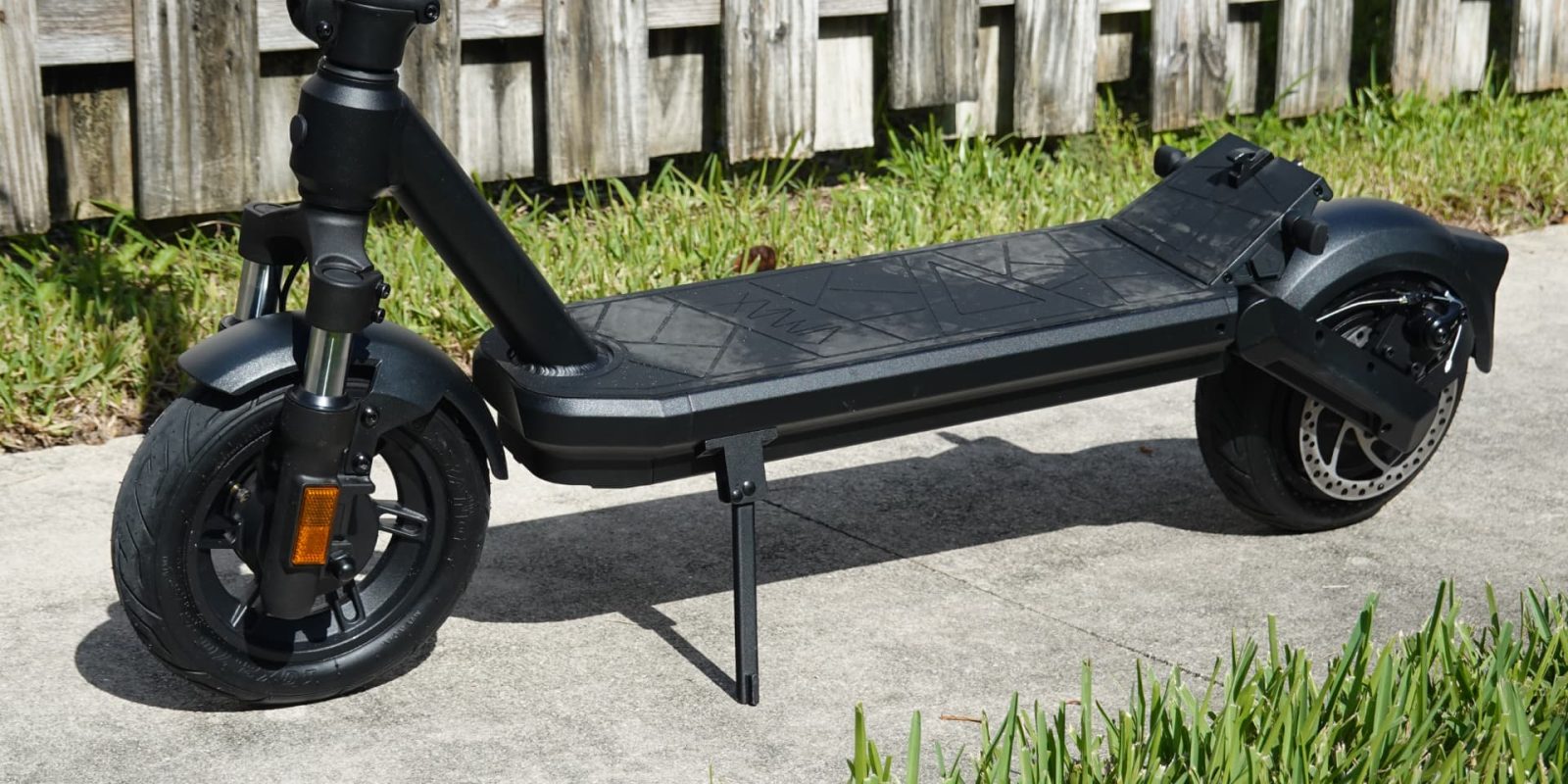
When it comes to high-performance electric scooters that are still reasonably priced, it’s a tricky balance. Most affordable scooters are underpowered and wobbly. The powerful ones often creep into motorcycle territory – with prices to match. But the VMAX VX2 Hub might just be the sweet spot we’ve been waiting for. It’s fast, it’s strong, it’s well-built, and most importantly – it actually feels good to ride.
Let’s dive into what makes this scooter stand out.
VMAX VX2 Hub video review
First of all, I know that seeing is believing, so for those who actually want to see the scooter in action, check out my video review below. Or keep reading for everything else!
Speed and power that actually feel usable
The VMAX VX2 Hub comes in two versions based on battery size – either a 642 Wh (13 Ah) pack or an 874 Wh (18.2 Ah) extended-range model. Both feed a rear hub motor capable of putting out a peak of 1,900W, giving the scooter enough torque to climb 35% grade hills. That’s steeper than pretty much anything you’ll find in San Francisco, and trust me, you’ll feel that power when you hit the throttle.
The top speed is a solid 33 mph. And unlike some scooters that get shaky or sketchy at high speeds, this one feels comfortable even as the numbers climb. It’s the kind of top-end performance that’s thrilling without becoming reckless – though yes, safety gear is still a good idea.
Just don’t do what I did and launch it in full-power mode on your first ride. I gave it full throttle, wasn’t ready for how torquey it was, and immediately pulled a wheelie. This isn’t your budget Amazon scooter with a throttle that’s either “on” or “off.” This one demands finesse – more like driving a vehicle than riding a toy.
And I love that about it, since it’s bad form (and a bad habit) to treat a throttle like an all-or-nothing affair. But weaker e-scooters teach us that bad habit, and when you finally get something with some real power, you have to remember that power is a spectrum.
Comfort, control, and a little class
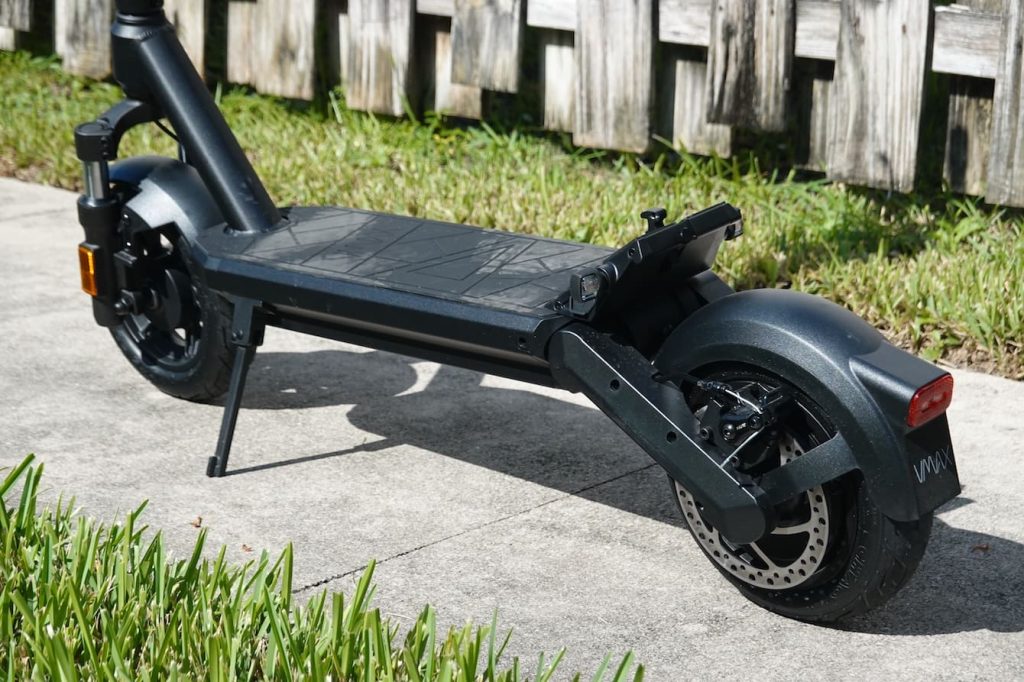
The rubberized deck provides excellent grip, though it is a bit of a footprint magnet – something I learned when I ruined my clean b-roll shots riding it to the filming location.
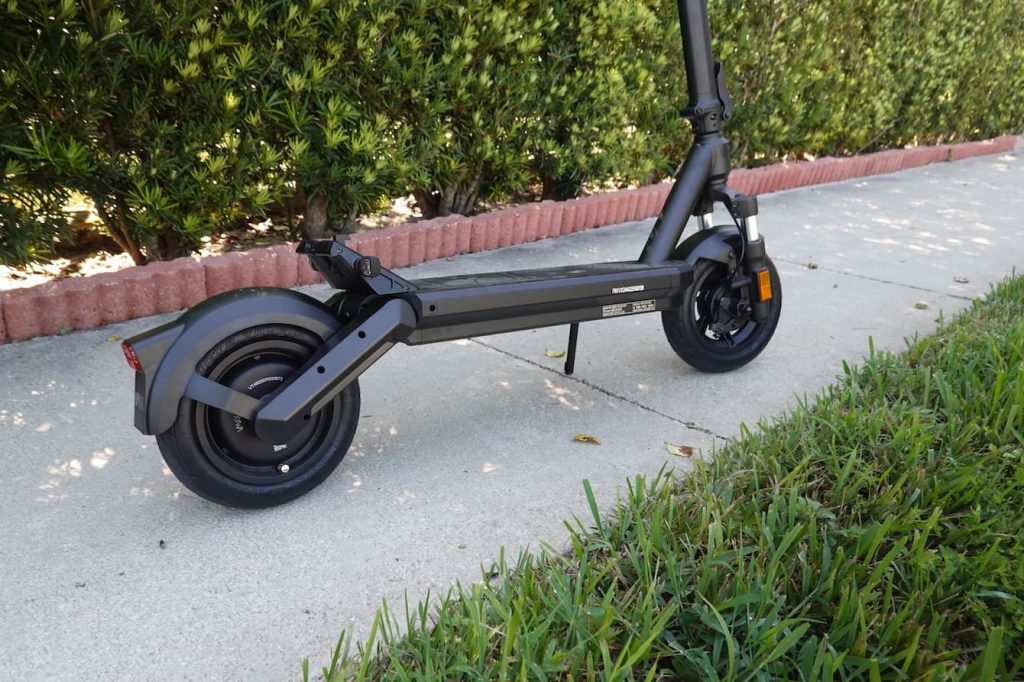
The folding mechanism is particularly well-designed, staying sturdy even under hard riding. And I appreciate the hidden hook-and-lock design at the rear of the deck, which keeps the handlebars secured when folded without a hook being an annoying protrusion during rides, like on most scooters. Just push the spring-loaded button and the locking hook pops up from its flush mount on the rear kick plate. It’s a really slick design. See it in my video review above.
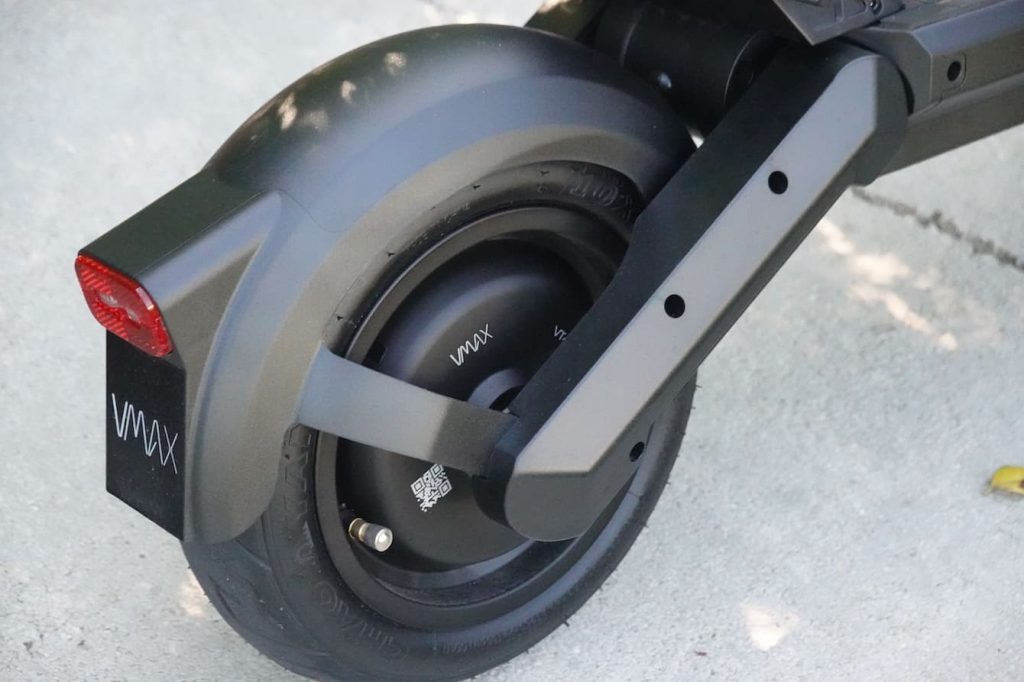
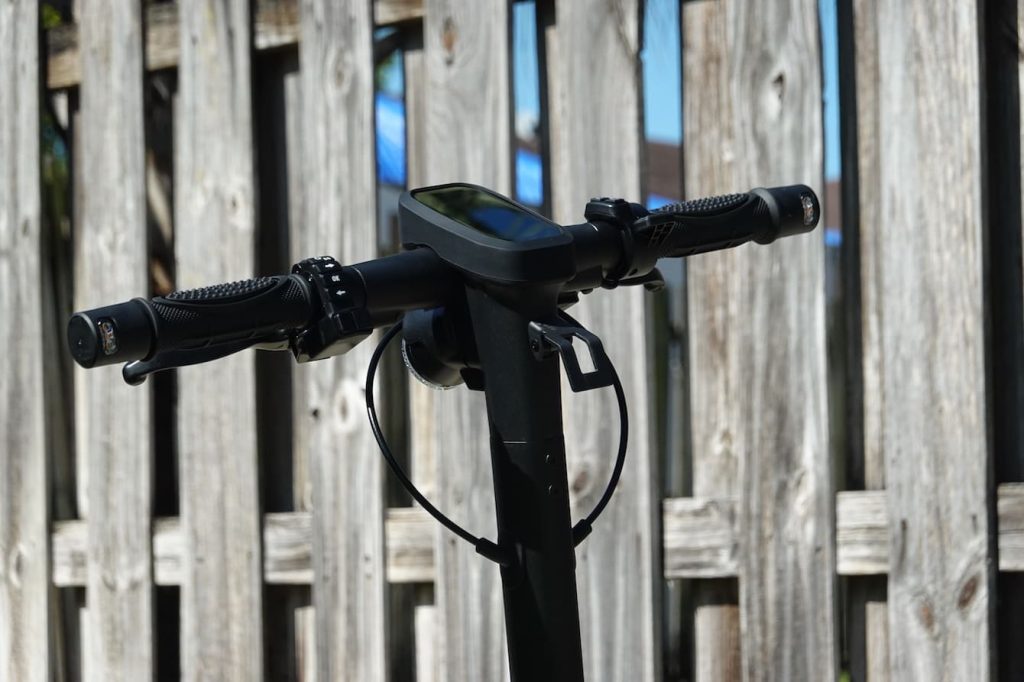
Lighting is another big win here. Rear turn signals stick out wide enough to actually be questionably useful in traffic, if cars are looking for turn signals on the back of a scooter. But there are also turn signals on the handlebars, too, facing both forward and rearward. Night commuting on VMAX scooters has always felt safer thanks to their lighting setups, and the VX2 Hub keeps that tradition strong.
Suspension-wise, it’s not an off-roader – but it doesn’t pretend to be. You can still take it off the paved path now and again, as I did several times, cutting across grassy embankments or taking the odd shortcut through a park. On flatter trails or grassy areas, the full suspension soaks up bumps better than you’d expect. It’s certainly worlds better than a rigid frame or single-suspension setup.
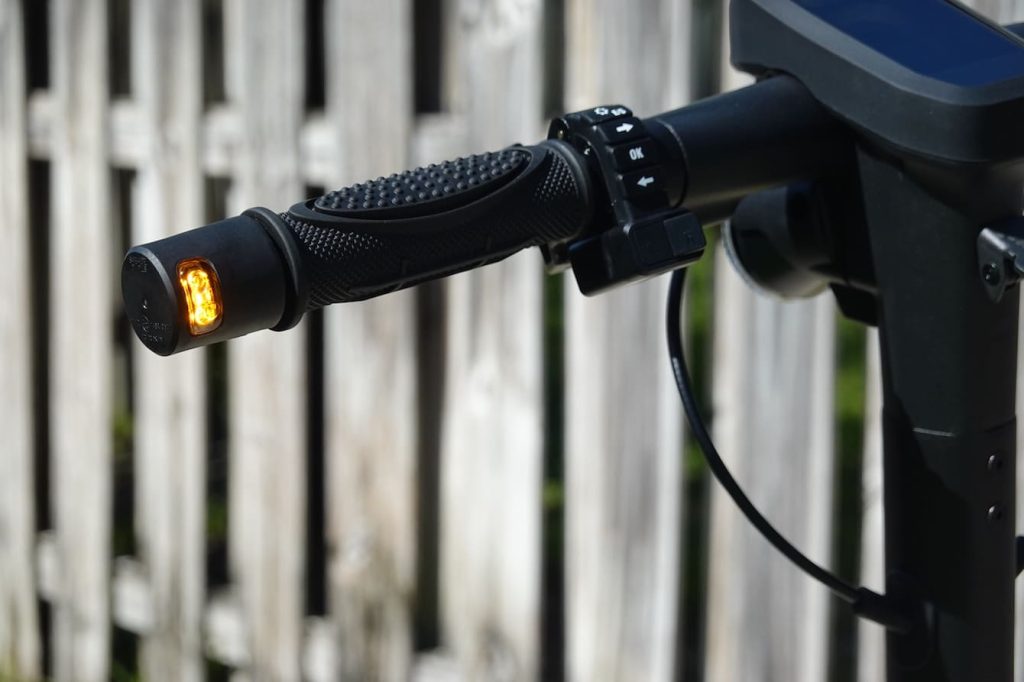

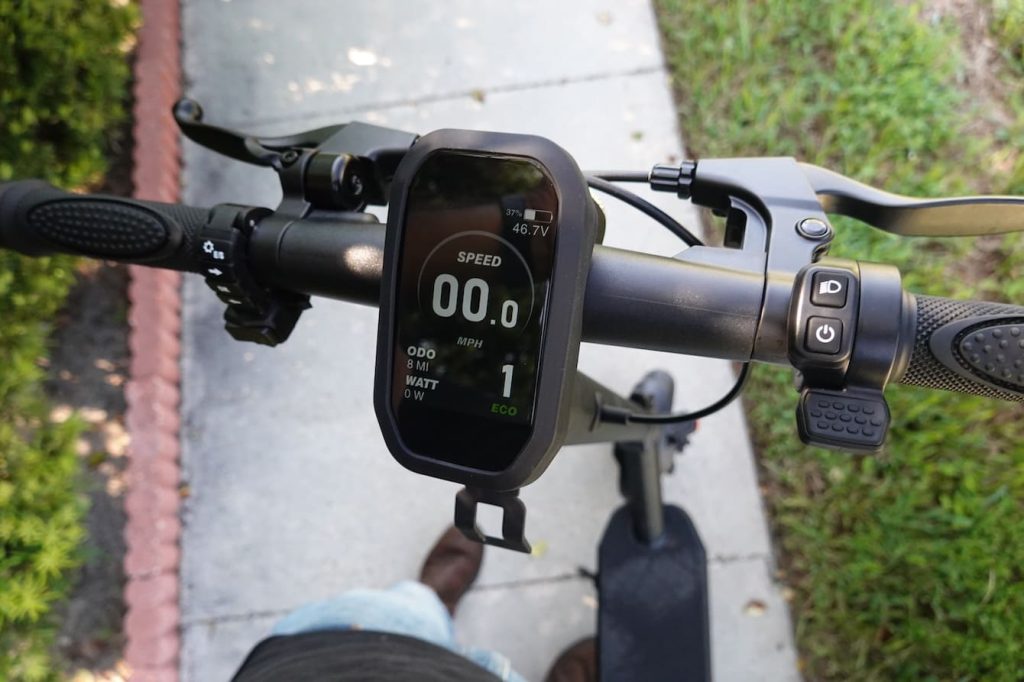
One feature I love is the presence of a USB-C charging port onboard. It’s small, but thoughtful, giving you a convenient way to keep your phone charged on the handlebars. So many scooters still have an older USB-A port, so I’m glad to see VMAX is rolling with the times.
And while VMAX does offer a fairly robust smartphone app, it’s completely optional. You don’t need the app to turn on or ride the scooter – just to unlock a few extra features and getting deeper ride data to nerd out on the numbers. That’s a breath of fresh air in an age where every company wants you to download yet another app just to use the basic functions of your device.
Pricing and value
At $1,199 for the standard battery and a couple hundred more for the extended-range version, the VX2 Hub isn’t a cheap scooter – but it’s an incredible value for what you get. Between the 10-inch tubeless tires, full suspension, fast performance, and sturdy build, it honestly feels more like a mini motorcycle than a last-mile scooter.
And that’s the point. This isn’t a toy. It’s a real vehicle. A compact, fun, efficient, and powerful one.
Over many years, I’ve tested everything from budget scooters to ultra-premium ones, and the VMAX VX2 Hub hits that elusive middle ground where performance meets practicality. It’s got the power and speed you want, with the safety and quality you need – and it doesn’t require a second mortgage.
If your idea of micromobility includes skipping over budget compromises and going straight to the good stuff without breaking the bank, the VX2 Hub deserves a serious look.


FTC: We use income earning auto affiliate links. More.

Folding e-bikes come in all shapes, sizes, and questionable design choices, but every once in a while, one comes along that makes me take a second look. After so much time on heavier folding e-bikes, that was my experience with the Tezeus Swift, a carbon fiber folding e-bike I recently spent a couple of weeks riding.
On paper, it looks like a lightweight urban commuter with modest power. In practice, it turned out to be a surprisingly polished little machine that feels far more refined than most of the budget folders we tend to see.
Let’s dive into what makes the Swift interesting, where it excels, and a couple of areas where I think Tezeus could still tighten things up.

Carbon fiber and compact practicality
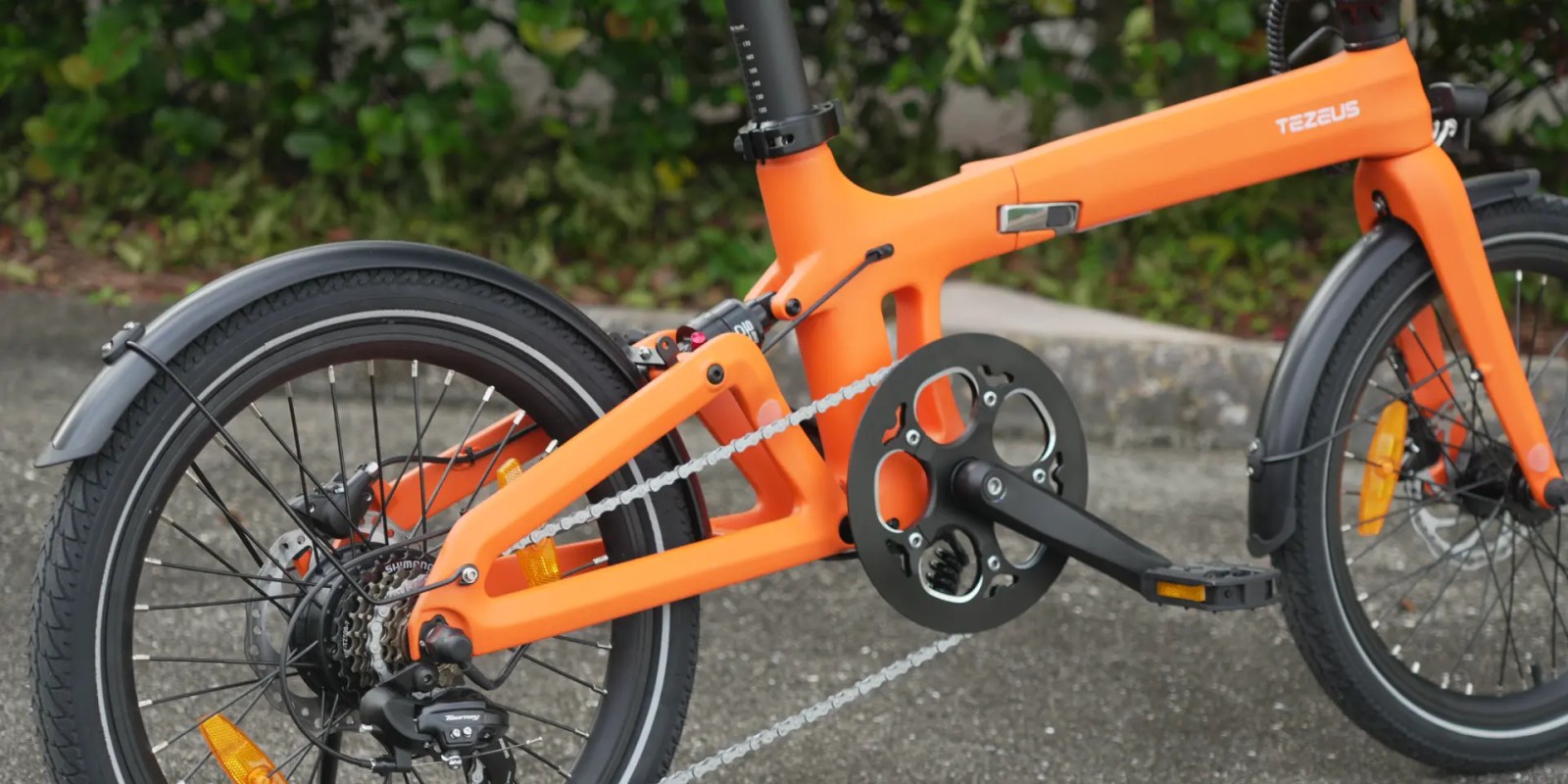
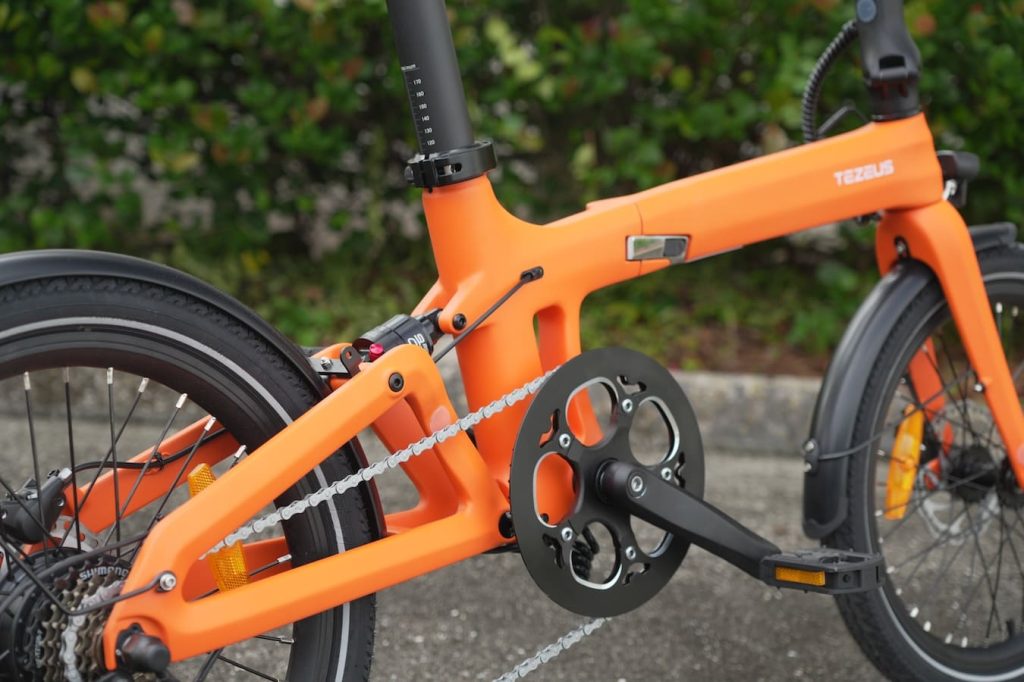
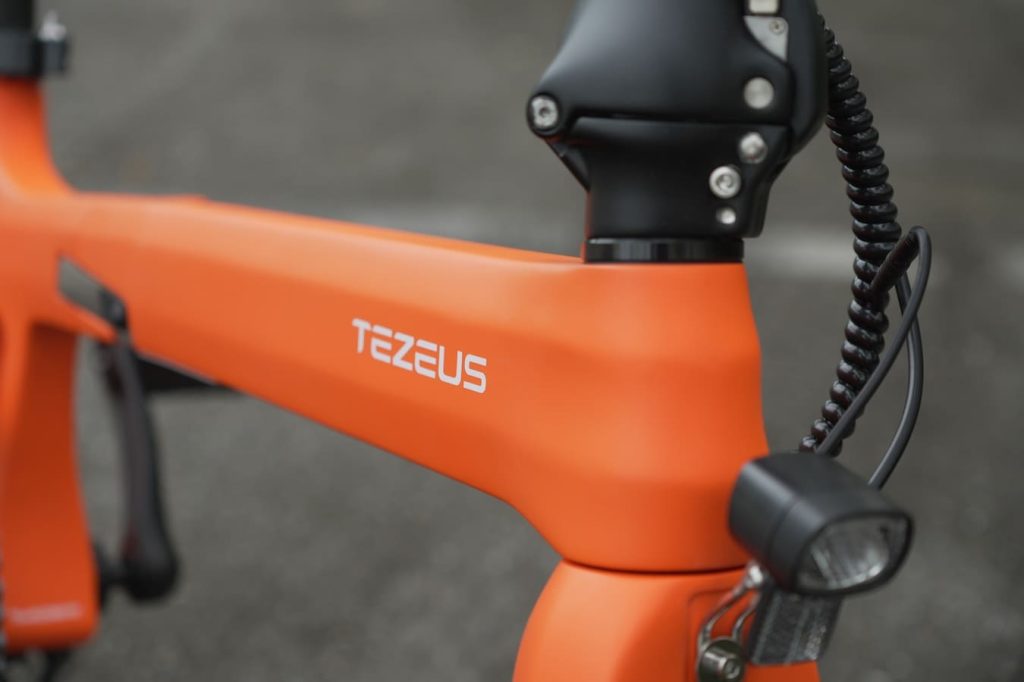
The obvious selling point here is the frame. Folding e-bikes are almost always aluminum and usually fairly chunky because they have to maintain stiffness around the folding mechanisms. Tezeus went with carbon fiber on the Swift, and the result is immediately noticeable.
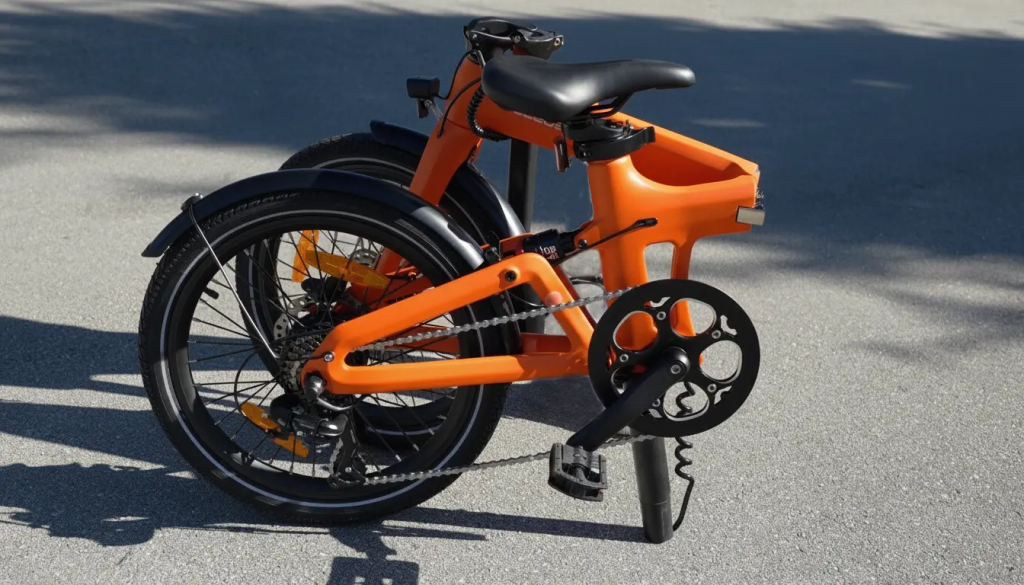
At around 36 pounds, this is one of the lightest full-featured folding e-bikes I’ve tested in quite a while. This is the kind of bike you can actually carry up a flight of stairs without questioning your life choices or icing your back.
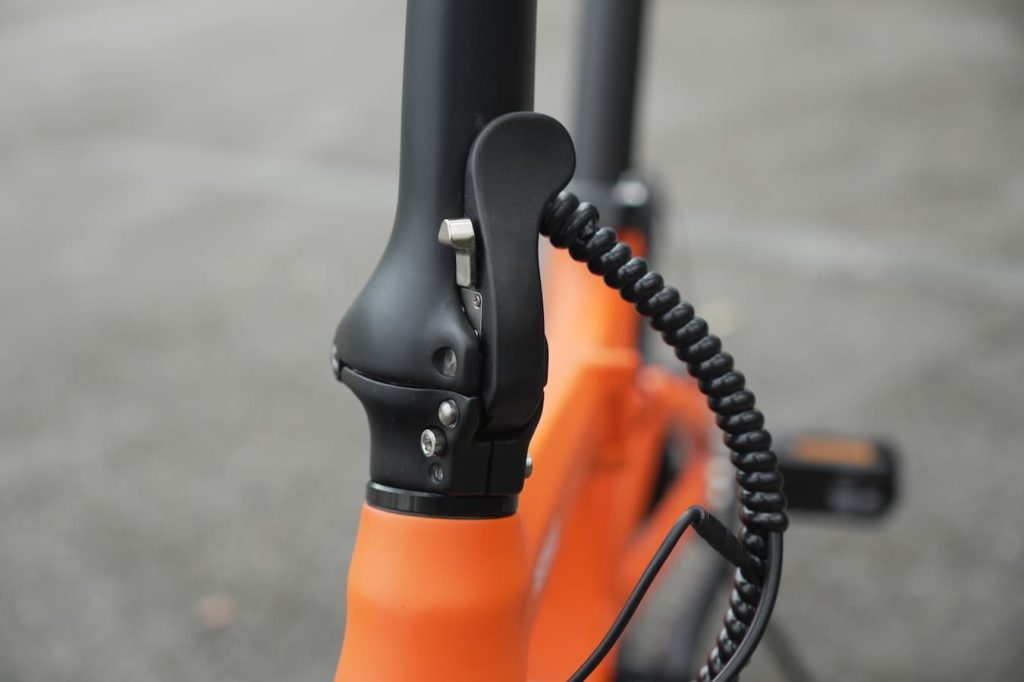
The overall shape and hinge layout are fairly typical for a 20-inch folding bike, but the execution is cleaner and the mechanism looks less bulky.
Cable routing is internal, the frame is smooth, and the whole bike feels like it got a little extra attention at the design table. It folds down reasonably compact – not tiny in the way a Brompton does, but certainly in the “subway-friendly” category. If you live in a walk-up or take public transit regularly, this bike fits that lifestyle very well.
At just $1,199, you wouldn’t expect carbon at this price, but the bike delivers!

Ride quality: small wheels, good manners
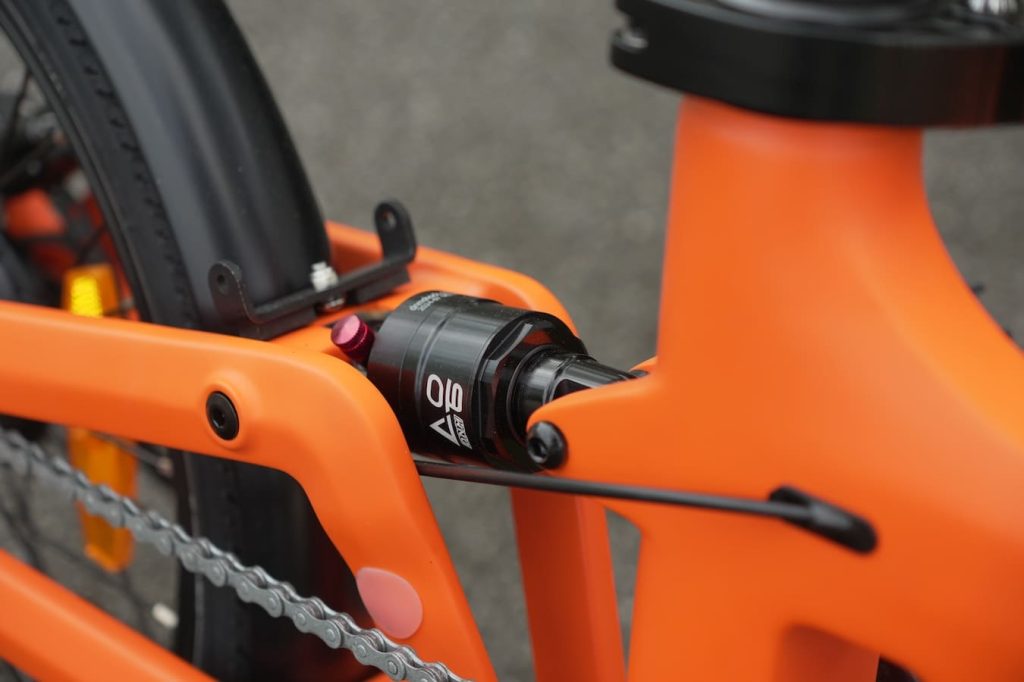
The Swift runs on 20-inch wheels paired with a rear suspension setup. Let’s be real that this isn’t exactly downhill mountain biking suspension, though.
The ride is comfortable enough to smooth out expansion joints and patchy pavement without turning the bike into a pogo stick, but it’s not going to magically make every bump and pothole disappear, that’s for sure. It’s a short travel shock in a direct suspension setup, but at least it is an adjustable air shock.
Handling is quite predictable, though, and feels confidence-inspiring. Many small-wheel folders can feel twitchy, especially at speed, but the Swift strikes a nice balance. It’s still compact and quick-steering, but never unstable.
I found myself weaving through traffic and dodging parked-car doors with the same confidence I’d expect from a larger-framed commuter bike.
Motor and power: enough for city commuting
The Swift uses a 250 W hub motor with about 30 Nm of torque, which tells you right away this isn’t a hill-crusher or a moped-wannabe.
But Tezeus tuned the controller well, and real-world performance is better than the numbers suggest. Acceleration is smooth, quiet, and linear. It’s not going to rocket you forward, but it adds just enough assist to make starts and short climbs easy without overwhelming the bike’s lightweight personality.
The assist cuts off at around 20 mph, which keeps it squarely in Class 2 territory in the US. On flat ground, I cruised comfortably in the 16–20 mph range. The Shimano 7-speed setup helps here, and it’s refreshing to see a folder that still feels like a bike rather than a throttle-dependent mini-scooter. You can genuinely ride this thing without power if you need to.
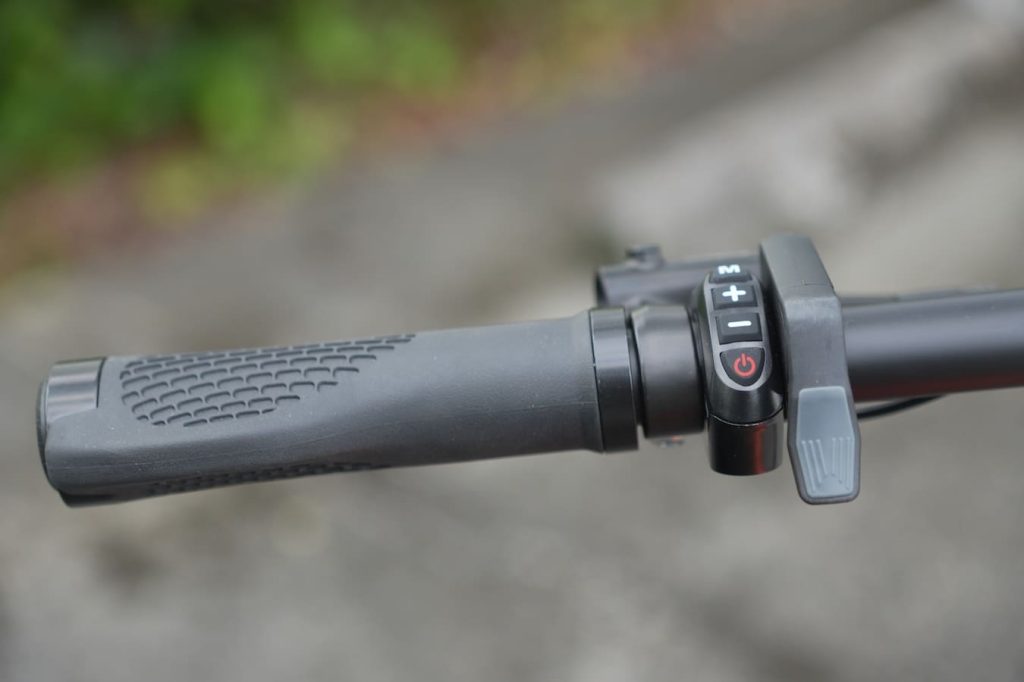
Of course, there is still a throttle, as you might have guessed by the Class 2 designation. It’s also a bit of a strange feeling thumb throttle, which isn’t my favorite style but gets the job done. The bike feels so good to pedal that I rarely go only throttle on it, and use it more just when I want to get rolling as quickly as possible. The smaller capacity battery also means that using the pedal assist is a good idea. Plus, that torque sensor does a great job of making you feel more in tune with the bike when pedaling.

Battery and range
The 36 V, 7 Ah (252 Wh) battery is hidden inside the seat tube, which is a clean design choice and keeps the bike’s silhouette tidy. It’s also removable for charging indoors.
The tradeoff, of course, is size. With 252 Wh, you’re not getting long-range weekend adventures. In my testing, riding in the city with a mix of PAS levels, I saw realistic range in the 17–25 mile (30-40 km) window.
That’s perfectly fine for the short-to-medium urban commutes this bike is designed for, but it’s worth setting expectations accordingly. This isn’t a long distance touring bike, so don’t expect to ride it like one.
Cockpit and features
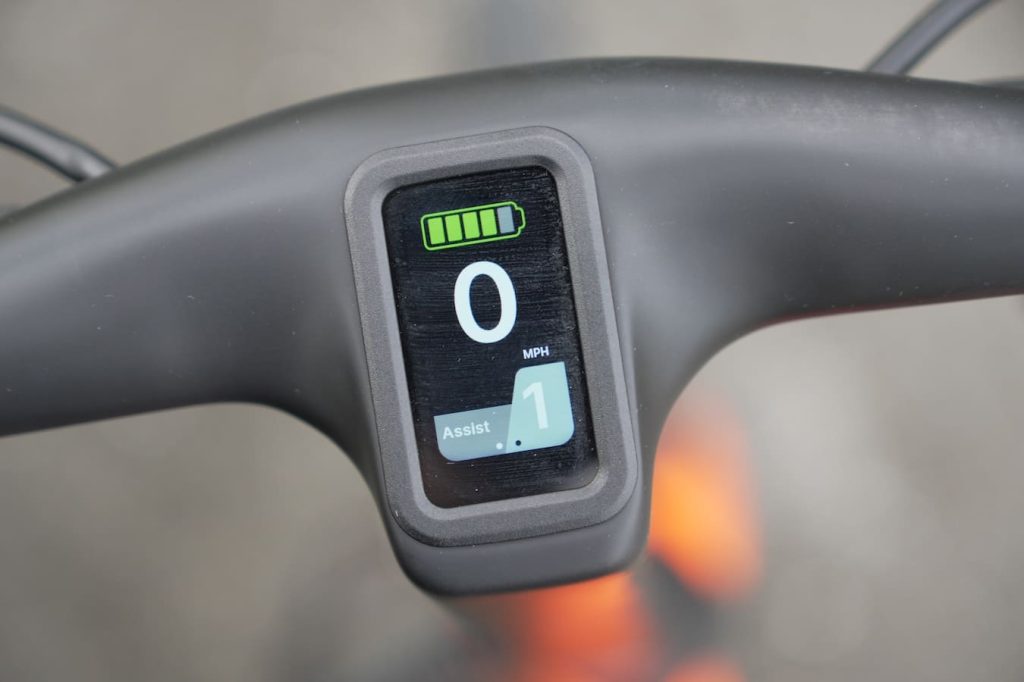
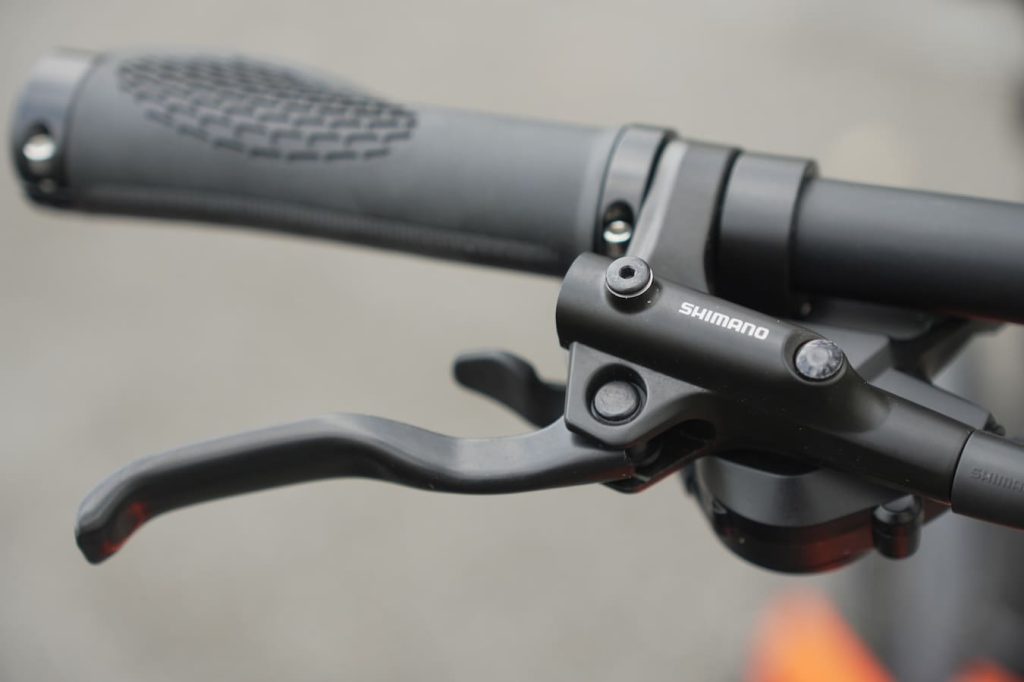
The bike includes a color display, decent-quality grips, and hydraulic disc brakes, which are a nice upgrade for more confident braking with less hand strength required. You can give a lighter pull and still get strong stopping power. The lever feel is crisp, and braking performance is solid, which matters when you’re darting between taxis and delivery vans in an urban environment.
Tezeus also kept the cockpit uncluttered. Many folding bikes get messy with clamps, triggers, and hinges everywhere, but the Swift keeps things simple. I appreciated that during folding and unfolding too – the process is quick and doesn’t require a three-handed origami routine.
A few downsides
As much as I enjoyed the Swift, there are a couple of areas where the bike shows tradeoffs.
First, the small battery will be limiting for riders who want to push longer distances or who live in particularly hilly areas. It’s clearly tuned for urban environments, but a slightly larger pack option would have broadened its appeal.
Second, the small-wheel geometry means this still isn’t the plushest bike on rough pavement. The rear suspension helps, but you’ll feel cracks and potholes more than you would on a full-size commuter.
Lastly, while the carbon frame is great for weight, it also means repairs or replacement in the event of damage could be more expensive than with a simple aluminum folder. Sure, aluminum repairs aren’t something most people are going to want to deal with either, but an aluminum frame can at least take a bit more of a beating.
Final thoughts
I went into this review expecting another generic folding e-bike with a quirky frame and middling performance. Instead, the Tezeus Swift feels like a thoughtfully executed lightweight commuter that prioritizes practicality, ride quality, and clean design. It’s not built for speed demons or range-hungry riders, but for people who want a portable, well-mannered e-bike for real urban use, it hits a sweet spot.
At $1,199, there are better watt-per-dollar deals out there, but bikes like this one don’t compete on performance. Instead, they do it for the lightweight and convenience.
If you value low weight, compact storage, and a bike-like ride over brute force or big battery numbers, the Tezeus Swift is absolutely worth a look.
FTC: We use income earning auto affiliate links. More.


A view of the NEO magnetic plant in Narva, a city in northeastern Estonia. A plant producing rare-earth magnets for Europe’s electric vehicle and wind-energy sectors.
Xinhua News Agency | Xinhua News Agency | Getty Images
NARVA, Estonia — Europe’s big bet to break China’s rare earths dominance starts on Russia’s doorstep.
The continent’s largest rare-earth facility, situated on the very edge of NATO’s eastern flank, is ramping up magnet production as part of a regional push to reduce its import reliance on Beijing.
Developed by Canada’s Neo Performance Materials and opened in mid-September, the magnet plant sits in the small industrial city of Narva. This little-known border city is separated from Russia by the Narva River, which is an external frontier of both NATO and the European Union.
Analysts expect the facility to play an integral role in Europe’s plan to reduce its dependence on China, while warning that the region faces a long and difficult road ahead if it is to achieve its mineral strategy goals.
Magnets made from rare earths are essential components for the function of modern technology, such as electric vehicles, wind turbines, smartphones, medical equipment, artificial intelligence applications and precision weaponry.
Speaking to CNBC by video call, Neo CEO Rahim Suleman said the facility is on track to produce 2,000 metric tons of rare earth magnets this year, before scaling up to 5,000 tons and beyond as it seeks to keep pace with “an enormously quick-growing market.”
It is a frankly a billion-dollar problem that affects trillion-dollar downstream industries. So, it is worth solving.
Ryan Castilloux
managing director of Adamas Intelligence
The European region currently imports nearly all of its rare earth magnets from China, although Suleman expects Neo’s Narva facility to be capable of fulfilling around 10% of that demand.
“Having said that, our view of that number is something like 20,000 tons. So, we’d have a lot more work to do, a lot more building to do because I think the customers have a real need to diversify their supply chains,” Suleman said.
“We’re not talking about independence from any jurisdiction. We’re just talking about creating robust and diverse supply chains to reduce concentration risk,” he added.
Neo has previously announced initial contracts with Schaeffler and Bosch, major auto suppliers to the likes of German auto giants Volkswagen and BMW.
Europe’s push to deliver on its resource security goals faces several obstacles. Analysts have cited issues including a funding shortfall, burdensome regulation, a limited and fragmented made-in-EU supply chain and relatively high production costs. All of these raise questions about the viability of the EU’s ambitious supply chain targets.
“Europe needs a big increase in rare earth magnet capacity to even come close to a diversified supply chain for its carmakers,” Caroline Messecar, an analyst at Fastmarkets, told CNBC by email.
‘The guillotine still looms’
Once a previously obscure issue, rare earths have come to the fore as a key bargaining chip in the ongoing geopolitical rivalry between the U.S. and China.
In October, China agreed to delay the introduction of further export controls on rare earth minerals as part of a deal agreed between China’s Xi Jinping and U.S. President Donald Trump. China’s earlier rare earths restrictions, which upended global supply chains, remain in place, however.
“The threat is still there; the guillotine still looms. And so, I think collectively all of this has just sobered the West, end-users and governments to the risks that they face,” Ryan Castilloux, managing director of critical mineral consultancy Adamas Intelligence, told CNBC by phone.
“It is a frankly a billion-dollar problem that affects trillion-dollar downstream industries. So, it is worth solving,” he added.
European Commission President Ursula von der Leyen delivers her speech during a debate on the new 2028-2034 Multi-annual Financial Framework at the European Parliament in Brussels on November 12, 2025.
Nicolas Tucat | Afp | Getty Images
Europe, in particular, has been caught in the crosshairs of tariff turbulence. In its Autumn 2025 Economic Forecast, the European Commission, the EU’s executive arm, identified Chinese export controls leading to supply chain disruptions in several sectors such as autos and green energy.
It thrusts the issue of supply diversification in the spotlight for European policymakers, especially as demand is projected to grow until 2030 and EU supply remains highly reliant on a single supplier, according to a statement from a European Commission spokesperson.
In response, European Commission President Ursula von der Leyen announced in October that plans were underway to launch a so-called “RESourceEU” plan — along the lines of its “REPowerEU” initiative, which sought to overcome another supply issue — energy.
The Narva project predates these measures but, with 18.7 million euros ($21.7 million) in EU funding, it’s an example of what the EU hopes to achieve. And although its output is modest when compared to overall demand, it demonstrates how the EU plans to boost the bloc’s magnet output capacity and reduce dependence on Chinese supply.
Photo taken on Sept. 19, 2025 shows inside view of NEO magnetic plant in Narva, a city in northeastern Estonia.
Xinhua News Agency | Xinhua News Agency | Getty Images
China is the undisputed leader of the critical minerals supply chain, responsible for nearly 60% of the world’s rare earths mining and more than 90% of magnet manufacturing. Europe, meanwhile, is the world’s biggest export market for Chinese rare earths.
Russia’s doorstep
The location of Neo’s new magnet facility, meanwhile, has raised some eyebrows, given the potential security challenge of being in such close proximity to Russia.
Speaking shortly after Moscow’s full-scale invasion of Ukraine in early 2022, Russian President Vladimir Putin said Narva was historically part of Russia and needed to be taken back.
Asked why the company positioned its new rare earths plant there, Neo’s Suleman said the firm already had an existing infrastructure presence in the country, “and the right place was to be in Europe.”
“And then you go one step deeper, which is to get into Estonia. We have a long history in Estonia. We already have a rare separation facility that can do both light rare earths, and we’re developing heavy rare earths there,” Suleman said.
“We’ve been extremely impressed by the quality of the people in Estonia, their education level, their commitment to hard work … So, you put all that together, along with the support that we received both in Estonia and in the EU, and it was a great choice for us,” he added.
Estonian lawmakers have welcomed the potential of Neo’s magnet plant, saying the facility will benefit the development of both the country and broader region.
Jaanus Uiga, deputy secretary general for Energy and Mineral Resources of Estonia, said Neo’s magnet plant opened “very on time.”

Speaking to CNBC on Oct. 30, Uiga acknowledged economic tensions between the U.S. and China over rare earths, saying Estonia and the EU needed to adapt to an evolving situation.
“It is a very unique processing capability that was built in Estonia and also we are very happy for that because it happened in a region that is transitioning away from fossil fuels,” Uiga told CNBC’s “Squawk Box Asia.”

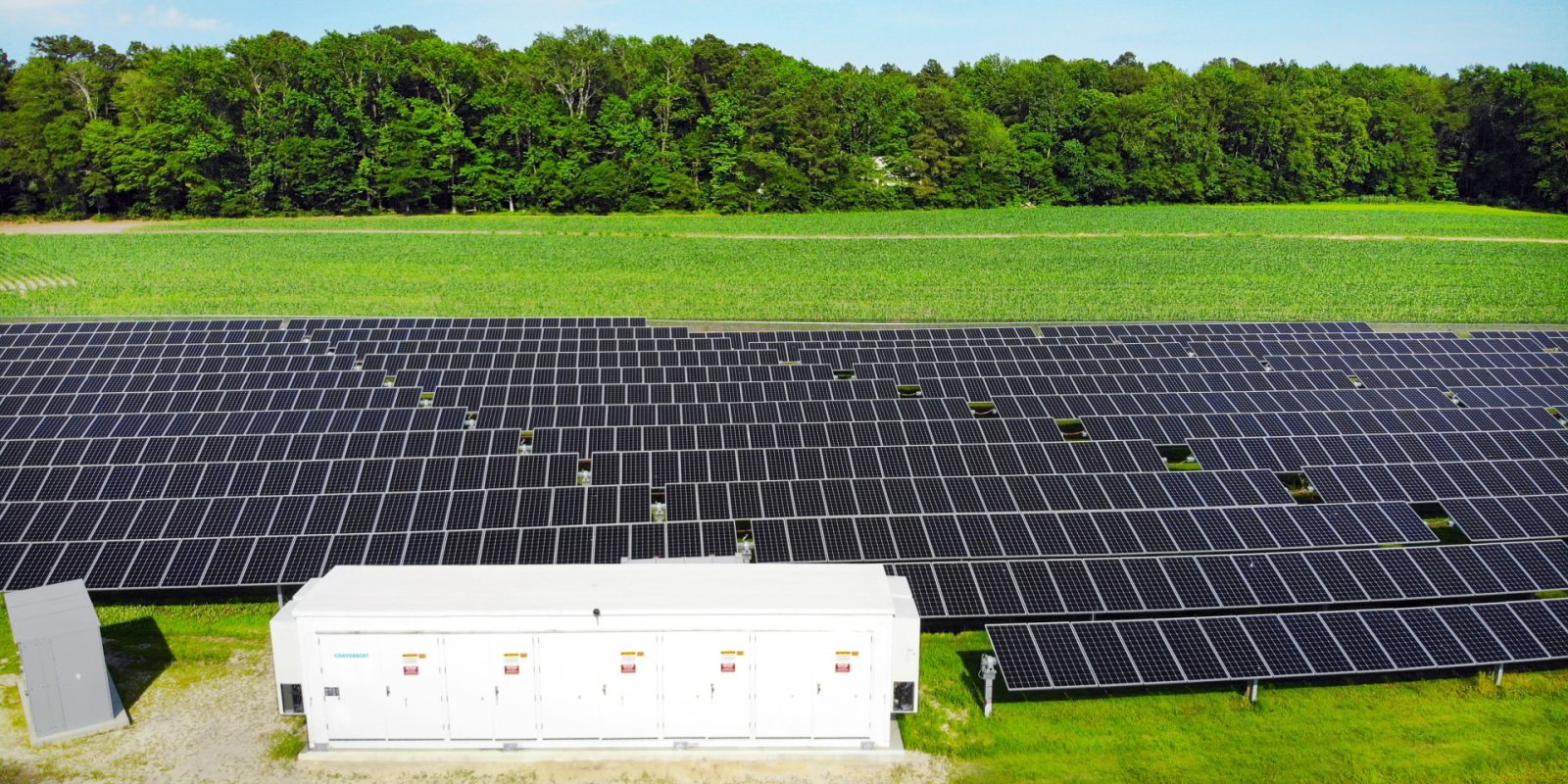
Newly published data from the Federal Energy Regulatory Commission (FERC), reviewed by the SUN DAY Campaign, reveal that solar accounted for over 75% of US electrical generating capacity added in the first nine months of 2025. In September alone, solar provided 98% of new capacity, marking 25 consecutive months in which solar has led among all energy sources.
Year-to-date (YTD), solar and wind have each added more new capacity than natural gas has. The mix of all renewables remains on track to exceed 40% of installed capacity within three years; solar alone may be 20%.
Solar was 75% of new generating capacity YTD
In its latest monthly “Energy Infrastructure Update” report (with data through September 30, 2025), FERC says 48 “units” of solar totaling 2,014 megawatts (MW) were placed into service in September, accounting for 98% of all new generating capacity added during the month. Oil provided the balance (40 MW).
The 567 units of utility-scale (>1 MW) solar added during the first nine months of 2025 total 21,257 MW and were 75.3% of the total new capacity placed into service by all sources. Solar capacity added YTD is 6.5% more than that added during the same period a year earlier.
Solar has now been the largest source of new generating capacity added each month for 25 consecutive months, from September 2023 to September 2025. During that period, total utility-scale solar capacity grew from 91.82 gigawatts (GW) to 158.43 GW. No other energy source added anything close to that amount of new capacity. Wind, for example, expanded by 11.07 GW while natural gas’s net increase was just 4.60 GW.
Between January and September, new wind energy has provided 3,724 MW of capacity additions – an increase of 28.6% compared to the same period last year and more than the new capacity provided by natural gas (3,161 MW). Wind accounted for 13.2% of all new capacity added during the first nine months of 2025.
Renewables were 88% of new capacity added YTD
Wind and solar (plus 4 MW of hydropower and 6 MW of biomass) accounted for 88.5% of all new generating capacity while natural gas added just 11.2% YTD. The balance of net capacity additions came from oil (63 MW) and waste heat (17 MW).
Utility-scale solar’s share of total installed capacity (11.78%) is now virtually tied with that of wind (11.80%). If recent growth rates continue, utility-scale solar capacity should surpass that of wind in FERC’s next “Energy Infrastructure Update” report.
Taken together, wind and solar make up 23.58% of the US’s total available installed utility-scale generating capacity.
Moreover, more than 25% of US solar capacity is in the form of small-scale (e.g., rooftop) systems that are not reflected in FERC’s data. Including that additional solar capacity would bring the share provided by solar and wind to more than a quarter of the US total.
With the inclusion of hydropower (7.59%), biomass (1.05%) and geothermal (0.31%), renewables currently claim a 32.53% share of total US utility-scale generating capacity. If small-scale solar capacity is included, renewables now account for more than one-third of the total US generating capacity.
Solar soon to be No. 2 source of US generating capacity
FERC reports that net “high probability” net additions of solar between October 2025 and September 2028 total 90,614 MW – an amount almost four times the forecast net “high probability” additions for wind (23,093 MW), the second fastest growing resource.
FERC also foresees net growth for hydropower (566 MW) and geothermal (92 MW) but a decrease of 126 MW in biomass capacity.
Meanwhile, natural gas capacity is projected to expand by 6,667 MW, while nuclear power is expected to add just 335 MW. In contrast, coal and oil are projected to contract by 24,011 MW and 1,587 MW, respectively.
Taken together, the net new “high probability” net utility-scale capacity additions by all renewable energy sources over the next three years – the Trump administration’s remaining time in office – would total 114,239 MW. On the other hand, the installed capacity of fossil fuels and nuclear power combined would shrink by 18,596 MW.
Should FERC’s three-year forecast materialize, by mid-fall 2028, utility-scale solar would account for 17.3% of installed U.S. generating capacity, more than any other source besides natural gas (39.9%). Further, the capacity of the mix of all utility-scale renewable energy sources would exceed 38%. The inclusion of small-scale solar, assuming it retains its 25% share of all solar energy, could push solar’s share to over 20% and that of all renewables to over 41%, while the share of natural gas would drop to less than 38%.
In fact, the numbers for renewables could be significantly higher.
FERC notes that “all additions” (net) for utility-scale solar over the next three years could be as high as 232,487 MW, while those for wind could total 65,658 MW. Hydro’s net additions could reach 9,927 MW while geothermal and biomass could increase by 202 MW and 32 MW, respectively. Such growth by renewable sources would swamp that of natural gas (29,859 MW).
“In an effort to deny reality, the Trump Administration has just announced a renaming of the National Renewable Energy Laboratory (NREL) in which it has removed the word ‘renewable’,” noted the SUN DAY Campaign’s executive director Ken Bossong. “However, FERC’s latest data show that no amount of rhetorical manipulation can change the fact that solar, wind, and other renewables continue on the path to eventual domination of the energy market.”

If you’re looking to replace your old HVAC equipment, it’s always a good idea to get quotes from a few installers. To make sure you’re finding a trusted, reliable HVAC installer near you that offers competitive pricing on heat pumps, check out EnergySage. EnergySage is a free service that makes it easy for you to get a heat pump. They have pre-vetted heat pump installers competing for your business, ensuring you get high quality solutions. Plus, it’s free to use!
Your personalized heat pump quotes are easy to compare online and you’ll get access to unbiased Energy Advisors to help you every step of the way. Get started here. – *ad
FTC: We use income earning auto affiliate links. More.
-
 Sports2 years ago
Story injured on diving stop, exits Red Sox game
-
 Sports3 years ago
‘Storybook stuff’: Inside the night Bryce Harper sent the Phillies to the World Series
-
 Sports2 years ago
Game 1 of WS least-watched in recorded history
-
 Sports3 years ago
Button battles heat exhaustion in NASCAR debut
-
 Sports3 years ago
MLB Rank 2023: Ranking baseball’s top 100 players
-
Sports4 years ago
Team Europe easily wins 4th straight Laver Cup
-
 Environment3 years ago
Japan and South Korea have a lot at stake in a free and open South China Sea
-
 Environment1 year ago
Here are the best electric bikes you can buy at every price level in October 2024