As the crypto industry matures, pragmatism and common sense are slowly creeping into the idealistic, messy business of blockchain tech.
For years, crypto founders have declared that they’re reinventing the financial system. And although the focus has been on big ideas and innovative financial engineering, many crypto products and services remain off-limits to regulated organizations.
As banks, OTC desks, and institutional investors enter the space, they find the basic infrastructure of serious finance either missing, or lacking in the compliance tools that allow them to fully participate.
Telegram and X may be the preferred communication channels of the crypto native, but institutions need more than disposable messages, constant phishing attempts, and managing countless channels with eminently hackable addresses. JPMorgan was fined $200 million by regulators in 2021 for using these platforms and personal accounts, while scammers have become proficient at using them for thefts.
Crypto communications platforms are unfit for compliance
The Tie, a provider of institutional-class digital asset data, has set about solving the issue of secure crypto communication, integrating with systems such as Global Relay that are already used for back office compliance between financial players.
“We’ve been so busy addressing the huge pain points in the system that we sometimes forget about the basics,” said Josh Frank, CEO of The Tie. “Institutions don’t get to opt in to compliance, they don’t get to hope that the person they’re talking to in a Telegram chat is actually the person they say they are. They have rules, they have a duty to preserve, and existing comms channels in crypto were never built with those requirements in mind.”
According to Frank, the new messaging solution, Bridge, addresses all the needs of institutions looking to be part of the digital asset economy.
“There’s nothing wrong with WhatsApp or Telegram for most users so long as they’re careful, but for institutions we had to build a communication platform that doesn’t suck at compliance.”
Melvin Deng, CEO of QCP in Singapore, told Cointelegraph that “Every regulated institution operates under clear obligations – to know who they’re dealing with, to preserve records, and to ensure that communications are both compliant and auditable. In crypto, those basics have long been missing. A platform like Bridge restores that integrity. It brings the standards of institutional finance into a digital-native environment, where identity verification and compliant record-keeping aren’t afterthoughts but defaults.”
Starting with email domain verification, strict Know Your Business (KYB) rules and verified identities to eliminate bad actors, Bridge is designed to open up B2B messaging for industry participants across the globe.
Frank notes that managing teams across multiple communication channels has proven a huge headache for compliant organizations. “You have 50 channels to each of your counterparties,” he says, “And each one of those has to be depopulated and repopulated every time someone leaves your business. Every one is a potential liability, so we’ve built a solution that allows for centralized team management, including bulk reassignment of old team members’ channels including their history, straight to new members.”
An audit log for all blockchain transactions
Included in that history is automatic auditing of transactions between counterparties. “The platform maintains a complete log of transactions, and includes verified and timestamped notifications of completion, confirmations of arrival – the whole process is designed for compliance,” says Frank. “And that persists immutably at the organization level, so that individual users’ events feed directly into a main dataset tracking all transactions.”
He also notes that Bridge allows for privacy-focused access to The Tie’s data platform directly within the app, allowing users to search for contextual information using AI. “Imagine you’re traveling to Singapore for Token2049. You can ask Bridge to load custodians, OTC desks, and prime brokers based in Singapore that have raised money in the last two years, and have at least $10M in total funding. Then you can message those parties directly within the app.”
“You can also use the AI to access real-time market sentiment, or to discover developer statistics – essentially all of our institutional-grade data is available.”
Bridge launches in early 2026 as both a web and desktop app, as well as native iOS and Android apps, and Frank claims The Tie will offer the service at just $5 per month, per user.
“It’s designed to be a no-brainer,” he says. “If you operate in crypto, you need this, so the goal isn’t to put up more hurdles. It’s simply to make the space safer, welcome new participants, and keep building the tools that make this the backbone of tomorrow’s global financial system.”
Young people could lose their right to universal credit if they refuse to engage with help from a new scheme without good reason, the government has warned.
Almost one million will gain from plans to get them off benefits and into the workforce, according to officials.
It comes as the number of young people not in employment, education or training (NEET) has risen by more than a quarter since the COVID pandemic, with around 940,000 16 to 24-year-olds considered as NEET as of September this year, said the Office for National Statistics.
That is an increase of 195,000 in the last two years, mainly driven by increasing sickness and disability rates.
The £820m package includes funding to create 350,000 new workplace opportunities, including training and work experience, which will be offered in industries including construction, hospitality and healthcare.
Around 900,000 people on universal credit will be given a “dedicated work support session”.
That will be followed by four weeks of “intensive support” to help them find work in one of up to six “pathways”, which are: work, work experience, apprenticeships, wider training, learning, or a workplace training programme with a guaranteed interview at the end.
However, Work and Pensions Secretary Pat McFadden has warned that young people could lose some of their benefits if they refuse to engage with the scheme without good reason.
The government says these pathways will be delivered in coordination with employers, while government-backed guaranteed jobs will be provided for up to 55,000 young people from spring 2026, but only in those areas with the highest need.
However, shadow work and pensions secretary Helen Whately, from the Conservatives, said the scheme is “an admission the government has no plan for growth, no plan to create real jobs, and no way of measuring whether any of this money delivers results”.
She told Sky News the proposals are a “classic Labour approach” for tackling youth unemployment.

Please use Chrome browser for a more accessible video player
7:57
Youth jobs plan ‘the wrong answer’
“What we’ve seen today announced by the government is funding the best part of £1bn on work placements, and government-created jobs for young people. That sounds all very well,” she told Sunday Morning with Trevor Phillips.
“But the fact is, and that’s the absurdity of it is, just two weeks ago, we had a budget from the chancellor, which is expected to destroy 200,000 jobs.
“So the problem we have here is a government whose policies are destroying jobs, destroying opportunities for young people, now saying they’re going to spend taxpayers’ money on creating work placements. It’s just simply the wrong answer.”
Ms Whately also said the government needs to tackle people who are unmotivated to work at all, and agreed with Mr McFadden on taking away the right to universal credit if they refuse opportunities to work.
But she said the “main reason” young people are out of work is because “they’re moving on to sickness benefits”.
Ms Whately also pointed to the government’s diminished attempt to slash benefits earlier in the year, where planned welfare cuts were significantly scaled down after opposition from their own MPs.
The funding will also expand youth hubs to help provide advice on writing CVs or seeking training, and also provide housing and mental health support.
Some £34m from the funding will be used to launch a new “Risk of NEET indicator tool”, aimed at identifying those young people who need support before they leave education and become unemployed.
Monitoring of attendance in further education will be bolstered, and automatic enrolment in further education will also be piloted for young people without a place.

Volodymyr Zelenskyy is heading to Downing Street once again, but Prime Minister Sir Keir Starmer will be keen to make this meeting more than just a photo op.
On Monday the PM will welcome not only the Ukrainian president, but also E3 allies France and Germany to discuss the state of the war in Ukraine.
French President Emmanuel Macron and German Chancellor Friedrich Merz will join Sir Keir in showing solidarity and support for Ukraine and its leader, but it’s the update on the peace negotiations that will be the main focus of the meet up.
The four leaders are said to be set to not only discuss those talks between Ukraine, the US and Russia, but also to talk about next steps if a deal were to be reached and what that might look like.
Ahead of the discussions, Sir Keir spoke with the Dutch leader Dick Schoof where both leaders agreed Ukraine’s defence still needs international support, and that Ukraine’s security is vital to European security.
But while Russia’s war machine shows no signs of abating, a warm welcome and kind words won’t be enough to satisfy the embattled Ukrainian president at a time when Russian drone and missile attacks continue to bombard Kyiv.
“The American representatives know the basic Ukrainian positions,” Mr Zelenskyy said in his nightly video address. “The conversation was constructive, although not easy.”
Meanwhile, Mr Trump’s outgoing Ukraine envoy has said a peace deal between Russia and Ukraine is “really close”.
Keith Kellogg, who is due to step down in January, told the Reagan National Defence Forum that efforts to resolve the conflict were in “the last 10 metres”, which he said were always the hardest.
Mr Kellogg pinpointed the future of the Donbas and Ukraine’s Zaporizhzhia nuclear power plant as the two main outstanding issues.
But Russia has signalled that “radical changes” are needed to the US-Ukraine peace plan before it is acceptable to Moscow.
Yuri Ushakov, Russian President Vladimir Putin’s top foreign policy aide, was quoted by Russian media as saying the US would have to “make serious, I would say, radical changes to their papers” on Ukraine.
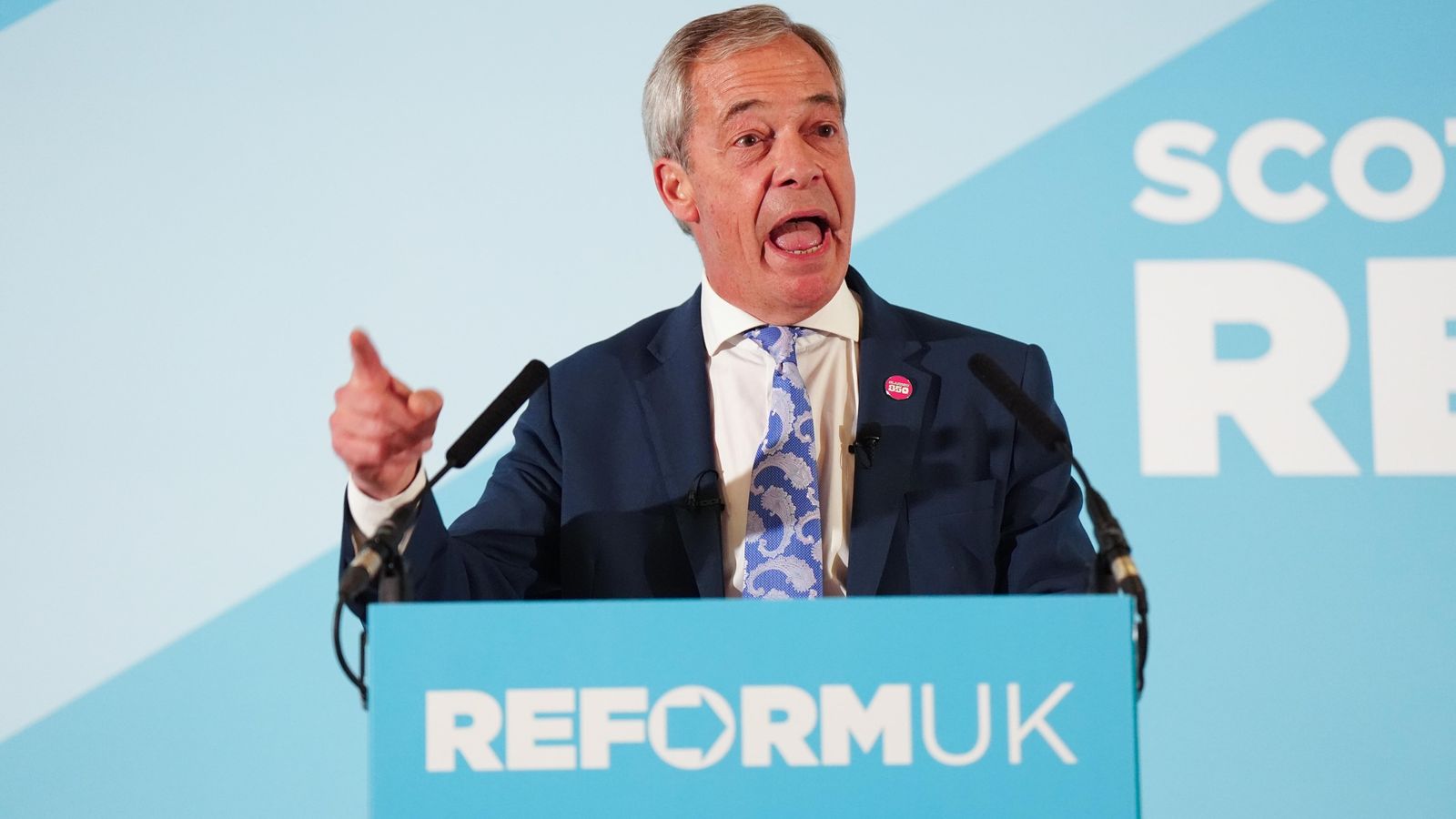
Reform UK has denied claims of Nigel Farage breaking electoral law.
It follows a report in Monday’s The Daily Telegraph that Mr Farage has been referred to the police by a former member of his campaign team over claims he falsified election expenses.
The claims relate to Mr Farage’s campaign in Clacton-on-Sea, the seat he won for Reform UK in the 2024 General Election.
In a statement, a Reform UK spokesperson said: “These inaccurate claims come from a disgruntled former councillor… the party denies breaking electoral law. We look forward to clearing our name.”
According to the Telegraph, the claims have been made by Richard Everett, a former Reform councillor.
It is reported by the Telegraph that Mr Everett has submitted documents to the Metropolitan Police.
Mr Everett was one of four councillors who defected from the Conservatives to Reform UK on the eve of the 2024 General Election campaign.
Sky News has not verified the allegations and the Metropolitan Police and the Electoral Commission are yet to comment.
Both Labour and the Conservatives have called for answers from Mr Farage.