
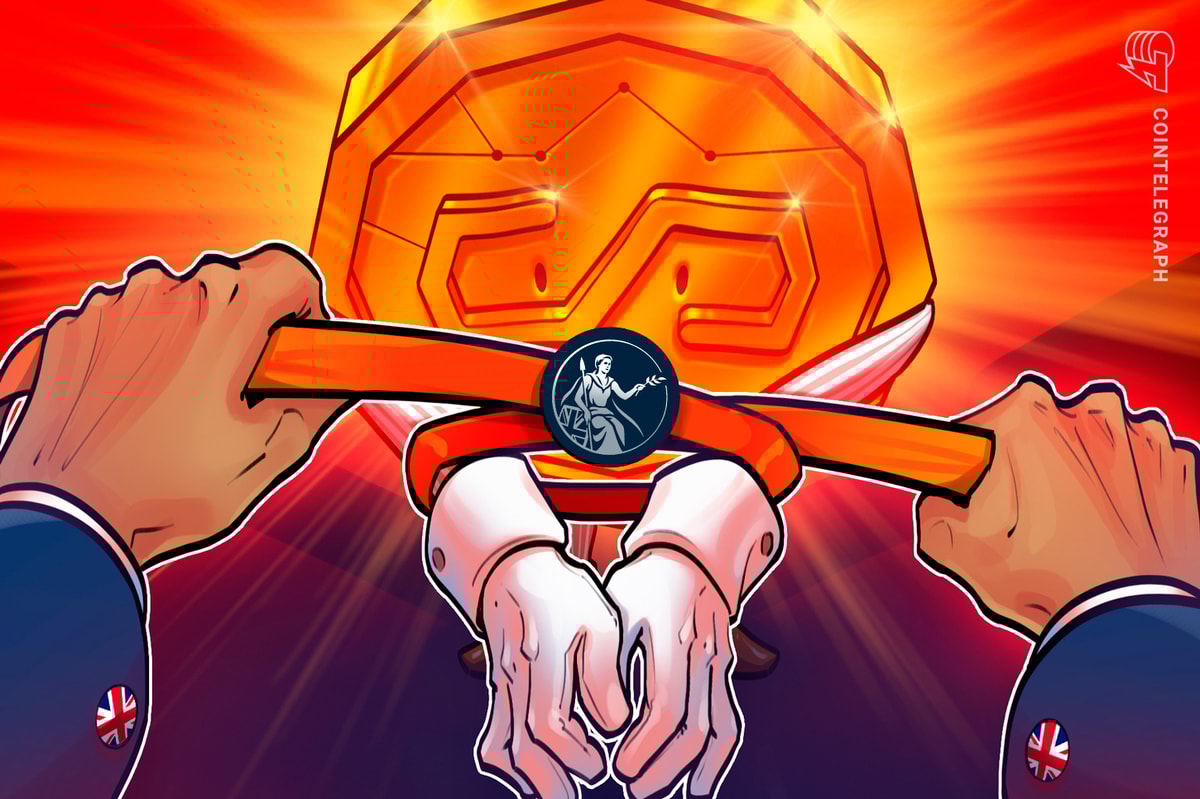
UK central bank still ‘disproportionately cautious’ about stablecoins

The UK’s central bank, the Bank of England (BOE), has released a proposed regulatory regime for stablecoins. The consultation paper took into account the perspectives of the crypto industry, but some observers say it remains restrictive.
BOE released the document on Nov. 10 — some two years after it announced the initial discussion paper. The original offered a vision for crypto that many in the industry claimed would doom the UK’s digital asset space.
The BOE said that it received comments and feedback from a broad range of 46 different stakeholders, including “banks, non-bank payment service providers, payment system operators, trade associations, academia, and individuals.”
The UK’s central bank may have scrapped some more hardline requirements, but some in the industry believe that it isn’t enough. Tom Rhodes, chief legal officer at UK-based stablecoin issuer Agant, said the bank remains “disproportionately cautious and restrictive.”

Bank of England still cautious on stablecoins
The new iteration presents a number of improvements on the 2023 version, Rhodes told Cointelegraph.
“The latest proposals do include some innovative features, such as direct BOE liquidity lines and the ability to repo reserves for liquidity purposes.”
He said that, as it concerns the UK market, “these proposals can be further explored and potentially expanded to create a more competitive backing asset regime, without compromising on stability.”
But despite the “welcome progress in the BOE’s sentiment towards stablecoins,” it has been “unusually vocal about the perceived risks of stablecoins,” said Rhodes.
One of the more controversial restrictions in the paper was limits on what the BOE called a “systemic retail stablecoin.” In the paper, this is defined as a stablecoin that is “widely used by individuals to make everyday payments such as for shopping and receiving salaries.”
The central bank wants to see limits of 20,000 pounds for individuals and 10 million pounds for businesses that accept it as a form of payment. This is an increase from the initial proposal, but the idea of limits on how much crypto you can hold didn’t sit well with some.
Crypto influencer Aleksandra Huk wrote, “Bank of England wants to cap stablecoin holdings at £20,000. Who gave them the right to tell us what to buy, where to store our money and how much we can have? […] Honestly, this is the best advert ever for privacy coins and for leaving the UK.”
Related: UK crypto hopes stall, but ‘encouraging signs’ are there
There are a few caveats to the suggested rule. Geoff Richards, head of community at the Ontology Network, noted, “The proposal applies only to sterling-denominated stablecoins used in UK payment systems that could become ‘systemic.’ Not USDT, not USDC, not random DeFi tokens.”
Ian Taylor, board member of crypto industry advocacy group CryptoUK, told Cointelegraph that he understands the central bank’s more cautious approach, at least as it applies to the stablecoin limits:
“The Bank of England has a mandate to protect against financial stability. And that financial stability is connected to the banking system. So insofar as banks take deposits and they issue loans against those deposits […] creates credit, this is an economic benefit to any economy that we have.”
The BOE is rightfully worried that taking deposits out of banks would reduce their ability to lend, affecting financial stability. “So, that’s why they want to baby-step this.”
Rhodes said that the “vast majority” of UK stablecoins will not fall under the regime anyway, at least not as stated in the paper. He noted that Mastercard was only recognized as a systemically important payment system in 2021 and that non-systemic stablecoins will be regulated under the Financial Conduct Authority’s (FCA) ruleset, “which is less restrictive.”
Still work to be done as UK opens up to crypto
Access to central bank liquidity and deposit accounts at the BOE was a welcome update for stablecoin issuers. But crypto industry representatives believe that there is still room for improvement in the central bank’s plan.
Regarding the stablecoin caps, “The systemic thresholds remain uncertain,” said Rhodes. He said it would be helpful to have clarification from His Majesty’s Treasury when an issuer has reached sufficient scale to “pose a risk to the UK economy as a whole, before they will recognize the issuer as systemic.”
Taylor also noted the difficulty of enforcing these stablecoin caps. If the government is licensing an issuer, then they’re the ones “responsible for monitoring each individual client or customer, whether wholesale, corporate or retail, as to how many stablecoins they’ve given them.”
The problem is that many people get their stablecoins on secondary markets or a “host of different sources.” People can receive stablecoins as compensation at work or on an exchange or peer-to-peer transaction. “So, the actual operational enforcement of that I question, and we’ve seen no detail in regards to that.”
Overall, “clarity and speed” will make the UK stablecoin ecosystem more competitive, said Arvin Abraham, partner at Goodwin Procter. He told Cointelegraph that regulators need to give issuers “a clean runway and predictable timelines” to navigate the approvals process.
Speed isn’t the government’s strong suit, however.
The British government has been working on crypto regulations since 2017, when it first adopted Anti-Money Laundering and Know Your Customer requirements for crypto-related businesses like exchanges. Now, eight years later, the central bank is still developing its policies based on industry feedback.

The slow pace of progress presents a problem. According to Taylor, “We’ve been consulting on a wider framework to regulate stablecoins for almost five years, and we still haven’t gotten any actual license framework in place, which is problematic for a number of reasons,” he said.
“It doesn’t help businesses that want to launch stablecoins in the UK. They don’t have a clear roadmap of how to do that,” he said, “which in turn forces them to move offshore to jurisdictions where there are other regulatory frameworks already live.”
This is for a number of reasons, Taylor explained, including consecutive changes in government, as well as a lack of “real champions in any of our key stakeholders, be that the current government, be that Treasury, be that the FCA.”
Progress on crypto regulations may be slow in the UK — slower than many in the industry would like — but for Abraham, “The Bank is being pragmatic and fair. The overriding message is that innovation is welcome, but if you want your token to function like money, you need money-grade controls.”
Magazine: 2026 is the year of pragmatic privacy in crypto: Canton, Zcash and more

The lower house of Poland’s parliament failed to secure the required three-fifths majority to override President Karol Nawrocki’s veto of the Crypto-Asset Market Act, pushing the country further away from regulating its digital-asset sector at a moment when lawmakers argue that oversight is increasingly urgent.
As Bloomberg reported Friday, the legislation — advanced by Prime Minister Donald Tusk’s government — was intended to align Poland with the European Union’s MiCA framework for crypto markets. The bill was introduced in June but did not survive the president’s veto.
Nawrocki blocked the measure last week, arguing it would “threaten the freedoms of Poles, their property, and the stability of the state,” as Cointelegraph previously reported.
With the president’s veto upheld, the bill will not move forward, forcing the government to restart its crypto lawmaking process.

The proposal has sharply divided lawmakers and the crypto industry. Supporters framed the bill as a national security priority, saying that comprehensive rules are necessary to curb fraud and prevent potential misuse of crypto assets by foreign actors, including Russia, according to Bloomberg.
However, several crypto-industry groups opposed the legislation, warning that its requirements were overly burdensome and could drive startups out of the country.
Critics pointed to stringent licensing rules, high compliance costs and criminal-liability provisions for service-provider executives, arguing that the bill risked stifling innovation and creating an uncompetitive business environment.
Related: EU plan would boost ESMA powers over crypto and capital markets
Crypto adoption in Poland ramps up amid regulatory pause
Cryptocurrency use in Poland continues to accelerate even as the country stalls on comprehensive regulation. Chainalysis recently identified Poland as one of Europe’s “large crypto economies,” noting that the country’s onchain activity has expanded significantly over the past year.
According to the company’s 2025 Europe Crypto Adoption report, Poland recorded more than 50% year-over-year growth in overall transaction volume.

Polish investors are also increasing their exposure to Bitcoin (BTC), reflected in a surge in Bitcoin ATM installations in recent years. In January, Cointelegraph reported that Poland had become the world’s fifth-largest Bitcoin ATM hub, surpassing even El Salvador — a country that has made Bitcoin a central element of its monetary and financial system.
Magazine: When privacy and AML laws conflict: Crypto projects’ impossible choice

US attorneys representing the federal government have requested that a judge send Terraform Labs co-founder Do Kwon to prison for 12 years at his sentencing hearing next week.
In a Thursday filing in the US District Court for the Southern District of New York, prosecutors asked that a judge sentence Kwon “to a term of twelve years’ imprisonment and finalize the forfeiture of his criminal proceeds.”
The filing came about four months after the Terraform co-founder pleaded guilty to two counts of wire fraud and conspiracy to defraud.
“In just a few years, Kwon caused losses that eclipsed those caused by Samuel Bankman-Fried […] Alexander Mashinsky […] and Karl Sebastian Greenwood [….] combined [emphasis included in filing],” said the Thursday filing. “The Terraform market crash triggered a cascade of crises that swept through cryptocurrency markets and contributed to what has since become known as ‘Crypto Winter.’”

Kwon, who is scheduled to be sentenced on Thursday, was indicted by US authorities in March 2023 for charges including securities fraud, market manipulation, money laundering and wire fraud related to his role at Terraform.
Though his whereabouts were initially unknown after the collapse of Terra in 2022, authorities in Montenegro arrested him on charges unrelated to his role at the company, and he was later extradited to the US.
Related: South Korea targets sub-$680 crypto transfers in sweeping AML crackdown
The price of Terra’s native token, LUNA, surged by more than 40% in the previous 24 hours amid the release of the sentencing recommendation, from about $0.07 to $0.10 at the time of publication. However, the token reached an all-time high price of more than $19.00 before the ecosystem collapsed in May 2022.
Kwon says he could still face prison time in South Korea
In a November court filing, lawyers representing Kwon asked that the Terraform co-founder be given a sentence of no more than five years. His attorneys presented several arguments in favor of a shorter sentence, including that the co-founder could face 40 years in prison in his native South Korea, where prosecutors are also working on a case against him.
“He would not be able to walk out of jail in the United States as a free man for any amount of time: He will be taken from whatever facility in which he serves his sentence directly to an immigration detention center to await a deportation flight to Seoul, where he will immediately reenter pretrial detention pending his criminal charges in South Korea,” said Kwon’s lawyers.
Although Kwon’s and prosecutors’ respective recommendations will remain under consideration, the judge overseeing the sentencing hearing has the authority to sentence the Terraform co-founder to decades in prison, or a significantly shorter time. In contrast, former FTX CEO Sam Bankman-Fried is serving a 25-year sentence after his conviction on seven felony charges, former Celsius CEO Alex Mashinsky was sentenced to 12 years in prison, and a judge sent Karl Sebastian Greenwood to prison for 20 years for his role in the OneCoin scheme.
Magazine: When privacy and AML laws conflict: Crypto projects’ impossible choice
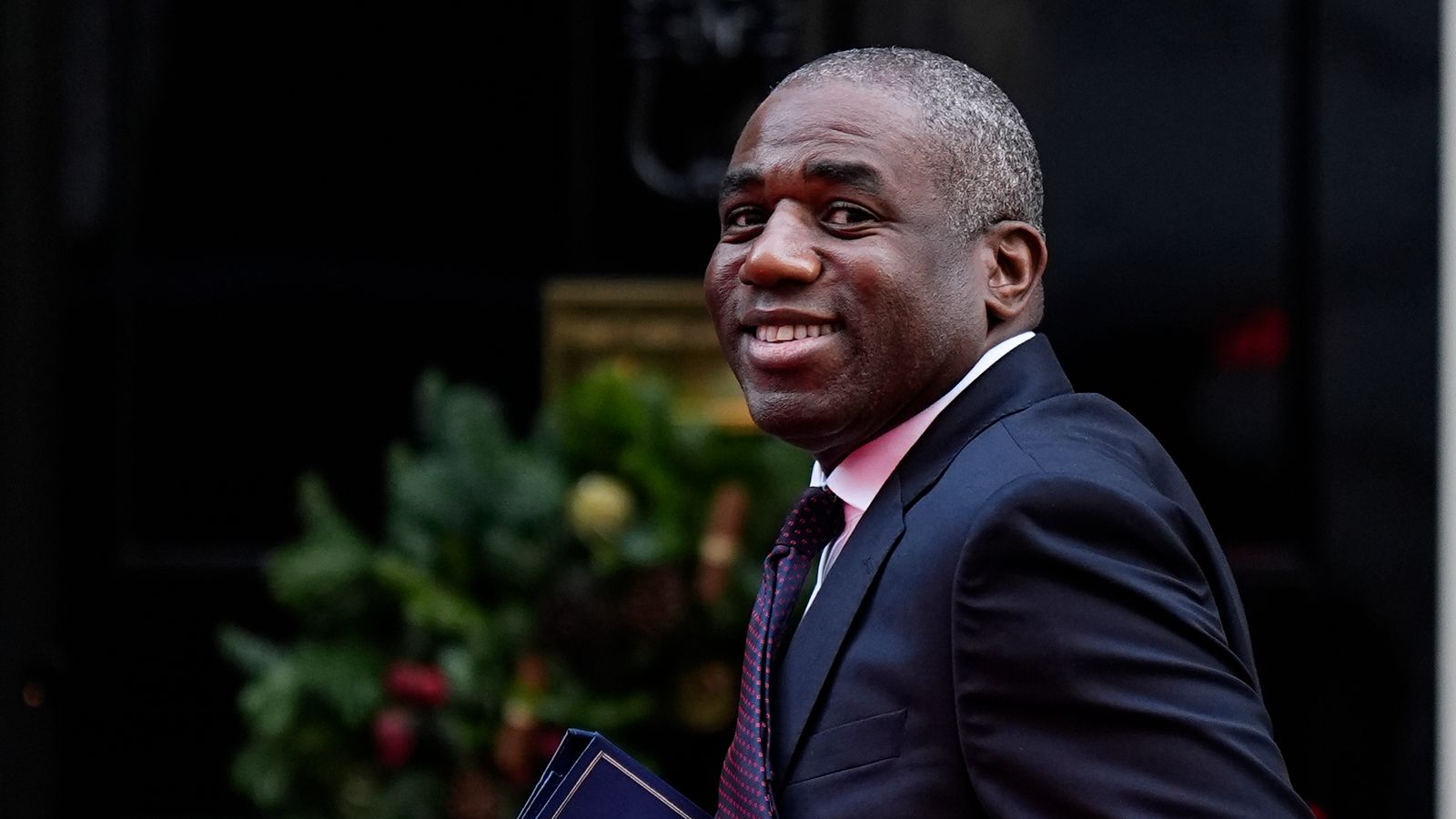
Deputy Prime Minister David Lammy has suggested it could be beneficial for the UK to consider re-entering a customs union with the EU.
He said that although doing so was not the government’s current policy, he could see how other countries outside the EU had benefited from such arrangements.
“It’s self-evident that leaving the European Union badly damaged our economy, took us out of an important marketplace and created serious friction, that untruths were being peddled by those that thought exiting the EU would be a good thing,” Mr Lammy told the News Agents podcast.
“And it’s why every single day that I was foreign secretary, I returned to the subject of our relationship with the European Union.”
Asked repeatedly if he would like to see the UK in a customs union, he said: “That is not currently our policy. That’s not currently where we are.
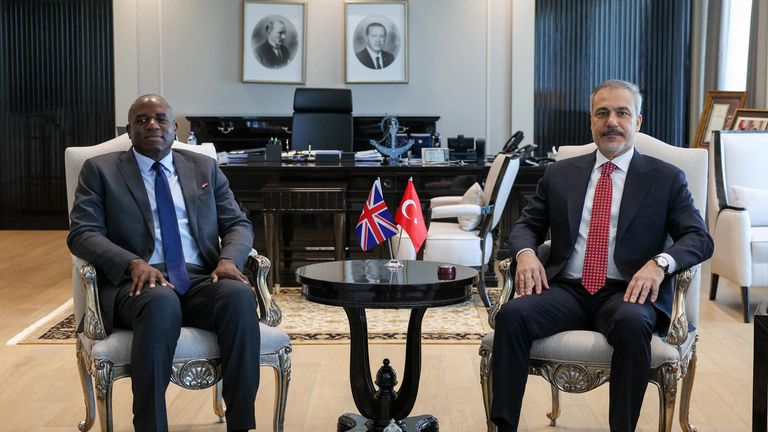
“But you can see countries like Turkey with a customs union seemingly benefiting and seeing growth in their economy, and again, that’s self-evident.”
David Lammy meets with Turkish Foreign Minister Hakan Fidan in Ankara earlier this year, when he was foreign secretary. Pic: Turkish Foreign Ministry/Reuters
The Prime Minister’s economic adviser Minouche Shafik has also reportedly advocated behind the scenes for joining a customs union.
Mr Lammy’s comments were being taken as the clearest indication yet that the government is considering bringing the UK further back in line with the European Union.
But when Sir Keir Starmer was asked to respond and say why he was not advocating for membership given that growth is an ongoing priority for his government, he was quick to dampen down the speculation.
The prime minister said Labour would be sticking to its manifesto, which pledged to deepen ties with the EU without returning to the customs union, single market or freedom of movement.
“Well, the position that we are taking has been clearly set out in the manifesto, and then we’ve been following it,” Sir Keir said. “And earlier this year, we had the first UK-EU summit ever, and we had 10 strands for a closer relationship.
“So we’ve totally reset relations with the EU.
“That’s good for our economy, good for defence and security, good for the work that we need to do on energy.
Earlier a spokesperson for Number 10 said: “We are strengthening relations with the EU whilst sticking to our red lines.”
“The prime minister reiterated that on Monday evening at the Lady Mayor’s Banquet.”

Starmer condemns ‘utterly reckless’ Brexit template
Sir Keir set out his foreign policy vision at the banquet, as is tradition.
He said the Brexit vote was a “fair, democratic expression” but the way it was “sold and delivered was wrong”.
“There’s no credible economic vision for Britain not positioning us as an open trading economy,” the Number 10 spokesman said.
“We have to be grown up about trade-offs. We have redefined bonds with EU and stuck to our red lines.”
On Mr Lammy’s comments, the spokesman added: “That is not our current policy or where we are.”
-
 Sports2 years ago
Story injured on diving stop, exits Red Sox game
-
 Sports3 years ago
‘Storybook stuff’: Inside the night Bryce Harper sent the Phillies to the World Series
-
 Sports2 years ago
Game 1 of WS least-watched in recorded history
-
 Sports3 years ago
Button battles heat exhaustion in NASCAR debut
-
 Sports3 years ago
MLB Rank 2023: Ranking baseball’s top 100 players
-
Sports4 years ago
Team Europe easily wins 4th straight Laver Cup
-
 Environment3 years ago
Japan and South Korea have a lot at stake in a free and open South China Sea
-
 Environment1 year ago
Here are the best electric bikes you can buy at every price level in October 2024