

Budget 2025: Starmer and Reeves ditch plans to raise income tax


Sir Keir Starmer and Rachel Reeves have scrapped plans to break their manifesto pledge and raise income tax rates in a massive U-turn less than two weeks from the budget.
The decision, first reported in the Financial Times, comes after a bruising few days which has brought about a change of heart in Downing Street.
Read more: How No 10 plunged itself into crisis
I understand Downing Street has backed down amid fears about the backlash from disgruntled MPs and voters.
The Treasury and Number 10 declined to comment.
The decision is a massive about-turn. In a news conference last week, the chancellor appeared to pave the way for manifesto-breaking tax rises in the budget on 26 November.
She spoke of difficult choices and insisted she could neither increase borrowing nor cut spending in order to stabilise the economy, telling the public “everyone has to play their part”.
‘Aren’t you making a mockery of voters?’
The decision to backtrack was communicated to the Office for Budget Responsibility on Wednesday in a submission of “major measures”, according to the Financial Times.
The chancellor will now have to fill an estimated £30bn black hole with a series of narrower tax-raising measures and is also expected to freeze income tax thresholds for another two years beyond 2028, which should raise about £8bn.
👉 Click here to listen to Electoral Dysfunction on your podcast app 👈
Conservative leader Kemi Badenoch said: “Only the Conservatives have fought Labour off their tax-raising plans.
“But one retreat doesn’t fix a budget built on broken promises. Reeves must guarantee no new taxes on work, businesses, homes, or pensions – and she should go further by abolishing stamp duty.”
How did we get here?
For weeks, the government has been working up options to break the manifesto pledge not to raise income tax, national insurance or VAT on working people.
I was told only this week the option being worked up was to do a combination of tax rises and action on the two-child benefit cap in order for the prime minister to be able to argue that in breaking his manifesto pledges, he is trying his hardest to protect the poorest in society and those “working people” he has spoken of so endlessly.
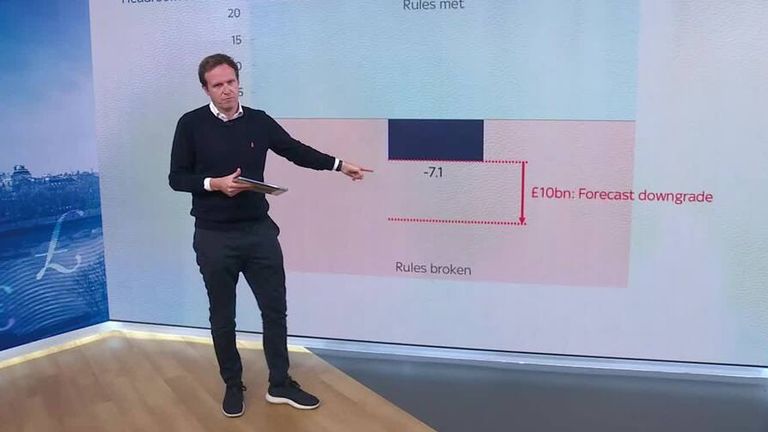
Ed Conway on the chancellor’s options
But days ago, officials and ministers were working on a proposal to lift the basic rate of income tax – perhaps by 2p – and then simultaneously cut national insurance contributions for those on the basic rate of income tax (those who earn up to £50,000 a year).
That way the chancellor can raise several billion in tax from those with the “broadest shoulders” – higher-rate taxpayers and pensioners or landlords, while also trying to protect “working people” earning salaries under £50,000 a year.
The chancellor was also going to take action on the two-child benefit cap in response to growing demand from the party to take action on child poverty. It is unclear whether those plans will now be shelved given the U-turn on income tax.
Read more: What taxes could go up now?
The change of plan comes after the prime minister found himself engulfed in a leadership crisis after his allies warned rivals that he would fight any attempted post-budget coup.
It triggered a briefing war between Wes Streeting and anonymous Starmer allies attacking the health secretary as the chief traitor.

Wes Streeting: Faithful or traitor? Beth Rigby’s take
Read more: Is Starmer ‘in office but not in power’?
The prime minister has since apologised to Mr Streeting, who I am told does not want to press for sackings in No 10 in the wake of the briefings against him.
But the saga has further damaged Sir Keir and increased concerns among MPs about his suitability to lead Labour into the next general election.
Insiders clearly concluded that the ill mood in the party, coupled with the recent hits to the PM’s political capital, makes manifesto-breaking tax rises simply too risky right now.
But it also adds to a sense of chaos, given the chancellor publicly pitch-rolled tax rises in last week’s news conference.

A growing rift has emerged in Washington, D.C., between the cryptocurrency industry and labor unions as lawmakers debate whether to ease rules allowing cryptocurrencies in 401(k) retirement accounts.
The dispute centers on proposed market structure legislation that would allow retirement accounts to gain exposure to crypto, a move labor groups say could expose workers to speculative risk. In a letter sent on Wednesday to the US Senate Banking Committee, the American Federation of Teachers argued that cryptocurrencies are too volatile for pension and retirement savings, warning that workers could face significant losses.
The letter drew immediate pushback from crypto investors and industry figures. “The American Federation of Teachers has somehow developed the most logically incoherent, least educated take one could possibly author on the matter of crypto market structure regulation,” a crypto investor said on X.

In response to the letter, Castle Island Ventures partner Sean Judge said the bill would improve oversight and reduce systemic risk, while enabling pension funds to access an asset class that has delivered strong long-term returns.
Consensys attorney Bill Hughes said the AFT’s opposition to the crypto market structure bill was politically motivated, accusing the group of acting as an extension of Democratic lawmakers.

Related: Atkins says SEC has ‘enough authority’ to drive crypto rules forward in 2026
Opposition to crypto in retirement and pension funds mounts
Proponents of allowing crypto in retirement portfolios, on the other hand, argue that it democratizes finance, while trade unions have voiced strong opposition to relaxing current regulations, claiming that crypto is too risky for traditional retirement plans.
“Unregulated, risky currencies and investments are not where we should put pensions and retirement savings. The wild, wild west is not what we need, whether it’s crypto, AI, or social media,” AFT president Randi Weingarten said on Thursday.
The AFT represents 1.8 million teachers and educational professionals in the US and is one of the largest teachers’ unions in the country.
According to Better Markets, a nonprofit and nonpartisan advocacy organization, cryptocurrencies are too volatile for traditional retirement portfolios, and their high volatility can create time-horizon mismatches for pension investors seeking a predictable, low-volatility retirement plan.

In October, the American Federation of Labor and Congress of Industrial Organizations (AFL-CIO) also wrote to Congress opposing provisions within the crypto market structure regulatory bill.
The AFL-CIO, the largest federation of trade unions in the US, wrote that cryptocurrencies are volatile and pose a systemic risk to pension funds and the broader financial system.
Magazine: 13 Christmas gifts that Bitcoin and crypto degens will love


-
 Sports2 years ago
Story injured on diving stop, exits Red Sox game
-
 Sports3 years ago
‘Storybook stuff’: Inside the night Bryce Harper sent the Phillies to the World Series
-
 Sports2 years ago
Game 1 of WS least-watched in recorded history
-
 Sports3 years ago
Button battles heat exhaustion in NASCAR debut
-
 Sports3 years ago
MLB Rank 2023: Ranking baseball’s top 100 players
-
Sports4 years ago
Team Europe easily wins 4th straight Laver Cup
-
 Environment3 years ago
Japan and South Korea have a lot at stake in a free and open South China Sea
-
 Environment1 year ago
Here are the best electric bikes you can buy at every price level in October 2024