

Eurovision to change voting rules after claims of Israeli government ‘interference’

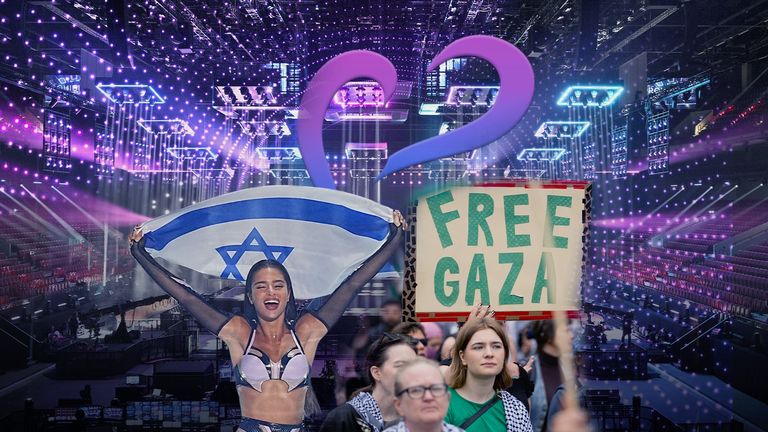
The Eurovision Song Contest is changing its voting system, following allegations of “interference” by Israel’s government this year.
Israeli singer Yuval Raphael received the largest number of votes from the public in the contest in May, ultimately finishing as runner-up after the jury votes were counted.
But a number of broadcasters raised concerns about Israel’s result.
After the final, Irish broadcaster RTE requested a breakdown in voting numbers from contest organiser the European Broadcasting Union (EBU), while Spain’s public broadcaster, Radio Television Espanola (RTVE), called for a “complete review” of the voting system to avoid “external interference”.
In September, Dutch public broadcaster AVROTROS said it could no longer justify Israel‘s participation in the contest, due to the Israel-Hamas war in Gaza.
It went on to say there had been “proven interference by the Israeli government during the last edition of the Song Contest, with the event being used as a political instrument”. The statement did not elaborate on the means of “interference”.
Sky News has contacted the Israeli government for comment.
In early December, the EBU will hold its winter general assembly, with members due to consider the changes, and if not satisfied, vote on Israel’s participation.
Key changes to next year’s competition include:
• Clearer rules around promotion of artists and their songs
• Cap on audience voting halved
• The return of professional juries to semi-finals
• Enhanced security safeguards
Read more: Could Eurovision boycotts over Israel lead to a competition crisis?
Will Eurovision boycott Israel?
Sanctions threat
The EBU said the tightening of rules around promotion was to “discourage disproportionate promotion campaigns… particularly when undertaken or supported by third parties, including governments or governmental agencies”.
It said that “any attempts to unduly influence the results will lead to sanctions”.
Contest director Martin Green said “no broadcaster or artist may now directly engage with or support campaigns by third parties – including governments or their agencies – that could distort the vote”.
He said the reduction in the number of votes that can be made online, or via SMS or phone call, from 20 to 10 was “designed to encourage more balanced participation”.
He said that “although the number of votes previously allowed did not unduly influence the results of previous contests, there were concerns expressed by participating broadcasters and fans alike”.
Professional juries in semi-finals – and younger jurors
It was also announced that professional juries in the semi-finals would be restored for the first time since 2022, with an expansion to the range of professions from which jurors can be chosen.
The EBU said this will give roughly 50-50 percentage weight between audience and jury votes.
At least two jurors aged 18-25 will be present in every jury, to reflect the appeal of the contest with younger audiences.
Also mentioned were enhanced technical safeguards designed to “protect the contest from suspicious or coordinated voting activity” and strengthen security systems that “monitor, detect and prevent fraudulent patterns”.
Politics making itself heard over Europop lyrics
Mr Green said that the neutrality and integrity of the competition is of “paramount importance” to the EBU, its members, and audiences, adding that the event “should remain a neutral space and must not be instrumentalised”.
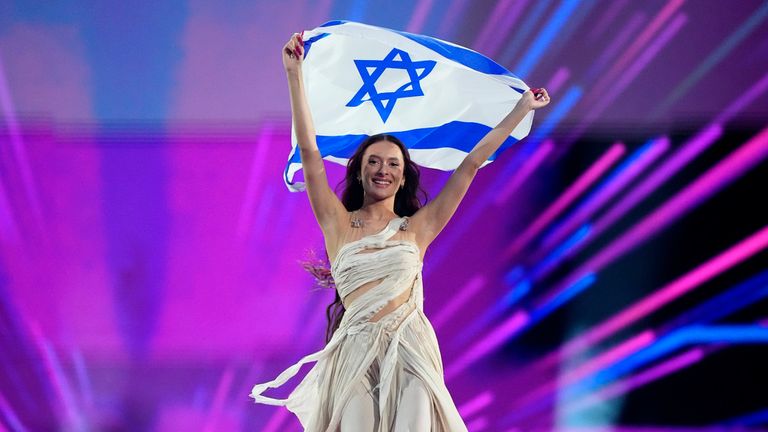
Israel’s 2024 representative, Eden Golan. Pic: AP
A vocally apolitical event, world events have dominated Eurovision in recent years.
Russia was banned from the competition in 2022 following its invasion of Ukraine.
Israel has competed in Eurovision for more than 50 years and won four times, but there have been ongoing calls to block their participation over the conduct of Prime Minister Benjamin Netanyahu’s government in the Hamas-Israel war.
Israel denies targeting civilians in Gaza and has said it is being unfairly demonised abroad.
In September, Spain, the Netherlands, Ireland, Iceland, and Slovenia threatened to withdraw their participation in Eurovision unless Israel is excluded from the competition.
There were also demonstrations against Israel’s inclusion in Basel, Switzerland, when the 2025 competition took place.
‘Step in right direction’
Responding to the changes, Iceland’s official broadcaster RUV told Sky News they were “a step in the right direction”, and they would be discussing them with their “sister stations in the Nordic countries” ahead of the EBU meeting in December.
Ireland’s official broadcaster RTE told Sky News: “Clearly, events in the Middle East are unfolding day by day. As previously confirmed by the EBU, the issue of participation in the 2026 Eurovision Song Contest has been included on the agenda of the EBU Executive Board’s ordinary Winter General Assembly.”
Sky News has also contacted the official broadcaster for the Netherlands (AVROTROS), Spain (RTVE), Slovenia (RTVSLO), and Israel (Kan) for comment.
The chief executive of Kan, Golan Yochpaz, has previously said the event should not become political and that there is “no reason” why Israel should not be part of it.
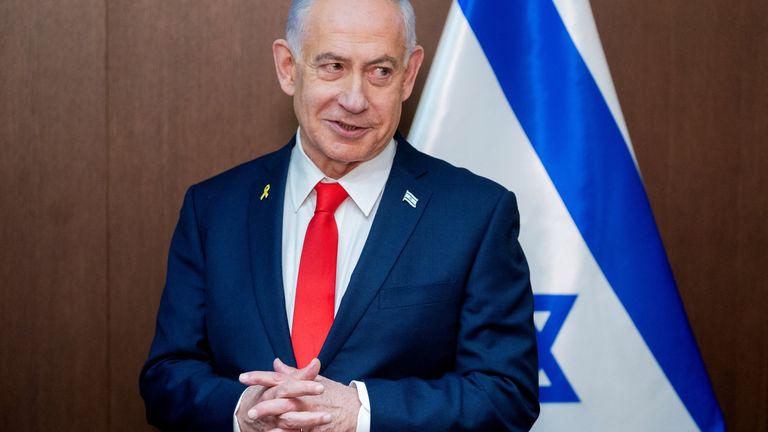
Israeli Prime Minister Benjamin Netanyahu. Pic: Reuters
Netanyahu praised Israeli entrant
Earlier this year, Israeli Prime Minister Benjamin Netanyahu told Israel’s 2025 Eurovision entrant Yuval Raphael she had brought the country “a lot of honour” after she finished in second place, adding “you’re the real winner. Statistically, it’s true… You entered the hearts of a huge portion of the public in Europe.”
The year before he told entrant Eden Golan: “I saw that you received almost the highest number of votes from the public and this is the most important thing, not from the judges but from the public, and you held Israel’s head up high in Europe.”
In October, a ceasefire deal was put in place, aimed at bringing an end to the two-year war in the Middle East.
The war began when Hamas stormed into Israel on October 7 2023, killing around 1,200 people and taking 251 hostage.
Israel invaded Gaza in retaliation, with airstrikes and ground assaults devastating much of the territory and killing more than 67,000, according to the Hamas-run health ministry.
Its figures do not differentiate between civilians and combatants, but it says around half of those killed were women and children.
The world’s largest live music event, next year’s contest will be held in Vienna, Austria, in May and will celebrate 70 years of Eurovision.
A man suspected of killing 15 people during a shooting in Bondi Beach “conducted firearms training” with his father before the attack on a Jewish event, Australian police have said.
Naveed Akram, 24, and his father, Sajid Akram, allegedly attacked people at a Hanukkah event at Bondi Beach on 14 December, killing victims aged 10 to 87 and injuring 40 others.
Fifty-year-old Sajid Akram was killed by police at the scene, while Naveed was injured and treated in hospital. He has since been charged with 59 offences, including a terror charge, and police transferred him to a prison on Monday.
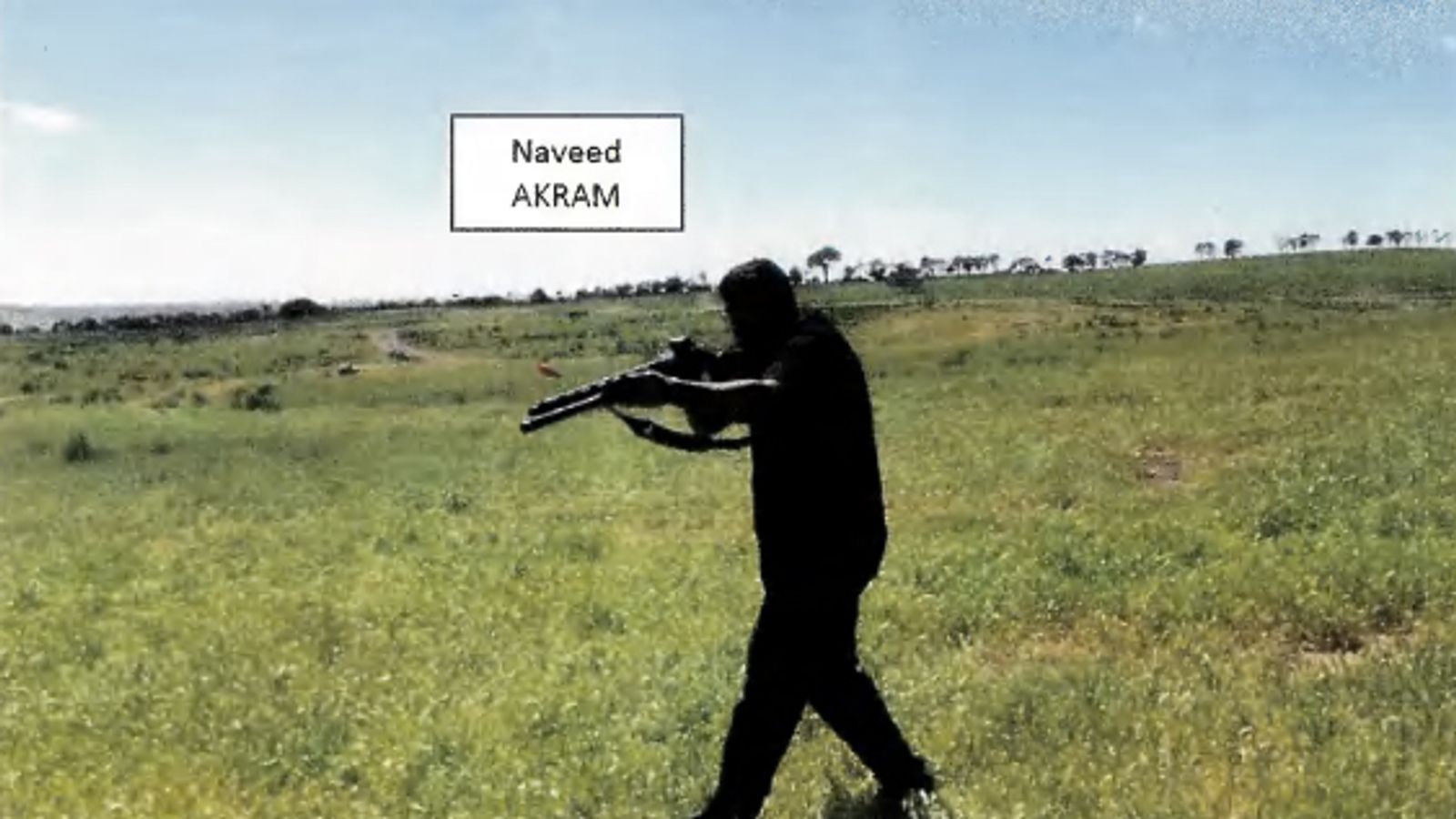
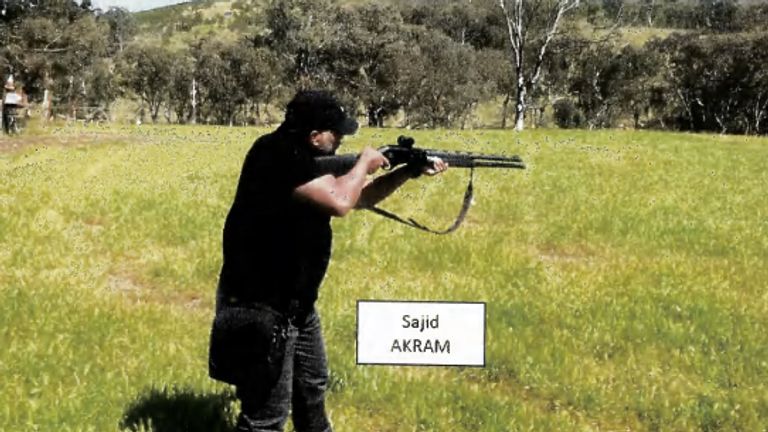
New South Wales Police have released pictures of Naveed Akram and his father holding guns, as they “conducted firearms training in a countryside location, suspected to be NSW” in late October, according to a police fact sheet seen by Sky News.
Suspected gunman Sajid Akram during the alleged firearms training with his son. Pic: NSW Police/NSW Local Court
“The accused and his father are seen throughout the video firing shotguns and moving in a tactical manner,” police said.
‘Homemade bombs’
On the day of the Bondi Beach attack, the pair allegedly threw homemade bombs and improvised explosive devices (IEDs) at the crowd of people at the gathering near the beach, but these did not detonate.
An analysis indicates that both were “viable” IEDs, according to the police file.
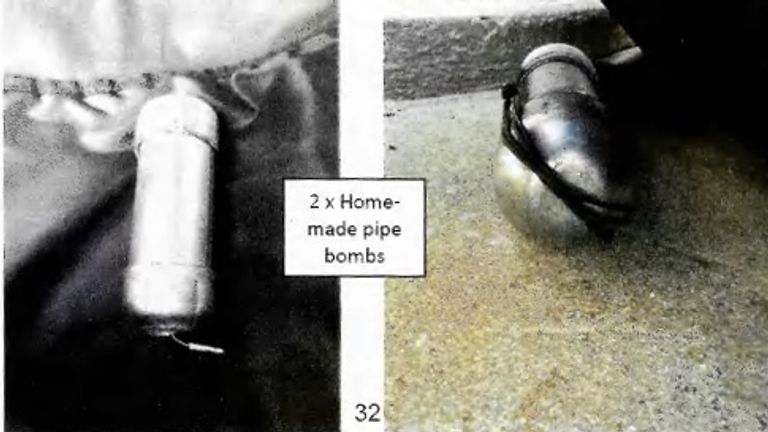
The suspected gunmen were allegedly armed with pipe bombs. Pic: NSW Police/NSW Local Court
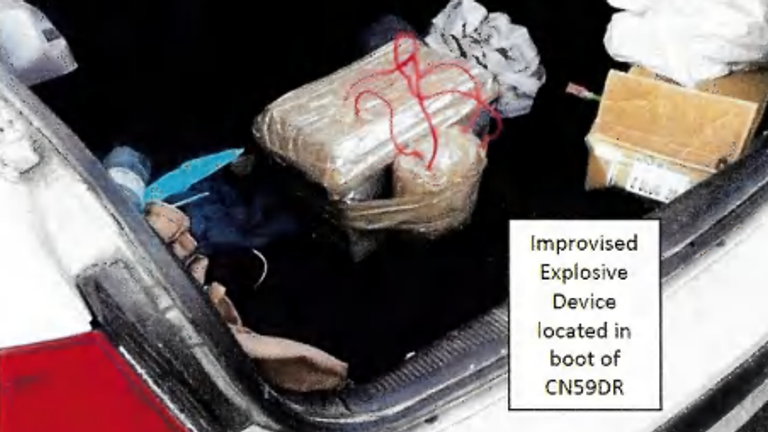
Police said they found an IED in the suspects’ car. Pic: NSW Police/NSW Local Court
The information on the fact sheet was released after a suppression order was lifted by an NSW court.
Police allege the men had stored the explosives – three pipe bombs, one tennis ball bomb and one large IED – in a silver Hyundai vehicle, alongside two single-barrel shotguns, a Beretta rifle and two Islamic State flags.
The Hyundai was parked near the scene of the shooting, with the Islamic State flags allegedly displayed in the front and rear windows.
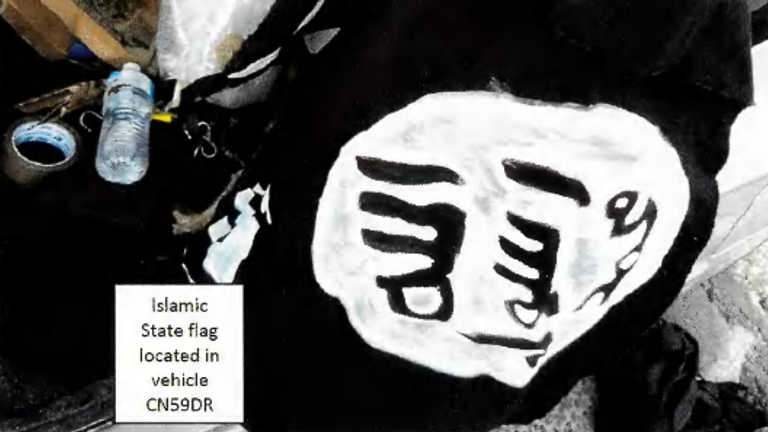
A homemade Islamic State flag was also found in the car, police said. Pic: NSW Police/NSW Local Court
‘Justification’ video found
A phone belonging to Naveed Akram was also found in the car, on which officers identified several videos, including the alleged firearms training video.
Another video shows Naveed Akram and his father sitting in front of an image of an Islamic State flag, with four long-arm guns with rounds attached seen in the background, police said.
The men “appear to summarise their justification for the Bondi terrorist attack” in the footage, according to the fact sheet.
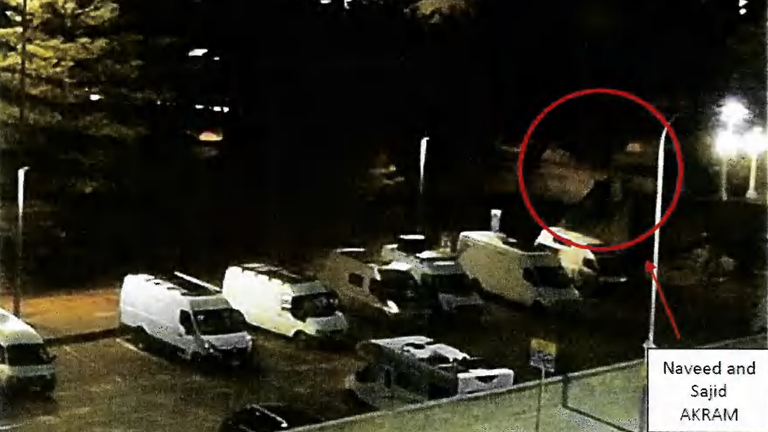
Police said the men walked on the footbridge from where they allegedly shot at crowds two days later. Pic: NSW Local Court
Their Hyundai was previously seen on CCTV entering the car park at Bondi Beach before Naveed Akram and his father walked around the area at around 10pm on 12 December – two days before the shooting.
Police allege that this is evidence of reconnaissance and planning of a terrorist act.
On the day of the shooting, CCTV showed the men leaving a rental house in the nearby suburb of Campsie at around 3pm before driving to Bondi at around 5pm, police said.
The pair were seen carrying bulky items wrapped in blankets, which officers allege were the rifles and homemade bombs.
In the room they rented throughout December, police said they later discovered a firearm scope, ammunition, a suspected IED, 3D-printed parts for a shotgun speed loader, a rifle, a shotgun, numerous firearms parts, bomb-making equipment and two copies of the Koran.
Police said Naveed Akram’s mother told officers that she believed her husband and son were on a fishing trip when they allegedly launched the attack. She said Naveed had been calling her every day from a public phone at around 10.30am.
New gun laws
Meanwhile, the NSW government announced new draft gun laws on Monday, which the state’s premier, Chris Minns, promised would be the toughest in Australia.
The new restrictions would include making Australian citizenship a condition of qualifying for a firearms licence.
But a law like this would have excluded Sajid Akram, who was an Indian citizen with a permanent resident visa for Australia.
Read more from Sky News:
On the ground in Venezuela as US threatens military intervention
NHS reported to police after ‘butcher surgeon’ evidence destroyed
He also legally owned six rifles and shotguns, which would be limited to a maximum of four guns under the new legal limit for recreational shooters.
This comes as Australia’s Prime Minister Anthony Albanese said on Monday that his government would introduce a new offence of adults trying to influence and radicalise children after already introducing legislation to criminalise hate speech and doxing.

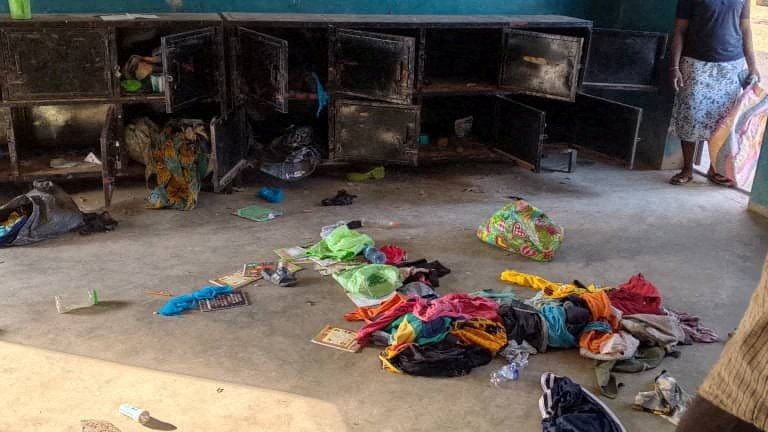
The remaining 130 schoolchildren and staff abducted by gunmen from a Catholic school in Nigeria last month have been freed.
They are among more than 300 pupils and 12 staff taken from St Mary’s Catholic boarding school in Niger State on 21 November.
Fifty children managed to escape at the time, the Christian Association of Nigeria previously said, while the government said on 8 December that it had rescued 100 of those abducted.
Belongings and clothes left behind at St Mary’s School after the kidnapping. Pic: Reuters
Now the last of the pupils have been released, a spokesman for President Bola Tinubu said, bringing a close to one of the country’s biggest mass kidnappings in recent years.
“The remaining 130 schoolchildren abducted by terrorists… have now been released,” wrote presidential spokesman Bayo Onanuga in a post on X.
“They are expected to arrive in Minna on Monday and rejoin their parents for the Christmas celebration.
“The freedom of the schoolchildren followed a military-intelligence driven operation.”
The abduction has fuelled outrage over worsening insecurity in northern Nigeria, where armed gangs frequently target schools for ransom.
School kidnappings surged after Boko Haram militants abducted 276 girls from Chibok in 2014.
Over a decade later, dozens of the girls taken on that occasion remain missing.
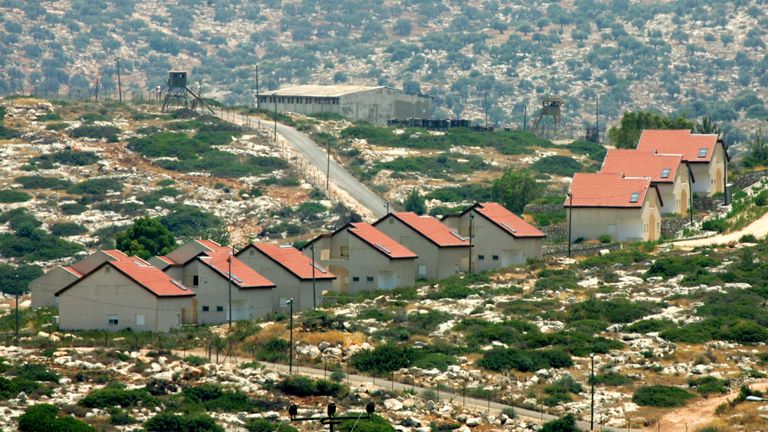
Israel has approved 19 new Jewish settlements in the occupied West Bank in a fresh blow to the possibility of a Palestinian state.
The move brings the number of new settlements over the past few years to 69, a new record, according to Israel‘s far-right finance minister Betzalel Smotrich.
Widely considered illegal under international law, the settlements have been criticised for fragmenting the territory of a future Palestinian state by confiscating land and displacing residents.
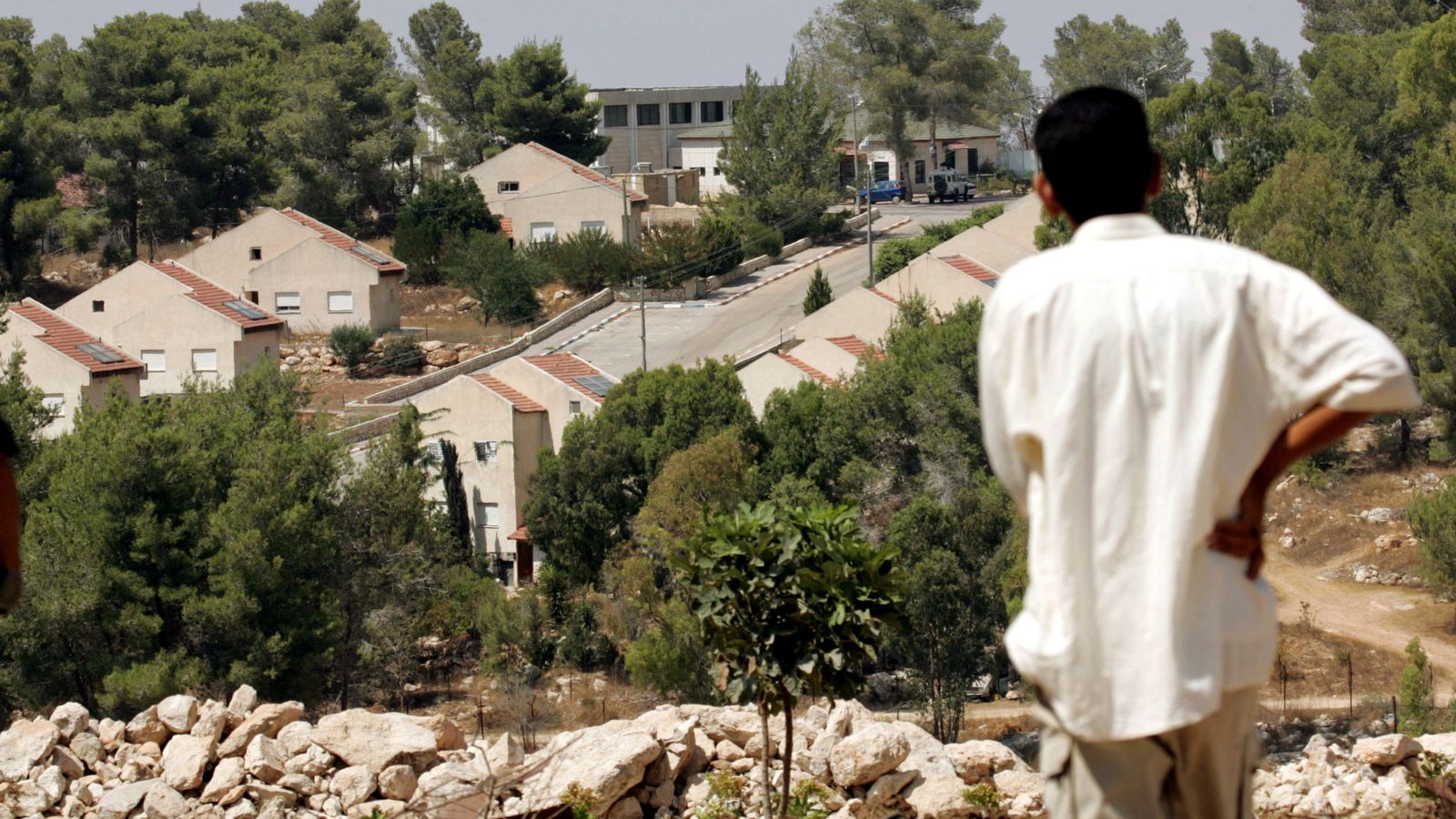
Ganim pictured in 2005. Pic: Reuters
Under Israel’s current government, figures show, the number of settlements in the West Bank has surged by nearly 50%, rising from 141 in 2022, to 210 with the new approvals, according to Peace Now, an anti-settlement watchdog.
The government’s latest action retroactively authorises some previously-established outposts or neighbourhoods of existing settlements, and the creation of settlements on land where Palestinians were evacuated.
It also approves Kadim and Ganim, two of the four settlements dismantled in 2005, and which Israelis were previously banned from re-entering as part of Israel’s withdrawal from the Gaza Strip.
Since Israel repealed the 2005 act in March 2023, there have been multiple attempts to resettle them.
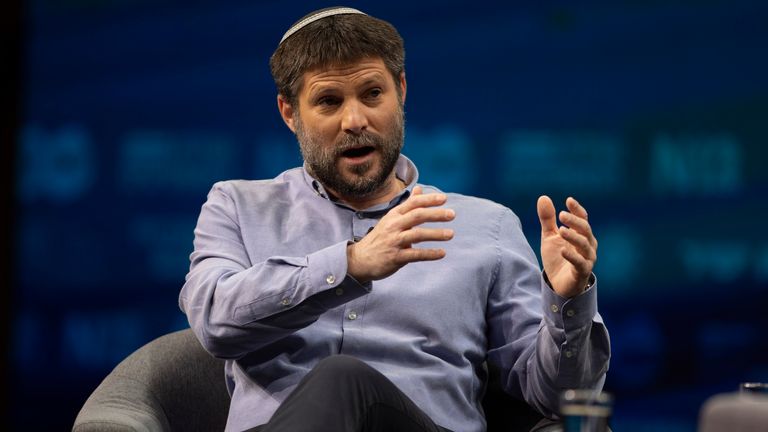
Betzalel Smotrich is among prominent names backing the settlements. Pic: AP
The move comes amid mounting pressure from the US to move ahead with the second phase of the Gaza ceasefire, which took effect on 10 October.
Mr Smotrich is one of a number of figures now prominent in Israel’s government who back the settlements.
The West Bank, east Jerusalem, and Gaza are claimed by the Palestinians for their future state, but were captured by Israel in the 1967 war.
Read more:
Analysis: Gaza longs for normality, but quasi-anarchy reigns
Two brothers killed in Israeli drone strike on Gaza
Today over 500,000 Jews are settled in the West Bank, in addition to over 200,000 in contested east Jerusalem.
Settlements can range in size from a single dwelling to a collection of high-rises, and the occupied territories are also host to a number of unauthorised Israeli outposts.
-
 Sports2 years ago
Story injured on diving stop, exits Red Sox game
-
 Sports3 years ago
‘Storybook stuff’: Inside the night Bryce Harper sent the Phillies to the World Series
-
 Sports2 years ago
Game 1 of WS least-watched in recorded history
-
 Sports3 years ago
Button battles heat exhaustion in NASCAR debut
-
 Sports3 years ago
MLB Rank 2023: Ranking baseball’s top 100 players
-
Sports4 years ago
Team Europe easily wins 4th straight Laver Cup
-
 Environment3 years ago
Japan and South Korea have a lot at stake in a free and open South China Sea
-
 Environment1 year ago
Here are the best electric bikes you can buy at every price level in October 2024