
Budget 2025: Three things Rachel Reeves’s speech boils down to – and two tricks the chancellor will fall back on

This is going to be a big budget – not to mention a complex budget.
It could, depending on how it lands, determine the fate of this government. And it’s hard to think of many other budgets that have been preceded by quite so much speculation, briefing, and rumour.
All of which is to say, you could be forgiven for feeling rather overwhelmed.
But in practice, what’s happening this week can really be boiled down to three things.
1. Not enough growth
The first is that the economy is not growing as fast as many people had hoped. Or, to put it another way, Britain’s productivity growth is much weaker than it once used to be.
The upshot of that is that there’s less money flowing into the exchequer in the form of tax revenues.
2. Not enough cuts
The second factor is that last year and this, the chancellor promised to make certain cuts to welfare – cuts that would have saved the government billions of pounds of spending a year.
But it has failed to implement those cuts. Put those extra billions together with the shortfall from that weaker productivity, and it’s pretty clear there is a looming hole in the public finances.
3. Not enough levers
The third thing to bear in mind is that Rachel Reeves has pledged to tie her hands in the way she responds to this fiscal hole.
She has fiscal rules that mean she can’t ignore it. She has a manifesto pledge which means she is somewhat limited in the levers she can pull to fill it.
Put it all together, and it adds up to a momentous headache for the chancellor. She needs to raise quite a lot of money and all the “easy” ways of doing it (like raising income tax rates or VAT) seem to be off the table.
The Budget Explained – in 60 seconds
So… what will she do?
Quite how she responds remains to be seen – as does the precise size of the fiscal hole. But if the rumours in Westminster are to be believed, she will fall back upon two tricks most of her predecessors have tried at various points.
First, she will deploy “fiscal drag” to squeeze extra income tax and national insurance payments out of families for the coming five years.
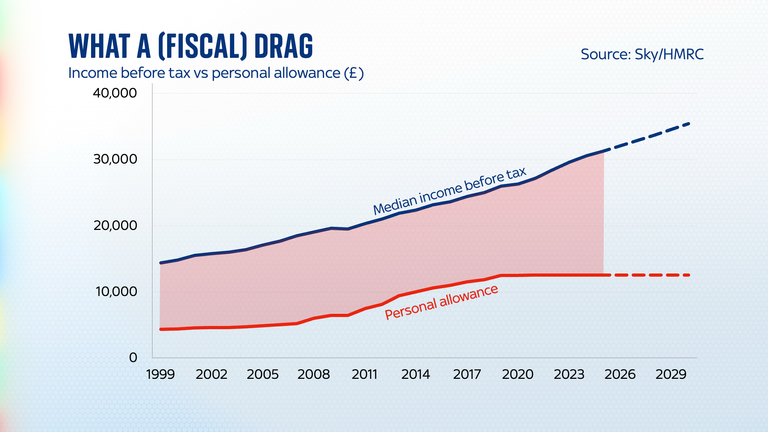
What this means in practice is that even though the headline rate of income tax might not go up, the amount of income we end up being taxed on will grow ever higher in the coming years.
Second, the chancellor is expected to squeeze government spending in the distant years for which she doesn’t yet need to provide detailed plans.
Together, these measures may raise somewhere in the region of £10bn. But Reeves’s big problem is that in practice she needs to raise two or three times this amount. So, how will she do that?
Most likely is that she implements a grab-bag of other tax measures: more expensive council tax for high value properties; new CGT rules; new gambling taxes and more.
No return to austerity, but an Osborne-like predicament…
If this summons up a particular memory from history, it’s precisely the same problem George Osborne faced back in 2012. He wanted to raise quite a lot of money but due to agreements with his coalition partners, he was limited in how many big taxes he could raise.
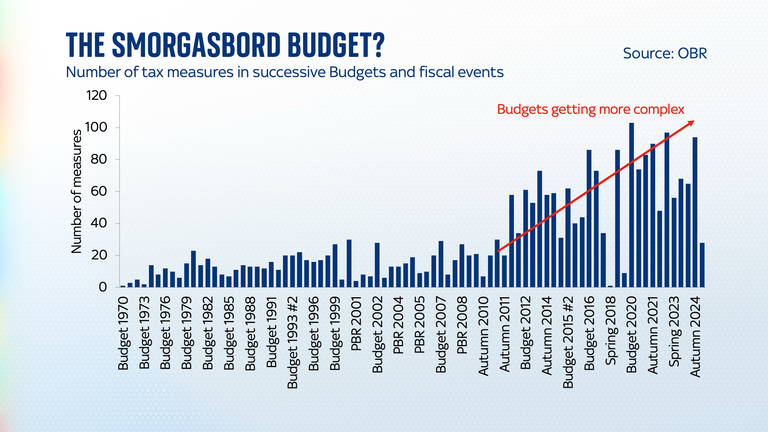
The resulting budget was, at the time at least, the single most complex budget in history. Consider: in the years between 1970 and 2010 the average UK budget contained 14 tax measures. Osborne’s 2012 budget contained a whopping 61 of them.
And not long after he delivered it, the budget started to unravel. You probably recall the pasty tax, and maybe the granny tax and the charity tax. Essentially, he was forced into a series of embarrassing U-turns. If there was a lesson, it was that trying to wodge so many money-raising measures into a single fiscal event was an accident waiting to happen.

Can the budget fix economic woes?
Except that… here’s the interesting thing. In the following years, the complexity of budgets didn’t fall – it rose. Osborne broke his own complexity record the next year with the 2013 budget (73 tax measures), and then again in 2016 (86 measures). By 2020 the budget contained a staggering 103 measures. And Reeves’s own first budget, last autumn, very nearly broke this record with 94 measures.
In short, budgets have become more and more complex, chock-full of even more (often microscopic) tax measures.
Read more from Sky News:
What tax measures are expected in budget?
The political jeopardy facing Rachel Reeves in budget
In part, this is a consequence of the fact that, long ago, chancellors seem to have agreed that it would be political suicide to raise the basic rate of income tax or VAT. The consequence is that they have been forced to resort to ever smaller and fiddlier measures to make their numbers add up.
The question is whether this pattern continues this week. Do we end up with yet another astoundingly complex budget? Will that slew of measures backfire as they did for Osborne in 2012? And, more to the point, will they actually benefit the UK economy?

A millionaires’ playground, Poole in Dorset boasts some of the most expensive properties in the UK, and has been called Britain’s Palm Beach.
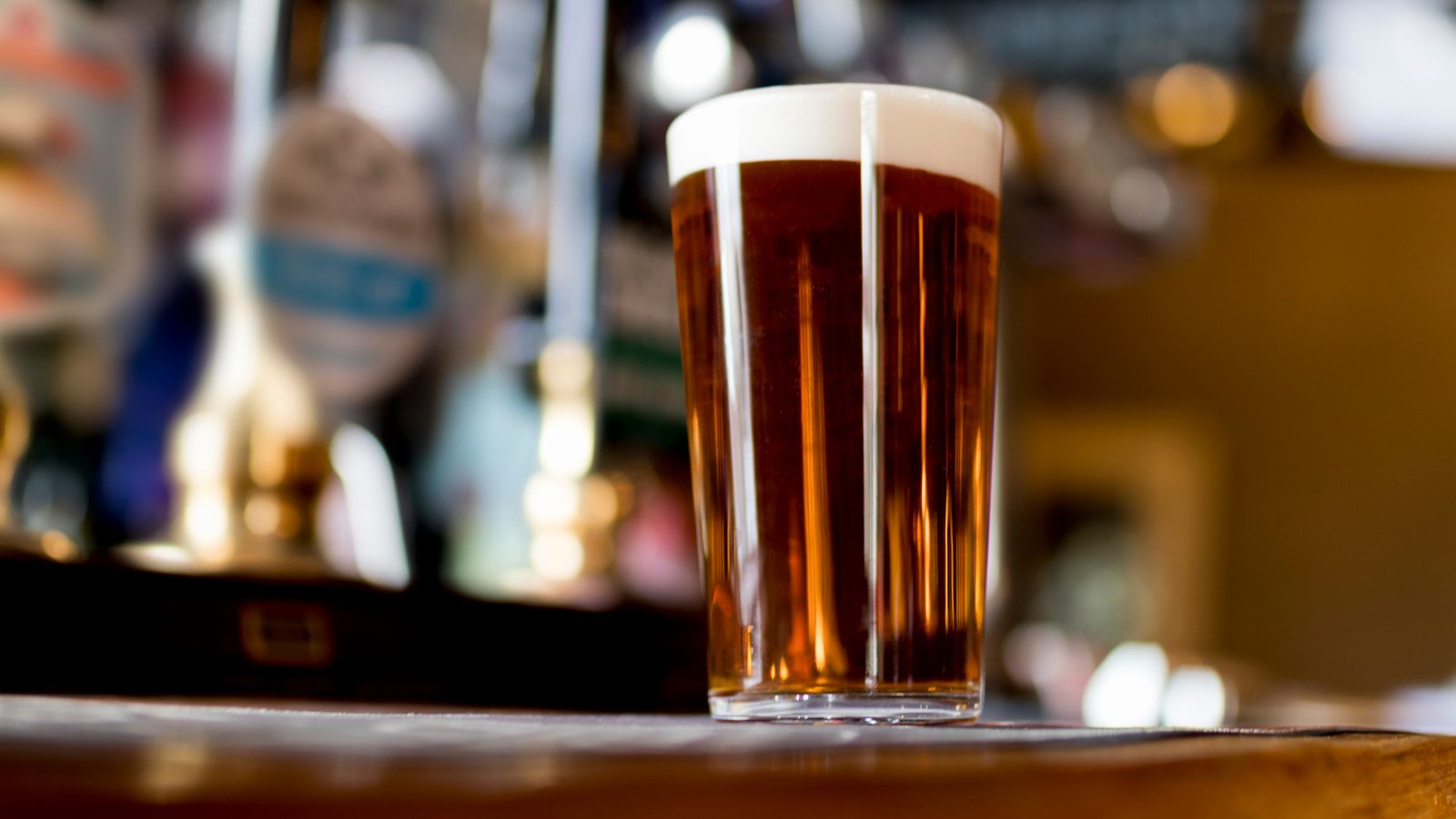
Away from the yachts and the mansions of Sandbanks, however, Poole is also a beer drinkers’ paradise, with 58 pubs in the parliamentary constituency alone.
But now many of Dorset’s pub landlords have joined a bitter backlash against rises in business rates of up to £30,000 in Rachel Reeves’s November budget.
Across the UK, it is claimed up to 1,000 publicans have even banned Labour MPs from their pubs, after the chancellor axed a 40% rates discount, introduced during COVID, from next April.
The row over the rises, brewing since the budget, came to a head in a clash between Kemi Badenoch and Sir Keir Starmer in the final Prime Minister’s Questions of 2025.
“He gave his word that he would help pubs,” said the Tory leader.
“Yet they face a 15% rise in business rates because of his budget. Will he be honest and admit that his taxes are forcing pubs to close?”
The PM replied that the temporary relief introduced during COVID – a scheme the Conservatives put in place and Labour supported, he said – had come to an end.
“But it was always a temporary scheme coming to an end,” he said.
“We have now put in place a £4bn transitional relief.”
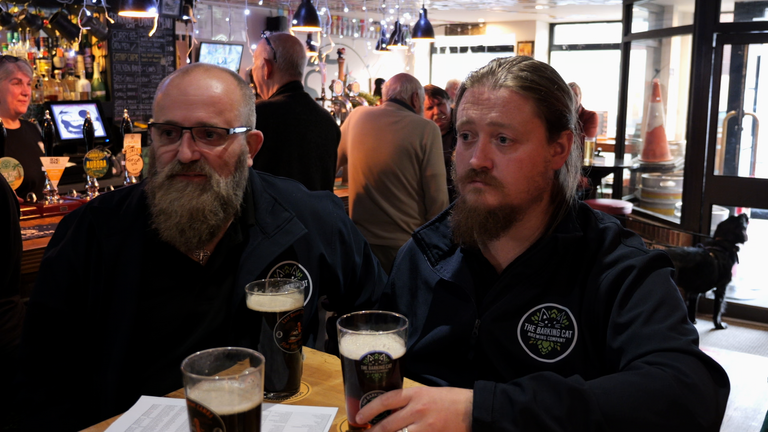
Mark and Michael Ambrose, father and son co-landlords of The Barking Cat, said the increases are a ‘pub destroyer’
But in the Barking Cat Ale House in Poole, facing an increase in business rates of nearly £9,000 a year, the father and son co-landlords fear the rises could mean last orders for many pubs.
“We’re sort of in the average area at 157%, but we’ve got a lot of local pubs that are increasing by 600%, and another one by 800%,” Ambrose senior, Mark, told Sky News.
“It’s a pub destroyer. Pubs can’t survive these kinds of increases. It’s not viable. Most pubs are just about scraping by anyway. If you add these massive increases your profit margins are wiped out.
“We struggle as it is. You can’t have that kind of increase and expect businesses to succeed.
“Fortunately, the customers understand. But they still don’t want to have to spend an extra 30 or 50 pence a pint.”
Son Michael added: “It’s all back to front. It’s really these bigger pub companies and supermarkets that need to be facing increased taxes. We can’t handle them. They can.”
Michelle Smith, landlady of the Poole Arms, the oldest pub on the town’s quay, dating back to 1635, said: “Our rates per value is due to go up £9,000 in April, so it’s quite a deal.”
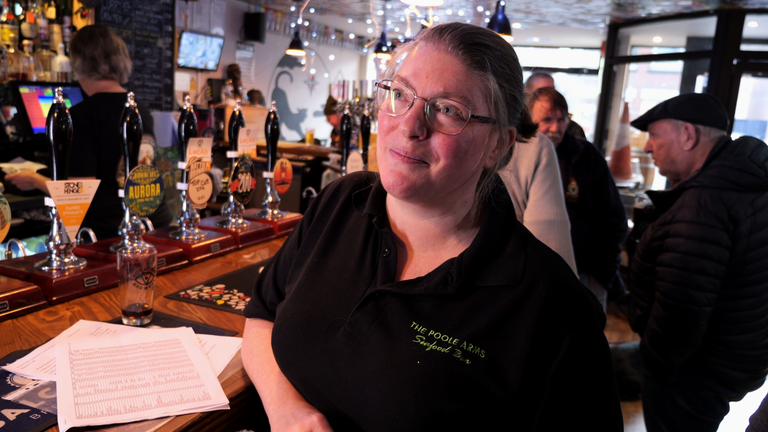
Michelle Smith, landlady of The Poole Arms, said all her prices are going up
“And we had a rates increase just gone as well,” she added. “So our rates had already increased over £1,000 a month last April. So another hit is quite considerable really.
“Prices definitely have to go up with all the different price increases that we’ve got throughout: business rates, wage increases, the beer goes up from the breweries. Everything is going up.”
Backing the publicans, Neil Duncan-Jordan, who became Poole’s first ever Labour MP last year, has written to the chancellor demanding a rethink. He said he is prepared to vote against the tax rise in the Commons.
“They’ve got to listen,” he told Sky News.
“They’ve got to listen to the high street, to publicans, people who run social clubs and listen to problems that they’re facing and the impact that these changes have made.”
Mr Duncan-Jordan said he was prepared to support an amendment to the Finance Bill, which turns the budget into law and had its second reading in the Commons last week.
Despite being suspended for four months for rebelling against welfare cuts earlier this year, he said: “I was discussing this with some MPs just this morning and I’ll be happy to support those. Sometimes you just have to say what you think is right.”
As chancellor, Ms Reeves has regularly raised a glass to pubs and promised to protect them from rising costs.
But Sir Keir has faced the wrath of a publican before, when he was thrown out of a pub in Bath during COVID by an anti-lockdown landlord.
This time, without a U-turn by the chancellor on the business rates increases, pub landlords fear the government has them over a barrel.
-
 Sports2 years ago
Story injured on diving stop, exits Red Sox game
-
 Sports3 years ago
‘Storybook stuff’: Inside the night Bryce Harper sent the Phillies to the World Series
-
 Sports2 years ago
Game 1 of WS least-watched in recorded history
-
 Sports3 years ago
Button battles heat exhaustion in NASCAR debut
-
 Sports3 years ago
MLB Rank 2023: Ranking baseball’s top 100 players
-
Sports4 years ago
Team Europe easily wins 4th straight Laver Cup
-
 Environment3 years ago
Japan and South Korea have a lot at stake in a free and open South China Sea
-
 Environment1 year ago
Here are the best electric bikes you can buy at every price level in October 2024