

Tesla AI4 vs. NVIDIA Thor: the brutal reality of self-driving computers

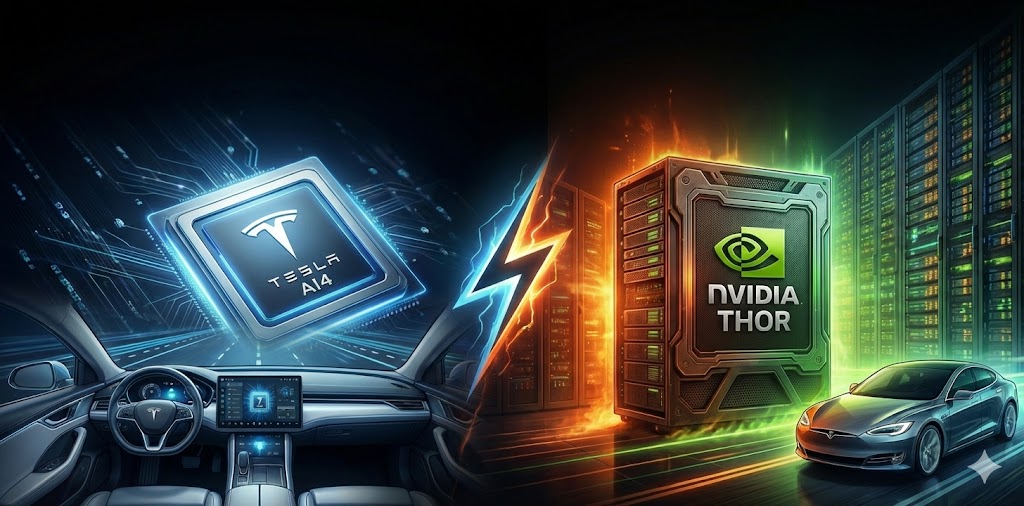
The race for autonomous driving has three fronts: software, hardware, and regulatory. For years, we’ve watched Tesla try to brute-force its way to “Full Self-Driving (FSD)” with its own custom hardware, while the rest of the automotive industry is increasingly lining up behind NVIDIA.
Now that we know Tesla’s new AI5 chip is delayed and won’t be in vehicles until 2027, it’s worth comparing the two most dominant “self-driving” chips today: Tesla’s latest Hardware 4 (AI4) and NVIDIA’s Drive Thor.
Here’s a table comparing the two chips with the best possible specs I could find. greentheonly’s teardown was particularly useful. If you find things you think are not accurate, please don’t hesitate to reach out:
| Feature / Specification | Tesla AI4 (Hardware 4.0) | NVIDIA Drive Thor (AGX / Jetson) |
|---|---|---|
| Developer / Architect | Tesla (in-house) | NVIDIA |
| Manufacturing Process | Samsung 7nm (7LPP class) | TSMC 4N (custom 5nm class) |
| Release Status | In production (shipping since 2023) | In production since 2025 |
| CPU Architecture | ARM Cortex-A72 (legacy) | ARM Neoverse V3AE (server-grade) |
| CPU Core Count | 20 cores (5× clusters of 4 cores) | 14 cores (Jetson T5000 configuration) |
| AI Performance (INT8) | ~100–150 TOPS (dual-SoC system) | 1,000 TOPS (per chip) |
| AI Performance (FP4) | Not supported / not disclosed | 2,000 TFLOPS (per chip) |
| Neural Processing Unit | 3× custom NPU cores per SoC | Blackwell Tensor Cores + Transformer Engine |
| Memory Type | GDDR6 | LPDDR5X |
| Memory Bus Width | 256-bit | 256-bit |
| Memory Bandwidth | ~384 GB/s | ~273 GB/s |
| Memory Capacity | ~16 GB typical system | Up to 128 GB (Jetson Thor) |
| Power Consumption | Est. 80–100 W (system) | 40 W – 130 W (configurable) |
| Camera Support | 5 MP proprietary Tesla cameras | Scalable, supports 8MP+ and GMSL3 |
| Special Features | Dual-SoC redundancy on one board | Native Transformer Engine, NVLink-C2C |
The most striking difference right off the bat is the manufacturing process. NVIDIA is throwing everything at Drive Thor, using TSMC’s cutting-edge 4N process (a custom 5nm-class node). This allows them to pack in the new Blackwell architecture, which is essentially the same tech powering the world’s most advanced AI data centers.
Tesla, on the other hand, pulled a move that might surprise spec-sheet warriors. Teardowns confirm that AI4 is built on Samsung’s 7nm process. This is mature, reliable, and much cheaper than TSMC’s bleeding-edge nodes.
When you look at the compute power, NVIDIA claims a staggering 2,000 TFLOPS for Thor. But there’s a catch. That number uses FP4 (4-bit floating point) precision, a new format designed specifically for the Transformer models used in generative AI.
Tesla’s AI4 is estimated to hit around 100-150 TOPS (INT8) across its dual-SoC redundant system. On paper, it looks like a slaughter, but Tesla made a very specific engineering trade-off that tells us exactly what was bottling up their software: memory bandwidth.
Tesla switched from LPDDR4 in HW3 to GDDR6 in HW4, the same power-hungry memory you find in gaming graphics cards (GPUs). This gives AI4 a massive memory bandwidth of approximately 384 GB/s, compared to Thor’s 273 GB/s (on the single-chip Jetson config) using LPDDR5X.
This suggests Tesla’s vision-only approach, which ingests massive amounts of raw video from high-res cameras, was starving for data.
Based on Elon Musk’s comments that Tesla’s AI5 chip will have 5x the memory bandwidth, it sounds like it might still be Tesla’s bottleneck.
Here is where Tesla’s cost-cutting really shows. AI4 is still running on ARM Cortex-A72 cores, an architecture that is nearly a decade old. They bumped the core count to 20, but it’s still old tech.
NVIDIA Thor, meanwhile, uses the ARM Neoverse V3AE, a server-grade CPU explicitly designed for the modern software-defined vehicle. This allows Thor to run not just the autonomous driving stack, but the entire infotainment system, dashboard, and potentially even an in-car AI assistant, all on one chip.
Thor has found many takers, especially among Tesla EV competitors such as BYD, Zeekr, Lucid, Xiaomi, and many more.
Electrek’s Take
There’s one thing that is not in there: price. I would assume that Tesla wins on that front, and that’s a big part of the project. Tesla developed a chip that didn’t exist, and that it needed.
It was an impressive feat, but it doesn’t make Tesla an incredible leader in silicon for self-driving.
Tesla is maxing out AI4. It now uses both chips, making it less likely to achieve the redundancy levels you need to deliver level 4-5 autonomy.
Meanwhile, we don’t have a solution for HW3 yet and AI5 is apparently not coming to save the day until 2027.
By then, there will likely be millions of vehicles on the road with NVIDIA Thor processors.


FTC: We use income earning auto affiliate links. More.

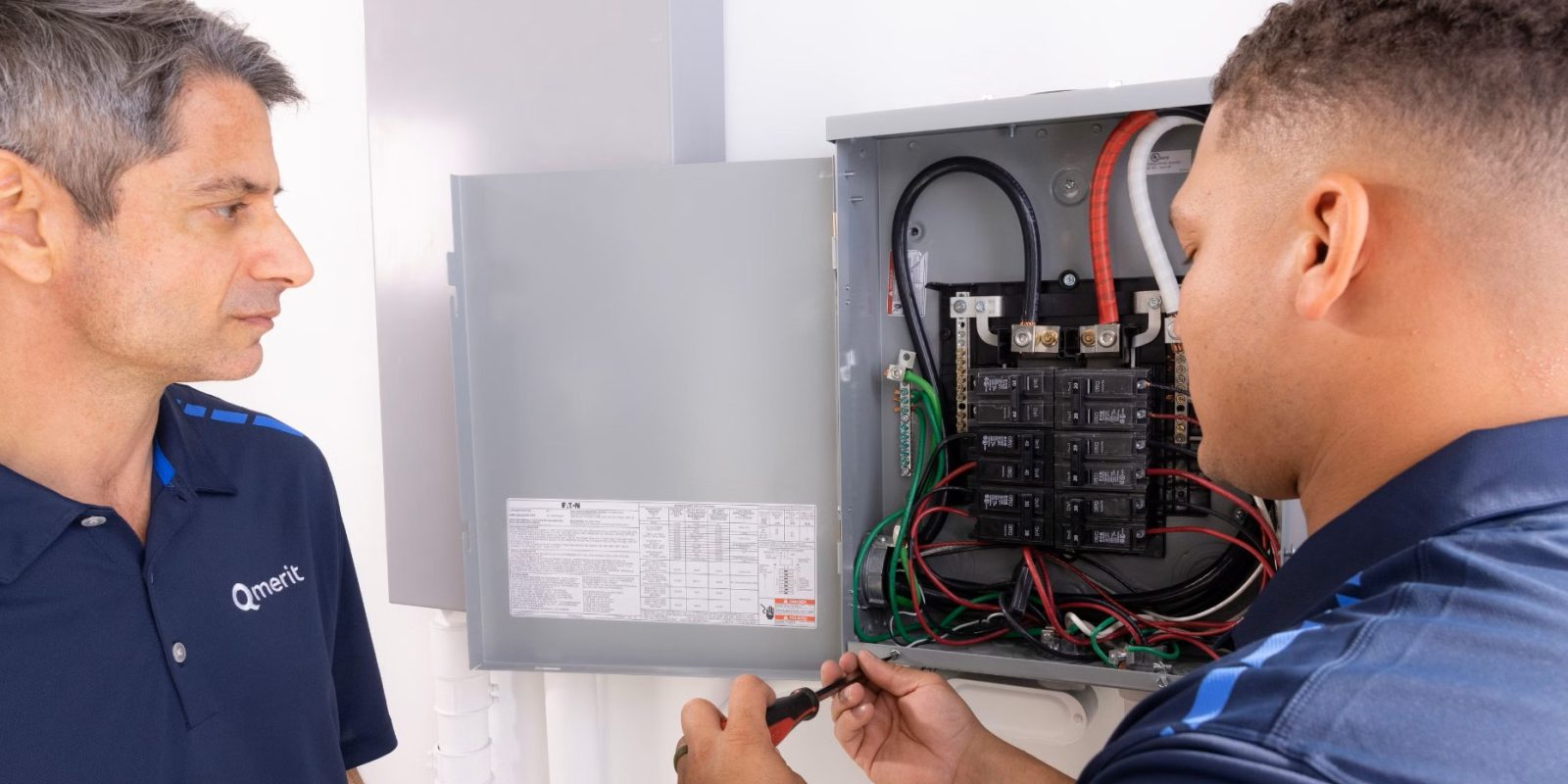
Adding a rooftop solar array to your home or business can be exciting and expensive. As such, it might be tempting to cut corners to keep costs down — but some upgrades are simply much cheaper to do while your solar system is being installed than they are to add later, and we’ve got some prime examples right here.
Just like it’s often cheaper for your mechanic to handle small add-on jobs while the bumper is already off and the engine is already exposed, there are a handful of home energy upgrades that are far easier and less expensive to take while your solar system is being installed that they would be later, if only because that work often means reopening permits, calling electricians back out, or even removing and reinstalling panels — all of which adds labor hours that can get really expensive really fast fast.
To help you navigate which jobs may be worth doing now, here’s a list of common upgrades home solar customers commonly regret skipping:
1. Smart panel upgrade
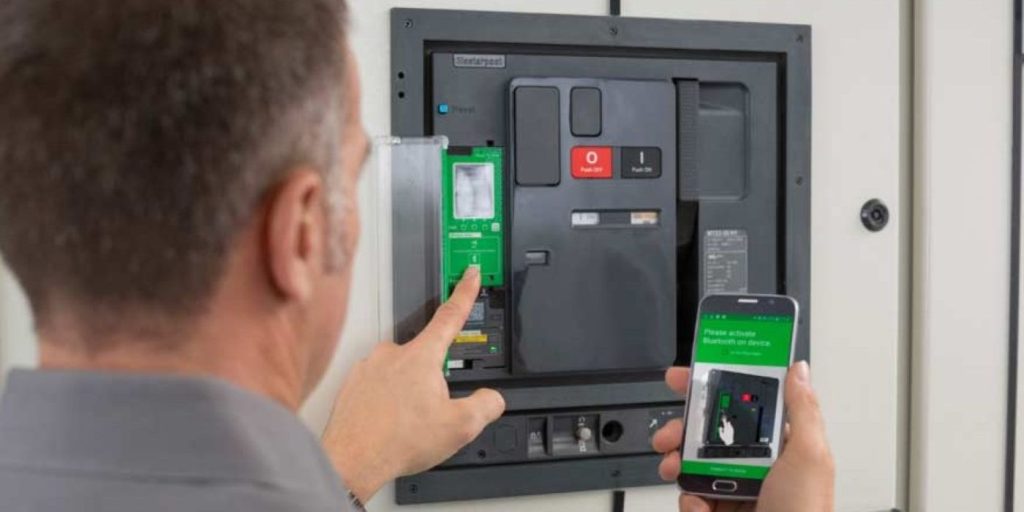
My solar panels work fine … but now I can’t add an EV, heat pump, or backup battery without redoing everything.
PEOPLE WHO SKIP THIS STEP
Even if your home solar setup is working perfectly, skipping a panel or service upgrade can create headaches down the road for homeowners looking to electrify everything, eventually. Upgrading from a 100A service to 200A, installing a smart panel (like those available from Leviton, Schneider, or SPAN), and adding load-shedding capabilities for future electrification projects makes a ton of sense while your electricians are already there.
Plus, making these changes often requires shutting down the solar array, reopening permits, and calling in the electricians again once the system is live — disruptive and expensive costs that are much easier to handle during the initial installation.
2. Battery-ready electrical (without a battery)
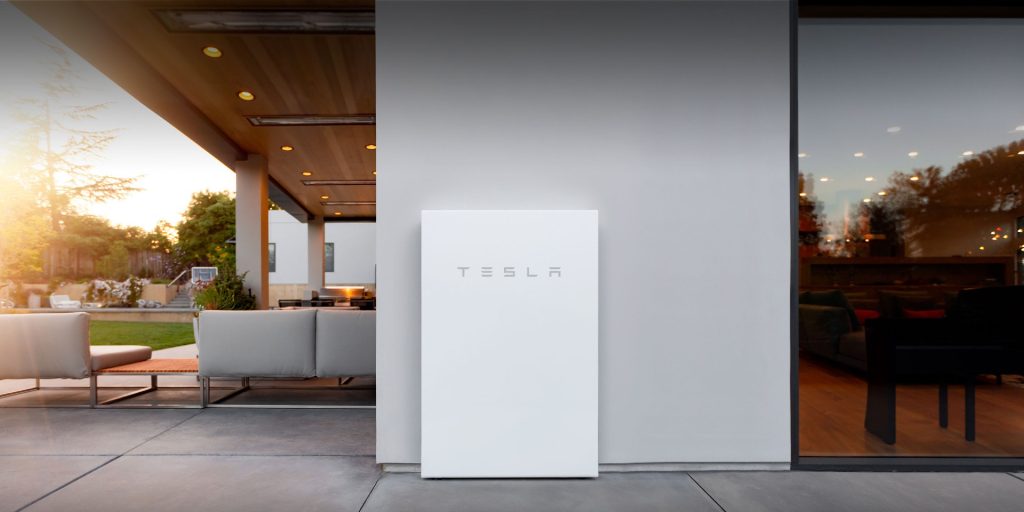
I didn’t think I’d need a battery … until we started getting more outages, our utility started TOU rates, and an EV showed up in my garage.
PEOPLE WHO SKIP THIS STEP
Even if you’re not installing a battery now, homeowners who skip the steps needed to make their homes “battery-ready” often regret not pre-installing a transfer switch, leaving space for battery breakers, or choosing a battery-compatible inverter. Once the system is live, adding these features usually means fresh permits, scheduling another building inspection, and paying for duplicate electrician labor — all before you even purchase a battery.
So, while it may make sense to wait on the right battery, itself as battery prices continue to come down and more competitors enter the market, any savings you might gain from waiting will almost definitely get eaten up by duplicate labor costs.
3. Whole-home energy monitoring
I have solar now and my energy bill is lower … but I still don’t know where most of my electricity is being used.
PEOPLE WHO SKIP THIS STEP
Even after they start to see savings from their home solar setup, many homeowners struggle with knowing exactly how their electricity is being used, and a smart, home energy monitor can help clear things up.
While some of these systems are easier to install than others (see the Sense Home Energy Monitor video, above), adding home- or circuit-level energy monitoring during the initial solar install can be less expensive than adding them on later, for the same reasons given for skipped steps 1 and 2: avoiding the duplicate labor costs that you’ll have to pay to get the job done later, without adding any value to the end result that you’ll end up living with.
4. Roof repairs and solar prep
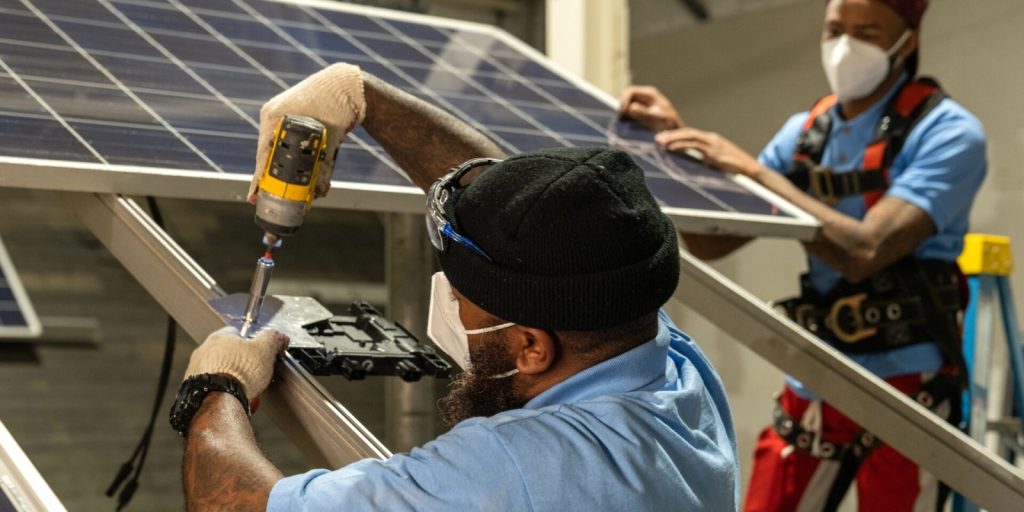
My roof was fine … until we added the solar panels.
PEOPLE WHO SKIP THIS STEP
This one came on my radar while I was writing up that no-cost solar program from BGE. Simply put: even if your roof seems perfectly fine today, you could regret not doing any solar-specific roof prep ahead of or during your rooftop solar installation.
Simple upgrades like putting fresh underlayment below the array area, improving flashing, or beefing up the structure beneath the planned panel layout can prevent costly headaches later, as removing and reinstalling panels a few years down the line is one of the priciest “oops” moments in residential solar.
As always, however, don’t take my word as gospel when it comes to any of this electrical or construction stuff. Your best resource is a reputable, vetted solar electrician who has seen and done this all before — which is just one of the reasons we recommend getting multiple quotes and asking lots of questions if and when you decide to move forward.
Original content by Electrek; featured image by QMerit.

If you’re considering going solar, it’s always a good idea to get quotes from a few installers. To make sure you find a trusted, reliable solar installer near you that offers competitive pricing, check out EnergySage, a free service that makes it easy for you to go solar. It has hundreds of pre-vetted solar installers competing for your business, ensuring you get high-quality solutions and save 20-30% compared to going it alone. Plus, it’s free to use, and you won’t get sales calls until you select an installer and share your phone number with them.
Your personalized solar quotes are easy to compare online and you’ll get access to unbiased Energy Advisors to help you every step of the way. Get started here.
FTC: We use income earning auto affiliate links. More.
![BYD design patent leaks, revealing new lower-priced pickup truck [Images]](https://i0.wp.com/electrek.co/wp-content/uploads/sites/3/2025/12/BYD-new-lower-priced-pickup-1.jpeg?resize=1200,628&quality=82&strip=all&ssl=1)
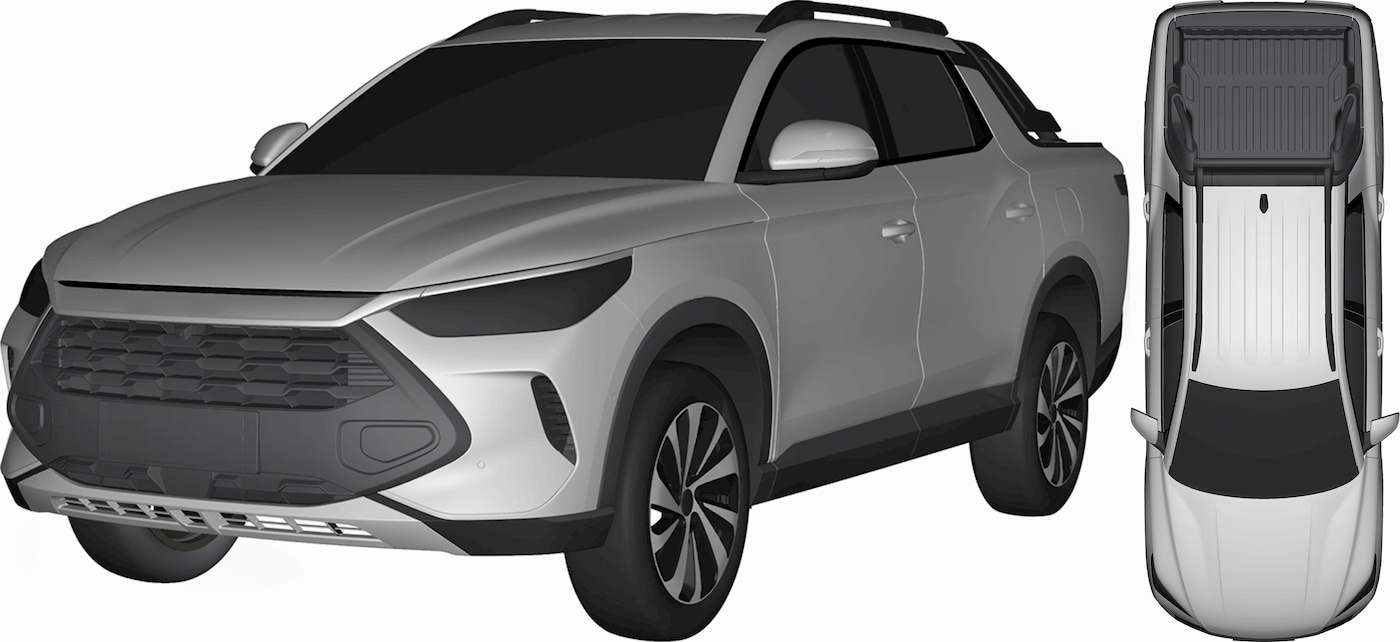
BYD is gearing up to reveal a new pickup truck that will sit under the Shark as a lower-priced alternative. A new design patent offers a closer look.
Is BYD launching a new, lower-priced EV pickup?
China isn’t really known for its pickup trucks, but that is changing. Several automakers, including BYD and Geely’s Radar Auto, are making a name for themselves in overseas markets with new battery electric (BEV) and plug-in hybrid (PHEV) pickup trucks.
BYD launched its first pickup, the Shark 6, in Mexico this May. It’s now sold in Brazil, Australia, New Zealand, the Philippines, Panama, Peru, and a few other countries, competing with the Toyota Hilux and Ford Ranger.
The Shark is a plug-in hybrid (PHEV) pickup that’s built on BYD’s DMO (Dual Mode Off-Road) platform. It uses a 29.58 kWh battery, dual electric motors, and a 1.5L turbocharged engine that packs about 430 hp (321 kW) and 650 Nm of torque.
BYD’s pickup offers an electric range of up to 62 mi (100 km). Combined, the Shark can drive around 522 mi (840 km).


Now, it looks like China’s EV giant is already preparing a second pickup. New design patents filed with the European Union Intellectual Property Office (EUIPO) reveal what appears to be a smaller pickup than the Shark.
Although BYD didn’t reveal prices or specs, a few design clues suggest this will be a lower-priced, compact pickup, compared to the mid-size Shark 6.


A “baby shark,” if you will. The new pickup was spotted in China earlier this month, covered in camouflage. Despite the disguise, it appeared a bit more compact than the Shark, with a smaller bed.
The new patent designs reveal it will have a unibody design, typical of smaller crossovers, suggesting it will sit below the Shark in the lineup. According to CarNewsChina, BYD’s new pickup will be the entry-level model for its Shark family.
BYD has yet to say if it will be fully electric or a plug-in, but local sources have reported that it will use the same DMO platform as the Shark 6. It could also be underpinned by BYD’s lower-cost DM-i or DM-p hybrid powertrain setups.
FTC: We use income earning auto affiliate links. More.

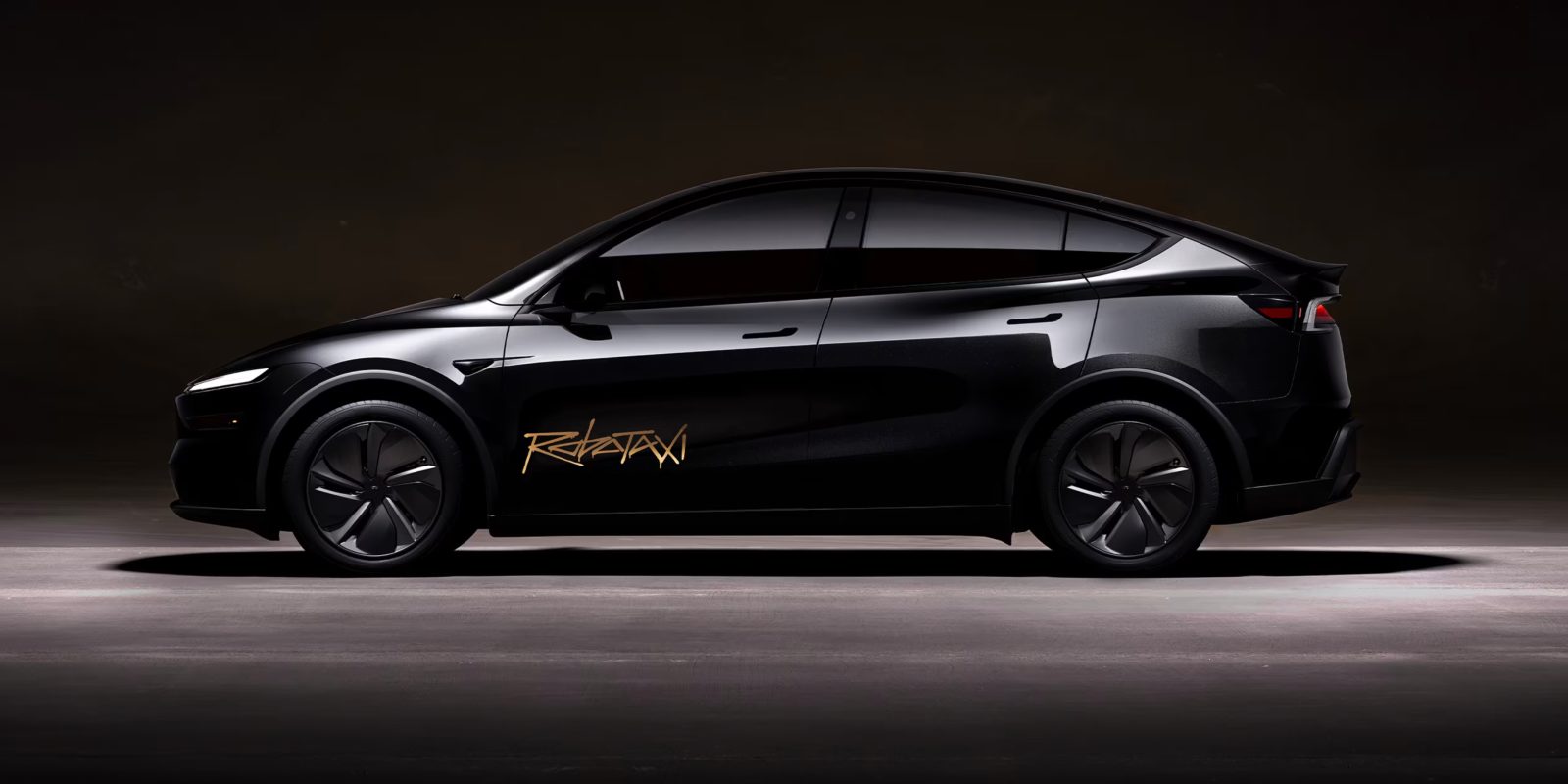
An engineering student managed to reverse-engineer Tesla’s Robotaxi app and collect data that shows the autonomous but supervised ride-hailing system in Austin consists of no more than a few vehicles (~5) operating at the same time.
In our report, ‘Tesla Robotaxi launch is a dangerous game of smoke and mirrors‘, from earlier this year, we reported that we expected Tesla to rush a “Robotaxi” service in Austin to give Elon Musk a win after years of missed deadlines and promises regarding autonomous driving.
Competitors, such as Waymo, are rapidly expanding their own robotaxi networks, making it harder for Tesla to maintain the impression Musk crafted that it is the leader in autonomous driving.
We suspected that the Robotaxi program in Austin, located in Texas, a state with some of the most lax regulations regarding autonomous driving, would be more about optics than the actual launch of Tesla’s long-promised autonomous ride-hailing service.
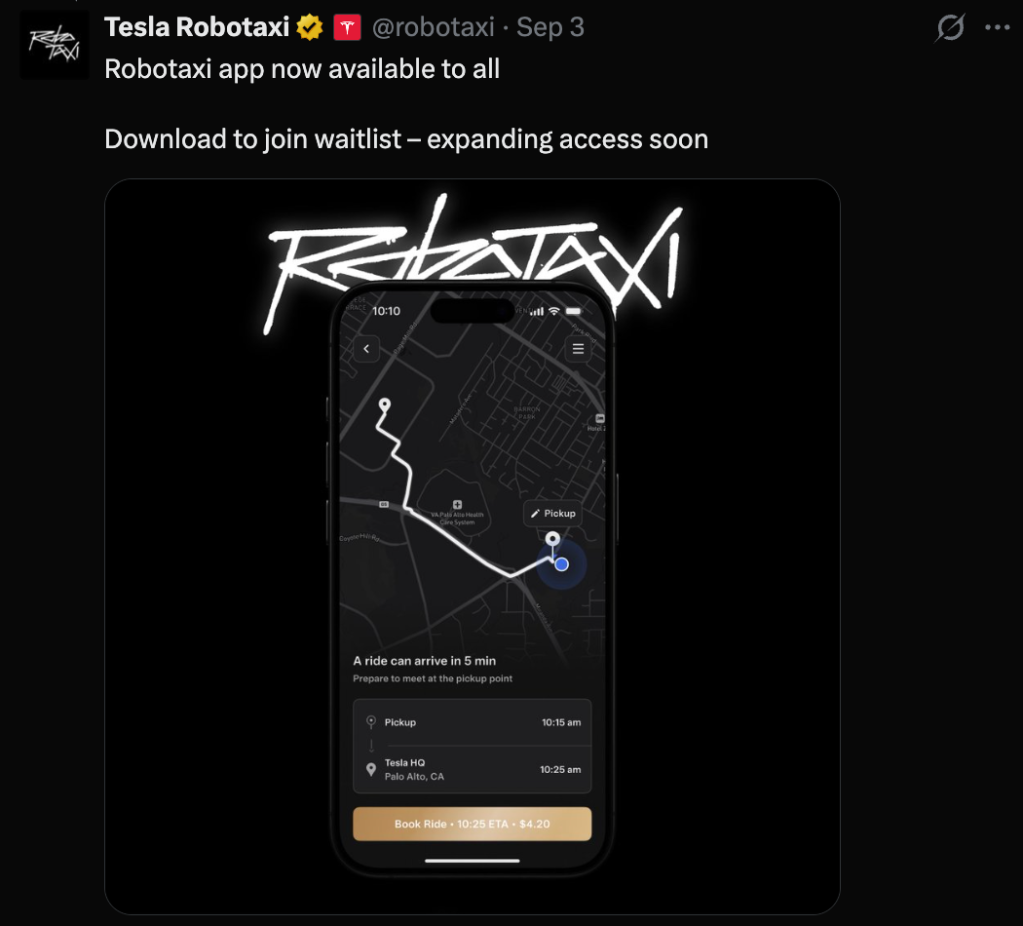
The service “launched” as a pilot in June, Tesla claims to launched the Robotazi app “for all” in September, CEO Elon Musk claimed to have since “doubled the size of the fleet” in November, and Tesla expanded the service area several times:
During those 6 months, Musk also made several wild predictions, including claims that the Robotaxi fleet in Austin would reach “500 vehicles” by the end of the year and that the Robotaxi would “cover half the US population” by the end of the year.
The CEO also said that Tesla would remove the safety drivers inside the vehicles in Austin by the end of the year.
If you are only following Tesla’s official channels, you would think that everything is going as planned: Tesla launched Robotaxi as a pilot with safety drivers in June, opened the service to “all” in September, and doubled the fleet in November. Now, Tesla accumulated enough safety data to remove the safety drivers and rapidly expand.
However, the reality is that Tesla is barely operating its Robotaxi in Austin.
This morning, Electrek spoke with Ethan McKanna, a 19-year-old engineering student at Texas A&M, who reverse-engineered Tesla’s Robotaxi app to track the availability of the network.
He made it available in an online tracker.
McKanna’s tracker has found 32 different Tesla Model Ys used in the Robotaxi network in Austin. It’s far from 500, but it is in line with the previous claim of “doubling” the fleet.
But what the tracker exposes is that while Tesla is “adding” vehicles to the Robotaxi fleet, it doesn’t mean that they are all or even the majority of them are in operation most of the time.
In fact, McKanna’s data points to Tesla using fewer than 10 Robotaxis at the same time, and that’s if they are using any at all:
This is speculative on my part, but it’s my best guess based on the little data we have and can collect. One person I talked to who scoped out the depot and recorded videos told me he believes there are 1-5 out at a time. The highly sporadic wait time shifts and my experience of consistently getting the same vehicle multiple times when I use the service in the data all corroborate that.
For example, over the last week, McKanna’s tracker showed that Tesla’s Robotaxi service in Austin was unavailable about 60% of the time:
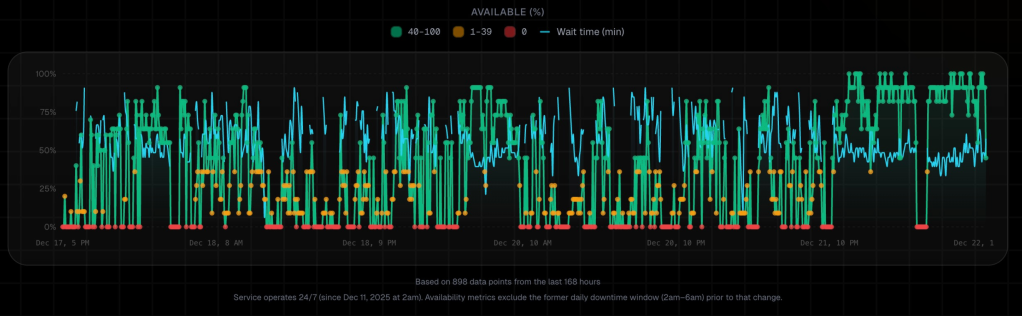
The young engineer explained how he obtained this data:
I reverse-engineered the robotaxi app and found the APIs to be able to fetch prebook eta estimates from Tesla. I have a server where every 5 minutes I ping Tesla at ~10 points in both service areas, pull the wait time, and store it. If a wait time is offered, I count it as available, if “high service demand” or any other type of error is shown, it is marked as unavailable.
Anyone using Tesla’s Robotaxi app in Austin would often get a notification that the service is unavailable due to “high service demand”, but this is not precisely the case.
McKanna’s tracker can ping 11 different locations within the service area in Austin, and as the chart above shows, it is often shown to be unavailable everywhere, even within the official working hours.
Here are the current wait times at the time of publishing this article (~1 PM Austint time):
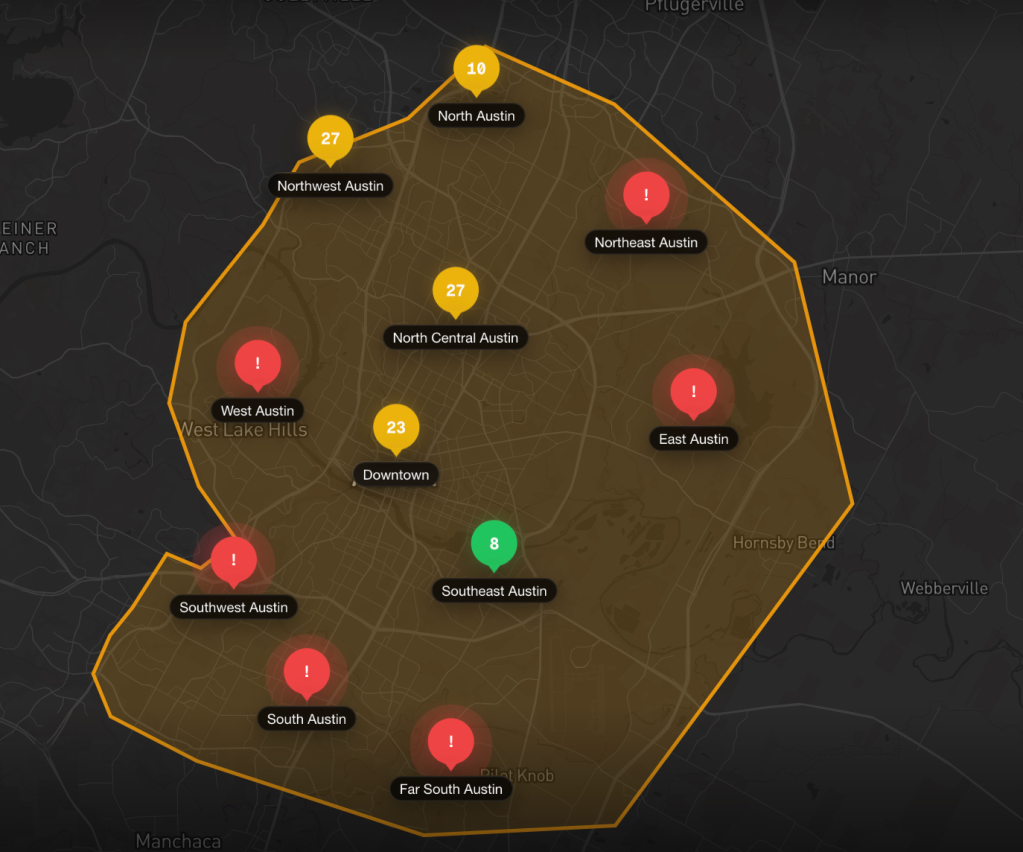
This suggests that either no vehicles are in operation or only a handful are concentrated in a specific area of the service map, and they are all pre-booked in advance, which is unlikely considering ride-hailing services are about quickly matching demand with supply.
Rather than being a “high service demand” situation, it is more about being a low or no supply situation.
Electrek’s Take
Based on Tesla’s official channels and paid influencers/investors, the Robotaxi service appears on the surface to be progressing as planned:
- Tesla launched as a pilot in June with a handful of cars available to a handful of influencers/investors
- Tesla expands the fleet and service area in August
- Tesla opens the Robotaxi app “to all” in September
- Tesla doubles the fleet in November
- Now, Tesla is about to remove the safety monitors and expand rapidly
The reality is that while Tesla is doing the “easy things” for optics, such as adding more vehicles to the fleet and expanding the service area, the actual service barely exists.
What is the point of having a fleet of 30 vehicles if you are only operating 3-6 at a time?
What is the point of “opening the service to all” if you are only able to offer a few rides per hour?
What is the point of removing the safety monitor if you already have a crash rate higher than human drivers, with the safety monitor presumably preventing further crashes?
The point is optics. Elon Musk is trying to maintain the illusion that Tesla is leading in autonomy and giving himself a win on some predictions after a full decade of missed deadlines.
The concerning part is that it poses a safety risk to all road users.
FTC: We use income earning auto affiliate links. More.
-
 Sports2 years ago
Story injured on diving stop, exits Red Sox game
-
 Sports3 years ago
‘Storybook stuff’: Inside the night Bryce Harper sent the Phillies to the World Series
-
 Sports2 years ago
Game 1 of WS least-watched in recorded history
-
 Sports3 years ago
Button battles heat exhaustion in NASCAR debut
-
 Sports3 years ago
MLB Rank 2023: Ranking baseball’s top 100 players
-
Sports4 years ago
Team Europe easily wins 4th straight Laver Cup
-
 Environment3 years ago
Japan and South Korea have a lot at stake in a free and open South China Sea
-
 Environment1 year ago
Here are the best electric bikes you can buy at every price level in October 2024