
Rachel Reeves hit by Labour rural rebellion over inheritance tax on farmers


Chancellor Rachel Reeves has suffered another budget blow with a rebellion by rural Labour MPs over inheritance tax on farmers.
Speaking during the final day of the Commons debate on the budget, Labour backbenchers demanded a U-turn on the controversial proposals.
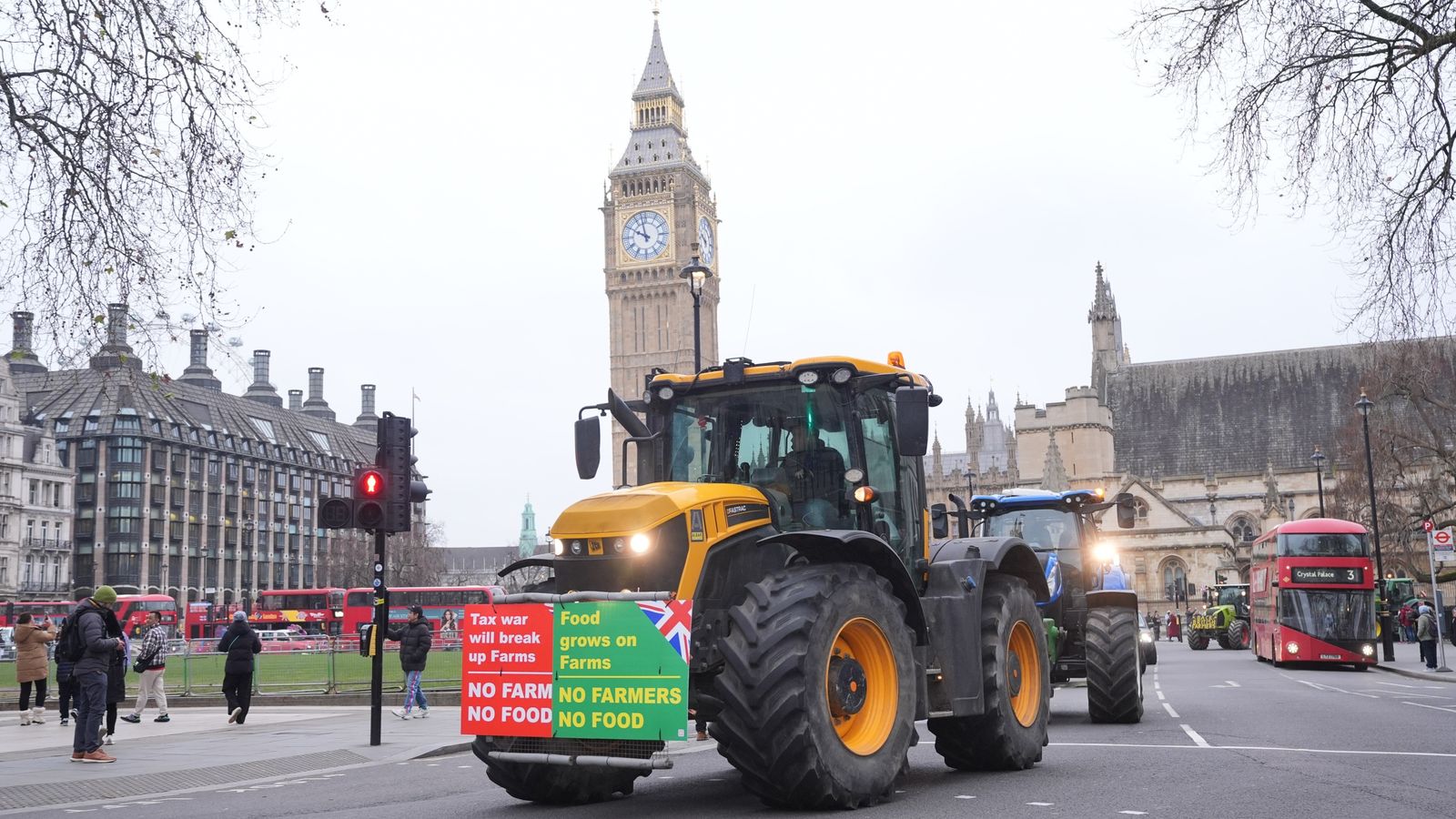
Plans to introduce a 20% tax on farm estates worth more than £1m from April have drawn protesters to London in their tens of thousands, with many fearing huge tax bills that would force small farms to sell up for good.
MPs voted on the so-called “family farms tax” just after 8pm on Tuesday, with dozens of Labour MPs appearing to have abstained, and one backbencher – borders MP Markus Campbell-Savours – voting against, alongside Conservative members.
In the vote, the fifth out of seven at the end of the budget debate, Labour’s vote slumped from 371 in the first vote on tax changes, down by 44 votes to 327.
The mini-mutiny followed a plea to Labour MPs from the National Farmers Union to abstain.
“To Labour MPs: We ask you to abstain on Budget Resolution 50,” the NFU urged.
“With your help, we can show the government there is still time to get it right on the family farm tax. A policy with such cruel human costs demands change. Now is the time to stand up for the farmers you represent.”
After the vote, NFU president Tom Bradshaw said: “The MPs who have shown their support are the rural representatives of the Labour Party. They represent the working people of the countryside and have spoken up on behalf of their constituents.
“It is vital that the chancellor and prime minister listen to the clear message they have delivered this evening. The next step in the fight against the family farm tax is removing the impact of this unjust and unfair policy on the most vulnerable members of our community.”
Farmers defy police ban in budget day protest in Westminster.
The government comfortably won the vote by 327-182, a majority of 145. But the mini-mutiny served notice to the chancellor and Sir Keir Starmer that newly elected Labour MPs from the shires are prepared to rebel.
Speaking in the debate earlier, Mr Campbell-Savours said: “There remain deep concerns about the proposed changes to agricultural property relief (APR).
“Changes which leave many, not least elderly farmers, yet to make arrangements to transfer assets, devastated at the impact on their family farms.”
Samantha Niblett, Labour MP for South Derbyshire abstained after telling MPs: “I do plead with the government to look again at APR inheritance tax.
“Most farmers are not wealthy land barons, they live hand to mouth on tiny, sometimes non-existent profit margins. Many were explicitly advised not to hand over their farm to children, (but) now face enormous, unexpected tax bills.
“We must acknowledge a difficult truth: we have lost the trust of our farmers, and they deserve our utmost respect, our honesty and our unwavering support.”

UK ‘criminally’ unprepared to feed itself in crisis, says farmers’ union.
Labour MPs from rural constituencies who did not vote included Tonia Antoniazzi (Gower), Julia Buckley (Shrewsbury), Torquil Crichton (Western Isles), Jonathan Davies (Mid Derbyshire), Maya Ellis (Ribble Valley), and Anna Gelderd (South East Cornwall), Ben Goldsborough (South Norfolk), Alison Hume (Scarborough and Whitby), Terry Jermy (South West Norfolk), Jayne Kirkham (Truro and Falmouth), Noah Law (St Austell and Newquay), Perran Moon, (Camborne and Redruth), Samantha Niblett (South Derbyshire), Jenny Riddell-Carpenter (Suffolk Coastal), Henry Tufnell (Mid and South Pembrokeshire), John Whitby (Derbyshire Dales) and Steve Witherden (Montgomeryshire and Glyndwr).
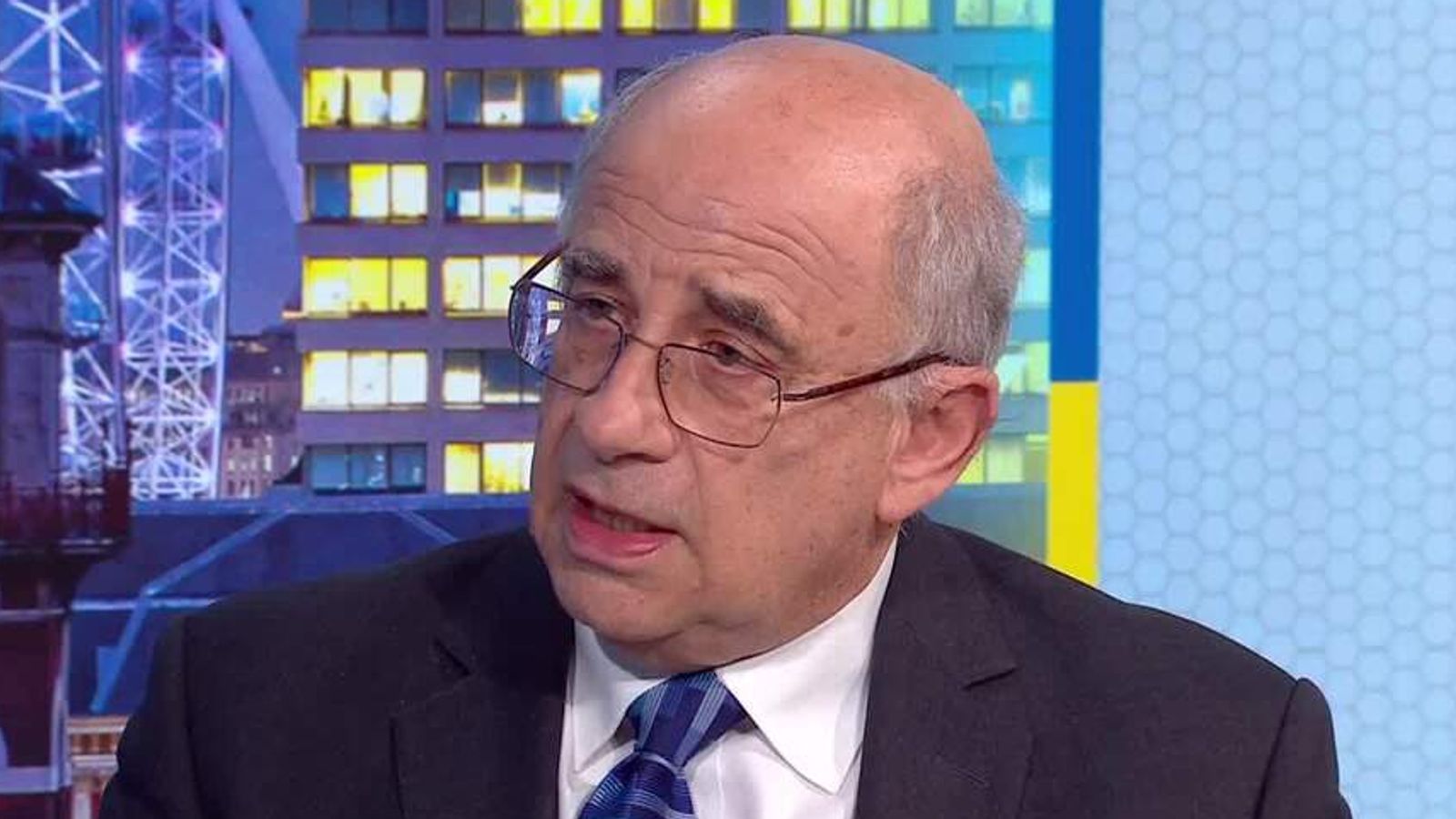
Sir Brian Leveson, who conducted the independent review of the courts system that guided the government’s decision to reduce on jury trials, has suggested there is no alternative.
Speaking to Sky’s Politics Hub programme, the retired judge argued that by restricting jury trials, Justice Secretary David Lammy is “aiming to try to solve the systemic problems” in courts.
He told Sky presenter Ali Fortescue: “I am a great believer in trial by jury, but trials with a jury take very much longer than trials conducted otherwise than with 12 people who are utterly unused to criminal procedure and criminal evidence.
“So my concern is that we need to get through cases quicker.”
He said that it was likely a “20% time saving would result” from the move, although he thinks that “a great deal more” would be saved.
Asked about the criticism today of the decision, Sir Brian said: “I’m gaining no pleasure from it, but what I say to all of them is ‘If not this, then what?’ How do we reduce the backlog so the victims and witnesses get their day in court within a reasonable time?”
He argued that “we should use our resources proportionately to the gravity of the offending”, and “there are some cases which, to my mind, do not merit or require a trial by jury”.
Sir Brian said that some jurors he had spoken to said it was “worthwhile”. But he added: “They’ve given up two weeks of their life, sometimes without any pay except the small remuneration that they receive from the state doing jury service, and they’ve been trying cases which shouldn’t merit their attention”.
Asked if he would want a trial by jury if he had been wrongly accused of theft, Sir Brian said: “If I’d been wrongly accused of theft, I’d be perfectly happy for a judge to decide I’d been wrongly accused of theft.”
Jury trials to be scrapped
More broadly, he said: “I don’t see how you’re going to bring down the backlog without more money, more sitting days, greater efficiency, and speedier trials…
“There aren’t the judges, there aren’t the court staff, more significantly there aren’t the advocates.”
He said that the justice system had never been in such a “calamitous” state.
👉 Listen to Sky News Daily on your podcast app 👈
‘The reforms are about fairness’
Courts minister Sarah Sackman also defended the decision on Tuesday’s Politics Hub. She acknowledged that jury trials were “a success story”, and “a cornerstone of British justice and will remain so after today’s plans”.
But she added: “What’s not such a success story is the fact that we inherited record and rising backlogs in our courts.
“Today the number starts at 80,000 cases, and it’s on the rise – due to hit 100,000 by 2028.”
That leaves victims “waiting for their case to be heard”. She argued that the measures announced on Tuesday were “a set of reforms that will restore confidence in our justice system, get those delays down, and indeed preserve jury trials for the most serious cases”.
Ms Sackman added that “right now in our system, 90% of cases [are] being heard without a jury in our magistrates”, which is “fair, robust justice”.
“Part of fairness is about the swiftness we need to deliver swifter justice for victims,” she said.
“What’s not fair is a victim of crime being told today that she needs to wait until 2029, 2030 for her day in court.”

‘Swifter justice for victims’
The minister gave an example of what will change, saying: “Supposing a defendant is accused of stealing a bottle of whisky.
“Is it right that we allow the defendant to insist on a slower, more expensive jury trial in the same queue as the victim of rape, making her wait and in some cases, justice not being served?
“That’s the choice that we’ve made today.”
But the minister refused to say how much this would reduce the backlog by.



The UK government has again delayed its decision over whether to approve a Chinese “super embassy” in London until January.
A decision over the controversial plan close to the Tower of London will now take place on 20 January, instead of 10 December, a letter from the planning inspectorate seen by Sky News says.
Despite multiple delays, Sky News understands the government is expected to approve the plans for what would be Europe’s largest embassy, with both MI5 and MI6 said to have given their blessing to the decision.
Politics latest: Jury trials to be scrapped for those facing sentences of three years or less
Housing Secretary Steve Reed has said he needs more time to consider new representations from the Foreign Office and Home Office.
A letter from the home and foreign secretaries to the planning inspectorate, published with the latest delay letter, said their national security concerns have been addressed by the Chinese government committing to ensure all its diplomatic premises in London, excluding the ambassador’s house, are consolidated on to the new embassy site.
The new letter sent to ministers and “interested parties”, including the Inter Parliamentary Alliance on China (IPAC) – which has warned against approving the embassy – said the government aims “to issue the decision as quickly as possible” on or before 20 January.
Luke de Pulford, executive director of IPAC, told Sky News: “This is the third delay, and entirely of the government’s own making.
“Residents and dissidents have endured months of dithering as the government tries to choose between UK national security and upsetting Beijing.”
The basements in most of the buildings have been greyed out ‘for security reasons’. Pic: David Chipperfield Architects
Three delays by Labour government
Mr Reed became housing secretary in September and had already delayed the decision once from October, as he said he had not had enough time to look at the details.
A decision had also been delayed earlier this year by the former housing secretary Angela Rayner, months after the Chinese re-submitted their planning application two weeks after Labour won the general election.
That was after Tower Hamlets Council rejected the application in 2022 and the Conservative government said it would not call it in for ministers to decide.
Read more:
Everything we know about China’s new ‘super embassy’
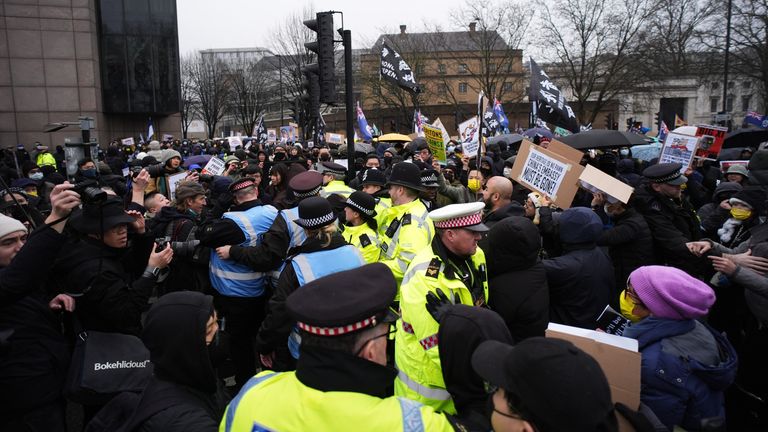
There have been multiple protests against the embassy’s development. Pic: PA
National security concerns
There have been large-scale protests against the embassy – on the site of the former Royal Mint – over concerns it will be used as a Chinese spy hub for Europe.
Hong Kong dissidents who have fled to the UK have expressed fears that rooms redacted “for security reasons” in submitted plans might be used to detain them.
The latest delay comes less than 24 hours after Sir Keir Starmer warned China poses “real national security threats to the United Kingdom” and said being tough on national security will enable the UK to pursue economic opportunities with Beijing.
He said UK government policy towards China cannot continue to blow “hot and cold” and said his government will focus on the relationship with Beijing.

Starmer on China: ‘It’s time for a serious approach’
Chinese embassy says UK interfering in its affairs
A Chinese embassy spokesman in London said China “firmly opposes the erroneous remarks” and accused Sir Keir of making “groundless accusations against China” and interfering in China’s internal affairs.
“Facts have fully demonstrated that China has always been a builder of world peace, a contributor to global development, and a defender of the international order,” he said.
“On issues of peace and security, China has the best track record among major countries. China’s development poses no threat to any country, but instead brings opportunities for common development to all.”
He said the UK should “adjust its mindset, adopt a rational and friendly approach towards China’s development”.
Last month, MI5 warned MPs, peers and parliamentary staff about the risk from Chinese spies after identifying two LinkedIn profiles it said are being used by the Chinese Ministry of State Security to act as “civilian recruitment headhunters”.
-
 Sports2 years ago
Story injured on diving stop, exits Red Sox game
-
 Sports3 years ago
‘Storybook stuff’: Inside the night Bryce Harper sent the Phillies to the World Series
-
 Sports2 years ago
Game 1 of WS least-watched in recorded history
-
 Sports3 years ago
Button battles heat exhaustion in NASCAR debut
-
 Sports3 years ago
MLB Rank 2023: Ranking baseball’s top 100 players
-
Sports4 years ago
Team Europe easily wins 4th straight Laver Cup
-
 Environment3 years ago
Japan and South Korea have a lot at stake in a free and open South China Sea
-
 Environment1 year ago
Here are the best electric bikes you can buy at every price level in October 2024