
Our trade proposals that would rock MLB’s winter meetings


Baseball’s winter meetings are just around the corner, and we’re ready for some blockbuster deals.
We’ve already seen some intriguing trades this offseason with the New York Mets acquiring Marcus Semien from the Texas Rangers for Brandon Nimmo and the Boston Red Sox adding Sonny Gray to their pitching staff — but there are even bigger stars who could move in the weeks ahead.
With that in mind, we asked our MLB insiders to give us their preferred destination for some of the biggest names in our ranking of the top 25 MLB offseason trade candidates.
Where did we send All-Stars Ketel Marte and Byron Buxton? Which Red Sox outfielder is on the move in our deals? And which contenders get starting pitching help? Let’s find out.
The Arizona Diamondbacks should trade Ketel Marte to the …

The Mariners plucked from the D-backs to jolt their offense just five months ago, acquiring corner infielders Eugenio Suarez and Josh Naylor. They should do so again, this time for Marte, the star second baseman who can be had for the right return. The Mariners have a need for another bat, and Marte would represent a massive upgrade over merely re-signing Suarez or Jorge Polanco.
Marte would slide in perfectly ahead of fellow All-Stars Julio Rodriguez and Cal Raleigh, allowing Randy Arozarena to join Naylor in the middle of the lineup and giving Seattle arguably the best offense in the American League — to pair with what is likely the best pitching staff.
Coming off a gut-wrenching loss in Game 7 of the American League Championship Series, it’s the perfect move to push the M’s toward the first World Series berth in franchise history. And whether it’s Cole Young, Michael Arroyo or Felnin Celesten, the Mariners might have enough young, promising middle infielders to satisfy the D-backs’ likely desire for a Marte replacement without parting with Colt Emerson. — Alden Gonzalez

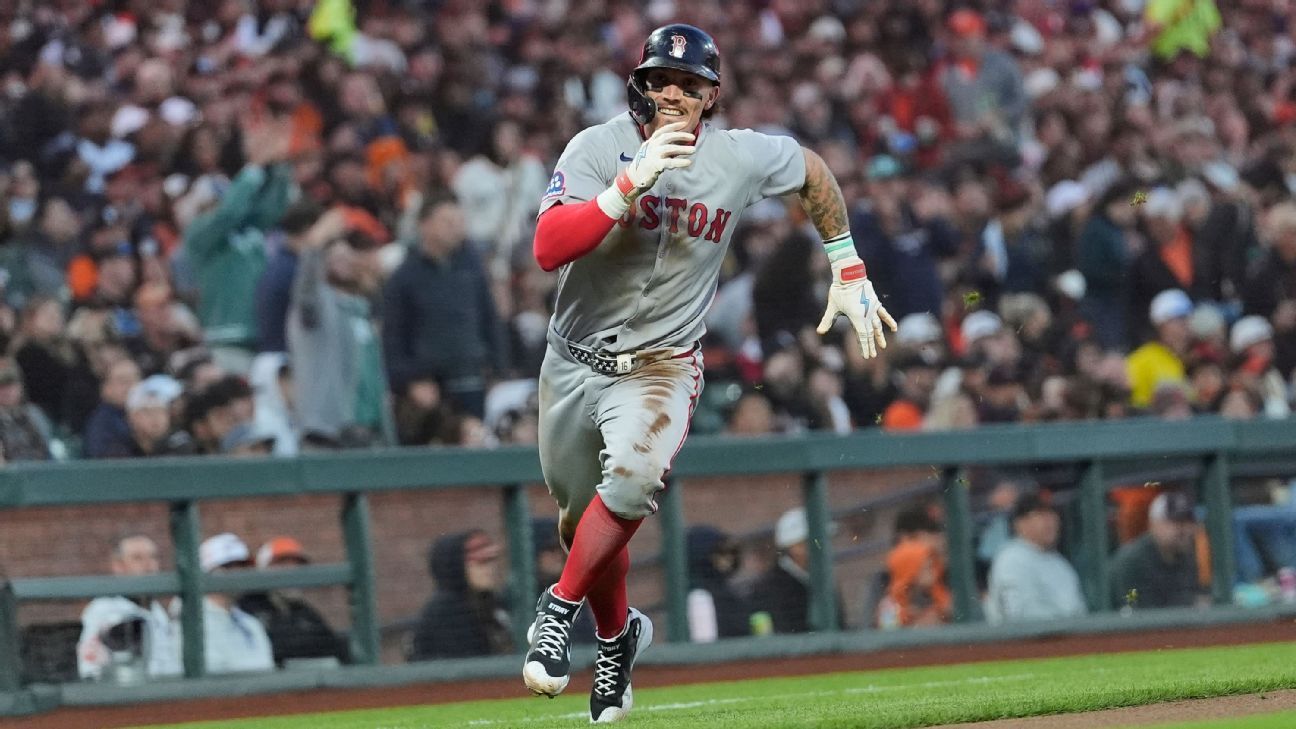
Boston Red Sox for Jarren Duran and Kyson Witherspoon
Roman Anthony‘s 2025 breakout rendered Duran expendable in an outfield already staffed by Ceddanne Rafaela and Wilyer Abreu, both of whom offer more remaining team control. And with presumed second-baseman-of-the-future Kristian Campbell struggling as a rookie (86 OPS+, -1.0 WAR), the door swung open for a move of this magnitude.
Duran’s proclivity for doubles and triples will play beautifully in Arizona (just ask Corbin Carroll), and Witherspoon, the No. 15 pick in the 2025 MLB draft, instantly becomes the club’s best pitching prospect. — Paul Hembekides

The Red Sox should trade Duran to the Philadelphia Phillies for a package including Alec Bohm
These lightning-rod players certainly are not coming off their best seasons and perhaps each needs the proverbial change of scenery. The Red Sox may need someone to play third base, and Bohm, while no match for Alex Bregman, is a capable hitter and defender. The Phillies could then get a more consistent third baseman who enjoys playing in Philadelphia. Duran would fill Philadelphia’s center-field need, and it would create some opportunity in a crowded Boston outfield. See, trades can work out for both teams! — Eric Karabell

The Cleveland Guardians should trade Steven Kwan to the Mariners
I love this idea so much. Kwan would return to the West Coast, about a four-hour drive from Corvallis, where he starred for Oregon State. He would give the Mariners a needed upgrade at a corner outfield spot, teaming with Julio Rodriguez to improve Seattle’s outfield defense. Most importantly, he could slide into the leadoff spot, offering contact and OBP as a poor man’s Ichiro, hitting in front of Cal Raleigh, Rodriguez and his old Cleveland teammate, Josh Naylor. Let’s get this done. — Bradford Doolittle

The Chicago White Sox should trade Luis Robert to the …

Rumor mill whispering has connected the Royals with Boston’s Jarren Duran for the hefty price of Cole Ragans, a swap I can’t abide. The Royals have starting pitching depth, but they don’t have ace depth and Ragans must stay. Duran isn’t an ideal defensive fit for Kauffman Stadium if you view him as a center fielder, and the Royals need to upgrade at that spot badly.
Enter Robert, whose work on strike zone judgment seemed to be paying off in the latter stages of last season. He’s younger than Duran and has more power upside without sacrificing speed and defense. The Royals’ new hitting staff is hyper-focused on improving pitch recognition, and I’d love for them to be new voices in Robert’s ear. The Royals could keep Ragans and modulate their rotation/prospect return based on Chicago’s willingness to pay down some of Robert’s $20 million for next season. Alas, this would be more palatable from a payroll perspective if the Royals had not already committed $8 million to run it back with Jonathan India. — Doolittle
Philadelphia Phillies
It’s time. Time for Robert to find a new home and time for the Phillies to mix up the vibe a little. It’s possible that last season proved to be Robert’s current floor — good defense and 33 stolen bases will help teams win games. But it’s also just as possible the ceiling is still within reach after years of underachieving. First off, getting away from the Sox did wonders for Gavin Sheets and Andrew Vaughn. The same could be true of Robert if he moves on, especially since he’s finally cutting his chase rate down.
Now put him in a good lineup with even better pitches to see — and perhaps a little more pressure to perform — and the Philles could just get the best version of him. He has hit 28 homers in a season. He hit .338 in another (partial year). Put it all together and he might turn into a steal. — Jesse Rogers

The Minnesota Twins should trade …

Byron Buxton to the Los Angeles Dodgers
This falls into the “Why? Because they can, that’s why” category. Enough is never enough for the Dodgers, so this offseason’s installment of making sure they have too much is the acquisition of the best available player at the position they may actually believe they need to upgrade. Move Andy Pages to left, slot Buxton into the top half of the lineup and go for three in a row. — Tim Keown

Joe Ryan and Ryan Jeffers to the New York Yankees
Ryan was a popular name at the trade deadline and he’s popular again coming off an All-Star season with a rebuilding team and two years of team control remaining. The Yankees don’t need another front-line starter, but Ryan would give them some rotation stability early in the season with Gerrit Cole and Carlos Rodon (and Clarke Schmidt) on the injured list and he would supply insurance should Cole or Rodón return later than usual or struggle upon return. And as these front offices like to say: You can never have enough starting pitching.
Jeffers would quench the Yankees’ need for a right-handed-hitting catcher after carrying three left-handed-hitting catchers for most of the 2025 season. He would platoon with Austin Wells and allow the Yankees to move Ben Rice, also a left-handed hitter, to first base full time. — Jorge Castillo

The Miami Marlins should trade Edward Cabrera to the New York Yankees for Jasson Dominguez If the Yankees are truly focused on keeping their payroll in check, they’ll need to be creative in how they address their roster shortcomings. Presuming that the team re-signs Cody Bellinger, the Yankees will already have spent a majority of their available free agent budget, and have rendered Dominguez excess with top prospect Spencer Jones also an in-season debut candidate. Dominguez is the kind of high-ceiling youngster the Marlins should be targeting.
Cabrera is a talented, albeit injury-prone, starter who can provide critical rotation depth while the team waits for the healthy returns of Gerrit Cole, Carlos Rodon and Clarke Schmidt. Dominguez’s two additional years of team control might make this a slight overpay for the Yankees, but Cabrera’s projected $3.7 million salary via arbitration could make him an ideal, budget-conscious acquisition. — Tristan Cockcroft

The Miami Marlins should trade Sandy Alcantara to the Athletics
Alcantara’s return from Tommy John surgery was a disaster in the first half of the season, as he entered the All-Star break with an ERA over 7.00. That made him untradeable; it made no sense for the Marlins to deal him at the trade deadline with his value at a low point. Alcantara found his groove over his final 12 starts, however, posting a 3.13 ERA with 69 strikeouts versus 18 walks over 77 innings. That is a pitcher you can trade.
The A’s finished 26th in rotation ERA in 2025. The rotation did struggle at home with a 5.52 ERA in Sacramento, so that led to inflated ERAs, but their only two returning starters with more than 100 innings are Jeffrey Springs (4.11 ERA) and Luis Severino (4.54 ERA). It will be difficult for the A’s to lure a decent free agent starter to Sacramento — they had to overpay to sign Severino — so a trade makes sense. Alcantara is signed to a reasonable $17.3 million for 2026 with a $21 million club option for 2027, which even the A’s can afford.
With the Nick Kurtz-led offense, the A’s will score runs. If they can build out the rotation and bullpen, they have the look of 2026’s sleeper playoff team. Their farm system is improved and they have low-salaried pitching depth with guys like Mason Barnett and Jack Perkins to throw back Miami’s way. — David Schoenfield


The Washington Nationals should trade MacKenzie Gore to the Baltimore Orioles
Gore hasn’t quite made the jump to front-line starter. But he has some qualities in common with higher slot lefties who are front-line types, like Blake Snell and Max Fried, so there could be another gear to be teased out. He also comes with two years of control and his arbitration number this year should land around $5 million.
In return, the Orioles can send a prospect package featuring OFs Slater de Brun and Austin Overn and RHPs Esteban Mejia and J.T. Quinn to the Nationals. Baltimore doesn’t have to include C Samuel Basallo and can probably hang onto OF Dylan Beavers, as well. I have the Nats opting for a larger package of players that includes what I think will be the sorts of prospects we’ll see new president of baseball operations Paul Toboni target. It helps new execs coming from the draft side of evaluation to target recent draftees, with de Brun and Quinn from the 2025 draft and Overn from the 2024 draft. — Kiley McDaniel


The Pittsburgh Pirates should trade Mitch Keller to the San Francisco Giants
The Giants churned through 15 starting pitchers in 2025 and return only three who made more than 10 starts (Logan Webb, Robbie Ray and Landen Roupp), leaving two slots to fill aside from the depth that is required in this era. Hayden Birdsong and Carson Whisenhunt are the top internal candidates, but adding a veteran starter for stability looks like an offseason necessity.
Keller is signed for three more years at an AAV of about $18.5 million. His biggest strength has been durability and consistency, making at least 29 starts four seasons in a row and averaging 183 innings and 2.1 WAR the past three seasons. His strikeout rate has declined from 25.5% to 20.0% since 2023, so that’s a minor cause for concern, but moving to the Giants, with better defense behind him and a stellar catcher in Patrick Bailey should help lower his batting average allowed.
Do the Pirates have enough rotation depth to trade Keller? Probably not, but they do have Paul Skenes, Mike Burrows, Braxton Ashcraft, Johan Oviedo and Bubba Chandler, plus Jared Jones returning from injury, so there at least is the makings of an exciting young rotation even without Keller. They need power, however, so the ask from the Giants would be their top prospect, first baseman Bryce Eldridge.
Too steep for the Giants? Perhaps. Eldridge has 35-homer potential and has produced while being very young for his levels, reaching Triple-A in 2025 at just 20 years old. He does have some holes in his game, with a 3-to-1 strikeout-to-walk ratio, he struggled against breaking balls from left-handers, he has below-average speed and his defense at first base is fringy, so he might be a DH with Rafael Devers playing first. The power is real — enough for the Pirates to gamble on and also real enough that he’ll be difficult to pry away from the Giants. — Schoenfield
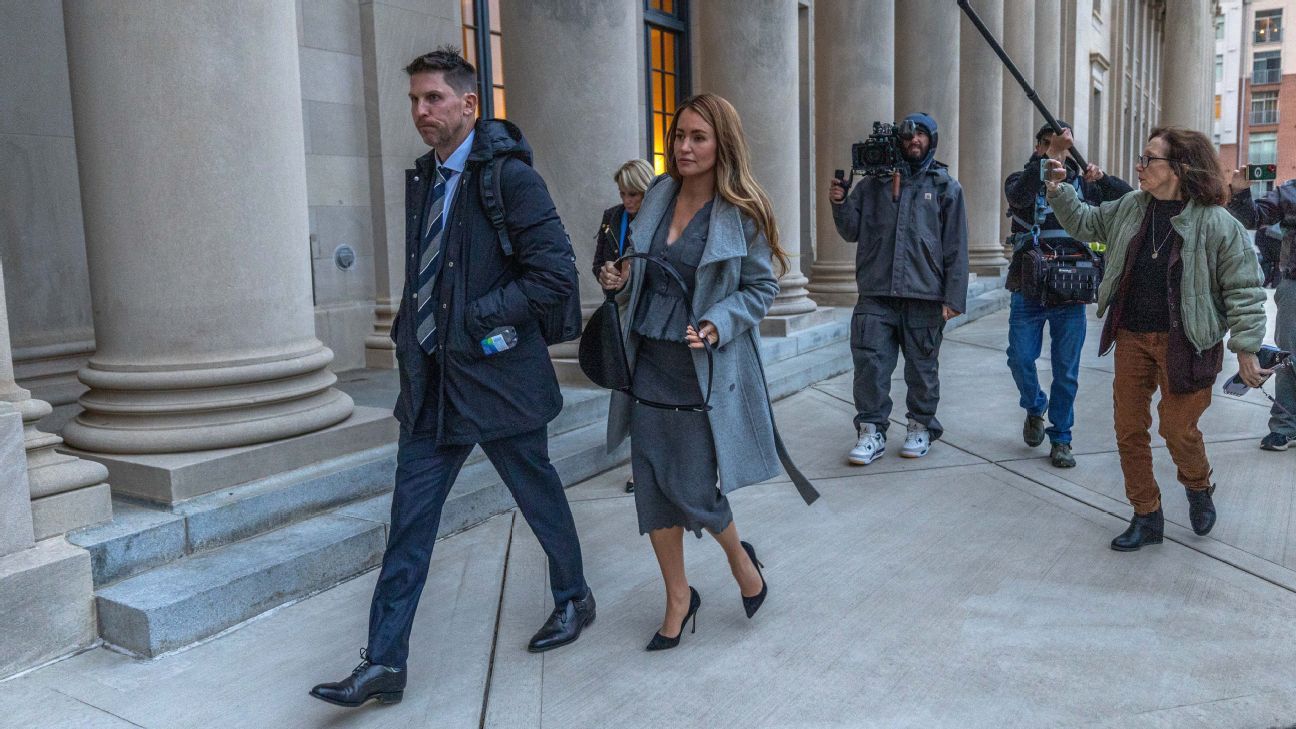

CHARLOTTE, N.C. — The landmark federal antitrust trial against NASCAR opened Monday with three-time Daytona 500 winner Denny Hamlin breaking down in tears minutes into his testimony as the first witness in a case that could upend the venerable stock car series.
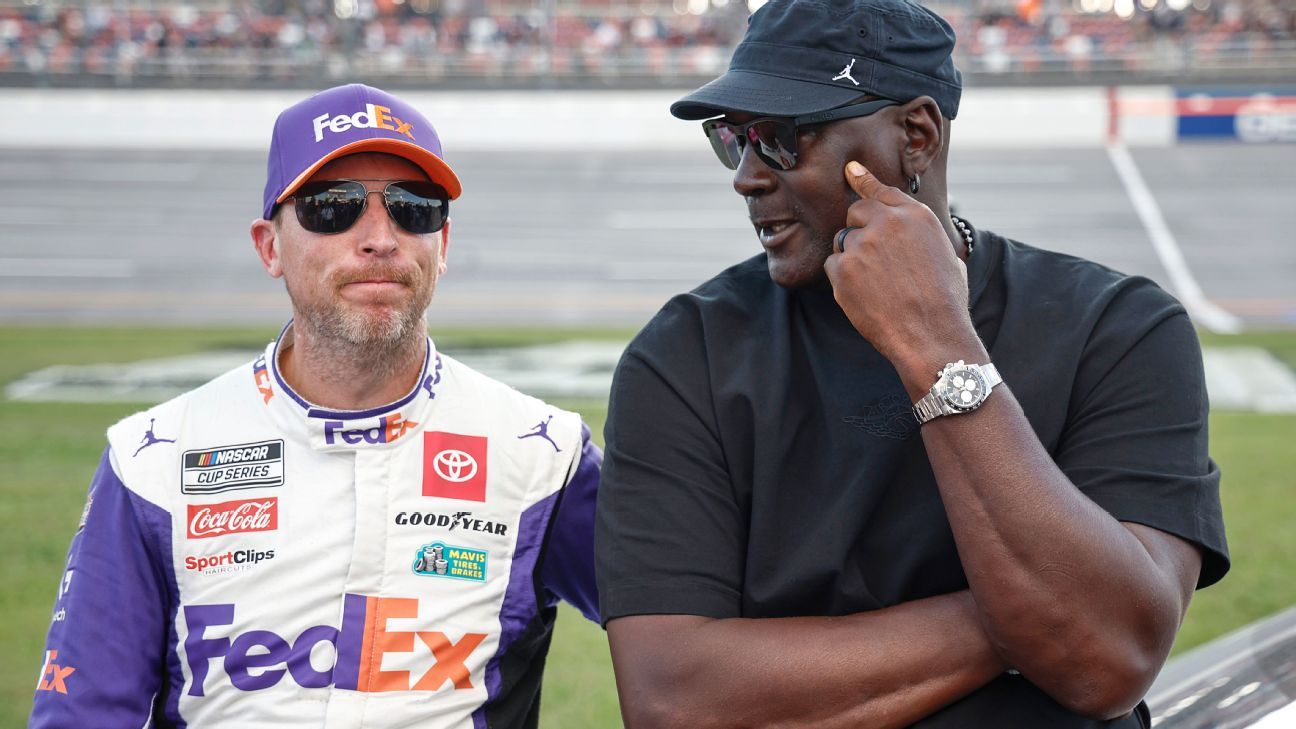
Hamlin’s 23XI Racing, which he co-owns with Michael Jordan, and Front Row Motorsports claim the series is a monopolistic bully that leaves its teams no option but to comply with rules and financing they don’t agree with.
As Jordan watched from the gallery, Hamlin began to cry and had to stop and compose himself when asked how he got into racing. He disclosed to The Associated Press last month that his father is dying, and he said on the stand he was emotional because his dad “is not in great health.”
“We got to when I was about 20 and a decision had to be made, I could keep racing or go out and work for my dad’s trailer business,” Hamlin testified, adding that he later was thinking about what retirement looked like and found a team going out of business. He needed a partner and turned to Jordan, who he had developed a friendship with when the Basketball Hall of Famer owned the Charlotte Hornets and Hamlin was a season-ticket holder.
“If I can’t be successful with Michael as a partner, I knew this was never going to work,” he said.
The references to his early days in auto racing and the sacrifices his family made were intended to show how difficult it is for both team owners and drivers to make it at the top level of the sport. He said he never would have been able to start 23XI in 2021 had he not partnered with Jordan.
Because of Jordan’s presence with the team, Hamlin testified, 23XI has turned a profit in all but one of its five seasons of operation. His attorney, Jeffrey Kessler, said in his opening statement that fast-food restaurant entrepreneur Bob Jenkins has never turned a profit since starting his Front Row team in 2004, a team that won the Daytona 500 in 2021.
Kessler said a NASCAR-commissioned study found that 75% of teams lost money in 2024 and added that over a three-year period almost $400 million was paid to the France Family Trust. He said a 2023 evaluation by Goldman Sachs found NASCAR to be worth $5 billion. NASCAR is currently run by Jim France, son of founder Bill France Sr.
“What the evidence is going to show is Mr. France ran this for the benefit of his family at the expense of the teams and sport,” Kessler said.
At the heart of the lawsuit is NASCAR’s revenue sharing model, which 23XI and Front Row argue is unfair to race teams that often operate at a loss. Hamlin testified it cost $20 million to simply bring a single car to the track over a 38-race season, not including overhead expenses such as driver salary and business operations.
“So, why would these people do this if you are just going to lose money because NASCAR isn’t giving you a fair deal?” asked Kessler, “Because you love stock car racing, and there’s nowhere else to do it.”
The charter agreements signed for this year that triggered the lawsuit guarantee the teams $12.5 million in annual revenue per chartered car. NASCAR argues the guaranteed payouts are an increase from $9 million from the previous agreement, but Hamlin noted that 11 of the first 19 chartered teams are no longer in business.
All three charters 23XI purchased came from teams that ceased operations, and Hamlin said 23XI paid $4.7 million for its first charter, $13.5 million for its second and $28 million for its third, acquired late last year. He acknowledged purchasing the third charter was a risk because of the pending litigation – and the price concerned him – but it was required if 23XI intends to build itself into a top team.
The charter system guarantees a car a spot in the field each race week as well as a percentage of the purse and gives team owners an asset to sell should they want to get out of the business.
NASCAR attorneys argued that the charter system has created $1.5 billion in equity for the 36 chartered teams. Prior to the charter system, teams raced “open,” with no guarantee they’d make the field or earn a payout.
“The France family built NASCAR from nothing. They are an American success story,” Johnny Stephenson said in the opening statement for NASCAR. Stephenson is a colleague of Christopher Yates, who had previously handled most of the courtroom arguments for the defendants.
“They’ve done it through hard work over 75 years. That’s the kind of effort that doesn’t deserve a lawsuit. That’s the kind of effort that deserves admiration.”
The case has churned through hearings and arguments for more than a year despite calls from other NASCAR teams to settle. U.S. District Judge Kenneth Bell even helped mediate a failed two-day summit in October.
A NASCAR victory could put 23XI, Front Row and their six combined cars out of business. Their charters – now being held by NASCAR – would likely be sold. The last charter went for $45 million, and NASCAR has indicated there is interest from potential buyers including private equity firms.
A win for the teams could lead to monetary damages and the potential demolition of NASCAR as it is run today. The judge has the power to unravel a monopoly, and nothing is off the table, from ordering a sale of NASCAR to the dismantling of the charter system.
Jordan’s presence factors into the trial
Jordan’s presence in the courtroom gallery near Hamlin was a factor: Among those dismissed from serving on the jury was a man who said he can’t be impartial because “I like Mike” and another who said he had Michael Jordan posters on his walls growing up. A juror said they were a North Carolina fan but noted the football team at Jordan’s alma mater is not “doing too well right now” to which the star shook his head and laughed.
NASCAR executives in the courtroom included chairman Jim France and vice chair Lesa France Kennedy, two scions of the family that founded NASCAR in 1948 and still owns it.
Hamlin will resume testimony Tuesday morning. NASCAR Commissioner Steve Phelps, 23XI minority owner Curtis Polk, France Kennedy and other top executives had to leave the courtroom after opening arguments because they are all potential witnesses.

-
Greg Wyshynski
NEW YORK — After 11 seasons as one of the NHL’s leading scorers, Mikko Rantanen has become accustomed to fame.
But infamy? Not so much, although he has experienced plenty of that this season.
Rantanen recently served the first suspension of his NHL career, having earned an automatic one-game ban for two game misconducts for physical infractions.
NHL rules state that players must go 41 games between ejections to avoid suspension. Rantanen’s second ejection, for boarding Calgary Flames forward Matt Coronato, came four days after his first ejection on a play that earned Rantanen widespread derision from fans — and one very angry coach.
On Nov. 18, Rantanen skated through a check by New York Islanders defenseman Scott Mayfield and shoved defenseman Alexander Romanov in the back, sending him violently into the end boards. As a result of that play, Romanov had shoulder surgery that will put him on the shelf for five months at a minimum.
Rantanen didn’t have a hearing with the NHL Department of Player Safety for either of these misconducts, but he heard plenty from Islanders coach Patrick Roy after the Romanov hit. It was a scene that instantly went viral: Rantanen leaving the ice after his major penalty and a red-faced Roy screaming at him from the New York bench.
0:38
Mikko Rantanen ejected for nasty hit on Alex Romanov
Alex Romanov is left flat out on the ice after this shove in the back from Mikko Rantanen with under a minute left in regulation.
“Usually if something happens, if somebody gets pissed off, the media picks it up,” Rantanen told ESPN on Tuesday. “So I’m not really surprised it got so big.”
Roy, who called the hit “disrespectful,” yelled at Rantanen, appearing to say, “You’re not going to f—ing finish that game” in reference to the teams’ rematch scheduled for March 26 on Long Island.
Is Rantanen worried about what might happen in that game?
“No, no, no,” he said. “I’m just going to play there, play hard, play hockey and see what comes at me. But I’m a grown man. So I can stand up for myself.”
But the notoriety wasn’t only on the ice for Rantanen in 2025. Earlier this year, thanks to two blockbuster trades, he became one of the NHL’s most debated players.
RANTANEN WAS PLAYING for the Colorado Avalanche in a contract year. His salary demands remained high — rumored at the time to be around $14 million annually for one of the league’s most dominant scoring wingers and a player who helped Colorado win the Stanley Cup in 2022.
Avalanche GM Chris MacFarland shocked the hockey world by trading him to the Carolina Hurricanes in a blockbuster deal on Jan. 24 that saw Canes leading scorer Martin Necas sent back to the Avalanche. MacFarland called it a “business decision” involving a player who “had the unrestricted free agent card” but lamented losing “a superstar human being.”
However, Rantanen’s time with the Hurricanes was incredibly short. Carolina hoped to convince him to sign an extension — meeting his salary demands — and to put roots down in Raleigh. But after 13 games, the player the Hurricanes hoped could lead them to the Stanley Cup was traded again, this time to Dallas, in a deal involving young forward Logan Stankoven.
“My sense of it was that this just didn’t feel like home for him, as far as I can tell. And that’s OK. He’s making an eight-year commitment,” Carolina GM Eric Tulsky said at the time.
It was a dizzying, at times humbling, experience for Rantanen. He wanted to remain in Colorado. He learned quickly how much was out of his control. It was no surprise that Rantanen’s contract with Dallas spanned eight seasons (for $96 million total) and carried a full no-movement clause.
“You learn always from those tough moments, whether it’s on the ice or wherever in life,” he said. “You always learn from those moments when you’re going through tough times.”
The double-trade season and the new monster contract sparked questions around the NHL about whether Rantanen was in fact worth coveting. Was he a superstar away from the Avalanche? Was he a franchise-level player?
“There’s been a lot written about him. There’s been a lot said about him,” then-Stars coach Peter DeBoer said last postseason. “There’s been a lot of doubters out there, based on the situations he’s been in and how it’s looked at different points.”
Rantanen began answering those questions in the Stanley Cup playoffs, leading the Stars back to the conference finals for the third straight season — including a seven-game, first-round elimination of his friends from Colorado. Rantanen had 22 points in 18 playoff games, including one torrid stretch in which he had nine goals and eight assists in the span of six games.
DALLAS IS HOME NOW. Rantanen and his girlfriend, Susanna Ranta, got engaged in the offseason. No contract talk leaks. No trade chaos. To his relief, just playing the game.
“We’re settled and know where we’re going to be,” he said. “You don’t have to think about off-ice stuff as much. You can just focus on hockey. It’s been more comfortable.”
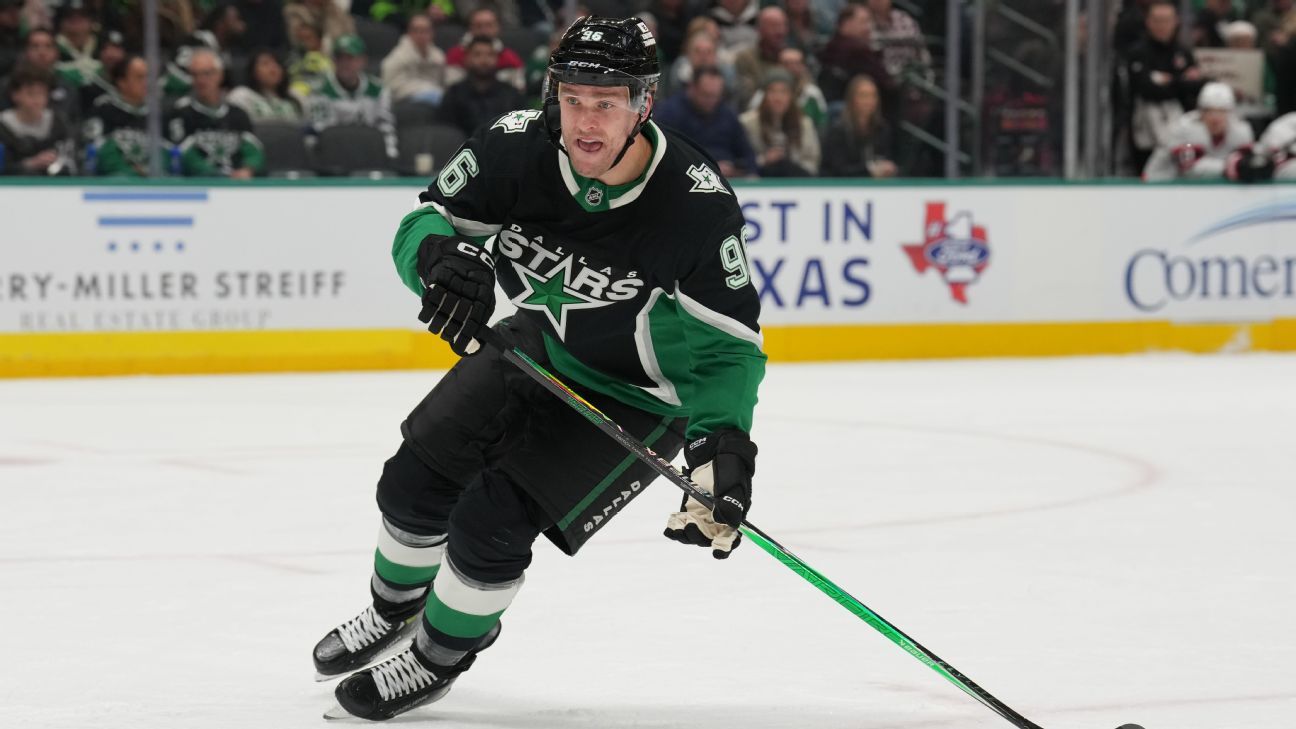
Rantanen’s comfort has been to Dallas’ benefit. Through 25 games, he has 33 points, including 10 goals. That includes 18 points on the Stars’ torrid power play, which ranked second to Pittsburgh heading into Tuesday’s game against the New York Rangers.
Winger Jason Robertson said having Rantanen for a full training camp was a key to that unit’s success. “You really didn’t have time to develop that look, that chemistry after the trade deadline last year,” he said.
At 5-on-5, Rantanen has found a fit with center Wyatt Johnston, who was tied with Robertson at 16 goals to lead the Stars. Like Nathan MacKinnon, the Avalanche star with whom Rantanen had explosive chemistry, Johnston is a right-shot center.
“Obviously last year I had a lot of success with playing with [Roope] Hintz and [Mikael] Granlund. Those are two lefties, so it’s not end of the world,” Rantanen said. “But playing a lot with Nate in the past as a righty, it’s more common for me to make plays and stuff. [Johnston] is a really good player. He can score goals. We find each other pretty well. Obviously, it takes some time. We haven’t played that long together, so we can still get better, but it’s going in a good direction.”
0:45
Mikko Rantanen capitalizes on the power play
Mikko Rantanen scores on the power play for Dallas Stars
Rantanen has played with Johnston and Dallas captain Jamie Benn recently, which is to say the Finland native is not playing with his countryman Hintz. When he was traded to the Stars last season, Rantanen joined what was colloquially known as Dallas’ “Finnish Mafia,” along with Hintz, defensemen Miro Heiskanen and Esa Lindell, and Granlund, who left for Anaheim as a free agent last summer. He played on a line with Hintz and Granlund for much of the playoffs.
There are moments when the Finns flock together. Such as at the end of a recent morning skate, when they were speaking their native tongue during a Suomi-only shooting drill. But Dallas players say Rantanen also has subverted some expectations.
“Normally, most of our Finnish guys are relatively quiet and whatever. Mikko comes in here and he’s this big, loud and happy guy. Just a different dynamic,” Robertson said. “He fit in obviously very well, and everyone welcomed him in.”
Forward Tyler Seguin knew Rantanen only as an opponent before the trade. A rather large opponent, at 6-foot-4 and around 230 pounds. Seguin said having Rantanen as a teammate offered an up-close glimpse at “how thick he is and why his nickname is what it is” referring to “Moose,” Rantanen’s moniker in Colorado.
“He’s a big boy,” Seguin said.
But Seguin also appreciates what a charismatic teammate he is, too.
“I used to know him as a skilled big forward that put up a lot of offense and points with Colorado. Getting him here as a teammate, I’ve learned what a good person he is. How much he can affect our locker room with his leadership,” Seguin explained. “Sometimes, guys come in and won’t feel comfortable talking. He does. So it’s nice.”
RANTANEN BRINGS SIZE, skill and personality to Dallas. He also brings a superstar quality to the franchise as “one of the elite power forwards in the game,” as GM Jim Nill described him last March.
Dallas coach Glen Gulutzan, hired to replace DeBoer in the offseason, coached two other elite forwards on the Edmonton Oilers‘ bench as an assistant coach: Connor McDavid and Leon Draisaitl. Gulutzan said that Rantanen is “certainly there” as far as comparable star quality.
“The most interesting thing that I’ve found coaching Mikko and then coaching Leon and Connor: The similarity is their fire. Their competitiveness. And that’s what you need, right?” Gulutzan said. “They’re very hard on themselves, just to be great every night. That’s what I really noticed. I didn’t know that as much with Mikko, but now that I’ve gotten to coach him, you just see that drive and that intensity.”
Rantanen is trying to drive the Stars into the Stanley Cup Final after three straight conference finals losses, and push Dallas to its first Cup win since 1999. He has found the right fit with a team committed to him for the long term. But he learned a lesson the hard way during last season’s chaos: Take nothing for granted.
“Last year was nothing like I’ve experienced before. Hopefully it never happens again,” he said. “But if it does, I’m ready.”
-
 Sports2 years ago
Story injured on diving stop, exits Red Sox game
-
 Sports3 years ago
‘Storybook stuff’: Inside the night Bryce Harper sent the Phillies to the World Series
-
 Sports2 years ago
Game 1 of WS least-watched in recorded history
-
 Sports3 years ago
Button battles heat exhaustion in NASCAR debut
-
 Sports3 years ago
MLB Rank 2023: Ranking baseball’s top 100 players
-
Sports4 years ago
Team Europe easily wins 4th straight Laver Cup
-
 Environment3 years ago
Japan and South Korea have a lot at stake in a free and open South China Sea
-
 Environment1 year ago
Here are the best electric bikes you can buy at every price level in October 2024