

UK takes ‘massive step forward,’ passing property laws for crypto

The UK has passed a bill into law that treats digital assets, such as cryptocurrencies and stablecoins, as property, which advocates say will better protect crypto users.
Lord Speaker John McFall announced in the House of Lords on Tuesday that the Property (Digital Assets etc) Bill was given royal assent, meaning King Charles agreed to make the bill into an Act of Parliament and passed it into law.
Freddie New, policy chief at advocacy group Bitcoin Policy UK, said on X that the bill “becoming law is a massive step forward for Bitcoin in the United Kingdom and for everyone who holds and uses it here.”

Common law in the UK, based on judges’ decisions, has established that digital assets are property, but the bill sought to codify a recommendation made by the Law Commission of England and Wales in 2024 that crypto be categorized as a new form of personal property for clarity.
“UK courts have already treated digital assets as property, but that was all through case-by-case judgments,” said the advocacy group CryptoUK. “Parliament has now written this principle into law.”
“This gives digital assets a much clearer legal footing — especially for things like proving ownership, recovering stolen assets, and handling them in insolvency or estate cases,” it added.
Digital “things” now considered personal property
CryptoUK said that the bill confirms “that digital or electronic ‘things’ can be objects of personal property rights.”
UK law categorizes personal property in two ways: a “thing in possession,” which is tangible property such as a car, and and a “thing in action,” intangible property, like the right to enforce a contract.
The bill clarifies that “a thing that is digital or electronic in nature” isn’t outside the realm of personal property rights just because it is neither a “thing in possession” nor a “thing in action.”
The Law Commission argued in its report in 2024 that digital assets can possess both qualities, and said that their unclear fit into property rights laws could hamstring dispute resolutions in court.
Related: Group of EU banks pushes for a euro-pegged stablecoin by 2027
Change gives “greater clarity” to crypto users
CryptoUK said on X that the law gives “greater clarity and protection for consumers and investors” and gives crypto holders “the same confidence and certainty they expect with other forms of property.”
“Digital assets can be clearly owned, recovered in cases of theft or fraud, and included within insolvency and estate processes,” it added.
The group added that the UK now has a “clear legal basis for ownership and transfer” of crypto and the country would now be “better positioned to support the growth of new financial products, tokenised real-world assets, and more secure digital markets.”
The country’s finance authority reported late last year that roughly 12% of UK adults own cryptocurrency, up from 10% in its previous findings.
The UK also revealed plans for a crypto regulatory regime in April that would bring crypto businesses under similar rules to other finance companies, aiming to make the country a global hub for crypto while promoting consumer protections.
Magazine: 2026 is the year of pragmatic privacy in crypto — Canton, Zcash and more

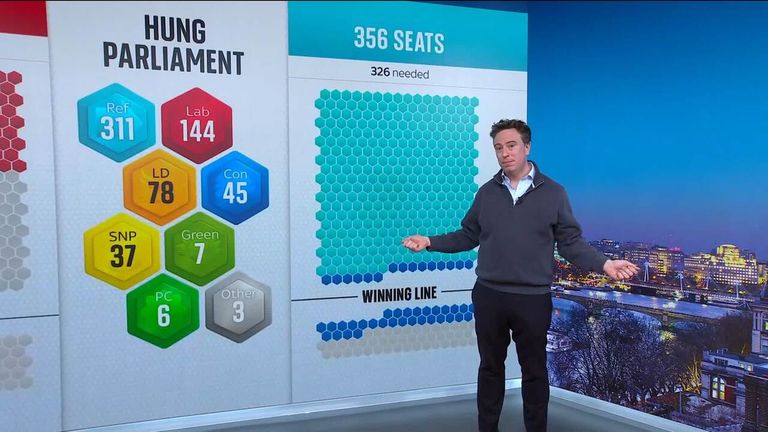
Four mayoral elections due to take place in May 2026 are set to be postponed by two years, Sky News understands.
Elections for the new mayoralties of Essex, Hampshire and the Solent, Sussex and Brighton, and Norfolk and Suffolk will be pushed back until 2028.
The decision, first revealed by The Sun, is due to be announced by ministers today.
This is the second time elections are being delayed in these areas. Local elections due in May 2025 were delayed by then communities secretary Angela Rayner for a year in order to convert them into combined authorities led by mayors.
However, it is understood that these councils need more time to complete their reorganisation.
Will Tories and Reform unite?
The news has sparked accusations Labour are delaying the elections for political purposes.
Reform UK’s head of policy Zia Yusuf said: “This is a blatant attempt to stop big Reform wins next May.
“It’s an act of a desperate government who are clinging onto power by any means necessary.
“Labour has proven time and time again that they’re not beyond denying democracy to millions of people in order to maintain their cosy status quo.”
Pic: PA
The Tories’ shadow housing secretary James Cleverly said it was a “scandalous attempt to subvert democracy by a Labour government whose credibility and popularity are already in tatters”.
“The Conservatives firmly oppose this decision to delay the mayoral elections, especially when candidates have been selected and campaigning is well under way,” he added.
“Democracy is being denied yet again after the council elections cancelled by Labour this year.
“There is no credible justification for this move. The Labour government must reverse it immediately.”
Read more:
Tory-Reform pact talks ‘not happening at any level’
Reeves hit by Labour rebellion

Starmer denies misleading voters
The reorganisation is part of Labour’s manifesto commitment to widen devolution, which it argues will improve local economies.
The government wants to abolish the two-tier system of county and district councils and merge them together to create larger unitary authorities. It also wants more areas to have regional mayors, like Greater Manchester’s Andy Burnham.
Reform UK enjoyed success in the local elections in May, winning more than 600 seats and taking control of 10 councils stretching from Kent to County Durham. The party also toppled a 14,000-strong Labour majority in a parliamentary by-election.
The Liberal Democrats’ local government spokesperson Zoe Franklin called the postponed elections “a disgrace”.
“Democracy delayed is democracy denied,” she added. “We are fighting to end this blatant stitch up between Labour and the Conservatives over local elections.”

The US state of Connecticut has hit Robinhood, Kalshi and Crypto.com with cease and desist orders, accusing the platforms of offering unlicensed sports betting through event contracts.
The Connecticut Department of Consumer Protection sent letters to the three platforms on Wednesday, claiming they were “conducting unlicensed online gambling, more specifically sports wagering,” with event contracts available online.
“None of these entities possess a license to offer wagering in our state, and even if they did, their contracts violate numerous other state laws and policies, including offering wagers to individuals under the age of 21,” said DCP Commissioner Bryan Cafferelli.
DCP Gaming Director Kris Gilman accused the platforms of “deceptively advertising that their services are legal,” adding that they operate outside of the state’s regulatory environment, “posing a serious risk to consumers who may not realize that wagers placed on these illegal platforms offer no protections for their money or information.”
Prediction markets have come under legal scrutiny in several US states, as the use of these platforms has skyrocketed this year and attracted billions of dollars in investment for allowing users to bet on the outcome of a variety of events.

Kalshi fires back in court
A Kalshi spokesperson told Cointelegraph that it is “a regulated, nationwide exchange for real-world events, and it is subject to exclusive federal jurisdiction.
“It’s very different from what state-regulated sportsbooks and casinos offer their customers. We are confident in our legal arguments and have filed suit in federal court,” Kalshi added.
In a complaint filed on Wednesday against the DCP, Kalshi claimed that “Connecticut’s attempt to regulate Kalshi intrudes upon the federal regulatory framework that Congress established for regulating derivatives on designated exchanges.”
It added that its platform was subject to the Commodity Futures Trading Commission’s “exclusive jurisdiction” and its sports event contracts “are lawful under federal law.”
“As we’ve previously shared, Robinhood’s event contracts are federally regulated by the CFTC and offered through Robinhood Derivatives, LLC, a CFTC-registered entity, allowing retail customers to access prediction markets in a safe, compliant, and regulated manner,” a Robinhood spokesperson told Cointelegraph.
Crypto.com did not immediately respond to requests for comment.
In its statement, Connecticut’s DCP said that prediction market platforms pose serious risks to consumers because they lack the required technical standards and security protections for financial and personal data.

The agency claimed that such platforms also lack integrity controls to prevent insider betting or manipulation, operate without regulatory oversight of their payout rules, advertise to self-excluded gamblers and on college campuses, and permit betting on events with known outcomes, thereby giving insiders unfair advantages.
Related: Polymarket opens US app to waitlisted users after CFTC green light
Only three platforms are legally licensed for sports wagering in Connecticut: DraftKings, FanDuel and Fanatics, all of which require users to be at least 21 years old.
Kalshi under fire in at least 10 US states
Connecticut is not the only state to take a hard stance on prediction platforms; regulators in two neighboring states have previously taken action.
New York sent a cease and desist to Kalshi in late October, and the company responded on Oct. 27 by suing the state. Meanwhile, the Massachusetts state attorney general sued Kalshi in the state court in September.
Kalshi also previously received cease and desist orders from Arizona, Illinois, Montana and Ohio this year, and it remains embroiled in ongoing litigation in New Jersey, Maryland and Nevada, reported Bookies.
Kalshi announced this week that it has closed a $1 billion funding round at a valuation of $11 billion, after seeing its best-ever monthly volume in November.
Magazine: Crypto gaming’s mainstream moment hinges on CLARITY Act: Web3 Gamer
-
 Sports2 years ago
Story injured on diving stop, exits Red Sox game
-
 Sports3 years ago
‘Storybook stuff’: Inside the night Bryce Harper sent the Phillies to the World Series
-
 Sports2 years ago
Game 1 of WS least-watched in recorded history
-
 Sports3 years ago
Button battles heat exhaustion in NASCAR debut
-
 Sports3 years ago
MLB Rank 2023: Ranking baseball’s top 100 players
-
Sports4 years ago
Team Europe easily wins 4th straight Laver Cup
-
 Environment3 years ago
Japan and South Korea have a lot at stake in a free and open South China Sea
-
 Environment1 year ago
Here are the best electric bikes you can buy at every price level in October 2024