
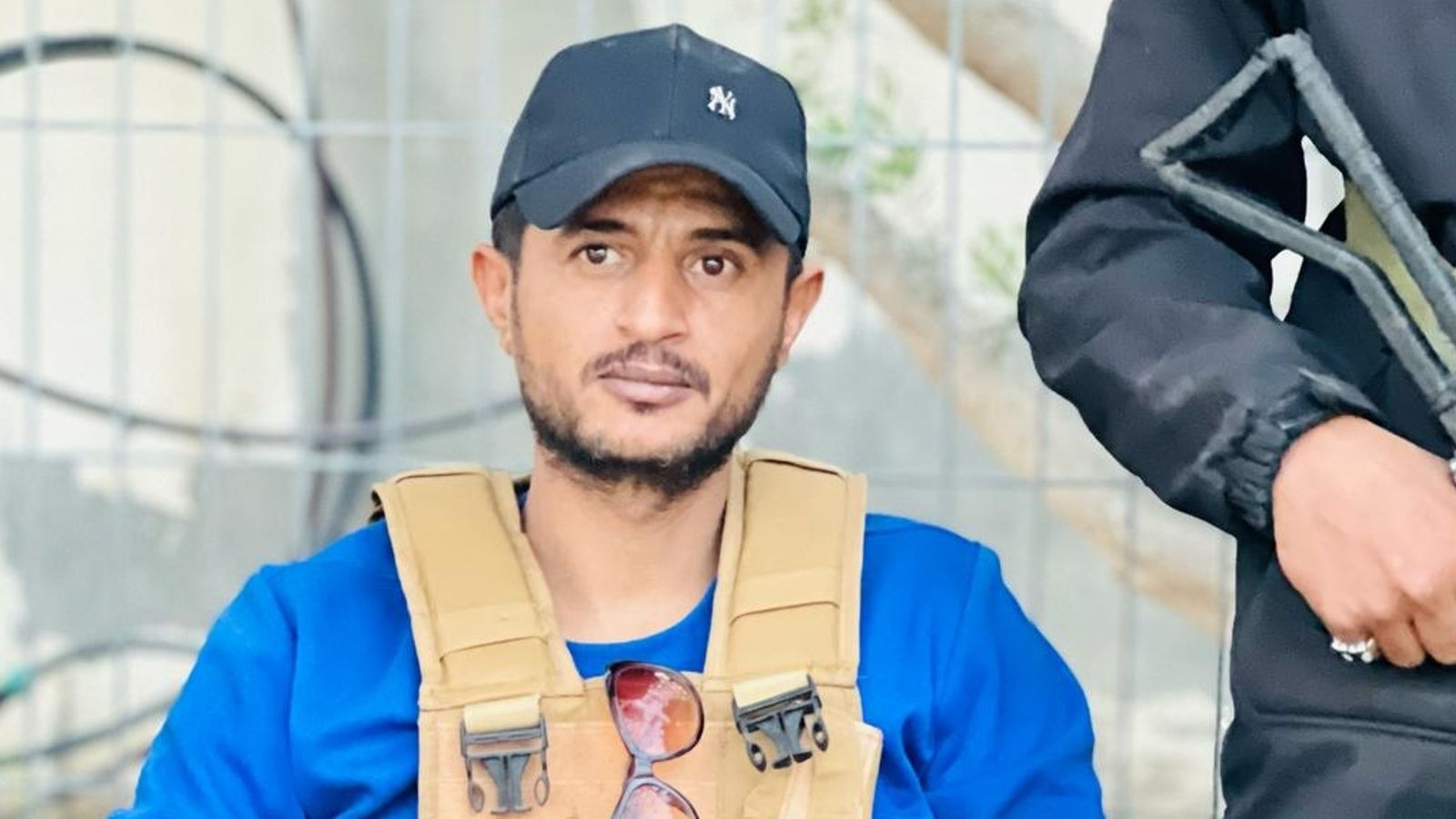
Anti-Hamas militia leader Yasser Abu Shabab killed in Gaza Strip – reports

A Palestinian anti-Hamas militia leader has been killed in the Gaza Strip, according to Israeli army radio.
Yasser Abu Shabab, the commander of the former looting gang Popular Forces, along with a large number of members from his group, and senior commander Ghassan al Duhine, reportedly fell into a well-planned ambush set by the resistance factions.
The Reuters news agency reported that Abu Shabab, the most prominent anti-Hamas clan leader in Gaza, had died of his wounds in a hospital in southern Israel. It did not say when he died.
Hamas had no comment, its Gaza spokesperson said, while Israeli authorities did not immediately make any comment.
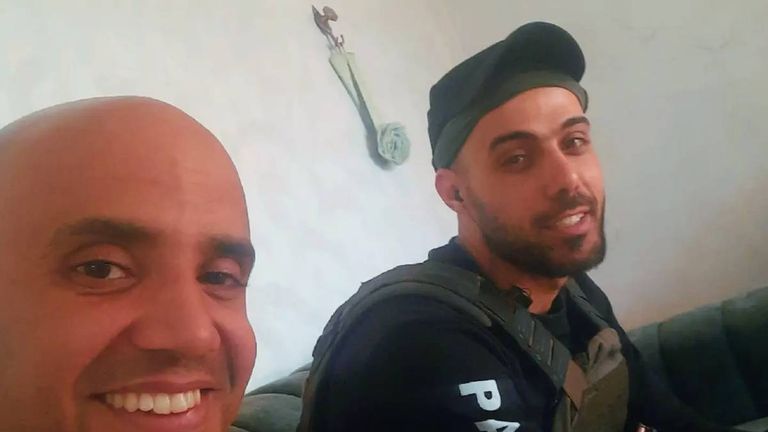
Ghassan Al Duhine, left, was the deputy commander of the Popular Forces’ military wing. Pic: Facebook
Hamas has accused Abu Shabab of collaborating with Israel, which he denied.
Sky News revealed that Abu Shabab’s Bedouin militia was smuggling vehicles into Gaza with the help of the Israeli military and an Arab-Israeli car dealer.
Popular Forces has been positioning itself as Gaza’s future government, despite denials in June that Abu Shabab had any intention of forming a government in Gaza.
The militia said at the time that he was focused solely on providing security to aid convoys and Palestinians.
Speaking to Sky News, however, Hassan Abu Shabab, a relative and childhood friend of Yasser Abu Shabab, showed no such restraint – he talked of reforming the school curriculum and holding a referendum on normalising relations with Israel.
“We’d like to run everything,” he said.
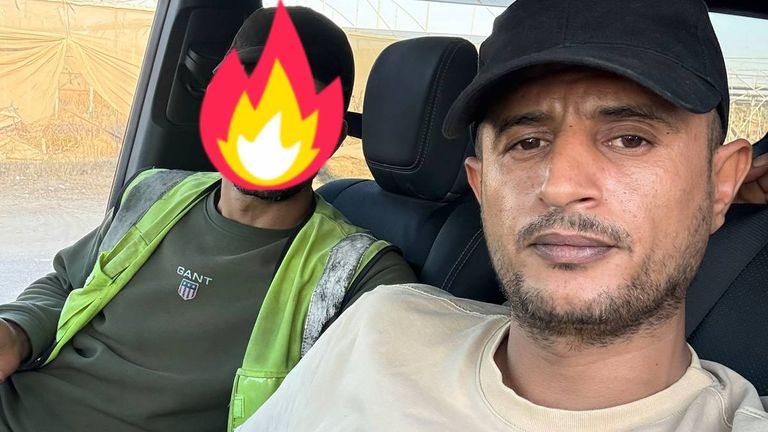
Yasser Abu Shabab (right), in a photo uploaded to his social media account. Pic: TikTok
Looting trucks and smuggling cigarettes
He said in October that the recruitment of new militias had swelled Popular Forces’ troops across Gaza to around 3,000.
The headquarters of the militia are located in a small neighbourhood in Gaza’s southern Rafah area, in territory still held by Israeli forces.
The base’s location is strategically important – it sits along the route by which aid trucks must travel when entering Gaza through the Kerem Shalom crossing, a route that aid officials have named “Looters’ Alley”.
An internal UN report, dated November 2024, identified Abu Shabab and his gang as “the most influential stakeholders behind the systematic and massive looting of convoys”.
The UN document identified their primary source of income as smuggling cigarettes – one of the many goods which Israel has officially banned from entering Gaza. The price of individual cigarettes has at some points reached $20.
Hassan Abu Shabab admitted that the group was involved in looting trucks and smuggling cigarettes, though he said they only ever targeted commercial trucks they believed to be supplying Hamas.
Read more:
Investigation reveals Israel’s support for militia
Hamas battles militias for control of Gaza
Revealed: The four militias backing Israel
He said it eventually escalated, with Hamas’s men allegedly killing his cousins in a “massacre” that left 54 people dead.
Sky News could not independently verify his claim, but there were numerous reports of deadly clashes between Abu Shabab’s men and Hamas, which declared the Popular Forces leader a wanted man.
World
Salisbury novichok poisonings: Putin ‘morally responsible’ for woman’s death after authorising botched spy assassination bid
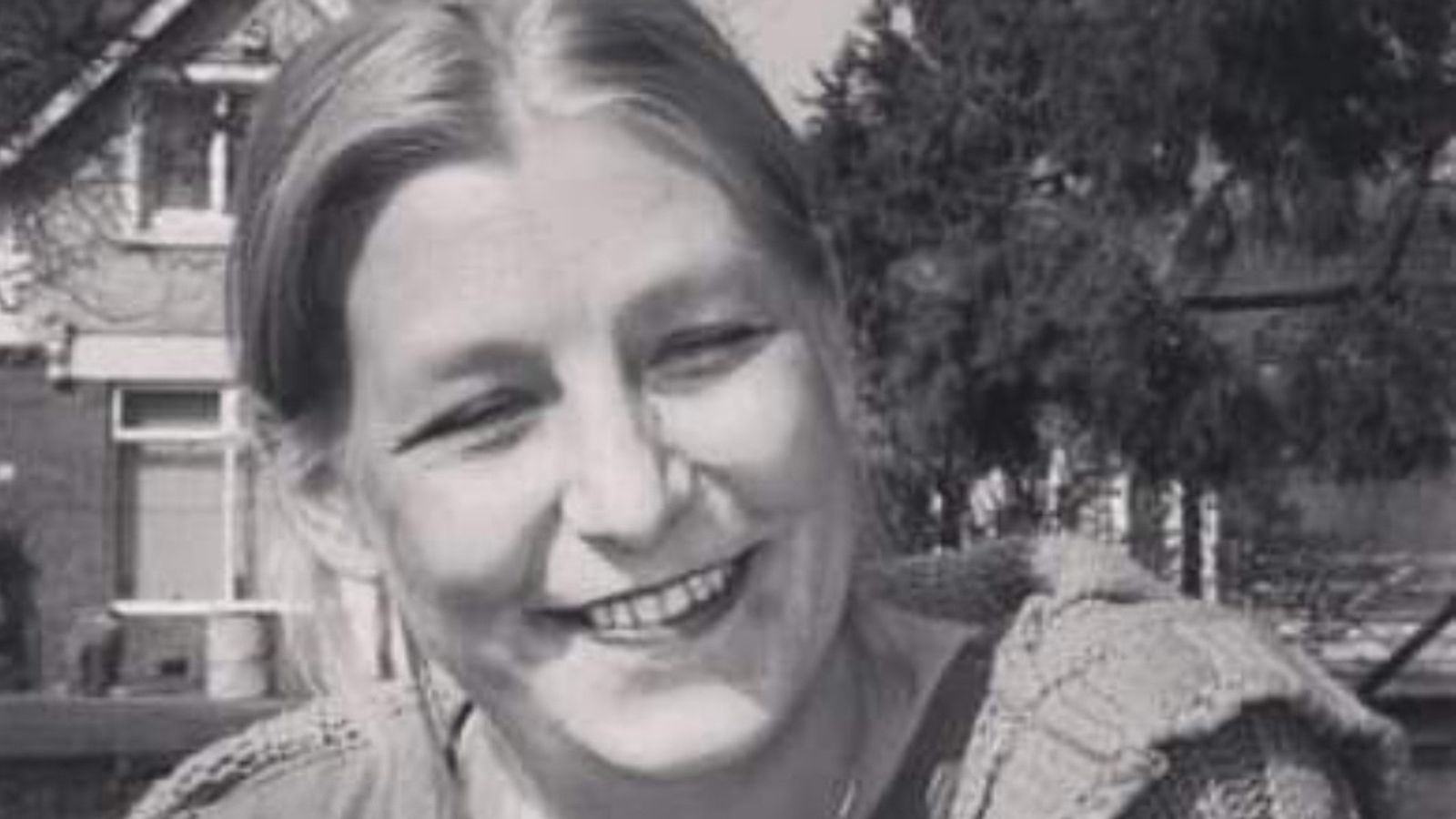
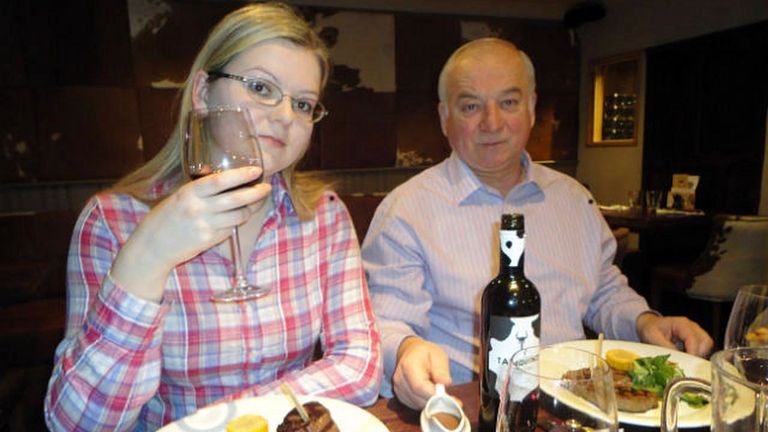
The assassination attempt on a former Russian spy was authorised by Vladimir Putin, who is “morally responsible” for the death of a woman poisoned by the nerve agent used in the attack, a public inquiry has found.
The chairman, Lord Hughes, found there were “failings” in the management of Sergei Skripal, 74, who was a member of Russian military intelligence, the GRU, before coming to the UK in 2010 on a prisoner exchange after being convicted of spying for Britain.
But he found the assessment that he wasn’t at “significant risk” of assassination was not “unreasonable” at the time of the attack in Salisbury on 4 March 2018, which could only have been avoided by hiding him with a completely new identity.
Mr Skripal and his daughter Yulia, 41, who was also poisoned, were left seriously ill, along with then police officer Nick Bailey, who was sent to search their home, but they all survived.
Sergei Skripal and Yulia Skripal.
Pic: Shutterstock
Dawn Sturgess, 44, died on 8 July, just over a week after unwittingly spraying herself with novichok given to her by her partner, Charlie Rowley, 52, in a perfume bottle in nearby Amesbury on 30 June 2018. Mr Rowley was left seriously ill but survived.
In his 174-page report, following last year’s seven-week inquiry, costing more than £8m, former Supreme Court judge Lord Hughes said she received “entirely appropriate” medical care but her condition was “unsurvivable” from a very early stage.
The inquiry found GRU officers using the aliases Alexander Petrov, 46, and Ruslan Boshirov, 47, had brought the Nina Ricci bottle containing the novichok to Salisbury after arriving in London from Moscow with a third agent known as Sergey Fedotov to kill Mr Skripal on 2 March.
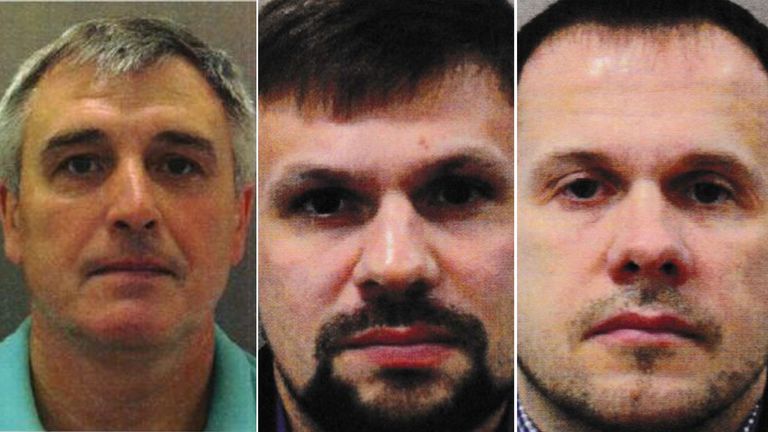
L-R Suspects who used the names of Sergey Fedotov, Ruslan Boshirov and Alexander Petrov. Pics: UK Counter Terrorism Policing
The report said it was likely the same bottle Petrov and Boshirov used to apply the military-grade nerve agent to the handle of Mr Skripal’s front door before it was “recklessly discarded”.
“They can have had no regard to the hazard thus created, of the death of, or serious injury to, an uncountable number of innocent people,” it said.
It is “impossible to say” where Mr Rowley found the bottle, but was likely within a few days of it being abandoned on 4 March, meaning there is “clear causative link” with the death of mother-of-three Ms Sturgess.
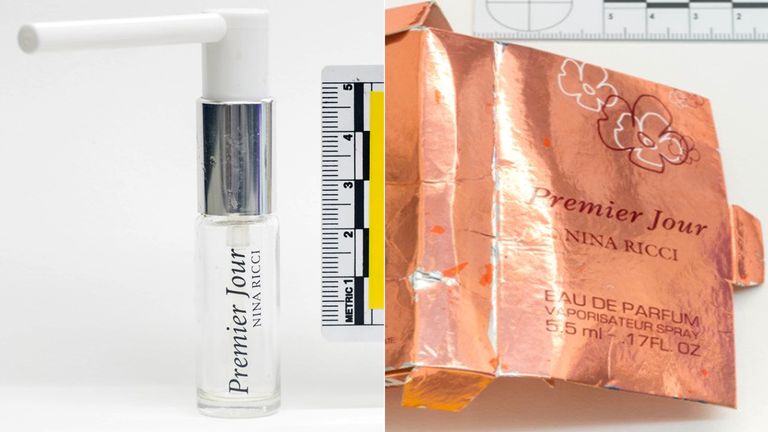
Novichok was in perfume bottle. Pic: Reuters
Lord Hughes said he was sure the three GRU agents “were acting on instructions”, adding: “I have concluded that the operation to assassinate Sergei Skripal must have been authorised at the highest level, by President Putin.
“I therefore conclude that those involved in the assassination attempt (not only Petrov, Boshirov and Fedotov, but also those who sent them, and anyone else giving authorisation or knowing assistance in Russia or elsewhere) were morally responsible for Dawn Sturgess’s death,” he said.
Russian ambassador summonsed
After the publication of the report, the government announced the GRU has been sanctioned in its entirety, and the Russian Ambassador has been summonsed to the Foreign Office to answer for Russia’s ongoing campaign of alleged hostile activity against the UK.
Sir Keir Starmer said the findings “are a grave reminder of the Kremlin’s disregard for innocent lives” and that Ms Sturgess’s “needless” death was a tragedy that “will forever be a reminder of Russia’s reckless aggression”.
“The UK will always stand up to Putin’s brutal regime and call out his murderous machine for what it is,” the prime minister said.
He said deploying the “highly toxic nerve agent in a busy city centre was an astonishingly reckless act” with an “entirely foreseeable” risk that others beyond the intended target would be killed or injured.
The inquiry heard a total of 87 people presented at A&E.
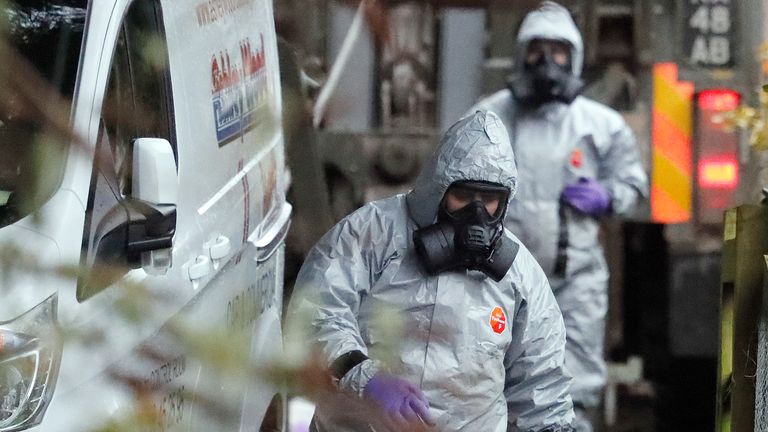
Pic AP
Lord Hughes said there was a decision taken not to issue advice to the public not to pick anything up which they hadn’t dropped, which was a “reasonable conclusion” at the time, so as not to cause “widespread panic”.
He also said there had been no need for training beyond specialist medics before the “completely unexpected use of a nerve agent in an English city”.
After the initial attack, wider training was “appropriate” and was given but should have been more widely circulated.
In a statement following the publication of his report, Lord Hughes said Ms Sturgess’s death was “needless and arbitrary”, while the circumstances are “clear but quite extraordinary”.
“She was the entirely innocent victim of the cruel and cynical acts of others,” he said.
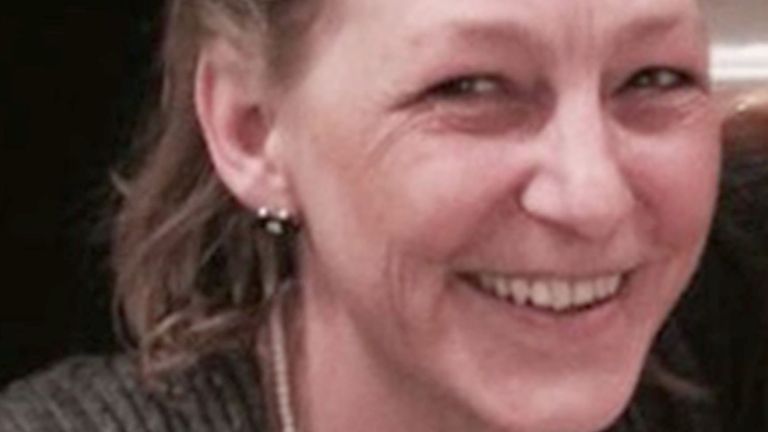
‘We can finally put her to peace’ . Pic: Met Police/PA
‘We can have Dawn back now’
Speaking after the report was published, Ms Sturgess’s father, Stanley Sturgess, said: “We can have Dawn back now. She’s been public for seven years. We can finally put her to peace.”
In a statement, her family said they felt “vindicated” by the report, which recognised how Wiltshire police wrongly characterised Ms Sturgess as a drug user.
But they said: “Today’s report has left us with some answers, but also a number of unanswered questions.
“We have always wanted to ensure that what happened to Dawn will not happen to others; that lessons should be learned and that meaningful changes should be made.
“The report contains no recommendations. That is a matter of real concern. There should, there must, be reflection and real change.”
Wiltshire Police Chief Constable Catherine Roper admitted the pain of Ms Sturgess’s family was “compounded by mistakes made” by the force, adding: “For this, I am truly sorry.”
Russia has denied involvement
The Russian Embassy has firmly denied any connection between Russia and the attack on the Skripals.
But the chairman dismissed Russia’s explanation that the Salisbury and Amesbury poisonings were the result of a scheme devised by the UK authorities to blame Russia, and the claims of Petrov and Borisov in a television interview that they were sightseeing.
The inquiry chairman said the evidence of a Russian state attack was “overwhelming” and was designed not only as a revenge attack against Mr Skripal, but amounted to a “public statement” that Russia “will act decisively in its own interests”.
Lord Hughes found “some features of the management” of Mr Skripal “could and should have been improved”, including insufficient regular written risk assessments.
But although there was “inevitably” some risk of harm at Russia’s hands, the analysis that it was not likely was “reasonable”, he said.
“There is no sufficient basis for concluding that there ought to have been assessed to be an enhanced risk to him of lethal attack on British soil, such as to call for security measures,” such as living under a new identity or at a secret address, the chairman said.
He added that CCTV cameras, alarms or hidden bugs inside Mr Skripal’s house might have been possible but wouldn’t have prevented the “professionally mounted attack with a nerve agent”.
Sky News has approached the Russian Embassy for comment on the report.

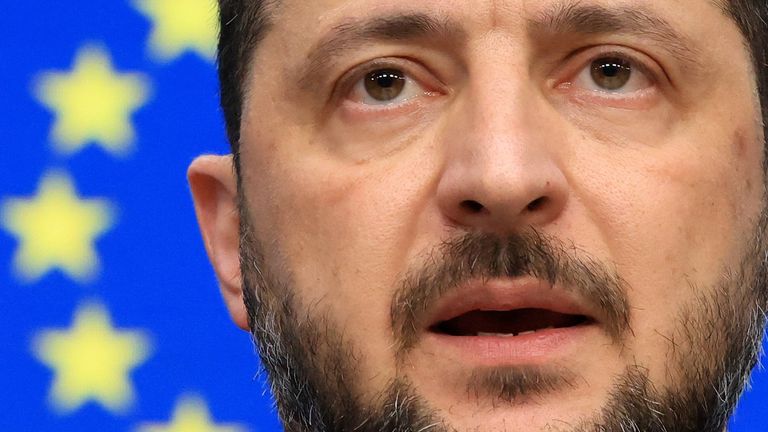
Something concrete and unarguable has emerged from the diplomatic turbulence generated by Donald Trump’s attempts to end the war in Ukraine.
The war in Ukraine has become Europe’s war – in fact, it is unlikely to be America’s problem for long.
The Trump administration’s 20-something-point peace plan, as shepherded by envoys Steve Witkoff and Jared Kushner, is going nowhere.
Ukrainian President Volodymyr Zelenskyy at the European Union leaders’ summit in Brussels, Belgium. Pic: Reuters
When presented with the proposal on Tuesday, a Russian negotiator said President Putin made, “no secret of our critical and even negative attitude toward a number of elements.”
But the words of the Russian leader himself are more instructive. In a belligerent speech made on the same day, he threatened to “cut Ukraine off from the sea entirely” in retaliation to a series of attacks on Russian-linked oil tankers.
This is not a man thinking about doing a deal. Putin is the obvious obstacle.
None of which will have come as any surprise to leaders in Europe and the UK, who did what they typically do when the situation looks grim.
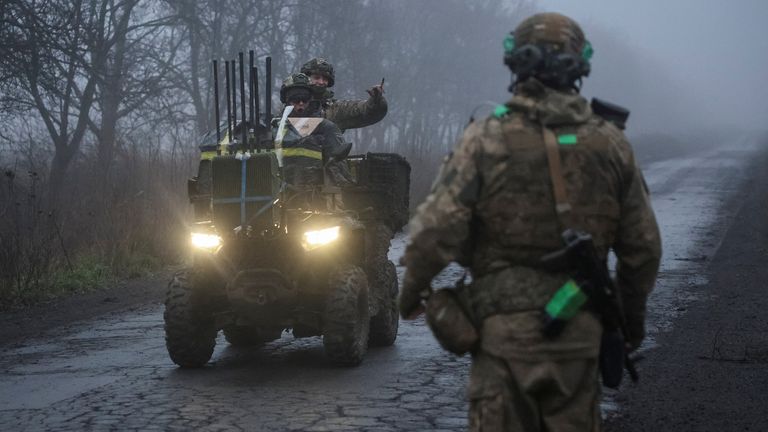
Servicemen of the 93rd Kholodnyi Yar Separate Mechanized Brigade of the Ukrainian Armed Forces. Pic: Reuters
Britain, France, Ireland, Germany and others have been issuing lofty declarations of the “we’ll support Ukraine as long as it takes,” variety.
But this time it is different. European leaders are going to have to treat Ukraine like the emergency it is – or face the consequences.
Presently, they occupy a position that many see as absurd.
Europe, including Britain, bankroll the Ukrainian government. Funding which was split down the middle with the Biden administration has been assumed by Europe in full. Furthermore, the Europeans pay for all American weaponry through a NATO facility called PURL.
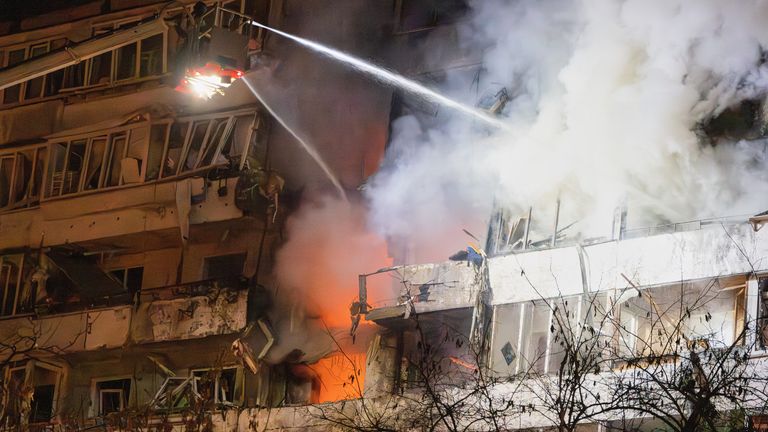
Firefighters put out a fire after a drone hit a multi-storey residential building during Russia’s night drone attack in Kyiv. Pic: AP
Thus, Europe has got skin in the game – they are paying the bills. But where are they sitting at the negotiation table?
They are not there at all. The Russians do not want them, and the US does not seem particularly keen. When US secretary of state Marco Rubio met a Ukrainian delegation to discuss the peace plan in Geneva, he said he did not know anything about European counter-proposals
“It’s extraordinary that Europe is picking up the bill but struggles to make itself heard,” says Marc De Vore, of St Andrews University. “It shows the lack of vision, coordination and leadership across the continent.”
The former foreign minister of Lithuania, Gabrielius Landsbergis, is utterly exasperated by Europe’s ineffectiveness.
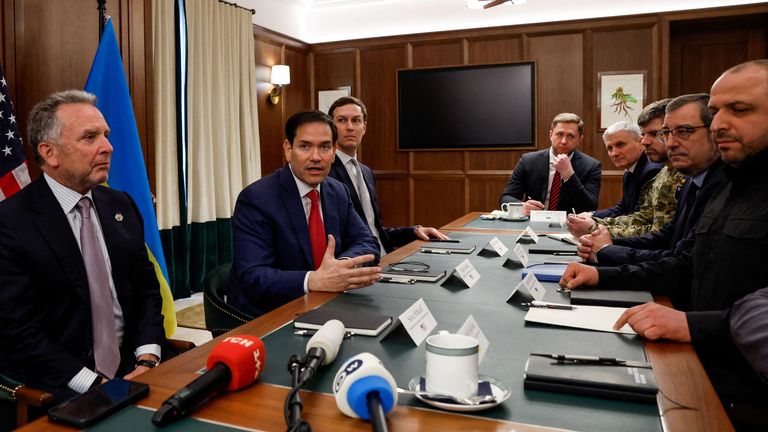
Marco Rubio, Steve Witkoff, and Jared Kushner meet with Ukrainian defence chief Rustem Umerov and his delegation in Florida. Pic: Reuters
“If you are a European leader asking your team to book you on the next flight to Washington to go talk to daddy, please don’t. Not without a plan, not cap in hand, not humiliating us all in front of the cameras at the Oval Office.
“Europe is our continent, our future is decided here, not there. We aren’t poor, we have options, we can finally decide to assist Ukraine to the full extent…”
Read more:
Putin ‘wasting the world’s time’ after rejecting peace deal
Briton held in Ukraine on suspicion of spying for Russia
This frustration is shared by the Ukrainians, who have begun to use a different word to describe this relationship – betrayal.
Inna Sovsun is an MP in the Ukrainian parliament. Her husband, a combat medic, is serving at the front.
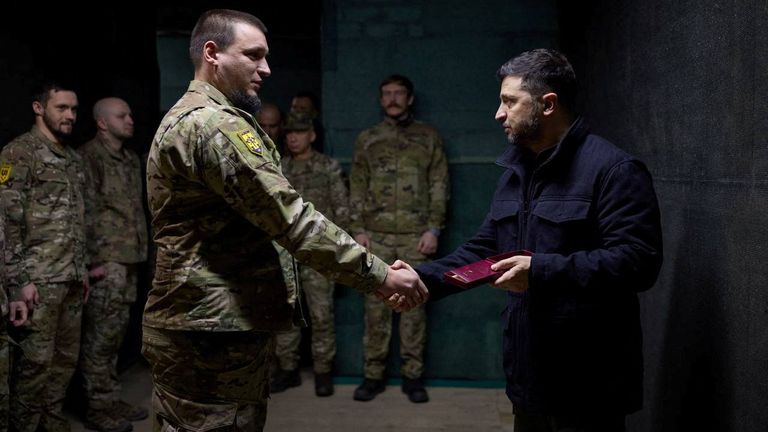
Ukraine’s President Volodymyr Zelenskiy awards a Ukrainian service member, as he visits a frontline position, amid Russia’s attack on Ukraine. Pic: Reuters
“People on the frontline feel really disappointed with the whole situation, and it does feel like betrayal.
“The challenge is much bigger than which village will be controlled by whom in Donbas. It is about, what does the future of civilisation look like? Does Russia’s barbaric version win? If you are not willing to fight for that, those values aren’t worth much, are they?”
Unsurprisingly perhaps, analysts and others are sketching out what Ukraine would look like if forced to capitulate. The idea here, is that Europe will not like what it sees.
Picture an unstable nation on Europe’s border with a proxy-Russian leader – or different groups battling for control. The population is restive, with many thousands of men both conditioned and traumatised by war. Millions of refugees seek shelter in Europe.
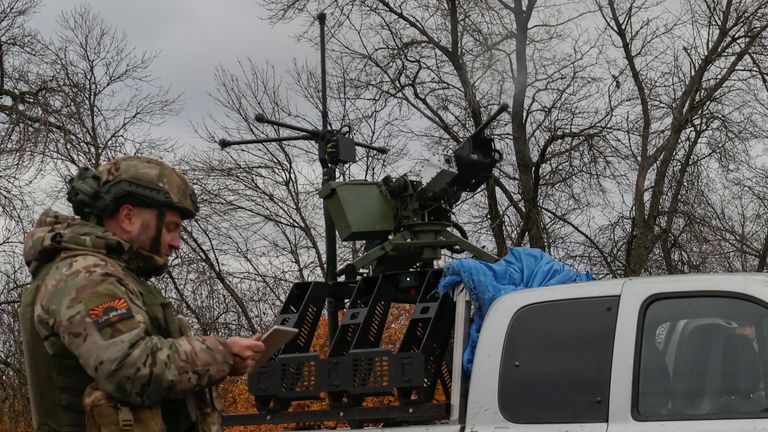
A service member of the 125th Separate Heavy Mechanized Brigade with a Kalashnikov tank machine gun. Pic: Reuters
Economists have tried to put a figure on such scenarios, with one group estimating costs to Europe approaching €3tn euros in additional defence and refugee-related spending if Ukraine is seriously weakened.
For the Europeans, a test of their resolve is already at hand. The EU must agree on a plan to seize up to €210bn euros in frozen Russian assets as a means of funding the cash-strapped government in Kyiv.
The issue is legally contentious, with countries like Belgium, where much of the money is held, fretting about liability. But the Ukrainians see it as a simple question of commitment.
“Given what is at stake, there just has to be stronger political will. That is what is difficult for us to grasp. (They) say all those good things, the right things, but that doesn’t really matter much,” says Ms Sovsun.
World
‘If someone took Trump’s land, how would he feel?’ – Ukrainians view peace talks with suspicion
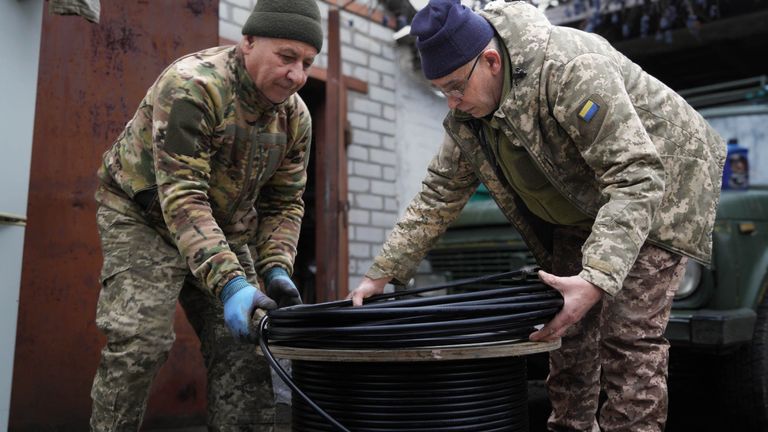
A Ukrainian farmer-turned-soldier in the Donbas has a message for Donald Trump as the US president attempts to broker a peace deal between Kyiv and Moscow.
Anatolii, 59, said: “If someone took a piece of his territory, what would he say to that? The same goes for us.”
Like many Ukrainians, the serviceman volunteered to join a territorial defence unit when Russia launched its full-scale war almost four years ago.
He has been fighting ever since, but will have the option to quit next year once he turns 60.
Anatolii and a colleague
Unable to wear body armour anymore because of its weight, Anatolii now operates further back from the frontline in a small workshop on the outskirts of the city of Kramatorsk where he helps to fix and improve the performance of drones – a crucial weapon on the battlefield.
“I want this war to finally end,” he said. “I want to go home, to my family, to my land.”
But not at any price.
He and other soldiers in 107 Brigade of Ukraine’s Territorial Defence Force view Mr Trump’s efforts to negotiate a peace agreement with suspicion.
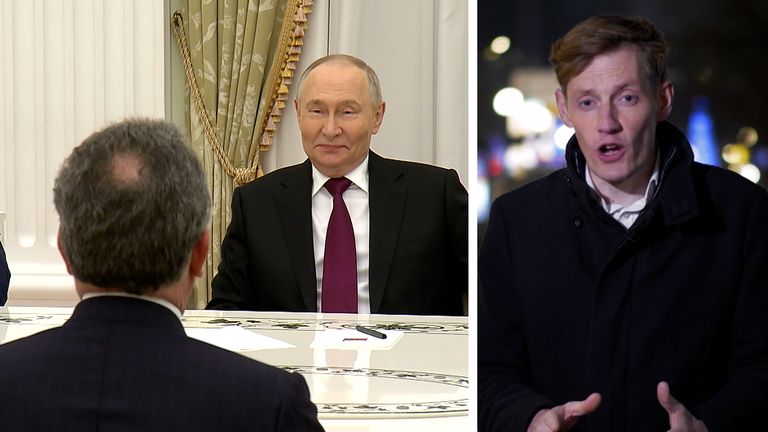
Peace deal: Russia ‘in no mood to compromise’.
An initial proposal envisaged the Ukrainian government giving up Donetsk and Luhansk, the two regions that make up the Donbas, to Russia.
This includes large swathes of land that are still under Ukraine’s control, and that thousands of Ukrainian soldiers have lost their lives fighting to defend.
“I feel negative about it,” Anatolii said, referring to the proposal.
“So many people already fell for this land … How can we give away our land? It would be like someone comes to my house and says: ‘Give me a piece of your home.'”
However, he added: “I understand, we have nothing to take it back with. Maybe through some political means…
“I do not want more people to fall, more people to die. I want politicians to somehow come to terms.”
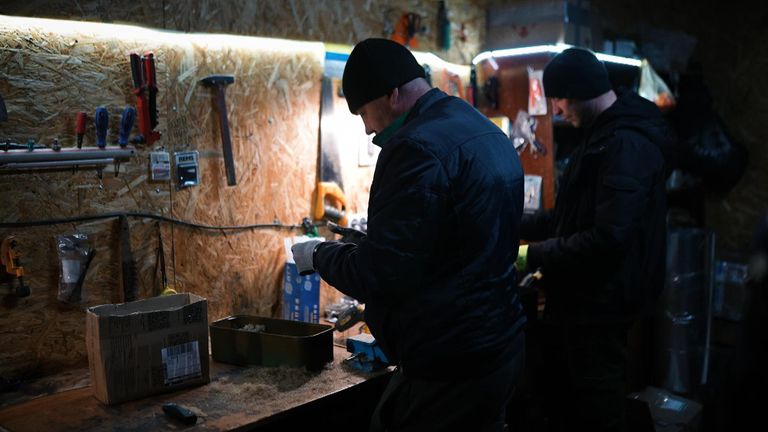
A short drive away from the workshop is a hidden bomb factory where other soldiers from the same unit are focused on a different kind of war effort.
Surrounded by 3D printed gadgets, metal ball bearings and plastic explosives, they make improvised bombs, including anti-personnel mines and devices that can be fitted onto one-way attack drones and exploded onto targets.
Vadym, 41, is in charge of the production line.
He has been fighting since Russian President Vladimir Putin first attacked eastern Ukraine in 2014.
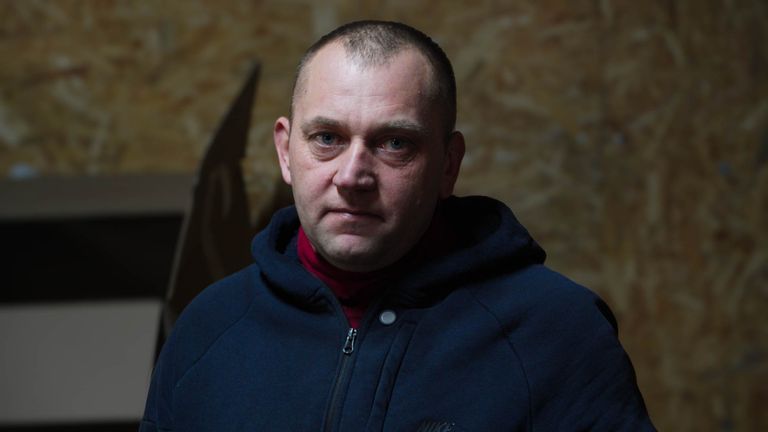
Vadym
Asked whether he felt tired, he said: “We are always tired, we have no motivation as such, but there is the understanding that the enemy will keep coming as long as we do not stop him. If we stop fighting, our children and grandchildren will fight. That keeps us going.”
Vadym is also against simply handing over Ukrainian land to Russia.
“If we now give away borders, give away Donbas, then what?” he said.
“Any country can come to any other country and say: This is our land. Let’s coordinate, do business, and keep living as before. That is not normal in my view.”

The Ukrainian president says ‘everyone must be on this side of peace’
The city of Kramatorsk stands testament to Ukraine’s will to fight, remaining firmly in Ukrainian hands, though Russia’s war is inching closer.
Nets stretched like a tunnel line a main road leading into the city to protect vehicles from the threat of small, killer drones.
Coils of barbed wire are also strung across fields around the outskirts of Kramatorsk along with other fortifications such as mounds of dirt and triangular lumps of concrete.
Many civilians have remained here as well as the nearby city of Slovyansk, even as other landmark sites such as Mariupol, Bakhmut and Avdiivka have fallen.
Yet the toll of living in a warzone is clear.
Stallholders swept away rubble and broken glass on Sunday after a Russian missile smashed into a central market in Kramatorsk on Saturday night.
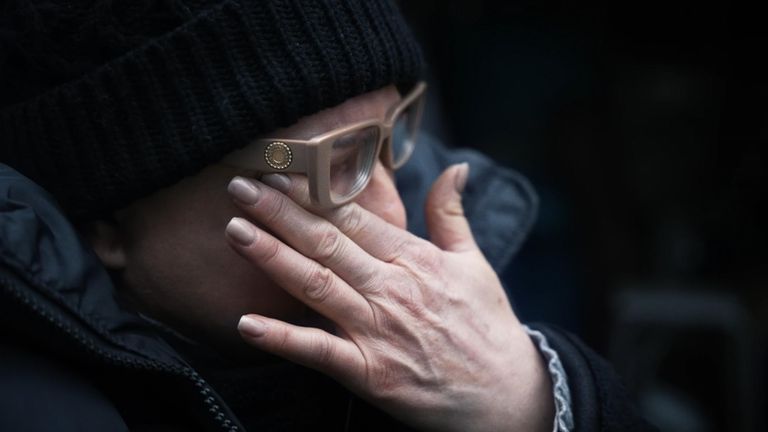
Some, like Ella, 60, even chose to reopen despite the carnage.
“It’s frightening. We need to earn a living. I have my mother, I need to look after her, help my children. So we do what we have to do,” she said.
Her adult children live in Kyiv and want her to leave, but Kramatorsk is her home.
“We’ve been living like this for four years now. We’re so used to it. A drone flies overhead and we keep working,” she said.
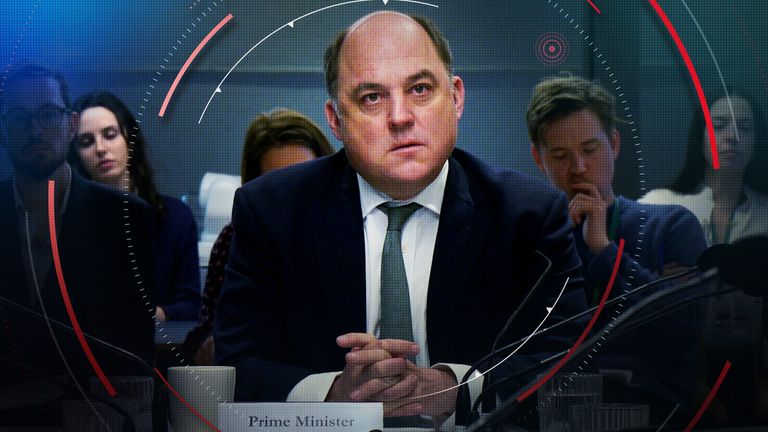
Is the UK prepared to fight a war?
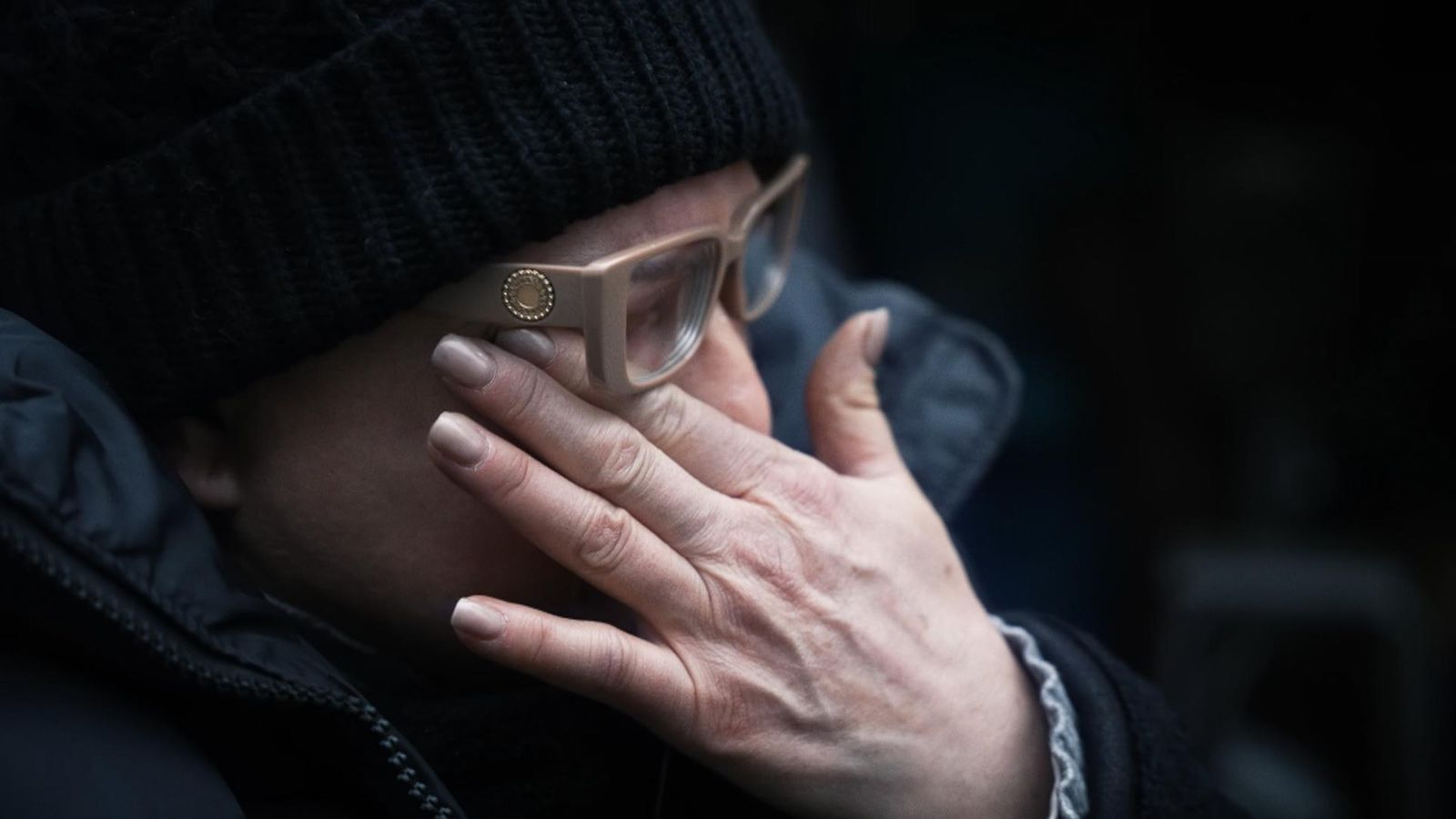
Asked how she felt about what the war had done to her city, Ella’s voice wobbled and she wiped tears from her eyes.
“We keep it all inside, but it still hurts. It’s frightening and painful. I just want things as they used to be. We don’t want anything here to change,” she said.
As for what she would do if a future peace deal forced Ukraine to surrender the area, Ella said: “That’s a hard question … I wouldn’t stay. I’d leave.”
Production by security and defence producer Katy Scholes, Ukraine producer Azad Safarov, camera operator Mostyn Pryce
-
 Sports2 years ago
Story injured on diving stop, exits Red Sox game
-
 Sports3 years ago
‘Storybook stuff’: Inside the night Bryce Harper sent the Phillies to the World Series
-
 Sports2 years ago
Game 1 of WS least-watched in recorded history
-
 Sports3 years ago
Button battles heat exhaustion in NASCAR debut
-
 Sports3 years ago
MLB Rank 2023: Ranking baseball’s top 100 players
-
Sports4 years ago
Team Europe easily wins 4th straight Laver Cup
-
 Environment3 years ago
Japan and South Korea have a lot at stake in a free and open South China Sea
-
 Environment1 year ago
Here are the best electric bikes you can buy at every price level in October 2024