

DOT opens public comment on plan to hike fuel costs during affordability crisis


This week, the US Environmental Protection Agency proposed a plan to make cars less efficient when Americans are already paying record-high energy bills during an affordability crisis fueled by tariff-driven inflation. That plan is now up for public comment.
Since the beginning of this year, the occupants of the White House have been on a mission to raise costs for Americans.
This mission has encompassed many different moves, most notably through unwise tariffs.
But another effort has focused on changing policy in a way that will raise fuel costs for Americans, adding to already-high energy prices.
This specific rollback focuses on a rule passed under President Biden which would save Americans $23 billion in fuel costs by requiring higher fuel economy from auto manufacturers. By making cars use less fuel on average, Americans would not only save money on fuel, but reduce fuel demand which means that prices would go down overall.
The effort to roll back this rule was initially announced on the first day that Sean Duffy started squatting in the head office of the Department of Transportation. Duffy notably earned his transportation expertise by being a contestant on Road Rules: All Stars, a reality TV travel game show.
Then in June, Duffy formally reinterpreted the Corporate Average Fuel Economy (CAFE) standard, claiming falsely that his department does not have authority to regulate fuel economy.
Republicans in Congress even got into effort to raise your fuel costs, as part of their ~$4 trillion giveaway to wealthy elites included a measure to make CAFE rules irrelevant by setting penalties for violating them to $0. In addition, it eliminated a number of other energy efficiency and domestic advanced manufacturing incentives.
Duffy’s department then told automakers that they would not face any fines retroactively to 2022, which saved the automakers (mostly Stellantis) a few hundred million dollars and cost American consumers billions in fuel costs.
Then, finally, earlier this week, Duffy formally announced the proposed changes to the CAFE rules, lowering the required fuel economy for 2022-2031 model year vehicles, even despite all of the other changes in trying to make the rules unenforceable.
The theory behind this would be to make it harder to later enforce the rules, and to allow automakers to get off with more pollution, and to increase fuel demand and fuel prices for longer until a real government returns to power and starts doing its job to regulate pollution.
Specifically, the announcement changes the planned 2031 50.5 mpg target to 34.5 mpg, cutting vehicle efficiency by nearly a third, which will lead to a commensurate increase in your fuel costs (note: CAFE numbers are calculated differently, and tend to look higher than actual mpg numbers).
The regulation even explicitly describes ballooning vehicle sizes in a positive light, which is ironic given that at the same event, Mr. Donald Trump, the convicted felon who directed this change to begin with, also quipped that he wants to bring tiny Japanese kei cars to the US, displaying his lack of knowledge of why he was even in the room to begin with.
If President Biden’s regulations were retained through 2031, average fuel economy would have tripled since the 1970s, when CAFE targets were first put in place. In the last two decades, CAFE targets helped drive a 30% improvement in average fuel economy, saving an average of $7,000 over the lifetime of an average vehicle – and they did this without increasing vehicle prices.
Despite that the dictatorial regime proposing such braindead rule changes would rather just push its oil company funders’ demands through without having to consult the people it will harm, these rulemaking procedures are still governed by the Administrative Procedures Act. This law requires the government to accept public comments and to take into account and respond to substantive comments posted to the docket related to the rulemaking procedure.
And so, you can now leave your own comments on whether or not you think this plan to make cars larger, more dangerous and less efficient, thus raising your fuel costs, is a good one or not.
Comments can be submitted through this link. Information for the docket can be found at docket number NHTSA-2025-0491. The comment period ends on Jan 20 at 2026 at 11:59 PM EST (yes, that superfluous “at” is from the NHTSA’s docket, wonderful attention to detail from the fake lawyers running the place).
Another of the administration’s recent plans to raise your fuel costs, the EPA’s plan to increase gas prices by $.76/gallon by deleting climate science, was recently posted and received 568,326 comments, the vast majority of which opposed the plan. Public comment on that plan is closed now and the EPA is sifting through the mountain of comments made, trying to figure out a way to kill people and raise energy costs in service of their oil masters despite massive public opposition in a country that is supposed to be a democracy.
That plan also received a virtual public hearing where commenters could call in with their thoughts, held over a few days, during which a vast majority opposed the plan. We’re not aware of a similar hearing for this plan yet, but we’ll let you know if we hear about one.
And despite many readers’ probable initial reaction that the unqualified dictator pushing these plans won’t be interested in hearing your comments, it should be noted that improper rulemaking has and will continue to result in certain rules being thrown out in court. There is a legally required method to how the government makes rules, and courts can throw out regulations that do not follow the proper method. Part of that method includes seeking public feedback, and this is your chance to enter your thoughts into the official government record on this regulation specifically.
Public comments on this ridiculous plan are open through Jan 20, 2026 at 11:59 PM EST, 8:59PM PDT. Comments can be submitted here. In case you get lost, the docket code is NHTSA-2025-0491. DOT/NHTSA has to respond to legitimate concerns made during public comment periods or else the rule could be voided (as was the case for 90% of the cases the NRDC challenged last go around), so the more substantive your comment, the better.
The 30% federal solar tax credit is ending this year. If you’ve ever considered going solar, now’s the time to act. To make sure you find a trusted, reliable solar installer near you that offers competitive pricing, check out EnergySage, a free service that makes it easy for you to go solar. It has hundreds of pre-vetted solar installers competing for your business, ensuring you get high-quality solutions and save 20-30% compared to going it alone. Plus, it’s free to use, and you won’t get sales calls until you select an installer and share your phone number with them.
Your personalized solar quotes are easy to compare online and you’ll get access to unbiased Energy Advisors to help you every step of the way. Get started here.


FTC: We use income earning auto affiliate links. More.

.jpg)

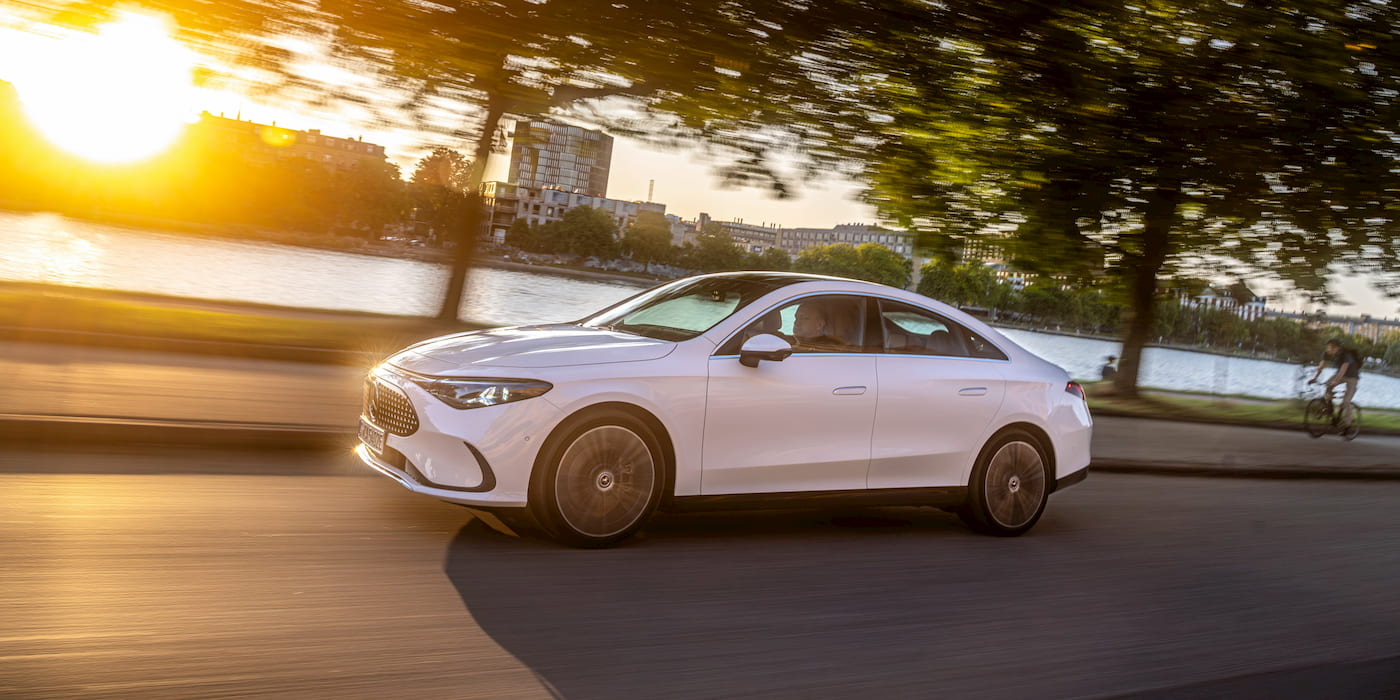
Mercedes calls it the “one-liter” car for a reason. The new Mercedes CLA EV has an impressive EPA range of 374 miles, but in real-world driving, it can go even further.
Mercedes CLA EV beats EPA range in real-world driving
The new CLA EV might just be the most critical Mercedes model yet. It’s the first of the luxury brand’s latest generation of electric vehicles, promising to be much more advanced, efficient, and refined than ever before.
Powered by an 85 kWh battery pack, the 2026 Mercedes-Benz CLA 250+ has an EPA-estimated range of 374 miles.
Although that’s already among the highest for any 2026 model-year EV in the US, the electric CLA can drive even further in the real world.
The folks at Edmunds just got their hands on one to test it out. In the Edmunds EV Range Test, the 2026 Mercedes CLA EV crushed its EPA figures, driving an impressive 434 miles on a single charge, beating its official ratings by 16%.
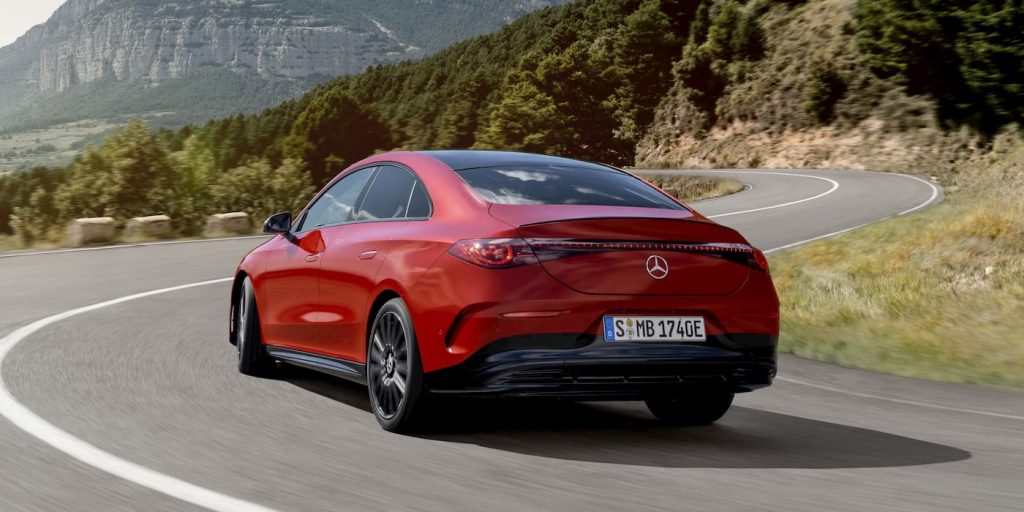
Out of 13 Mercedes models Edmunds has tested, the new CLA EV had the second-longest driving range, trailing only the EQS 450+. However, given that the EQS is a full-size sedan and significantly more expensive than the CLA, it’s expected.
The 2026 Tesla Model 3 Standard went 339 miles, while the 2026 Audi A6 E-tron drove 402 miles during the EV Range Test.

The Edmunds EV Range Test is 60% city and 40% highway driving with an average speed of 40 mph. Each vehicle is set to the most efficient drive setting, while the climate control is set to 72 degrees to reflect the most accurate real-world driving conditions drivers encounter each day.
During the test, the electric CLA used 23.2 kWh per 100 miles of driving, beating the EPA’s estimates by 16.5%.
On the Edmunds EV Charging Test, it had an average charge rate of 193 kW from 10% to 80%, earning a score of 833 miles per hour. That’s the second-best of those tested, behind the Hyundai IONIQ 6.
| 2026 Mercedes-Benz CLA trim | Starting Price* | Driving Range |
| CLA 250+ | $47,250 | 374 miles |
| CLA 350 4MATIC | $49,800 | 312 miles |
The new Mercedes CLA EV is now the least expensive car they’ve tested, with over 400 miles of range. Last week, Mercedes launched the 2026 CLA 250+ EV, starting at $47,250.
Mercedes said it will begin delivering the first customer models this month, with output ramping up throughout early 2026.
Ready to test one out for yourself? We can help you get started. Check out our link to find the 2026 Mercedes-Benz CLA EV in your area.
FTC: We use income earning auto affiliate links. More.


Tesla is pulling every demand lever available as we head into the final weeks of the year. The automaker has launched a new set of aggressive incentives in the US, including free upgrades on inventory vehicles, 0% APR financing, and $0 down leases.
It’s the end of the quarter (and year), and as per usual, Tesla is trying to empty its inventory, but it’s more difficult this year due to the end of the tax credit in Q3 pulling a lot of demand away from Q4.
We have regularly reported on Tesla ramping up incentives at the end of the year, but this new batch is arguably the most aggressive we have seen in a long time.
First off, Tesla is offering one free upgrade on eligible inventory vehicles.
If you go to Tesla’s inventory page for Model 3 or Model Y, you will see a lot of vehicles listed with a “Free Upgrade” tag. This basically means that if you pick a car that has a paid option, like a premium paint color (Ultra Red or Quicksilver), 20″ Induction wheels, or the White interior, Tesla is waiving the cost of that option.
That’s a value of anywhere from $1,000 to $2,500 depending on the option.
On top of that, Tesla has expanded its financing offers. The company is now offering 0% APR financing for up to 72 months on Model 3 and Model Y purchases.
This is a significant move. We have seen low interest rates before, but 0% for 72 months is basically free money, especially in the current interest rate environment.
But wait, there’s more.
For those looking to lease, Tesla has introduced $0 down leases for the Model Y.
Previously, Tesla required a down payment of at least $3,000 for its best lease rates. Now, you can drive off the lot with a Model Y for $0 down, though the monthly payments will obviously be higher than with a down payment.
Tesla writes on its website regarding the new push:
“Take delivery by December 31, 2025 to take advantage of these limited-time offers. Available on select inventory vehicles while supplies last.”
The automaker is clearly trying to deliver as many cars as possible before the ball drops on 2025.
Electrek’s Take
The end-of-year push is in full swing.
When you see Tesla stacking incentives like this, 0% financing, zero down, and free options, it tells you one thing: they have inventory to move.
With a lot of demand in the US pulled forward into Q3 due to the end of the tax credit for electric vehicles, it was always clear that Tesla would have trouble moving cars in Q4.
These are roughly the best end-of-quarter incentives we have ever seen, and even then, I’d be surprised if Tesla can come close to its record deliveries of last year’s Q4: 495,000 vehicles.
If you drive an electric vehicle, make charging at home fast, safe, and convenient with a Level 2 charger installed by Qmerit. As the nation’s most trusted EV charger installation network, Qmerit connects you with licensed, background-checked electricians who specialize in EV charging. You’ll get a quick online estimate, upfront pricing, and installation backed by Qmerit’s quality guarantee. Their pros follow the highest safety standards so you can plug in at home with total peace of mind. Ready to charge smarter? Get started today with Qmerit.
FTC: We use income earning auto affiliate links. More.
-
 Sports2 years ago
Story injured on diving stop, exits Red Sox game
-
 Sports3 years ago
‘Storybook stuff’: Inside the night Bryce Harper sent the Phillies to the World Series
-
 Sports2 years ago
Game 1 of WS least-watched in recorded history
-
 Sports3 years ago
Button battles heat exhaustion in NASCAR debut
-
 Sports3 years ago
MLB Rank 2023: Ranking baseball’s top 100 players
-
Sports4 years ago
Team Europe easily wins 4th straight Laver Cup
-
 Environment3 years ago
Japan and South Korea have a lot at stake in a free and open South China Sea
-
 Environment1 year ago
Here are the best electric bikes you can buy at every price level in October 2024