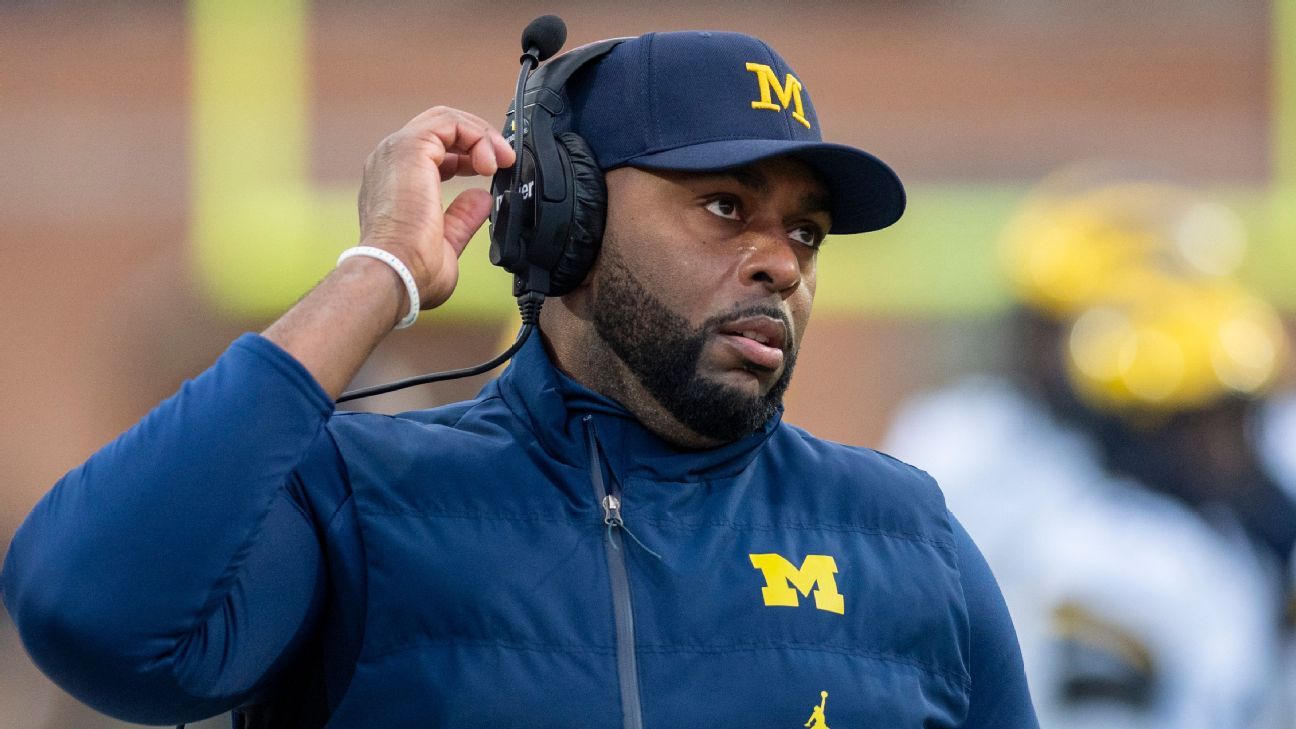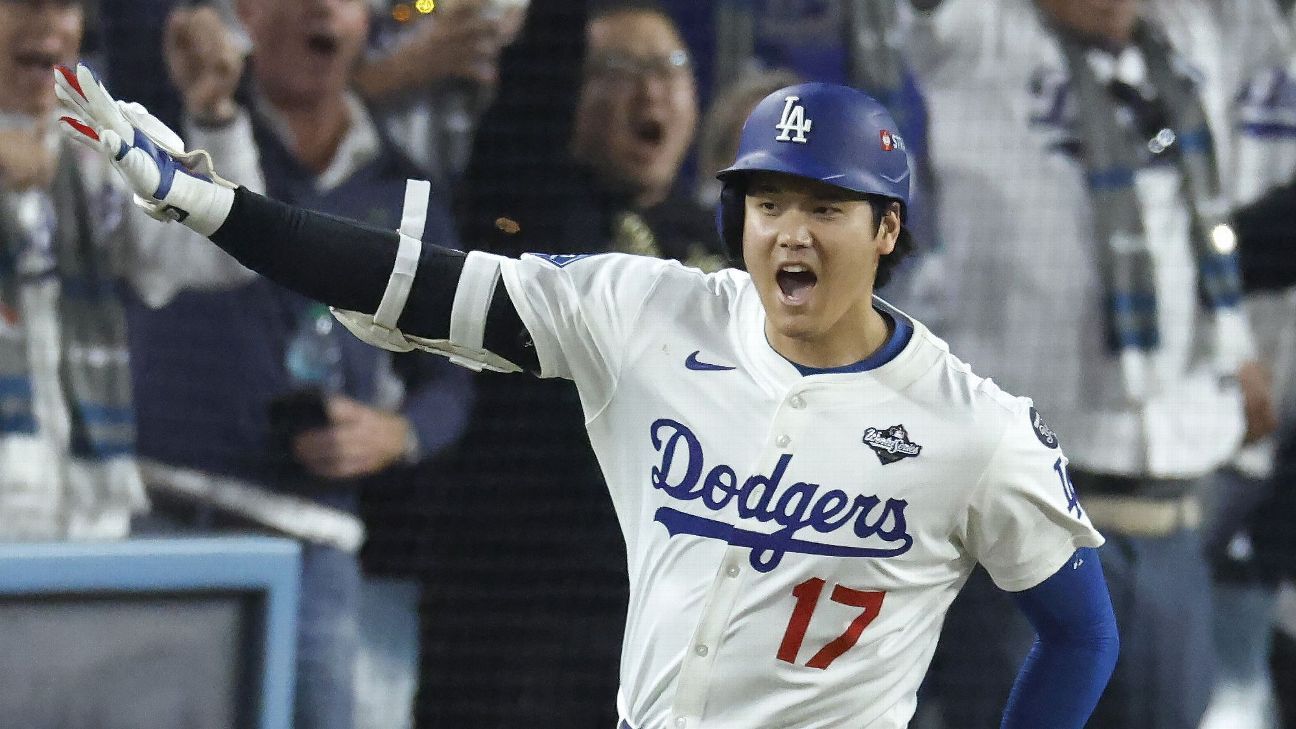
PASADENA, Calif. — Shohei Ohtani is catching up with more legends.
The baseball superstar ends 2025 by winning The Associated Press Male Athlete of the Year for the fourth time, tying Lance Armstrong, LeBron James and Tiger Woods for most among male honorees.
“Receiving this award multiple times is something truly special,” Ohtani said in Japanese in an exclusive interview with the AP.
Ohtani received 29 of 47 votes in balloting among sports journalists from the AP and its members after his two-way dominance culminated in a repeat World Series title for his Los Angeles Dodgers — delivering perhaps the greatest single-game individual performance in sports history along the way. He previously won the award in 2024, his first season with the Dodgers, and in 2023 and 2021, when he was with the Los Angeles Angels.
The AP honor has been given out since 1931. Multisport standout Babe Didrikson Zaharias won six times over the 1930s, ’40s and ’50s, the most by a man or woman.
The ultracompetitive Ohtani’s latest win broke a tie with Michael Jordan, who along with Woods, he followed while growing up in Japan.
“Last year, I said I wanted to win this award again, and I will work hard so that I can win it again next year as well,” he said.
Swedish-American pole vaulter Armand Duplantis, who won his third consecutive world title and has set the world record 14 times, including four times in 2025, was second with five votes in balloting announced Tuesday. Carlos Alcaraz, the world’s top-ranked tennis player who won titles at the French and US Opens, was third with four.
The AP Female Athlete of the Year will be announced Wednesday.
Ohtani has shown remarkable consistency since joining the Dodgers on a then-record $700 million, 10-year contract in December 2023. He won his fourth career Most Valuable Player award (second with the Dodgers) by unanimous vote, the first player in major league history to do so.
This year, he posted a 1.014 OPS and hit 55 home runs. Returning to the mound for the first time since 2023, he had a 2.87 ERA and 62 strikeouts in 47 innings over 14 starts.
Ohtani saved his best for the postseason.
In Game 4 of the National League Championship Series against the Milwaukee Brewers, he pitched six scoreless innings with 10 strikeouts and hit three home runs to earn MVP honors. He said it was his greatest game in a career full of incredible feats.
“If you think about it in terms of a single game, I’d say that’s probably true,” Ohtani said. “It was a crucial game in the postseason, and I personally feel I played quite well in that game.”
Does he surprise himself?
“Well, yes, there are times when I feel that way about myself, and of course there are times when I think I’m not good enough,” Ohtani said, “so I suppose athletes experience both kinds of feelings.”
Ohtani showed he’s human in Game 7 of the World Series. He singled in the first inning and then took the mound on short rest, but he struggled with his command. He gave up a three-run homer to Toronto’s Bo Bichette along with five hits in 2⅓ innings.
But he and the Dodgers raised a second straight World Series trophy after outlasting the Blue Jays in the most scintillating Series in recent memory.
“Shohei obviously has the weight of the world on his shoulders as far as expectations, being probably the face of baseball, certainly when you’re talking about the world,” Dodgers manager Dave Roberts said after Game 7. “It’s just really special what he’s done. Just a great person and a great competitor.”
Ohtani’s presence has been transformative for MLB’s global reach. Game 7 of this World Series averaged 13.1 million viewers in Japan, the most watched World Series game on a single network there ever, and 51 million watched worldwide to make it the most viewed since Game 7 of the 1991 World Series.
How does Ohtani keep topping himself?
“I think the higher your goals are, the more you have to do, and the more you want to do,” Ohtani said. “If you’re satisfied with where you are now, I don’t think it’s possible to achieve your goals without putting in the effort. So, setting goals high is what I believe is most important.”
The Dodgers carefully managed Ohtani’s return to pitching this year by gradually increasing his workload after rehabbing from elbow surgery in September 2023. His innings were initially capped before he was allowed to make longer starts as he felt better.
“When it comes to feeling nervous, being on the mound definitely makes me more tense,” Ohtani said. “It’s a position where you can single-handedly ruin a game, and at the same time, it’s also a position where you can contribute to a win. So, in my mind, I feel that being a pitcher is truly a special role.”
At 31, Ohtani has undergone three major surgeries: two on his right elbow and another on his left shoulder. Regardless of the physical and mental wear and tear, he plans on remaining a two-way player his entire career.
“I think it’s best to keep doing it right up until the moment I retire,” Ohtani said.
Winning a third consecutive World Series championship is among Ohtani’s biggest goals in 2026.
“Staying healthy and appearing in every game without injury, that’s the smallest goal I have,” Ohtani said.
Ohtani became a father when his wife, Mamiko Tanaka, gave birth to their daughter in April. He carefully guards against revealing her name and any details about his home life. No word on how his beloved dog Decoy reacted to having a new sibling, either.
Ohtani’s American fans enjoy hearing him speak English on the rare occasions that he has done so publicly, including at both World Series celebrations. He understands most of the language, although he uses an interpreter in interviews.
“I think it would be best if I could speak in English, so even if it’s just small steps, I want to keep working at it,” Ohtani said. “Whether it’s with fans or in different situations, being able to speak directly in English might help bridge the gap between us.”
In the meantime, he’ll keep letting his bat and arm speak volumes.
Dan Wetzel is a senior writer focused on investigative reporting, news analysis and feature storytelling.
Dec 10, 2025, 07:37 PM ET
Sherrone Moore was in custody in the Washtenaw (Michigan) County Jail on Wednesday night as a suspect in an alleged assault, just hours after he was fired as Michigan’s football coach for having what the school said was an “inappropriate relationship with a staff member.”
Moore was initially detained by police in Saline, Michigan, on Wednesday and turned over to authorities in Pittsfield Township “for investigation into potential charges.”
Pittsfield police released a statement Wednesday night saying they responded at 4:10 p.m. to the 3000 block of Ann Arbor Saline Road “for the purposes of investigating an alleged assault. … A suspect in this case was taken into custody. This incident does not appear to be random in nature, and there appears to be no ongoing threat to the community.
“The suspect was lodged at the Washtenaw County Jail pending review of charges by the Washtenaw County Prosecutor,” the statement continued. “At this time, the investigation is ongoing. Given the nature of the allegations, the need to maintain the integrity of the investigation, and its current status at this time, we are prohibited from releasing additional details.”
Pittsfield police did not name the suspect in its statement.
Earlier, Saline police stated they “assisted in locating and detaining former University of Michigan football coach Sherrone Moore. Mr. Moore was turned over to the Pittsfield Township Police Department for investigation into potential charges.”
Michigan fired Moore on Wednesday following an investigation into his conduct with a staff member.
“U-M head football coach Sherrone Moore has been terminated, with cause, effective immediately,” the school said in a statement. “Following a University investigation, credible evidence was found that Coach Moore engaged in an inappropriate relationship with a staff member.”
Moore, 39, spent two seasons as Michigan’s coach, after serving as the team’s offensive coordinator.
ESPN baseball reporter. Covered the Washington Wizards from 2014 to 2016 and the Washington Nationals from 2016 to 2018 for The Washington Post before covering the Los Angeles Dodgers and MLB for the Los Angeles Times from 2018 to 2024.
ORLANDO, Fla. — The New York Yankees made their first selection in a Rule 5 draft since 2011 on Wednesday, taking right-hander Cade Winquest from the St. Louis Cardinals.
Winquest was one of 13 players — and 12 right-handed pitchers — chosen in the major league portion of the draft.
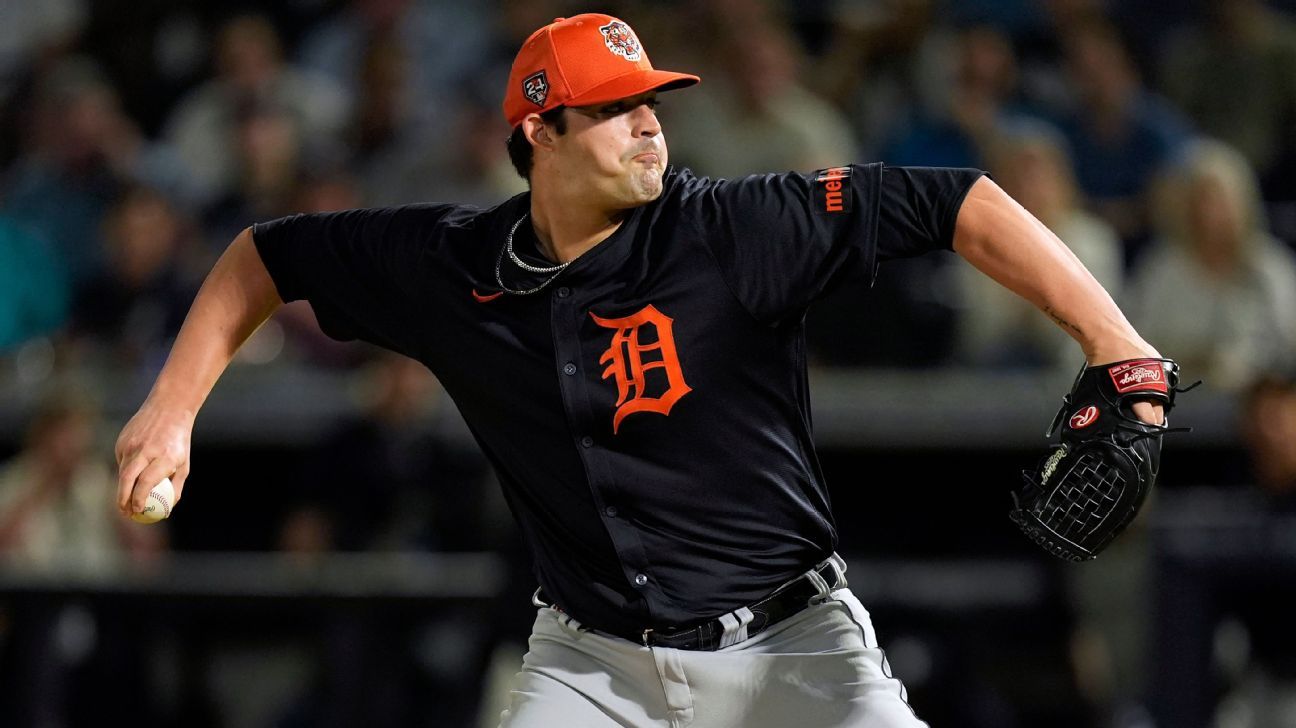
The Rockies took RJ Petit, a 6-foot-8 reliever, with the first pick from the Detroit Tigers. Petit, 26, had a 2.44 ERA in 45 relief appearances and two starts between Double A and Triple A last season. The Minnesota Twins chose the only position player, selecting catcher Daniel Susac from the Athletics.
Clubs pay $100,000 to select a player and must keep him on the active major league roster for the entire following season unless he lands on the injured list. Players taken off the roster must be offered back to the former club for $50,000.
The 25-year-old Winquest recorded a 4.58 ERA with a 48% groundball rate in 106 innings across 25 games, including 23 starts, between Single A and Double A last season. He features a fastball that sits in the mid-90s and touches 98 mph plus a curveball, cutter and sweeper. He is expected to compete for a spot in the Yankees’ bullpen next season.
Right-hander Brad Meyers was the last player the Yankees had chosen in a Rule 5 draft. He suffered a right shoulder injury in spring training and was on the injured list for the entire 2012 season before he was offered back to the Washington Nationals. He never appeared in a major league game.
Also picked were right-hander Jedixson Paez (Colorado from Boston), right-hander Griff McGarry (Washington from Philadelphia), catcher Carter Baumler (Pittsburgh from Baltimore), right-hander Ryan Watson (Athletics from San Francisco), right-hander Matthew Pushard (St. Louis from Miami), right-hander Roddery Munoz (Houston from Cincinnati), right-hander Peyton Pallette (Cleveland from Chicago White Sox), right-hander Spencer Miles (Toronto from San Francisco), right-hander Zach McCambley (Philadelphia from Miami) and right-hander Alexander Alberto (White Sox from Tampa Bay).
Even though Joe Buck is more widely known these days as the voice of ESPN’s “Monday Night Football,” his broadcast career is rooted in baseball, including calling the most World Series games on television.
On Wednesday, Buck received a call that he thought was at least a few years down the line. He found out he received the Ford C. Frick Award for excellence in broadcasting by baseball’s Hall of Fame.
Buck is not only the 50th winner of the Frick Award, he joins his father, Jack, to become the only father-son duo to win the honor. Jack Buck, who broadcast St. Louis Cardinals games from 1954 until 2021 and was the lead announcer on CBS’ baseball package in 1990 and ’91, received the award in 1987.
“I am shocked in many ways. I didn’t think this was coming right now,” Buck said. “I was saying to the group that called to tell me that my best memory of my father as a Major League Baseball broadcaster was in 1987 in Cooperstown, New York, and what it meant to him, what it meant to our family to see him get the award. To see the joy and the pride that he had for what he had done.”
Joe Buck will receive the award during the Hall’s July 25, 2026, awards presentation in Cooperstown, a day ahead of induction ceremonies. At 56, Buck becomes the second-youngest Frick Award winner, trailing only Vin Scully, who was 54 when he was named the 1982 winner.
Buck grew up in St. Louis and called games for the Triple-A Louisville Redbirds in 1989 and ’90 after graduating from Indiana University. He joined his father for Cardinals broadcasts in 1991, a job Joe held through 2007. Jack Buck died in June 2002 at age 77.
“I was lucky to call Jack Buck my dad and my best friend. I’m lucky that I’m Carol Buck’s son. I tend to downplay awards and what have you because of always feeling like I had a leg up at the start of my career and I did. I’m the first to admit it. But I am happy that when I was a kid, I paid attention and I wanted to be with him. I think the greatest gift my dad gave me was allowing me to be in the room with him. I’d like to think there’s still some stuff out in front of me, but this is the greatest honor I could receive. And to know what he would be thinking and feeling on this day, that’s the part what makes it special.
“I recall him saying [during his speech] that he was honored to be the eyes and the ears for Cardinal fans, wherever the Cardinals went, and he was very proud of being the conduit between wherever the Cardinals were playing and those fans that were listening. That always resonated with me.”
Buck joined Fox Sports when it started doing NFL games in 1994. Two years later, it got the rights to Major League Baseball and Buck was made the lead announcer with Tim McCarver as the analyst. McCarver retired from broadcasting after the 2013 season and received the Frick Award in 2021.
Buck was 27 when he called his first World Series in 1996. He would go on to do the Fall Classic in 1998 and then annually from 2000-21. His 135 World Series games make him one of six U.S. play-by-play announcers to reach the century mark calling either the Fall Classic, NBA Finals or Stanley Cup Finals. Scully had 126 World Series games on radio and television.
Buck also worked 21 All-Star Games and 26 League Championship Series for Fox before joining ESPN in 2022 as the voice of “Monday Night Football.”
Since going to ESPN, Buck called a game on Opening Day last year and worked a Cardinals game with Chip Caray in 2023. Buck said there is the possibility of doing a couple more games for ESPN in the future.
“I think of myself as a baseball announcer probably first because that’s what I was around the most. I love the game. I’m a fan of the game,” he said. “I still dream as a baseball announcer at night. I think all announcers have the same nightmare where you show up at a game and you can’t see anybody on the field, you don’t know anybody’s name and you’re trying to fake your way through a broadcast. Those are all baseball games in my dreams. So it’s in my genetics, it’s in my DNA. I grew up at Busch Stadium as a kid and yeah, baseball is always kind of first and foremost in my heart.”
Buck also becomes the sixth broadcaster to win both the Frick Award and the Pro Football Hall of Fame’s Pete Rozelle Radio-Television Award, joining Jack Buck, Dick Enberg, Curt Gowdy, Al Michaels and Lindsey Nelson.
A broadcaster must have 10 continuous years of experience with a network or team to be considered, and the ballot was picked by a subcommittee of past winners that includes Marty Brennaman, Joe Castiglione and Bob Costas, along with broadcast historians David J. Halberstam and Curt Smith. At least one candidate must be a foreign-language broadcaster.
Voters are 13 past winners — Brennaman, Castiglione, Costas, Ken Harrelson, Pat Hughes, Jaime Jarrín, Tony Kubek, Denny Matthews, Michaels, Jon Miller, Eric Nadel, Dave Van Horne and Tom Hamilton — plus historians Halberstam, Smith and former Dallas Morning News writer Barry Horn.
John Rooney of the Cardinals and Brian Anderson of the Milwaukee Brewers were ballot newcomers this year, joining returnees Skip Caray, Rene Cardenas, Gary Cohen, Jacques Doucet, Duane Kuiper and John Sterling. Buck was on the ballot after being dropped last year, and Dan Shulman was on for the third time in four years.