

I tested Tesla’s latest ‘mind blowing’ Full Self-Driving v14


I’ve put over 200 km (125 miles) on Tesla’s latest ‘Full Self-Driving Supervised’ (FSD) v14 update, and I’ve gathered my thoughts in this article.
In short, Tesla FSD v14 is an incremental improvement to the automaker’s advanced driver-assist system (ADAS) and the most impressive Level 2 system available in a consumer vehicle today.
However, it is still far from what Tesla sold to car buyers: unsupervised self-driving.
I briefly tested FSD v14 in a friend’s car when it launched two months ago, but now that I’ve picked up a new Model 3 with HW4, I’ve spent much more time with it and can share more thoughts.
First off, for context, I was already a somewhat heavy user of FSD on my Model 3 with HW3, which is stuck on FSD v12 because the computer has reached its limits. I’ve been using it for years.
With v12, FSD was involved in roughly 80% of my driving – mainly on the highway. I’m a responsible FSD user because I always pay attention to the road and am ready to take control at all times. I do appreciate FSD taking over most of the driving tasks so I can focus on scanning the road.
It tried to kill me a couple of times, but it is something you sign up for when you are basically a beta tester.
I haven’t had a significant update to FSD on my HW3 Model 3 for a year now, as Tesla has focused almost all its efforts on updates to vehicles equipped with the newer HW4 computer and its Robotaxi pilot program in Austin, Texas.
There’s now virtually no hope that Tesla vehicles with HW3 computers (most cars up to 2024) will ever deliver on Musk’s promise of unsupervised self-driving. He has been talking about a computer retrofit to help, but that was almost a year ago, and Tesla still hasn’t offered anything to HW3 owners beyond transferring FSD to a new car with HW4, which is what I reluctantly did.
The latest update, available only to cars with the HW4 (AI4) computer, is called FSD v14, and CEO Elon Musk has been hyping it as “sentient” and “mind-blowing.”
After driving more than 200 km (125 miles) with the FSD v14 update (v14.2.1.25 to be exact), here are my thoughts:
Tesla FSD V14 Pros
We already reported on the new point-to-point features of FSD v14, which now enable you to go from parking to parking only on FSD under the driver’s supervision.
That’s a noticeable improvement that removed a lot of disengagements.
However, that’s more a direct capability added to the system rather than an improvement in actual driving performance, which I’m focused on here.
Coming from v12, I can say with certitude that v14 feels more confident. It drives more like a human. It feels less robotic in its actions. Acceleration and deceleration are smoother.
Obviously, that’s going to depend heavily on the driving mode you choose. Much like v12, I find that the ‘Hurry’ mode is the best suited for me, as I generally like to drive above the speed limit, but not high enough to get a speeding ticket, which the new Mad Max mode would rack up quickly
FSD v14 finally tries to go back into the right lane after passing to the left – although emphasis on the word ‘tries’ as there’s a significant con to that in the next section.
Tesla FSD V14 Cons
The obvious one is: it’s not what Tesla sold to customers, unsupervised self-driving, and I don’t see it becoming that any time soon.
I had plenty of interventions and a couple of disengagements over those ~200 km. Fortunately, none of them were safety-related.
Two disengagements were due to FSD not entering the right lane at the right time. I gave it a chance until the last second, but it kept making me miss my exits or have a car cut me off at the last second, which is not acceptable to me.
From v12, I miss the ability to directly adjust the max speed live with the scroll depending on the situation. I hate it when automakers remove capabilities instead of just adding options.
As I mentioned in the ‘pros’ section, FSD v14 now tries to go back in the right lane after passing someone, something that it would do only half the time for me in v12. However, it only “tries” to do it. Half the time, it flashes its lights and moves to the right before returning to the middle of the left lane for seemingly no reason, even though it appears safe to return to the right lane.
It often does this little dance once or twice before either giving up or successfully moving to the right lane.
Electrek’s Take
My take on FSD has always been that if it were developed by Tesla in a vacuum, it would mostly be celebrated as a great driver-assistance system.
However, the fact that Tesla sold this to customers as something that “has all the hardware to support full autonomy” and will increase in price as the software will improve, until you can eventually go to sleep in the car and wake up at your destination, has changed everything.
Now, not only was Tesla wrong about the hardware and the price, but we also have to compare it to what was promised: unsupervised self-driving.
As long as it is not that, it is a failure. There’s no way around it.
I have a theory on people who are impressed by Tesla FSD v14. Putting aside biased people who are invested in Tesla’s stock, I think people who are impressed fall into one of two categories:
- People who, for whatever reason, are disconnected from Tesla selling FSD as a level 4, unsupervised self-driving system. And doing so since 2016.
- Bad drivers.
There are also people who have never experienced FSD before. For those, it is obviously impressive, but personally, I expected a bigger jump from v12 to v14.
Many people are bad drivers, and they are OK with FSD doing strange things that might confuse or upset other road users. Personally, I can’t accept that. As Tesla makes abundantly clear (in court, less so in its marketing), I’m the one responsible for the car. Therefore, its driving reflects me, and I refused to let it negatively affect other road users.
As for the claim that “no other consumer vehicle can do what Tesla FSD can” and that it is “the best level 2 ADAS,” to me, those points are moot compared to: Does it actually deliver what Tesla sold to customers?
The answer to that is undoubtedly a big fat no.
Can it get there? Of course. On HW4? I have serious doubts.
FSD v14 is “feature complete”. It can perform all the tasks related to driving, but it can’t reliably cover millions of miles without human supervision. It also lacks the redundancy that you need in a system that doesn’t require human supervision.
Maybe it can do it in a small geo-fenced environment with remote monitoring, but that’s not scalable to the customer fleet.


FTC: We use income earning auto affiliate links. More.
Environment
First savings hits Navee XT5 Pro long-range off-road e-scooter for $1,400, Anker SOLIX 60,000mAh power station $108, Lectric, more


Our mid-week Green Deals is headlined by a surprise first-ever holiday deal on the brand-new Navee XT5 Pro Long-Range Off-Road Electric Scooter at $1,400, which boasts some serious premium upgrades. Right behind it, we have Anker’s SOLIX C200 DC Compact Power Station, and its larger C300 counterparts, that start from $108, as well as a roundup of Lectric’s three e-bikes getting up to $500 price cuts and $220 bundles that start from $1,399, Bluetti’s current 48-hour Christmas flash sale through December 18, and much more waiting for you below. And don’t forget about the hangover deals that are collected together at the bottom of the page, like yesterday’s Velotric Christmas e-bike Gift Season Sale, the new $999 low on Heybike’s dual-battery Hauler cargo e-bike, and more.
Head below for other New Green Deals we’ve found today and, of course, Electrek’s best EV buying and leasing deals. Also, check out the new Electrek Tesla Shop for the best deals on Tesla accessories.
First savings just hit Navee’s newest feature-packed XT5 Pro long-range off-road electric scooter for $1,400
Navee’s official Amazon storefront is undercutting the brand’s direct Christmas Sale pricing on its brand-new XT5 Pro Long-Range Off-Road Electric Scooter for $1,399.99 shipped, after clipping the on-page $200 off coupon. This model just hit the market early last month with a $1,500 price tag, which is where it’s still priced direct from the brand. At Amazon, however, it started off priced at $1,700 and dropped to $1,600 right before Black Friday, with today’s deal being the first official chance at cash savings that we’ve spotted. While this deal lasts, you’re getting $100 off the going rate that sets the bar for future discounts, while also upgrading your commutes/joyrides with the brand’s take on a superscooter.
The most high-end of Navee’s e-scooter lineup that even outpaces the flagship ST3 Pro, this new XT5 Pro Long-Range Electric Scooter is an off-roading superscooter that comes with bolstered durability from its carbon steel frame, while also being the second series to boast the brand’s unique damping arm suspension system. It arrives equipped with a 750W motor that can peak as high as 2,200W for seriously monstrous power, with the entire thing powered by a 596.7Wh battery. This combination gives it a travel range of up to 46.6 miles on a single six-hour charge (with a 1.5-hour flash charging feature available), maxing out at 31 MPH top speeds for the thrill seekers amongst you. It even comes with an add-on option through a 468Wh external battery (sold separately) that increases the mileage with up to 34 miles of extra travel.
As Navee’s XT5 Pro electric scooter is a more premium commuter, it should be no surprise that it comes loaded with a premium array of features, including smart features like Apple Find My, Bluetooth proximity locking/unlocking, app-based setting customization, and more. Your riding experience is also further heightened by the stock features that include a triple braking system (dual front and rear disc brakes, as well as a rear regenerative EABS brake), 12-inch off-road tubeless tires, an auto-on headlight, mecha-style logo lamps in the stem, a brake-activated taillight, front and rear built-in turn signals, the brand’s traction control system, a 5-inch full color display, and much more.
As I mentioned, alongside this surprise Navee XT5 electric scooter deal, the brand also has its ongoing Christmas Sale with up to 30% discounts still going right now, which offers its e-scooters at some of the best rates starting from $200.
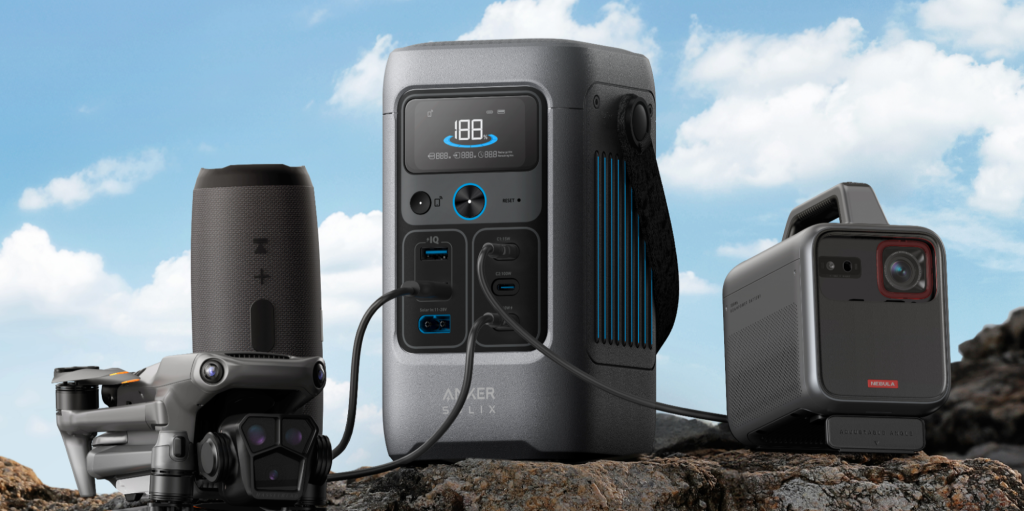
Get 60,000mAh/192Wh support for devices from Anker’s SOLIX C200 DC power station at $108 for Xmas, more from $162
As part of its ongoing Christmas Sale, Anker SOLIX is offering its C200 DC 60,000mAh/192Wh Compact Power Station at $108.49 shipped, which matches in price at Amazon while also beating out the current price of the predecessor PowerCore Reserve by $7. While it carries a $200 MSRP, you can find it starting lower at $170 at Amazon, with discounts over the year having taken the costs as low as $100, most recently during Black Friday through Cyber Monday over two weeks ago. You’re looking at the third-best price we have tracked while the $62 savings last ($92 off the MSRP), only beaten out by that $100 low and $105 rates that sporadically pop up. If you want to go bigger, you can also find the C300 DC and C300 AC 90,000mAh models starting from $162.
If you want to learn more about these compact power stations, be sure to check out our original coverage of these Christmas deals here. You can also go even larger by taking advantage of Anker’s current SOLIX Christmas Sale deals, with up to 65% discounts across its entire power station lineup that starts from $162.
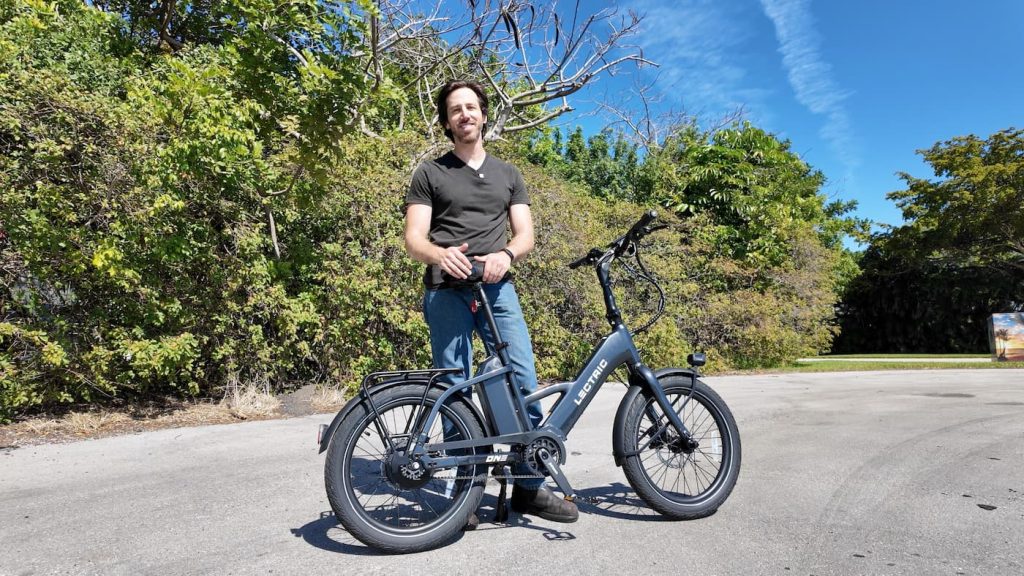
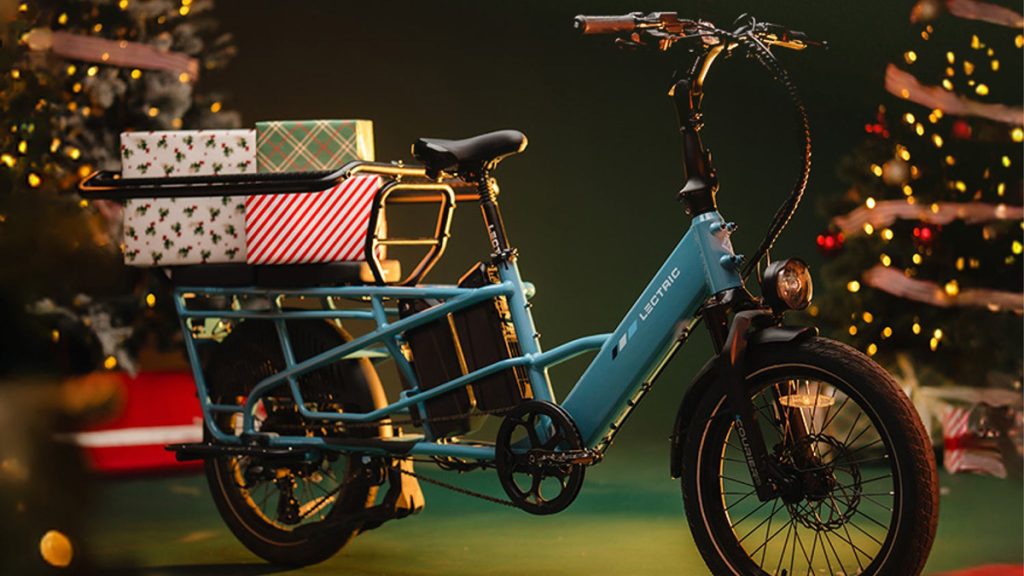
Save up to $720 on these three Lectric e-bikes with price cuts to lows starting from $1,399 for Xmas
Looking back in on Lectric’s ongoing Christmas Holiday Sale event, we wanted to shine a spotlight on the three e-bikes receiving rare price cuts over the usual free bundle packages – a first for so many models at once. The biggest of these price cuts that also retains a bundle is Lectric’s ONE e-bike Long-Range Belt-Drive Commuter e-bike with a $220 FREE bundle of gear at $1,899 shipped. This entire package would normally run you $2,619 at full price, with a repeat of the $500 price cut we’ve been seeing more frequently since Labor Day to its all-time lowest tracked price, along with a FREE rear cargo rack and fender set. While the deadline to receive it before Christmas has passed, you can still secure it and all the other e-bikes with some of their best deals to kick-off your new year with a new commuting option.
If you want to learn more about this premium e-bike, or the other models getting Christmas price cuts, be sure to check out our original coverage of these deals here, while you can also browse the brand’s full Christmas lineup here.

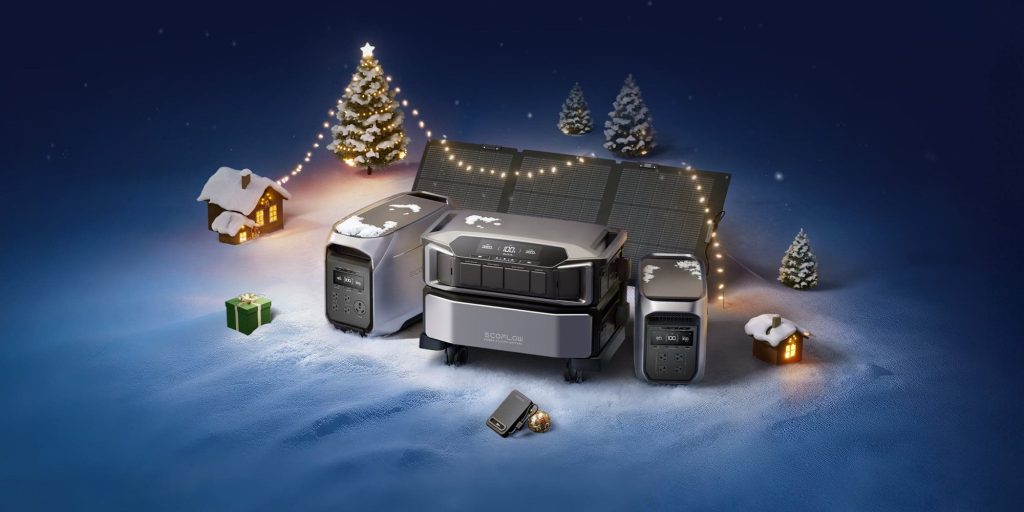
For 48 hours, you can pick up Bluetti’s latest Elite 10 Mini power station at a new $109 Xmas flash sale low (Save $90), more
As part of its ongoing Christmas Sale, Bluetti has a 48-hour flash sale running that is taking up to $199 off three different offers, with a notable standout in the Elite 10 Mini Power Station for $109 shipped, which sadly cannot be stacked with the exclusive 5% off savings code, but does beat out its Amazon pricing by $10. While carrying a $239 MSRP direct from the brand, you can find it starting lower at Amazon for $199, with the holiday discounts that started last week having only taken the costs down to $149, before falling to $119 and then $109 during this flash sale window. While these $90 savings ($130 off the MSRP) last through December 18, you’re able to score it at a new all-time low price, with another flash offer being two of these stations for $199 shipped.
If you want to learn more about this mini power station, or browse the full lineup of temporary deals, be sure to check out our original coverage of this flash sale here.



Best Winter EV deals!
- Velotric Nomad 2X e-bike (camo) with DELTA 3 Plus station: $3,048 (Reg. $3,298)
- Velotric Nomad 2X e-bike (sage or fig) with DELTA 3 Plus station: $2,948 (Reg. $3,298)
- Heybike Hero 750W Mid-Drive Carbon-Fiber All-Terrain e-bike: $2,099 (Reg. $3,099)
- Segway Xyber e-bike (at lowest price): $2,900 (Reg. $3,300)
- Lectric XPedition 2.0 35Ah Cargo e-bike w/ $893 bundle: $1,999 (Reg. $2,761)
- Ride1Up TrailRush German Mid-Drive e-bike: $1,995 (Reg. $2,095)
- Heybike Hero 1,000W Carbon-Fiber All-Terrain e-bike: $1,899 (Reg. $2,599)
- Tenways Wayfarer e-bike with $366 bundle: $1,899 (Reg. $2,199)
- Velotric Fold 1 Plus e-bike with DELTA 2 station: $1,898 (Reg. $2,198)
- Segway Xafari e-bike (at lowest price): $1,800 (Reg. $2,400)
- Aventon Aventure 3 Smart All-Terrain e-bike: $1,799 (Reg. $1,999)
- Aventon Aventure 3 Smart Step-Through All-Terrain e-bike: $1,799 (Reg. $1,999)
- Velotric Summit 1 Versatile Multi-Terrain e-bike w/ 160 bundle: $1,799 (Reg. $2,059)
- Lectric XPedition 2.0 26Ah Cargo e-bike w/ $744 bundle: $1,799 (Reg. $2,543)
- Lectric XP Trike2 750 Long-Range eTrike: $1,699 (Reg. $1,799)
- Aventon Level 3 Step-Over Smart Commuter e-bike: $1,699 (Reg. $1,899)
- Aventon Level 3 Step-Through Smart Commuter e-bike: $1,699 (Reg. $1,899)
- Lectric XPeak 2.0 Long-Range Off-Road e-bike: $1,599 (Reg. $1,699)
- Aventon Abound Cargo e-bike: $1,599 (Reg. $1,999)
- Ride1Up VORSA Modular Multi-Use e-bike: $1,595 (Reg. $1,695)
- Navee’s new XT5 Pro Long-Range Off-Road Electric Scooter: $1,400 (Reg. $1,500)
- Lectric XP Trike2: $1,399 (Reg. $1,499)
- Lectric XPeak 2.0 Standard Off-Road e-bike: $1,399 (Reg. $1,499)
- Lectric XPedition 2.0 13Ah Cargo e-bike with $346 bundle: $1,399 (Reg. $1,745)
- Heybike ALPHA All-Terrain e-bike with $266 bundle: $1,299 (Reg. $1,699)
- Lectric XPress 750 Commuter e-bikes with $518 bundle: $1,299 (Reg. $1,817)
- Lectric XP4 750 LR Folding Utility e-bikes with $514 bundle: $1,299 (Reg. $1,813)
- Lectric XP Lite 2.0 JW Black LR e-bike with $350 bundle: $1,099 (Reg. $1,449)
- Heybike Hauler Dual-Battery Cargo e-bike with $89+ bundle (new low): $999 (Reg. $1,413)
- Lectric XP4 Standard Folding Utility e-bikes with $227 bundle: $999 (Reg. $1,226)
- Lectric XP Lite 2.0 Long-Range e-bikes with $350 bundles: $999 (Reg. $1,349)
- Segway ZT3 Pro All-Terrain Electric Scooter: $850 (Reg. $1,000)
- Segway E3 Pro Electric Scooter: $600 (Reg. $700)

Best new Green Deals landing this week
The savings this week are also continuing to a collection of other markdowns. To the same tune as the offers above, these all help you take a more energy-conscious approach to your routine. Winter means you can lock in even better off-season price cuts on electric tools for the lawn while saving on EVs and tons of other gear.
- Get up to $562 savings on Velotric e-bikes + $100 gift card promotion for Christmas – deals start from $1,099
- Carry packages, people, more on Heybike’s 85-mile dual-battery Hauler cargo e-bike with FREE gear/gifts at a new $999 low
- Bluetti Elite 30 V2 288Wh LiFePO4 power station and its many colorways start from $204 and arrive before Xmas
- Autel’s MaxiCharger Home 40A level 2 EV charging station arrives ahead of Christmas for $319 (Reg. $470)
- Hiboy’s Christmas Sale offers EV commuting solutions at up to 50% off + bonus savings codes – all starting from $150
- Pass lawn mowing to ECOVACS’ Goat O1000 RTK robot while at a new $699 low for Xmas (Reg. $1,000)
- Off-season savings take EGO’s 56V 15-inch rapid reload string trimmer down to $149 annual low ($50 off)
- Save up to $175 on Goal Zero’s compact Yeti 700 or 500 power stations at best prices in months from $375
- Electrified Weekly – Christmas sales from Lectric, Velotric, Rad Power, Anker SOLIX, EcoFlow, Bluetti, and so much more
FTC: We use income earning auto affiliate links. More.

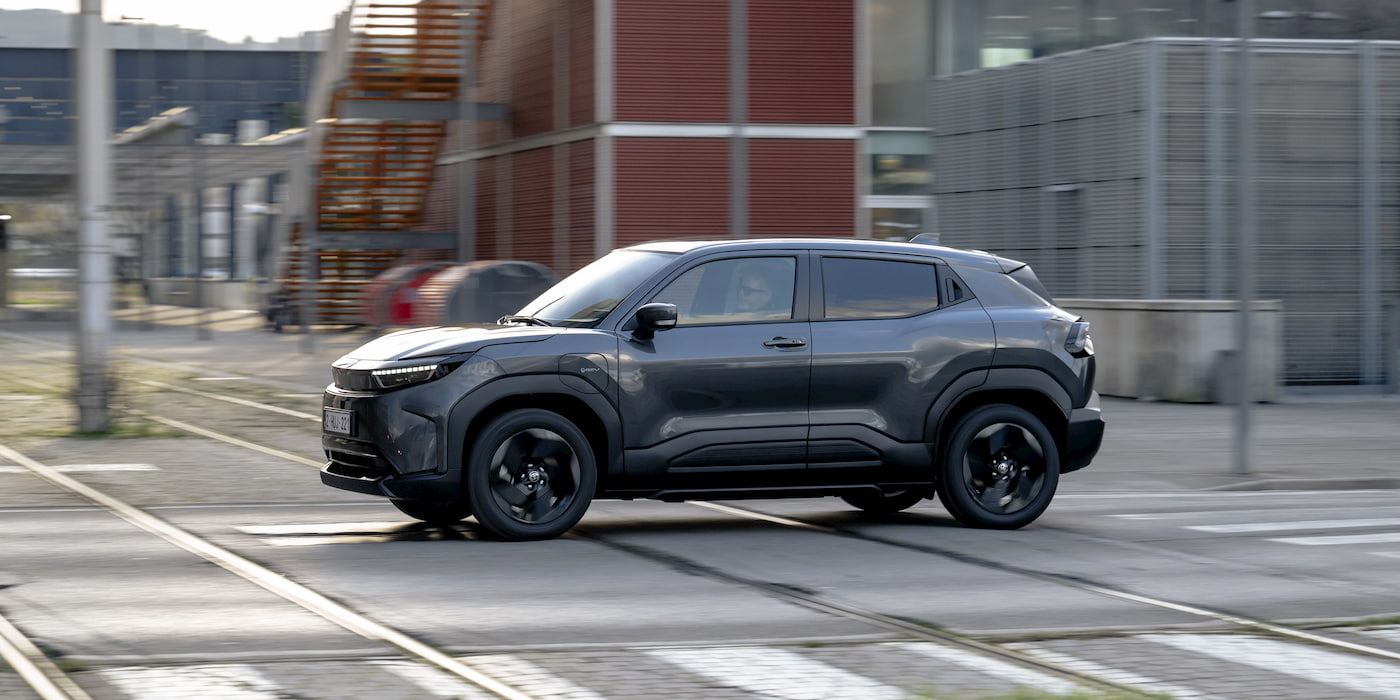
The Urban Cruiser is Toyota’s second fully electric SUV, but it adds some meaningful upgrades over the outgoing bZ4X.
Meet the new Toyota Urban Cruiser electric SUV
Based on a new dedicated EV platform, Toyota calls the Urban Cruiser “an authentic SUV” in terms of design and performance.
Toyota launched the new entry-level electric SUV in Europe with two lithium iron phosphate (LFP) battery pack options: 49 kWh or 61 kWh. The smaller (49 kWh) battery is only available with a 142 hp (106 kW) front-wheel-drive (FWD) motor, rated with a WLTP driving range of 344 km (214 miles).
The larger 61 kWh version is available with FWD or all-wheel drive (AWD) powertrains, delivering WLTP driving ranges of 426 km and 395 km, respectively. The AWD version delivers a combined 181 hp (135 kW).
Toyota said all Urban Cruiser variants can tow braked loads of up to 750 kg (1,650 lbs). With DC fast charging, the electric SUV can recharge from 10% to 80% in around 45 minutes.
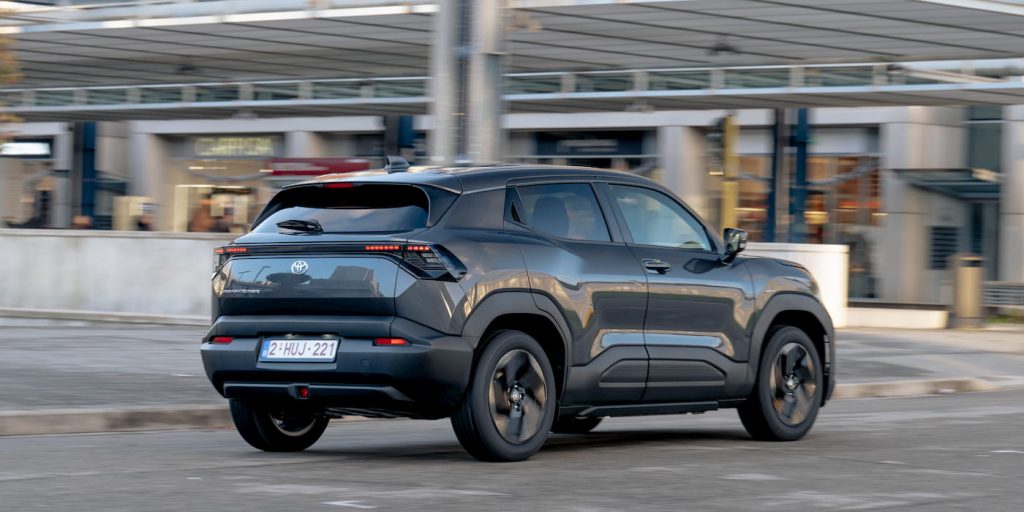
To improve efficiency, unlock faster charging, and boost driving range, Toyota added a heat pump and battery preconditioning feature as standard.
Thanks to the new dedicated EV platform, the interior is open and spacious. With sliding and split-folding rear seats, the Urban Cruiser rivals “the load-carrying capabilities of larger SUVs,” Toyota said.
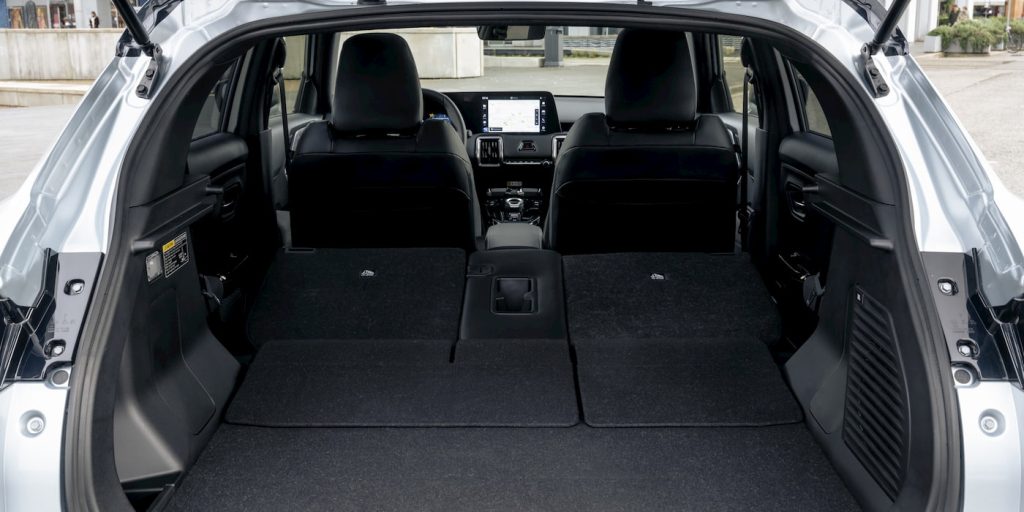
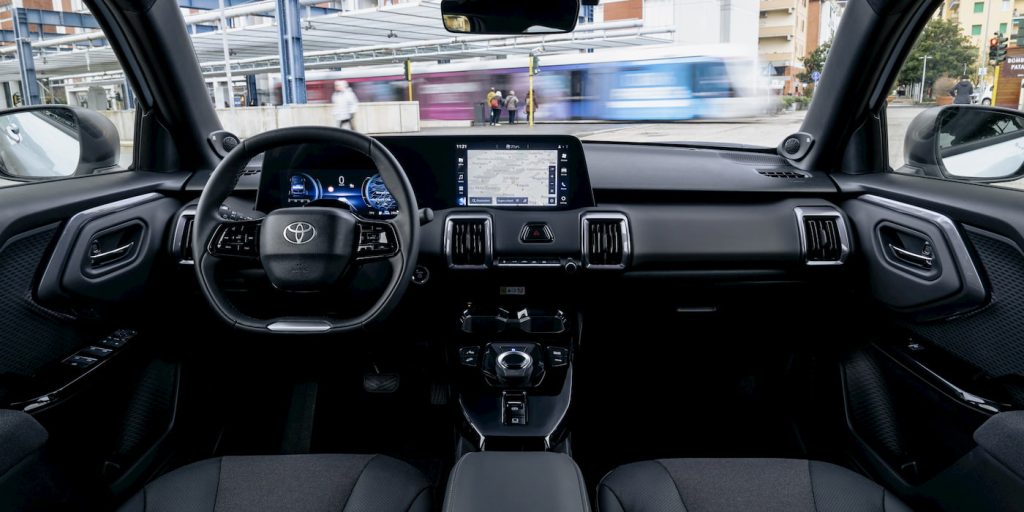
Measuring 4,285 mm long, 1,800 mm wide, and 1,640 mm tall, the electric SUV is slightly bigger than its popular Yaris Cross. It also gains extra interior space thanks to an extended wheelbase of 2,700 mm (+140 mm compared to the Yaris Cross).
The infotainment system consists of a 10.25″ driver display and a 10.1″ multimedia touchscreen with wireless Apple CarPlay and Android Auto.
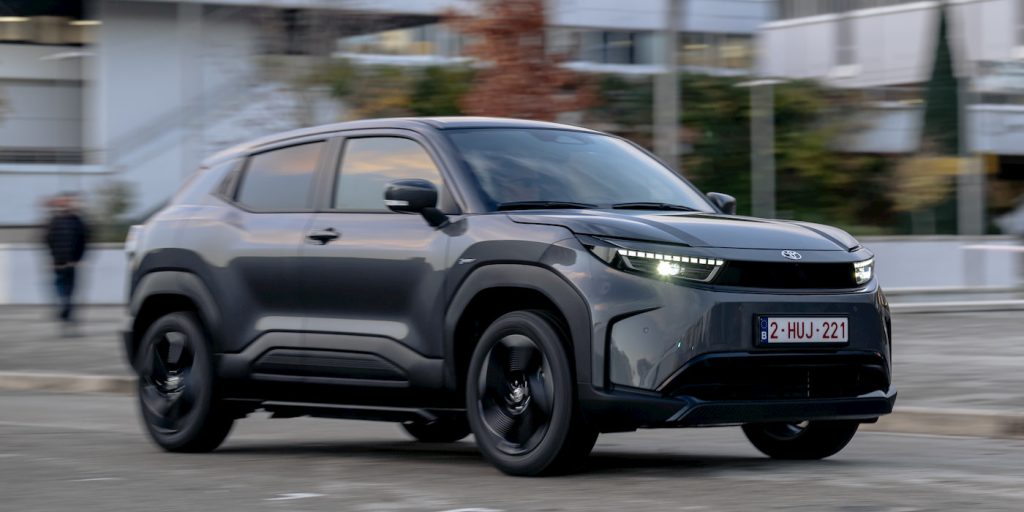
All Urban Cruiser models are equipped with standard safety features such as Brake Support System, Adaptive Cruise Control, Lane Keep Assist, and Traffic Sign Recognition.
In Germany, the Urban Cruiser EV is on sale, priced from €31,990 ($37,500). Financing is available from €340.41 ($400) a month.
Toyota’s new entry-level electric SUV follows the launch of the refreshed bZ4X. In 2026, Toyota will introduce the C-HR+, bZ4X Touring, and Hilux BEV electric pickup.
For those in the US, Toyota is not expected to launch the Urban Cruiser in the States. However, the new and much-improved 2026 Toyota bZ is among the few EVs in the US with starting prices under $35,000. Next year, it will launch the C-HR, which is expected to be even more affordable.
FTC: We use income earning auto affiliate links. More.

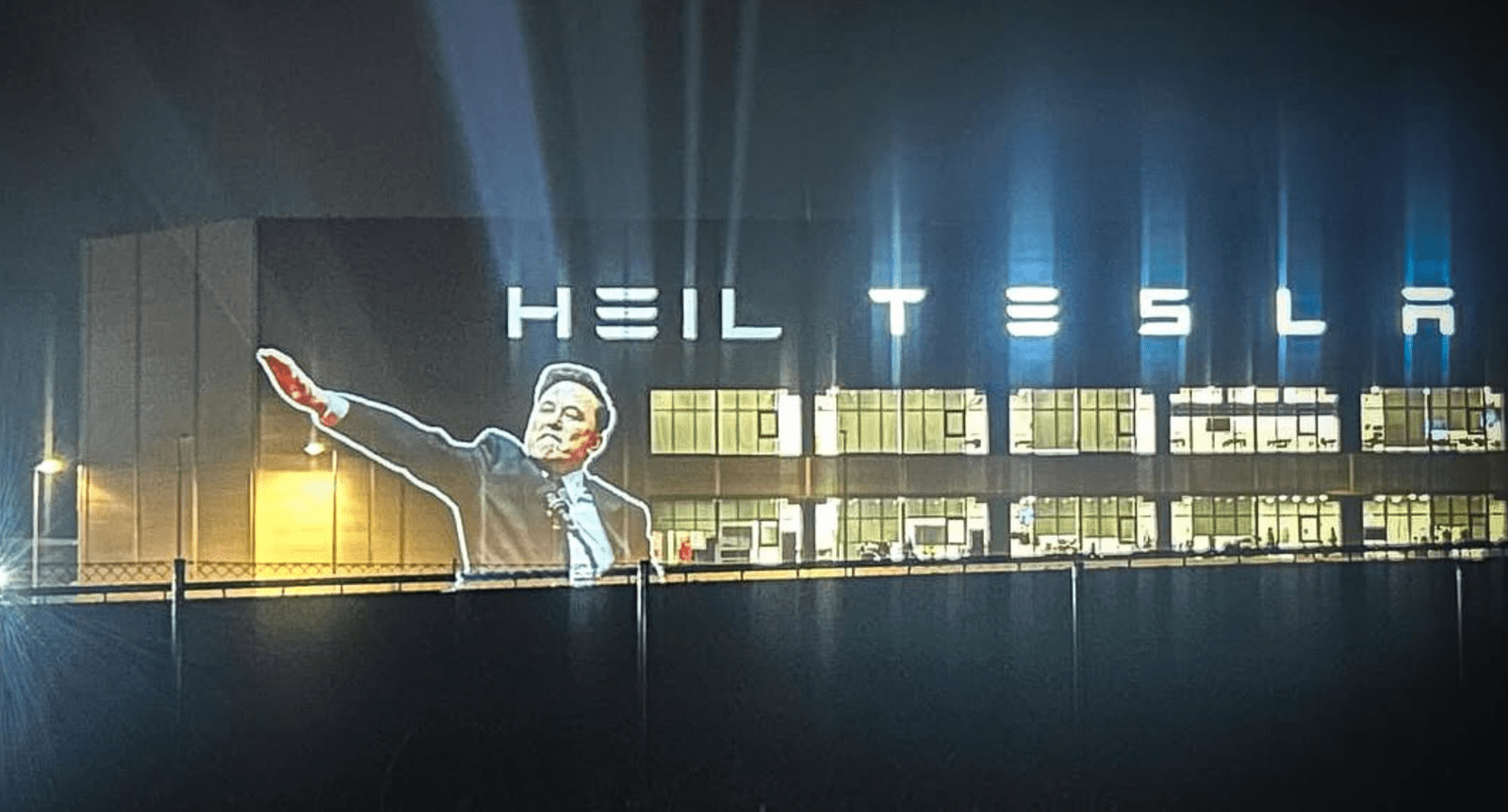
Tesla has reportedly thrown a “Giga-Event” for its employees at Gigafactory Berlin, featuring German rapper Kool Savas. The goal? To rally the troops ahead of a critical union vote. The result? A “cringe” performance involving a Cybertruck, failed “Elon” chants, and some anti-union propaganda.
We have been covering the ongoing tensions between Tesla and IG Metall, the powerful German metalworkers’ union, for years now. While Tesla has managed to fend off a complete union takeover of the works council in the past, the union has gained ground in a vote last year, and a new election is looming.
Tesla’s strategy to counter this seems to be… distinct.
According to a new report from Handelsblatt, Tesla management organized a private “Giga-Event” on December 2 to “boost morale” and, apparently, to explicitly campaign against IG Metall.
The centerpiece of the event was a performance by famous German rapper Kool Savas. And this is where things reportedly got cringe.
Witnesses and a video provided to the German newspaper described the scene as incredibly awkward. Savas reportedly drove onto the stage in a Tesla Cybertruck, which is a rare sight in Europe, and attempted to hype up the crowd of factory workers.
The report states that the rapper tried to start an “Elon, Elon” chant, but the crowd of employees refused to join in. He changed references of ‘Mercedes’ to ‘Tesla’ in his song.
Tesla employees weren’t into it at all, and the rapper admitted after five songs:
“You guys are tough, man. You guys are really tough. Tesla, what’s wrong with you?
When the applause for Tesla as a “great employer” was lukewarm at best, Savas reportedly asked the audience if they had a “stick up their ass” (Stock im Arsch).
You can’t make this stuff up.
But it wasn’t just about a rapper struggling to read the room. The event was held with the backdrop of an upcoming work council vote.
In the last one in 2024, IG Metall managed to elect the biggest faction, but fell short of a majority.
Now, with Tesla’s sales crashing in Europe and Elon Musk’s popularity plummeting to a new low, management is scared that IG Metall could make the gains needed to control a majority of the workers’ council.
Tesla Gigafactory Berlin manager André Thierig took some shots at the union in his speech at the event, according to Handelsblatt’s report.
The good news is that he announced a 4% wage increase for employees, but he falsely claimed that they would have only gotten two if IG Metall held collective bargaining power.
On the other hand, IG, which welcomed the wage increase, claimed that Tesla needs to increase salaries by another 30% to be on par with the auto industry in Germany.
Furthermore, the report claims that Thierig suggested that Tesla’s expansion plans at the factory, including recently announced battery production, is dependent on the results of the upcoming work council election in early 2026.
IG Metall chief Otto sees a pattern at Tesla:
For years, the message has been: if you work hard, don’t join IG Metall, and dutifully elect the management-appointed works council, the factory will be expanded. Then you’ll all have unprecedented opportunities for advancement.
He sees this as a threat to control employees.
While Tesla reiterated that jobs for the 11,000 employees at Gigafactory Berlin are secured, there are growing concerns as Tesla’s sales in Europe have crashed more than 30% in 2025.
Electrek’s Take
One thing is clear: the union is having a positive impact on Tesla workers.
I doubt Tesla would be offering a 4% wage increase right before a union vote if people weren’t flirting with the idea of joining IG Metall.
What I dislike is the anti-union rhetoric. It is not needed. Let the union make its case, management make theirs, and let the employees choose. That’s it.
If you are a good employer, you don’t need to hire a rapper to tell your employees that you are a good employer.
As for job security for Tesla employees in Germany, I think there’s room for concern.
Thierig noted on stage that Model Y was still the best-selling EV in Europe, which is true, but it’s also true that sales are down 30% in Europe in 2025. And that’s compared to 2024, when sales were down 10% year-over-year.
Tesla’s situation in Europe is undeniably not great.
The automaker was expected to bring several vehicle programs to Giga Berlin, but the factory has now been operational for almost 4 years and still only produces the Model Y.
I think the only reasonable hope the factory has is the potential addition of the Tesla Semi program. Other than that, I see it shrinking rather than expanding.
FTC: We use income earning auto affiliate links. More.
-
 Sports2 years ago
Story injured on diving stop, exits Red Sox game
-
 Sports3 years ago
‘Storybook stuff’: Inside the night Bryce Harper sent the Phillies to the World Series
-
 Sports2 years ago
Game 1 of WS least-watched in recorded history
-
 Sports3 years ago
Button battles heat exhaustion in NASCAR debut
-
 Sports3 years ago
MLB Rank 2023: Ranking baseball’s top 100 players
-
Sports4 years ago
Team Europe easily wins 4th straight Laver Cup
-
 Environment3 years ago
Japan and South Korea have a lot at stake in a free and open South China Sea
-
 Environment1 year ago
Here are the best electric bikes you can buy at every price level in October 2024