

Crypto CLARITY Act set for Senate markup in January, Sacks says


The long-awaited Digital Asset Market Clarity Act, or CLARITY Act, is moving closer to law, with a Senate markup expected in January, says White House artificial intelligence and crypto czar David Sacks.
Sacks posted to X on Thursday that Senate Banking Committee Chair Tim Scott and Agriculture Committee Chair John Boozman had confirmed that the bipartisan crypto bill will be shaped up by the Senate next month.
”We are closer than ever to passing the landmark crypto market structure legislation that President Trump has called for. We look forward to finishing the job in January!”
The CLARITY Act would define crypto securities and commodities and clarify the roles of the Securities and Exchange Commission, the Commodity Futures Trading Commission, and other financial regulators.
Backers of the bill say it will reduce regulatory uncertainty for crypto firms by establishing clearer compliance pathways and encourage innovation while strengthening investor protections.
Related: Bitcoin institutional buys flip new supply for the first time in 6 weeks
Movement of the CLARITY Act has been slower than expected, with Senator Cynthia Lummis having predicted in September that the CLARITY Act would get to President Donald Trump’s desk for his signature before the end of 2025.
The delays have largely been attributed to the record 43-day US government shutdown across October and November. However, US regulators met with executives from Coinbase, Ripple, Circle and others during that time to ensure the momentum of the bill didn’t stall.
Sacks’ post had confirmed earlier reports that the Senate markup would be pushed into the new year.
The House passed the CLARITY Act in July, and the Senate markup will debate and potentially amend the bill before it’s sent to the full chamber for a vote.
Scott will have to tackle passing the bill with a supermajority of votes to avoid it being forever stalled and essentially abandoned.
If the Senate passes it with amendments, the bill will return to the House for final approval before reaching Trump’s desk.
Magazine: Quantum attacking Bitcoin would be a waste of time: Kevin O’Leary
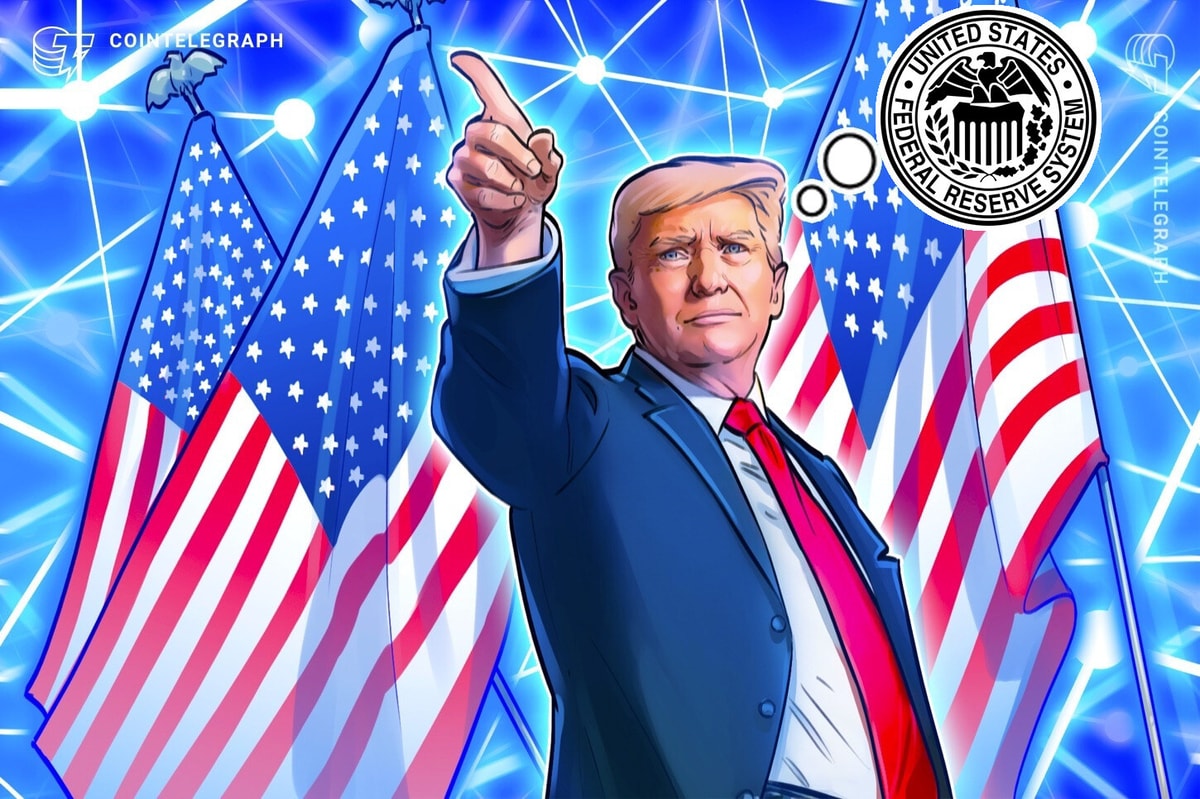

United States President Donald Trump offered positive remarks about pro-crypto Fed chair nominee Chris Waller at a recent press conference, as speculation continues over his final choice.
“I think he’s great. I mean, he’s been a man who’s been there a long time. Somebody that I was very involved with and sense of his career, and he’s a fantastic man,” Trump said during a press conference on Thursday.
Waller has recently been perceived as relatively supportive of crypto, saying in an August speech at the Wyoming Blockchain Symposium 2025 that there is “nothing to be afraid of” about crypto payments operating outside the traditional banking system.
Trump says everyone on the shortlist “would be a good choice”
Waller currently has a 14% chance of being selected, according to crypto prediction platform Polymarket, making him the third most likely pick. Crypto-friendly White House economic adviser Kevin Hassett leads at 53%, followed by former Fed governor Kevin Warsh with 28% odds.
Trump said that the list has been narrowed to three or four candidates. “I think every one of them would be a good choice, honestly,” he said.
When asked whether Fed governor Michelle Bowman was also on the shortlist, Trump did not directly answer the question, but described her as a “fantastic person.” Polymarket currently puts Bowman’s odds at 2%.
Trump said that he expects to make the announcement over the “next couple of weeks.” “I don’t know before the end of the year, but pretty soon,” Trump said.
Crypto industry has been keeping a close eye on Fed chair developments
The crypto industry has been paying close attention to developments surrounding Trump’s Fed chair nominee, with the discussion ramping up in recent months as the Fed’s role in monetary policy is often seen as affecting broader crypto market conditions.
Related: Global debt markets show dollar dominance moves in cycles, US Fed says
Interest rates, which are set by the Federal Reserve, are widely viewed as having a significant impact on the crypto market.
When rates are lowered, investors tend to seek higher-risk assets such as cryptocurrencies, as traditional investments like bonds and term deposits become less attractive.
Magazine: Big questions: Would Bitcoin survive a 10-year power outage?

XRP exchange-traded funds have surpassed $1 billion in assets due to the long-standing recognition of the token among mainstream market participants, combined with its strong price performance over the past few years, according to a crypto executive.
It comes as spot Ether (ETH) ETFs continue to post outflows, while spot Bitcoin (BTC) ETFs have recorded choppy performance over the past week.
“Many investors are taking a position in XRP because of the familiarity. It has a long track record,” Sui Chung, the CEO of crypto price index provider CF Benchmarks, told CNBC on Wednesday.
XRP’s 3-year return not unnoticed by investors
Chung said that XRP’s multi-year performance has also played a role in attracting capital.
“Obviously, price performance has been pretty impressive over the past three or four years, so there are a number of reasons that it’s attracting investor dollars,” he said.
XRP (XRP) is trading at $1.81 at the time of publication, and while it is up approximately 417% since 2022, it is down 22.81% since Jan. 1, according to CoinMarketCap.
Spot XRP ETF has seen $423.27 million in inflows since Nov. 14, according to CoinGlass, and recently surpassed $1 billion in assets under management, data from SoSoValue shows.
The five major XRP ETF issuers, Canary Capital, 21Shares, Grayscale Investments, Bitwise Asset Management and Franklin Templeton, currently have $1.14 billion in AUM.
Solana narrative is starting to be better understood
Meanwhile, Chung said that investors are beginning to better understand the investment case for Solana (SOL), helping drive recent inflows into spot Solana ETFs.
Over the past nine days, spot Solana ETFs have posted $102.8 million in net inflows, according to CoinGlass.
“The understanding that traditional investors have of Solana and the types of applications that run on Solana, the types of fees that Solana has and the daily active users makes for a pretty compelling reading,” he said.
Related: XRP’s ‘bearish’ setup may crash price below $1: Analyst
The rising demand for Solana and XRP spot ETFs coincides with the increased volatility in trading of the two largest cryptocurrencies by market capitalization, Bitcoin and Ethereum, in their US-based ETF products.
Spot Ether ETFs have recorded five consecutive days of outflows totaling $533.1 million, according to Farside.
However, spot Bitcoin ETFs have recorded choppier performance over the same period. On Thursday, US spot Bitcoin ETFs logged $457.3 million in inflows, recouping part of the $634.8 million in outflows seen over the prior two sessions.
Magazine: Big questions: Would Bitcoin survive a 10-year power outage?


Representatives of the Bitcoin Policy Institute (BPI), a nonprofit Bitcoin advocacy organization, warned that US lawmakers have not included a de minimis tax exemption for Bitcoin transactions below a certain threshold.
“De Minimis tax legislation may be limited to only stablecoins, leaving everyday Bitcoin transactions without an exemption,” Conner Brown, BPI’s head of strategy, said on X, adding that the decision to exclude Bitcoin (BTC) is a “severe mistake.”
In July, Wyoming Senator Cynthia Lummis introduced a bill proposing a de minimis tax exemption for crypto transactions of $300 or less, with a $5,000 annual limit on tax-free transactions and sales.
The bill proposal also included tax exemptions for digital assets used for charitable donations and tax deferment for crypto earned through mining proof-of-work (PoW) protocols or staking to secure blockchain networks.
Allowing a tax exemption for small Bitcoin transactions would increase its use as a medium of exchange rather than just as a store of value asset, allowing a new financial system built on a Bitcoin standard, BTC advocates say.
The discussion around de minimis tax exemptions has also raised questions about whether such relief should apply to stablecoins, which are designed to maintain a stable value.
“Why would you even need a De Minimis tax exemption for stablecoins,” Marty Bent, founder of media company Truth for The Commoner (TFTC), wrote on X. “They don’t change in value. This is nonsensical.”
Cointelegraph reached out to BPI about the proposed legislation, but had not received a response at time of publication.
Related: Japan’s new crypto tax could wake ‘sleeping giant’ of retail investors
Bitcoin is gaining value, but it isn’t being used as peer-to-peer electronic cash
The Bitcoin white paper, authored by its pseudonymous creator Satoshi Nakamoto in 2019, describes Bitcoin as a “peer-to-peer electronic cash system.”
However, relatively high transaction fees, average block times of about 10 minutes, and capital gains taxes on Bitcoin stifle BTC’s use as a payment method for goods and services.
Many Bitcoin investors choose to hold BTC for the long term, sometimes borrowing fiat currency against their BTC holdings to pay expenses and fund everyday purchases.

The Bitcoin Lightning Network is a second-layer protocol designed for BTC payments, which works by locking a specific amount of BTC in a payment channel between two or more people.
Users connected through a payment channel can conduct multiple transactions offchain, with only the final net balance recorded on the Bitcoin ledger for settlement once the channel is closed.
This makes Bitcoin transactions faster and cheaper, as the users in the payment channel do not have to wait for new blocks to be mined or pay a network fee for each transaction between parties in the channel.
Magazine: The one thing these 6 global crypto hubs all have in common…
-
 Sports2 years ago
Story injured on diving stop, exits Red Sox game
-
 Sports3 years ago
‘Storybook stuff’: Inside the night Bryce Harper sent the Phillies to the World Series
-
 Sports2 years ago
Game 1 of WS least-watched in recorded history
-
 Sports3 years ago
Button battles heat exhaustion in NASCAR debut
-
 Sports3 years ago
MLB Rank 2023: Ranking baseball’s top 100 players
-
Sports4 years ago
Team Europe easily wins 4th straight Laver Cup
-
 Environment3 years ago
Japan and South Korea have a lot at stake in a free and open South China Sea
-
 Environment1 year ago
Here are the best electric bikes you can buy at every price level in October 2024