

‘No fear of failure’: Miami’s Malachi Toney is ready for prime time


-
Andrea Adelson
CORAL GABLES, Fla. — Carson Beck remembers the first time he saw Malachi Toney making plays against the Miami defense in the spring. He was running routes like a veteran and making moves that Beck calls “inexplicable.”
Beck stood on the sideline, unable to throw while rehabbing an elbow injury, but he had seen enough to know the receiver would be a star. He asked Toney to watch game tape with him, so they could be on the same page once fall camp started. The two spent hours together inside the Miami facility: Beck, the sixth-year veteran; Toney, the 17-year-old true freshman who should have been preparing for his senior year of high school.
They watched tape of Georgia, where Beck played the previous season. He pointed out the way receiver Ladd McConkey, tight end Brock Bowers and running back Cash Jones ran option routes to perfection.
“I want you to do it this way,” Beck told him.
Toney listened and nodded.
“Sure enough, we go out to practice in the fall, and everything is identical.”
But the moment that Beck knew Toney was different came during Miami’s game against Florida State, in early October. Miami lined up to go for it on fourth-and-2 from the Florida State 40-yard line, hoping to build on its 14-3 lead. Toney lined up just behind the right tackle, and the Florida State defense showed a specific look the two went over in the summer.
When the play started, Toney ran around the right side of the tackle to an open spot beyond the first down marker as the Florida State defense lost track of him for a split second. That was long enough. Toney quickly turned around, Beck got him the ball and Toney made one juke move to get him racing past the defense and into the end zone for a touchdown.
Beck stood there, incredulous. Toney had remembered exactly what to do, months after they went over the play. What Beck did not know was that Toney had been waiting all season for that moment.
“I knew once I got that look, it’s a touchdown,” Toney said. “It was all like slow motion.”
Toney finished with seven catches for 107 yards and two touchdowns in the 28-22 win. He had a third score that was called back because of a penalty. Afterward, Toney deflected praise, instead thanking the coaches and his teammates for believing in him while crediting his mom for his work ethic. “Getting up early and staying late, that comes from watching my mom,” he said. “If she can do that, why can’t I?”
Early the next day, at around 3 a.m., Toney sent a message to his high school coach, Mike Smith. It included a picture from the state championship game his freshman year in 2022, when Toney fumbled as the team was driving for a game-tying score.
Toney wrote, “This changed my life forever.”
AS MIAMI PREPARES to play Texas A&M in the first round of the College Football Playoff on Saturday (noon, ABC), Toney has emerged as one of the most fascinating players in the 12-team field. The ACC Rookie of the Year, Toney had 84 catches for 970 yards and seven touchdowns, rushed for another and threw for two more, lining up at every position on offense minus the offensive line.
“Hell, he even might be able to do that,” Miami offensive coordinator Shannon Dawson says.
Texas A&M defensive coordinator Jay Bateman said this week that Toney is “maybe the best player we’ve played all year.” Beck heaps even bigger praise on Toney, saying he is already one of the best players he has played with in his entire career. “If he continues on the path he’s on,” Beck says, “he will be the best that I’ve ever played with.”
At 5-foot-11, 188 pounds, he is not the biggest player on the field. Nor is he the fastest. But Dawson says Toney’s football knowledge, capability, body control and peripheral vision set him apart now, just as they set him apart as a youth football player in South Florida.
The Toney legend grew early on, when he started playing quarterback at age 7 because his team needed one. On his 8U team, he scored a game-winning touchdown on a quarterback sweep that went 40 yards to get his team into the playoffs. One of his youth coaches dubbed him “Baby Jesus,” and the nickname took off from there — though the devout Toneys avoid using it themselves.
Once Toney arrived at American Heritage High in 2022, the plan was for him to play receiver. In his very first game, he had 100 yards.
Toney was a bona fide varsity star, and it was hard to keep him away from football. He’d plead with his coaches to play in junior varsity games, too. He spent all his extra time on the game. Then came the Florida Class 2M state championship game against Miami Central. American Heritage trailed 38-31 with two minutes left and started driving for the tying score.
Toney caught a pass in the flat, and he took off. But as he was getting hit, he fumbled at the 28-yard line. Future Miami teammate Rueben Bain Jr. recovered with 1:17 remaining to give Central the championship. Toney sobbed as he headed for the sideline, inconsolable, believing he had cost his team the game.
His mom still has a photo of him on the floor of the locker room, in tears.
“That feeling that you cost your team a great moment, like a moment that will never be remade, that was the turning point for me,” Toney said. “Knowing that feeling will never go away, that’s why I work so hard.”
His mom saw a different Malachi from that moment forward.
“That freshman season put something different inside of him,” Shatravia “Toni” Toney said.
Malachi Toney doubled down on the work. Every day during lunch, he would go on the Jugs machine and catch 200 balls. He watched game tape religiously, competing against Smith for most hours watched in a week. Once, he got up to 14 hours and told Smith, “I’m going to catch you.” Toney would often call Smith in the middle of the night with questions about coverages, and plays they should run.
“Malachi,” Smith would say. “Go to sleep.”
By the time his junior year rolled around, Toney decided to reclassify and leave high school one year early to play in college.
“I had some coaches ask me, ‘Do you think he’s ready? Is that a smart idea?'” Smith says. “For 99 percent of kids I would say, ‘No.’ But for Malachi? I knew that kid was ready. This is what he’s been wanting to do his whole life.”
American Heritage made the playoffs again, but Toney was out of the regional semifinal against Fort Lauderdale’s Dillard with a sprained ankle. By his own admission, Toney was hobbled and unable to run at full speed. But trailing 14-0, Smith felt a tap on his shoulder.
“Coach, can I go suit up?” Toney asked.
Smith held him off, but only for so long. Toni saw her son, in a walking boot, headed back to the locker room and ran after him, knowing he was getting ready to put on his uniform to play.
“Malachi, you can’t do that,” Toni said.
“I’ve got to try something,” he told her. “We can’t go out like this.”
Toney came out after halftime to play receiver, but a few plays into the second half, starting quarterback and Texas commit Dia Bell went down with an ankle injury of his own. Smith turned to Toney and told him he would have to go in at his old position: quarterback.
Coming in cold with literally zero quarterback reps in three years? Toney smiled at Smith, the way he always did. Toney used to joke around in practice that he was a human Jugs machine because he could deliver the ball with both speed and precision. He threw his first pass so hard that his receiver dropped it. No biggie. Toney proceeded to lead American Heritage to 24 unanswered points and the victory.
They rolled to wins in their next two games before meeting Orlando Jones in the state championship game — the moment Toney had waited on since his freshman year. Only this time, he had the ball in his hands as the quarterback. Toney threw one dime after another — starting the game 15-of-15 as American Heritage won its first state title since 2020.
“I feel like I repaid the program,” Toney said. “I stayed down ’til I came up.”
“When he came in as a freshman and they were like, ‘This is Baby Jesus,’ I’m like, ‘I am not calling that kid Baby Jesus,'” Smith said. “But by the end of his career, after the state championship, I said, ‘You know what? I will call you Baby Jesus now.'”
TONEY ENROLLED AT Miami in January. He took his work habits to a new level with the Hurricanes. Every minute of every day was dedicated to either football or class, with little time for anything else.
What Beck saw in those first practices is what the coaches saw: a player who was not only hard to cover, but fearless. Put him in a two-minute drill and watch him make every catch and score. Jump up for a catch, land with perfect balance, then keep going? Check. That is why Mario Cristobal said last March, after a handful of spring practices, “They keep calling him Baby Jesus. You guys know who I’m talking about, right?”
Everyone in South Florida knew exactly who Cristobal was talking about. The rest of the country would find out soon enough. Miami opened the season against Notre Dame, in a national spotlight prime-time game.
“It was easy for us to see this kid’s special,” Dawson said. “Then it went to: ‘Let’s don’t talk about it too much, because he’s never done it in a game.’ Then he just made plays against Notre Dame. The game was not too big for him. He had no fear of failure.”
Indeed, Toney had six catches for 82 yards and a touchdown against the Irish, finding ways to repeatedly get open against one of the best secondaries in the nation. Afterward, Cristobal lamented, “We tried to keep him a secret, but it didn’t take long.”
The word was out, and defenses adjusted. Toney saw more double teams. He heard more trash talk, as players yelled at him, “This isn’t high school anymore!” He got pushed more when he got tackled to the ground. Toney never said a word back.
Dawson got creative with the way he lined Toney up. Because he played quarterback, Toney has a unique ability to understand not only what everyone on offense should be doing, but what defenses are doing, too. That ability, matched with his desire to learn, gave Dawson more options.
“You move him around, it doesn’t faze him,” Dawson said. “If you show him something on a whiteboard, or you show him something that somebody did — and it may not be his position — but we’re going to line you up here, and you’re going to do this. Then you go out to the field, and it looks better than the damn kid that you showed him.”
That includes lining Toney up in the Wildcat position, or as Dawson has coined it, the “Malicat.” In the regular-season finale against Pitt, Toney lined up in the Malicat and took the snap. He dropped back to pass. His first read, a post route, was covered. So he threw a wheel route instead to Elija Lofton for the touchdown.
Cristobal has repeatedly praised Toney for carrying himself like an NFL veteran, pointing to his work ethic as exemplary.
Every morning, Toney wakes up at 4:55, the same time as his mother. He arrives at the facility 30 minutes before he is supposed to, then proceeds to get taped up and stretched before going to meet with coaches upstairs to go over the practice script and take notes.
After practice, he spends more time on the Jugs machine, gets in the cold tub, heads to class and comes back to the facility to watch more tape before going back home to do it all again the next day.
“I know what I had to do to get to this position, so I was willing to sacrifice things like sleep, not going to parties, missing out on time with my mom,” Toney says. “What you put in is what you’re going to get out, so that’s how I go about it. If I want to go out there and have a big game, I’ve got to put in the work.”
Once rivals, now teammates, Bain has watched Toney work since his arrival in January. When the offense has a 30-minute break between the end of practice and a lifting session, Bain sees Toney lead the receivers on the Jugs machine. “He’s the last guy to leave the building and the first guy to be in,” Bain says. “It’s a mindset for him, and it’s a way of life.”
He has not let Toney forget that fumble. This past Wednesday, after the first-team offense went against the first-team defense to close out practice, he went up to Toney and could not help but talk some trash, telling him, “I’ve got a play in your mind that will last the rest of your life.”
Toney played it off, but Bain is right.
Because every time he takes the field, Toney remembers the way he felt three years ago in the state title game. He channels that pain into action. He grips the football tight.
He has not fumbled since that night.
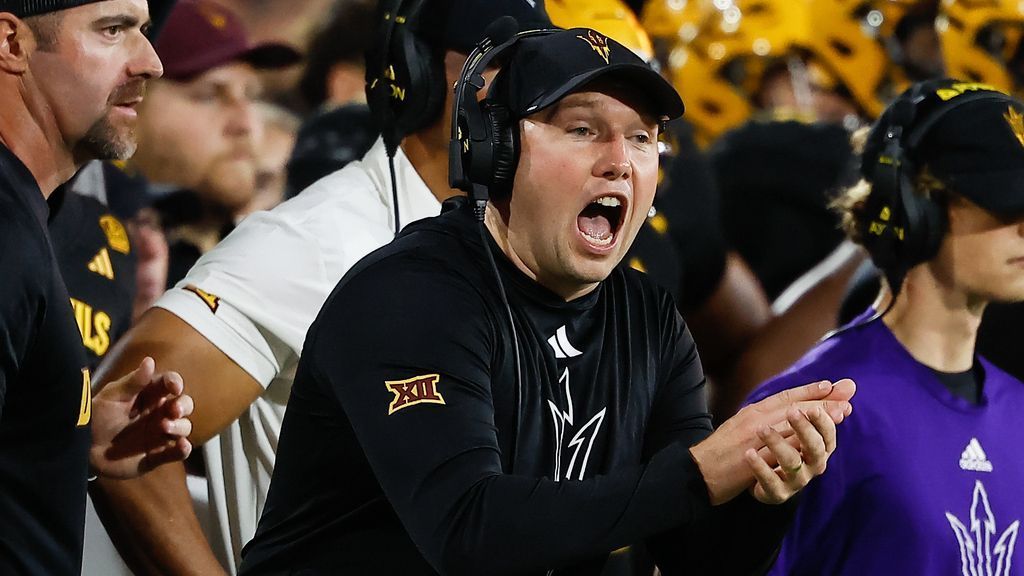
Arizona State coach Kenny Dillingham has signed a new five-year contract that will average nearly $7.5 million over the course of the deal, sources told ESPN on Saturday.
The deal prioritized resources for the staff, as the salary pool increases $11 million, which puts it near the top of the Big 12.
The extension takes Dillingham out of the conversation for the Michigan job. He had been in the top group of candidates considered for it.
The deal remains for five years, as longer ones aren’t allowed by Arizona state law, but there are incentives to extend the contract up to 10 years. The deal is pending board approval.
Dillingham signed a new deal a year ago that made him the second-highest-paid coach in the Big 12 in 2025. While there are increases in salary, the heart of this new deal was resources for the program.
“We have the perfect coach for ASU,” a school source said. “We want to give him the tools to do his job the best way possible. That’s giving him resources to put into the staff and program and giving him longevity.”
The deal shows how Arizona State has prioritized football in recent years, as it won the Big 12 last season and reached the College Football Playoff for the first time in school history. It marked the first time the Sun Devils won a conference title outright since 1996.
It is also significant for athletic director Graham Rossini, who made it clear this week that retaining Dillingham was the top priority.
As the Michigan job lingered in the wake of Sherrone Moore’s firing, Dillingham got emotional talking about Arizona State. He is a graduate who long called the school his dream job and said on Dec. 13, “I love this place.”
He added: “That doesn’t change how I feel about here. That doesn’t change that my sister’s my neighbor. That doesn’t change that my parents live three doors down. … [Michigan] is one of the best jobs in America, it’s an unbelievable brand, an iconic brand, so a great opportunity for somebody.”
Arizona State is 22-16 under Dillingham, including a 19-7 record over the past two seasons. The Sun Devils play Duke in the Tony the Tiger Sun Bowl on Dec. 31.

-
Eli Lederman
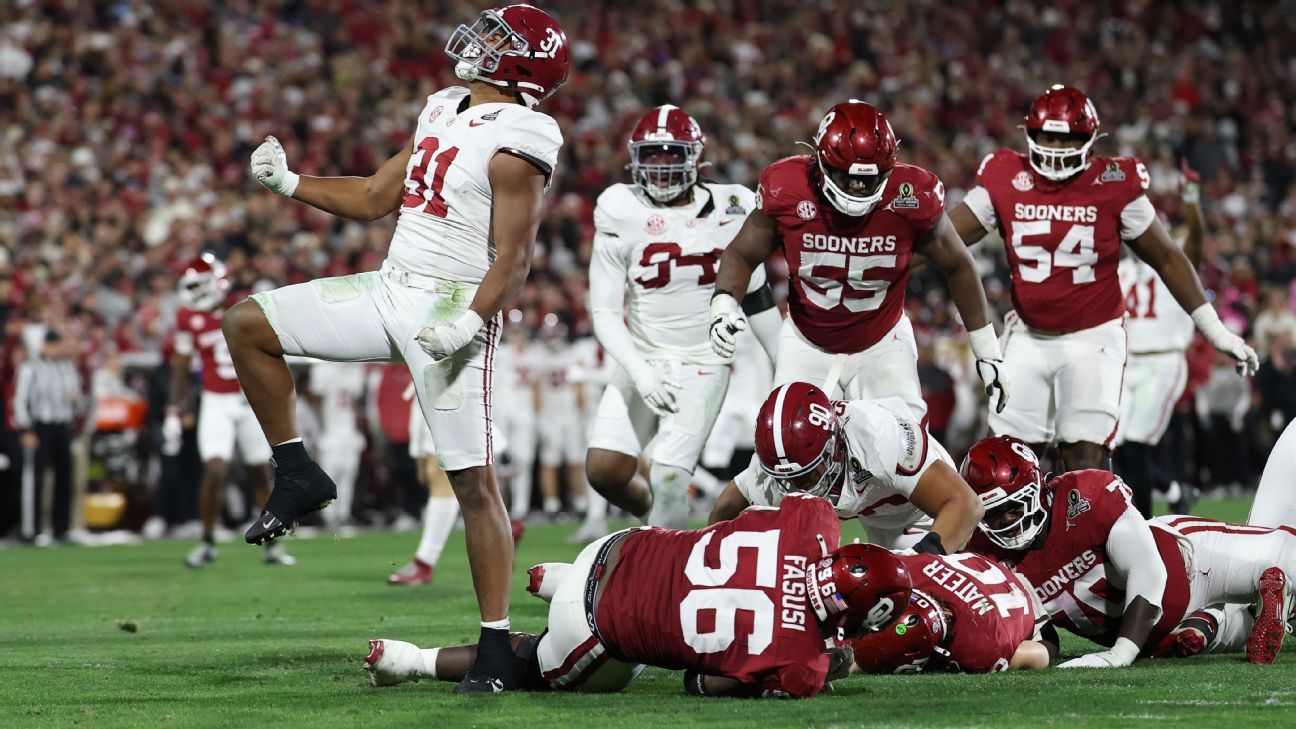
NORMAN, Okla. — Back in the College Football Playoff for the first time since 2019, No. 8 Oklahoma earned an unwanted distinction Friday night. After squandering a 17-point advantage in a 34-24 loss to No. 9 Alabama, the Sooners now own the two largest blown leads in playoff history.
A month after Crimson Tide miscues fueled the defining win of Oklahoma’s 2025 season on Nov. 15, Alabama flipped the script inside Oklahoma Memorial Stadium, feasting on errors by quarterback John Mateer and the Sooners’ special team to bounce the hosts in the CFP first round and secure a Rose Bowl quarterfinal date with No. 1 Indiana on Jan. 1.
Down 17-0 early in the second quarter, the Crimson Tide scored on five of their next seven possessions and rattled off 27 unanswered points to match the largest comeback in CFP history, tying the 17-point deficit Georgia overcame to top Oklahoma in a double-overtime, Rose Bowl thriller on New Year’s Day 2018. According to ESPN Research, teams that have led by 17 or more in a CFP game are 28-2 all time. The two losses belong to the Sooners.
Additionally, Friday’s result marked the program’s second-largest blown lead at home since Oklahoma Memorial Stadium opened in 1923. Winless in five playoff trips since 2015, Oklahoma now holds the most losses of any program in CFP history.
“We had the ability and the opportunities to overcome it all even in just the last several minutes of the game, despite some just incredibly critical mistakes,” Sooners coach Brent Venables said. “But it just wasn’t in the cards for us tonight.”
The Sooners’ adopted team motto this fall was “Hard to Kill.” On the same night rap legend 50 Cent performed inside Oklahoma Memorial Stadium with those words emblazoned on his sweater, the Sooners buried themselves with a parade of errors.
An Oklahoma offense that began the postseason ranked 90th nationally scored on three of its first four possessions. By the time wide receiver Isaiah Sategna III caught a 7-yard touchdown from Mateer to open a 17-0 lead with 10:51 remaining in the second quarter, the Sooners had forced three consecutive three-and-outs and were outgaining Alabama 135-12.
After Alabama responded with a nine-play, 75-yard touchdown drive, the dynamics of the second meeting between the two programs in the past 34 days swung on three plays.
Facing third-and-3 from midfield, Mateer evaded a sack and rolled out of the pocket with open space in front of him. He could have run for a first down. Instead, Mateer fired 40-plus yards downfield to running back Xavier Robinson, who failed to haul in the throw. On the next snap, Oklahoma punter Grayson Miller dropped his punt attempt and turned the ball over on downs, setting the stage for a 35-yard field goal from Alabama’s Conor Talty that cut the lead to 17-10.
“Field position against an Oklahoma team is so critical with their defense, so that was huge,” Alabama coach Kalen DeBoer said. “That was really huge for us.”
On the ensuing series, Alabama ran a disguised defensive look that appeared to confuse Mateer. With a safety dropped into coverage and Oklahoma wide receiver Keontez Lewis streaking downfield, Mateer fired, inexplicably, to no one other than Alabama defensive back Zabien Brown, who intercepted the pass and streaked down the Sooners sideline for a 50-yard pick-six.
Suddenly, the game sat level at 17-17 with 1:18 remaining in the second quarter. Of the 15 teams that have gone behind by at least 17 in the first half of a CFP game, the Crimson Tide became the first not to be trailing, courtesy of Mateer’s fourth interception in his past two games.
“I got tricked, and it’s pretty bad,” Mateer said. “I mean, you watch the tape. It was obvious it wasn’t a Cover 0. I got tricked, and it happens sometimes. But when you get tricked, you’ve got to mitigate the damage, and I didn’t do it.”
DeBoer described Alabama’s first-round win as “the opposite of the first game back at home.” Indeed, the Crimson Tide were statistically dominant in Oklahoma’s 23-21 win in Tuscaloosa last month. But the Sooners left with a signature win by taking advantage of mistakes.
In Friday’s rematch, the roles reversed. Second-half touchdowns from Lotzeir Brooks and Daniel Hill thrust the Crimson Tide to a 34-24 lead with 7:24 remaining. Pushing to close the gap, Oklahoma reached field goal position twice in the final three minutes, setting the stage for Lou Groza Award winner Tate Sandell, who had converted on each of his past 24 field goal attempts.
Battling gusting winds, Sandell pushed the first attempt — a 36-yarder — wide left. Ninety seconds later, he came up short on a 51-yard attempt, his first miss from 50-plus yards this season.
Sandell’s pair of misses were the final markers of a night that simply stopped going Oklahoma’s way following a scorching opening 20 minutes. After stunning wins over Tennessee and Alabama in November, and the similarly astonishing appearance of 50 Cent in Norman on Friday night, the Sooners ran out of magic, ultimately beaten at their own game by Alabama.
“When we needed to, we couldn’t pull one out like we have in several other games this year,” Venables said.

-
Max Olson
NORMAN, Okla. — Alabama wasn’t ready to do this last year. Or earlier this year. Or even two weeks ago in Atlanta. But down by 17 points in a road College Football Playoff game, with its season in jeopardy, something finally clicked.
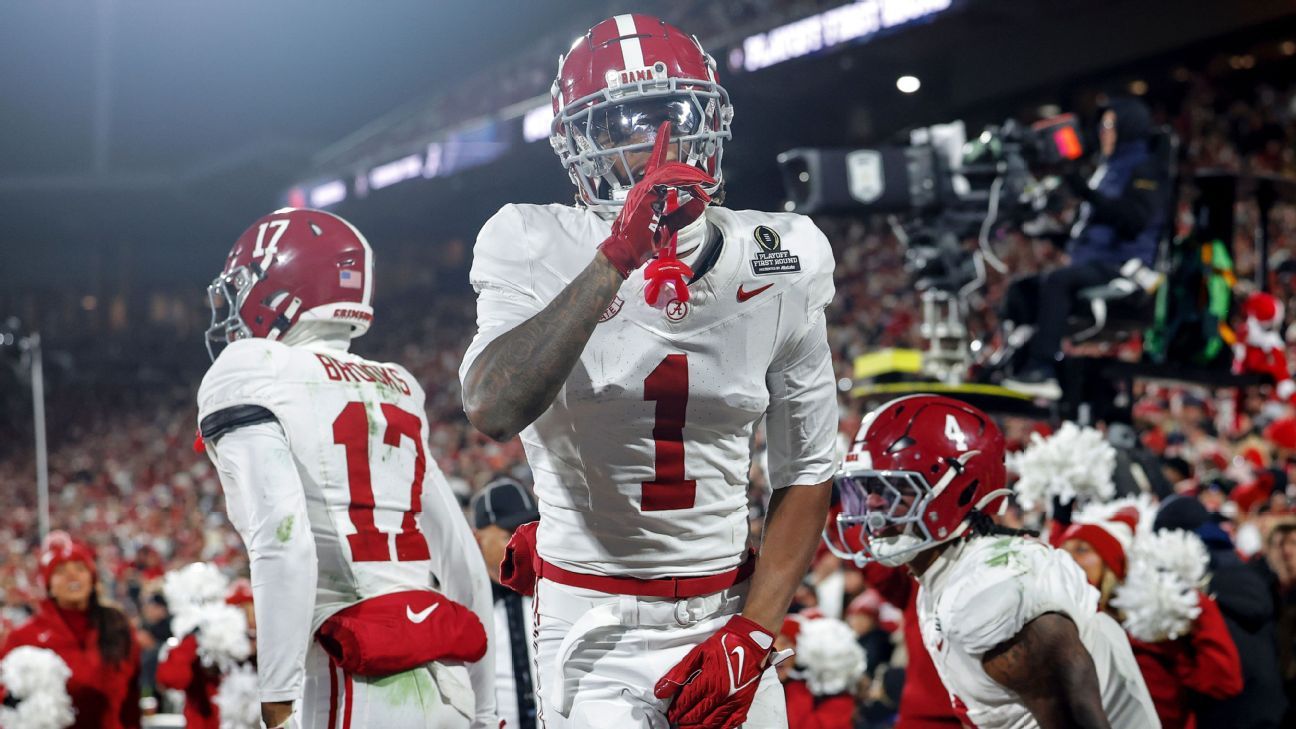
The No. 9 Crimson Tide had what it took to match the biggest comeback in CFP history, rallying with 27 consecutive points to stun No. 8 Oklahoma 34-24 on Friday in a first-round rematch that might have signaled a long-awaited breakthrough.
The Crimson Tide punched their ticket to a Rose Bowl quarterfinal against No. 1 Indiana by overcoming a double-digit deficit for the first time under coach Kalen DeBoer. They snapped a streak of six consecutive losses when trailing by at least 10 points, including all three defeats this season, since DeBoer took over in 2024.
They had put themselves in this tough spot, opening their CFP run with one more SEC road game, by losing 28-7 to Georgia in the SEC championship game Dec. 6. Then they fell behind fast yet again, down three scores within the first five minutes of the second quarter.
This time, though, quarterback Ty Simpson and his Crimson Tide teammates stuck to their plan and just kept chipping away.
“We always talk about the game is going to come back to us,” DeBoer said. “We have too many good players. If you just keep fighting, you’re going to force them to make a mistake, something’s going to happen. Just keep coming after them, play after play, and the game’s going to come back to you. And that’s what happened tonight.”
The Crimson Tide turned a dangerous deficit into a tied score with a rapid second-quarter sequence. Freshman wide receiver Lotzeir Brooks got the rally started with a 29-yard gain on a third-and-5 then turned a fourth-down catch into a 10-yard touchdown by making two Sooners defenders miss.
Five plays later, Oklahoma punter Grayson Miller dropped the ball on a punt attempt, and Alabama defensive tackle Tim Keenan III came through with a block and recovery, helping cut the Oklahoma lead to 17-10 after Conor Talty‘s 35-yard field goal.
Alabama’s defense delivered four plays later with cornerback Zabien Brown baiting Sooners quarterback John Mateer into a 50-yard pick-six. In less than five minutes, Alabama went from on the brink to all the way back.
“Keep going,” Simpson said. “That’s kind of been our message all season.”
The Crimson Tide did just that against a Sooners program that had notched 27 consecutive victories at Oklahoma Memorial Stadium when leading by double digits. College Football Playoffs teams were 1-28 all time when trailing by 17 or more points.
What made this Alabama team different? The Crimson Tide have been on a roller-coaster ride all season, beginning with a shocking 31-17 road loss at Florida State. Defensive coordinator Kane Wommack said they have been living with a win-or-go-home mentality and “supreme urgency” ever since.
The Crimson Tide fell behind 10-0 in a home loss to Oklahoma in November. They trailed 14-0 at halftime of the SEC title game. Offensive coordinator Ryan Grubb said they didn’t show the resolve necessary to get the job done. This time, though, they left no doubt.
“Our players won this game,” Wommack said. “They won the game with sheer will.”
Simpson kept the run going with a 30-yard touchdown pass to Brooks early in the third quarter and sealed the win with a 35-yard touchdown drive following a short punt midway through the fourth quarter after the Sooners cut the lead to 3.
Asked what it meant to him to rally back after the SEC title game defeat, Simpson looked around a room of reporters and raised his eyebrows.
“I guess we can thank you guys for that,” Simpson said. “I mean, y’all kind of wrote us off in a sort of way. Appreciate that.”
After nervously waiting to find out if they earned a spot in the College Football Playoff, DeBoer felt the two-week break after the Georgia loss was invaluable for getting players healthy and ready to go on a run. The message in the days after that loss was to keep things in perspective.
“Don’t overthink it,” DeBoer said. “It’s a lot of guys doing a little bit better in everything they can control.”
He saw confidence from Simpson and an encouraging level of calm on the sideline when the Crimson Tide trailed 17-0. If they could cut it to 17-10 before halftime, DeBoer liked their chances of clawing back. Once Brown stepped in front of Mateer’s pass and raced past him for a game-changing takeaway, they were well on their way.
After it was over, Simpson ran off the field with a rose in his mouth. He and his squad are ready to play the underdog role yet again against top-ranked and undefeated Indiana.
“You’ve got a great team culture. You’ve got a bunch of fighters, a bunch of punchers,” Wommack said. “That wasn’t who we were a year ago.”
-
 Sports2 years ago
Story injured on diving stop, exits Red Sox game
-
 Sports3 years ago
‘Storybook stuff’: Inside the night Bryce Harper sent the Phillies to the World Series
-
 Sports2 years ago
Game 1 of WS least-watched in recorded history
-
 Sports3 years ago
Button battles heat exhaustion in NASCAR debut
-
 Sports3 years ago
MLB Rank 2023: Ranking baseball’s top 100 players
-
Sports4 years ago
Team Europe easily wins 4th straight Laver Cup
-
 Environment3 years ago
Japan and South Korea have a lot at stake in a free and open South China Sea
-
 Environment1 year ago
Here are the best electric bikes you can buy at every price level in October 2024