

Farmers celebrate Sir Keir Starmer’s Christmas U-turn on inheritance tax

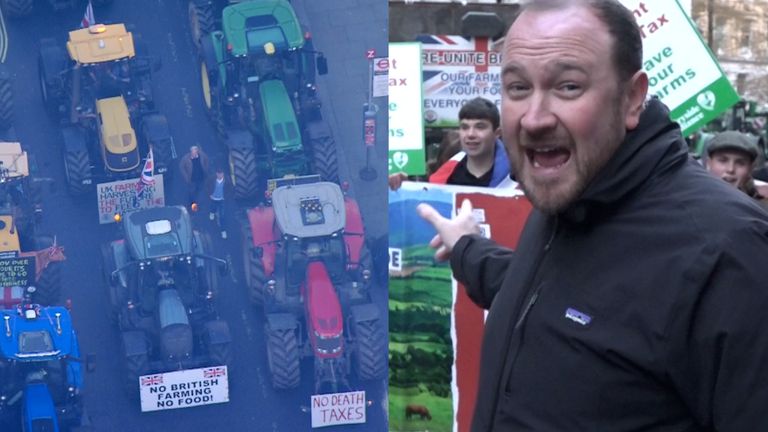
In a massive Christmas U-turn by Sir Keir Starmer, the government has announced a huge climbdown on inheritance tax on farmers.
The tax relief on family farms handed down between families is to increase from £1m to £2.5m, meaning only farms worth more than £5m will pay.
The climbdown, overturning bitterly unpopular proposals in Rachel Reeves’s budget last year, follows a personal intervention by the prime minister.
The National Farmers Union (NFU) president Tom Bradshaw revealed the government backed down after he had two “very constructive meetings” with the PM.
Responding to the climbdown, Mr Bradshaw – who led a high-profile campaign which included tractors blocking Whitehall – said it would come as a huge relief.
Tory leader Kemi Badenoch claimed it was a “huge U-turn” by the government and a big win for her party’s campaign against Labour’s “family farms tax”.
But the shadow environment secretary Victoria Atkins claimed it was only a partial U-turn on the “vindictive family farm tax” and was too late for some farmers. Businesses and lives had been lost, she said.
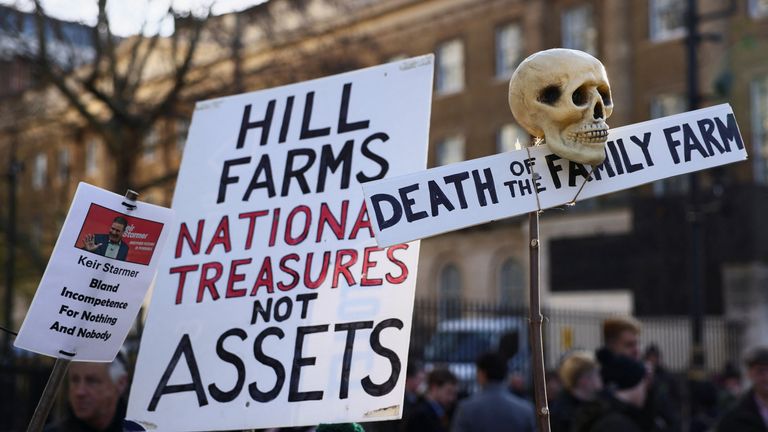
A skull hangs on a sign, as British farmers took part in a protest at Whitehall, calling on the chancellor to change course.
Announcing the climbdown, Environment Secretary Emma Reynolds said: “We have listened closely to farmers across the country, and we are making changes today to protect more ordinary family farms.
“We are increasing the individual threshold from £1m to £2.5m which means couples with estates of up to £5m will now pay no inheritance tax on their estates.
“It’s only right that larger estates contribute more, while we back the farms and trading businesses that are the backbone of Britain’s rural communities.”
The U-turn was given a warm welcome by the NFU, which has led the relentless protests in Westminster and around the UK.
Mr Bradshaw said Tuesday’s announcement would “greatly” reduce that tax burden for many family farms
He said: “Changes to Agricultural Property Relief (APR) and Business Property Relief (BPR) announced in last year’s budget came as a huge shock to the farming community.
“Until that moment, the best tax planning advice was to hold on to your farm until death and pass it on to the next generation who could continue to run a viable farming, food-producing business.
“The original changes to APR and BPR, contained within the Finance Bill, resulted in a pernicious and cruel tax, trapping the most elderly and vulnerable people and their families in the eye of the storm. The NFU and its members have stood strong for what we believed in.
“I am thankful common sense has prevailed and government has listened.”
The climbdown also follows a mini-rebellion in the Commons in early December in a vote on the inheritance tax proposal, when around 30 Labour MPs representing rural areas abstained and one, Markus Campbell-Savours, voted against and had the Labour whip withdrawn.
‘A big win for the Conservatives against a cruel and immoral tax’
Ms Badenoch, who has campaigned against the tax during several farm visits, said: “This is a huge U-turn by the government and a big win for the Conservative Party’s campaign against Labour’s family farm tax.
“The family farm tax is cruel, immoral and will not raise any money because farmers will stop farming. It would have pushed farms to the brink, damaged our food supply, and hurt the people who work long hours to feed the country.
“This fight isn’t finished. Other family businesses are still affected by Labour’s tax raid, and we will keep pushing until the tax is lifted from them too. But today is an important win, and proof that standing up for what’s fair, even when the odds are against us can make a real difference.”
Tim Farron, the Liberal Democrats spokesperson, urged the government to scrap the “unfair tax in full” as “many family farms will still find themselves financially crippled and barely making the minimum wage”.
Reform UK deputy leader Richard Tice said: “This cynical climbdown – whilst better than nothing – does little to address the year of anxiety that farmers have faced in planning to protect their livelihoods.
“With British agriculture hanging by a thread, the government must go further and abolish this callous farms tax.”

The International Monetary Fund’s mission chief for El Salvador issued a statement confirming that government authorities were proceeding with negotiations for the sale of the country’s Chivo Bitcoin wallet.
In a Monday statement, the IMF said El Salvador’s government was continuing to discuss its Bitcoin (BTC) project with the fund’s officials, and “negotiations for the sale of the government e-wallet Chivo are well advanced.” The announcement signaled that the government may be preparing to sell some or all of its crypto holdings in the Chivo wallet.
The statement followed a May deal with El Salvador in which the IMF would pay $120 million as part of a 2024 loan agreement for $1.4 billion. As part of the deal, the government would stop acquiring Bitcoin.
It’s unclear whether El Salvador is abiding by the terms of the deal. Though the IMF reported in July that the country’s government had not purchased any BTC since December 2024, El Salvador’s Bitcoin Office continues to announce crypto buys, including 1,090 Bitcoin worth about $100 million in November.
Related: CFTC changes guard as Selig takes reins, Pham departs
According to the terms of the IMF-El Salvador deal made public, the government would make public sector engagement of BTC-related economic activity “confined,” the private sector’s acceptance of Bitcoin would be voluntary, and it would wind down involvement in the Chivo wallet. Cointelegraph reached out to the IMF for comment but had not received a response at the time of publication.
El Salvador recognized Bitcoin as legal tender in 2021 and began acquiring the cryptocurrency as part of a strategy largely pushed by President Nayib Bukele. According to data provided by the country’s Bitcoin Office, the government held 7,509 Bitcoin as of Monday, worth about $659 million at the time of publication.
‘It’s not stopping,’ says Bukele on Bitcoin buys
Despite the reported deal between the IMF and El Salvador, Bukele said in March that the government would continue its Bitcoin investment strategy, purchasing at least one BTC daily. It’s unclear how the president’s statement could affect the IMF agreement.
Magazine: When privacy and AML laws conflict: Crypto projects’ impossible choice
-
 Sports2 years ago
Story injured on diving stop, exits Red Sox game
-
 Sports3 years ago
‘Storybook stuff’: Inside the night Bryce Harper sent the Phillies to the World Series
-
 Sports2 years ago
Game 1 of WS least-watched in recorded history
-
 Sports3 years ago
Button battles heat exhaustion in NASCAR debut
-
 Sports3 years ago
MLB Rank 2023: Ranking baseball’s top 100 players
-
Sports4 years ago
Team Europe easily wins 4th straight Laver Cup
-
 Environment3 years ago
Japan and South Korea have a lot at stake in a free and open South China Sea
-
 Environment1 year ago
Here are the best electric bikes you can buy at every price level in October 2024