
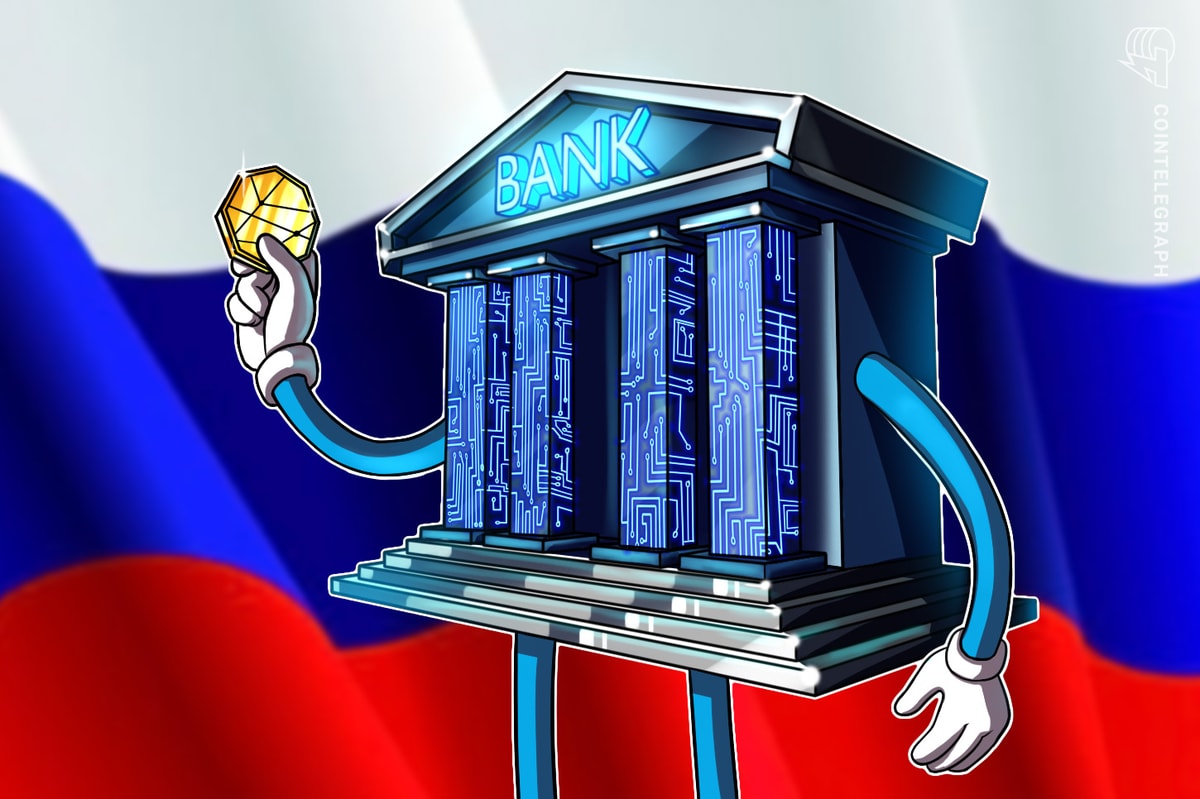
Russia’s central bank signals shift toward retail crypto access


The Bank of Russia put forward a policy proposal that would allow non-qualified investors to buy certain cryptocurrencies.
According to a Tuesday announcement, the central bank’s proposal would allow both qualified and non-qualified investors to buy most crypto, but with limitations.
Non-qualified investors would be limited to a yet-to-be-defined set of liquid crypto after passing a knowledge test, capped at 300,000 rubles ($3,834) a year. Qualified investors would gain broad market access excluding privacy coins, also subject to a knowledge test.
Russian residents will also be able to acquire crypto on foreign platforms, pay with foreign accounts, and transfer the resulting assets through Russian intermediaries. In such cases, they will be required to notify the tax service of those transactions.
Related: Belarus blocks Bybit, Bitget, OKX as Russia clamps down on crypto gray area
An anticipated change, broader than expected
The report follows a recent statement from the central bank’s first deputy governor, Vladimir Chistyukhin, who recently said that Russia was considering easing crypto rules.
He hinted at the potential removal of the requirement to meet the “super-qualified investor” criteria for buying and selling crypto with actual delivery.
The “super-qualified investor” category was introduced in late April, when Russia’s finance ministry and central bank launched a crypto exchange. This classification is defined by wealth and income thresholds of over 100 million rubles ($1.3 million) or an annual income of at least 50 million rubles.
Related: Here’s why Russia ranks highest in Europe for crypto adoption: Chainalysis
Open to, but not endorsing
The central bank said that it “continues to consider cryptocurrencies a high-risk instrument.”
The announcement also reiterates that — while stablecoins and cryptocurrencies are recognized as monetary assets that can be bought and sold — they cannot be used for domestic payments.
This follows the State Duma — Russia’s legislative body — passing a law in June 2020 that bans the use of cryptocurrencies as a payment method.
Under the proposal, crypto transactions will be available through exchanges, brokers and trustees operating through their existing licenses. Specialized depositories and exchanges that work with cryptocurrencies will be subject to separate requirements.



South Korean payments processor BC Card has completed a pilot project that enabled foreign users to pay local merchants using stablecoins.
BC Card’s pilot project was announced Tuesday and was conducted with blockchain company Wavebridge, wallet provider Aaron group and cross-border remittance provider Global Money Express. The companies had foreign users convert their stablecoins held in overseas wallets, which were partnered with BC Card, into digital prepaid cards.
The company said this pilot was not a short-term project, but part of preparations to implement a stablecoin payment structure. The change is a response to the evolution of South Korean stablecoin regulations, it said.
BC Card is one of South Korea’s largest payment companies, which reportedly processes over 20% of South Korea’s card transactions and covers 3.4 million domestic merchants. Its majority owner is KT Corp, one of the country’s three major telecom companies.
Shehram Khattak, general counsel at Trust Wallet, told Cointelegraph:
Ultimately, banks will have to deal with legacy operations but not only from an operations perspective but also processes; the entire department will have to change how they function.”
Related: US lawmakers propose tax break for small stablecoin payments, staking rewards
South Korea takes stablecoins seriously
In late July, local media reported that credit card companies were scrambling to respond to perceived threats from stablecoins. The nation’s credit card industry reportedly formed a joint task force as local regulators opened discussions regarding the introduction of won-based stablecoins.
BC Card reportedly launched an internal team dedicated to tracking trends in both the domestic and international stablecoin markets. Still, local stablecoin regulations are taking longer to take shape than anticipated.
Earlier this month, South Korea’s Financial Services Commission (FSC) failed to submit a draft proposal on stablecoin regulations by the deadline requested by the country’s ruling Democratic Party. Lawmakers said that the delay was caused by disagreements between the FSC and the Bank of Korea (BOK), the nation’s central bank.
The crux of the debate appears to be the BOK’s desire to require banks to own at least 51% of any stablecoin issuer seeking regulatory approval. Other regulators appear to be pushing towards a more diverse ecosystem.
Related: Crypto Biz: Bank stablecoins get a rulebook; Bitcoin gets a land grab
Stablecoins take on the world
Stablecoins are increasingly discussed as an alternative or complementary payment method to traditional solutions such as payment cards or bank wire transfers.
Adoption is moving quickly, with YouTube allowing US content creators to receive payouts in the dollar-pegged PayPal USD (PYUSD), earlier in December.
Meanwhile, Visa launched USD Coin (USDC) settlement services for some US-based financial institutions.
Related: Galaxy predicts stablecoins will overtake ACH transaction volume in 2026


In a massive Christmas U-turn by Sir Keir Starmer, the government has announced a huge climbdown on inheritance tax on farmers.
The tax relief on family farms handed down between families is to increase from £1m to £2.5m, meaning only farms worth more than £5m will pay.
The climbdown, overturning bitterly unpopular proposals in Rachel Reeves’s budget last year, follows a personal intervention by the prime minister.
The National Farmers Union (NFU) president Tom Bradshaw revealed the government backed down after he had two “very constructive meetings” with the PM.
Responding to the climbdown, Mr Bradshaw – who led a high-profile campaign which included tractors blocking Whitehall – said it would come as a huge relief.
Tory leader Kemi Badenoch claimed it was a “huge U-turn” by the government and a big win for her party’s campaign against Labour’s “family farms tax”.
But the shadow environment secretary Victoria Atkins claimed it was only a partial U-turn on the “vindictive family farm tax” and was too late for some farmers. Businesses and lives had been lost, she said.
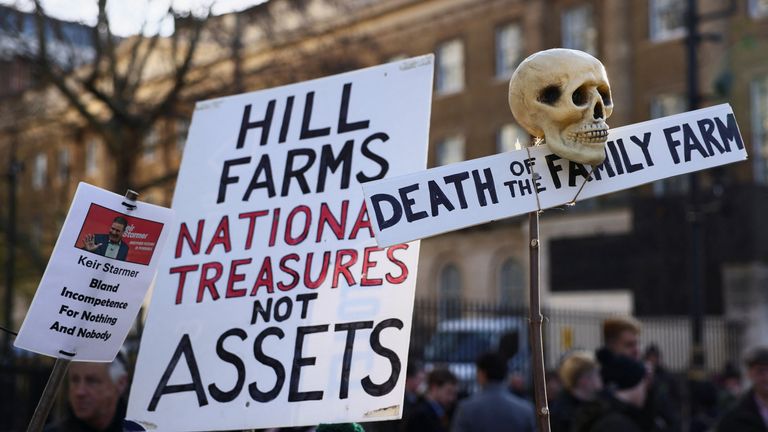
A skull hangs on a sign, as British farmers took part in a protest at Whitehall, calling on the chancellor to change course.
Announcing the climbdown, Environment Secretary Emma Reynolds said: “We have listened closely to farmers across the country, and we are making changes today to protect more ordinary family farms.
“We are increasing the individual threshold from £1m to £2.5m which means couples with estates of up to £5m will now pay no inheritance tax on their estates.
“It’s only right that larger estates contribute more, while we back the farms and trading businesses that are the backbone of Britain’s rural communities.”
The U-turn was given a warm welcome by the NFU, which has led the relentless protests in Westminster and around the UK.
Mr Bradshaw said Tuesday’s announcement would “greatly” reduce that tax burden for many family farms
He said: “Changes to Agricultural Property Relief (APR) and Business Property Relief (BPR) announced in last year’s budget came as a huge shock to the farming community.
“Until that moment, the best tax planning advice was to hold on to your farm until death and pass it on to the next generation who could continue to run a viable farming, food-producing business.
“The original changes to APR and BPR, contained within the Finance Bill, resulted in a pernicious and cruel tax, trapping the most elderly and vulnerable people and their families in the eye of the storm. The NFU and its members have stood strong for what we believed in.
“I am thankful common sense has prevailed and government has listened.”
The climbdown also follows a mini-rebellion in the Commons in early December in a vote on the inheritance tax proposal, when around 30 Labour MPs representing rural areas abstained and one, Markus Campbell-Savours, voted against and had the Labour whip withdrawn.
‘A big win for the Conservatives against a cruel and immoral tax’
Ms Badenoch, who has campaigned against the tax during several farm visits, said: “This is a huge U-turn by the government and a big win for the Conservative Party’s campaign against Labour’s family farm tax.
“The family farm tax is cruel, immoral and will not raise any money because farmers will stop farming. It would have pushed farms to the brink, damaged our food supply, and hurt the people who work long hours to feed the country.
“This fight isn’t finished. Other family businesses are still affected by Labour’s tax raid, and we will keep pushing until the tax is lifted from them too. But today is an important win, and proof that standing up for what’s fair, even when the odds are against us can make a real difference.”
Tim Farron, the Liberal Democrats spokesperson, urged the government to scrap the “unfair tax in full” as “many family farms will still find themselves financially crippled and barely making the minimum wage”.
Reform UK deputy leader Richard Tice said: “This cynical climbdown – whilst better than nothing – does little to address the year of anxiety that farmers have faced in planning to protect their livelihoods.
“With British agriculture hanging by a thread, the government must go further and abolish this callous farms tax.”
-
 Sports2 years ago
Story injured on diving stop, exits Red Sox game
-
 Sports3 years ago
‘Storybook stuff’: Inside the night Bryce Harper sent the Phillies to the World Series
-
 Sports2 years ago
Game 1 of WS least-watched in recorded history
-
 Sports3 years ago
Button battles heat exhaustion in NASCAR debut
-
 Sports3 years ago
MLB Rank 2023: Ranking baseball’s top 100 players
-
Sports4 years ago
Team Europe easily wins 4th straight Laver Cup
-
 Environment3 years ago
Japan and South Korea have a lot at stake in a free and open South China Sea
-
 Environment1 year ago
Here are the best electric bikes you can buy at every price level in October 2024