
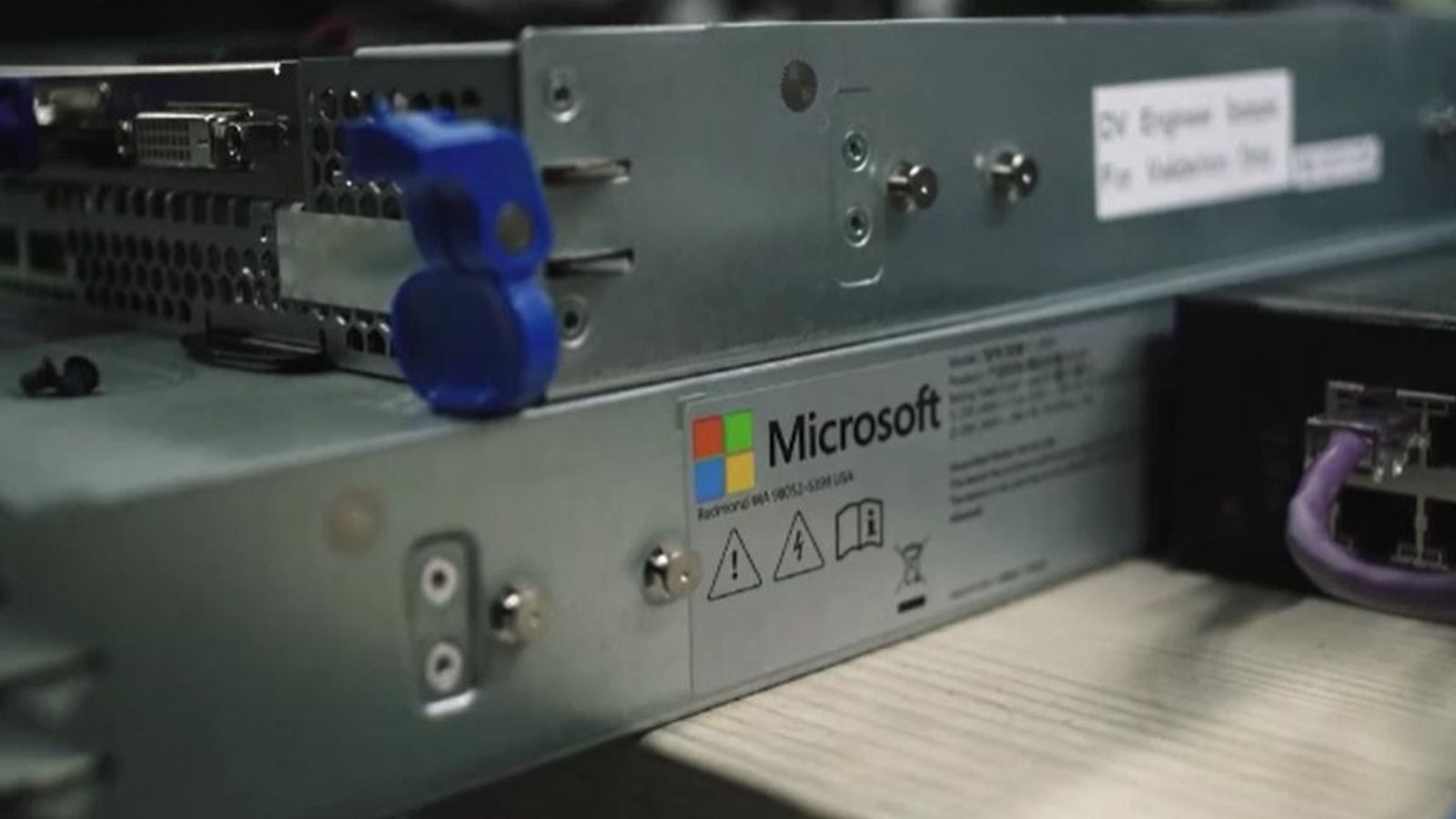
‘AI skills for more than a million people’ through Microsoft UK investment


Microsoft says its £2.5bn UK investment will enable more than a million people to gain crucial skills in the burgeoning sphere of artificial intelligence (AI).
The US tech firm’s president, Brad Smith, said its three-year programme led by datacentre expansion from 2026 was “the most important infrastructure of the second quarter of the 21st century”.
Training and partnership programmes, the latter concentrating on AI safety and research with government and universities, are the other major elements.
Speaking on a visit to the construction site for the new London datacentre, Chancellor Jeremy Hunt said it was a “massive day in the UK’s ambition to be the next Silicon Valley” and a “massive vote of confidence by Microsoft who do think the UK is going to be the next Silicon Valley”.
The £2.5bn investment was announced earlier this week as part of almost £30bn in foreign direct investment secured by the government ahead of its Global Investment Summit.
Under details released on Thursday, the Treasury said Microsoft was bringing more than 20,000 of the most advanced Graphics Processing Units (GPUs) – crucial for machine learning and the development of AI models – to the country.
Construction of Microsoft’s new datacentre in west London began earlier this year
“This is the single largest investment in its 40-year history in the country which will see Microsoft grow its UK AI infrastructure across sites in London and Cardiff and potential expansion into northern England, helping to meet the exploding demand for efficient, scalable and sustainable AI specific compute power,” the statement said.
Mr Smith said during a tour of the London site: “In this five-storey complex there will be put the world’s most advanced computer chips, the servers, they will provide the AI infrastructure for much of the UK.
“And we’re doing this in London, in Cardiff, in all probability in northern England. What we’re announcing today is Microsoft is investing £2.5bn in the next three years to build that infrastructure and then combining that with a programme to provide AI skills to more than a million people.”
The deal was confirmed a few months after the company had questioned whether the UK was a place to do business.

Why the change of heart for CMA?
It had appealed for ministers to intervene after its initial £55bn takeover of Call of Duty video game maker Activision Blizzard was blocked by the Competition and Markets Authority (CMA) in April.
The regulator later, and unusually, U-turned on its opposition when Microsoft offered a new remedy following the final ruling.
Read more business news:
Struggling Metro Bank to cut 800 jobs
Musk criticises fleeing advertisers
Shoppers ‘overcharged’ for branded goods
The government has always denied any interference.
Mr Hunt said of Microsoft’s investment: “The UK is the tech hub of Europe with an ecosystem worth more than that of Germany and France combined – and this investment is another vote of confidence in us as a science superpower.
“And it follows the £500m investment in Compute that I committed to in my autumn statement last week, taking our investment in advanced computing for AI to £1.5bn – a down payment on the jobs and economic growth it will bring to the UK.”

BP is parting ways with the chief executive who led its early drive for increased profits from oil and gas, after investor pressure for more progress.
It was announced after markets had closed in the US last night that Meg O’Neill, the head of Australia’s Woodside Energy since 2021, would take over from Murray Auchincloss.
He has spent less than two years in the role.
Money latest: Why a Bank of England rate cut is expected today
Mr Auchincloss was appointed following the sudden departure of renewables-focused Bernard Looney, who left under a cloud in 2023 amid a row with the board over the disclosure of relationships with BP colleagues.
Ms O’Neill will not only become BP’s first female boss when she takes over in April but also the first woman to lead one of the world’s top five oil firms.
Her appointment marks the first major move by BP’s new chairman Albert Manifold, who took over in October amid continued shareholder frustration over the progress of BP’s turnaround.
Meg O’Neill. Pic: BP
He is seeking a renewed push to improve returns as BP’s shares and earnings continue to lag those of rivals – a trend that has lasted for years.
The company embarked on a major strategy shift earlier this year, slashing billions in planned renewable energy initiatives and shifting its focus back to traditional oil and gas.
“Progress has been made in recent years, but increased rigor and diligence are required to make the necessary transformative changes to maximise value for our shareholders,” Mr Manifold said in a statement announcing the appointment.
Under Ms O’Neill’s leadership, Woodside merged with BHP Group’s petroleum arm to create a top 10 global independent oil and gas producer valued at $40bn and doubled Woodside’s oil and gas production.
Mr Manifold added: “Her proven track record of driving transformation, growth, and disciplined capital allocation makes her the right leader for BP.
“Her relentless focus on business improvement and financial discipline gives us high confidence in her ability to shape this great company for its next phase of growth and pursue significant strategic and financial opportunities.”

Murray Auchincloss had been in the top job for less than two years. Pic: AP
Mr Auchincloss said of his own exit: “After more than three decades with BP, now is the right time to hand the reins to a new leader.
“When Albert became chair, I expressed my openness to step down were an appropriate leader identified who could accelerate delivery of BP’s strategy. I am confident that bp is now well positioned for significant growth and I look forward to watching the company’s future progress and success under Meg’s leadership.”
Woodside shares fell by almost 3% on news of her looming departure – a clear sign of disappointment over her loss from the business.
Those for BP, however, were trading only 0.2% up in early trading on the FTSE 100. Rival energy shares were seeing better gains on the back of rising oil prices.
Michael Alfaro, chief investment officer at Gallo Partners, suggested the appointment signalled that BP wanted to “pursue a firm-wide push in natural gas”. “O’Neill is definitely respected, has a good track record of execution,” he said.
BP said that executive vice president Carol Howle would serve as its interim chief executive until Ms O’Neill assumes her role while Mr Auchincloss would stay on in an advisory role for up to a year.

The rate of inflation hit a much lower than expected 3.2% last month, according to official figures which should lock in an interest rate cut by the Bank of England on Thursday.
The Office for National Statistics (ONS) reported an easing in the pace of the main consumer prices index measure from the 3.6% annual rate seen in October.
The main downwards pressure came from food costs amid a supermarket price war to secure custom ahead of the core Christmas season.
Money latest: What the fall in inflation means for you
ONS chief economist Grant Fitzner noted decreases in the prices paid for cakes, biscuits and breakfast cereals in particular.
“Tobacco prices also helped pull the rate down, with prices easing slightly this month after a large rise a year ago”, he wrote.
“The fall in the price of women’s clothing was another downward driver.
“The increase in the cost of goods leaving factories slowed, driven by lower food inflation, while the annual cost of raw materials for businesses continued to rise.”
The data marked further downwards progress for the headline rate after a spike this year which economists have partly attributed to higher employment costs, imposed after the government’s first budget, being passed on to consumers.
This price wave has muddied the waters over the pace of interest rate reductions by the Bank, which has wanted to see more evidence that inflation is not being further stoked by factors including strong wage growth.
It will be encouraged by better than expected slowdowns in other closely-watched inflation measures which strip out volatile elements, such as food and energy, as well as services inflation.
Recent data has also shown intensifying weakness in the labour market, with the unemployment rate surging by a percentage point to 5.1% since Labour took office.
Separate ONS figures have also found that the economy contracted for two consecutive months in the run-up to Rachel Reeves’s second budget.
London Stock Exchange Group Data shows more than 90% of financial market participants are expecting the Bank to agree a rate cut to 3.75% – the lowest level in almost three years – from 4%.
The inflation data will come as a relief to the chancellor after a tough few months for her politically given the wider economic data and backlash over the Treasury’s handling of the lead up to the budget.
Ms Reeves said: “I know families across Britain who are worried about bills will welcome this fall in inflation.
“Getting bills down is my top priority. That is why I froze rail fares and prescription fees and cut £150 off average energy bills at the budget this year.
“The Bank of England agree this will help cut prices and expect inflation to fall faster next year as a result.”
You’ve doubtless heard of the National Grid, the network of pylons and electricity infrastructure ensuring the country is supplied with power. You’re probably aware that there is a similar national network of gas pipelines sending methane into millions of our boilers.
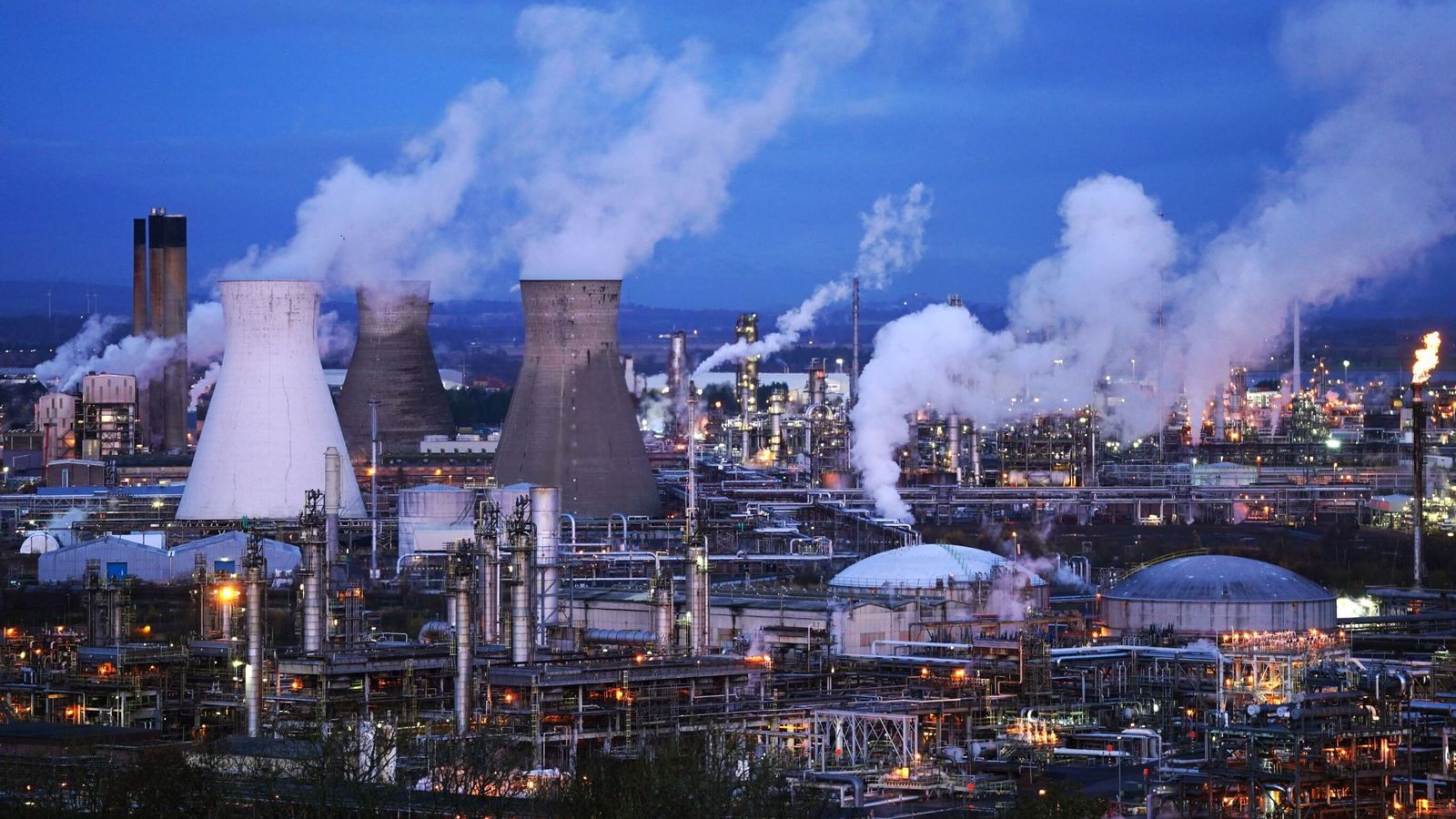
But far fewer people, even among the infrastructure cognoscenti, are even faintly familiar with the UK Ethylene Pipeline System. Yet this pipeline network, obscure as it might be, is one of the critical parts of Britain’s industrial infrastructure. And it’s also a useful clue to help explain why the government has just announced it’s spending more than £120m to bail out the chemical plant at Grangemouth in Scotland.
Ethylene is one of those precursor chemicals essential for the manufacture of all sorts of everyday products. React it with terephthalic acid and you end up with polyester. Combine it with chlorine and you end up with PVC. And when you polymerise ethylene itself you end up with polyethylene – the most important plastic in the world.
Why Grangemouth matters
Ethylene is, in short, a very big deal. Hence, why, many years ago, a pipeline was built to ensure Britain’s various chemical plants would have a reliable supply of the stuff. The pipes connected the key nodes in Britain’s chemicals infrastructure: the plants in the north of Cheshire, which derived chemicals from salt, the vast Wilton petrochemical plant in Teesside and, up in Scotland, the most important point in the network – Grangemouth.
The refinery would suck in oil and gas from the North Sea and turn it into ethane, which it would then “crack”, an energy-hungry process that involves heating it up to phenomenally high temperatures. Some of that ethylene would be used on site, but large volumes would also be sent down the pipeline. It would be pumped down to Runcorn, where the old ICI chlor-alkali plant, now owned by INEOS, would use it to make PVC. It would be sent to Wilton, where it would be turned into polyethylene and polyester.
Read more from Ed Conway:
The reality of Trump’s trade war
The reason for Trump’s Venezuela exploits
That’s the first important thing to grasp about this network – it is essential for the operation of a whole series of plants, many of them run by entirely different companies.
The second key thing to note is that, after the closure of the cracker at Wilton (now owned by Saudi company Sabic) and the ExxonMobil plant at Mossmorran in Fife, Grangemouth is the last plant standing. While the refinery no longer uses North Sea oil and gas, instead shipping in ethane from the US, it still makes its own ethylene.
So when INEOS began consulting on plans to close that ethylene cracker, officials down south in Westminster began to panic. The problem wasn’t just the 500 or so jobs that might have been lost in Grangemouth. It was the domino effect that would feed throughout the sector. All of a sudden, all those plants at the other ends of the pipeline would be affected too. In practice, the closure might have eventuated in more than a thousand job losses – maybe more.
What’s happening now?
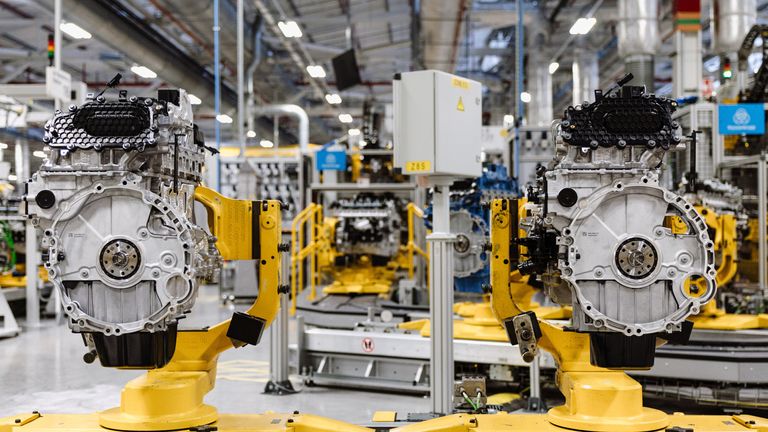
All of which helps explain the news today – that the Department for Business and Trade is putting more than £120m of taxpayer money into the site. The bailout (it’s hard to see it as anything but) is not the first. The government has also put hundreds of millions of pounds of taxpayer money into British Steel, which it quasi-nationalised earlier this year, not to mention extra cash into Tata Steel at Port Talbot and loan guarantees to help Jaguar Land Rover after it faced an unprecedented cyber attack.
Work ground to a halt at JLR’s Wolverhampton factory after a cyber attack. Pic: PA
But while this package will undoubtedly provide Christmas cheer here in Grangemouth today, the government is left facing two distinct problems.
Reactive rather than strategic
The first is that for all that the chancellor and business secretary (who are themselves planning to visit Grangemouth today) are keen to pitch this latest move as a coherent part of their industrial strategy, it’s hard not to see it as something else. Far from appearing strategic, instead they seem reactive. To the extent that they have a coherent industrial strategy, it mostly seems to involve forking out public money when a given plant is close to closure. If they weren’t already, Britain’s industrialists will today be wondering to themselves: what would it take to get ourselves some of this money in future?
The crisis continues
The second issue is that the Grangemouth bailout is very unlikely to end the crisis spreading across Britain’s chemicals sector. A series of plants – some prominent, others less so – have closed in the past few years. The chemicals sector – once one of the most important in the economy – has seen its economic output drop by more than 20% in the past three years alone.
This is not just a UK-specific story. Something similar is happening across much of Europe. But for many chemicals companies, it simply doesn’t add up to invest and build in the UK any more – a product in part of regulations and in part of high energy costs. In short, this story isn’t over yet. There will be more twists and turns to come.
-
 Sports2 years ago
Story injured on diving stop, exits Red Sox game
-
 Sports3 years ago
‘Storybook stuff’: Inside the night Bryce Harper sent the Phillies to the World Series
-
 Sports2 years ago
Game 1 of WS least-watched in recorded history
-
 Sports3 years ago
Button battles heat exhaustion in NASCAR debut
-
 Sports3 years ago
MLB Rank 2023: Ranking baseball’s top 100 players
-
Sports4 years ago
Team Europe easily wins 4th straight Laver Cup
-
 Environment3 years ago
Japan and South Korea have a lot at stake in a free and open South China Sea
-
 Environment1 year ago
Here are the best electric bikes you can buy at every price level in October 2024