
BBC licence fee: Minister ‘concerned’ planned rise is ‘very high’ amid reports it could be scrapped

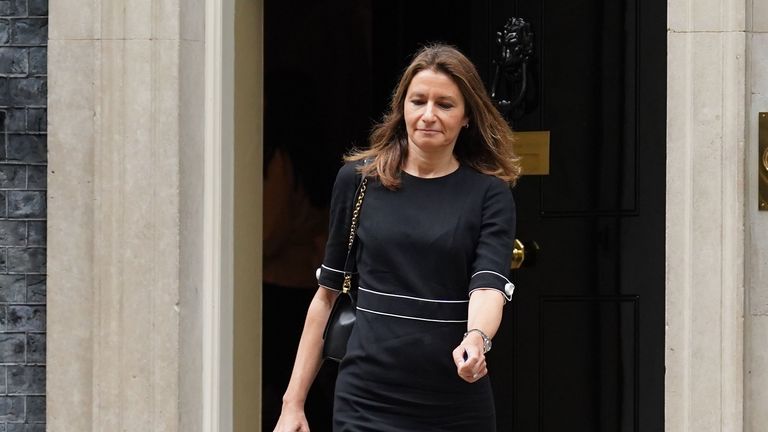
The culture secretary has said she is concerned the planned 9% rise in the BBC licence fee is “very high” and that the BBC must remain “value for money”.
Lucy Frazer said the government wanted to ensure the licence fee rises by an “appropriate amount” amid the ongoing cost of living crisis.
The licence fee is currently £159 per year but is due to increase by 9% or £15 to £173.30 in April.
Asked by Sky News’s Kay Burley whether the planned rise would not happen due to the government’s concerns, Ms Frazer replied: “I’m concerned that that’s a very high level.
“It’s a decision that I’m looking at the moment and we’ll be making an announcement on this very shortly.”
Pressed again on whether the rise would not go ahead, Ms Frazer replied: “Well, I’m concerned about that level of rise. So it’s something that we’re looking at very carefully.”
Culture Secretary Lucy Frazer
Ms Frazer said that although she believed the BBC provided a “fantastic service” and was an “amazing tool for soft power”, the “media landscape is changing” and the licence fee must be “fair to people”.
She said 400,000 people did not renew their licence fees last year and that’s why she was also “doing a broader review on the licence fee in the round and how we should fund the BBC”.
Prime Minister Rishi Sunak told reporters over the weekend that the BBC should be “realistic about what it can expect people to pay at a time like this”.
“I think it is welcome that the BBC are looking at making savings and efficiencies in how they operate,” he said.
“It’s really important that when things are difficult everyone is doing what they can to ease the cost of living on families.
“That’s certainly what I have done over the last year and made a bunch of decisions that haven’t been easy, but that’s helped to bring inflation down to ease the burden and the cost of living.
“The BBC like any other organisation that serves the public should be looking to do that and cut its cloth appropriately so I think that is very welcome.”
He added: “Final decisions haven’t been taken obviously – but the BBC should be realistic about what it can expect people to pay at a time like this.”
Read more:
What could alternative funding methods look like?
BBC Newsnight to be cut to 30 minutes
The government is currently looking at whether to replace the £159-a-year licence fee with a new funding model after 2027, when the BBC’s current Royal Charter ends.
The licence fee is due to start rising again with inflation from April after a two-year freeze.
Non-payment of the licence fee is a crime and is enforced by door-stepping inspectors.
Almost 1,000 people a week – seven out of 10 of whom are women – are prosecuted for evasion.
Asked whether pensioners should be “locked up if they don’t pay their licence fee”, Ms Frazer said: “I’m not in favour of criminalisation and it’s one of the things that we will be looking at in the charter review.”
A BBC spokesperson said: “The government and BBC agreed a six-year licence fee settlement in January 2022, which froze the licence fee for two years with increases in line with inflation from 2024.
“As is usual practice the government sets and confirms the cost of a licence each year and this remains unconfirmed for 2024/25.
“The BBC will continue to focus on what it does best: working to deliver world-class content and providing great value for all audiences.”

The nine largest US banks restricted financial services to politically contentious industries, including cryptocurrency, between 2020 and 2023, according to the preliminary findings of the Office of the Comptroller of the Currency (OCC).
The banking regulator said on Wednesday that its early findings show that major banks “made inappropriate distinctions among customers in the provision of financial services on the basis of their lawful business activities” across the three-year period.
The banks either implemented policies restricting access to banking or required escalated reviews and approvals before giving financial services to certain customers, the OCC said, without giving specific details.
The OCC initiated its review after President Donald Trump signed an executive order in August, directing a review of whether banks had debanked or discriminated against individuals based on their political or religious beliefs.
Crypto issuers and exchanges caught in restrictions
The OCC’s report found that in addition to crypto, the sectors that faced banking restrictions included oil and gas exploration, coal mining, firearms, private prisons, tobacco and e-cigarette manufacturers and adult entertainment.
Banks’ actions toward crypto included restrictions on “issuers, exchanges, or administrators, often attributed to financial crime considerations,” the OCC said.

“It is unfortunate that the nation’s largest banks thought these harmful debanking policies were an appropriate use of their government-granted charter and market power,” said Comptroller of the Currency Jonathan Gould.
“While many of these policies were undertaken in plain sight and even announced publicly, certain banks have continued to insist that they did not engage in debanking,” he added.
The OCC examined JPMorgan Chase, Bank of America, Citibank, Wells Fargo, US Bank, Capital One, PNC Bank, TD Bank and BMO Bank, the largest national banks it regulates.
The OCC reported that it is continuing its investigation and could refer its findings to the Justice Department.
OCC debanking report leaves “much to be desired”
Nick Anthony, a policy analyst at libertarian think tank the Cato Institute, said in an emailed statement to Cointelegraph that the OCC’s report “leaves much to be desired” and didn’t mention “the most well-known causes of debanking.”
“The report criticizes banks for severing ties with controversial clients, but it fails to mention that regulators explicitly assess banks on their reputation,” he said.
Related: ‘Grow up… We debank Democrats, we debank Republicans:’ JPMorgan CEO
“Making matters worse, the report appears to blame banks for cutting ties with cryptocurrency companies, yet makes no mention of the fact that the [Federal Deposit Insurance Corporation] explicitly told banks to stay away from these companies,” Anthony added.
Republicans on the House Finance Committee reported earlier this month that the FDIC’s so-called “pause letters” it sent to banks under the Biden administration helped to spur “the debanking of the digital asset ecosystem.”
Caitlin Long, the founder and CEO of the crypto-focused Custodia Bank, said the “worst culprits” of crypto-related debanking under the Biden administration were the FDIC and Federal Reserve, “not OCC.”
“In OCC’s defense, this report covers large banks only. Crushing crypto wasn’t a supervisory priority for large banks like it was for small [and] mid-sized banks,” she added.
Magazine: Quitting Trump’s top crypto job wasn’t easy: Bo Hines
Politics
Live music venues warn of ‘devastating consequences’ of budget tax changes in letter to Sir Keir Starmer

Tax changes announced in the budget could have “devastating, unintended consequences” on live music venues, including widespread closures and job losses, trade bodies have warned.
The bodies, representing nearly 1,000 live music venues, including grassroots sites as well as arenas such as the OVO Wembley Arena, The O2, and Co-op Live, are calling for an urgent rethink on the chancellor’s changes to the business rates system.
If not, they warn that hundreds of venues could close, ticket prices could increase, and thousands could lose their jobs across the country.
Politics latest: Ex-Olympic swimmer nominated for peerages
Business rates, which are a tax on commercial properties in England and Wales, are calculated through a complex formula of the value of the property, assessed by a government agency every three years. That is then combined with a national “multiplier” set by the Treasury, giving a final cash amount.
The chancellor declared in her budget speech that although she is removing the business rates discount for small hospitality businesses, they would benefit from “permanently lower tax rates”. The burden, she said, would instead be shifted onto large companies with big spaces, such as Amazon.
But both small and large companies have seen the assessed values of their properties shoot up, which more than wipes out any discount on the tax rate for small businesses, and will see the bills of arena spaces increase dramatically.
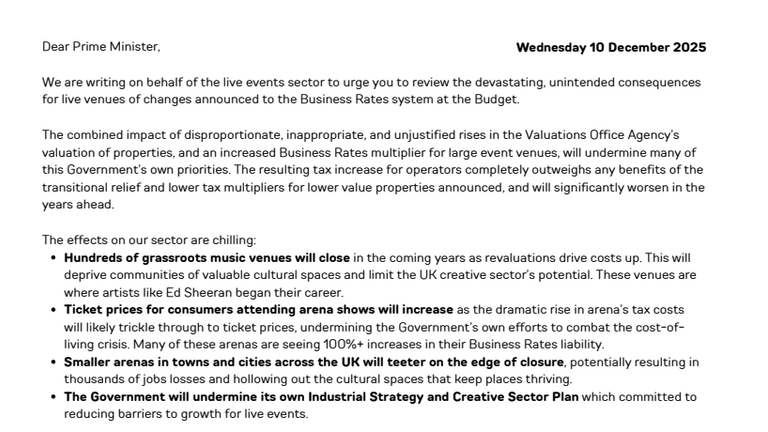
In the letter, coordinated by Live, the trade bodies write that the effect of Rachel Reeves’s changes are “chilling”, saying: “Hundreds of grassroots music venues will close in the coming years as revaluations drive costs up. This will deprive communities of valuable cultural spaces and limit the UK creative sector’s potential. These venues are where artists like Ed Sheeran began their career.
“Ticket prices for consumers attending arena shows will increase as the dramatic rise in arena’s tax costs will likely trickle through to ticket prices, undermining the government’s own efforts to combat the cost of living crisis. Many of these arenas are seeing 100%+ increases in their business rates liability.
“Smaller arenas in towns and cities across the UK will teeter on the edge of closure, potentially resulting in thousands of jobs losses and hollowing out the cultural spaces that keep places thriving.”
The full letter from trade bodies to the prime minister.
They go on to warn that the government will “undermine its own Industrial Strategy and Creative Sector Plan which committed to reducing barriers to growth for live events”, and will also reduce spending in hotels, bars, restaurants and other high street businesses across the country.
To mitigate the impact of the tax changes, they are calling for an immediate 40% discount on business rates for live venues, in line with film studios, as well as “fundamental reform” to the system used to value commercial properties in the UK, and a “rapid inquiry” into how events spaces are valued.
Sky’s Jess Sharp explains how the budget could impact your money
In response, a Treasury spokesperson told Sky News: “With Covid support ending and valuations rising, some music venues may face higher costs – so we have stepped in to cap bills with a £4.3bn support package and by keeping corporation tax at 25% – the lowest rate in the G7.
“For the music sector, we are also relaxing temporary admission rules to cut the cost of bringing in equipment for gigs, providing 40% orchestra tax relief for live concerts, and investing up to £10m to support venues and live music.”
The warning from the live music industry comes after small retail, hospitality and leisure businesses warned of the potential for widespread closures due to the changes to the business rates system.
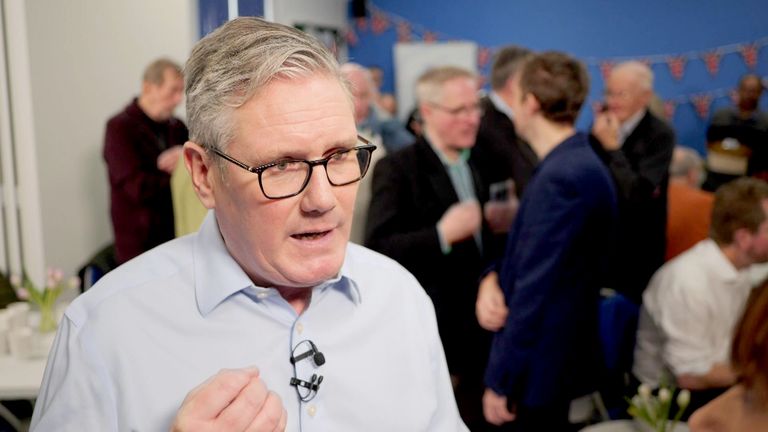
Sky’s political editor Beth Rigby challenged Prime Minister Sir Keir Starmer on the tax rises in the budget.
Sky News reported after the budget that the increase in business rates over the next three years following vast increases in the assessed values of commercial properties has left small retail, hospitality and leisure businesses questioning whether their businesses will be viable beyond April next year.
Analysis by UK Hospitality, the trade body that represents hospitality businesses, has found that over the next three years, the average pub will pay an extra £12,900 in business rates, even with the transitional arrangements, while an average hotel will see its bill soar by £205,200.
Read more: Hospitality pleads for ‘lifeline’
A Treasury spokesperson said their cap for small businesses will see “a typical independent pub pay around £4,800 less next year than they otherwise would have”.
“This comes on top of cutting licensing costs to help more venues offer pavement drinks and al fresco dining, maintaining our cut to alcohol duty on draught pints, and capping corporation tax,” they added.
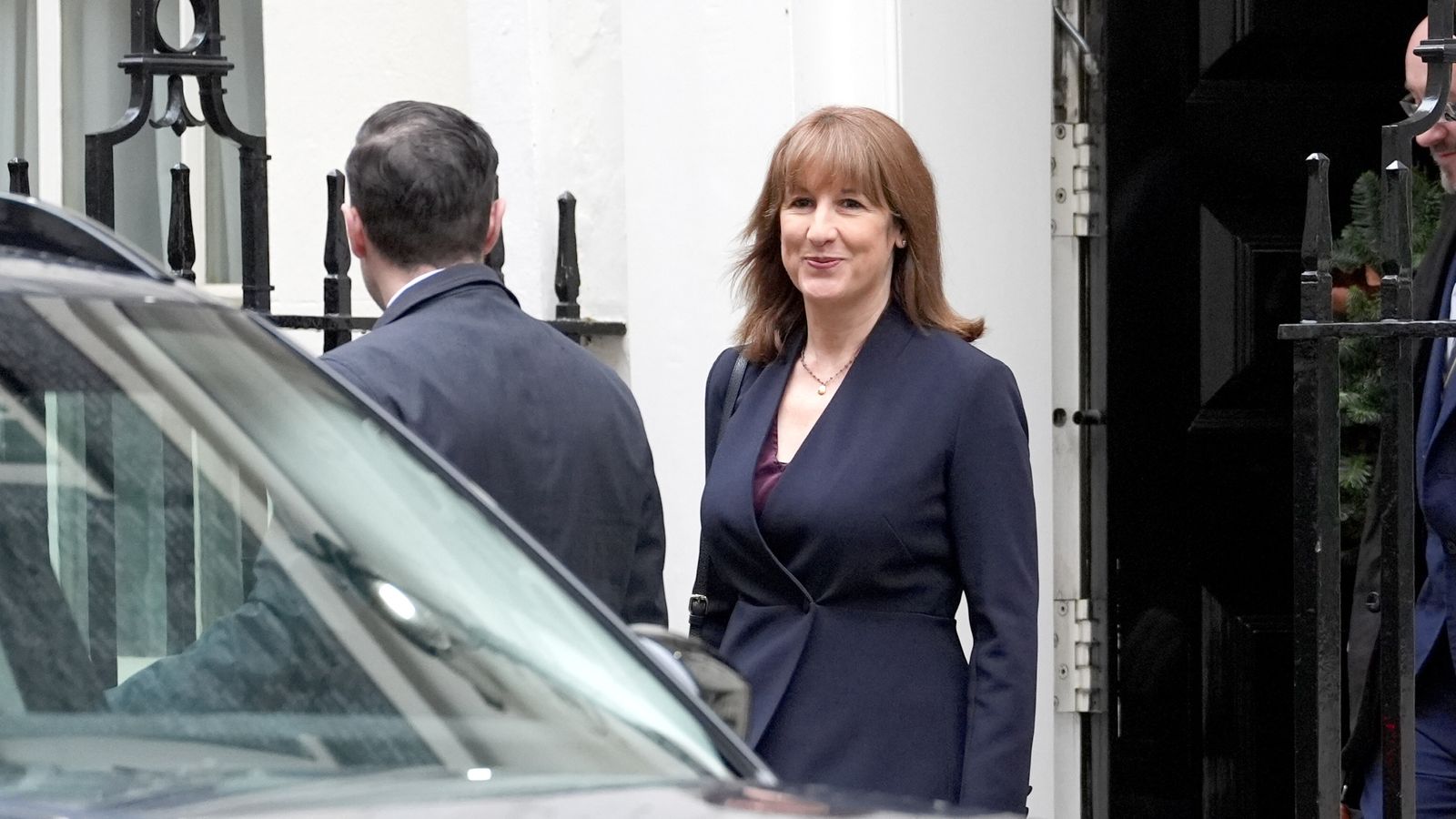
The Chancellor Rachel Reeves has acknowledged there were “too many leaks” in the run-up to last month’s budget.
The flow of budget content to news organisations was “very damaging”, Ms Reeves told MPs on the Treasury select committee on Wednesday.
“Leaks are unacceptable. The budget had too much speculation. There were too many leaks, and much of those leaks and speculation were inaccurate, very damaging”, she said.
Money blog: Nine-year-old set up Christmas tree business to pay for university
The cost of UK government borrowing briefly spiked after news reports that income taxes would not rise as first expected and Labour would not break its manifesto pledge.
An inquiry into the leaks from the Treasury to members of the media is to take place. But James Bowler, the Treasury’s top official, who was also giving evidence to MPs, would not say the results of it would be published.
Committee chair Dame Meg Hillier asked if the group of MPs could see the full inquiry.
“I’d have to engage with the people in the inquiry about the views on that”, replied Mr Bowler, permanent secretary to the Treasury.
OBR leak ‘a mistake of such gravity’
The entire contents of the budget ended up being released 40 minutes early via independent forecasters, the Office for Budget Responsibility (OBR).
A report into this error found the OBR had uploaded documents containing their calculations of budget numbers to a link on the watchdog’s website it had mistakenly believed was inaccessible to the public.
Tax rises ruled out
The chancellor ruled out future revenue-raising measures, including applying capital gains tax to primary residences and changing the state pension triple.
Committee member and former chair Dame Harriet Baldwin had noted that the chancellor’s previous statement to the MPs when she said she would not overhaul council tax and look at road pricing, turned out to be inaccurate.
During the budget, an electric vehicle charge per mile was introduced, as was an additional council tax for those with properties worth £2m or more.
-
 Sports2 years ago
Story injured on diving stop, exits Red Sox game
-
 Sports3 years ago
‘Storybook stuff’: Inside the night Bryce Harper sent the Phillies to the World Series
-
 Sports2 years ago
Game 1 of WS least-watched in recorded history
-
 Sports3 years ago
Button battles heat exhaustion in NASCAR debut
-
 Sports3 years ago
MLB Rank 2023: Ranking baseball’s top 100 players
-
Sports4 years ago
Team Europe easily wins 4th straight Laver Cup
-
 Environment3 years ago
Japan and South Korea have a lot at stake in a free and open South China Sea
-
 Environment1 year ago
Here are the best electric bikes you can buy at every price level in October 2024