
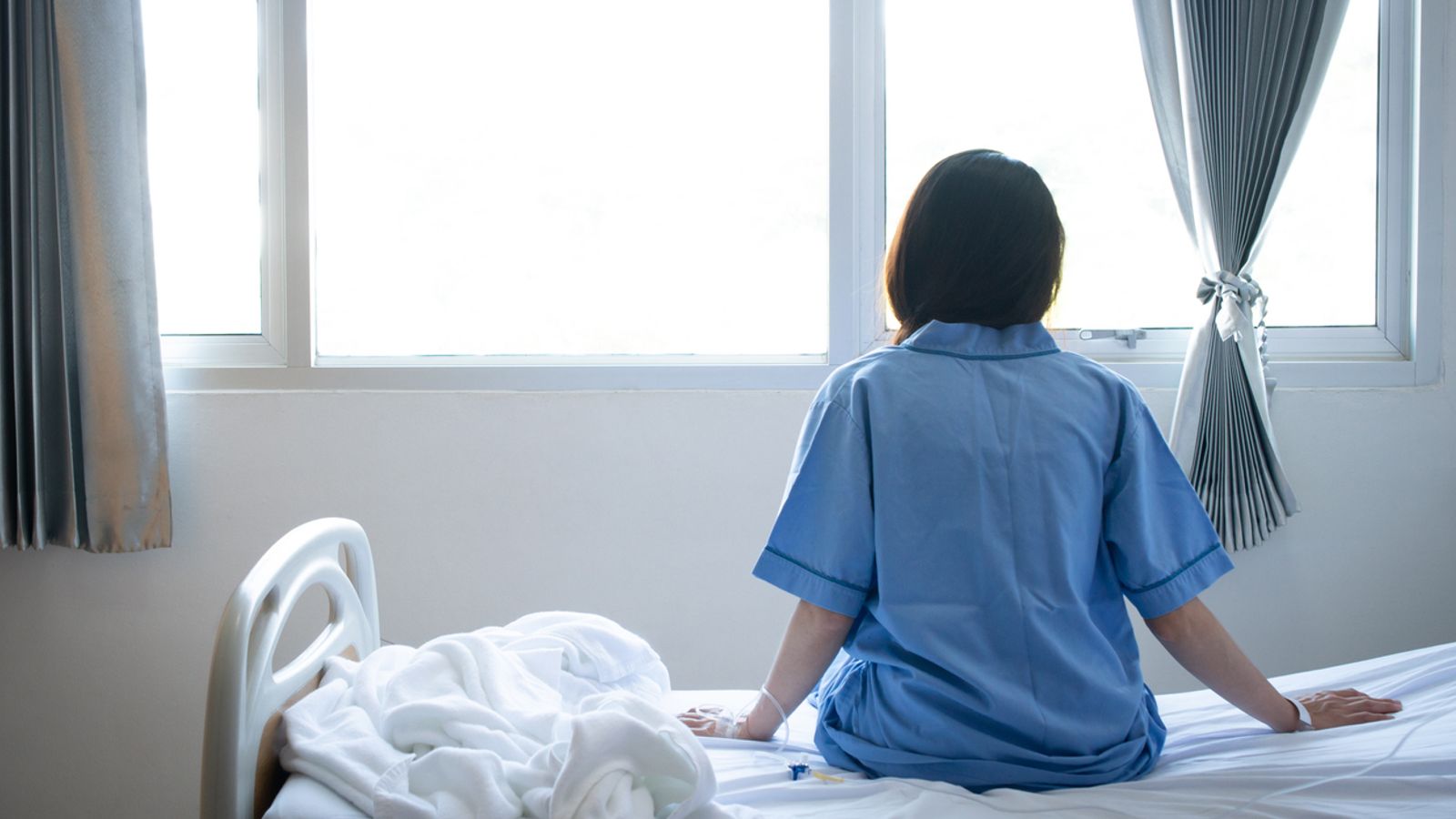
‘They did nothing’: Dozens of NHS mental health inpatients make fresh rape and sexual assault allegations

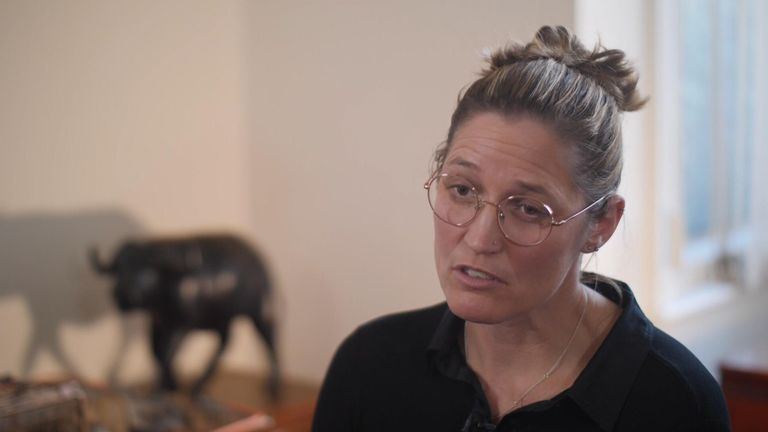
Dozens of new allegations of abuse – including claims of multiple rapes of one patient and another with a mental disorder who fell pregnant after sex with a staff member – have emerged against NHS trusts following an investigation by Sky News and The Independent.
The fresh cases came to light as NHS England says it doesn’t enforce “vital” government-backed guidelines around sexual safety on mental health inpatient wards.
As part of a joint Patient 11 podcast investigation, Sky News and The Independent, last week revealed 20,000 new complaints of sexual abuse, harassment and rape, involving patients and staff, across more than 30 NHS England mental health trusts since 2019.
Click to subscribe to Storycast wherever you get your podcasts
Significantly, the investigation also revealed that out of more than 50 contacted, only six trusts demonstrated that they’re applying 2020 government-backed protections – The Sexual Safety Collaborative – developed with and described as “vital” by the Royal College of Psychiatrists.
But this week – after more than 40 former patients, their families, and current patients contacted Sky News and The Independent with yet more claims of sexual assault and rape in psychiatric care facilities – NHS England said these protection guidelines, which it cites as key in terms of patient safety, are not mandated or enforced.
The admission comes during a week-long national awareness campaign around sexual abuse and sexual violence.
Among the 40-plus cases brought to the attention of Sky News is a former taxi driver who alleges that she was raped by two staff members at the same time while she was a psychiatric patient in Doncaster in 2017.
Another is the mother of a current mental health inpatient who fell pregnant as a result of sexual intercourse with a staff member when an inpatient at the Priory Hospital in Surrey.
And a teaching student alleges that after complaining to staff that she’d been sexually assaulted in a mixed-care setting, she found herself returned to the same mixed environment as the male patient she’d complained against.
Following the findings of the Patient 11 podcast investigation – sparked by the witness testimony and escape from psychiatric care of Alexis Quinn after two complaints of sexual assault – the health secretary said claims of sexual assault and rape would be part of a national review of care on mental health wards.
The government move was immediately branded as “insufficient” by Ms Quinn.
Now former patients have come forward with fresh claims and calls for a national inquiry.
Read more:
Claims to be reviewed after Sky News investigation
‘There needs to be an inquiry’
Jacqueline Dean, a mother and former taxi driver, alleges that she was drugged and raped by two male staff members at the same time when she was a sectioned mental health inpatient at Tickhill Road Hospital in Doncaster in 2017.
“I wasn’t even able to move, I was paralysed,” she claims. “I could see everything. I could feel everything, [but] I couldn’t do anything. Not anything at all.”
“There needs to be an inquiry,” she added. “People need to know what’s gone on.”
Responding to her allegations, Rotherham, Humber and Doncaster NHS Foundation Trust – which previously failed to reply to a Sky News freedom of information request asking for data on sexual abuse complaints – said: “We can confirm that six years ago, the organisation received a complaint, which was investigated at the time.
“Ourselves and the police concluded that we should not proceed further, as they did not believe that a crime had been committed.
“If new information is now available, we would welcome contact from the complainant which we will consider.”
Patient fell pregnant after ‘sex with staff member’
Ms Dean has now called for an inquiry, a sentiment echoed by one mother from the New Forest, whose mentally ill daughter fell pregnant after having sex with a staff member while an inpatient at the Priory in Surrey in 2019.
Subsequently, the male staff member at the centre of the incident was charged by police.
A spokesperson for the Priory in Surrey said: “As soon as we became aware of this incident in 2019, we made the necessary safeguarding referrals, and informed the police and the employment agency concerned.
“The agency staff member was immediately excluded from working within our services and subsequently convicted.”
The Priory said it has since enhanced its reporting processes and training.
As part of the Sky News/The Independent Patient 11 investigation, 500 allegations of rape or sexual assault in mixed wards or care spaces were identified across more than 20 trusts.
‘They did nothing’
In 2022, Serena – not her real name – was being treated as a mental health inpatient in Langley Green Hospital under the care of Sussex Partnership NHS Trust.
Serena entered care with complex post-traumatic stress disorder as a result of abuse suffered as a child.
While there, the now university student claims she was sexually assaulted in a shared male and female common area.
“I was assaulted by another patient,” she explained. “It was touching the leg going up to, you know, where you don’t ever need to go.
“Because of my history, I went to the nurses’ station to tell them what happened, that I was upset and didn’t feel comfortable [but] they did nothing apart from to tell him [the male patient] not to talk to me.”
Serena claims that despite her complaint, she was left exposed to the male patient she’d complained about after being returned to a mixed-gender care environment.
“It was [like] just another day at the office,” she said.
A spokesperson for Sussex Partnership NHS Foundation Trust said: “With this alleged incident, we urge the person affected to get in touch with us or report it to the police.
“In circumstances where there are allegations of this nature, our priority is to ensure the safety of the patient – offering support and putting appropriate safeguarding measures in place.
“We are committed to learning from any incidents, especially if someone feels they have not received the appropriate support.”
‘I’m just being traumatised’
‘Sexual violence is unacceptable’
In response to our latest findings, NHS England said it has asked trusts to appoint domestic abuse and sexual violence leads as part of a zero-tolerance approach to keep patients and staff safe from sexual misconduct and violence.
NHS England also said that it is a mandatory requirement for trusts to share all the information they receive with the Care Quality Commission (CQC) on a weekly basis.
Last week, when Sky News first revealed the findings of its investigation, NHS England said: “We are taking action to ensure the safety of patients and staff, including rolling out better reporting mechanisms, training and support as part of the NHS’s new Sexual Safety Charter.
“NHS England has advised all trusts and local health systems to appoint a domestic abuse and sexual violence lead to support patients and staff to report incidents and access support, with more than 300 now in place.”
A Department of Health spokesperson said: “Sexual violence or misconduct of any kind is unacceptable and has no place in the NHS, and NHS organisations have a responsibility to protect both staff and patients.
“We are working closely with the NHS to ensure anyone receiving treatment in a mental health facility receives safe, high-quality care, and is looked after with dignity and respect.”
If you have a story about a similar experience in NHS psychiatric care contact StoryCast@sky.uk
UK
Sharaz Ali found guilty of murdering ex-partner’s sister and her three children in Bradford house fire
A man has been found guilty of murdering his ex-partner’s sister and her three children in a house fire.
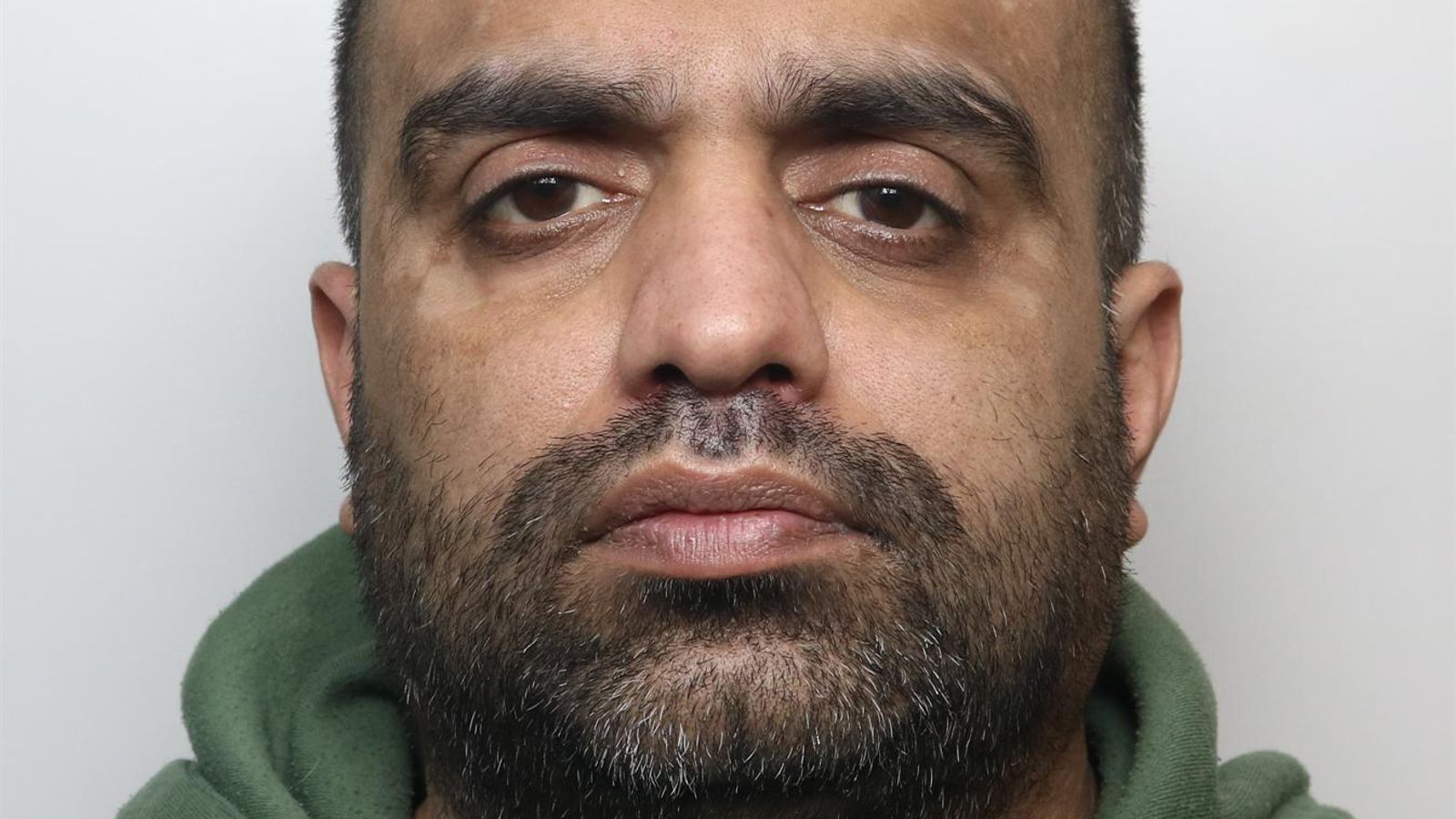
Prosecutors said Sharaz Ali, 40, was “motivated by jealousy and fuelled by drink and drugs” when he set fire to Bryonie Gawith’s home early on 21 August last year.
Jurors heard that Ali went to the home in Westbury Road, Bradford, aiming to “take revenge” on his ex, Antonia Gawith, who was staying there after ending their “abusive” seven-year relationship earlier that month.
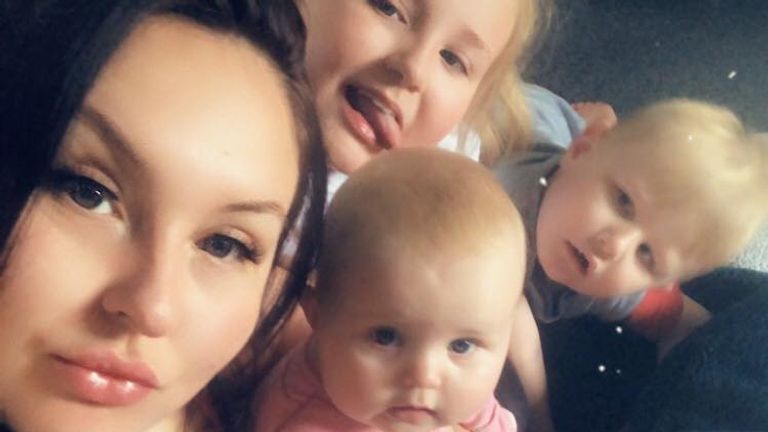
Antonia Gawith managed to escape, but Bryonie Gawith, 29, and her children Denisty Birtle, nine, Oscar Birtle, five, and 22-month-old Aubree Birtle died in the blaze.
Bryonie Gawith and her children Denisty, Oscar and Aubree Birtle died in the fire
Ali told a jury he had no intention of harming others when the house went up in flames, saying: “I didn’t want to hurt anyone but myself.”
But after a trial at Doncaster Crown Court, he was found guilty of four counts of murder and attempting to murder Antonia Gawith.
Calum Sunderland, 26, who went with Ali to the house and kicked the door in for him, was found guilty of the manslaughter of Bryonie Gawith and her three children, but cleared of the more serious charges of murder.
He was also cleared of attempted murder, and an alternative count of attempting to cause grievous bodily harm, in relation to Antonia Gawith.
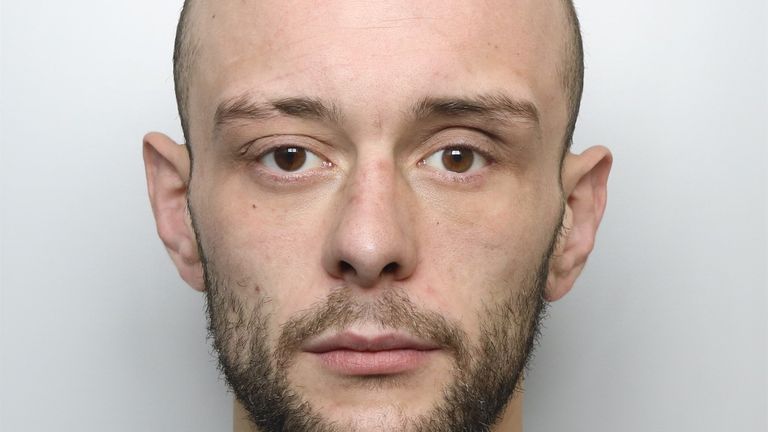
Calum Sunderland. Pic: West Yorkshire Police
Mohammed Shabir, 45, who had also been due to go on trial, died of a heart attack in October after collapsing in prison.
After the verdicts, the judge, Mr Justice Hilliard, thanked jurors and said the case had been “distressing beyond measure – three children and their mother murdered”.
“I don’t think anyone who heard Antonia’s desperate cries for help will ever forget them,” he said.
“These are truly dreadful crimes.”
The judge also praised the “extraordinary bravery” of those who tried to save the children trapped in the house.
Ali and Sunderland, a convicted arsonist, were driven to the house by Shabir, stopping on the way to fill a seven-litre canister with petrol, the court heard.
Doorbell footage captured Ali telling Sunderland, who was carrying the petrol and a lighter, to “kick the door in”, which he did before running back to the car.
Antonia Gawith said she saw an “angry” Ali run into the house and begin pouring petrol on her while shouting before setting himself and the house on fire.
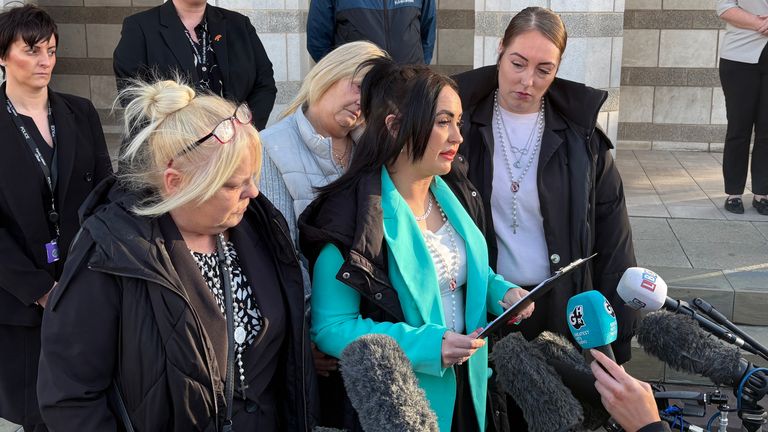
Antonia Gawith outside Doncaster Crown Court. Pic: PA
‘I couldn’t save them’
In a video interview played to jurors, she sobbed as she told police how she “couldn’t save” her sister, nieces and nephew, as she tried frantically to get back in the house through the back door.
“I was just screaming, trying to get back in the house and I couldn’t get in. I couldn’t save them,” she said.
Read more from Sky News:
‘Depraved predator’ jailed for rapes and sexual assaults
British soldier who died in Ukraine named
West Yorkshire Police’s Detective Chief Inspector Stacey Atkinson said: “Bryonie and her three children would still be alive today if it wasn’t for the horrific and truly callous actions of Ali and Sunderland that day.
“They left a mum and her three children completely helpless whilst her sister and their auntie watched on in horror.
“Our thoughts and sympathies are with the family, who despite their immense strength of character now face the rest of their lives without them.”
Senior Crown Prosecution Service prosecutor Amanda McInnes said Ali was a “selfish killer who had no regard for anyone but himself”.
“He was motivated by jealousy and his actions have now needlessly robbed a family of their loved ones,” she said.
“Both men played their role and caused the deaths of a young family who should still be with us today.”
UK
‘I didn’t know where to turn’: Why ethnic minorities with gambling addictions struggle to get help
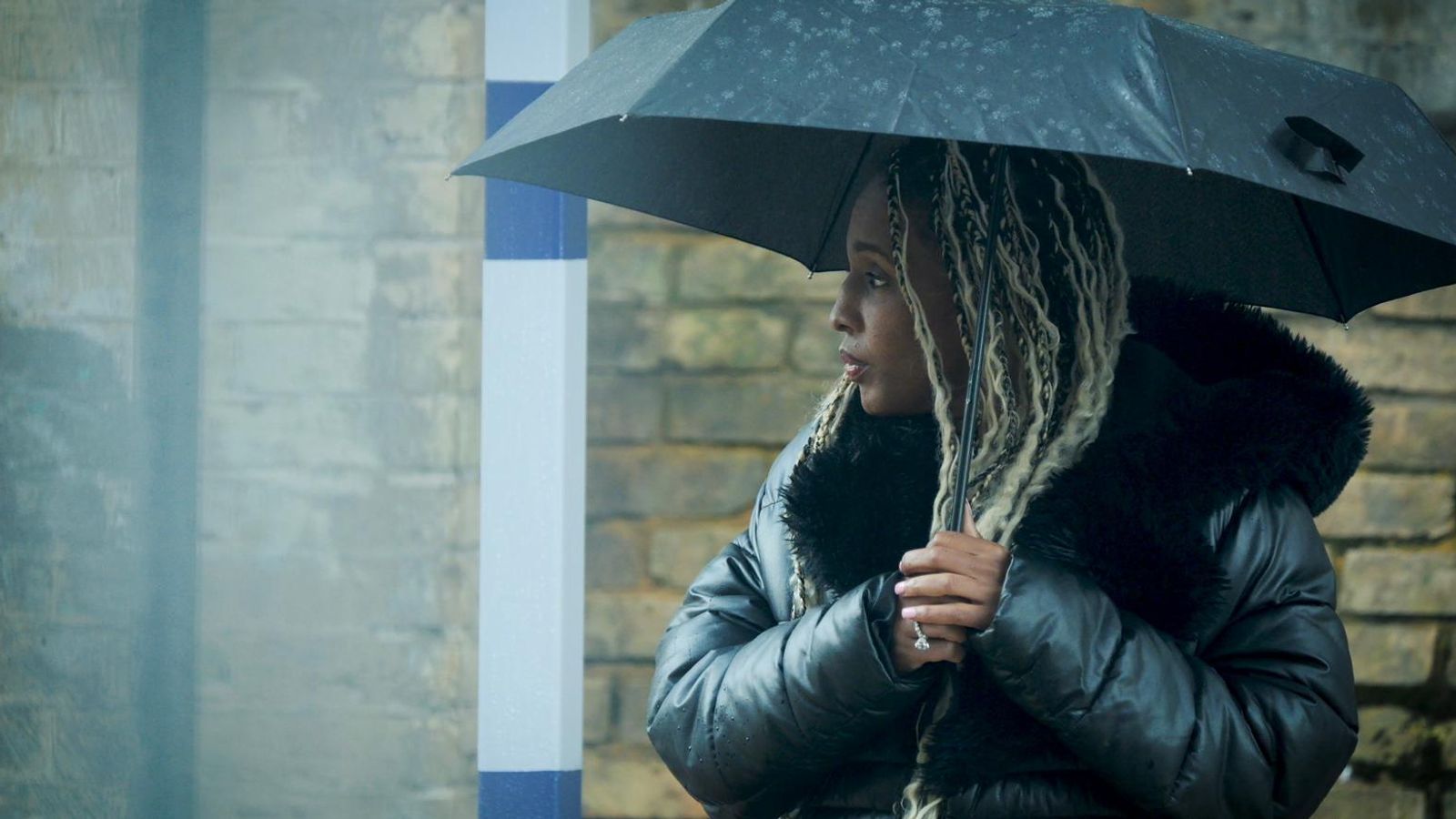
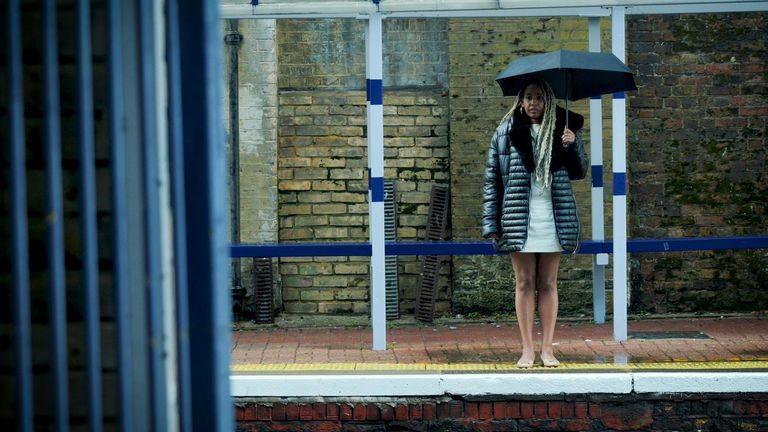
On a dark December morning two years ago, Kiki Marriott left her flat and started walking.
Content warning: This article contains references to suicide.
It was 5am, and she was heading for the station.
“I was numb at that point,” she says.
“I was just so done with trying to survive and just existing… feeling extremely lonely and isolated and didn’t know where to turn.”
She was trapped in a cycle of addiction, gambling all hours and taking cocaine for the maximum buzz.
‘I didn’t know where to turn,’ says Kiki
“I sat at the train station thinking about my daughter, thinking about the mistakes that I’ve made in the past, thinking that I didn’t want to live this life any more.”
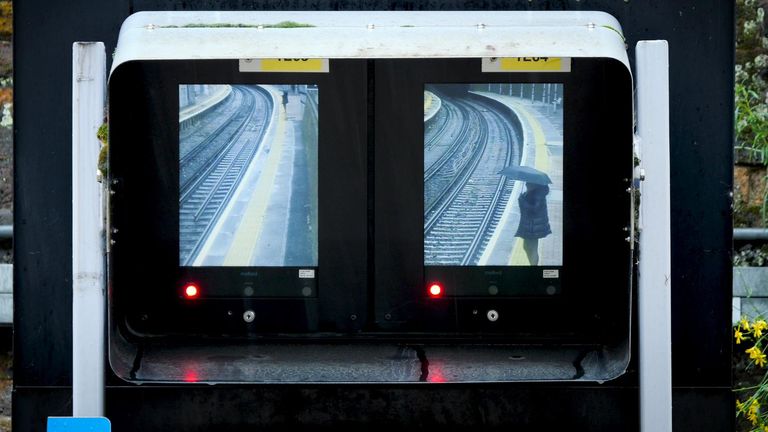
Kiki was waiting for the first train.
But that train was late. And she changed her mind.
Instead of taking her own life, she decided to seek help.
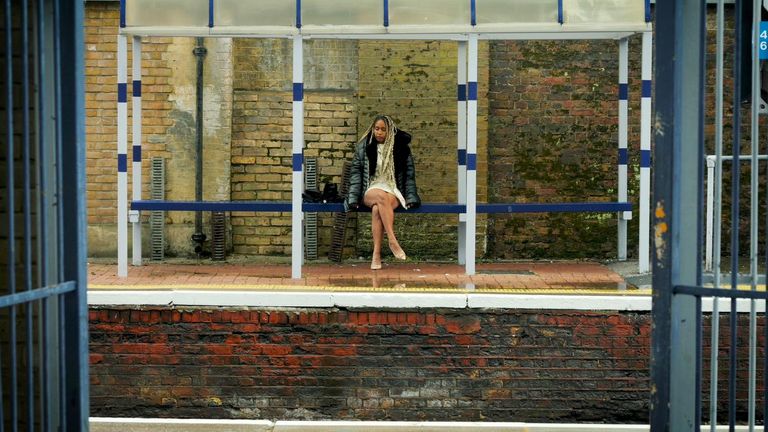
Yet what she would find on that journey of recovery would shock her.
“I just realised that there wasn’t anybody that looked like me, sounded like me, and it got me to thinking, well I can’t be the only black woman suffering with a gambling or cocaine addiction.”
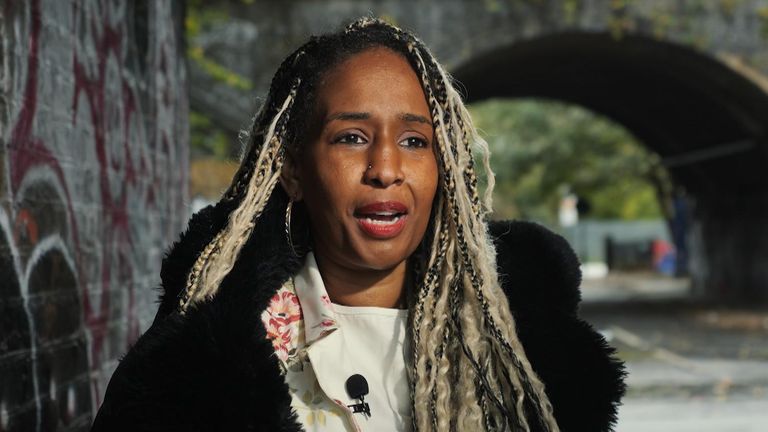
‘I can’t be the only black woman suffering addiction’
Racial disparities
Research has shown that people from ethnic minority backgrounds are less likely to gamble than white people, but are more likely to suffer harm from gambling.
Despite that, too often they do not seek help.
And YouGov statistics shared exclusively with Sky News shed a light on why.
The survey of 4,000 adults for GamCare, which runs the National Gambling Helpline, found that two-thirds of people from ethnic minority backgrounds who’d gambled in the past year had spent more money than they’d planned, double the amount of white respondents.
They were also more than twice as likely to hide their gambling and nearly three times as likely to feel guilt.
Kiki is not surprised.
“For me, coming from a black community, a black background, what goes on indoors stays behind closed doors,” she says.
“You keep your mouth shut, and you handle your business yourself.”
And when she considered what an addict looked like, it wasn’t someone like her.
“I just thought it’s an old white man’s thing – that they go into the bookies, and they have a drink and they bet.
“I thought, well, that’s not me.”
But Dharmi Kapadia, a senior sociology lecturer from Manchester University, who focuses on racial inequality, thinks there’s more than just cultural pressure at play.
“These explanations of stigma have become dominant,” she says.
“We’ve found that what’s more important is that people don’t want to go and get help from gambling services because of previous racist treatment that they’ve suffered at the hands of other statutory services, for example, when they went to the GP.”
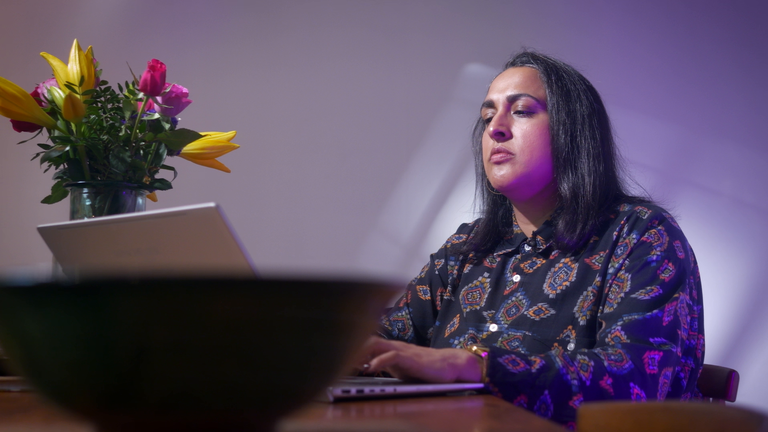
Dharmi Kapadia thinks there’s more than just cultural pressure at play
‘I needed to change’
The stigma felt very real for Kiki, so she hid what she was doing.
“I’ve had trauma in my life. I’ve been sexually abused as a child.
“As the years have gone on, a traumatic event happened in my family that really changed the dynamics of my life and that’s when I moved on from scratch cards to online slots.”
She became hooked – betting around the clock, spending her benefits on 10p and 20p spins on online slots and borrowing money from those around her.
Eventually her daughter moved out when she was 15.
“That’s when everything escalated. I didn’t have that responsibility of keeping up appearances.
“Before that, gas, electric, food shopping, all those things had to be in place.
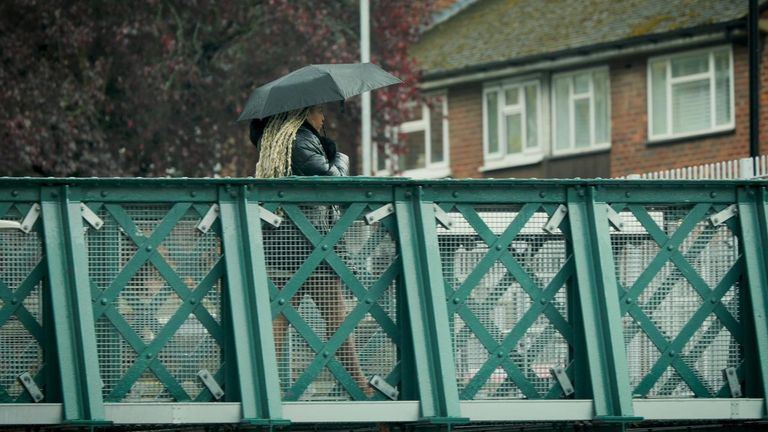
“I just lived and breathed in my bedroom at that point and yeah, it was very lonely.”
When Kiki left the station that day, she called the National Gambling Helpline.
“For the first time in my life, I was completely honest about everything that I was doing – the lies, the manipulation when I was in active addiction, the secrecy.
“I was completely transparent because I wanted to change. I needed to change.”
‘Where’s all the women?’
Since then, she has undergone constant therapy, including a six-week stint in rehab.
And as she headed home in the taxi, her phone rang.
It was Lisa Walker, a woman who understood gambling addiction. She had won £127,000 playing poker at 29 before losing everything and ending up homeless with her young children.
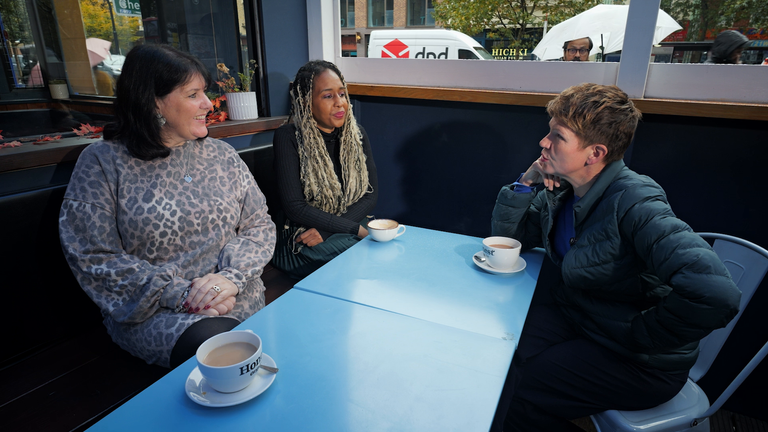
Lisa Walker (left) sought help from Gamblers Anonymous and was among very few women at her meetings
When she finally asked for help, she too felt she was different, walking into a Gamblers Anonymous meeting to find she was one of only two women in a room with 35 men.
“I was thinking, where’s all the women?” says Lisa.
“I can’t be the only woman in the world with a gambling addiction, so that got me thinking, what services are out there for women?”
It was the catalyst to set up support for female gamblers in April 2022.
Since then, Lisa has helped close to 250 women, but all but four have been white.
One of those four was Kiki.
‘There’s no getting away from it’
“It just baffles me… Why aren’t they reaching out for support? Is it the shame? Is it stigma?” says Lisa.
But another concern is that it’s simply too easy to hide the gambling.
“Getting on the train this morning, 90% of people are on their phones, and we don’t know whether they’re playing slots,” she says.
“I could probably sit here now and sign up for 50 online casinos and probably get over a thousand free spins.
“I just think there’s no getting away from it because it’s 24 hours a day.”
Kiki says she now has an ‘amazing’ relationship with her daughter
Kiki’s flat in Woolwich, where once she couldn’t even go to the bathroom without gambling, has become the place where she runs her own online peer mentoring groups.
“Feeling understood and validated for your experiences, for how you was raised… the core beliefs that you’re taught from a young age, to have somebody that looks like you, talks like you, has the same cultural background… it’s extremely important to make you feel understood, to make you feel validated,” she says.
‘You can learn from it’
Kiki will need to attend support groups for life to keep her addictions at bay.
But she has a clear goal, just as Lisa did.
“My focus is to help other people, help empower other people to choose themselves, to show them that there is light after so much darkness… that you don’t have to be a victim of your circumstances, that you can choose to grow from it and learn from it and heal from it,” she says.
For Kiki, there was so much at stake.
“It was either I was going to die or I was going to become a woman and a mother that my daughter could come back to and respect again.”
And that has happened. Kiki’s daughter is 19 now.
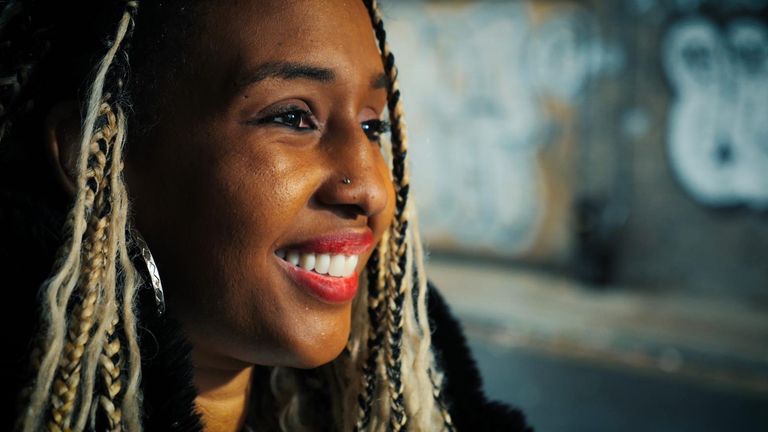
Kiki now helps others suffering from gambling addiction
“We’ve got an amazing relationship today. I’ve took full accountability for the mistakes that I’ve made.
“She’s extremely proud of where I am today.”
It’s more than Kiki could have dreamt of two years ago.
Now all she wants is to help others escape the endless cycle of addiction.
Anyone feeling emotionally distressed or suicidal can call Samaritans for help on 116 123 or email jo@samaritans.org in the UK. In the US, call the Samaritans branch in your area or 1 (800) 273-TALK
To speak to an adviser on the National Gambling Helpline, call 0808 8020 133

Sir Keir Starmer has declared it his “moral mission” to “turn the tide on the lost decade of young kids left as collateral damage”.
The government launches its 10-year youth plan today, which has pledged £500m to reviving youth services.
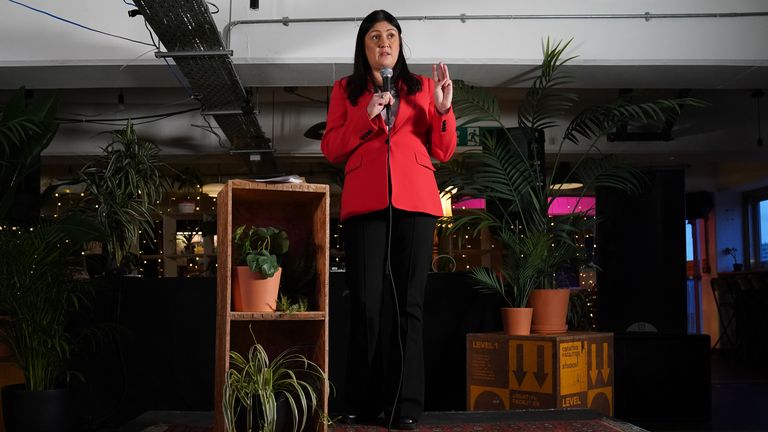
Culture Secretary Lisa Nandy has also warned that young people are now “the most isolated in generations” and face challenges that are “urgent and demand a major change in direction”.
But despite the strong language, the Conservatives have warned that “under Labour, the outlook for the next generation is increasingly bleak”.
Lisa Nandy is on Sky News from 7am – follow live
Launching the 10-year strategy, Sir Keir said: “As a dad and as prime minister, I believe it is our generation’s greatest responsibility to turn the tide on the lost decade of young kids left as collateral damage. It is our moral mission.
“Today, my government sets out a clear, ambitious and deliverable plan – investing in the next generation so that every child has the chance to see their talents take them as far as their ability can.”
What’s in the government’s strategy?
Under the plans, the government will seek to give 500,000 more young people across England access to a trusted adult outside their homes – who are assigned through a formal programme – and online resources about staying safe.
The prime minister said the plans will also “ensure” that those who choose to do apprenticeships rather than go to university “will have the same respect and opportunity as everyone else”.
The plan comes following a so-called “state of the nation” survey commissioned by Ms Nandy, which heard from more than 14,000 young people across England.
Launching the strategy, she said: “Young people have been crystal clear in speaking up in our consultation: they need support for their mental health, spaces to meet with people in their communities and real opportunities to thrive. We will give them what they want.”
Read more:
Child poverty strategy launched
Young people may lose benefits
Lisa Nandy will speak about the plan on Sky News on Wednesday morning. Pic: PA
But the Conservatives have criticised the government for scrapping the National Citizen Service (NCS), which ended in March this year.
Shadow culture secretary Nigel Huddlestone said “any renewed investment in youth services is of course welcome”, but said Labour’s “economic mismanagement and tax hikes are forcing businesses to close, shrinking opportunities while inflation continues to climb”.
-
 Sports2 years ago
Story injured on diving stop, exits Red Sox game
-
 Sports3 years ago
‘Storybook stuff’: Inside the night Bryce Harper sent the Phillies to the World Series
-
 Sports2 years ago
Game 1 of WS least-watched in recorded history
-
 Sports3 years ago
Button battles heat exhaustion in NASCAR debut
-
 Sports3 years ago
MLB Rank 2023: Ranking baseball’s top 100 players
-
Sports4 years ago
Team Europe easily wins 4th straight Laver Cup
-
 Environment3 years ago
Japan and South Korea have a lot at stake in a free and open South China Sea
-
 Environment1 year ago
Here are the best electric bikes you can buy at every price level in October 2024