

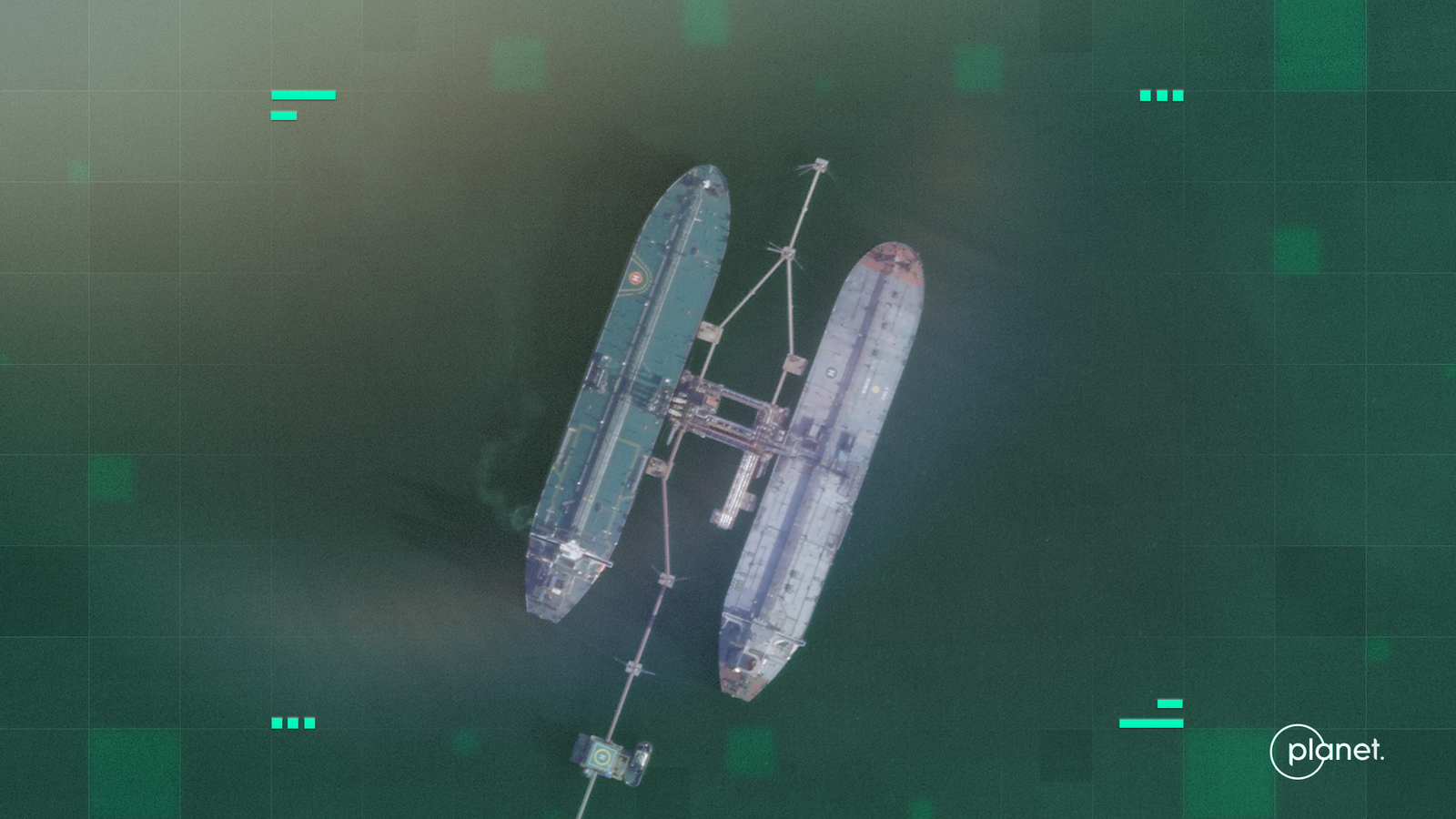
An oil tanker seized by the US off the Venezuelan coast on Wednesday spent years trying to sail the seas unnoticed.
Changing names, switching flags, and vanishing from tracking systems.
That all came to an end this week, when American coast guard teams descending from helicopters with guns drawn stormed the ship, named Skipper.
A US official said the helicopters that took the teams to the tanker came from the aircraft carrier USS Gerald R Ford.
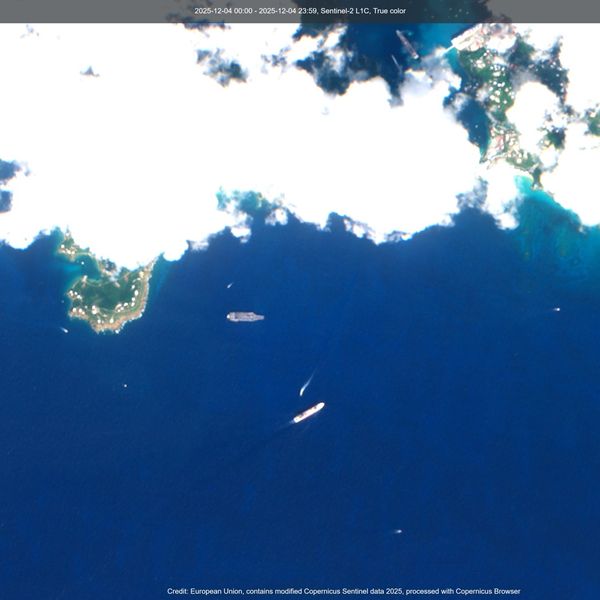
The USS Gerald R Ford (in grey) off the US Virgin Islands on 4 December. Source: Copernicus
The sanctioned tanker
Over the past two years, Skipper has been tracked to countries under US sanctions including Iran.
TankerTrackers.com, which monitors crude oil shipments, estimates Skipper has transported nearly 13 million barrels of Iranian and Venezuelan oil since 2021.
And in 2022, the US Treasury Office of Foreign Assets Control (OFAC) placed Skipper, then known as Adisa, on its sanctions list.
But that did not stop the ship’s activities.
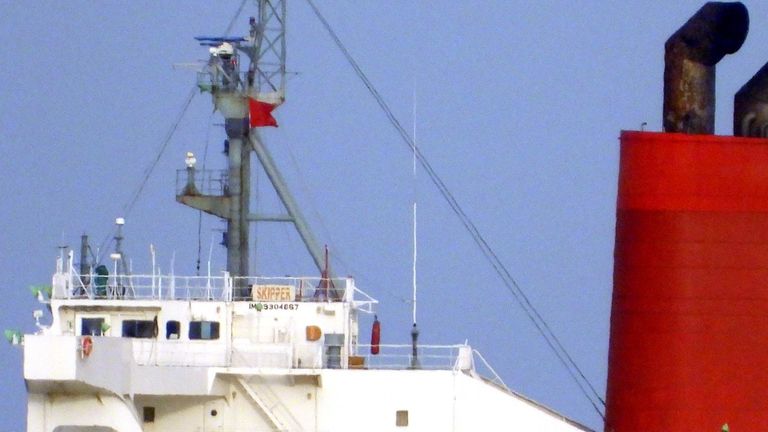
Skipper pictured from the Venezuelan shore. Source: TankerTrackers.com
In mid-November 2025, it was pictured at the Jose Oil Export Terminal in Venezuela, where it was loaded with more than one million barrels of crude oil.

Skipper (R) loads up with crude oil at the Jose Oil Export Terminal in Venezuela. Source: Planet
It left Jose Oil Export Terminal between 4 and 5 December, according to TankerTrackers.com.
And on 6 or 7 December, Skipper did a ship-to-ship transfer with another tanker in the Caribbean, the Neptune 6.
Ship-to-ship transfers allow sanctioned vessels to obscure where oil shipments have come from.
The transfer with Neptune 6 took place while Skipper’s tracking system, known as AIS, was turned off.
Read more:
Everything we know about dramatic ship seizure
Is this what the beginning of a war looks like?
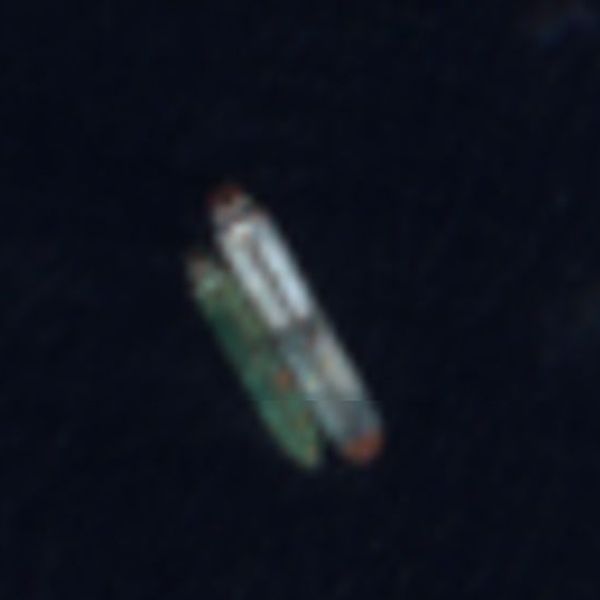
Skipper (R) and Neptune 6 in the Caribbean Sea during an AIS gap. Source: European Union Copernicus Sentinel and Kpler
Dimitris Ampatzidis, senior risk and compliance manager at Kpler, told Sky News: “Vessels, when they are trying to hide the origin of the cargo or a port call or any operation that they are taking, they can just switch off the AIS.”
Matt Smith, head analyst US at Kpler, said they believe the ship’s destination was Cuba.
Around five days after leaving the Venezuelan port, it was seized around 70 miles off the coast.
Moving in the shadows
Skipper has tried to go unnoticed by using a method called ‘spoofing’.
This is where a ship transmits a false location to hide its real movements.
“When we’re talking about spoofing, we’re talking about when the vessel manipulates the AIS data in order to present that she’s in a specific region,” Mr Ampatzidis explained.
“So you declare false AIS data and everyone else in the region, they are not aware about your real location, they are only aware of the false location that you are transmitted.”
When it was intercepted by the US, it was sharing a different location more than 400 miles away from its actual position.
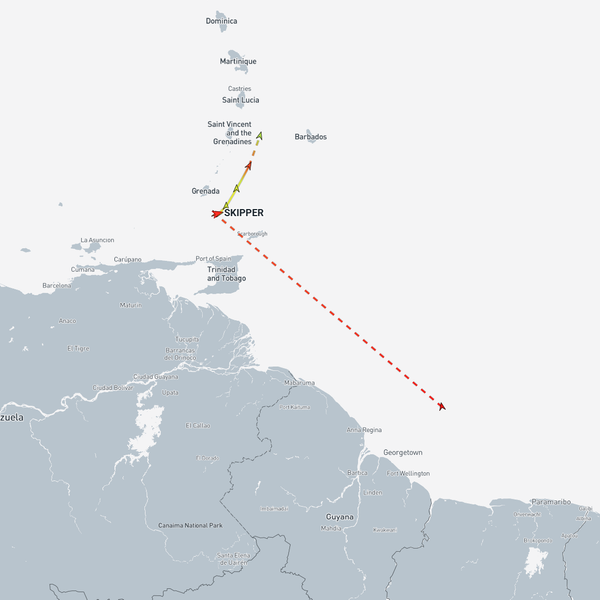
The distance between Skipper’s spoofed position on AIS (towards the bottom right hand corner) and its real position when seized by the US. Source: MarineTraffic
Skipper was manipulating its tracking signals to falsely place itself in Guyanese waters and fraudulently flying the flag of Guyana.
“We have really real concerns about the spoofing events,” Mr Ampatzidis told Sky News.
“It’s about the safety on the seas. As a shipping industry, we have inserted the AIS data, the AIS technology, this GPS tracking technology, more than a decade back, in order to ensure that vessels and crew on board on these vessels are safe when they’re travelling.”
Dozens of sanctioned tankers ‘operating off Venezuela’
Skipper is not the only sanctioned ship off the coast of Venezuela.
According to analysis by Windward, 30 sanctioned tankers were operating in Venezuelan ports and waters as of 11 December.
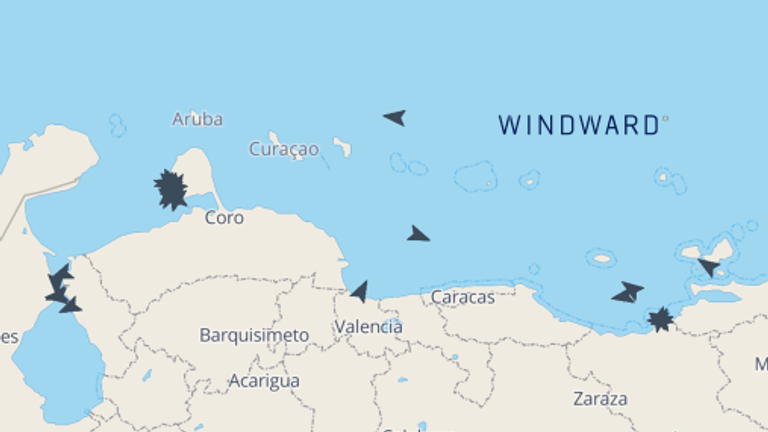
About 30 sanctioned tankers are currently operating in Venezuelan waters. Source: Windward Maritime AI Platform
The tanker seizure is a highly unusual move from the US government and is part of the Trump administration’s increasing pressure on Venezuelan President Nicolas Maduro.
In recent months, the largest US military presence in the region in decades has built up, and a series of deadly strikes has been launched on alleged drug-smuggling boats in the Caribbean Sea and eastern Pacific Ocean.
In the past, Mr Ampatzidis explained, actions like sanctions have had a limited effect on illegally operating tankers.
But the seizure of Skipper will send a signal to other dark fleet ships.
“From today, they will know that if they are doing spoofing, if they are doing dark activities in closer regions of the US, they will be in the spotlight and they will be the key targets from the US Navy.”
The Data X Forensics team is a multi-skilled unit dedicated to providing transparent journalism from Sky News. We gather, analyse and visualise data to tell data-driven stories. We combine traditional reporting skills with advanced analysis of satellite images, social media and other open source information. Through multimedia storytelling we aim to better explain the world while also showing how our journalism is done.


Traditional financial markets are moving rapidly onchain as the US Securities and Exchange Commission chair doubled down on the idea of an “innovation exemption” to accelerate tokenization.
“U.S. financial markets are poised to move on-chain,” wrote Paul Atkins, chair of the SEC, in a Friday X post, adding that the agency is “embracing new technologies to enable this onchain future.”
His comments come shortly after the SEC issued a “no action” letter to a subsidiary of the Depository Trust and Clearing Corporation (DTCC), enabling it to offer a new securities market tokenization service.
The DTCC plans to tokenize assets, including the Russell 1000 index, exchange-traded funds tracking major indexes and US Treasury bills and bonds, which Atkins called an “important step towards onchain capital markets.”
“On-chain markets will bring greater predictability, transparency, and efficiency for investors,” he said.
However, the green light for the DTCC’s pilot is only the beginning, as the SEC will consider an innovation exemption to enable builders to start “transitioning our markets onchain,” without being burdened by “cumbersome regulatory requirements,” added Atkins.

Atkins pledged to encourage innovation as the industry moves toward onchain settlement, which would mean settling transactions on a blockchain ledger, removing intermediaries, enabling 24/7 trading and faster transaction finality.
Related: Crypto nears its ‘Netscape moment’ as industry approaches inflection point
Cointelegraph has contacted the SEC for comment on the details and timeline of an innovation exemption for tokenization.
Atkins first proposed an innovation exemption for tokenization during his remarks at the Crypto Task Force Roundtable on DeFi on June 9.
The SEC’s no-action letter means that the agency won’t take enforcement action if the DTCC’s product operates as described. The DTCC provides clearing, settlements and trading services as one of the most important infrastructure providers for US securities.
Asset tokenization involves minting tangible assets on the blockchain ledger, offering more investor access through fractionalized shares and 24/7 trading opportunities.
Related: Bitcoin treasuries stall in Q4, but largest holders keep stacking sats
DTCC pilot and RWA builders push more TradFi onchain
Crypto analysts have praised the SEC’s move to allow the DTCC’s new market tokenization service, which will award tokenized assets the same entitlements and investor protection mechanisms as traditional assets.
“Not sure people fully appreciate how quickly financial markets are heading towards full tokenization… Moving even faster than I expected,” wrote ETF analyst Nate Geraci, in a Friday X post.
Over the past few months, the SEC issued two no-action letters: one for a Solana-based decentralized physical infrastructure network (DePIN) project, and a second no-action letter in September that allowed investment advisers to use state trust companies as crypto custodians.
Meanwhile, crypto projects continue to raise funds to build the infrastructure necessary for tokenized onchain markets.
On Tuesday, asset tokenization network Real Finance closed a $29 million private funding round to build an infrastructure layer for real-world assets (RWAs) that can boost institutional participation.
Magazine: SEC’s U-turn on crypto leaves key questions unanswered
-
 Sports2 years ago
Story injured on diving stop, exits Red Sox game
-
 Sports3 years ago
‘Storybook stuff’: Inside the night Bryce Harper sent the Phillies to the World Series
-
 Sports2 years ago
Game 1 of WS least-watched in recorded history
-
 Sports3 years ago
Button battles heat exhaustion in NASCAR debut
-
 Sports3 years ago
MLB Rank 2023: Ranking baseball’s top 100 players
-
Sports4 years ago
Team Europe easily wins 4th straight Laver Cup
-
 Environment3 years ago
Japan and South Korea have a lot at stake in a free and open South China Sea
-
 Environment1 year ago
Here are the best electric bikes you can buy at every price level in October 2024