
Connect with us

Published

on

This week is Sunshine Week , an annual celebration of transparency laws, which means that government press offices across the country are hard at work pretending they don’t spend the other 51 weeks a year undermining those transparency laws.

If you want to see what your leaders really think of you and your statutory right to know what they’re up to, just ask them to comply with the open government laws on the books.

Two Florida Department of Law Enforcement officers claimed earlier this month that Gov. Ron DeSantis’ office blocked the release of DeSantis’ publicly-funded travel records and retaliated against them for arguing that the records were public under the state’s Sunshine Law.

As I wrote last year for Reason ‘s special issue on Florida, politicians have been chipping away at the state’s vaunted public records law for decades, but DeSantis and his allies in the Florida Legislature are taking a sledgehammer to it.

Elsewhere in the Sunshine State, a fire chief called the police because a local reporter had the temerity to insist, correctly, that he had a legal right to inspect public records in person. Tampa Bay Times reporter Jason Garcia showed up at the headquarters of the Tampa Fire Rescue Department asking to see paperwork related to a firefighter’s termination. Florida’s Sunshine Law law is unambiguous on this point: “All state, county and municipal records are open for personal inspection and copying by any person.”

Nevertheless, two department employees, one of whom was the personnel chief, argued Garcia had no right to see the records since he’d already filed a records request online. Eventually, Tampa fire chief Barbara Tripp called the police to report Garcia for causing a disturbance, although he left by the time reinforcements arrived to end his reign of terror.

The personnel chief claimed in a memo that Garcia “persisted in being argumentative and repetitive and refused to accept the answer and leave.”

“No matter how you want to spin it, though, journalists are supposed to ask questions and seek explanations,” the Tampa Bay Times wrote in an editorial about the alleged hullabaloo. “That may rankle people in power, but it doesn’t constitute an unruly disturbance.”

Meanwhile in Virginia, a former Richmond government employee filed a whistleblower retaliation lawsuit earlier this month alleging that city officials told her to intentionally delay and stonewall Freedom of Information Act (FOIA) requests. The former employee claims she was fired “in retaliation for reporting and refusing to engage in illegal and unethical activities in violation of FOIA.”

The lawsuit came shortly after local news outlet CBS 6 reported that Richmond is regularly not meeting FOIA deadlines and sometimes ignoring requests altogether.

If you want to see more government gone wild, you can peruse the Electronic Frontier Foundation’s annual Foilies , ignominious “awards” for public record violations and abuses.

The reason that government offices get away with flouting record laws is that there is no one to hold them accountable and few consequences in the rare instances that they are scolded.

An Associated Press survey of all 50 U.S. states , released yesterday for Sunshine Week, found that fewer than a third of states have offices to handle Freedom of Information appeals and force agencies to comply with the law.

“In most states, the only meaningful option for residents to resolve complaints about agencies wrongfully withholding public records is to file costly lawsuits,” the AP wrote.

These ombudsmen and other positions provide crucial layers of oversight. Without them, agencies know that they can delay and frivolously deny requests with little resistance, and even if they lose a lawsuit, the only consequence is usually a small fine, paid for with taxpayer dollars, naturally.

“It shows that we have a problem in the United States. We have these laws, but there’s really a lack of enforcement,” says David Cuillier, director of the Joseph L. Brechner Freedom of Information Project at the University of Florida, which coordinates Sunshine Week. “The system’s stacked against the average person. It’s not fair that they have to hire an attorney and take all that time and money to just make sure the law’s followed. Who can afford $10,000, $20,000 to do that? Not the average person.”

If you want a transparent, responsive government, one place to start is by demanding the creation of independent offices to resolve public records disputes outside of costly courtroom battles. Without them, the statutes are, just like government press releases, a lot of empty promises.

Continue Reading

Politics

Young people may lose benefits if they don’t engage with help from new £820m scheme, government warns


Published

on

By

Young people may lose benefits if they don't engage with help from new £820m scheme, government warns

Young people could lose their right to universal credit if they refuse to engage with help from a new scheme without good reason, the government has warned.

Almost one million will gain from plans to get them off benefits and into the workforce, according to officials.

Latest updates from the Politics Hub

Pic: iStock
Image:
Pic: iStock

It comes as the number of young people not in employment, education or training (NEET) has risen by more than a quarter since the COVID pandemic, with around 940,000 16 to 24-year-olds considered as NEET as of September this year, said the Office for National Statistics.

That is an increase of 195,000 in the last two years, mainly driven by increasing sickness and disability rates.

The £820m package includes funding to create 350,000 new workplace opportunities, including training and work experience, which will be offered in industries including construction, hospitality and healthcare.

Around 900,000 people on universal credit will be given a “dedicated work support session”.

That will be followed by four weeks of “intensive support” to help them find work in one of up to six “pathways”, which are: work, work experience, apprenticeships, wider training, learning, or a workplace training programme with a guaranteed interview at the end.

However, Work and Pensions Secretary Pat McFadden has warned that young people could lose some of their benefits if they refuse to engage with the scheme without good reason.

“Doing nothing should not be an option,” he told Sky News’ Sunday Morning with Trevor Phillips.

“If someone just took that attitude, yes, they would then be subject to, you know, the obligations that are already part of the system.”

“What I want to see is young people in the habit of getting up in the morning, doing the right thing, going to work,” he added.

“That experience of that obligation, but also the sense of pride and purpose that comes with having a job.”

Some young people on benefits will be offered job opportunities in construction. Pic: iStock
Image:
Some young people on benefits will be offered job opportunities in construction. Pic: iStock

Read more from Sky News:
Child poverty strategy unveiled – but not everyone’s happy

Universal credit claimants soar by over million in a year

The government says these pathways will be delivered in coordination with employers, while government-backed guaranteed jobs will be provided for up to 55,000 young people from spring 2026, but only in those areas with the highest need.

However, shadow work and pensions secretary Helen Whately, from the Conservatives, said the scheme is “an admission the government has no plan for growth, no plan to create real jobs, and no way of measuring whether any of this money delivers results”.

She told Sky News the proposals are a “classic Labour approach” for tackling youth unemployment.

Please use Chrome browser for a more accessible video player

Youth jobs plan ‘the wrong answer’

“What we’ve seen today announced by the government is funding the best part of £1bn on work placements, and government-created jobs for young people. That sounds all very well,” she told Sunday Morning with Trevor Phillips.

“But the fact is, and that’s the absurdity of it is, just two weeks ago, we had a budget from the chancellor, which is expected to destroy 200,000 jobs.

“So the problem we have here is a government whose policies are destroying jobs, destroying opportunities for young people, now saying they’re going to spend taxpayers’ money on creating work placements. It’s just simply the wrong answer.”

Ms Whately also said the government needs to tackle people who are unmotivated to work at all, and agreed with Mr McFadden on taking away the right to universal credit if they refuse opportunities to work.

But she said the “main reason” young people are out of work is because “they’re moving on to sickness benefits”.

Ms Whately also pointed to the government’s diminished attempt to slash benefits earlier in the year, where planned welfare cuts were significantly scaled down after opposition from their own MPs.

The funding will also expand youth hubs to help provide advice on writing CVs or seeking training, and also provide housing and mental health support.

Some £34m from the funding will be used to launch a new “Risk of NEET indicator tool”, aimed at identifying those young people who need support before they leave education and become unemployed.

Monitoring of attendance in further education will be bolstered, and automatic enrolment in further education will also be piloted for young people without a place.

Continue Reading

Politics

A peace deal isn’t a sure thing, Zelenskyy’s UK visit needs more than a warm welcome

Published

on

By

A peace deal isn't a sure thing, Zelenskyy's UK visit needs more than a warm welcome

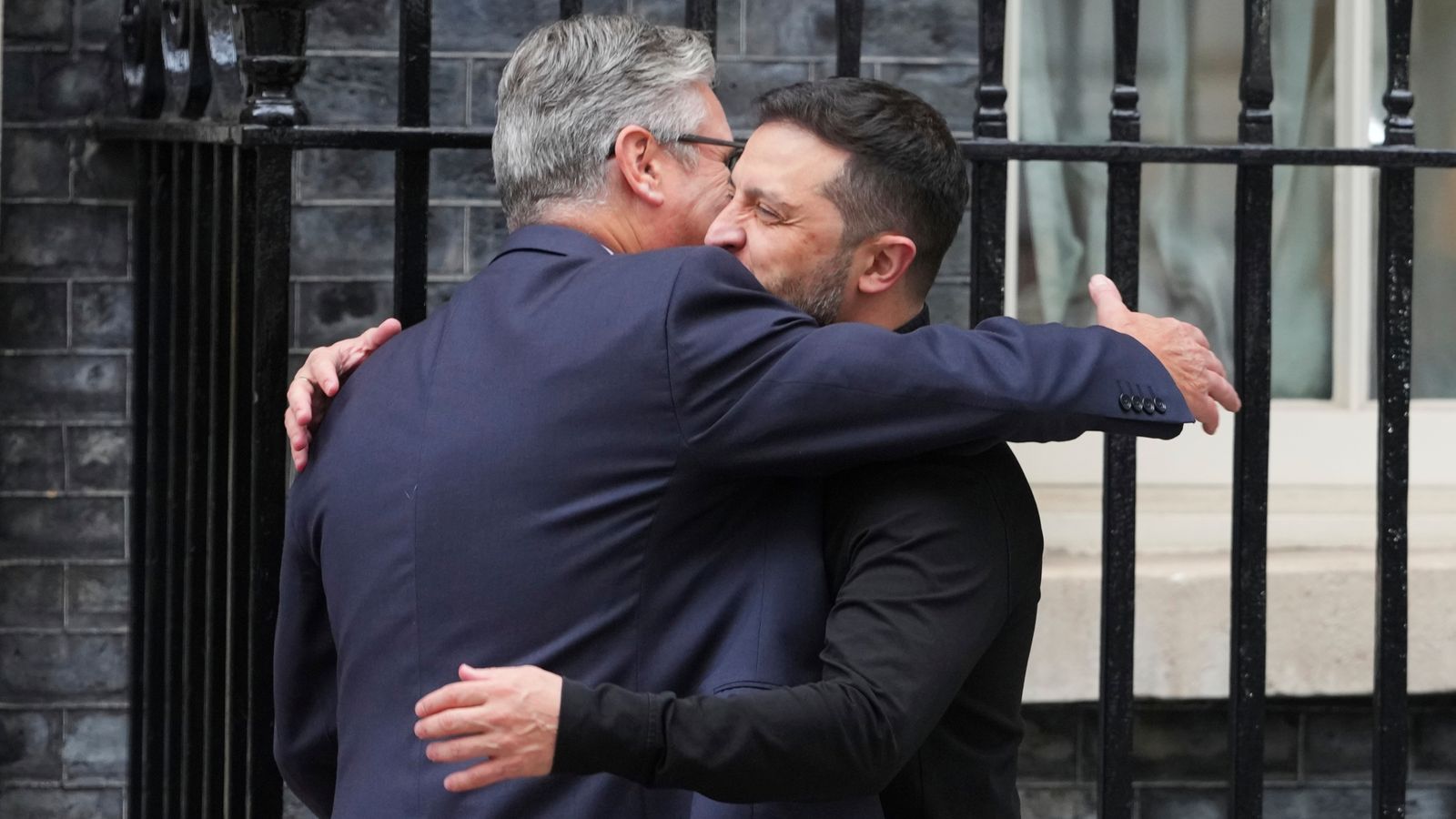
Volodymyr Zelenskyy is heading to Downing Street once again, but Prime Minister Sir Keir Starmer will be keen to make this meeting more than just a photo op.

On Monday the PM will welcome not only the Ukrainian president, but also E3 allies France and Germany to discuss the state of the war in Ukraine.

French President Emmanuel Macron and German Chancellor Friedrich Merz will join Sir Keir in showing solidarity and support for Ukraine and its leader, but it’s the update on the peace negotiations that will be the main focus of the meet up.

The four leaders are said to be set to not only discuss those talks between Ukraine, the US and Russia, but also to talk about next steps if a deal were to be reached and what that might look like.

Read more:
Ukraine has become Europe’s war – so why doesn’t it act like it?
Inside a secret underground military base in eastern Ukraine

Ahead of the discussions, Sir Keir spoke with the Dutch leader Dick Schoof where both leaders agreed Ukraine’s defence still needs international support, and that Ukraine’s security is vital to European security.

But while Russia’s war machine shows no signs of abating, a warm welcome and kind words won’t be enough to satisfy the embattled Ukrainian president at a time when Russian drone and missile attacks continue to bombard Kyiv.

More on Sir Keir Starmer

Mr Zelenskyy held a call on Saturday with US President Donald Trump’s special envoy Steve Witkoff and Mr Trump’s son-in-law Jared Kushner.

“The American representatives know the basic Ukrainian positions,” Mr Zelenskyy said in his nightly video address. “The conversation was constructive, although not easy.”

Meanwhile, Mr Trump’s outgoing Ukraine envoy has said a peace deal between Russia and Ukraine is “really close”.

Keith Kellogg, who is due to step down in January, told the Reagan National Defence Forum that efforts to resolve the conflict were in “the last 10 metres”, which he said were always the hardest.

Mr Kellogg pinpointed the future of the Donbas and Ukraine’s Zaporizhzhia nuclear power plant as the two main outstanding issues.

But Russia has signalled that “radical changes” are needed to the US-Ukraine peace plan before it is acceptable to Moscow.

Yuri Ushakov, Russian President Vladimir Putin’s top foreign policy aide, was quoted by Russian media as saying the US would have to “make serious, I would say, radical changes to their papers” on Ukraine.

Continue Reading

Politics

Reform UK denies Nigel Farage broke electoral law

Published

on

By

Reform UK denies Nigel Farage broke electoral law

Reform UK has denied claims of Nigel Farage breaking electoral law.

It follows a report in Monday’s The Daily Telegraph that Mr Farage has been referred to the police by a former member of his campaign team over claims he falsified election expenses.

The claims relate to Mr Farage’s campaign in Clacton-on-Sea, the seat he won for Reform UK in the 2024 General Election.

In a statement, a Reform UK spokesperson said: “These inaccurate claims come from a disgruntled former councillor… the party denies breaking electoral law. We look forward to clearing our name.”

According to the Telegraph, the claims have been made by Richard Everett, a former Reform councillor.

It is reported by the Telegraph that Mr Everett has submitted documents to the Metropolitan Police.

Mr Everett was one of four councillors who defected from the Conservatives to Reform UK on the eve of the 2024 General Election campaign.

Sky News has not verified the allegations and the Metropolitan Police and the Electoral Commission are yet to comment.

Both Labour and the Conservatives have called for answers from Mr Farage.

Continue Reading

Trending





