
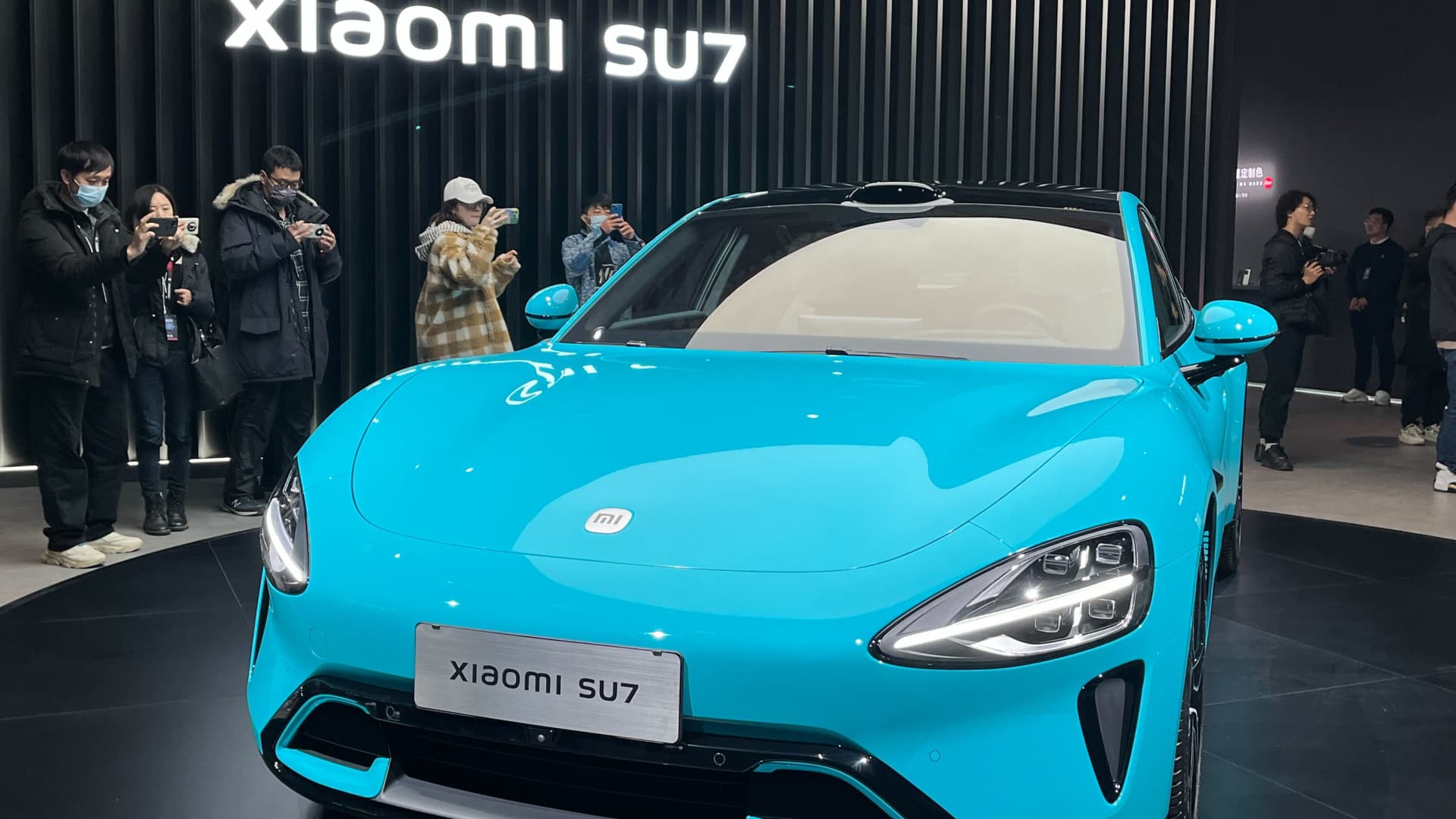
Xiaomi releases electric car $4K cheaper than Tesla’s Model 3 as price wars heat up

Chinese consumer electronics company Xiaomi revealed Thurs., Dec. 28, 2023, its long-awaited electric car, but declined to share its price or specific release date.
CNBC | Evelyn Cheng
BEIJING — Chinese smartphone company Xiaomi said Thursday it will sell its first car for far less than Tesla’s Model 3, as price wars heat up in China’s fiercely competitive electric car market.
Xiaomi CEO Lei Jun said the standard version of the SU7 will sell for 215,900 yuan ($30,408) in the country — a price he acknowledged would mean the company was selling each car at a loss.
Tesla’s Model 3 starts at 245,900 yuan in China.
Lei claimed the standard version of the SU7 beat the Model 3 on more than 90% of its specifications, except on two aspects that he said it might take Xiaomi at least three to five years to catch up with Tesla on. He also said the SU7 had a minimum driving range of 700 kilometers (nearly 435 miles) versus the Model 3’s 606 kilometers. The company said orders had exceeded 50,000 cars in the 27 minutes since sales started at 10 p.m. Beijing time Thursday.
Deliveries are set to start by the end of April, Lei said. Lei also claimed that Xiaomi’s car factory, for which all “key” steps are fully automated, can produce an SU7 every 76 seconds. It was not immediately clear whether the factory was fully operational.
Earlier this week, the Xiaomi CEO said on social media the SU7 would be the best sedan “under 500,000 yuan” ($69,328).
The car is entering a fiercely competitive market in China, where companies are launching a slew of new models and cutting prices in order to survive. Chinese telecommunications giant Huawei has partnered with traditional automakers, most notably launching the Aito brand whose vehicles are often on display in Huawei smartphone showrooms.
Tesla‘s Model 3 is the best-selling new energy sedan in China that has a driving range of at least 600 kilometers (372 miles) and costs less than 500,000 yuan, according to data from industry website Autohome.
BYD‘s Han sedan starts at 169,800 yuan, according to Autohome.
Nio‘s ET5 starts at 298,000 yuan, while Xpeng‘s P7 starts at 209,900 yuan, the data showed. Geely-owned Zeekr’s 007 sedan starts at 209,900 yuan, according to Autohome.
Sales of new energy vehicles, which include battery-only powered cars, have surged in China to account for about one-third of new passenger cars sold, according to the China Passenger Car Association.
Accessories
The heads of competing electric car startups Nio, Xpeng and Li Auto were among the featured guests at the Xiaomi SU7 launch event.
Lei on Thursday showed off a range of accessories such as an in-car refrigerator, a custom front-window shade, and a smartphone holder, some available for free with a car purchase before the end of April, and others for a separate price.
The SU7 supports Apple’s Car Play and can integrate with the iPad, Lei said. He also revealed driver-assist tech for highways and cities, set to be fully available in China in August.
Tesla’s Autopilot for driver assist on highways is available in China, but the company’s “Full Self Driving” for city streets has yet to be released in the country.
Despite saying Xiaomi wanted to compete with Porsche at a car tech event in December, Lei acknowledged that the SU7 had longer to go before it might be able to compete at this more premium level. He announced that the “Max” version of the SU7, aimed as a competitor with Porsche’s Taycan, would sell for 299,900 yuan.
Ecosystem of devices
The SU7 is part of Xiaomi’s recently launched “Human x Car x Home” strategy that seeks to build an ecosystem of devices connected to its new HyperOS operating system. Most of the company’s revenue is from phones, with just under 30% coming from appliances and other consumer products.
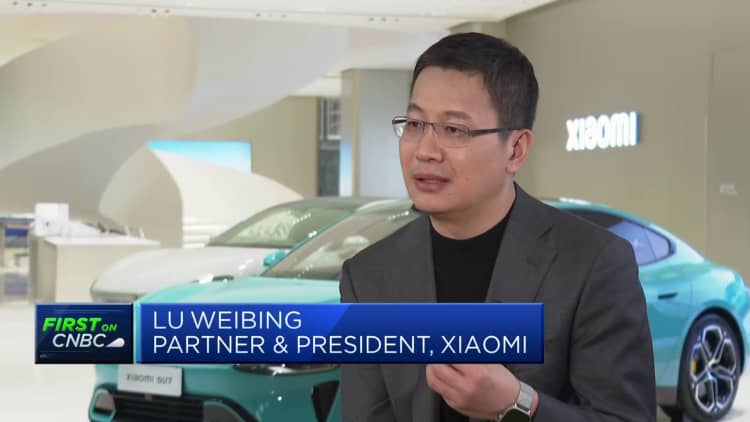
Although Xiaomi is generally known for more affordable products, its President Lu Weibing told CNBC earlier this year the company has been pursuing a premiumization strategy since 2020 — and that there are about 20 million users in that price segment who might buy the SU7.
Lu told CNBC that the SU7 will first be sold to consumers in China, and that it would take at least two to three years for any overseas launch.
The company showed off the car at Mobile World Congress in Barcelona in late February, following a reveal of the vehicle’s exterior and tech in Beijing in late December.


Intel stock held a sharp hike in pretrading on Monday, after the stock surged on Friday when an analyst predicted the chip giant was nearing a deal to supply Apple in 2027.
Shares in Intel rose 10% on Friday after TF International Securities analyst Ming-Chi Kuo posted on X that he expected Intel to begin shipping its lowest-end M processor to Apple as early as second or third quarter 2027.
He said that his latest industry surveys indicate that “visibility on Intel becoming an advanced-node supplier to Apple has recently improved significantly.”
Intel stock fell 0.59% as of 6.26am ET on Monday in early pretrading.
Kuo added that the timeline of the partnership is contingent on the development process after Intel releases its process design kit — the blueprint from which Apple’s engineers can build the chips — which is expected early 2026.
Apple’s silicon chips for its iPhone, iPad and Mac products are currently supplied by TSMC.
In his post, Kuo played down the potential Intel-Apple partnership’s impact on the Taiwanese chip maker, saying that Apple is expected to remain “highly dependent” on the company’s advanced nodes for the “foreseeable future.”
“In absolute terms, order volumes for the lowest-end M processor are relatively small and virtually no material impact on TSMC’s fundamentals or its technology leadership over the next several years.”
Kuo added a deal with Intel would signal strong support from Apple for the Trump administration’s push for its homegrown companies to manufacture in the U.S.
Neither Intel nor Apple immediately responded to a request for comment from CNBC.
‘If Intel pulls it off, there is potential to win higher volume and value business from Apple’
Intel’s stock has seen a resurgence over the past 12 months after years of decline. Share price fell as low as $17.66 in April, before recovering over the past few months.
“Apple is a potential major reference customer whose presence validates Intel’s high-performance foundry offering,” Paul Markham, investment director at GAM Global Equities, told CNBC.
“If Intel pulls it off, there is potential to win higher volume and value business from Apple, for example CPU production for the iPhone, and win business from other large chip designers.”
Intel has had an up and down relationship with Apple since it first announced the chip giant’s processors would power some products in 2005. The iPhone maker transitioned away from the company’s processors at the start of the 2020s.
Last week Intel was on the subject of a lawsuit filed by TSMC, in which it alleged one of its former senior vice president had leaked “confidential information” to the company. Intel did not immediately respond to CNBC’s request for comment at the time.


-
 Sports2 years ago
Story injured on diving stop, exits Red Sox game
-
 Sports3 years ago
‘Storybook stuff’: Inside the night Bryce Harper sent the Phillies to the World Series
-
 Sports2 years ago
Game 1 of WS least-watched in recorded history
-
 Sports3 years ago
Button battles heat exhaustion in NASCAR debut
-
 Sports3 years ago
MLB Rank 2023: Ranking baseball’s top 100 players
-
Sports4 years ago
Team Europe easily wins 4th straight Laver Cup
-
 Environment3 years ago
Japan and South Korea have a lot at stake in a free and open South China Sea
-
 Environment1 year ago
Here are the best electric bikes you can buy at every price level in October 2024