
Tesla’s stock wraps up one of its worst quarters on record as global dominance wanes

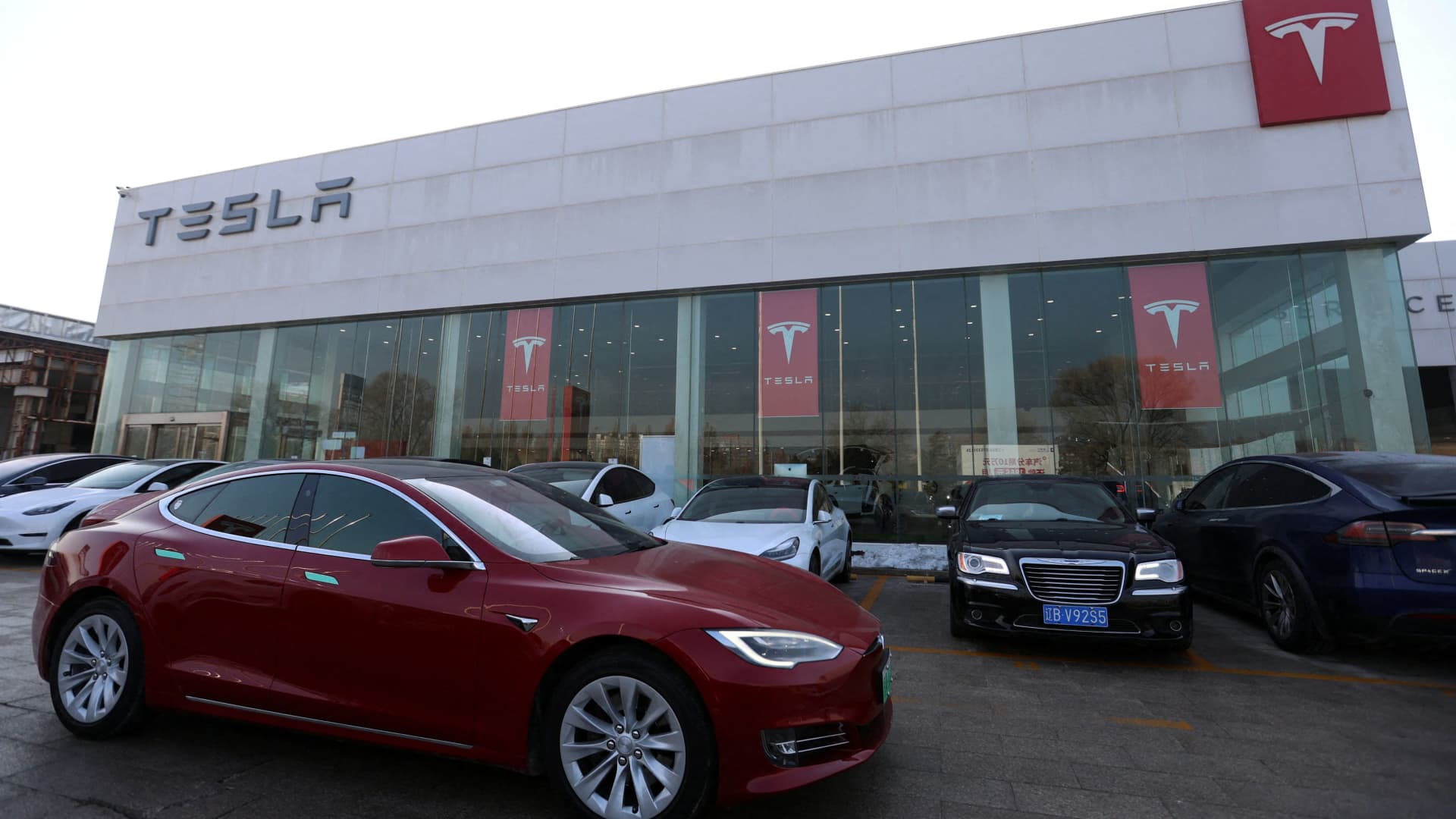
A Tesla car is driven past a store of the electric vehicle (EV) maker in Beijing, China January 4, 2024.
Florence Lo | Reuters
It was a brutal first quarter for Tesla investors.
Shares of the electric vehicle maker plunged 29% in the first three months of the year, the worst quarter for the stock since the end of 2022 and the third worst since Tesla went public in 2010. It was also the biggest loser in the S&P 500.
Chief among concerns on Wall Street is Tesla’s core business. The company is poised to report first-quarter vehicle production and deliveries in coming days, and even bulls are expecting sluggish results, despite price cuts and incentives for buyers dangled throughout the quarter.
As of Thursday, the last trading day of the quarter, analysts were expecting around 457,000 deliveries for the period, according to the average of 11 analyst estimates compiled by FactSet. That would mark an increase of 8% from 422,875 a year earlier. Estimates for the quarter ranged from 414,000 to 511,000 deliveries.
Analysts who updated their numbers in March were the most bearish, with their estimates ranging from 414,000 to 469,000. Independent autos industry researcher “Troy Teslike” expects the company’s deliveries to come in below even the lowest estimate captured by FactSet.
Deliveries are the closest approximation of sales reported by Tesla but are not precisely defined in the company’s shareholder communications.
Here are four major reasons for Tesla’s first-quarter slide.
Unrelenting competition in China
In China, there’s competition from an onslaught of fully electric vehicles, including new models that cost less than Tesla’s popular Model Y SUV and Model 3 sedan.
To end 2023, China’s BYD dethroned Tesla as the world’s top EV maker. In the first quarter of this year, BYD kept up the pressure, launching its Qin Plus EV at a starting price of around $15,200, followed by its BYD Seagull, a small all-electric hatchback with a starting price below $10,000.
Chinese smartphone company Xiaomi is getting in the game with its first vehicle, a fully electric SUV that costs far less than Tesla’s entry-level Model 3 sedan. Xiaomi CEO Lei Jun said the standard version of the SU7 will sell for the equivalent of $30,408 in China, a price he acknowledged would mean the company is losing money on each sale. Tesla’s Model 3 is about $4,000 more than that.
Tesla slashed prices in response, but sales were still sluggish.
According to data from the China Passenger Car Association, Tesla sold 71,447 of its China-made cars in January, including 39,881 sold domestically, representing a drop from December. The numbers slid again in February to 60,365 China-made Teslas, including exports.
As sales dipped, Tesla reduced production at its Shanghai factory, shifting staffers from working six and a half days to week to five days, Bloomberg first reported.
Tesla didn’t offer guidance for 2024 in its earnings call in January, but analysts see Tesla’s China struggles as a harbinger for a rough quarter, if not full year.
Deutsche Bank analyst Emmanuel Rosner lowered his price target on Tesla this week, citing weaker-than-expected China sales and the company’s recent plan to cut production in the region. Rosner is now expecting Tesla to report deliveries of 414,000 for the first three months of 2024, and is predicting just mid-single-digit growth for the year from Tesla.
Red Sea attacks, activist clashes in Europe
There was also drama in Europe.
Tesla and other manufacturers like Volvo suspended some production on the continent in January due to a shortage of components following attacks on shippers in the Red Sea. Iran-backed Houthi militia attacks have continued to disrupt one of the world’s busiest routes.
Elon Musk, CEO of Tesla Inc., arrives at the Tesla plant in Gruenheide, Germany, on March 13, 2024.
Krisztian Bocsi | Bloomberg | Getty Images
Then in March came a dramatic protest by environmentalists in Germany. Objecting to Tesla’s plans to expand the footprint of its car and battery factory in Brandenburg, outside of Berlin, the protesters set fire to electrical infrastructure near the Tesla plant. While the fire didn’t spread to the factory, it left the facility without sufficient power for operations, forcing a temporary suspension in production.
CEO Elon Musk visited the German factory after the attack to reassure employees. He also called the protest “extremely dumb.” Tesla’s head of policy, Rohan Patel, wrote on X that Tesla’s mission is to “create zero emissions products” but to do that well, “we also focus on creating the most sustainable factories along with a culture to do the right thing in our community.”
Meanwhile, in Nordic countries, Tesla service technicians and other workers have been on strike in support of the Swedish labor union IF Metall. The labor group has been pressuring Tesla, since October 2023 to negotiate and sign a collective bargaining agreement with its workers.
IF Metall’s website says that nine out of 10 workers are union members in Sweden, yet Tesla has resisted unions, as it consistently does in the U.S., and rebuffed IF Metall’s efforts to negotiate.
Aging lineup, early days for Cybertruck
While EV sales are still gaining popularity worldwide, the growth rate has slowed. And with Tesla no longer the dominant player, every new product becomes more crucial. There’s not a lot in the hopper.
The Cybertruck is still in its very early days and has a niche audience. The company began delivering the angular, unpainted steel model of the truck in December at a promotional event in Austin, Texas.
Musk previously stated on an earnings call that Tesla “dug its own grave,” with the sci-fi inspired Cybertruck. In an interview with Tesla fan and auto critic Sandy Munro in late 2023, Musk cautioned that the “Cybertruck is not something that will be material to Tesla’s financials” in 2024, and “will probably be material in 2025.”
A Tesla Cybertruck at a Tesla store in San Jose, California, on Nov. 28, 2023.
Bloomberg | Bloomberg | Getty Images
Tesla has been gearing up production of its refreshed Model 3, known as the Highland, in Fremont, California. Forbes’ Larry Magid wrote, “Visually, the changes on the outside are subtle.” He also disliked Tesla’s controversial design decision to omit “stalks” from sides of the steering wheel. Highland drivers use buttons and on-screen controls to shift between drive, reverse and park or to signal a turn or lane change.
Tesla does have a totally new platform in the works, a more affordable EV that fans refer to as the “Model 2.” But it won’t be delivered to customers for years.
Musk control and controversy
Musk has continued to bet that Tesla customers and shareholders will stick with the company regardless of his increasingly incendiary rhetoric on X and beyond.
Earlier this month, Musk met with former President Donald Trump in Florida. He’s called for a “red wave” in upcoming U.S. elections, and he’s shared, liked or otherwise promoted far-right accounts and content on X, where he now has 178.8 million listed followers. He has repeatedly disparaged undocumented immigrants, ranted against corporate diversity initiatives and made absurd claims that migrants from Haiti are cannibals.
Musk’s political ideology stands at odds with groups of people most likely to buy his products. Proponents of electric vehicles tend to be left-leaning ideologically, according to research from Pew Research and Gallup last year.
Musk has also wagered that Tesla shareholders and its board of directors will follow his lead. In February, Musk said he would move for a shareholder vote to transfer Tesla’s site of incorporation to Texas from Delaware, after a judge in Delaware voided the $56 billion pay package that he was granted in 2019 on grounds that the board failed to prove “the compensation plan was fair.”
Before the ruling, Musk had begun pressuring shareholders and the Tesla board to give him more control of the EV maker.
“I am uncomfortable growing Tesla to be a leader in AI & robotics without having ~25% voting control,” Musk wrote in a post in January.
Investor Ross Gerber, a longtime Tesla bull, called the demand tantamount to “blackmail” in an interview with CNBC.
Bears cleaning up
It all adds up to over $230 billion in lost market cap for Tesla and its shareholders since the calendar turned to 2024. That made for a very lucrative quarter for short sellers, who’ve been expecting such a downturn.
According to data from S3 Partners, Tesla shorts are up more than $5.77 billion in 2024, making it the most profitable name in the U.S. Short interest at the end of trading on Thursday was about 3.76% of float, representing $18.71 billion in notional value.
Altimeter Capital’s Brad Gerstner is buying the dip. Gerstner told CNBC this week that the company is now making “massive progress at an accelerating rate” on its self-driving technology efforts.
Musk has been making such pronouncements for years. In 2015, he told shareholders that by 2018 Tesla’s cars would achieve “full autonomy,” and be able to drive themselves. In 2016, he said Tesla would able to send one of its cars on a cross-country drive without requiring any human intervention by the end of the following year.
Tesla still has yet to deliver a robotaxi, autonomous vehicle or technology that can make its cars into “level 3” automated vehicles. However, Tesla offers advanced driver assistance systems (ADAS), including a standard Autopilot option, or premium Full Self-Driving “FSD” option, the latter of which costs $199 a month for subscribers in the U.S. or $12,000 up front.
In a push for end-of-quarter sales, Musk recently mandated that all sales and service staff install and demo FSD for customers before they hand over their cars. He wrote in an e-mail to employees, “Almost no one actually realizes how well (supervised) FSD actually works. I know this will slow down the delivery process, but it is nonetheless a hard requirement.”
Despite its name, Tesla’s premium option requires a human driver at the wheel, ready to steer or brake at any moment.


Go back a decade and most Americans had never heard of Huawei. Today, the Chinese telecom giant is a symbol of how quickly China can dominate a strategic technology sector and in the process create new national security and market threats for U.S. government and industry.
Democratic Senator Mark Warner of Virginia, the top Democrat on the Senate Select Committee on Intelligence, is now worried about another Chinese company that he predicts will eclipse Huawei in both scale and consequence: BGI. It is not building cell towers or smartphones for the 5G era. It is collecting DNA.
“If Huawei was big, BGI will be even bigger,” Warner said at the CNBC CFO Council Summit in Washington, D.C. on Wednesday.
BGI is one of the largest genomics companies in the world. It operates DNA sequencing laboratories in China and abroad. It processes genetic data for hospitals, pharmaceutical firms and researchers across dozens of countries, according to a recent report by the National Security Commission on Emerging Biotechnology.
The company began as a Beijing-based research entity, the Beijing Genomics Institute, tied closely to China’s national genome projects. It later expanded into a global commercial powerhouse, selling DNA sequencing, prenatal testing, cancer screening, and large-scale population genetic analysis, according to an NBC News report.
Through subsidiaries, BGI says it operates in the U.S. Europe, and Japan. In several countries, it helped built national genetic databases and pandemic testing systems.
A man visits the booth of BGI at the Healthy Life Chain area of the third China International Supply Chain Expo CISCE in Beijing, capital of China, July 16, 2025.
Xinhua News Agency | Xinhua News Agency | Getty Images
U.S. intelligence officials believe that global footprint gives BGI access to one the largest collections of genetic data on Earth. Lawmakers have warned that genetic data is not just medical information. At scale, it becomes a strategic asset spurring a “DNA arms race,” according to a Washington Post report. DNA profiles can reveal ancestry, physical traits, disease risk, and family relationships, and when linked with artificial intelligence, the data can also be used for surveillance, tracking and long-term biological research tied to national security, according to the Washington Post’s reporting.
At the CNBC event this week, Warner continued to press for more focus on BGI. “They are hoovering up DNA data,” Warner said. “This level of experimentation on humans and intellectual property theft, we all should be concerned about it.”
Congressional investigators have previously warned that BGI maintains close ties to the Chinese Communist Party and Chinese military, according to a report from the House Select Committee on the CCP. They argue that China makes little distinction between commercial data and state security needs.
The ‘super soldier’ fear
One of the biggest fears tied to BGI and China’s broader biotech push is the possibility of a genetically enhanced soldier. U.S. officials have publicly claimed that China has explored human performance enhancement and military biotechnology. U.S. defense analysts say China’s research spans population DNA collection, military databases, and AI-driven human performance modeling, according to a Wall Street Journal op-ed written by U.S. Director of the Central Intelligence Agency John Ratcliffe in 2020, when he was Director of National Intelligence during President Trump’s first term.
Warner directly referenced those concerns this week.
“It’s terrifying,” Warner said.
Troops make preparations before a military parade in Beijing, capital of China, Sept. 3, 2025.
Xinhua News Agency | Xinhua News Agency | Getty Images
Warner described China as a great nation and great competitor, and as a former telecom executive (he was among the founders of Nextel), he said what Huawei was able to execute on — producing good products at inexpensive prices before the U.S. and Western competitors were prepared — is a cautionary tale.
The BGI story looks uncomfortably familiar to Warner.
“Go back in time eight or nine years, and most people had never heard of Huawei,” he said.
Huawei rose by combining massive state support, global market access and aggressive pricing, not only outcompeting Western firms on scale and cost, but positioning itself inside the world’s telecom infrastructure before governments understood the security implications. Huawei was first placed on a U.S. trade blacklist in 2019, which banned U.S. firms from selling some technology to the Chinese tech giant over national security concerns. Chip restrictions on Huawei have since become even stricter.
But Warner said by the time the U.S. moved to restrict Huawei, “[we started to] lose a little.”
Much of the 5G backbone had already been shaped by Chinese technology.
During a separate interview with Javers at the CNBC CFO Council Summit, the Republican Chairman of the House committee on the Chinese Communist Party, Michigan congressman John Moolenaar, said “We’ve seen how they run the play of excess capacity, price manipulation, driving people out of business in different areas; they’re going to continue to run that play,” he said. “We want to be friendly with China, but China is not our friend. They are our foremost adversary,” he added.
The Soviet Union was a military and ideological competitor, but China, in tech domain after domain, Warner says — from telecom and 5G to AI, quantum computing and biotech — is a different kind of competitor.
Warner now sees BGI following a similar model in biotechnology. Like Huawei, BGI scaled rapidly with state support. The Washington, D.C.-based think tank Foundation of Defense of Democracies called upon lawmakers of both parties earlier this year to restrict BGI’s access to U.S. institutions.
Congress has been trying to pass various versions of the BIOSECURE Act, which would limit the ability of Chinese biotechs to operate in the U.S. Some U.S. hospitals and research institutions with ties to Chinese genomics firms are under federal pressure, according to the Associated Press, though some medical professionals within the U.S. say they risk losing key research support for core medical goals. BGI told the AP that the bill is “a false flag targeting companies under the premise of national security. We strictly follow rules and laws, and we have no access to Americans’ personal data in any of our work,” it said.
U.S. intel has moved too slowly, and disrupted key spying alliances
Warner said the U.S. intelligence apparatus has moved too slowly to recognize the biotech threat. He says that intelligence agencies focus too much on foreign governments and militaries, with less attention placed on commercial technology sectors. But in a world where technology supremacy is national security, Warner says more of our intelligence efforts need to reflect this shift.
Only in the past two to three years, he says, has the U.S. seriously expanded spying into AI, semiconductors, and biotechnology. Warner says we need a more “advanced approach” in this area, and he gave as one recent example when China’s largest chipmaker SMIC stunned U.S. officials by producing a six-nanometer chip despite sweeping U.S. export controls. The breakthrough showed that Washington had underestimated both China’s technical qualities and ability to work around restrictions. “We got caught off guard with the SMIC six-nanometer chip,” Warner said.
Warner is also worried that tracking China’s tech rise requires a type of deep cooperation with U.S. allies that the Trump administration has squandered, such as the global intelligence-sharing network called the “Five Eyes” alliance.
Those relationships are now under strain, he said, and key partners including the United Kingdom, the Netherlands, and France have gone public in saying they are reluctant to share intel with the U.S. “They feel like we may be politicizing the intel product and that is not good news for America,” Warner said.
Underlying his concerns about the technology competition with China in areas including AI and biotech is the U.S. ceding the global lead in standards setting. For decades, the U.S. shaped the rules for wireless networks, satellites, and internet infrastructure. That dominance help Americans lead global markets, Warner said, but now China is aggressively positioning itself as the international standards setter.
Warner described the U.S. role in international bodies as one of the “secret sauces” in the era of America’s dominance of the global economy and technology, allowing the U.S. to leverage innovations occurring around the globe, “even if it didn’t arise in America.”
Across technology domains, influencing standards and protocols is critical to not only maintaining a competitive edge but also establishing ethical boundaries. “Will it be us or the Chinese?” Warner said. “The Chinese come in with clearly a less humanist approach. It’s been effective in lots of domains. We see it on standards-setting bodies. China floods the zone with lots of engineers, almost buying off the votes. We’ve got to reengage for American business and government,” he said.
-
 Sports2 years ago
Story injured on diving stop, exits Red Sox game
-
 Sports3 years ago
‘Storybook stuff’: Inside the night Bryce Harper sent the Phillies to the World Series
-
 Sports2 years ago
Game 1 of WS least-watched in recorded history
-
 Sports3 years ago
Button battles heat exhaustion in NASCAR debut
-
 Sports3 years ago
MLB Rank 2023: Ranking baseball’s top 100 players
-
Sports4 years ago
Team Europe easily wins 4th straight Laver Cup
-
 Environment3 years ago
Japan and South Korea have a lot at stake in a free and open South China Sea
-
 Environment1 year ago
Here are the best electric bikes you can buy at every price level in October 2024