
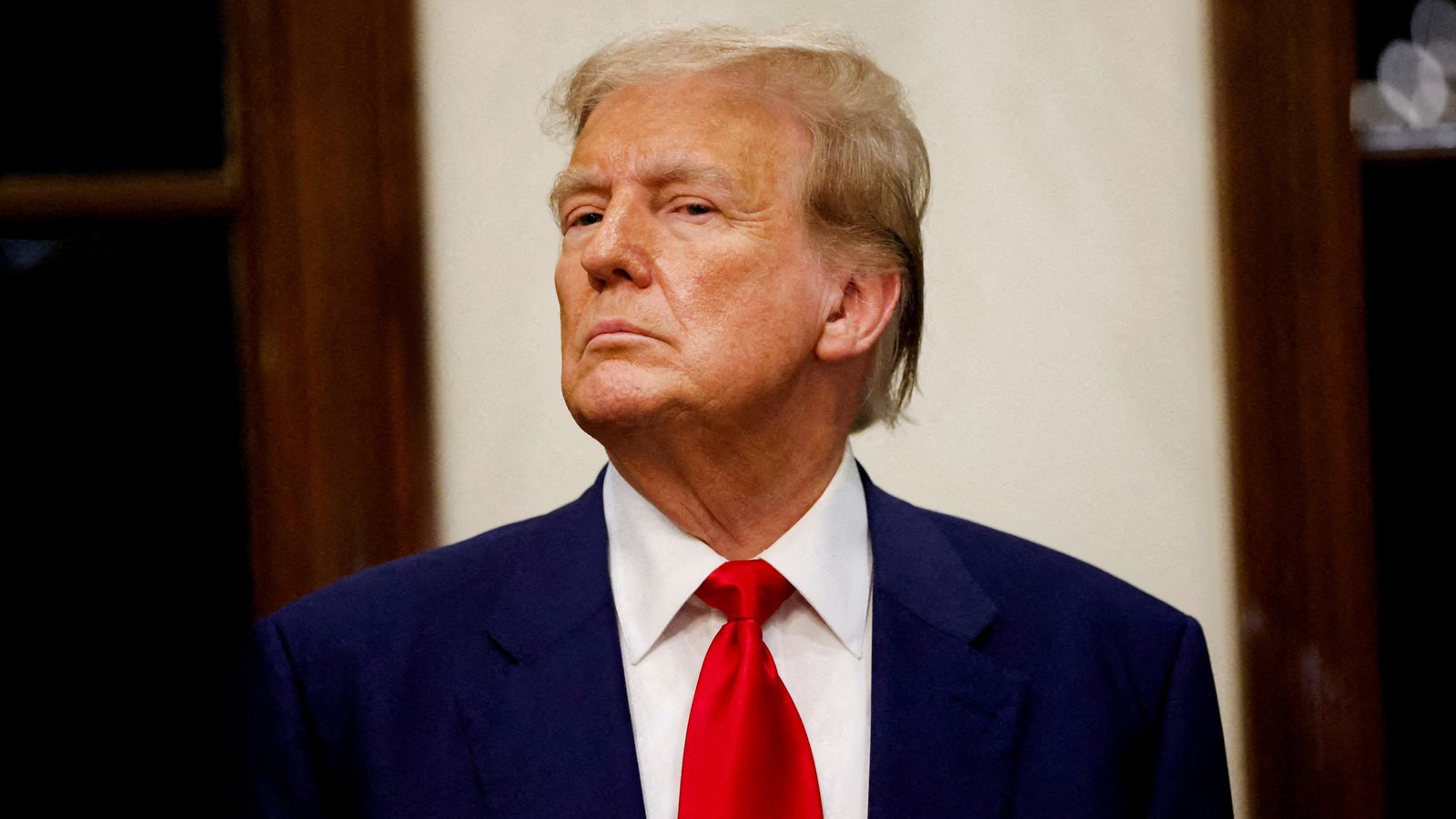
Shares in Donald Trump’s Truth Social platform plunge after major losses revealed

Shares in Donald Trump’s Truth Social platform have plunged more than 20% – wiping out gains made following its stock market debut last week.
The tumble came after Trump Media & Technology Group (TMTG) reported losses of more than $58m (£46m) in 2023.
The company also warned it would struggle to meet its financial liabilities going forward.
Shares in the social media platform finished the day at $58 (£46) when it made its New York debut last week.
However, following the latest disclosure, they fell 21% to almost $49 (£39) by the close on Monday – almost $1 (80p) below its initial offering price.
Mr Trump owns 78.75 million shares in the company, which could provide him with a lifeline during his ongoing legal and financial challenges if he decides to sell his stock.
At its peak last week, his stake would have been more than $6bn (£4.8bn) – but it is now worth around $3.8bn (£3bn). He is not allowed to sell or borrow against any of his shares for six months.
Ross Benes, an analyst at Insider Intelligence, said: “Truth Social was overvalued and that reality is dragging down the stock.
“Because the service does not have a clear path to profitability and its revenues are meagre, its high debut was unsustainable.”
Pic: Reuters
The former president launched the social media platform in February 2022 after he was blocked from Twitter, now X, Facebook and YouTube for allegedly inciting violence online.
It came as the Republican presidential hopeful posted a $175m (£140m) bond in his New York civil fraud case on Monday – preventing the state from seizing his assets.
Trump had been given 10 days to make the payment after his lawyers successfully asked for the bond to be reduced from $454m (£362m).
However, Mr Trump will be liable to pay the full amount – plus daily interest – if he loses an appeal in the case.
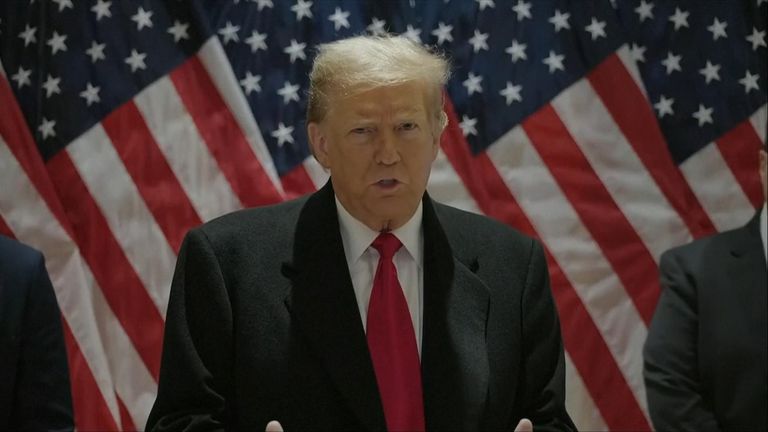
Trump lashes out at news conference
New York’s attorney general, Letitia James, had been prepared to start seizing the 77-year-old’s real estate unless the bond was posted.
In February, he was found guilty of scheming for years to deceive banks and insurers by inflating his wealth on financial statements used to secure loans and make deals.
Mr Trump, who has secured the Republican nomination for this year’s general election, has frequently claimed to be worth billions of dollars and last year said he had $400m (£319m) in cash, in addition to properties and other investments.
He has repeatedly denied wrongdoing, and argued the statements actually underestimated his fortune.
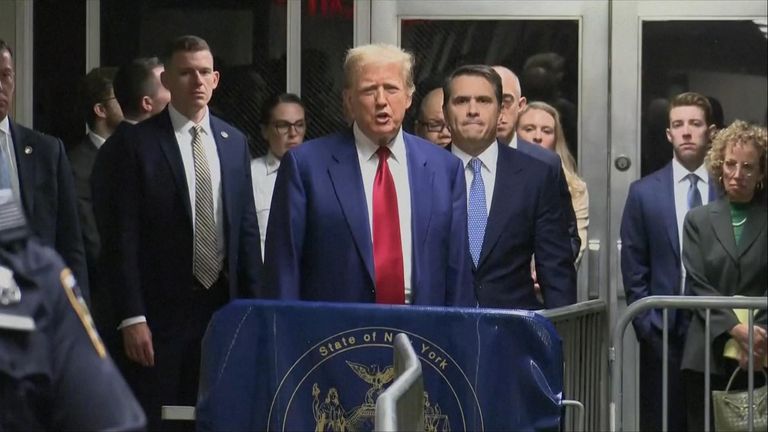
Trump: Judge is ‘disgrace to this country’
Trump ordered to stop attacking judge’s family
There have also been developments in a separate trial that Mr Trump is facing, which relates to a hush money payment made to the porn star Stormy Daniels.
On Monday, he was ordered to stop verbal attacks on the family members of the judge in this upcoming case.
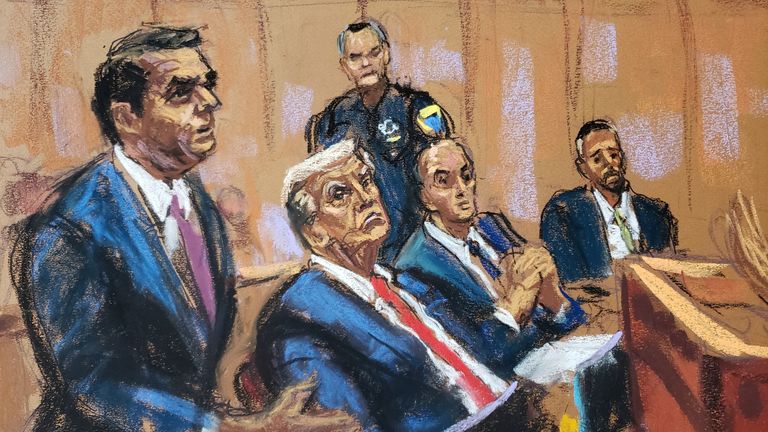
Courtroom sketch of Mr Trump during hush money payment trial. Pic: Reuters
It comes after Judge Juan Merchan’s daughter was described as a “rabid Trump hater” in a social media post.
Prosecutor Matthew Colangelo had warned: “Family members of trial participants must be strictly off-limits.
“Defendant’s insistence to the contrary bespeaks a dangerous sense of entitlement to instigate fear and even physical harm to the loved ones of those he sees in the courtroom.”
Read more from Sky News:
British volunteer among seven killed in Gaza
PM backs JK Rowling in row over hate crime laws
Iran promises ‘harsh’ response to consulate strike
It is an extension to an order already in place that bars Mr Trump from publicly commenting about witnesses and court staff.
If Mr Trump violates the order he could face jail time, but it does not stop him from criticising Mr Merchan or Manhattan District Attorney Alvin Bragg, whose office brought the charges last year.
The trial is due to start on 15 April in Manhattan. Mr Trump has pleaded not guilty to 34 counts of falsifying business records and denies an alleged sexual encounter with Ms Daniels, whose real name is Stephanie Clifford.

Did the chancellor mislead the public, and her own cabinet, before the budget?
It’s a good question, and we’ll come to it in a second, but let’s begin with an even bigger one: is the prime minister continuing to mislead the public over the budget?
The details are a bit complex but ultimately this all comes back to a rather simple question: why did the government raise taxes in last week’s budget? To judge from the prime minister’s responses at a news conference just this morning, you might have judged that the answer is: “because we had to”.
“There was an OBR productivity review,” he explained to one journalist. “The result of that was there was £16bn less than we might otherwise have had. That’s a difficult starting point for any budget.”
Politics latest: OBR boss resigns over budget leak
Beth Rigby asks Keir Starmer if he misled the public
Time and time again throughout the news conference, he repeated the same point: the Office for Budget Responsibility had revised its forecasts for the UK economy and the upshot of that was that the government had a £16bn hole in its accounts. Keep that figure in your head for a bit, because it’s not without significance.
But for the time being, let’s take a step back and recall that budgets are mostly about the difference between two numbers: revenues and expenditure; tax and spending. This government has set itself a fiscal rule – that it needs, within a few years, to ensure that, after netting out investment, the tax bar needs to be higher than the spending bar.
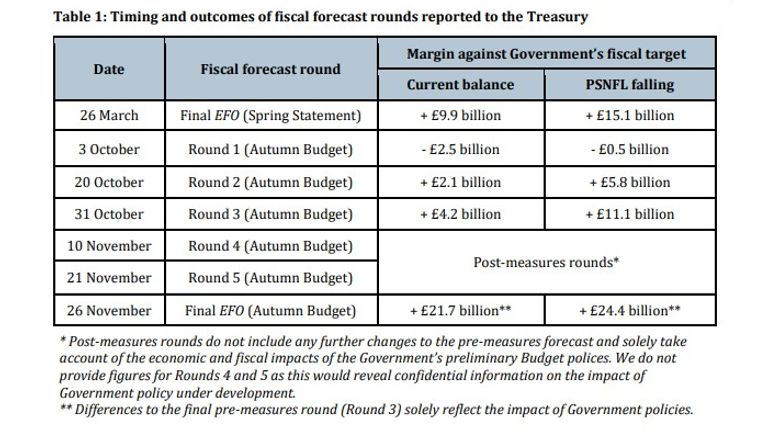
At the time of the last budget, taxes were indeed higher than current spending, once the economic cycle is taken account of or, to put it in economists’ language, there was a surplus in the cyclically adjusted current budget. The chancellor had met her fiscal rule, by £9.9bn.
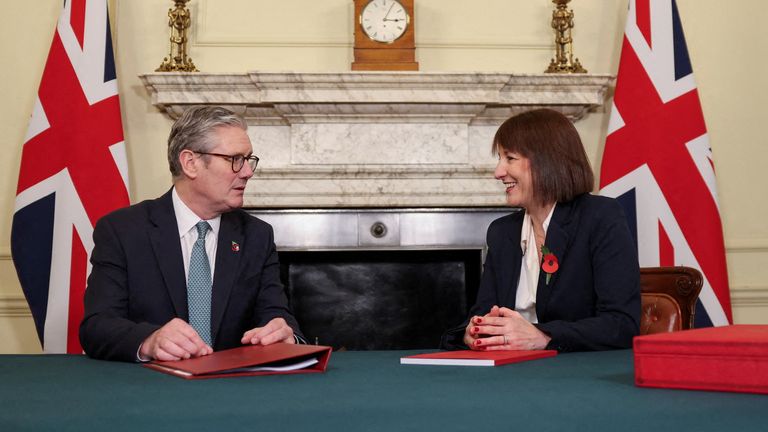
Pic: Reuters
This, it’s worth saying, is not a very large margin by which to meet your fiscal rule. A typical budget can see revisions and changes that would swamp that in one fell swoop. And part of the explanation for why there has been so much speculation about tax rises over the summer is that the chancellor left herself so little “headroom” against the rule. And since everyone could see debt interest costs were going up, it seemed quite plausible that the government would have to raise taxes.
Then, over the summer, the OBR, whose job it is to make the official government forecasts, and to mark its fiscal homework, told the government it was also doing something else: reviewing the state of Britain’s productivity. This set alarm bells ringing in Downing Street – and understandably. The weaker productivity growth is, the less income we’re all earning, and the less income we’re earning, the less tax revenues there are going into the exchequer.
The early signs were that the productivity review would knock tens of billions of pounds off the chancellor’s “headroom” – that it could, in one fell swoop, wipe off that £9.9bn and send it into the red.
Read more:
Main budget announcements – at a glance
Enter your salary to see how the budget affects you
That is why stories began to brew through the summer that the chancellor was considering raising taxes. The Treasury was preparing itself for some grisly news. But here’s the interesting thing: when the bad news (that productivity review) did eventually arrive, it was far less grisly than expected.
True: the one-off productivity “hit” to the public finances was £16bn. But – and this is crucial – that was offset by a lot of other, much better news (at least from the exchequer’s perspective). Higher wage inflation meant higher expected tax revenues, not to mention a host of other impacts. All told, when everything was totted up, the hit to the public finances wasn’t £16bn but somewhere between £5bn and £6bn.
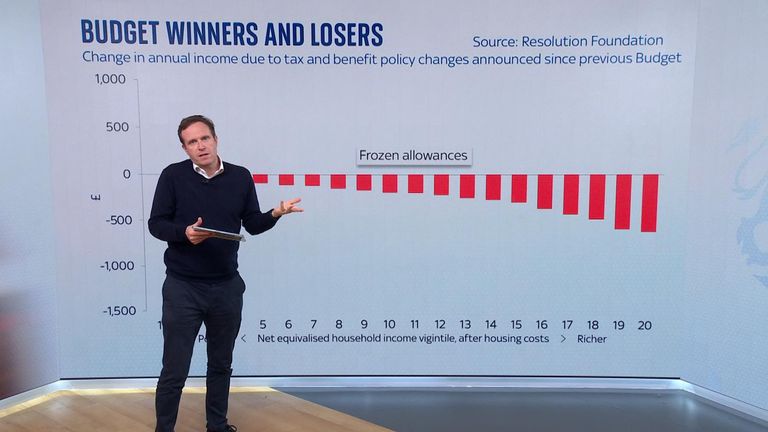
Budget winners and losers
Why is that number significant? Because it’s short of the chancellor’s existing £9.9bn headroom. Or, to put it another way, the OBR’s forecasting exercise was not enough to force her to raise taxes.
The decision to raise taxes, in other words, came down to something else. It came down to the fact that the government U-turned on a number of its welfare reforms over the summer. It came down to the fact that they wanted to axe the two-child benefits cap. And, on top of this, it came down to the fact that they wanted to raise their “headroom” against the fiscal rules from £9.9bn to over £20bn.
These are all perfectly logical reasons to raise tax – though some will disagree on their wisdom. But here’s the key thing: they are the chancellor and prime minister’s decisions. They are not knee-jerk responses to someone else’s bad news.
Yet when the prime minister explained his budget decisions, he focused mostly on that OBR report. In fact, worse, he selectively quoted the £16bn number from the productivity review without acknowledging that it was only one part of the story. That seems pretty misleading to me.

Sir Keir Starmer has denied he and the chancellor misled the public and the cabinet over the state of the UK’s public finances ahead of the budget.
The prime minister told Sky News’ political editor Beth Rigby “there was no misleading”, following claims he and Rachel Reeves deliberately said public finances were in a dire state, when they were not.
Politics latest: Reeves says Cabinet briefed on morning of budget
He said a productivity review by the Office for Budget Responsibility (OBR), which provides fiscal forecasts to the government, meant there would be £16bn less available so the government had to take that into account.
“To suggest that a government that is saying that’s not a good starting point is misleading is wrong, in my view,” Sir Keir said.
Cabinet ministers have said they felt misled by the chancellor and prime minister, who warned public finances were in a worse state than they thought, so they would have to raise taxes, including income tax, which they had promised not to in the manifesto.
At last Wednesday’s budget, Ms Reeves unveiled a record-breaking £26bn in tax rises.
The OBR published the forecasts it provided to the chancellor in the two months before the budget, which showed there was a £4.2bn headroom on 31 October – ahead of that warning about possible income tax rises on 4 November.
The OBR’s timings and outcomes of the fiscal forecasts reported to the Treasury
Sir Keir added: “There was a point at which we did think we would have to breach the manifesto in order to achieve what we wanted to achieve.
“Late on, it became possible to do it without the manifesto breach. And that’s why we came to the decisions that we did.”
Sir Keir said a productivity review had not taken place in 15 years and questioned why it was not done at the end of the last government, as he blamed the Conservatives for the OBR downgrading medium-term productivity growth by 0.3 percentage points to 1% at the end of the five-year forecast.
Read more:
Senior cabinet minister defends Reeves
‘Of course I didn’t lie about budget forecasts, says chancellor
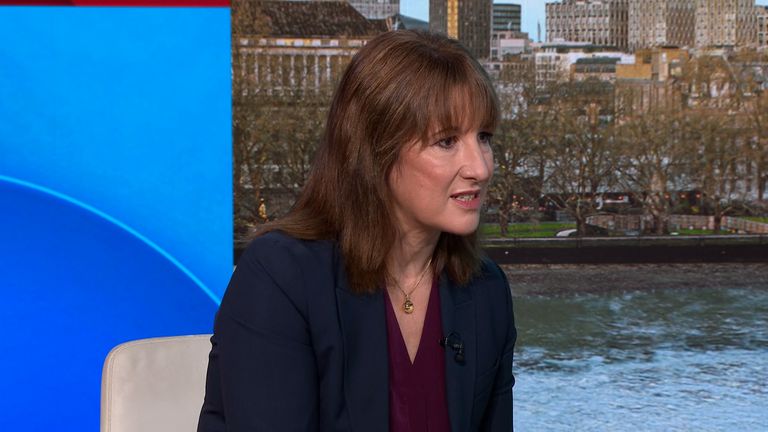
Reeves: I didn’t lie about ‘tax hikes’
The prime minister added: “I wanted to more than double the headroom, and to bear down on the cost of living, because I know that for families and communities across the country, that is the single most important issue, I wanted to achieve all those things.
“Starting that exercise with £16 billion less than we might otherwise have had. Of course, there are other figures in this, but there’s no pretending that that’s a good starting point for a government.”
On Sunday, when asked by Sky’s Trevor Phillips if she lied, Ms Reeves said: “Of course I didn’t.”
She also said the OBR’s downgrade of productivity meant the forecast for tax receipts was £16bn lower than expected, so she needed to increase taxes to create fiscal headroom.
-
 Sports2 years ago
Story injured on diving stop, exits Red Sox game
-
 Sports3 years ago
‘Storybook stuff’: Inside the night Bryce Harper sent the Phillies to the World Series
-
 Sports2 years ago
Game 1 of WS least-watched in recorded history
-
 Sports3 years ago
Button battles heat exhaustion in NASCAR debut
-
 Sports3 years ago
MLB Rank 2023: Ranking baseball’s top 100 players
-
Sports4 years ago
Team Europe easily wins 4th straight Laver Cup
-
 Environment3 years ago
Japan and South Korea have a lot at stake in a free and open South China Sea
-
 Environment1 year ago
Here are the best electric bikes you can buy at every price level in October 2024