
How the Lightning’s March madness has put them among top Cup contenders — again


-
Kristen Shilton, ESPN NHL reporter
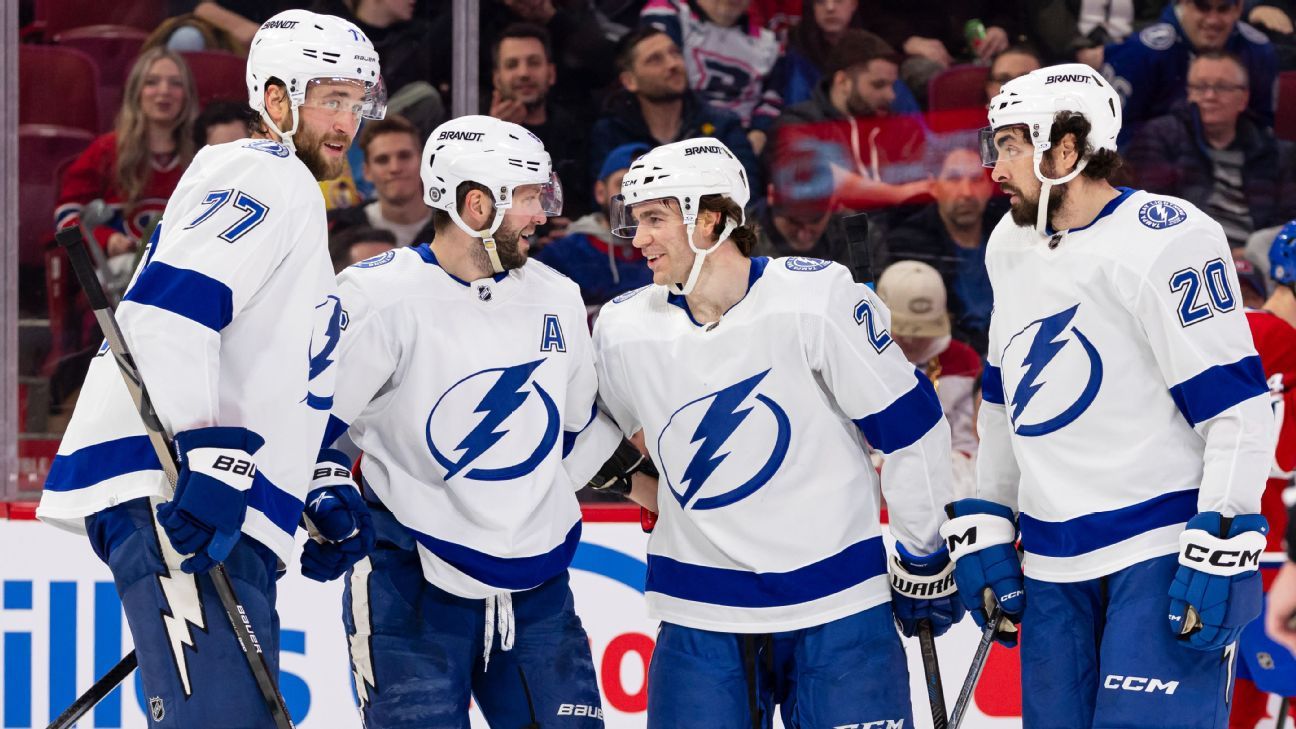
The Tampa Bay Lightning had their own March madness this year. With a March mantra to boot: Just win, baby.
And no surprise — the Lightning did. A lot.
Tampa Bay went 9-1-1 last month, saving their best run of the season (so far) for the stretch drive toward playoffs. It’s not the first time the Lightning have hung back, only to flip the proverbial switch right when points and positioning are paramount.
It’s a sound strategy when successful — even if Tampa Bay isn’t exactly aiming to be so dramatic.
“We’re obviously not trying to wait that long [to get going],” defenseman Victor Hedman said with a laugh. “But yeah, that’s just how things have played out. But we’re always confident in ourselves and we’re confident in the core group that we are going to be able to sustain a high level of play from here for a deep playoff run.”
Tampa Bay certainly knows what it takes to go on one. The Lightning were back-to-back Stanley Cup champions in 2020 and 2021, and reached the Final again in 2022. The accumulation of acclaim made their first-round exit against Toronto in 2023 all the more disappointing — but even additional offseason rest didn’t help the Lightning transition to a new year.
In fact, Tampa Bay downright struggled to start this season. Without goaltender Andrei Vasilevskiy — who was sidelined by offseason hip surgery until late November — the Lightning struggled to barely get above .500 and were 18-15-5 on Dec. 31. The Lightning had at that point also lost top-pairing defenseman Mikhail Sergachev to an upper-body injury and were looking for a clear direction.
That was uncharted territory for Tampa Bay after being rapidly locked in to its postseason fate a season ago.
“I think last year at Christmas we knew we were playing the Leafs [in the first round],” Jon Cooper said last week. “This year at Christmas, we knew we weren’t playing the Leafs. It’s been one of those years. I don’t know what our point total was [at this point] last year. But we’re not too far off. It’s just we got to this point in a different way.”
Cooper was right: Tampa Bay had 96 points on April 3, 2023; the Lightning were at 91 points on April 3, 2024, and holding the Eastern Conference’s first wild-card spot.
So, what changed for Tampa Bay to take it from writhing to thriving? Because finding a way to sneak up on — and slip past — the competition is a tall order even for recent two-time champions. But the Lightning are doing it and hitting their stride after weathering a few storms.
And maybe those past achievements are also pushing Tampa Bay — on and off the ice — to embrace the ride.
“These guys have really in the month of March put them in a spot that you maybe on March 1 we weren’t thinking was going to be like this,” Cooper said. “I’m proud of the guys for what they’ve done. Because you know, every year is different.”
DOWNTIME DURING THE SEASON isn’t usually a bad thing.
Unless you’re the Lightning.
Tampa Bay had just cruised through January at 8-1-0 to arrive at its 10-day layoff between the bye week and All-Star activities. When the Lightning resumed play, though, it was under increasingly choppy seas.
“For whatever reason, our team hasn’t been good coming out of [All-Star] breaks in recent years, and we were true to that this year,” captain Steven Stamkos said. “We went into the break on a good tear. Then we had a couple of games where things really kind of went sideways in terms of what our identity is. We got away from it.”
The first wave hit when Sergachev — back in the lineup on Feb. 7 after a 17-game absence — suffered multiple tibia fractures that same night. He immediately had surgery, and Cooper said Tampa would have to go “deep” in the playoffs to see Sergachev rejoin the team.
The Lightning went downhill from there, finishing February 5-6-1 while barely clinging to a playoff spot.
Their slump presented a significant challenge. Would they let that crack turn into a crevice, swallowing the season whole? Or could they start patching what holes were in front of them?
Tampa Bay chose the latter.
“The coaching staff has a good feel on [what we needed],” Stamkos said. “You have those meetings where things aren’t necessarily pretty watching the video as a player, but it’s one of those moments whereas a group collectively, you have to man up and be better and just pay attention to more details when you don’t have the puck. Those are the harder things to do, but that’s the stuff that wins in playoff time, and the core group of this team knows what that takes.”
That’s not to say losing Sergachev hasn’t stung, or that the Lightning believe they’re in top form without him patrolling their blue line. Forging ahead without Sergachev is just another obstacle in Tampa Bay’s path.
“We’re a much better team when he’s in than out,” Cooper said. “We’ve had to learn to live with it and move on just as years ago when we lost [Stamkos] for a long time in a [2019] playoff run or we lost [Nikita Kucherov] for a year [in 2020-21]. You just have to adapt. The pity party can last for a day, but then you have to move on.”
Fortunately for Tampa Bay, Kucherov has been the molten-hot core of its nucleus this year. The dazzling winger has dominated as a frequent league-leader in points, generating a Hart Trophy-worthy campaign to buoy the Lightning through their inevitable ebbs and flows. It especially kept Tampa Bay afloat while Vasilevskiy rebounded into form.
The Lightning have yearly leaned on Vasilevskiy’s excellence, but the injury clearly set their Vezina Trophy winner back: After his first month in the crease, Vasilevskiy was 7-7-0 with an .899 save percentage and 3.01 goals-against average. Tampa Bay oscillated between Vasilevskiy and backup Jonas Johansson until Vasilevskiy began to look like himself again right around (wait for it) March into April, when he was outstanding at 9-2-1 with a .918% and 2.33 GAA.
Kucherov’s other teammates eventually caught on, too, and the uptick in production across the board made every difference.
By the end of March, Brayden Point had 12 goals in 12 games, Stamkos punched in 17 points in 13 games and Hedman added 12 points in 12 games.
Oh, and Kucherov hit another high note, too, collecting 26 points in 13 games. Casual.
If it weren’t for Kucherov’s consistency, the Lightning would have had an even steeper climb up the standings. He’s without question the team’s MVP, and Hedman believes that candidacy should expand past their dressing room walls.
“[There’s] no debate in my mind [who should win the Hart],” Hedman said. “Just the way he’s carried this team through the adversity we’ve faced and the tough start that we had, he kept producing and trying to get us out of the slump. Now that we have, he’s still producing at an incredibly high level and he’s played big minutes. He’s the smartest player in hockey.”
Lightning GM Julien BriseBois had to be intelligent, too, in supporting Kucherov & Co., but Brisebois’ position heading into the trade deadline was (unsurprisingly) familiar: depth roles having to be filled, with little salary cap space with which to do it.
Stop if you’ve heard this one before, but Tampa Bay found its solutions again.
THE LIGHTNING HAVE A WAY of welcoming fresh faces.
In 2019-20, the Lightning brought in Blake Coleman and Barclay Goodrow at the trade deadline to help Tampa Bay lift the Cup. The Lightning did it again in 2020-21 with the addition of David Savard. In 2021-22, it was Nicholas Paul and Brandon Hagel joining Tampa Bay’s ranks, and they’ve continued to thrive with the Lightning since.
So BriseBois knew the benefit of bringing in veterans. He found them in landing Anthony Duclair from the San Jose Sharks for a prospect and 2025 seventh-round draft choice, and Matt Dumba (plus a 2025 seventh-round pick) from the Arizona Coyotes for a 2027 fifth-round selection. Both trades followed a typical Tampa Bay pattern of identifying key, depth-related needs and targeting the ideal players to address them.
Naturally, they’ve been a hit already. Since the March 8 deadline, Duclair has emerged as a top-line winger, collecting five goals and 10 points in 11 games, while Dumba has settled into a reliable, third-pairing role.
“The trade deadline [this year] I think was huge,” Hedman said. “For us, we added some pieces, and that’s kind of when our game started to click at a top level. We’ve had some runs throughout the year but for us mostly, after the trade deadline, we’ve been able to kind of cement ourselves with the way we want to play.”
Tampa Bay has remained loyal to many players from its championship run, but there were inevitable cap casualties, too, such as Yanni Gourde, Ryan McDonagh, Alex Killorn, Coleman and Goodrow. Replacing those players year after year is hardly a straightforward task, but somehow the Lightning have become masters of the craft.
“It’s so hard to win in this league,” Stamkos said. “Even the core guys that are still here, as many guys as we’ve lost, we brought in guys that have that same pedigree and management has always done an unbelievable job of just giving us that added boost come trade deadline with making moves. This year, maybe we didn’t have the capital that we had in other years to make big trades but for us, those were big moves. You add a top-six forward and reliable defenseman, and that’s exactly what we need and both those guys bring an element of obvious skill on the ice but character in the room, too. You lose some of those players over the years who just are glue guys in the room, and those [new] guys have fit in really well and sparked us I think.”
The Lightning’s second-half surge wouldn’t have been complete without a little youth movement. Rookie Emil Lilleberg, 23, has been stationed next to Dumba on Tampa’s blue line, and freshman Mitchell Chaffee, 26, can lately be found in a third-line slot with Paul and Michael Eyssimont. They, along with Max Crozier in previous stretches, have been a shot in the arm for the club’s overall mood.
“The youthful energy that has been brought into this room has been great,” Stamkos said. “They’ve done an amazing job on the ice but just that anxiousness, that nervousness, that energy that you have in the room for these young guys, I think that has been a help as well, maybe a little jolt. They’ve certainly played extremely well for us.”
Tampa Bay has used skaters old and new to up the ante on special teams. Going back to March 1, the Lightning own the league’s fifth-ranked power play (28.2%) and it’s No. 1 penalty kill (95.0%), and are tied for the lead in shorthanded goals (3).
The stars have, to put it mildly, aligned for the Lightning. Clinching a seventh consecutive playoff berth seems inevitable. And no, Tampa Bay doesn’t care which team it faces in the first round.
It’s the getting back there that counts — and the incomparable journey that awaits.
SOME EXPERIENCES IN LIFE might have a shelf life. Competing for a Cup isn’t one of them.
That’s what makes the Lightning’s current trajectory so fun — and all the hard days behind (and potentially ahead) of them so worthwhile.
“When you’ve been to the top of the mountain and you have that feeling, it’s almost like an addiction,” Stamkos said. “You want it again because it feels so amazing. You’ve accomplished your ultimate dream and then for the guys who have done that, that’s what drives you to do it again. And I think for the most part, the guys that are still here from those teams still feel that way.”
The exhilaration of winning might never fade, but players themselves do. Careers end in all sorts of ways, and the saddest one is with regrets. That thought alone is enough to fuel those lucky enough to remain in the fight.
“It’s the hunger that doesn’t stop,” Hedman said. “We’re not going to play this game until we’re 45 or 50. It’s a short lifespan, and you’ve just got to embrace every opportunity that you have, and you can’t take anything for granted just because you had success in the past. It’s just making sure that you embrace every situation, embrace every year and you look at it like it might your last chance. And that hunger we have in this room is what’s impressed me the most.”
Cooper’s perspective on winning it all spans beyond just the Lightning lens. It goes out to an appreciation for the fact that Tampa Bay didn’t see its early exodus last spring as a sign of its inevitable demise. It was more like a wakeup call about what’s at stake — and that’s extending the Lightning’s window long past what even they initially believed might be possible.
Tampa Bay has the formula down. Just win, baby.
“It was devastating when we lost to Toronto,” Cooper said. “It’s [lost] time in the league. Not everybody’s blessed to get to play for 15, 20 years. Guys get to play six, seven, eight and in that time, you’ve got to hope you play on a team that makes the playoffs. There are some guys in this league that haven’t had that experience. And they [never] get to have the experience. We’ve had that experience, but you cherish it because you don’t know when you go back. You just don’t know.”

-
Greg Wyshynski
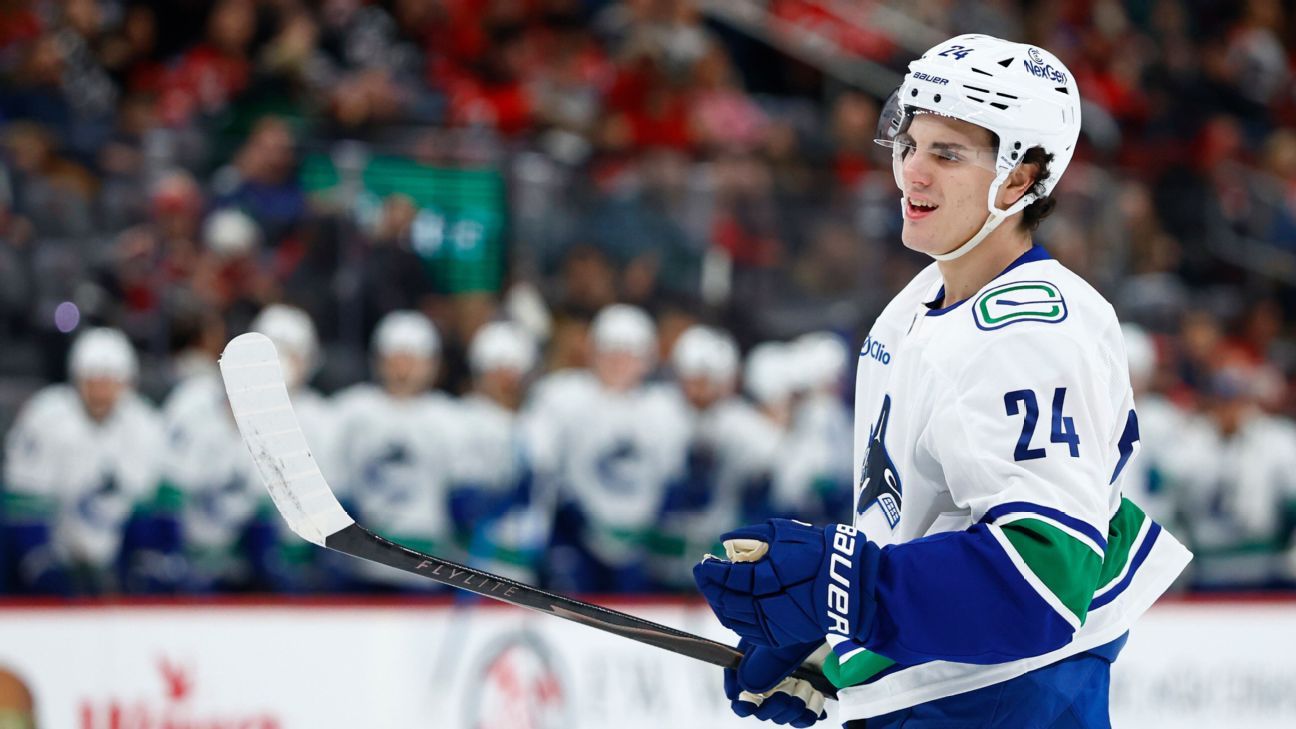
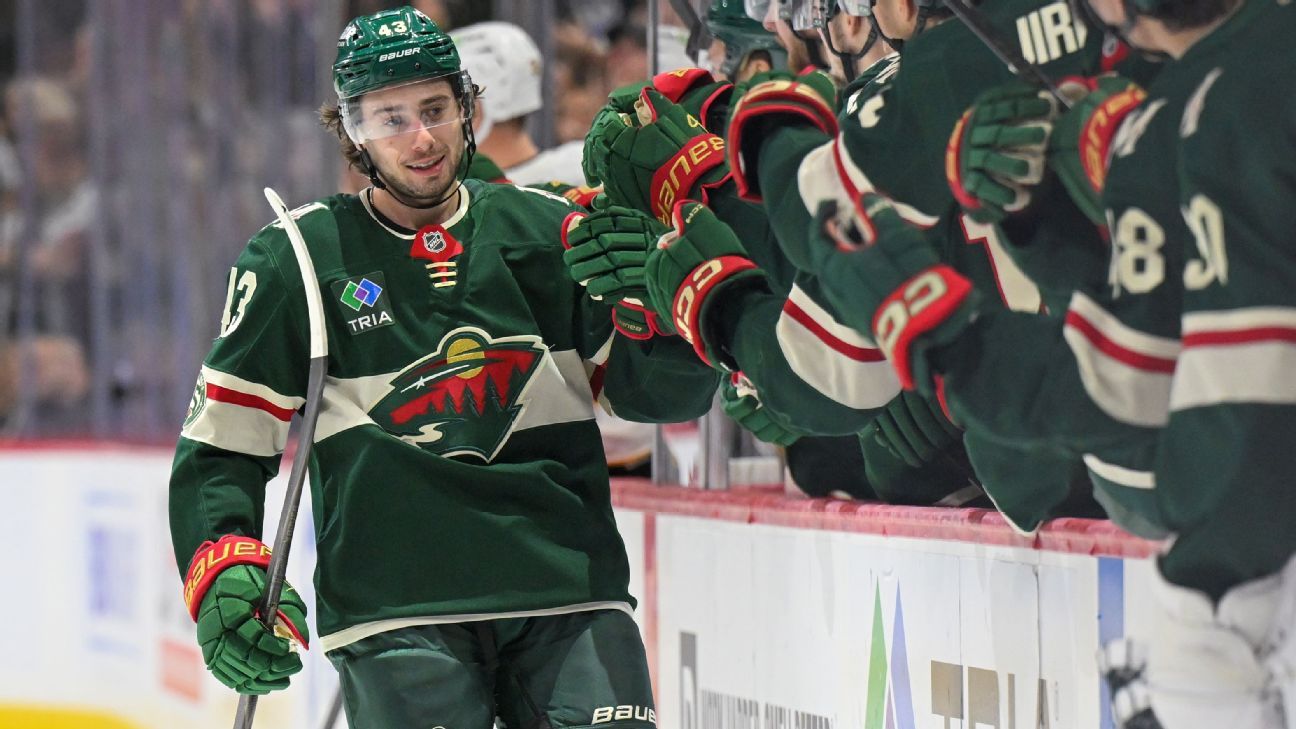
NEWARK, N.J. — Zeev Buium was the Minnesota Wild‘s defenseman of the future until they made him the centerpiece of the Quinn Hughes trade last Friday, shipping the 20-year-old in a package to the Vancouver Canucks for their star captain.
Buium said he doesn’t feel he was misled about his status with the Wild before the trade.
“I don’t think anything they told me was a lie. I really don’t,” Buium said Sunday after the Canucks’ 2-1 road victory over the New Jersey Devils. “[Wild GM] Bill Guerin is an unbelievable person. He’s such a smart guy. He wants to try and win now, and that’s a move he thought was best for the team. At the end of the day, you have to do what’s best for the team.”
Buium was traded to Vancouver along with center Marco Rossi, winger Liam Ohgren and a 2026 first-round pick for Hughes, the 26-year-old Norris Trophy winner who is considered one of the best defensemen in hockey. Hughes had 432 points in 459 games heading into Sunday’s action and was the leading scorer on Vancouver (23 points in 26 games) before Friday’s blockbuster trade.
Buium had two points in his debut with the Canucks, both on the power play. He earned an assist on Jake DeBrusk‘s opening goal and then was credited with his fourth goal of the season when his pass deflected off the stick of Devils defenseman Brenden Dillon.
He was drafted 12th overall in 2024 by the Wild and was an offensive dynamo with the University of Denver for two seasons (98 points in 83 games). He had 14 points in 31 games as a rookie this season before the trade.
Guerin called Buium a “special kid and a special human,” but he indicated that the Wild’s bid for Hughes was only successful because Buium was a part of it.
“I love that kid, but you have to give something to get something,” Guerin said.
Buium didn’t take the trade personally, but he said he’ll use it as motivation.
“I don’t think it’s [Guerin] saying, ‘You’re not good enough’ or ‘We don’t believe in you.’ But I think he sees me needing to develop a little bit more,” Buium said. “I think it works out for both teams. I’m going to do my best to show the Canucks that they made a good trade. Hopefully, I can turn into a player like that.”

-
Mark Schlabach
Indiana quarterback Fernando Mendoza, who led the No. 1 Hoosiers to a perfect 13-0 record and their first Big Ten title since 1967, captured the 91st Heisman Trophy on Saturday night.
Mendoza beat out quarterbacks Diego Pavia (Vanderbilt) and Julian Sayin (Ohio State) and running back Jeremiyah Love (Notre Dame) to take home the trophy during a ceremony in New York.
Mendoza, who played two seasons at California before joining the Hoosiers this season, completed 71.5% of his pass attempts for 2,980 yards with 39 total touchdowns.
He was only the second Heisman Trophy finalist from Indiana. Running back Anthony Thompson was runner-up to Houston quarterback Andre Ware in one of the closest votes in 1989.
With Mendoza, Pavia and Love expected to move on to the NFL after this season, who are the top returning Heisman Trophy candidates for 2026?
In compiling the list of potential candidates, I projected that quarterbacks John Mateer (Oklahoma), Ty Simpson (Alabama) and Dante Moore (Oregon); receivers Carnell Tate (Ohio State), Zachariah Branch (Georgia) and Makai Lemon (USC); and running back Emmett Johnson (Nebraska) will turn pro (along with the aforementioned finalists from this year).
Here is a look at some of the top potential contenders (in no particular order):


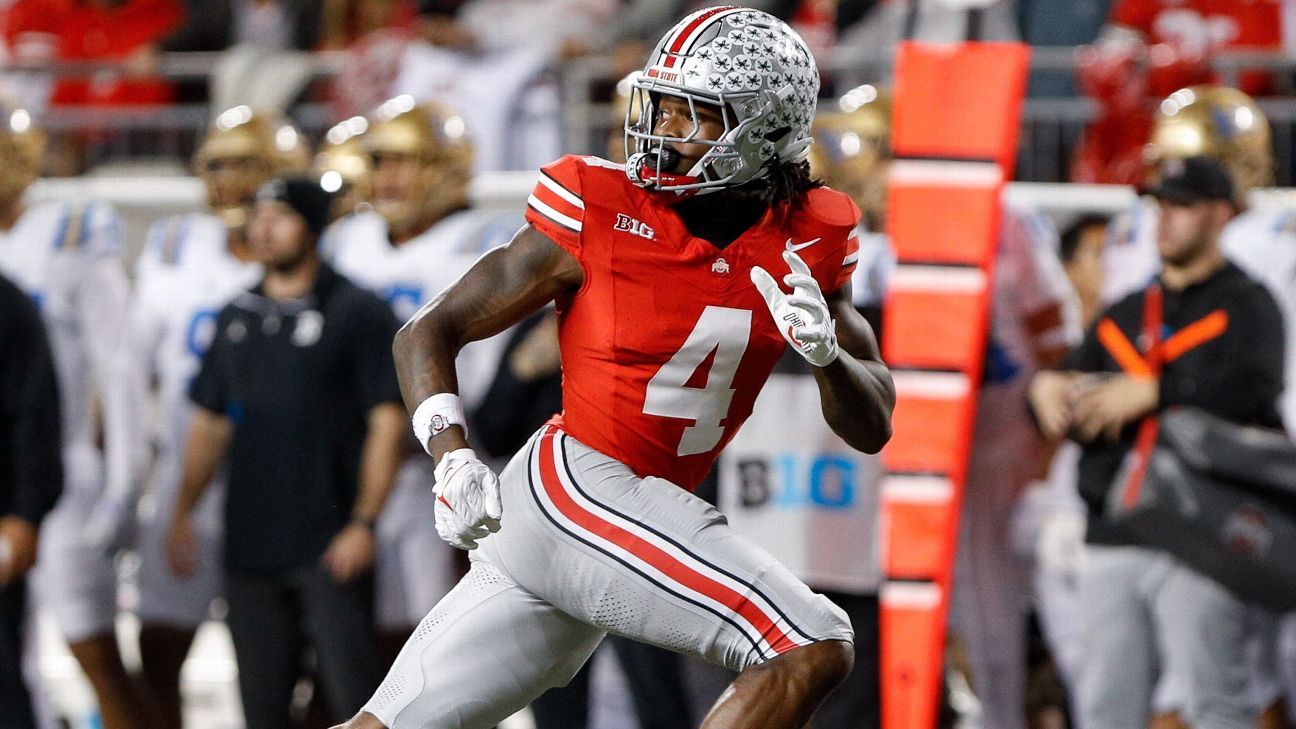
2025 stats: 80 catches, 1,086 receiving yards, 12 total touchdowns
Smith’s highlight reel of acrobatic, one-handed catches continues to grow, and he arguably has been the best player in college football this season. He was the fastest Buckeyes player to reach career marks of 2,000 receiving yards (24 games), 100 catches (20) and 25 touchdown receptions (25).
2025 stats: 78.4% completion pct, 3,323 passing yards, 31 touchdowns, 6 interceptions
Sayin might have captured the Heisman Trophy this season if Ohio State’s offense hadn’t flopped in its 13-10 loss to Indiana in the Big Ten championship game. In his first season as a starter, Sayin is on pace to break the NCAA single-season pass completion record of 77.4%, set by Oregon’s Bo Nix in 2023.

2025 stats: 70.7% completion pct, 2,691 passing yards, 442 rushing yards, 31 total touchdowns
In his first full season as Georgia’s starting quarterback, Stockton helped guide the Bulldogs to a 12-1 record and SEC title. His legs and right arm were a big reason the Bulldogs averaged 31.9 points, despite enduring myriad injuries on the offensive line. Stockton was at his best when the game was on the line — he completed 86% of his passes with 11 touchdowns and one interception in the fourth quarter against ranked opponents.

2025 stats: 84 receptions, 970 receiving yards, 7 receiving touchdowns
Toney’s teammates call him “Baby Jesus,” and the true freshman delivered in a big way in his first season with the No. 10 Hurricanes. He ranks sixth in the FBS with 84 catches and had 1,328 all-purpose yards. Toney even threw for two scores. Not bad for an 18-year-old who would be a senior in high school if he hadn’t reclassified to the class of 2025.

2025 stats: 61.4% completion pct, 2,942 passing yards, 32 total touchdowns
Even after all the hand-wringing about Manning being overrated at the start of the season, the former five-star recruit ended up putting together a good campaign, throwing for 2,942 yards with 24 touchdowns. The No. 13 Longhorns need to find some offensive linemen (he was sacked 23 times) and receivers to help him in 2026.

2025 stats: 65.5% completion pct, 3,016 passing yards, 24 total touchdowns
Ole Miss officials have submitted a waiver to the NCAA on Chambliss’ behalf for another season of eligibility. He played his first three seasons at Division II Ferris State before transferring to Ole Miss this year. He was named SEC Newcomer of the Year after taking over the starting job in the third game of the season.

2025 stats: 1,560 rushing yards, 16 touchdowns
A transfer from Louisiana-Monroe, Hardy led the FBS with 130 rushing yards per game and was No. 2 with 1,560 total rushing yards. He had eight 100-yard games for the Tigers, including a whopping 300-yard effort with three touchdowns in a 49-27 victory against Mississippi State on Nov. 15.

2025 stats: 61.8% completion pct, 2,932 passing yards, 466 rushing yards, 31 total touchdowns
Reed announced this week that he plans to stay at Texas A&M next season, which is great news for the No. 7 Aggies. He was a threat with the ball in his hands, throwing for 2,932 yards with 25 touchdowns and running for 466 yards with six scores. His decision-making needs to continue to improve, so he can cut down on his 10 interceptions.

2025 stats: 63.6% completion pct, 3,117 passing yards, 20 total touchdowns
There’s a reason new Bears coach Tosh Lupoi took a late-night flight to Hawai’i to make sure Sagapolutele was staying at Cal. He was only the second true freshman in FBS history to pass for 200 yards or more in each of his first 11 starts. In the Bears’ late-season upsets of then-No. 21 SMU and No. 15 Louisville, Sagapolutele passed for a combined 653 yards with six touchdowns and no picks.
2025 stats: 1,279 rushing yards, 20 touchdowns
After transferring from Missouri, Lacy helped the No. 6 Rebels win 11 games in the regular season for the first time. He ranks No. 2 in the FBS with 20 rushing touchdowns and piled up 1,279 yards on the ground. Will he follow former coach Lane Kiffin to LSU or remain with the Rebels in 2026?

2025 stats: 66.2% completion pct, 3,431 passing yards, 29 total touchdowns
If Maiava returns to the No. 16 Trojans for another season, he’ll probably flourish in Lincoln Riley’s offense. This year, he threw for 3,431 yards with 23 touchdowns and 8 interceptions. He ranks No. 1 with a 91.2 total QBR. According to Pro Football Focus, he was second in the FBS with 26 big-time throws. (A big-time throw is defined as a high-difficulty, high-value pass.)
2025 stats: 1,035 rushing yards, 6 total touchdowns
Jackson became the fifth true freshman in OSU history to produce a 1,000-yard season, joining Robert Smith (1990), Maurice Clarett (2002), JK Dobbins (2017) and TreVeyon Henderson (2021). That’s good company. And, of course, he’d be the second Bo Jackson to collect a stiff-armed trophy.

2025 stats: 70.2% completion pct, 4,129 passing yards, 36 total touchdowns
Mestemaker is one of the best stories in college football. He didn’t start a single game in high school, then joined North Texas as a walk-on. This season, he led the FBS with 4,129 passing yards, helping him capture the Burlsworth Trophy as the top walk-on in the country. Will he join former Mean Green coach Eric Morris at Oklahoma State in 2026?

CJ Carr, QB, Notre Dame
2025 starts: 66.6% completion pct, 2,741 passing yards, 24 touchdowns
Fighting Irish coach Marcus Freeman entrusted Carr to lead his offense after a heated battle in preseason camp. The decision paid off, as Carr put together one of the best performances by a first-time starter in Notre Dame history. He threw for at least one touchdown in each of his first 12 starts, becoming the first Irish player to do that since Everett Golson in 2012-14. Carr’s 24 passing touchdowns are tied for the most in the first 12 starts by a Notre Dame player since 1966.

2025 stats: 70% completion pct, 2,850 passing yards, 595 rushing yards, 27 total touchdowns
Williams is one of the best dual-threat quarterbacks in the FBS, and his ability to run and throw was on display in the Huskies’ 38-19 victory against Rutgers on Oct. 10. He became the first player in school history to pass for at least 400 yards (400) and run for at least 100 (136) in the same game. Williams was second on the team with 595 rushing yards.
Others to watch: Sam Leavitt, QB, TBA; Cam Coleman, WR, Auburn; Brendan Sorsby, QB, Cincinnati; Josh Hoover, QB, TCU; Darian Mensah, QB, Duke; Nate Frazier, RB, Georgia; LJ Martin, RB, BYU; Bear Bachmeier, QB, BYU; LaNorris Sellers, QB, South Carolina; Bryce Underwood, QB, Michigan
-
 Sports2 years ago
Story injured on diving stop, exits Red Sox game
-
 Sports3 years ago
‘Storybook stuff’: Inside the night Bryce Harper sent the Phillies to the World Series
-
 Sports2 years ago
Game 1 of WS least-watched in recorded history
-
 Sports3 years ago
Button battles heat exhaustion in NASCAR debut
-
 Sports3 years ago
MLB Rank 2023: Ranking baseball’s top 100 players
-
Sports4 years ago
Team Europe easily wins 4th straight Laver Cup
-
 Environment3 years ago
Japan and South Korea have a lot at stake in a free and open South China Sea
-
 Environment1 year ago
Here are the best electric bikes you can buy at every price level in October 2024