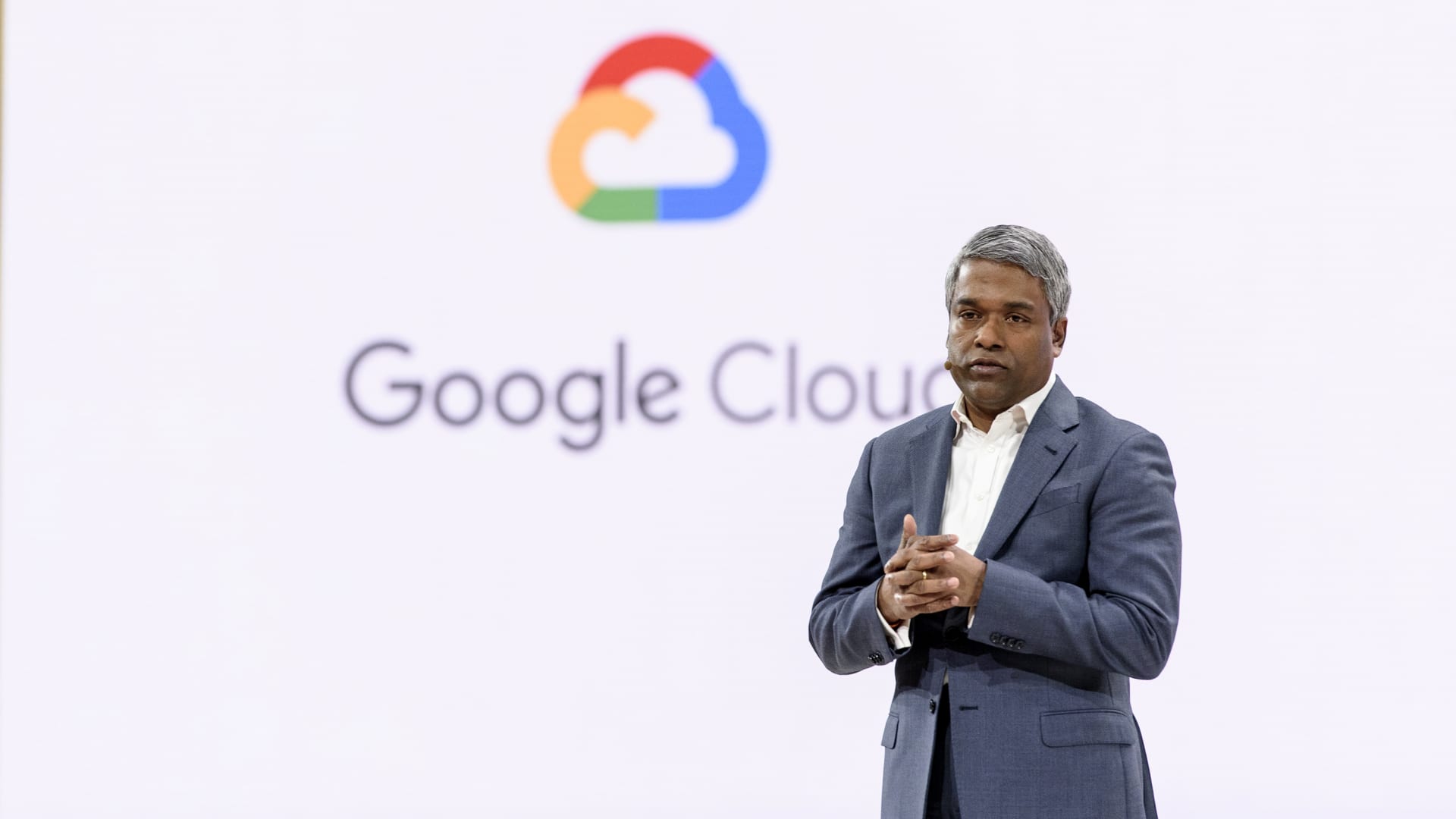
Google Cloud and the German health-care company Bayer on Tuesday announced they are building an artificial intelligence-powered platform that aims to help radiologists diagnose patients and work through cases more quickly.
The platform’s generative AI flags anomalies within images for radiologists to look at, and it can also pull up relevant information from that patient’s medical history, Thomas Kurian, CEO of Google Cloud, told CNBC. If a patient comes in for an annual breast cancer screening, for example, the platform can detect current problems, compare the image to prior screenings and summarize that information, he said.
Health-care companies like Bayer will be able to use the platform to develop radiology-specific applications that carry out functions like these more easily, Google said.
A radiologist is a doctor who uses medical images like CT scans, MRIs and X-rays to identify and treat conditions. But like physicians across many specialties in the U.S., radiologists are facing a growing labor shortage, according to the Association of American Medical Colleges. As of early April, there are more than 1,800 vacant job postings on the American College of Radiology’s website, compared to around 220 listings in April 2014.
Many radiologists are also fighting burnout as an aging population, and easier access to imaging technologies have led to mounting caseloads. Google Cloud said its new platform could help alleviate these ongoing workforce challenges.
“That whole process flow is designed to help radiologists get through their task with assistance more quickly,” Kurian said in an interview. “It makes them more efficient so they can actually see more images and service more patients.”
Kurian said the platform does not replace radiologists, as the doctor still maintains “sole control” of the recommendation they will make. Instead, he wants people to look at the platform as an assistive tool, like a microscope. The goal is to easily give radiologists the information they need and save them from spending 15 or 20 minutes searching through patient records, Kurian said.
Google Cloud and Bayer are not the only companies exploring AI applications for medical imaging. In 2021, the Netherlands-based health-care company Philips and Amazon Web Services said they are working to use AI to analyze medical imaging data. Similarly, GE HealthCare published a blog post in 2022 about the various AI tools it has developed for radiology.
Keith Kirkpatrick, research director at The Futurum Group, said there’s not one clear leader in the medical imaging AI market yet since the technology is still so new.
“It’s really wide open,” Kirkpatrick told CNBC. “We’re still fairly early in the game right now.”
Kirkpatrick, who was briefed on Tuesday’s announcement, said Google Cloud and Bayer’s radiology platform will have to demonstrate high levels of technical accuracy, offer strong privacy and security controls and be easy to use in order to win in the space. Establishing trust with radiologists will be the key, he added.
“Google is going to have to make sure that their technology is as close to foolproof as possible,” Kirkpatrick said.
Google Cloud has been working with Bayer on the radiology platform for around five years. The foundation was built using existing Google Cloud solutions like Vertex AI, Healthcare API and BigQuery, and Kurian said the platform’s data is encrypted.
The companies drew on Bayer’s expertise in radiology to make sure that the product is easy for the doctors to use. Bayer said its radiology products generated around €2 billion (US$2.16 billion) in sales last year, according to a release.
Even so, the platform represents a foray into an entirely new business model for Bayer, according to Guido Mathews, Bayer’s vice president of radiology.
“We don’t offer a new pill — we offer a service for which we will charge users accordingly,” Mathews told CNBC in an interview. “To help develop models and also to help deploy models for radiology, that’s a big step forward for us.”
Google Cloud and Bayer are exploring a number of different pricing models for the platform, he said. Other health-care organizations will begin testing and providing feedback on the platform this year.
Ben Powell, chief strategist for Middle East and Asia Pacific at BlackRock Investment Institute, during a Bloomberg Television interview at the Abu Dhabi Finance Week (ADFW) conference in Abu Dhabi, AD, United Arab Emirates, on Monday, Dec. 9, 2024.
Bloomberg | Getty Images
The wave of capital pouring into artificial intelligence infrastructure is far from peaking, said Ben Powell, chief investment strategist for APAC at BlackRock, arguing the sector’s “picks and shovels” suppliers — from chipmakers to energy producers and copper-wire manufacturers — remain the clearest winners as hyperscalers race to outspend one another.
The surge in AI-related capital expenditure shows no sign of slowing as tech giants push aggressively to secure an edge in what they see as a winner-takes-all contest, Powell told CNBC Monday on the sidelines of the Abu Dhabi Finance Week.
“The capex deluge continues. The money is very, very clear,” he said, adding that BlackRock is focused on what he called a “traditional picks and shovels capex super boom, which still feels like it’s got more to go.”
AI infrastructure has been one of the biggest drivers of global investment this year, fueling a broader market rally, even as some investors question how long the boom can last.
Nvidia, whose GPU chips are the backbone of the AI revolution, became the first company to briefly surpass $5 trillion in market capitalization amid a dizzying AI-fueled market rally that sparked talk of an AI bubble.
The build-out has set off long-term procurement efforts across the tech sector, from chip supply agreements to power commitments. Grid operators from the U.S. to the Middle East are racing to meet soaring electricity demand from new data centers. Companies, including Amazon and Meta, have budgeted tens of billions of dollars annually for AI-related investments.
S&P Global estimates data-center power demand could nearly double by 2030, mostly driven by hyperscale, enterprise and leased facilities, along with crypto-mining sites.
‘Dipping toes into credit market’
Powell also noted that leading tech firms have only begun to tap capital markets to fund the next phase of AI expansion, suggesting additional capital is on the way.
“The big companies have only just started dipping their toes into the credit markets… feels like there’s a lot more they can do there,” he said.
The “hyperscalers” are behaving as if coming second would effectively leave them out of the market, Powell said. That mindset, he added, has pushed firms to accelerate spending even at the risk of overshooting.
Much of that capital, Powell noted, is likely to flow to the companies powering the AI build-out rather than model developers, reinforcing a growing view among global investors that the most durable gains from the AI boom may lie in the hardware, energy and infrastructure ecosystems behind the technology.
“If we’re the recipients of that cash flow, I guess that’s a pretty good place to be, whether you’re making chips, whether you’re making energy all the way down to the copper wiring,” Powell noted, expecting “positive surprises driving those stocks in the year ahead.”
Netflix’s headquarters are pictured in Hollywood, California on December 5, 2025.
Patrick T. Fallon | Afp | Getty Images
“Who’s watching?” Netflix asks whenever someone accesses its site. On Friday, it was probably everyone with an interest in business, markets and television.
The key characters that had people hooked were Netflix and Warner Bros. Discovery, which jointly announced that the streaming giant will acquire the latter’s film studio and streaming service, HBO Max. The equity deal value is pegged at $72 billion.
Netflix investors did not seem too jazzed about the deal, with shares dropping 2.89% on the sheer size of the transaction.
“Look, the math is going to hurt Netflix for a while. There’s no doubt,” Rich Greenfield, co-founder of LightShed Partners, told CNBC. “This is expensive,” he added.
But if one side is paying a lot, that means the other is receiving a bounty. Indeed, investors cheered the potential Warner Bros. Discovery windfall, sending the stock up 6.3% on the news.
It is not a done deal yet, and faces regulatory scrutiny. U.S. President Donald Trump said he would be involved in the decision, Reuters reported Monday, after a senior official from the Trump administration told CNBC’s Eamon Javers on Friday that they viewed the deal with “heavy scepticism.”
Despite this initial show of resistance, stranger things have happened in this administration, and the transaction might eventually go through. We may as well get ready for Netflix’s next blockbuster: “The K-Pop Demon Hunters’ Song of Ice and Fire”?
What you need to know today
U.S. stocks had a positive Friday. The S&P 500 clocked its ninth winning session in 10 and rose 0.3% for the week. Asia-Pacific markets traded mixed Monday. Japan’s Nikkei 225 ticked up even as data showed the country’s economy shrinking more than expected in the third quarter.
Netflix to buy Warner Bros. Discovery’s film and streaming businesses. The total equity value of the deal is $72 billion, announced the two companies Friday. But the transaction could run intoregulatory hurdles.
China’s exports grow more than expected. In U.S. dollar terms, shipments in November jumped 5.9% year on year, outstripping the 3.8% increase estimated in a Reuters poll and returning to growth from October’s 1.1% drop. But U.S.-bound exports plunged 28.6%.
A Ukraine peace deal is ‘really close.’ That’s according to Keith Kellogg, the U.S. special envoy for Ukraine, who reportedly said Saturday that there were two key outstanding issues: the future of Ukraine’s Donbas region and its Zaporizhzhia nuclear power plant.
[PRO] Have $1 million to invest? The current investment landscape might look volatile. But veteran strategists suggest that the path forward is more straightforward than it seems, advising how they would craft a $1 million portfolio.
And finally…
A construction workers paints an eagle on the Marriner S. Eccles Federal Reserve Board Building, the main offices of the Board of Governors of the Federal Reserve System, on Sept. 16, 2025 in Washington, DC.
Elon Musk has called for the European Union to be abolished after the bloc fined his social media company X 120 million euros ($140 million) for a “deceptive” blue checkmark and lack of transparency of its advertising repository.
The European Commission hit X with the ruling on Friday following a two-year investigation into the company under the Digital Services Act (DSA), which was adopted in 2022 to regulate online platforms. At the time, in a reply on X to a post from the Commission, Musk wrote, “Bulls—.”
On Saturday he stepped up his criticism of the bloc. “The EU should be abolished and sovereignty returned to individual countries, so that governments can better represent their people,” he said in a post on X.
Musk’s comments come as top U.S. government officials have also intensified their opposition to the decision.
Secretary of State Marco Rubio called the fine an “attack on all American tech platforms and the American people by foreign governments,” in a post on X on Friday.
“Today’s excessive €120M fine is the result of EU regulatory overreach targeting American innovation,” said Andrew Puzder, the U.S. ambassador to the EU, on X on Saturday.
“The Trump Administration has been clear: we oppose censorship and will challenge burdensome regulations that target US companies abroad. We expect the EU to engage in fair, open, & reciprocal trade — & nothing less.”
Last week, the Commission said breaches included “the deceptive design of its ‘blue checkmark,’ the lack of transparency of its advertising repository, and the failure to provide access to public data for researchers.”
“With the DSA’s first non-compliance decision, we are holding X responsible for undermining users’ rights and evading accountability,” said Henna Virkkunen, executive vice president for tech sovereignty, security and democracy, at the time.
X now has 60 days to inform the Commission of plans to address the issues with “deceptive” blue checkmarks. It has 90 days to submit a plan to resolve the issues with its ads repository and access to its public data for researchers.
“Failure to comply with the non-compliance decision may lead to periodic penalty payments,” the Commission said in a statement.
X.ai, the company which owns X, and the Commission have been approached for comment. oh