
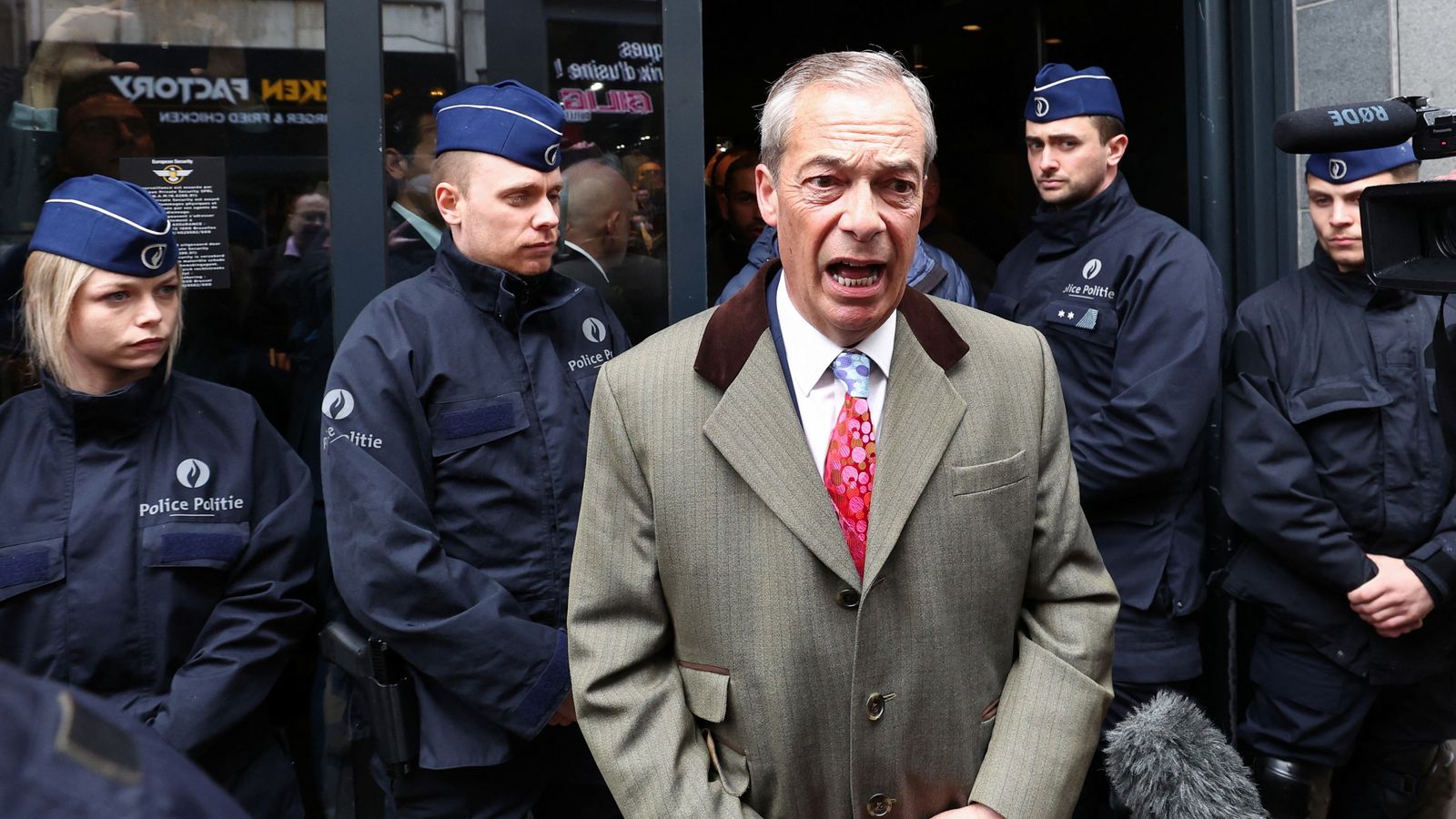
Nigel Farage hits out at ‘cancel culture’ after police move to shut down conference


Nigel Farage has hit out at “cancel culture” after officers moved to shut down the National Conservatism conference in Brussels.
Local officials arrived as the former Brexit Party leader was finishing a speech at the event, which is also due to hear from Hungary’s pro-Putin leader Viktor Orban and two Conservative MPs.
Politics Live: Police turn up at conference while Nigel Farage on stage
Emir Kir, the mayor of Brussels district Saint-Josse-ten-Noode, said he had issued an order banning the conference from taking place on Tuesday “to guarantee public safety”.
He added: “In Etterbeek, in Brussels City and in Saint-Josse, the far-right is not welcome.”
Tory MP Suella Braverman, who was sacked as home secretary last year, was also due to speak on Tuesday, as well as Conservative MP Miriam Cates.
Conference organisers said they were launching a legal challenge to Mr Kir’s order, adding: “There is no public disturbance and no grounds to shut down a gathering of politicians, intellectuals, journalists, students, civic leaders, and concerned citizens.
“The police entered the venue on our invitation, saw the proceedings and the press corps, and quickly withdrew. Is it possible they witnessed how peaceful the event is?”
Police arrive at the National Conservatism Conference in Brussels
Police officers arrived two hours into the event near the city’s European Quarter to inform organisers it must close.
Officers did not appear to force the event to shut down and speeches continued.
Sky’s political correspondent Darren McCaffery, who is at the scene, said police initially told the venue owner that if the building isn’t evacuated they will start removing people.
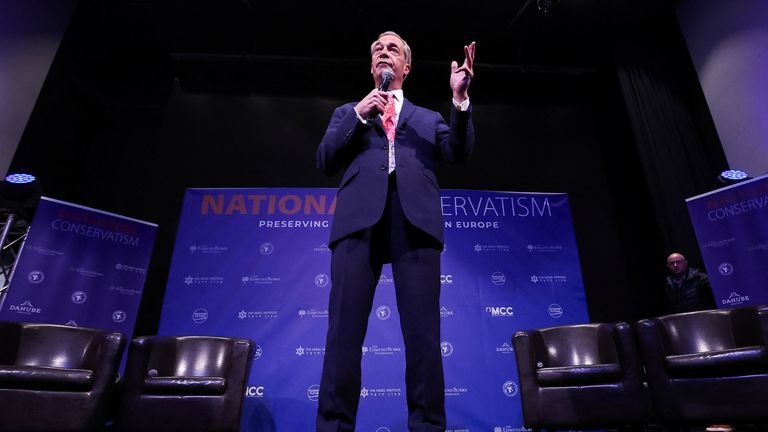
Nigel Farage gestures as he gives a keynote speech
Pic: Reuters
However, they later said they “would not be dragging people out” and instead the tactic was to stop anyone new from entering the venue.
He said this is the third venue chosen by conference organisers, after two others cancelled at the last minute “due to political pressure”.
Police ‘shutting down ideology’
Mr Farage said the conference attendees were “respectable people” and “there’s no protest of significance” happening against it.
“It’s about closing down an ideology,” he told Sky News.
Read More:
The actions of Brussels’ authorities only helped those arguing against cancel culture
What are the Tory renegade gatherings and how much of a threat do they pose to Sunak
Speaking to broadcasters as he left the venue, he said it would be closing down shortly and “I decided to make a discreet exit”.

Darren McCaffrey reports from Brussels as local officials say the National Conservatism Conference will be shut down
“I’m not going to stay when the police storm the place and get everybody out. I’m not going to get involved in a fight.”
He added that he had “personally” experienced cancel culture in Brussels, such as restaurants and pubs refusing to service him, but now “global media” can see it happening.
Ms Braverman accused police of trying to “undermine and denigrate” free speech, saying she was there to talk about “issues that matter”, including border security.
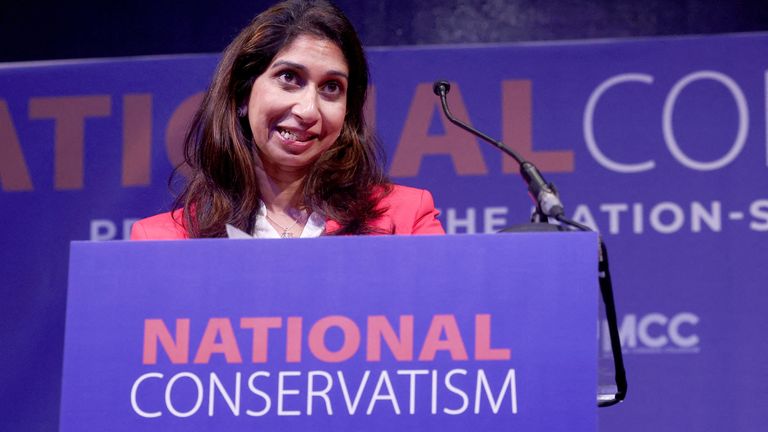
Suella Braverman. Pic: Reuters
Rishi Sunak had faced pressure to block her attendance at the conference, with Labour shadow minister Jonathan Ashworth urging him to stop the former home secretary “giving oxygen to these divisive and dangerous individuals”.
Downing Street later said it was “extremely disturbing” that the conference was shut down, citing freedom of speech.
National Conservatism is a global, right-wing movement which claims that traditional values are being “undermined and overthrown”.
Under Boris Johnson’s government in 2020, Conservative backbencher Daniel Kawczynski was reprimanded for attending a National Conservatism conference in Rome, with a Tory spokesman condemning the views of some other speakers, including Mr Orban.
Both Ms Braverman and Ms Cates addressed the National Conservatism conference in London last year, which was disrupted by protesters.
In her speech Ms Braverman claimed “it is not racist” to want control of our borders, while Ms Cates claimed that falling birth rates are “the one overarching threat.. to the whole of Western society” and that “cultural Marxism” was “destroying our children’s souls”.

A growing rift has emerged in Washington, D.C., between the cryptocurrency industry and labor unions as lawmakers debate whether to ease rules allowing cryptocurrencies in 401(k) retirement accounts.
The dispute centers on proposed market structure legislation that would allow retirement accounts to gain exposure to crypto, a move labor groups say could expose workers to speculative risk. In a letter sent on Wednesday to the US Senate Banking Committee, the American Federation of Teachers argued that cryptocurrencies are too volatile for pension and retirement savings, warning that workers could face significant losses.
The letter drew immediate pushback from crypto investors and industry figures. “The American Federation of Teachers has somehow developed the most logically incoherent, least educated take one could possibly author on the matter of crypto market structure regulation,” a crypto investor said on X.

In response to the letter, Castle Island Ventures partner Sean Judge said the bill would improve oversight and reduce systemic risk, while enabling pension funds to access an asset class that has delivered strong long-term returns.
Consensys attorney Bill Hughes said the AFT’s opposition to the crypto market structure bill was politically motivated, accusing the group of acting as an extension of Democratic lawmakers.

Related: Atkins says SEC has ‘enough authority’ to drive crypto rules forward in 2026
Opposition to crypto in retirement and pension funds mounts
Proponents of allowing crypto in retirement portfolios, on the other hand, argue that it democratizes finance, while trade unions have voiced strong opposition to relaxing current regulations, claiming that crypto is too risky for traditional retirement plans.
“Unregulated, risky currencies and investments are not where we should put pensions and retirement savings. The wild, wild west is not what we need, whether it’s crypto, AI, or social media,” AFT president Randi Weingarten said on Thursday.
The AFT represents 1.8 million teachers and educational professionals in the US and is one of the largest teachers’ unions in the country.
According to Better Markets, a nonprofit and nonpartisan advocacy organization, cryptocurrencies are too volatile for traditional retirement portfolios, and their high volatility can create time-horizon mismatches for pension investors seeking a predictable, low-volatility retirement plan.

In October, the American Federation of Labor and Congress of Industrial Organizations (AFL-CIO) also wrote to Congress opposing provisions within the crypto market structure regulatory bill.
The AFL-CIO, the largest federation of trade unions in the US, wrote that cryptocurrencies are volatile and pose a systemic risk to pension funds and the broader financial system.
Magazine: 13 Christmas gifts that Bitcoin and crypto degens will love


-
 Sports2 years ago
Story injured on diving stop, exits Red Sox game
-
 Sports3 years ago
‘Storybook stuff’: Inside the night Bryce Harper sent the Phillies to the World Series
-
 Sports2 years ago
Game 1 of WS least-watched in recorded history
-
 Sports3 years ago
Button battles heat exhaustion in NASCAR debut
-
 Sports3 years ago
MLB Rank 2023: Ranking baseball’s top 100 players
-
Sports4 years ago
Team Europe easily wins 4th straight Laver Cup
-
 Environment3 years ago
Japan and South Korea have a lot at stake in a free and open South China Sea
-
 Environment1 year ago
Here are the best electric bikes you can buy at every price level in October 2024