
Inside Spencer Rattler’s tumultuous journey to the NFL draft


-
Hallie Grossman, ESPN Staff Writer
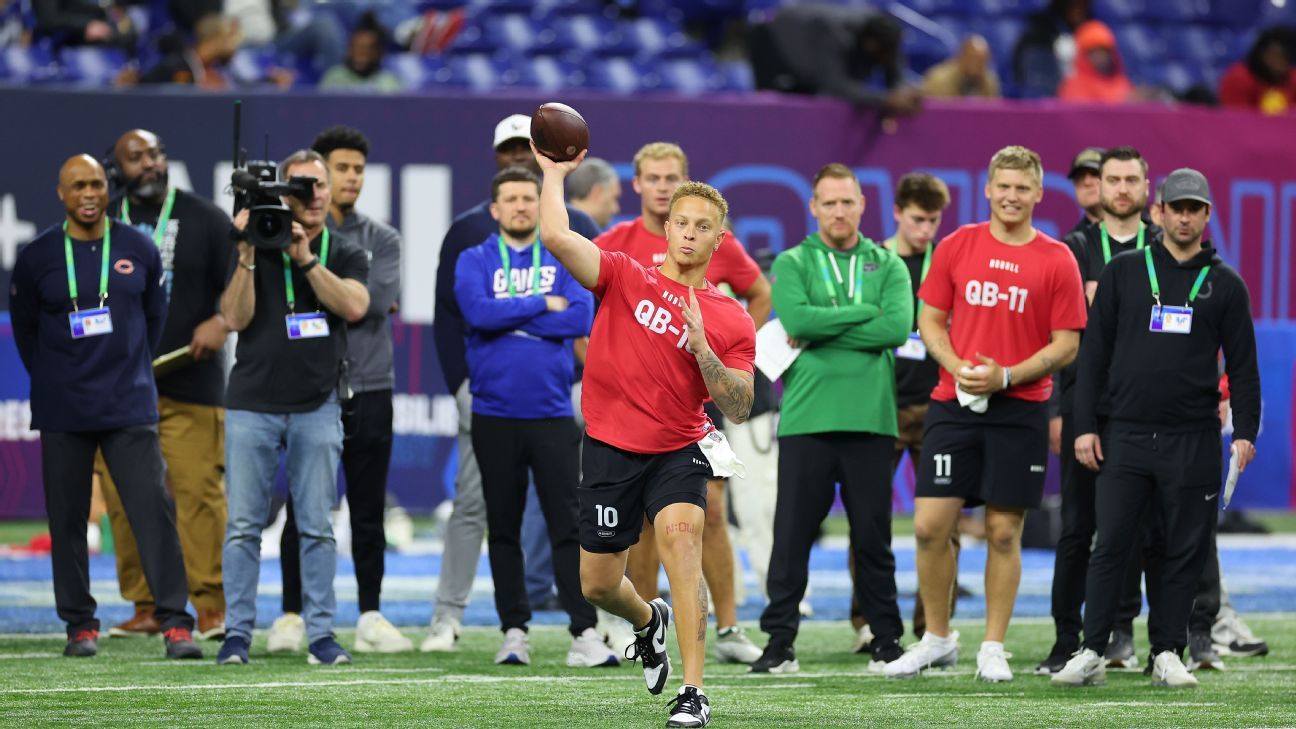
SPENCER RATTLER IS not done yet. He’s closing in on an hour for this afternoon’s throwing session, but he’s just sniffed out a challenge. The road to the NFL draft is a slog — the self-seriousness of the combine, the forensic analysis of testing numbers, the sheer quantity of questions asked and answered, then asked and answered again. (“The Patriots f—ing grilled me,” he says in between passing drills.) But for this one moment in late March, one month before some team in the NFL calls his name early in the draft — or not; he’s one of the draft’s most intriguing riddles — Rattler’s just a kid with a ball and the chance to one-up his buddy. He tells Mike Giovando, his longtime personal coach and the man at the helm of today’s training, he’s not ready to call it quits right now.
“I think my arm’s got one more,” he yells out.
He and Jalen Daniels, who spent time at South Carolina and is one of his training partners for the day, have been heaving long balls down the sideline, trying — and so far failing — to overthrow the speedy wide receiver Giovando has enlisted for today’s prep work. “He’s like Flash Gordon!” Giovando raves.
Daniels has just given it his best, but the receiver screams out a taunt from far downfield: “I had to slow down to catch it!”
Rattler, as he often does, has thoughts: “Watch this,” he says, ribbing Daniels. “Let me show you how to throw it to a fast guy.”
On cue, Shawn Charles, said fast guy, streaks down the right sideline. He’s a blur, like when the road, from a distance, goes wavy on a hot day. Rattler plants his right foot square on the 20-yard line, dances for a few steps, then launches one last moon shot.
The throw is hardly out of his hands before Giovando hollers his approval. “That’s it, right there!” The rest of the group — Daniels; an old teammate of Rattler’s from his high school days in Phoenix; and a hotshot quarterback in the Phoenix prep scene — lets out a collective gasp. This particular moon shot is easily 65 yards (70? 75? It all seems plausible) and Charles catches it over his shoulder, in the nick of time.
“He had to accelerate,” Giovando says, laughing, giddy from Rattler’s arm strength. The preposterousness of it. “He had to accelerate to it!”
Rattler is 23 years old, and it feels like he’s been a part of the public discourse for just as long. In that time, he’s been: the prodigy; the punk; the Heisman favorite; the flameout; the presumptive No. 1 NFL draft pick; the draft’s dead-man-walking; the comeback hero. But it’s this, right here — sublime, tantalizing arm talent — that keeps people coming back for more. It is tough to quit Spencer Rattler, even when it’s not quite clear who Spencer Rattler is. Or who he’ll be next.
IN THE SHADOW of some rolling Arizona mountains, Rattler ponders the climb before him.
He’s worked out with teams (Falcons, Broncos) and interviewed with teams (Seahawks, Patriots) and trotted out his best sales pitch for why all these prospective employers ought to hire him. But here, miles away on a high school football field in Scottsdale, it’s Denver that gnaws at him. He’s tossing a football to himself, waiting for the day’s throwing session to get in full swing, daydreaming aloud.
“They’d be smart to take me over Nix,” he says to his coach. Bo Nix, he means, the quarterback from Oregon. If Caleb Williams, Jayden Daniels and Drake Maye are this draft’s holy triumvirate of passers, with J.J. McCarthy right on their heels, Nix and Michael Penix Jr. are the quarterbacks most often coupled with Rattler. The next-best tier. The could-be-a-starter-one-day tier.
“They’re not getting you in the third,” Giovando says.
The Broncos, who are in the quarterback market this draft, have the 12th overall pick but none in the second round, so they’re all dabbling in a bit of NFL draft game theory at the moment.
“Hope not,” Rattler says.
Three years ago, a conversation like this would’ve been unfathomable. The notion of Spencer Rattler trying to separate himself from the pack? At odds with logic. He was the pack. Lincoln Riley had assembled a revolving door of Heisman quarterbacks at Oklahoma — Baker Mayfield (winner), Kyler Murray (winner), Jalen Hurts (finalist). Rattler was the next man up, except he’d be homegrown in Norman, not a transfer finishing out his college football string there, like his three predecessors. In the early days of Rattler’s recruitment, when Giovando first got on the phone with Riley, he told the Oklahoma coach at the time: “This guy is going to be like those guys.”
“This kid’s special,” Riley concurred. “I see it.”
He was both technician and showman, practically from the moment his father, Mike, realized his 2-year-old could skillfully throw and catch a Nerf football. “I would just look and go, ‘Wow, that’s not normal,'” he says. “And so then I knew, ‘OK, we got something going on here.'”
Rattler, the technician, perfected his back shoulder throw as an eighth-grader, according to his high school coach, Dana Zupke, which is hard enough to do as an NFL quarterback, let alone a middle-schooler still clumsy in a growing body. Rattler the showman could park himself at the 50-yard line, and sitting on the field cross-legged, throw the ball 60 yards and straight through the goalposts.
The technician: In ninth grade, he’d go to his high school field to throw alongside NFL hopefuls prepping for the combine; a nearby training facility would often have their college kids use Pinnacle High’s field. One time a college coach came over to marvel to Zupke: “Well, the best quarterback out here is your freshman.”
The showman: A few years later, he stood at the top of Tempe Butte — a literal mountain — on Arizona State’s campus, then fired footballs toward a trash can some 1,500 feet away and below, just because he thought he could. He nailed it on his eighth try.
Those who witnessed his feats say he’d preface them with a verbal wink. Watch this.
And we have. We were glued to the Spencer Rattler Experience, first for the come-up, and then when everything suddenly cratered. The only thing the masses love more than a conquering hero is to watch that hero’s downfall.
FOR A SPELL, Rattler’s story unfolded exactly as designed.
By the time he played his redshirt freshman season at Oklahoma — a COVID-shortened one in 2020 — he earned a 92.6 grade from Pro Football Focus. Only Mac Jones, Zach Wilson and Justin Fields, all top 15 quarterbacks in the 2021 draft, bested him, and the talk (and betting odds) turned loftier, inevitable. Rattler was at once the face of college football and the sport’s most formidable marketing power. The Heisman favorite. The presumptive No. 1 draft pick.
Then, in less than one year, he was not.
He was decidedly tolerable to start the 2021 season — a decent haul for touchdowns (10), probably a few too many turnovers (five interceptions) — but the offense looked disjointed and the team was winning tight games that didn’t need to be tight at all. Rattler wasn’t lighting the world on fire, but there was a quarterback waiting just behind him who might. Midseason and still undefeated, he was cast aside just before halftime of the Texas game for Williams, who’d go on to capture everything that once seemed preordained for Rattler. A Heisman (at USC, where Williams followed Riley after the 2021 season). The top overall draft pick, too (barring some sort of shift in the tectonic plates, Williams will be called first next week).
In short order, he faded to college football afterthought, relegated to national punching-bag status (Oklahoma fans once chanted midgame for Williams to take Rattler’s job), the transfer portal and the long, chastening road to starting over.
It was a dizzying paradigm shift. But for all that cratering going on around him, Rattler, himself, did not.
Just before the Texas game and the benching that ensued, his mother, Susan, was diagnosed with cancer. She underwent chemotherapy and was declared cancer-free, and when Rattler thinks about that time, he is clear on which battles were real. “That’s real-life adversity,” he says. “Having to push through that.”
He kept pushing through in football because Susan wanted him to, but he did so with a new kind of clarity. His father wanted to yank him out of OU the second he was benched; Rattler chose instead to ride out the year as a second-stringer before seeking a new homebase. The narrative imploded — Spencer Rattler, QB1 since the time he first held a football — but the story Rattler told himself did not. He was still a starter. Still a star. He was just someplace else’s starter; someone else’s star. It was simply a question of finding where, and for whom, he could “kill it.”
“I’m built different,” he says, explaining how he could lose his job but not his sure-footing. “I truly feel like that.”
He thinks of his bottoming out as something of a résumé-padder, instead. He had to learn three offenses (two of which were pro-style) at his two stops, and that counts for something. He was demoted and humbled in excruciatingly public ways. But he survived. Thrived, he’d tell you.
“I wouldn’t change a thing,” he says. “I wouldn’t change a thing because I’m more ready than ever because of the things I’ve had to go through.”
It helps, of course, that he started over — and started games again — for two years at South Carolina, where he, by and large, helped to revive the Spencer Rattler brand. He reestablished his credentials — by 2023, he was ninth among FBS quarterbacks with a 79.4% adjusted completion rate, per PFF. And at times, as he foretold, he flashed an undeniable ability to kill it. See: the November 2022 game against Tennessee, when he threw for six touchdowns and dispatched the Volunteers who, at the time, were ranked fifth in the country and generally looked like world-beaters.
South Carolina had never had a former No. 1 quarterback recruit — even a bruised and battered one — to call its own. Rattler had had masses fawning over him before, but he had lost them too, and it was a relief to feel valued again. To feel liked again, at all. At his throwing session, he pulls up to the parking lot next to the field in his G-Wagon that showcases a decal of the South Carolina emblem — a palmetto tree beneath a crescent moon. He steps out wearing a black T-shirt with the faces of Gamecocks legends — Jadeveon Clowney, Marcus Lattimore, Stephon Gilmore. Beneath that tee, he sports a Block C tattoo on his left arm, for the university that reclaimed him and that let him reclaim his place in the football world order. A different place, maybe a less exalted one than he once envisioned. But a place all the same.
“I’ve had a lot of NFL people tell me this. That’s one of the reasons they’re buying stock in Spencer Rattler,” says Jim Nagy, who oversees the Reese’s Senior Bowl, college football’s de facto all-star game and unofficial kickoff to the draft process.
“He has come out the other side.”
RATTLER’S YOUTH COACH loves to tell this one story.
Matt Frazier was unnerved, paralyzed over what play to call with six seconds left in the state championship game and his team, the Firebirds, down by five points. He called a timeout, visited the huddle — coaches were allowed in the huddle for kids that age; 9- and 10-year-olds — and looked at his quarterback. “Spence,” he said. “I want to run quarterback counter.”
They’d never run the play before, but Rattler looked at Frazier — Frazier swears this part is true — and promised him: “I got this, Coach.”
He did, in fact, have it. Rattler scored; the Firebirds won by a point.
The long span of Rattler’s career is littered with intoxicating anecdotes where he’s got this. Gauzy memories of telling his coaches, or his teammates, or strangers on the street to watch this. Take eighth grade: He’d regularly throw a pass and before the ball even got to its intended target, he’d throw up his hands. “Touchdown,” he’d say. And it would be.
“That was really the time that I got to see firsthand the moxie,” Zupke says. “OK, this kid knows he’s good. He lets everybody know he’s good. But he backs it up every time.”
Rattler is filled to bursting with moxie, Zupke will tell you. Or swagger, his friends will say. Or confidence, his father will offer. And because we’ve been exposed to him for so long, the perception of that moxie (or swagger, or confidence) has soured into something more distasteful. Arrogance. Worse, maybe. Entitlement.
He keeps a tight circle, but those inside it offer their theory of the case, and a culprit: “QB1: Beyond the Lights,” Season 3. Rattler spent his senior year of high school at Pinnacle trailed by cameras in service of the Netflix show; he was cast as the villain, and so the villain he became, to legions of people he didn’t know but who thought they knew him.
He had big dreams and was loud about them — “two Heismans,” he crowed in one episode. In another, he pointed fingers at his No. 2 quarterback, but never himself, according to that quarterback. Was he being deliberately over the top? Was it just two quarterbacks and friends bickering? It was simpler, more satisfying, to not ask those questions.
“Eyes were always on him,” Zupke says. And they weren’t just watching, he goes on. They were searching for proof of his divahood or his dearth of team spirit or some sin not yet dreamt up.
“I was like everybody else,” says Marcus Satterfield, Rattler’s offensive coordinator for his first year in Columbia. “All I could envision was the Netflix documentary, and when I met him, he was totally the opposite. Not an a–hole. He was grateful. Considerate.”
Austin Stogner started his college career at Oklahoma, transferred to South Carolina alongside Rattler, then repeatedly found himself on the receiving end of this conversation with their new teammates: He’s … awesome? I … didn’t think he would be like that?
Rattler has a mop of tightly coiled blond hair and a pair of diamond studs in both ears on any given day. A lot about him flashes, but his personality is best described quietly. He’s kind, according to most everyone around him. Thoughtful, even, which is why he does things like beeline for a South Carolina freshman running back who picked up a blitz, just to pay his respects. “It’s a little thing, but it’s a big thing too,” says Shane Beamer, his head coach at South Carolina. “We were 4-6 at that point. It’s Game 11 and a hotshot NFL quarterback is going out of his way to lift that freshman up.”
It is hard to hold two things at once sometimes. Rattler can be decent, and he can have outsized confidence. He can show love for an unheralded freshman running back and be a showman.
Back in his “QB1” days, the cameras settled on Rattler in the middle of a game. As he often did back then, he was hearing it extra from his opponents.
“I don’t even know your name, bro,” he told one such opponent. “You know mine.”
That was a person who knew who he was. Knew you did too. And if you hated him for it, all the better because that hate gave him the chance to do what he loved.
“He likes to hush the crowd,” his father says.
When he replays the tape of that moment, hears his own words all these years later, he doesn’t grimace. That was a young version of himself, he says. He probably wouldn’t say it again, but he’s not ashamed of it, either.
Because he still knows who he is. And if the rest of us have forgotten or disagree or don’t even register him at all, well, that’s fine too. It’s just another crowd he can hush; one more chance to make everyone tune in.
In the days before his pro day in Columbia, Rattler was at home in Phoenix and bumped into his old high school coach. “I got pro day coming up,” Rattler told Zupke. “Man, I’m so fired up for it. I’m going to kill it.”
SPENCER RATTLER HAS spent the months leading up to Thursday’s draft proving why he has been impossible to quit.
At South Carolina’s pro day, he zipped 65-yard moon shots again, this time for contingents from the Falcons and Broncos, the Panthers and Raiders. At the combine, he atoned for his 4.95 40-yard dash with a throwing exhibition where he showed his command of velocity and touch. And at the Senior Bowl, he spent the week racking up plaudits as the best quarterback of the week (Williams, Daniels, Maye and McCarthy were not in attendance; Nix, Penix, Sam Hartman and Michael Pratt were) and, eventually, the MVP.
“If he continues on this trajectory, I think you’re going to really like what you get,” says one NFL scout.
The question, of course, is who will get him, and when.
Nagy thinks there’s a case to be made that some eight or nine quarterbacks from this class project to be starters in the NFL. Rattler sits squarely in those ranks, but he’ll almost assuredly hear four of those quarterbacks’ names called before his own. Maybe five. Perhaps six, or — gasp — seven. His highs are so high: Flashes of excellent pocket movement, a knack for making throws from any conceivable angle, that lightning-quick release and effortless delivery. But his lows can be so low: A tendency to take bad sacks, a propensity for interceptions, the uncanny ability, as Mel Kiper Jr. has said, to look like a first-rounder one game and a late-rounder the next. He can make teams at once squeamish and starry-eyed, all which makes his draft projection as clear as mud.
That’s far from those dreamy days filled with top-draft-pick prognostications, but he is no draft afterthought, even after a fall from grace. That’s not nothing.
For one: “It seems like every couple years, there’s a guy that comes outside of the first round and ends up being a really good starter,” Nagy says. “And I think Spencer’s got a chance to be that guy.”
For two: Rattler, as ever, is sure of what lies ahead for himself, even if — especially if, if he’s being honest — not everyone else is too. Where would he draft himself?
“Shoot,” he says, then smiles just a little. “First round.”
He is settled in a lounge chair in the courtyard of his apartment building in Scottsdale. It’s a sprawling complex that looks like it deserves its own zip code, but in his small patch of shade, he gets a brief respite. There has been so much noise these past few months. NFL teams asking questions and scouts projecting and talking heads talking. But for now, there is also quiet. Rattler takes a moment to consider all that distance, from where he started to where he thinks he’ll go next..
“Sleep on me,” he says. “For now.”
He doesn’t say it in this moment, but the idea is there, looming, ever present. Watch this.

-
Greg Wyshynski
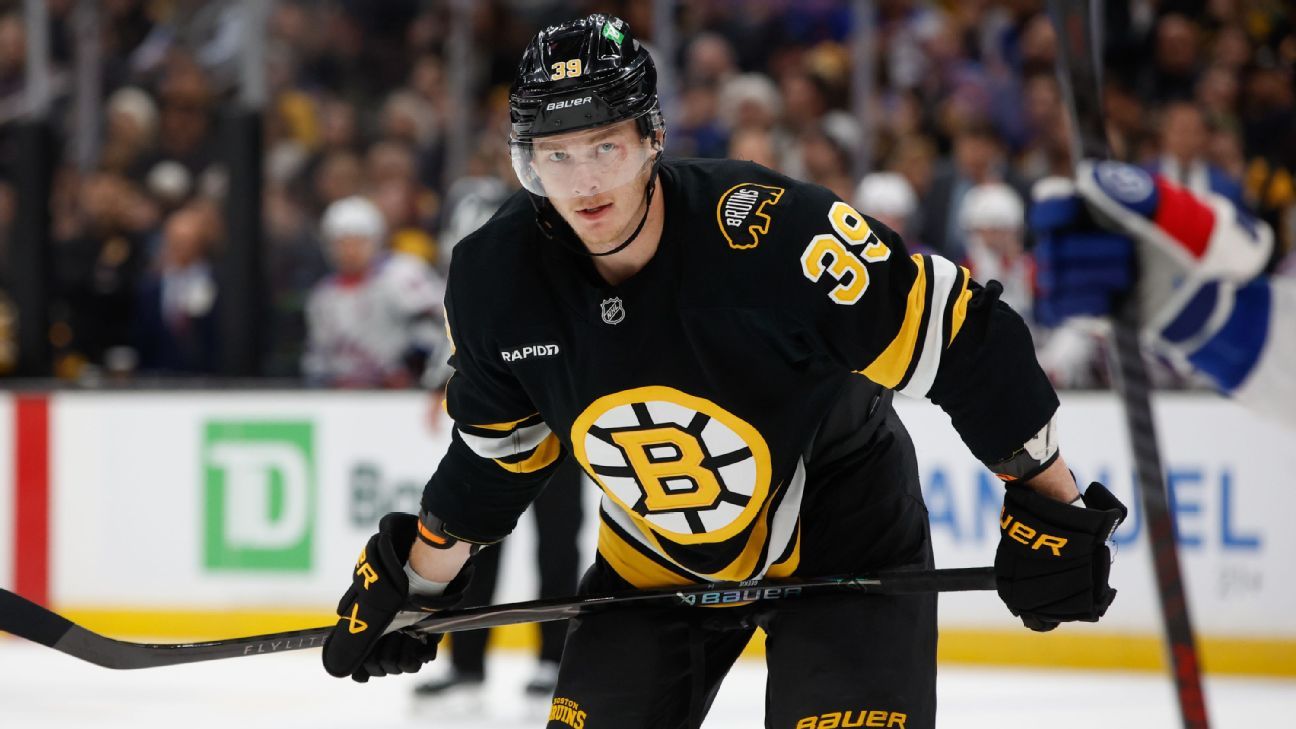
Boston Bruins forward Morgan Geekie can finish a Rubik’s Cube in under a minute.
“I mean, right now I’d be pretty rusty,” he said. “I’m not insane, like those kids that you see on TV, but I’m pretty good at them.”
When Geekie was around 10 years old, a cousin taught him how to speed solve the puzzle. While some have never found a way to line up that mosaic of colors despite years of trying, Geekie said it’s doable once one cracks the code. One summer at their lake cottage, his cousin wrote down its patterns. Geekie spent two weeks memorizing them and working out solutions while fiddling with the cube.
“It’s basically just all algorithms. You just do the same moves all the time once you get the pieces in the right spot. Once you do that, I mean, it’s pretty cut and dry. Everything goes in order,” he said. “I haven’t really forgot. It’s just one of those things that once you know it, you know it.”
Perhaps Geekie just knows how to score goals now, too.
That’s the simplest rationalization for the 27-year-old’s unexpected transformation into one of the NHL’s premier goal scorers. Through 34 games, Geekie is second in the NHL with 24 goals, trailing only the dominant Nathan MacKinnon of the Colorado Avalanche (28). Going back to the start of last season, Geekie is tied for 11th in goals scored (57).
Geekie scored 33 goals in 2024-25, which is 16 more than his previous career high set two years ago with the Bruins. He shot 22%, which obliterated his previous career best of 13.1% set in 2023-24.
There’s always an offensive player whose unexpected scoring surge in one season makes him the consensus choice for regression the following season. Entering this season, that player was Geekie.
He was the first player listed on ESPN’s rundown of regression candidates, with the expectation that he would top out at 26 goals. Sports Illustrated did the same thing, writing that his “offensive numbers are set to dip next season.” Daily Faceoff wrote that Geekie’s shooting percentage was “a strong indication that his performance isn’t sustainable, at least at this level” for the Bruins.
Geekie gets it. He called the predictions “a fair statement” given that he was scoring less than 10 goals in a season with the Seattle Kraken just a few seasons ago.
“I see it all. It’s an easy cherry to pick to be like, ‘Obviously he’s shooting 22%, it’s going to go down.’ It didn’t bother me at all,” Geekie said.
Rather than regress, Geekie has progressed this season. Through 34 games, he is shooting 28.2%.
“I mean, it’s got to go down at some point,” he said, with a laugh. “Like I said, I don’t really pay attention to that and I’m not somebody that has 10 shots a game, so I just try to make the most of my opportunities when I get the puck.”
GEEKIE IS AMUSED by the focus on his shooting percentage, because he feels there are easy explanations for it. The first is that he doesn’t believe he shoots the puck all that much. Over the past two seasons, David Pastrnak averaged 3.79 shots per game in 110 games. Geekie averaged 2.11 in that same span. Only Sidney Crosby (2.45 shots per game) has a lower average than Geekie (2.48) among the top 10 goal-scorers this season.
“I feel like I’m a big quality over quantity person,” he said.
His first season in Boston, coach Jim Montgomery stressed the need for Geekie to get chances from deep inside the attacking zone.
“I think a high-danger chance is better than just shooting it from the wall. That’s kind of the mentality that I’ve had always. I’m not trying to waste shots that aren’t good for anybody,” Geekie said. “Unless I’m trying to create something off it, I’m honestly not trying to put it on net. Maybe that’s why I end up where I end up.”
Pastrnak recently said the Bruins were reminding Geekie to shoot the puck more often. In fairness, Geekie is shooting more this season. Pastrnak said Geekie is “definitely trying to be a little more selfish to take them” when he fights into high-danger areas of the ice. But Geekie acknowledged there are sometimes philosophical differences between his striving for quality over his team’s desire for quantity.
“I think it’s a push and pull,” he said. “It’s like, I don’t think I need to be shooting this, but other people think that it still gives us an opportunity to create a chance. So I just try to keep that in mind when I have the puck”
This is Geekie’s seventh season in the NHL. He was selected by the Carolina Hurricanes with the 67th pick in the 2017 draft as a goal-scoring forward with the WHL Tri-City Americans. His first two seasons as a pro were mostly spent in the AHL with the Charlotte Checkers, before playing 36 games with the Hurricanes in 2020-21.
That summer, the Seattle Kraken held their expansion draft as the NHL’s newest team. Geekie was left off Carolina’s protected list. At the time, it wasn’t expected that former Hurricanes GM Ron Francis would select him for the Kraken, with options like defenseman Jake Bean and forward Nino Niederreiter available from Carolina. But Geekie was the choice, a player whom Francis had drafted while with the Canes.
Geekie had 22 points in 73 games in his first season in Seattle, skating 12:36 per game with just seven goals. His second campaign saw him jump to 28 points in 69 games, but with even less ice time (10:27).
He was a restricted free agent after the 2022-23 season. Francis attempted to re-sign him before the deadline for submitting qualifying offers, but Geekie and his representatives declined it. The two sides couldn’t find common ground. Rather than go to arbitration, where the Kraken weren’t keen on Geekie potentially setting the terms of his next deal, they chose not to qualify him, making him an unrestricted free agent.
“With Morgan, we did make what I felt was a pretty fair offer,” Francis said at the time, via Sound of Hockey. “It didn’t work out, and he has the right once we don’t qualify him to go elsewhere.”
And so he went to Boston, signing a two-year deal worth $4 million in total.
While he wasn’t seeing much time with the Kraken, Geekie felt he was improving as a player. He said a “integral part” of that development was thanks to Jonathan Sigalet, a skills coach who improved all facets of his game.
“When I first started working with him, he was adamant that he wasn’t going to try and make me play like I’m on the first line,” Geekie recalled. “He said, ‘We both know that trying to do things that you do on the first line on the fourth line is going to get you in the press box.'”
He said working with Siglet slowed the game down for him. He started to see the game differently. He began to see “little tendencies” that all of the NHL’s good players share. Geekie also appreciated having a “third party” assessment for his play, apart from that of his coaches and his own.
Geekie was immediately given an opportunity to thrive in Boston in 2023-24, playing 15:21 in his first game with the Bruins. He ended up averaging 15:25 per game, with 17 goals and 22 assists in 76 games. He earned time with Pastrnak and Pavel Zacha on the Bruins’ top line.
His follow-up season didn’t start well. Geekie scored one goal in his first 17 games and was a healthy scratch early in the season. Some trade whispers started about him as a pending restricted free agent. He had eight goals by the end of the 2024 calendar year.
How did he end up with 33 of them? With one of the greatest goal-scoring heaters this side of Alex Ovechkin: Geekie scored 14 goals in his last 20 games of the season. His chemistry with Pastrnak was undeniable — the Bruins scoring ace assisted on 21 of Geekie’s 33 goals last season.
Geekie expressed a desire to stay with the Bruins. The feeling was mutual, as GM Don Sweeney in June handed him a six-year, $33 million contract for a team-friendly $5.5 million annual cap hit.
WHEN GEEKIE SIGNED his new contract, he decided he wanted to join in the tradition of NHL players celebrating a windfall with their teammates. It’s usually a dinner or something of that nature.
But Geekie wanted to do something different.
“Everybody’s eating at the same restaurants in every city. And I’m sure they’d remember it for a little while, but I think it would be just one of those things like, ‘Hey, thanks for dinner.’ So I wanted to do something a little more nostalgic,” he said.
Geekie is a huge baseball fan who played competitively until his late teens. He was in the process of designing a personalized baseball glove for himself through a company called 44 Pro Custom Gloves when his wife, Emma, suggested that he design ones for all of his teammates as a gift.
Geekie started the process in July, sketching out what he wanted on the gloves for 30 teammates — including players that were on the bubble for the Bruins’ roster this season. He had the biographical information for them, from their birth cities and countries to their schools to where they played junior hockey.
“Honestly, for probably three weeks, I just sat in front of my TV watching baseball and I would just draft gloves up. I thought it was so fun,” Geekie said. “My wife got sick of me for a little while.”
He would FaceTime his brother Noah, a coach at Okotoks Dawgs Academy in Alberta, to bounce the designs off him and get input. He was cognizant of having the designs as unique as possible, despite some of the school colors being similar for his teammates.
Before a practice in October, Geekie delivered the gloves to the locker room stalls of his teammates. It went over well.
“Baseball is not that big in Sweden, but it’s obviously cool to have,” center Elias Lindholm told the Bruins website, having received a glove with a Swedish flag on it. “Hopefully, when my kids get a little bit older, we can play a little game or something. For now, it is just going to be at home, resting.”
0:17
Morgan Geekie nets goal for Bruins
Morgan Geekie nets goal for Bruins
While the gloves were a chance to celebrate with his teammates, there weren’t many celebrations anticipated for Boston this season. The Bruins were trading players away at last season’s trade deadline, sending mainstays like captain Brad Marchand (Florida), center Charlie Coyle (Colorado) and defenseman Brandon Carlo (Toronto) elsewhere. They had an incoming first-year coach in Marco Sturm. At best, it was supposed to be a transition year for the Bruins.
But through 34 games, Boston is second in the Atlantic Division with a 20-14-0 record, within a point of division-leading Detroit in the crowded Eastern Conference.
Many around the NHL were surprised. Geekie wasn’t.
“We underperformed. Last season was like the perfect storm of bad events with our kind of discombobulated training camp and then having a coaching change and just kind of everything that could have went wrong went wrong,” Geekie said. “The core group we have is just too good to be written off. But I understand why people had doubts about us.”
But defying doubts is what Morgan Geekie’s all about, whether it’s his team’s predicted finish in the standings or his own predicted regression as a scorer.
“He has everything to score 50 in this league,” Pastrnak said. “He has a heck of a shot. He has the goal-scoring instincts. He is going to get it one day.”
-
 Sports2 years ago
Story injured on diving stop, exits Red Sox game
-
 Sports3 years ago
‘Storybook stuff’: Inside the night Bryce Harper sent the Phillies to the World Series
-
 Sports2 years ago
Game 1 of WS least-watched in recorded history
-
 Sports3 years ago
Button battles heat exhaustion in NASCAR debut
-
 Sports3 years ago
MLB Rank 2023: Ranking baseball’s top 100 players
-
Sports4 years ago
Team Europe easily wins 4th straight Laver Cup
-
 Environment3 years ago
Japan and South Korea have a lot at stake in a free and open South China Sea
-
 Environment1 year ago
Here are the best electric bikes you can buy at every price level in October 2024