
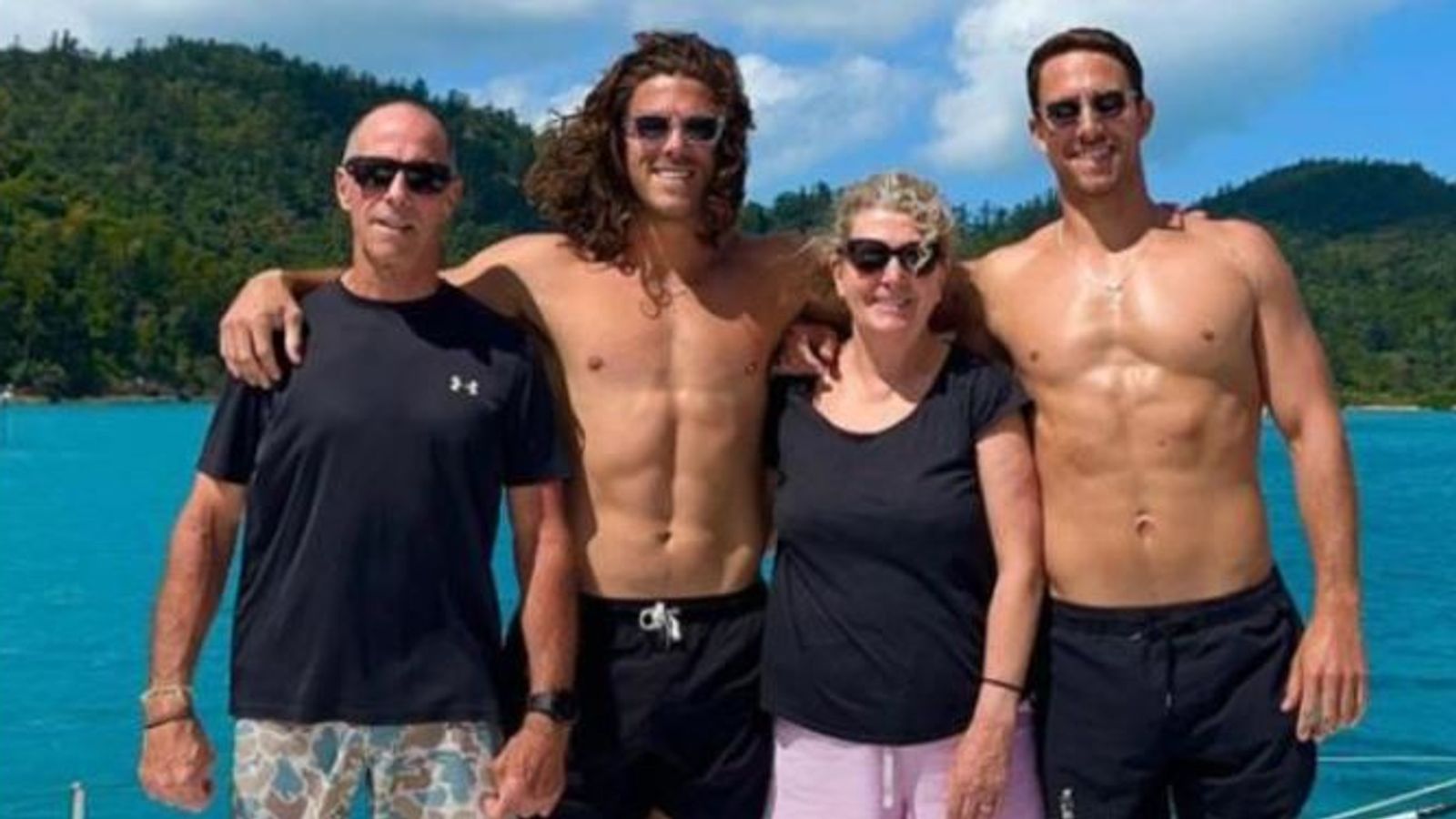
Australian brothers and US tourist who went missing on surfing trip in Mexico ‘shot dead by thieves’


Two Australian brothers and a US tourist who went missing in Mexico were shot dead by thieves who wanted their truck’s tyres, according to prosecutors.
Relatives of Jake and Callum Robinson and Jack Carter Rhoad have identified the three bodies.
They were dumped in a remote 15m-deep (50ft) well.
American Jack Carter Rhoad was travelling with the brothers
The trio went missing a week ago while on a surfing trip near the northern city of Ensenada – not far from the US border – and had posted photos on social media of isolated beaches.
Thieves likely saw their truck and tents and wanted their tyres but the men probably resisted, said prosecutor María Elena Andrade Ramírez.
She said the bodies were taken to “a site that is extremely hard to get to” in Baja California state.
The well, near where their truck and tent were found on Thursday, also contained a fourth body that had been there much longer.
It took two hours to winch the bodies out, said Ms Andrade Ramírez.
She said the same thieves may also have dumped the fourth body there.
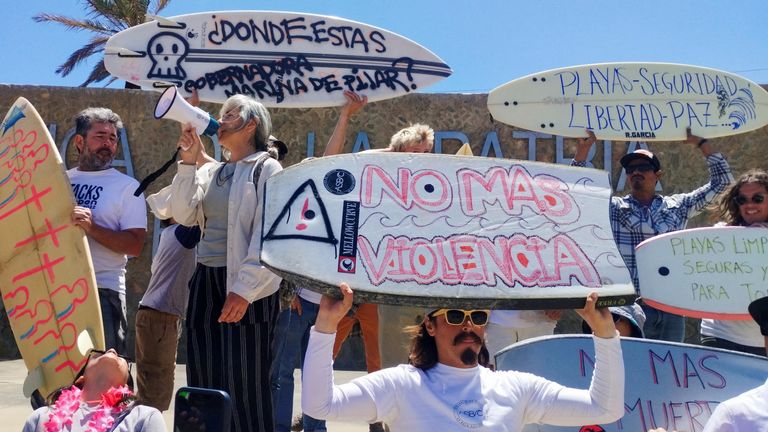
Surfers protested over what they say is a lack of safety in the area. Pic: Reuters
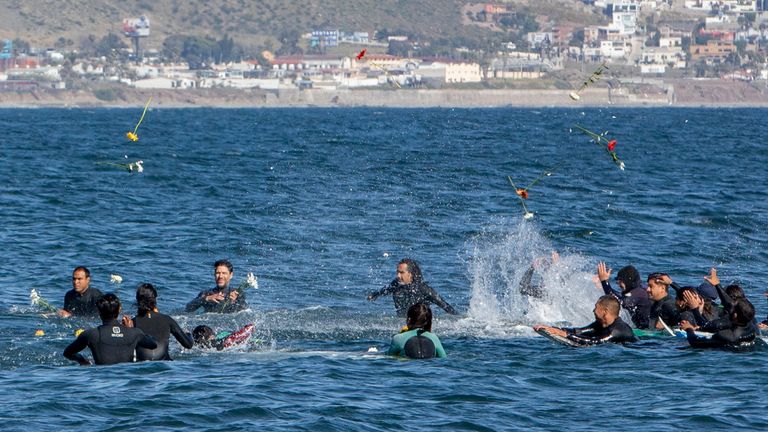
Surfers near Ensenada threw flowers into the sea in a tribute to the men. Pic: AP
Read more:
Police shoot boy dead in car park after possible terror stabbing
Brazil flooding death toll rises to 75
Three men are being questioned over the killings.
After the bodies were found, surfers gathered in Ensenada, the nearest city, to protest at what they say is a lack of safety in the state.
“They only wanted to surf – we demand safe beaches,” said a sign held by one woman.
Some of them later took part in a ‘paddle-out’ ceremony in remembrance of the three men, forming a circle with their boards in the sea and throwing flowers.
In a Facebook message last week, Jake and Callum’s mother said she hadn’t been in touch with them since 27 April.
The post, on 1 May, said they were meant to check into an Airbnb in the resort town of Rosarito but “did not show up”.
Australian media reported Callum had been living in the US to try to become a professional lacrosse player, while his brother had only flown out to visit him two weeks ago.
World
Egypt and Iran complain to FIFA after World Cup match scheduled to coincide with Seattle Pride event

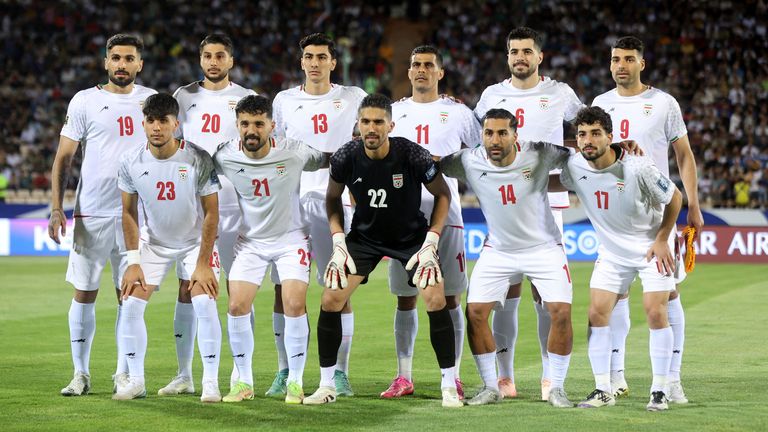
Iran and Egypt have complained after FIFA scheduled a World Cup match between the two nations in Seattle to coincide with the city’s LGBTQ+ Pride festival.
Seattle’s PrideFest 2026, which organisers say regularly sees more than 200,000 participants, takes place on 27 and 28 June – immediately following the match.
Local organisers have said the 26 June game at the Seattle Stadium will include a “once-in-a-lifetime moment to showcase and celebrate LGBTQIA+ communities in Washington”.
Iran players pose for a team group photo before a match against North Korea in June 2025. Pic: Reuters
In Iran, where gay couples can face the death penalty, the president of Iran’s Football Federation, Mehdi Taj, condemned the decision to use Seattle as a venue and the timing of the match.
Mr Taj told Iranian state TV: “Both Egypt and we have objected, because this is an unreasonable and illogical move that essentially signals support for a particular group, and we must definitely address this point.”
He said Iran would bring up the issue at a FIFA Council meeting in Qatar next week.
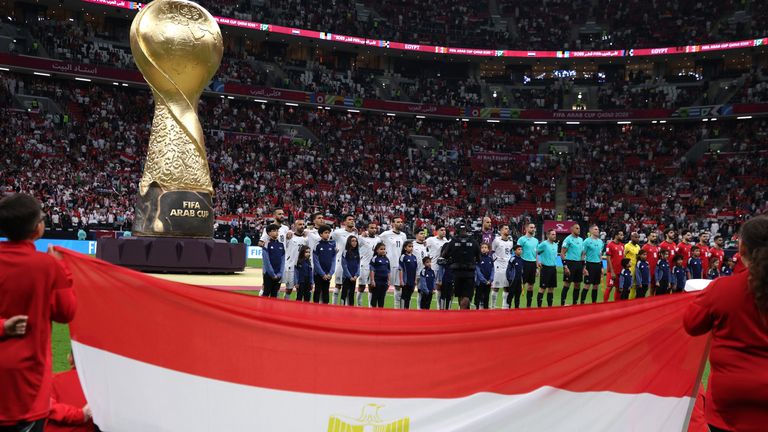
The Egypt players line up during the national anthems before the match against Jordan. Pic: Reuters
The football federation in Egypt, where Human Rights Watch says people from LGBTQ+ communities face persecution, said in a statement that it had written to FIFA “categorically rejecting any activities related to supporting homosexuality during the match between the Egyptian national team and Iran.”
The letter also stated: “Information had circulated indicating the local organising committee’s decision and plans to hold some activities related to supporting homosexuality during that match” and the federation “completely rejects such activities, which directly contradict the cultural, religious and social values in the region, especially in Arab and Islamic societies”.
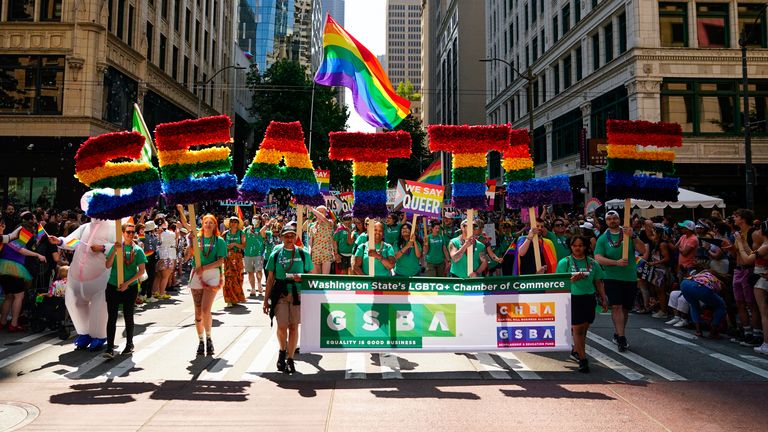
The Seattle Pride festival takes place in late June, attracting hundreds of thousands of people every year, like in 2023. File pic: AP
In Seattle, the local organising committee said it was “moving forward as planned with our community programming outside the stadium during Pride weekend and throughout the tournament,” having already promoted an art contest ahead of the match.
Read more:
Man charged with racially abusing Antoine Semenyo
Steven Hutton: Three men and one woman jailed over ‘frenzied’ Dundee murder
It added: “We get to show the world that in Seattle, everyone is welcome.”
Seattle PrideFest has been organised in the city since 2007 by a nonprofit group which designated the 26 June match for celebration before FIFA carried out the World Cup draw on Friday.
On Saturday, FIFA announced the Egypt-Iran game had been allocated to Seattle instead of Vancouver, where the teams’ group rivals Belgium and New Zealand will play at the same time.
FIFA has been asked for a comment.


Iceland has announced it is boycotting next year’s Eurovision over Israel’s participation in the competition, saying taking part would “neither be a source of joy nor peace”.
The announcement from Iceland‘s RUV follows withdrawals by broadcasters from the Netherlands, Spain, Ireland and Slovenia.
In a statement, RUV said participation of Israeli national broadcaster KAN had “created disunity” among members of the European Broadcasting Union (EBU), which organises Eurovision, and the general public.
Israel‘s place in the contest was confirmed at the EBU’s general assembly last week.
Yuval Raphael represented Israel at this year’s competition in Switzerland. Pic: Reuters/ Denis Balibouse
The past two events have attracted protests and fan boycotts over Israel’s inclusion amid the country’s military action in Gaza. This year, there were also allegations that voting had been manipulated in favour of their contestant.
After growing criticism, members were asked to vote in a secret ballot last week, on whether they were happy with tougher new rules introduced in November, or whether they wanted a second vote on participation for 2026.
The majority agreed the changes were enough, although Sky News understands 11 countries were against accepting these without a further vote.
Dutch broadcaster AVROTROS, Spain’s RTVE, Ireland’s RTE and Slovenia’s RTV immediately issued statements announcing their withdrawal.
Becoming the fifth broadcaster to pull out, RUV made the announcement following a board meeting. It said that while the new rules address many of the concerns it has raised, it believes there are “still doubts” about whether the changes are enough.

Spain, represented by Melody earlier this year, is among the countries boycotting the event. Pic: REUTERS/Denis Balibouse
“RUV has repeadly raised concerns that various Icelandic stakeholders, such as artist associations and the general public, were opposed to participation in the contest,” the statement said. “Furthermore, RUV had requested the EBU to exclude KAN from the contest in accordance to precedents.
“It is a complex matter which has already damaged the contest’s reputation and EBU, emphasising the necessity of a solution for all concerned parties.”
Austria, which will host next year’s show, last week said it was pleased to see Israel allowed to participate. Roland Weissmann, director-general for Austrian broadcaster ORF, said the contest was a “competition for broadcasters, not governments”.

Remember Monday represented the UK in 2025. The BBC has said it supports the EBU vote decision. Pic: MANDOGA MEDIA/picture-alliance/dpa/AP
The BBC, which broadcasts Eurovision in the UK, also said it supported the decision.
Earlier on Wednesday, Poland’s TVP confirmed its participation.
In a statement, the broadcaster said it was aware of the scale of the tension surrounding the competition and understood the emotions and concerns raised.
“However, we believe that Eurovision still has a chance to once again become a space filled with music. And only music,” a TVP statetment said.
Despite some pressure from the cultural union in Belgium for a boycott, broadcaster RTBF also confirmed its participation last week.
But the walk-outs cast a shadow over what is meant to be a celebration of the unifying power of music.
Countries have pulled out or been banned in previous years – most notably Russia in 2022, just days after the invasion of Ukraine – but this is perhap’s Eurovision’s biggest political crisis.
Noa Kirel, who represented Israel in 2023, told Sky News in an interview in October that while the situation now is “very different” to when she took part in May of that year, she believes it should not be about politics and must “focus on the music”.
Wednesday marked the final day for national broadcasters to announce whether they plan to participate next year.
The EBU says a final list of competing nations will be published before Christmas.
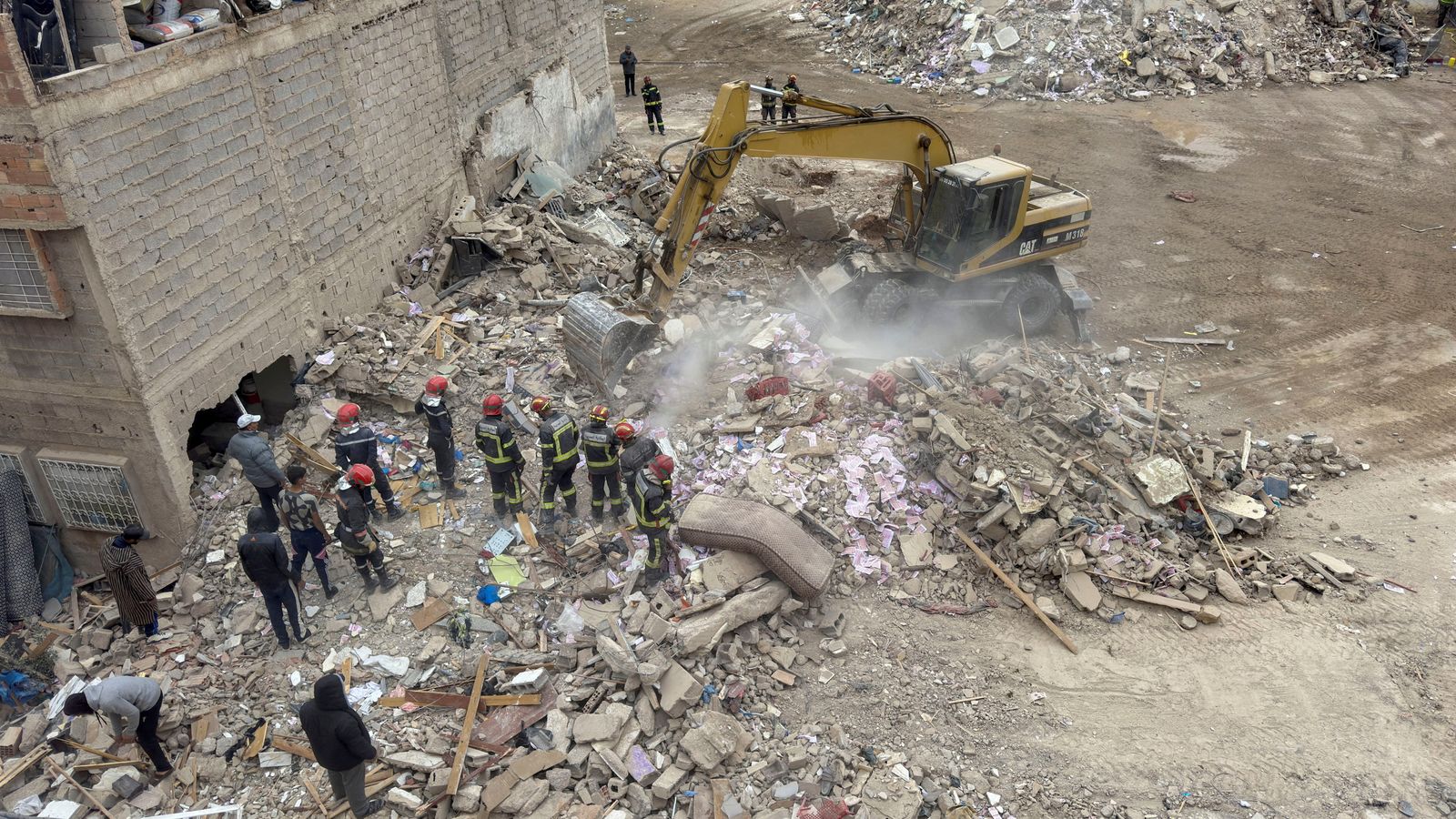
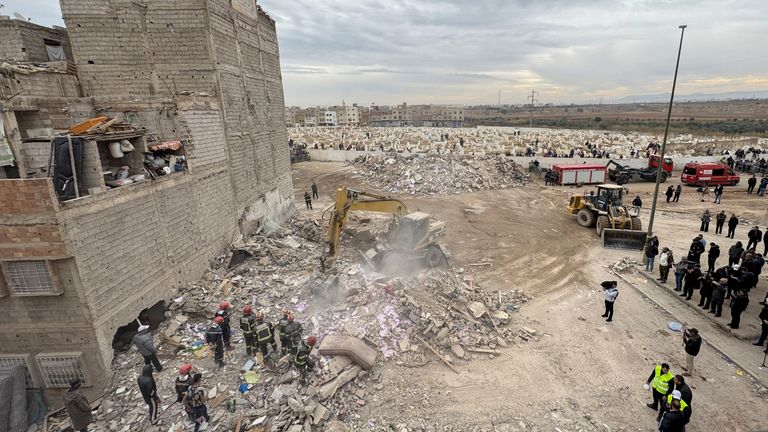
At least 22 people are dead and more than a dozen injured after a double building collapse in Morocco.
The disaster in Fez unfolded while one building was hosting an Aqiqah, a traditional Muslim celebration marking the birth of a child.
This building was home to eight families, the local authorities said, while the other was unoccupied.
Pic: Reuters
A survivor, who lost his wife and three children in the overnight collapse, told a local TV station that rescuers had only been able to retrieve one body.
Another survivor, interviewed by SNRT News, Morocco’s national broadcaster, said: “My son who lives upstairs told me the building is coming down.”
She added: “When we went out, we saw the building collapsing.”
Witnesses said the buildings had shown signs of cracking for some time, when interviewed at the scene by SRNT.
Both buildings, in the Al-Mustaqbal neighbourhood, were four-storeys high.
Announcing an investigation, the Fez prosecutor said 16 people had also been injured, citing preliminary figures.
Some 38,800 buildings across the country are classified as being at risk of collapse, according to Adib Ben Ibrahim, housing secretary of state.
The latest collapse is one of the worst in Morocco since a minaret fell in the historic northern city of Meknes, killing 41 people in 2010.
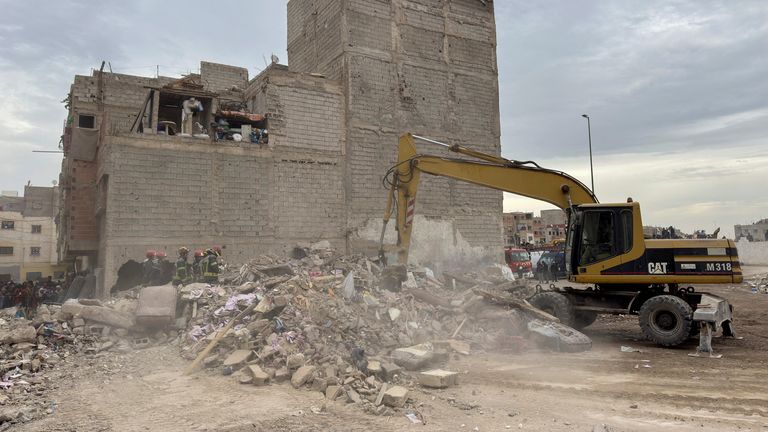
Pic: Reuters
Fez, a former Moroccan capital, is the country’s third most-populous city, as well as one of its oldest, dating back to the eighth century.
But deteriorating living conditions, and poor public services, sparked a wave of anti-government protests there, and in other cities, two months ago.
Read more:
Hundreds injured as Morocco youth protests turn violent
Miliband shuns £25bn UK-Morocco renewable energy project
The unrest, which was driven by younger Moroccans, revealed deep-seated anger over poverty and public services.
It comes at a time when the government is pushing ahead with ambitious infrastructure projects, including modern stadiums, ahead of the 2030 FIFA World Cup.
Fez, one of the host cities, has some of the country’s poorest neighbourhoods.
-
 Sports2 years ago
Story injured on diving stop, exits Red Sox game
-
 Sports3 years ago
‘Storybook stuff’: Inside the night Bryce Harper sent the Phillies to the World Series
-
 Sports2 years ago
Game 1 of WS least-watched in recorded history
-
 Sports3 years ago
Button battles heat exhaustion in NASCAR debut
-
 Sports3 years ago
MLB Rank 2023: Ranking baseball’s top 100 players
-
Sports4 years ago
Team Europe easily wins 4th straight Laver Cup
-
 Environment3 years ago
Japan and South Korea have a lot at stake in a free and open South China Sea
-
 Environment1 year ago
Here are the best electric bikes you can buy at every price level in October 2024